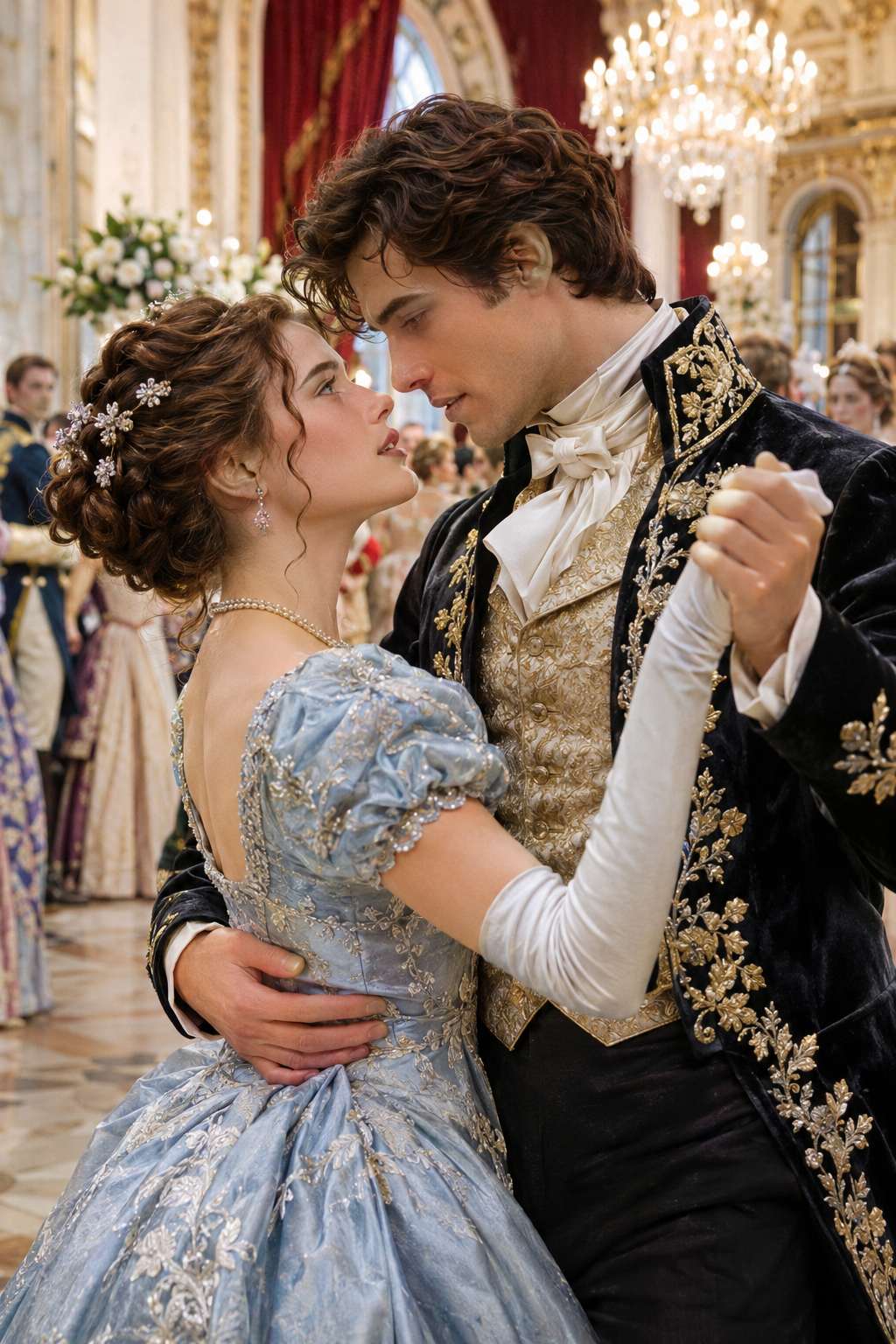
The entire ballroom knew Alina Whitmore was engaged to the Duke of Ashkcom before she even realized he had proposed.
The question hung between them while the garden continued its pleasant afternoon rituals. Somewhere behind Alina, a woman laughed. A servant passed carrying a silver tray of lemonade. Beyond the terrace, sunlight rested upon the roses as though nothing extraordinary had occurred.
Gabriel stared at the document in her hand.
“Alina,” he said quietly, “there are things I have been trying to understand myself.”
“Then perhaps you should have allowed me to help.”
Mr. Vale adjusted his gloves, watching them with the faint satisfaction of a man who had successfully disturbed an otherwise peaceful gathering.
“How touching,” he murmured. “A misunderstanding between two devoted families.”
Gabriel turned toward him.
“You have delivered your message. Leave.”
“Certainly, Your Grace. Though I would advise against destroying that document. Copies have a remarkable habit of finding their way into unexpected hands.”
He bowed and departed, his silver-headed walking stick striking the gravel at measured intervals.
Alina watched him disappear through the garden gate. Only then did she turn back toward Gabriel.
“Is the signature genuine?”
“I don’t know.”
“Did you know my father was involved?”
Gabriel hesitated.
That hesitation told her more than his answer.
“I discovered his name three days ago.”
“Three days.”
“I intended to speak to you.”
“When? After the wedding?”
His face tightened.
“There was never supposed to be a wedding.”
The words landed between them with a force neither had anticipated.
Alina lowered her eyes to the document. She knew their engagement had been an arrangement, a temporary performance designed to protect them both. Yet hearing him dismiss the possibility so easily brought an unexpected ache.
“Of course,” she replied.
Gabriel reached for her, but she stepped away.
“Please have your carriage take me home.”
“Let me explain.”
“You have had three days to explain.”
She returned the document to him, careful not to touch his fingers.
For a moment, he seemed prepared to abandon every rule of propriety and follow her across the crowded terrace. Instead, he stood motionless as she walked away.
By evening, half of London had heard that the Duke of Ashkcom and his intended bride had quarreled at Lady Pembroke’s luncheon.
By morning, the rumors had grown considerably more imaginative.
Some claimed Alina had discovered another woman. Others insisted the duke had secretly lost his fortune. One particularly inventive account suggested that Miss Whitmore had demanded the Ashkcom diamonds before agreeing to proceed with the marriage.
Alina read none of them.
She sat in her father’s former study, surrounded by shelves that still carried the faint scent of leather, dust, and the lavender polish he had favored.
Edmund Whitmore had been dead for six years.
During those years, Alina had preserved his letters, organized his books, and carefully avoided disturbing the locked cabinet beneath his writing desk.
Now she held its small brass key.
Her mother had given it to her after the funeral, explaining that Edmund had requested the cabinet remain closed until Alina was ready to manage the family’s remaining affairs.
At nineteen, she had not been ready.
At twenty-five, she was beginning to suspect that readiness was a luxury she could no longer afford.
The lock resisted before turning with a sharp click.
Inside were account books, bundles of correspondence, and a narrow wooden box tied with faded green ribbon.
Alina opened the box first.
There was a miniature portrait of her mother, a pressed violet, and a letter addressed to her in her father’s familiar handwriting.
She unfolded it carefully.
“My dearest Alina,
If you are reading this, I have failed to explain certain decisions while I still had the opportunity. You will hear that I was careless with money, perhaps even dishonest. I ask only that you examine the evidence before believing either accusation.”
Alina stopped.
She had never heard anyone accuse her father of dishonesty.
His business had suffered shortly before his death, certainly, but her mother had always attributed their reduced circumstances to unfortunate investments.
She continued reading.
“The late Duke of Ashkcom was once my closest friend. I trusted him with matters I should have examined more carefully. When I discovered what had been done in our names, I attempted to correct it. I was not successful.”
A faint sound escaped her.
She turned the page.
“If the matter should ever return, seek out Nathaniel Bell, formerly of Bell and Harcourt Solicitors. He knows where the original agreements were deposited. Trust no document bearing my signature unless it can be compared with the originals.”
The letter ended with a brief expression of affection.
Alina read it twice.
Then she reached for the account books.
By the time her maid arrived with supper, the candles had burned low and Alina had discovered that her father’s final business transactions involved several enormous transfers to a company called the Westbridge Trading Consortium.
The company had ceased operating shortly after his death.
Its principal investor had been the former Duke of Ashkcom.
And its managing secretary had been a man named Frederick Vale.
Alina stared at the name.
Outside, rain began falling against the windows.
At Ashkcom House, Gabriel had not slept.
He stood in the library examining the same financial records his father’s solicitor had repeatedly assured him were beyond recovery.
The estate was heavily mortgaged. Several tenants had gone years without necessary repairs. His younger sister’s marriage settlement remained unpaid, and his mother’s modest household allowance depended upon income that no longer existed.
Gabriel had inherited a title, a magnificent house, and enough debt to destroy both.
For nearly four years, he had negotiated with creditors, sold distant properties, reduced household expenses, and quietly supported the families whose livelihoods depended upon the estate.
He had accepted invitations he despised because influential acquaintances sometimes extended financial favors.
He had smiled through conversations about his supposed wealth while calculating whether he could afford to replace a leaking roof.
And then Alina Whitmore had appeared at his ball, demanding a dance with the expression of a woman escaping a particularly determined hunter.
He remembered how she had looked at him without calculation.
How she had laughed when he questioned her motives.
How she had treated him, for one remarkable evening, as an ordinary man.
He had wanted to preserve that innocence.
Instead, he had made her another participant in the elaborate deception surrounding his family.
A knock interrupted his thoughts.
His steward entered carrying a sealed letter.
“From Mr. Vale, Your Grace.”
Gabriel broke the seal.
The message contained only three sentences.
The outstanding obligation must be settled within fourteen days. The Whitmore collateral will be considered recoverable property. Failure to comply will result in public disclosure of all associated agreements.
Gabriel read the letter again.
The Whitmore collateral.
He had assumed the debt threatened only his inheritance.
Now he understood why Vale had deliberately approached Alina.
The man intended to seize whatever remained of her father’s estate.
Gabriel summoned his solicitor immediately.
The following morning, Alina arrived at the offices of Bell and Harcourt shortly after nine.
The establishment occupied a narrow building near Lincoln’s Inn, its windows overlooking a street crowded with clerks, messengers, and carriages.
An elderly gentleman received her in a room lined with shelves of legal volumes.
Nathaniel Bell had silver hair, tired eyes, and hands that trembled slightly as he examined her father’s letter.
“I wondered whether this day would come,” he said.
“Then you know why I am here.”
“I believe so.”
He removed his spectacles.
“Your father was an honorable man, Miss Whitmore. Unfortunately, honorable men sometimes assume others possess the same principles.”
Alina sat opposite him.
“Tell me what happened.”
Bell hesitated before unlocking a drawer.
“Your father and the former duke invested in a trading venture that promised substantial returns. For a time, the enterprise prospered. Then money began disappearing.”
“Who took it?”
“We suspected the managing secretary, Frederick Vale. But the accounts were complicated, and the duke refused to permit a proper investigation.”
“Why?”
“Because he had authorized several transactions without understanding their purpose. Public exposure would have ruined him.”
Bell placed a ledger on the desk.
“Your father attempted to withdraw from the arrangement. Shortly afterward, he discovered that additional loans had been obtained using his name.”
Alina looked up sharply.
“Without his permission?”
“That was his allegation.”
“Was it true?”
“I believe it was.”
“Then why was nothing done?”
Bell’s expression grew grave.
“Because the original documents disappeared before we could bring the matter before the authorities. Your father became ill soon afterward. By the time he died, the evidence had vanished.”
Alina remembered the document Vale had shown her.
“My father’s signature appears on a debt that is still outstanding.”
“Then someone has preserved the false agreements.”
“Can they be challenged?”
“Certainly. But we must prove they were falsified.”
Bell opened another drawer and withdrew a small packet.
“Your father left me several authenticated samples of his signature. He also deposited a statement describing the irregularities. I have kept them for six years.”
Alina took the packet.
“Why did you never contact us?”
“Your mother wished to avoid further scandal. And without the original disputed agreements, I could do very little.”
Alina stood.
“Then we must find them.”
Bell studied her.
“You understand that pursuing this may expose your father’s business affairs to public examination?”
“Yes.”
“And the Ashkcom family may suffer considerable embarrassment.”
Alina thought of Gabriel standing alone on the terrace, his face pale beneath the afternoon sunlight.
“I understand that as well.”
Bell inclined his head.
“Then perhaps we should begin.”
Three days later, Gabriel received an unexpected visitor.
Alina entered his library carrying a leather portfolio.
He rose immediately.
“I was beginning to think you would never speak to me again.”
“I considered it.”
The corner of his mouth moved, but she did not smile.
She placed the portfolio upon his desk.
“I have found evidence that my father’s signature was used without his consent.”
Gabriel looked at the papers.
“Where did you obtain these?”
“From his solicitor.”
He examined the documents in silence.
As he read, his expression changed from concentration to disbelief.
“Vale,” he said.
“Yes.”
“My father trusted him completely.”
“So did mine, apparently. That was their mistake.”
Gabriel lowered himself into his chair.
For several moments, he said nothing.
Then he looked at Alina.
“Why are you helping me?”
She met his gaze.
“Because the truth belongs to both our families.”
“That isn’t what I meant.”
“I know.”
He rose slowly.
“Alina, I have been unfair to you.”
“You have been frightened.”
“That does not excuse it.”
“No.”
He accepted the answer without protest.
She watched him move toward the window, where winter sunlight illuminated the worn fabric of the curtains.
“I believed that if I could settle the debts quietly, my mother and sister would never discover how close we came to losing everything,” he said.
“And what would happen to you?”
He gave a small, humorless smile.
“I hadn’t considered that particularly important.”
Alina crossed the room.
“Then perhaps someone should.”
He turned.
Their eyes met, and for a moment neither spoke.
Gabriel lifted his hand, brushing a loose strand of hair away from her cheek.
The gesture was so gentle that Alina almost leaned into it.
Almost.
Then she remembered the agreement.
“No unnecessary intimacy,” she whispered.
His hand fell.
“I remember.”
Yet the distance between them had become increasingly difficult to maintain.
Over the following week, they worked together with Nathaniel Bell and Gabriel’s solicitor, examining ledgers, comparing signatures, and tracing transactions through long-defunct commercial accounts.
They discovered that Vale had transferred enormous sums into private holdings under several different names.
The money had not disappeared through unfortunate trading ventures.
It had been systematically stolen.
But one crucial problem remained.
The original loan agreements were missing.
Without them, Vale could claim that the disputed signatures were genuine and that the surviving records were incomplete.
Then Gabriel’s mother made an unexpected revelation.
The Dowager Duchess of Ashkcom had spent years avoiding discussions of her late husband’s financial affairs.
She had known his investments were disastrous, but she had never understood their full extent.
When Gabriel finally explained what they had discovered, she listened without interruption.
Then she rose and crossed to a small cabinet.
“Your father kept certain papers away from his secretary,” she said.
Gabriel looked up.
“What papers?”
“He called them his private assurances.”
She removed a narrow ivory key from a velvet-lined drawer.
“There is a compartment beneath the writing table in his old study. I found it after his death, but I could never bring myself to open it.”
Gabriel stared at the key.
His father had died four years earlier.
For four years, the answer might have been resting only a few rooms away.
They went to the study together.
The compartment opened beneath a carved panel.
Inside lay a leather-bound journal, several sealed envelopes, and a packet of documents tied with black ribbon.
Gabriel opened the packet.
His father’s handwriting covered the first page.
“I have permitted Frederick Vale to conduct transactions I no longer understand. Edmund Whitmore believes our signatures have been misused. I fear he is correct.”
Gabriel continued reading.
The former duke had discovered the fraud shortly before Edmund’s death.
But rather than expose Vale, he had attempted to negotiate privately, terrified that the scandal would destroy his family.
Vale had threatened to reveal the duke’s own negligence.
The duke had surrendered more money.
Then more.
And finally, he had signed an agreement acknowledging debts that did not belong to him.
Gabriel closed his eyes.
His father had not merely been deceived.
He had helped preserve the deception.
Alina stood beside him, reading the final page.
There, in trembling handwriting, the former duke had written:
“Edmund was right. I should have listened before it was too late.”
Gabriel lowered the journal.
“I spent years trying to protect his reputation.”
Alina touched his sleeve.
“Perhaps protecting his reputation was never the same as protecting his memory.”
He looked at her.
She continued quietly.
“You can love someone and still acknowledge the harm they caused.”
For a long moment, Gabriel studied the journal.
Then he nodded.
“We take everything to Bell.”
Their plan might have succeeded quietly had Vale not learned of the discovery.
Two nights later, a fire broke out in the old estate office.
The building stood beyond the main courtyard and contained decades of household accounts, tenancy agreements, and correspondence.
Gabriel was awakened by shouting.
He reached the courtyard as flames climbed the eastern wall.
Servants carried buckets from the well while smoke rolled beneath the roof.
Inside, the steward was trapped.
Gabriel did not hesitate.
He seized a wet cloth and entered through the side door.
By the time Alina arrived, having been summoned from her family’s house, the building was nearly engulfed.
She found the dowager duchess standing beneath the portico, her hands clasped so tightly that her knuckles had turned white.
“Where is he?”
The older woman could not answer.
Then two figures emerged through the smoke.
Gabriel supported the steward with one arm, coughing violently as they stumbled into the courtyard.
Alina ran toward them.
His coat was scorched, and a dark burn marked his wrist.
But he was alive.
She reached him before anyone else.
For one unguarded moment, she pressed both hands against his face.
“You impossible man.”
He attempted a smile.
“I’ve been called worse.”
“You could have died.”
“The steward was inside.”
“And you thought that made you expendable?”
Gabriel looked at her.
The fear in her expression silenced him.
Slowly, he covered her hand with his own.
“No,” he said. “Not anymore.”
Later, after the fire had been extinguished, investigators discovered that the office door had been deliberately secured from the outside.
Someone had intended to destroy more than old papers.
Fortunately, the most important documents had already been removed.
Vale had made his first serious mistake.
His second came the following afternoon.
He arrived at Ashkcom House demanding immediate payment, apparently unaware that Nathaniel Bell had already arranged for witnesses to examine the recovered documents.
Gabriel received him in the drawing room.
Alina sat beside the window, her hands folded calmly in her lap.
Vale stopped when he saw her.
“Miss Whitmore. I had not expected you.”
“Your visits have become rather difficult to predict, Mr. Vale.”
His smile thinned.
He turned to Gabriel.
“I trust you have reconsidered my proposal.”
“I have.”
“Excellent.”
“I will not pay you another shilling.”
Vale’s expression hardened.
“That would be unwise.”
“Would it?”
Gabriel placed his father’s journal upon the table.
Vale glanced at it.
For the first time, his composure faltered.
“Where did you find that?”
“In my father’s study.”
“Private writings are hardly reliable financial evidence.”
“Perhaps not,” Alina replied. “But original agreements are.”
Nathaniel Bell entered from the adjoining room, followed by Gabriel’s solicitor and two gentlemen appointed to investigate the suspected fraud.
Vale took a step backward.
Bell placed the recovered agreements beside the journal.
“These documents contain alterations made after their original execution,” he said. “Several signatures have been transferred from unrelated correspondence. We also possess records identifying the accounts into which the missing funds were deposited.”
Vale’s face lost its color.
“You cannot prove who made those alterations.”
“Then perhaps,” Gabriel said, “you would care to explain why the same alterations appear in the private copies recovered from your office yesterday.”
Vale turned sharply.
The investigators had searched his premises under lawful authority after the evidence of fraud and the suspicious fire had been reported.
Among the recovered materials were financial records, correspondence, and a payment made to a laborer who had been seen near the estate office shortly before the fire.
Vale looked toward the door.
One investigator stepped into his path.
“You will need to accompany us, sir.”
For several seconds, the room remained silent.
Then Vale laughed bitterly.
“You think this restores your family’s honor, Ashkcom? Your father knew what was happening. He paid me to keep quiet.”
Gabriel’s expression did not change.
“Yes,” he said.
Vale blinked.
Gabriel continued.
“My father made decisions that harmed innocent people. I intend to acknowledge them.”
“You would disgrace your own name?”
“I would rather disgrace a name than continue a lie.”
Vale stared at him, apparently unable to comprehend the answer.
Then he was escorted away.
The investigation lasted several months.
The evidence exposed a complicated scheme of fraudulent borrowing, forged signatures, and stolen investments.
Vale was eventually convicted of financial crimes, while the laborer responsible for the fire confessed that he had been paid to destroy records.
The court accepted that Edmund Whitmore had not authorized the disputed obligations.
His estate was released from the fraudulent claims.
Some of the stolen funds were recovered, though not enough to restore everything that had been lost.
The Ashkcom family still faced considerable debts.
But for the first time, those debts could be honestly assessed.
Gabriel sold two unprofitable properties and negotiated fair settlements with legitimate creditors.
He reduced unnecessary household expenses while preserving the wages of longtime servants.
The estate’s tenants received repairs that had been postponed for years.
The dowager duchess surrendered several valuable pieces of jewelry to help secure her daughter’s future.
And Gabriel, who had spent so long fearing public disgrace, discovered that admitting the truth did not destroy every relationship he valued.
Some acquaintances withdrew.
Others remained.
The difference proved unexpectedly useful.
Throughout those months, Alina stayed beside him.
At first, their appearances together were necessary to preserve the engagement while the investigation proceeded.
Gradually, necessity became something neither cared to examine too closely.
They walked through the estate gardens discussing books, tenants, and the peculiar habits of London society.
They argued over Gabriel’s tendency to assume responsibility for every problem within fifty miles.
He teased her about her stubborn insistence upon investigating matters that sensible people would have left to their solicitors.
She learned that he preferred quiet mornings to crowded celebrations.
He discovered that she played the pianoforte only when she believed no one was listening.
And somewhere between shared breakfasts, difficult conversations, and evenings spent reviewing household accounts, their carefully constructed arrangement became indistinguishable from a genuine courtship.
Except for one thing.
Neither had spoken of love.
The original agreement remained in Gabriel’s desk, signed by both of them.
It stipulated that their engagement would end once the financial difficulties had been resolved and public attention had diminished.
Now the investigation was complete.
The creditors had accepted their settlements.
And London had found several new scandals to occupy its attention.
There was no longer any reason to continue.
One afternoon in early spring, Gabriel asked Alina to meet him in the library.
She arrived to find the windows open and sunlight falling across the polished floor.
A small vase of violets stood upon the desk.
Beside it lay their agreement.
Alina recognized the document immediately.
Her chest tightened.
Gabriel stood when she entered.
“I believe,” he said, “that I have kept you bound to an arrangement long enough.”
She looked at the papers.
“I see.”
“You have been extraordinarily generous.”
“Have I?”
“More than I deserved.”
Alina turned toward the window.
Beyond the glass, the gardens were beginning to bloom.
She had imagined this conversation many times, yet now that it had arrived, she found herself unable to summon any of the sensible remarks she had prepared.
Gabriel picked up the agreement.
“You are free, Alina.”
The words were offered gently.
That made them worse.
She forced herself to smile.
“Then I suppose I should congratulate us both.”
He looked at her for a moment.
“Is that what you wish?”
She could not answer.
Gabriel lowered his eyes.
“I thought so.”
He tore the agreement in half.
The sound was unexpectedly sharp in the quiet room.
Then he tore it again and placed the pieces upon the desk.
Alina stared at them.
“You needn’t have destroyed it.”
“I no longer want a contract deciding what you owe me.”
She looked up.
Gabriel’s expression had changed.
There was no practiced charm, no carefully maintained distance.
Only a man standing before her without the protections he had spent years constructing.
“I have loved you for some time,” he said.
Alina remained still.
He continued before she could speak.
“I cannot tell you precisely when it began. Perhaps when you challenged Lady Fenwick. Perhaps when you walked into my library carrying evidence that could have destroyed my family, yet chose to help me understand it.”
His voice softened.
“Or perhaps it began that first evening, when you took my hand without knowing who I was.”
Alina felt tears gather, but she refused to look away.
Gabriel approached slowly.
“I have spent much of my life believing that love meant protecting people from every unpleasant truth. You taught me that trust requires something more difficult.”
He stopped before her.
“I cannot offer you the fortune society imagines I possess. There are still repairs to be made, debts to be paid, and responsibilities I cannot abandon.”
A faint smile touched his mouth.
“But I can offer you honesty. And whatever remains of my life.”
Alina looked at the torn agreement.
Then at the violets.
Then at the man who had once believed himself expendable.
“You foolish duke,” she whispered.
Gabriel’s expression faltered.
She stepped closer.
“Did you truly imagine I spent all those months beside you because I was waiting for permission to leave?”
He stared at her.
“I didn’t dare presume.”
“Then allow me to make myself perfectly clear.”
She took his hand.
“I love you, Gabriel Ashkcom. Not because you are a duke. Not because you rescued me from Mr. Hartley. And certainly not because of that ridiculous ballroom tradition.”
He laughed softly, though his eyes had grown bright.
“I love you because you finally learned to let someone stand beside you.”
Gabriel drew her into his arms.
For a moment, neither spoke.
Outside, a breeze moved through the budding trees, carrying the faint scent of spring into the room.
When he kissed her, there was no audience, no orchestra, and no expectation of a public announcement.
Only the quiet certainty of two people who had stopped pretending.
Their wedding took place six weeks later.
It was smaller than society expected.
The ceremony was held in the chapel near Ashkcom House, attended by family, close friends, and several tenants who had known Gabriel since childhood.
Alina wore ivory silk with a narrow ribbon of blue at her waist.
Her mother’s pearls rested against her throat.
Gabriel waited near the altar, looking considerably more nervous than he had during any confrontation with creditors or investigators.
When Alina entered, his expression softened so completely that his sister began crying before the ceremony had even started.
The vows were simple.
The promises were not.
They spoke of loyalty, patience, and faithfulness.
But beneath those familiar words lay promises they had already learned to keep.
To speak when silence would be easier.
To listen when pride demanded otherwise.
To share burdens rather than conceal them.
And to remember that love was not a debt one person owed another.
After the ceremony, the guests gathered in the gardens beneath a bright afternoon sky.
Gabriel’s mother approached Alina while her son was speaking with the estate steward.
“I owe you a great deal,” the dowager duchess said.
Alina shook her head.
“You owe me nothing.”
The older woman glanced toward Gabriel.
“He was so determined to save us that he nearly forgot how to live.”
Alina followed her gaze.
Gabriel was laughing at something his sister had said.
The sound carried across the lawn.
“He remembers now,” Alina replied.
The duchess took her hand.
“Yes. I believe he does.”
That evening, after the guests had departed, Gabriel found Alina standing alone in the ballroom where their extraordinary acquaintance had begun.
The chandeliers were unlit.
Only the last golden light of sunset entered through the tall windows.
She stood near the marble column where she had first approached him, her wedding gown brushing the polished floor.
Gabriel paused in the doorway.
“Have I interrupted something?”
Alina turned.
“Merely a memory.”
He approached.
“A pleasant one, I hope.”
“An alarming one, actually. I was remembering how desperately I wanted to escape Mr. Hartley.”
Gabriel smiled.
“And how unfortunate that you encountered me instead.”
“Quite unfortunate. I seem to have acquired an entire household and a husband with a dangerous disregard for his own safety.”
“I shall endeavor to improve.”
“You had better.”
He offered his hand.
“May I have this dance, Your Grace?”
Alina raised an eyebrow.
“Are there any traditions I should know about before accepting?”
“Only one.”
“And what is that?”
Gabriel drew her gently toward him.
“That I intend to ask you again tomorrow.”
She smiled.
“And the day after?”
“If you will allow it.”
“And when we are old?”
“Especially then.”
There was no orchestra.
Gabriel began humming a melody he remembered from their first evening together.
Alina laughed at his imperfect rhythm, then rested her head against his shoulder.
They moved slowly through the empty ballroom, beneath the chandeliers that had once witnessed their accidental promise.
Outside, the final sunlight faded beyond the gardens.
Years later, when their children asked how their parents had fallen in love, Gabriel always insisted that their mother had proposed to him.
Alina would correct him immediately.
“I merely asked him to dance.”
“And I accepted,” he would reply.
“You neglected to explain the consequences.”
“I was rather distracted.”
“By what?”
Gabriel would look at her across the room with the same quiet affection that had survived financial ruin, public scandal, and years of ordinary married life.
“By the woman holding out her hand.”
Their children would groan at the familiar exchange.
Alina would pretend to be exasperated.
And Gabriel would smile, knowing that the story they told was only a small part of the truth.
For their marriage had not been saved by a fortunate accident, an ancient custom, or the grandeur of a ducal title.
It had been built in the difficult moments that followed.
In the courage to uncover what had been hidden.
In the willingness to admit mistakes without allowing those mistakes to define an entire life.
In the choice to remain when leaving would have been easier.
Gabriel eventually restored much of the estate’s prosperity, though he never again measured his worth by its income.
Alina established a charitable fund to provide legal assistance to families threatened by fraudulent debts, naming it in honor of her father.
Together, they ensured that the people who depended upon Ashkcom House would never again be sacrificed merely to preserve its appearance.
The ballroom remained their favorite room.
Not because it was magnificent, but because it reminded them of the evening when two strangers had reached for something neither understood.
One had been searching for escape.
The other had been carrying a burden he believed no one could share.
Neither had expected to find a companion.
Yet the greatest gift of their marriage was not that they had fallen in love.
It was that they had learned to love without pretending.
And whenever Gabriel offered his hand, Alina accepted it freely, knowing exactly what the gesture meant.
For a promise made by accident could become a beautiful beginning.
But only a promise renewed by choice, honesty, and kindness could become a lifetime.
THE END.