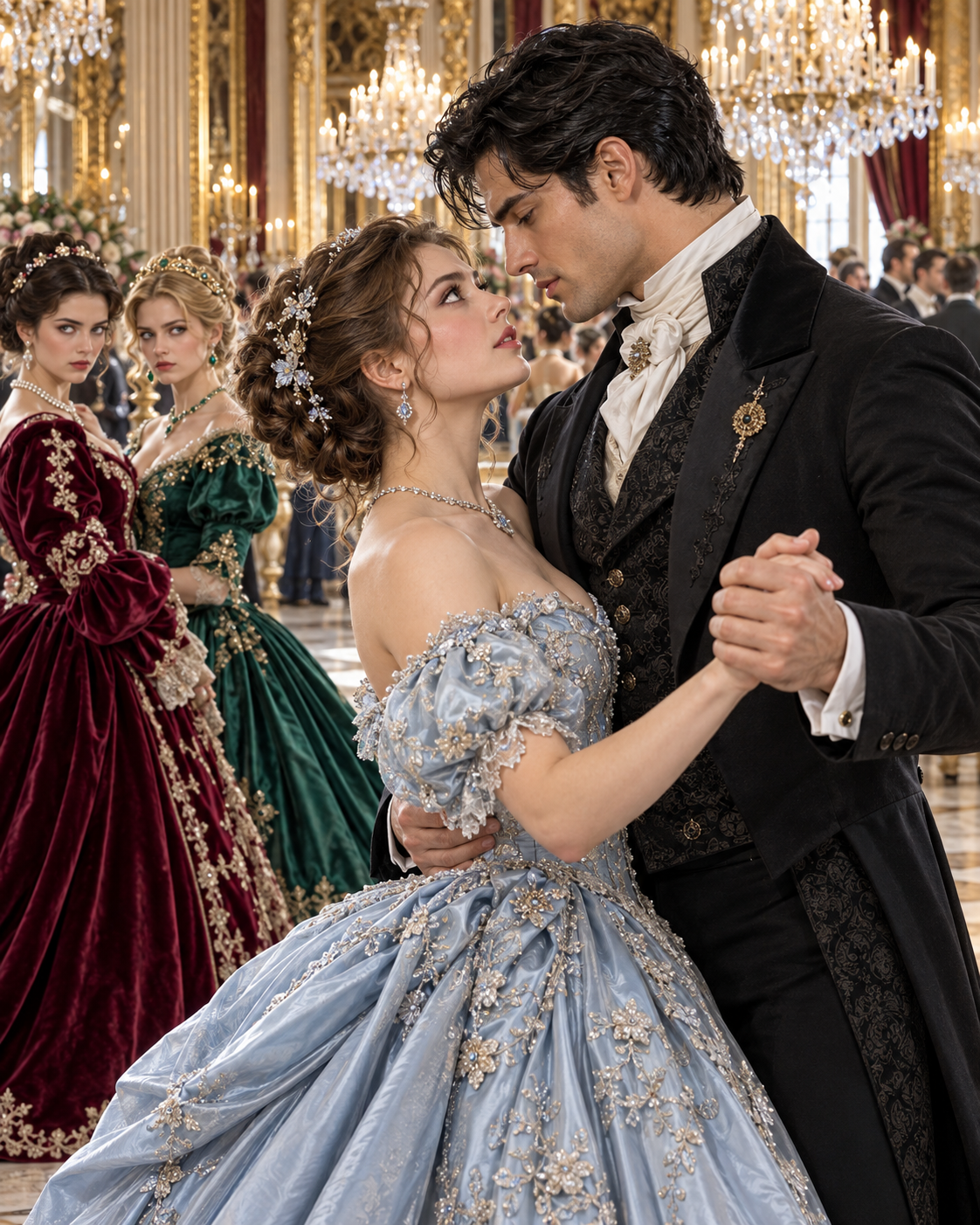
The Duke of Westford had not danced with a woman since his wife died.
THE DUCHESS OF WESTFORD — THE FINAL CHAPTER
The woman’s voice came from the darkness beyond the hidden passage, steady enough to make Harriet’s blood run cold.
“Harriet, ask your husband why they buried an empty coffin.”
Behind her, the Duke of Westford stood motionless.
For several seconds, the only sound was rain striking the windows and the faint ticking of a clock somewhere down the corridor.
Harriet tightened her fingers around the embroidered glove.
“Who is there?”
No answer came.
She took one step toward the passage, but Westford caught her arm.
“Don’t.”
His voice was barely recognizable.
Harriet turned to him.
“Your Grace, there is a woman inside your walls who knows my name. I think we have passed the point where silence is useful.”
His grip loosened.
Something moved beyond the narrow opening.
A figure emerged slowly from the darkness, one hand pressed against the stone for support.
She was a small woman dressed in a plain gray gown. Her silver hair had been gathered into a loose knot, and a narrow scar crossed her left eyebrow.
She looked first at the Duke.
Then at Harriet.
“Good heavens,” the woman whispered. “She really does look like her.”
Westford’s expression changed.
“Mrs. Vale?”
The woman lowered her head.
“I am sorry, Your Grace.”
Harriet looked between them.
“You know her?”
The Duke stared at the woman as though she were standing beside her own grave.
“She was my wife’s companion.”
His voice grew quieter.
“And I was told she died the same winter.”
Mrs. Vale closed her eyes.
“That was what they wanted you to believe.”
Westford did not allow the woman to remain in the passage.
He led them into his private study, locked the door, and instructed the housekeeper that no one was to interrupt them.
Mrs. Vale refused the chair offered to her.
Instead, she stood beside the fireplace, warming her trembling hands while Harriet poured tea from a silver pot.
The Duke remained near his desk.
“Start with the coffin.”
Mrs. Vale looked at him.
“Your wife was never inside it.”
The words settled over the room.
Westford’s hand closed around the edge of the desk.
“I saw her body.”
“You saw a woman beneath a burial veil, after being told that your wife had died of a fever. You were permitted only a moment.”
His jaw tightened.
“I knew my wife.”
“Yes, Your Grace. And that is precisely why they kept you away until the funeral.”
Harriet noticed that Mrs. Vale had not touched her tea.
“Who kept him away?”
The older woman glanced toward the locked door.
“Mr. Ashcombe.”
The name was familiar.
Edmund Ashcombe had served the Westford family for nearly twenty years. He managed the estate’s finances, supervised its tenants, and occupied a comfortable residence beyond the eastern gardens.
He was also the man whose accounts Harriet had begun examining.
Westford gave a sharp, disbelieving laugh.
“Ashcombe arranged the burial because I could scarcely stand.”
“He arranged much more than that.”
Mrs. Vale reached inside her gown and withdrew a small leather pouch.
Inside lay a silver locket, tarnished at its edges.
She placed it on the desk.
The Duke did not move.
Harriet opened it carefully.
There was a miniature portrait of a young woman with soft brown eyes. Beneath it, tucked behind the glass, lay a folded scrap of paper.
The writing was faint.
If anything happens to me, find the northern ledgers.
Westford sat down.
For the first time since Harriet had known him, he seemed incapable of forming a sentence.
Mrs. Vale watched him with wet eyes.
“Lady Eleanor was frightened during the last months of her life. She discovered that money intended for the northern tenants had been disappearing. When she confronted Mr. Ashcombe, he told her she had misunderstood the accounts.”
Harriet thought of the discrepancies she had found.
Small sums diverted repeatedly.
Payments recorded under false names.
Entire columns rewritten in a different hand.
“She continued investigating,” Mrs. Vale said. “And then she discovered something worse.”
“What?”
Mrs. Vale looked directly at Harriet.
“The missing money was being used to purchase debts.”
Harriet felt a strange pressure beneath her ribs.
“Whose debts?”
“Families with unmarried daughters. Gentlemen too desperate to question where their money came from.”
Westford rose slowly.
“To what purpose?”
Mrs. Vale hesitated.
“I believe the purpose has now arrived at Westford Manor.”
Her eyes settled on Harriet’s wedding ring.
Harriet returned to her chamber shortly before midnight.
Westford insisted that two trusted servants remain near the west wing, but she refused his suggestion that she sleep elsewhere.
The room had felt like a prison when she first arrived.
She would not allow someone else’s fear to turn it into one.
She sat beside the fire and examined her marriage certificate.
Her father’s signature looked hurried.
The Duke’s was bold and precise.
Beneath them sat the name of the witness who had arranged the legal documents.
Edmund Ashcombe.
Harriet had noticed the name before.
Now it seemed to darken the paper.
A quiet knock interrupted her thoughts.
“Come in.”
Westford entered carrying a candle.
He wore neither coat nor cravat, and exhaustion had hollowed the lines around his mouth.
For a moment, he remained near the doorway.
“I owe you an apology.”
Harriet folded the certificate.
“For which offense?”
He almost smiled.
“There are several to choose from.”
She waited.
He crossed to the fireplace.
“I brought you here believing this house could offer you peace. Instead, I have placed you in the middle of something I do not yet understand.”
“You did not know.”
“I should have.”
Harriet studied his face.
“Do you believe Mrs. Vale?”
His eyes moved toward the flames.
“I don’t know.”
It was the first time she had heard him admit uncertainty without turning it into anger.
After a silence, he added, “Eleanor and I were married for seven years.”
Harriet said nothing.
“She was kind. Clever. Far more patient than I deserved.”
He turned the candleholder slowly between his fingers.
“During her final winter, we argued frequently. She accused Ashcombe of stealing from the estate. I told her she was imagining things.”
Harriet felt the weight of what he did not say.
“The day before she disappeared, she asked me to examine a set of papers. I refused.”
His voice grew rough.
“I had just returned from London. I was tired. I told her to leave business to those who understood it.”
He set the candle down.
“The next morning, they told me she was dead.”
Harriet looked toward the window.
Rainwater slid down the glass in thin silver lines.
“You have spent four years believing that one conversation could have saved her.”
Westford did not answer.
She rose.
“Then perhaps we should make certain her final request is heard.”
He looked at her.
“You are not frightened?”
“I am.”
Her fingers rested lightly against the folded certificate.
“But I was frightened in my father’s house, too. Fear did not protect me there.”
Westford stepped closer.
“Harriet—”
She lifted her eyes.
“I would rather know what is happening than spend another evening being told to stay safely in my room.”
For a moment, he simply watched her.
Then he offered his hand.
“Very well, Duchess.”
This time, she took it without hesitation.
By morning, the snow had begun.
It fell lightly over the Yorkshire moors, whitening the garden paths and softening the outlines of the distant hills.
Inside Westford Manor, Harriet resumed her ordinary duties.
Breakfast was served.
The kitchen accounts were checked.
The servants received their instructions.
Nothing in her manner suggested that the household had become the center of a dangerous investigation.
At eleven, Edmund Ashcombe arrived.
He entered the drawing room carrying his usual leather portfolio, his silver spectacles balanced neatly on his nose.
“My lady.”
He bowed.
“I understand you have been examining the older accounts.”
Harriet continued writing.
“I have.”
“I’m afraid some of those records are rather complicated.”
“So I have discovered.”
He smiled.
“If you had consulted me first, I might have spared you considerable trouble.”
Harriet closed her ledger.
“Perhaps. Though I suspect the trouble was there long before I opened the books.”
His smile faded.
Only for a moment.
Then he withdrew a sealed document.
“His Grace asked me to deliver this.”
Harriet recognized the Duke’s signature.
The document authorized the transfer of a considerable sum from the estate’s reserve accounts to a banking house in York.
She looked at the date.
It had been signed two days before her wedding.
Before Westford had any reason to consider such a transfer.
“How interesting.”
Ashcombe inclined his head.
“Is something wrong?”
“Only that His Grace seems to have signed this before deciding the money was needed.”
He reached for the paper.
Harriet placed her palm over it.
Their eyes met.
For the first time, his pleasant expression disappeared entirely.
“You are very observant, Duchess.”
“My mother considered it an unfortunate habit.”
“Such habits can become exhausting.”
Harriet smiled faintly.
“Not nearly as exhausting as correcting dishonest arithmetic.”
Ashcombe’s fingers tightened around his portfolio.
Then he bowed.
“Good day, Your Grace.”
She waited until his footsteps had faded before ringing for the footman.
“Find His Grace. Quietly.”
The next clue came from the stables.
A young groom named Thomas, no older than seventeen, appeared at Harriet’s door that afternoon.
His cap twisted nervously between his hands.
“My lady, I was told you wished to know if anyone used the horses after dark.”
Harriet set aside her needlework.
“Yes.”
He swallowed.
“Mr. Ashcombe’s carriage went out last night.”
“At what hour?”
“Near midnight.”
“Did you see where it went?”
“Toward the northern road.”
Harriet leaned forward.
“Was he alone?”
Thomas shook his head.
“There was a woman inside.”
The room seemed suddenly colder.
“Did you recognize her?”
“No, my lady. She had a veil.”
He hesitated.
“But she was carrying a wooden box. A long one, like the cases gentlemen keep their important papers in.”
Harriet thanked him and instructed him not to repeat what he had seen.
When the boy left, she opened the estate map.
The northern road led past several abandoned farms and a ruined chapel.
But one property remained marked in the Duke’s private records.
A hunting lodge.
Closed for nearly five years.
She touched its location with one finger.
Then she remembered the final sentence inside Eleanor’s locket.
Find the northern ledgers.
Westford wanted to summon the magistrate immediately.
Harriet disagreed.
They stood beside his study desk, with the map spread between them.
“If Ashcombe suspects you know about the lodge, he will destroy whatever is there.”
“And you suggest we do nothing?”
“I suggest we give him a reason to leave.”
Westford looked at her.
“What reason?”
“A journey to London.”
He frowned.
“I have no business in London.”
“Then invent some.”
A faint smile touched his mouth.
“You have become remarkably comfortable giving me orders.”
“You have become remarkably comfortable following them.”
His smile deepened.
Then it vanished.
“I will not permit you to go near that lodge alone.”
Harriet looked at him steadily.
“I wasn’t planning to.”
By evening, news had spread through the household that the Duke and Duchess intended to depart for London the following morning.
Their trunks were brought downstairs.
Traveling clothes were laid out.
The carriage was ordered.
Ashcombe sent a courteous note wishing them a pleasant journey.
Harriet read it twice.
Then placed it beside the forged financial authorization.
At dawn, the Duke’s carriage rolled away from Westford Manor.
Inside sat two servants dressed in traveling cloaks.
Meanwhile, Harriet and Westford left through the old kitchen entrance and entered a smaller carriage driven by Thomas.
The snow had stopped, but the northern roads remained slick with ice.
The journey took nearly two hours.
They reached the hunting lodge shortly before noon.
The building stood alone among black pines, its windows shuttered and its stone chimney leaning slightly to one side.
Fresh carriage tracks crossed the frozen ground.
Westford noticed them immediately.
“Someone is here.”
Harriet climbed down.
“And someone has been here recently.”
The front door was locked.
But the rear entrance had been forced, leaving splintered wood beneath the handle.
Inside, the rooms smelled of dust and cold ashes.
They found no one in the kitchen.
No one in the dining room.
Then Harriet heard a faint sound from upstairs.
A single cough.
Westford moved ahead of her.
They climbed the narrow staircase, stopping outside the final bedroom.
The door stood ajar.
Inside, a woman sat beside the window, wrapped in a dark woolen shawl.
Her hair was streaked with gray.
Her face was thin.
Yet there was an unmistakable resemblance between her and the miniature in the silver locket.
Westford stopped breathing.
“Eleanor?”
The woman turned.
For a moment, her expression remained blank.
Then she stood so quickly that her chair scraped against the floor.
“Henry?”
His name broke against her lips.
Westford took one uncertain step.
His hand rose, then fell.
Eleanor crossed the room and touched his face.
He closed his eyes.
Harriet turned toward the window, giving them the small privacy that four stolen years deserved.
Behind her, she heard Eleanor whisper, “I tried to come home.”
Westford’s answer was barely audible.
“Why didn’t you?”
A long silence followed.
Then Eleanor said, “Because they told me you were dead.”
The explanation unfolded beside a dying fire.
Eleanor had discovered that Ashcombe was stealing estate funds and purchasing debts through intermediaries.
When she attempted to expose him, he arranged for her to be drugged and removed from the manor.
She awoke in a private institution far from Yorkshire.
There, she had been told that her husband had died in a riding accident and that she was suffering from a nervous illness.
Her letters were intercepted.
Her attempts to leave were recorded as evidence of instability.
After several years, she escaped with the assistance of an elderly nurse.
But Ashcombe found her before she reached Westford.
He threatened to have her returned to confinement unless she remained hidden.
Mrs. Vale had helped her.
The two women had been gathering evidence, hoping to reach the Duke without attracting Ashcombe’s attention.
“Why didn’t you simply write to him?” Harriet asked.
Eleanor looked toward Westford.
“I did.”
She reached into the wooden box beside her chair.
Inside lay dozens of letters.
Every one had been opened.
Every one bore the Duke’s name.
Harriet examined the envelopes.
The seals had been broken with remarkable care.
“Someone intercepted them.”
Eleanor nodded.
“Mrs. Vale discovered that Ashcombe had been reading the household correspondence for years.”
Westford looked down at the letters.
His face had become terribly still.
“And I trusted him.”
Eleanor touched his hand.
“You trusted the man your father trusted.”
“That does not excuse what happened.”
“No.”
Her voice was gentle.
“But it explains how he succeeded.”
Harriet watched the two of them.
A husband and wife reunited after four years.
A marriage that had never truly ended.
And standing beside them, another wife.
Herself.
The realization entered quietly.
But it changed everything.
Eleanor was the first to speak of it.
She looked at Harriet’s wedding ring.
“Henry, have you married again?”
Westford remained silent.
Harriet answered.
“Yes.”
Eleanor’s eyes widened.
“Oh.”
Nothing more.
Yet that single sound carried a confusion no speech could have contained.
Westford stood.
“Eleanor, I believed you were dead.”
“I know.”
“I would never have—”
“I know.”
She glanced toward Harriet.
“And you?”
Harriet folded her hands.
“I married a man who offered me safety, independence, and a life away from people who believed cruelty was a privilege.”
Eleanor studied her for a long moment.
Then she said softly, “He has always been rather good at offering protection while forgetting to ask what people actually need.”
Harriet looked at the Duke.
To her surprise, he lowered his eyes.
“That,” he murmured, “may be a fair criticism.”
Eleanor almost smiled.
But the moment ended when footsteps sounded below.
Heavy.
Deliberate.
A door slammed.
Then came the unmistakable click of a pistol being cocked.
Edmund Ashcombe appeared in the doorway.
He wore a dark traveling coat, and snow had melted across his shoulders.
His pistol was pointed directly at the Duke.
“How touching.”
No one moved.
Ashcombe’s gaze traveled from Eleanor to Harriet.
“I had hoped the little arrangement would remain manageable.”
Westford stepped in front of the women.
“Lower the weapon.”
Ashcombe laughed softly.
“You have given me orders for twenty years, Your Grace. I believe I have earned one opportunity to refuse.”
Harriet noticed his left hand.
It was shaking.
Not from fear.
From anger.
“You knew Eleanor was alive,” she said.
“Of course.”
“And you arranged my father’s debts.”
Ashcombe smiled.
“Your father was particularly obliging.”
Harriet felt her fingers go cold.
“He knew?”
“He knew enough.”
The words struck harder than she expected.
Her father had not merely allowed her marriage.
He had helped arrange it.
Ashcombe continued, almost pleasantly.
“Your family was desperate. His Grace was lonely. I simply brought two unfortunate circumstances together.”
“Why?”
“Because a young Duchess with no powerful relations would be easier to control than a grieving Duke who might eventually discover his wife’s accounts.”
He looked at Harriet with open irritation.
“Unfortunately, you developed an interest in mathematics.”
Westford’s expression darkened.
“You used her.”
“I offered her father a solution to his debts.”
“You purchased a human being.”
Ashcombe shrugged.
“Society does so every season. It merely prefers prettier language.”
Harriet moved slightly toward the writing desk.
Ashcombe raised the pistol.
“Stay where you are.”
She stopped.
The room fell silent.
Then Eleanor spoke.
“You were never going to let me go, were you?”
Ashcombe looked at her.
“No.”
Something in his expression hardened.
“You were meant to disappear quietly. Instead, you made a nuisance of yourself.”
Westford took a step forward.
The pistol shifted toward his chest.
“Another step,” Ashcombe said, “and this ends badly.”
Harriet glanced at the fireplace.
A small brass poker lay beside the hearth.
Too far away.
The window behind Eleanor was partly open.
Cold air moved the curtains.
And downstairs, through the floorboards, Harriet heard the faint creak of a door.
She recognized the sound.
Thomas.
The young groom had been instructed to remain outside unless he heard trouble.
Harriet met Westford’s eyes.
He followed the direction of her glance.
Barely.
Then Harriet spoke.
“You’ve made one mistake, Mr. Ashcombe.”
He looked amused.
“Only one?”
“You assumed everyone would continue being afraid of you.”
She reached into her sleeve.
Ashcombe raised his pistol.
“Don’t.”
Harriet withdrew a folded sheet of paper.
The financial authorization.
She held it between two fingers.
“Your forged signature is rather good. But the bank has already been informed.”
His smile disappeared.
“You’re lying.”
“Perhaps.”
She moved the paper closer to the fire.
“But if this document is destroyed, so is the only evidence that the Duke authorized your transfer.”
Ashcombe’s eyes flickered toward it.
A moment.
Nothing more.
But it was enough.
Westford struck his arm.
The pistol discharged.
The sound shattered the room.
Plaster fell from the ceiling.
Eleanor screamed.
Harriet dropped to the floor as the weapon skidded beneath the bed.
Ashcombe lunged for it.
The door flew open.
Thomas rushed inside with two men from the estate.
Within seconds, Ashcombe was pinned against the floor, his arms twisted behind his back.
The room smelled of smoke.
Harriet rose slowly.
Westford was standing beside the window.
Blood darkened his sleeve.
“Henry.”
Her voice came out strangely quiet.
He looked down at his arm.
“A scratch.”
Harriet crossed the room.
“Your Grace, I have seen scratches. That is not one.”
Eleanor reached for a clean cloth.
Together, the two women pressed it against the wound.
Westford looked from one to the other.
For once, he appeared to have no idea what to say.
Ashcombe was taken to York under guard.
The magistrate received the forged documents, Eleanor’s letters, the concealed account books, and Mrs. Vale’s testimony.
Within days, the investigation uncovered years of theft, coercion, and fraudulent financial dealings.
Other families came forward.
Some had lost their homes.
Others had surrendered inheritances to debts they had never truly incurred.
Harriet’s father was among those questioned.
He admitted accepting money in exchange for encouraging her marriage to the Duke.
When Harriet learned the truth, she remained silent for a long time.
Then she folded the magistrate’s letter and placed it inside her desk.
Westford stood beside her.
“I can ensure you never need to see him again.”
Harriet shook her head.
“That is a decision I would like to make for myself.”
He studied her.
Then nodded.
“Of course.”
Outside, the first pale signs of spring had begun appearing beneath the snow.
There remained one matter that no magistrate could resolve with a warrant.
The marriage.
Because Eleanor had never died, Westford’s marriage to Harriet had no legal standing.
The news reached them on a cold March morning.
Harriet read the solicitor’s letter without moving.
When she finished, she placed it carefully on the breakfast table.
Westford watched her.
“What does it say?”
“Precisely what we expected.”
He glanced toward the envelope.
“Harriet—”
“I am not your wife.”
The words were quiet.
They hurt more than either had anticipated.
Westford leaned back.
“Eleanor and I have discussed the matter.”
Harriet looked up.
There was something unfamiliar in his expression.
Not uncertainty.
Resolve.
“We intend to petition for a legal separation.”
Harriet stared at him.
“Why?”
Westford’s eyes remained on hers.
“Because we have changed.”
She said nothing.
He continued.
“Eleanor wishes to establish a home near her sister in Bath. She has endured four years of captivity. I will not ask her to spend the rest of her life inside another arrangement she no longer desires.”
“And you?”
He took a breath.
“I wish to stop making decisions for other people because I believe I know what will protect them.”
Harriet’s fingers tightened around her teacup.
“Then perhaps you should begin with me.”
Westford nodded.
“Very well.”
He placed a folded document beside her plate.
It was a deed.
A small property on the eastern edge of his estate, with an adjoining garden and an annual income secured in her name.
Harriet stared at it.
“What is this?”
“Your independence.”
Her throat tightened.
“I didn’t ask for a house.”
“No. You asked for freedom.”
He stood.
“You may remain here, travel, establish a home of your own, or leave England entirely. Whatever you choose, I will not interfere.”
Harriet looked down at the deed.
The signature was genuine.
The gift carried no condition.
For a woman whose entire life had been measured by what others were willing to allow her, the absence of obligation felt almost unbearable.
“And if I choose to leave?”
Westford’s expression changed, but his voice remained steady.
“Then I will wish you happiness.”
He turned toward the door.
Harriet watched him go.
For the first time, she understood how much courage it had taken him to offer something he could not control.
Eleanor left Westford Manor in April.
The morning was bright and cold, with sunlight shining on the wet gravel.
Harriet accompanied her to the carriage.
For several moments, they stood beside the open door.
“I owe you more than I can say,” Eleanor began.
Harriet shook her head.
“You owe me nothing.”
Eleanor smiled.
“Then perhaps I may offer you some advice.”
Harriet inclined her head.
“Of course.”
“Do not spend your life proving that you deserve kindness.”
The words settled quietly between them.
Eleanor touched Harriet’s hand.
“Some people will take everything you give and still insist you should be grateful.”
Harriet looked down.
“I know.”
“Then promise me you will not mistake endurance for happiness.”
The coachman opened the carriage door.
Eleanor climbed inside.
Before the door closed, she leaned forward.
“Henry is a good man, Harriet. But goodness is not enough unless it is accompanied by courage.”
Harriet watched the carriage disappear beneath the trees.
Then she turned back toward the manor.
Westford stood at an upstairs window.
He did not wave.
But when she raised her eyes, he remained there.
The months that followed were unlike anything Harriet had known.
She moved into the small eastern house.
She supervised repairs, planted herbs beneath the kitchen windows, and hired a young widow to help manage the household.
She began visiting neighboring farms, speaking with tenants who had spent years fearing the estate’s officials.
Several widows asked her to help examine their accounts.
Then others came.
Soon, Harriet had transformed the little drawing room into an informal office where women could seek assistance with contracts, debts, wages, and property.
She charged those who could afford it.
For those who could not, she accepted bread, flowers, or nothing at all.
Westford visited occasionally.
At first, he invented reasons.
A question about a tenant’s lease.
A document requiring her opinion.
A newly repaired bridge.
Harriet listened politely.
Then, one afternoon, she looked up from her desk.
“Your Grace, have you come to discuss drainage again?”
He glanced at the papers in his hand.
“I had intended to.”
“And now?”
He placed them aside.
“Now I should rather like to have tea.”
Harriet smiled.
“That is the first sensible thing you’ve said all week.”
He laughed.
Not the restrained sound she had heard once or twice in the ballroom.
A real laugh.
It startled them both.
By late summer, the legal separation between Westford and Eleanor had been finalized, and the dissolution of their marriage followed under the arrangements available to them.
Harriet learned of it through a brief letter.
Westford wrote that Eleanor had settled comfortably in Bath and begun restoring a neglected garden.
He did not mention marriage.
Neither did Harriet.
Instead, their friendship grew through ordinary afternoons.
They walked through the orchard.
They argued over books.
They shared meals in her small kitchen, where the Duke discovered that he preferred fresh bread and plain butter to elaborate dinners served beneath chandeliers.
Sometimes they spoke of the past.
More often, they spoke of things yet to be done.
Harriet noticed that he had begun listening differently.
He no longer interrupted when she disagreed.
He no longer offered solutions before hearing the problem.
And when she fell silent, he did not demand to know why.
One evening, they sat beneath an old apple tree as the sun lowered behind the hills.
Westford was reading aloud from a book Harriet had recommended.
She was mending a tear in her glove.
After several minutes, he stopped.
“Harriet.”
She looked up.
“Yes?”
“Do you miss the manor?”
She considered the question.
“I miss the library.”
He smiled.
“Only the library?”
“And Mrs. Vale’s plum cakes.”
“I shall inform her she has become indispensable.”
Harriet returned to her sewing.
Westford closed the book.
“Do you miss me?”
Her needle stopped.
The orchard was quiet except for the distant call of a bird.
Harriet looked at him.
“You come here three times a week.”
“Four, recently.”
“Then you have hardly given me the opportunity.”
He laughed softly.
But his eyes remained serious.
“I could visit less.”
She lowered her gaze.
“I would prefer that you didn’t.”
The words were simple.
Yet Westford held them with the care of a man receiving something precious.
Autumn arrived with copper leaves and colder mornings.
One afternoon, Harriet received a letter bearing her father’s seal.
She recognized the handwriting immediately.
For a long time, she left it unopened.
Then she broke the wax.
He wrote that his debts had ruined him, that her sisters had married poorly, and that he hoped she would remember her duty to her family.
He offered no apology.
Not for the years of cruelty.
Not for accepting money to arrange her marriage.
Not for treating her future as something to be sold.
At the end, he asked for financial assistance.
Harriet read the letter twice.
Then she carried it outside, where Westford was examining a broken garden gate.
He looked up.
“Something troubling?”
She handed him the paper.
He read it in silence.
When he finished, his expression hardened.
“You owe him nothing.”
“I know.”
She held out her hand for the letter.
Westford returned it.
Harriet looked toward the garden, where the first fallen leaves had gathered beneath the roses.
For years, she had imagined that freedom would mean hearing her family admit what they had done.
She had waited for remorse.
For an explanation.
For some small acknowledgment that she had deserved better.
But now, standing in the garden of a home that belonged entirely to her, she realized she no longer needed their permission to believe it.
She folded the letter.
Then she placed it in the pocket of her gown.
“I shall send him the address of a reputable solicitor.”
Westford watched her.
“Nothing more?”
“He has always been very talented at finding someone else to solve his problems.”
A faint smile touched his lips.
“And your sisters?”
“They may learn to manage their own affairs.”
He nodded.
Harriet looked at the broken gate.
“Now, Your Grace, are you going to repair that, or shall I find someone who can?”
Westford removed his coat.
“I should hate to disappoint you.”
For the rest of the afternoon, the Duke of Westford worked in shirtsleeves while Harriet handed him tools.
Neither spoke of the letter again.
The first proposal came in November.
Not at a crowded ball.
Not beneath a chandelier.
Not with her sisters laughing behind their fans.
It came on a quiet evening in Harriet’s kitchen, while rain whispered against the windows.
Westford had arrived carrying a basket of apples from the manor orchard.
Harriet was making tea.
He stood beside the table, turning his hat between his hands.
She noticed his unusual silence.
“Have you broken something?”
He looked startled.
“No.”
“Lost something?”
“Not exactly.”
She set down the teapot.
“Then you had better sit before you wear a hole in the floor.”
He sat.
For several moments, he studied the wooden table.
Then he reached into his coat and withdrew a small velvet box.
Harriet went still.
Westford placed it between them.
“I have rehearsed this conversation several times.”
“That sounds unlike you.”
“Entirely.”
He opened the box.
Inside lay a simple gold ring set with a single pale sapphire.
It was not the grand jewel one might expect from a duke.
It was delicate.
Unassuming.
Beautiful.
Westford looked at her.
“When I first asked you to marry me, I offered you a bargain.”
Harriet remained silent.
“I thought I was giving you a way out of an unhappy life. In truth, I was asking you to make yourself useful in mine.”
Her fingers rested against the edge of the table.
“You gave me a home.”
“And you gave that home a reason to feel alive.”
He paused.
“I once believed love was something a man could survive losing only once.”
Rain tapped gently against the glass.
“Then you came into my study with ink on your fingers and informed me that my steward’s mathematics were an insult to basic intelligence.”
Harriet laughed despite herself.
“He was stealing from you.”
“Yes. But I remember being rather impressed by the accusation.”
His expression softened.
“I cannot promise you a life without grief, arguments, or uncertainty.”
He drew a breath.
“But I can promise that you will never again have to earn your place beside me by making yourself smaller.”
Harriet’s eyes filled.
Westford did not reach for her hand.
He waited.
“I love you, Harriet.”
The words were quiet.
Certain.
“I would like to marry you. Not because society requires it. Not because I need someone to manage my house. And not because I believe you require saving.”
He glanced at the ring.
“Only because the ordinary hours of my life have become better when you are in them.”
Harriet looked at him for a long time.
Then she closed the velvet box.
Westford’s face changed.
But he said nothing.
She stood and walked toward the window.
Outside, the garden lay dark beneath the rain.
For a moment, she remembered herself at twenty-two, crossing a crowded ballroom in a faded gown while her sisters watched eagerly for her humiliation.
She remembered the Duke’s cold expression.
The unexpected hand.
The marriage contract.
The enormous silent manor.
The fear.
The discovery.
And the long, difficult journey toward a life that belonged to her.
When she turned, Westford was still seated.
Waiting.
Harriet crossed the room.
“I have one condition.”
He rose immediately.
“Name it.”
“If I marry you, I will continue my work.”
“Of course.”
“I will keep this house.”
“Certainly.”
“And when we disagree, you will not retreat behind a locked study door for three days.”
He winced.
“Was it really three?”
“Four, once.”
He lowered his eyes.
“That was poorly done.”
“Very.”
He looked up.
“Anything else?”
Harriet considered.
“Yes.”
Westford waited.
She reached for his hand.
“This time, I would like you to ask me as though you believe I might say no.”
His fingers tightened gently around hers.
He understood.
He knelt.
Not because she required a grand gesture.
But because, for the first time, he wanted to make a request without hiding behind his title.
“Harriet Linfield, will you marry me?”
She looked down at him.
And smiled.
“Yes, Henry.”
Their wedding took place the following spring.
There were no hundreds of guests, no extravagant decorations, and no society column invited to witness the occasion.
The chapel was small.
The windows stood open.
Sunlight fell across the worn stone floor.
Mrs. Vale sat in the front pew, crying openly into a handkerchief.
Thomas, now promoted to head groom, stood near the door with a smile he could not conceal.
Several tenants attended with their families.
Women whom Harriet had helped through difficult winters filled the remaining seats.
Eleanor sent a letter from Bath.
It contained a pressed violet and a simple message.
May this marriage give you both room to become yourselves.
Harriet read it privately before the ceremony.
Then she tucked the flower inside her glove.
When she entered the chapel, Westford turned.
For a moment, he looked exactly as he had at the ball.
Still.
Serious.
Almost intimidating.
But his eyes changed when he saw her.
Harriet walked toward him without being pushed.
Without being dared.
Without wondering whether someone was waiting to laugh.
At the altar, she placed her hand in his.
His fingers were warm.
And when the vows were spoken, neither looked away.
Five years later, the west wing of Westford Manor was no longer closed.
Its windows stood open in summer.
Its fireplaces burned through winter.
The room that had once belonged to Eleanor had become a library and schoolroom for children from the surrounding villages.
Harriet insisted that every child, whether born to a tenant, servant, tradesman, or gentleman, should be able to read and understand a simple account.
“An ignorant person is easier to deceive,” she told Westford one afternoon.
He glanced at the row of children bent over their lessons.
“I suspect you intend to make Yorkshire exceedingly difficult to deceive.”
“That is the general idea.”
He smiled.
Their own daughter sat near the window, concentrating fiercely on a column of figures.
She had her father’s dark eyes and her mother’s stubborn little mouth.
When Harriet approached, the child held up her slate.
“Mama, Mr. Collins says girls don’t need to understand accounts.”
Harriet looked across the room.
The elderly tutor suddenly became very interested in the fireplace.
Westford lowered his book.
“Did he indeed?”
Their daughter nodded.
Harriet pulled out a chair beside her.
“Then perhaps we should show Mr. Collins why he is mistaken.”
Westford watched as mother and daughter bent over the slate.
Outside, the Yorkshire hills rolled away beneath a clear afternoon sky.
The manor was full of sounds he had once believed he would never hear again.
Footsteps.
Laughter.
Arguments over books.
Music from the drawing room.
The ordinary noise of people unafraid to live.
Later that evening, Harriet found him standing beside the window where she had first noticed the neglected curtains.
“What are you thinking about?” she asked.
He took her hand.
“A ballroom.”
She smiled.
“A rather unpleasant one?”
“Terribly.”
He looked down at her.
“I remember a young woman who walked toward me because two foolish girls wanted to see her embarrassed.”
Harriet raised an eyebrow.
“She was rather foolish herself.”
“No.”
He brushed his thumb gently over her knuckles.
“She was brave.”
Harriet shook her head.
“She was simply tired of being frightened.”
“Sometimes,” he said, “that is where courage begins.”
She leaned against him.
Beyond the windows, the last light faded over the moors.
For a while, neither spoke.
Then Harriet glanced at the dining-room clock.
“Henry, you promised our daughter you would help her finish the little wooden house.”
He sighed.
“I believe she intends to add another floor.”
“She takes after her father.”
“Surely you mean her mother.”
Harriet laughed.
And together, they walked toward the sound of their daughter’s impatient voice.
Years earlier, Harriet had believed that happiness was something granted by people with greater power, greater wealth, or greater importance.
Her father had taught her to be obedient.
Her sisters had taught her to endure humiliation.
Society had taught her that a woman’s worth could be measured by the name she carried, the fortune she brought, and the man who chose her.
But a woman who had once been treated as a burden had become the center of a household where no one needed to be afraid.
Not because she had married a duke.
Not because she had been rescued from poverty.
And not because suffering had somehow made her more deserving of love.
She had discovered that dignity did not require permission, that kindness without respect was another form of control, and that love could only flourish where both people were free to choose it.
The Duke had given her the chance to leave a cruel home.
But the life she built afterward was her own.
And the man who had once offered her a marriage without love eventually learned that the greatest gift he could give her was not a title, a fortune, or even his heart.
It was the certainty that she could walk away.
And the quiet joy of knowing she chose to stay.
THE END.