The Duke of Ravenshire was about to announce his engagement to another woman when the wife he had abandoned walked into the ballroom—with a child who had his eyes.
The words hung in the narrow chamber, heavier than the silence that followed.
Alexander stood motionless, one hand resting against the hidden door. Behind him, the flames in the small fireplace shifted, casting uncertain shadows across the walls.
His father had been dead for seven years.
He remembered the funeral, the black horses moving through the rain, and his mother standing beside the grave without shedding a tear. He had been twenty-three then, old enough to inherit a dukedom but too young to recognize how quickly grief could become an instrument in someone else’s hands.
“What did you say?” Alexander asked.
Lord Whitmore stepped into the room, leaning heavily against the bookcase. His coat was torn near the shoulder, and a dark bruise marked the side of his face.
Eleanor moved toward him.
“Grandfather.”
He caught her hand, but his eyes remained fixed on Alexander.
“Your father discovered something he was never meant to see. And when he threatened to expose it, he was silenced.”
Alexander looked down at the sealed document in the old man’s trembling fingers.
“By whom?”
Lord Whitmore swallowed painfully.
“By someone who has spent seven years making certain you never asked that question.”
A sound came from the corridor.
The soft rustle of silk.
Alexander turned.
The Dowager Duchess stood in the doorway, her expression composed except for the hand gripping the doorframe.
Behind her, Cordelia had stopped several steps away.
For a moment, nobody spoke.
Then the Dowager Duchess looked at Lord Whitmore.
“You should have remained where you were.”
Eleanor felt her grandfather’s fingers tighten.
Alexander slowly stepped between them.
“Mother,” he said, “what have you done?”
The Dowager Duchess did not answer immediately. Instead, she glanced toward the fireplace, where the ashes of recently burned papers still smoldered.
“You have no idea what your father intended to destroy.”
“Then tell me.”
“He intended to destroy this family.”
Lord Whitmore gave a bitter, exhausted laugh.
“No, Your Grace. He intended to save it from you.”
The Dowager Duchess’s expression hardened.
Alexander took the sealed document from Lord Whitmore’s hand and broke the wax.
Inside was a letter written in his father’s unmistakable handwriting.
He recognized the long, deliberate strokes, the severe angle of each capital letter. His father had written him hundreds of letters during his childhood, always correcting his grammar and reminding him that a title meant nothing without the character to honor it.
Alexander began to read.
The letter was dated six days before the late duke’s death.
It described missing funds from the Ravenshire estates, false accounts, and payments made to a distant financial concern controlled by the Dowager Duchess’s brother.
The money had been taken from tenant reserves, charitable trusts, and funds intended for repairs to cottages across the northern estates.
His father had discovered the irregularities and demanded their immediate correction.
But the final paragraph made Alexander’s blood run cold.
If anything should happen to me before these matters are resolved, my son must know that I have placed copies of the evidence in the hands of Lord Whitmore. I fear my wife has mistaken the preservation of our name for permission to destroy those who depend upon it.
Alexander lowered the letter.
His mother stood perfectly still.
“Is this true?”
She lifted her chin.
“Your father never understood what was necessary.”
“What was necessary?” Alexander repeated.
“The estate was failing. Your father’s generosity was bleeding us dry. He gave money to tenants who could never repay it. He forgave debts. He refused profitable arrangements because he considered them improper.”
“And you stole from them?”
“I protected your inheritance.”
Eleanor watched Alexander’s face change. The anger did not arrive suddenly. It gathered slowly, beneath the shock, as each sentence stripped another layer from the woman he had trusted all his life.
“And his death?” he asked.
The Dowager Duchess looked away.
Lord Whitmore leaned against the desk.
“The physician who attended him was paid to conceal the circumstances. I found his private notes years later. Your father had been given a sleeping draught that reacted dangerously with the medicine prescribed for his heart.”
Alexander stared at him.
“Are you saying she poisoned him?”
“I am saying his death was not the natural illness recorded in the family papers. The physician believed the second medicine had been administered deliberately.”
The Dowager Duchess’s fingers began to tremble.
“That physician was dismissed for incompetence.”
“He was paid to leave England,” Lord Whitmore replied. “I have the bank record.”
Alexander turned to his mother.
“Did you give him the draught?”
She remained silent.
Outside, the winter wind struck the windowpane with a low, hollow sound.
Finally, she spoke.
“He was going to have me prosecuted.”
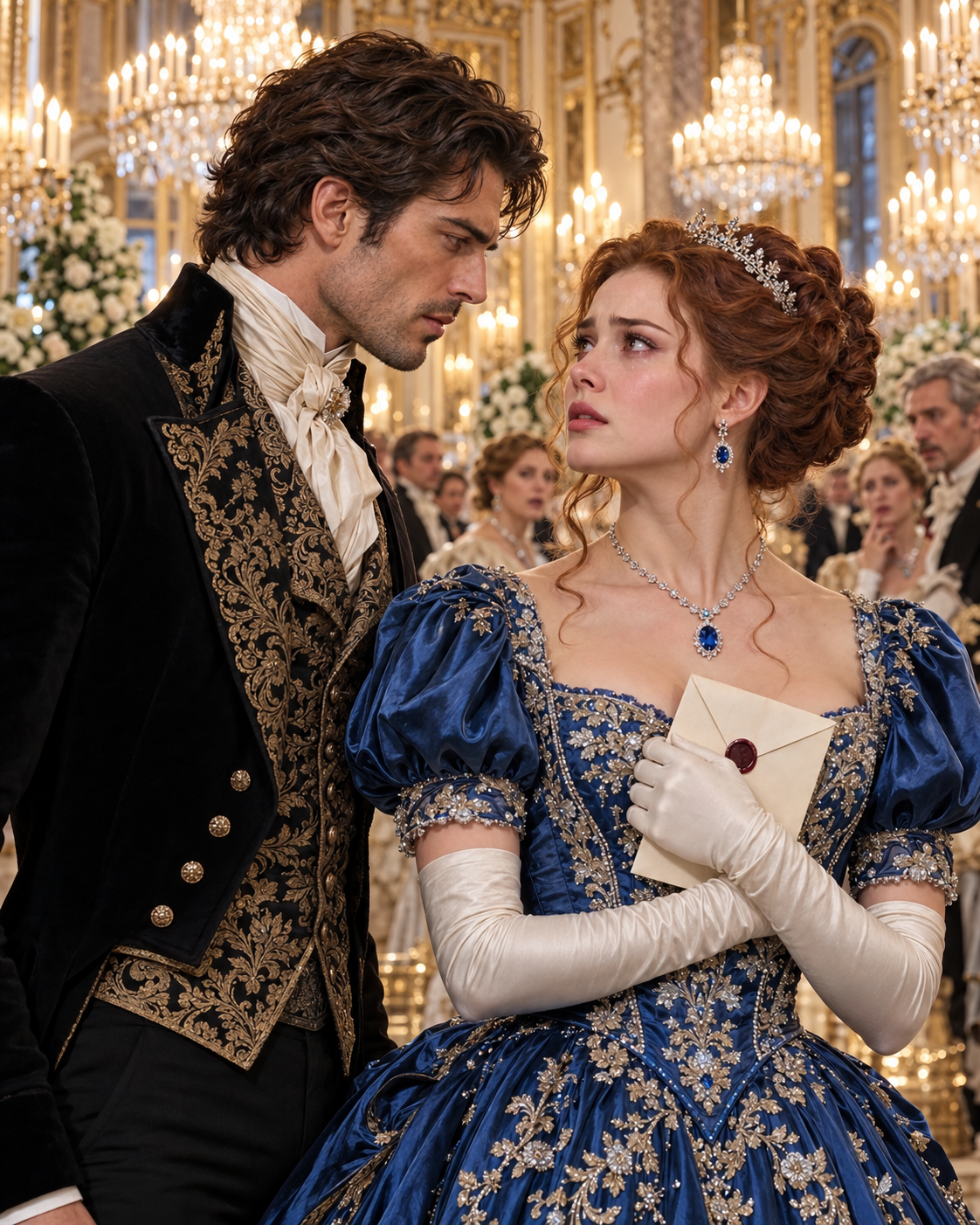
The words seemed to exhaust her.
Alexander stepped backward.
His mother looked at him with something almost like desperation.
“I had spent twenty-five years building this house into something worthy of its name. Your father would have dragged us through the courts, exposed our finances, and surrendered everything to men who would have enjoyed watching our humiliation.”
“You could have told me.”
“You were your father’s son. You would have made the same foolish choice.”
Alexander closed his eyes.
For seven years, he had remembered his mother as a widow who had sacrificed her happiness to preserve his future.
Now he remembered other things.
The servants dismissed without explanation.
The books of accounts she insisted on managing.
The northern tenants who had begged him for assistance, only to be told that no money remained.
And his own willingness to believe her.
He opened his eyes again.
“Did you know the medicine would kill him?”
The Dowager Duchess’s lips parted.
But Cordelia answered from the doorway.
“She knew.”
Everyone turned.
Cordelia stood with her hands clasped tightly before her. The diamonds at her throat glimmered in the fading firelight.
The Dowager Duchess stared at her.
“Be careful.”
Cordelia gave a small, humorless smile.
“That is what you always say when someone begins telling the truth.”
Alexander looked between them.
“What do you know?”
“My father handled several of the transfers. When he died, I inherited his correspondence. Your mother knew I possessed it.”
“And that is why she wanted you to marry me?”
Cordelia’s expression tightened.
“It was part of the reason.”
Eleanor studied the young woman.
Cordelia had spent an entire season moving through society as though she were untouchable, speaking little, smiling less, allowing others to mistake calculation for elegance.
Now her composure seemed painfully thin.
“You forged my letters,” Eleanor said.
Cordelia looked at her.
“Yes.”
No excuse followed.
Eleanor had expected denial, perhaps tears or an accusation. The simple admission left her silent for a moment.
“Why?”
Cordelia glanced toward Alexander.
“Because I thought he would never look at me while you were alive in his affections.”
The words were spoken so quietly that Alexander almost missed them.
Cordelia continued.
“Your mother told me the marriage was merely a youthful mistake. She said it could be undone if Alexander believed he had been deceived.”
“She told you that?” Alexander asked.
Cordelia nodded.
“And you believed her?”
“I wanted to.”
Eleanor lowered her gaze.
There was something almost unbearable about that answer. Not because it earned sympathy, but because it revealed how easily longing could become an excuse for cruelty.
“You knew I had nowhere to go,” Eleanor said.
Cordelia’s eyes filled, but she did not look away.
“Yes.”
“You knew I was expecting a child?”
A terrible pause followed.
Cordelia shook her head.
“Not until later.”
“How much later?”
“When your grandfather began searching for you.”
Eleanor remembered the winter streets, the rooms she could barely afford, the evenings spent sewing beside a candle that burned down to the metal holder.
She remembered writing to Alexander after learning she was pregnant.
She had waited for weeks.
Then months.
No reply had ever come.
“That letter,” she whispered. “You intercepted it too.”
Cordelia’s silence answered.
Alexander turned away.
His hand came to rest against the desk, gripping its edge until his knuckles whitened.
He had spent a year convincing himself that Eleanor had betrayed him.
All the while, she had been carrying his child, writing letters he never received, surviving consequences he had been too proud to investigate.
He looked at her.
“Eleanor, I—”
“Not now.”
The words were gentle.
That made them harder to bear.
Lord Whitmore suddenly swayed.
Eleanor caught his arm before he fell.
“Grandfather, sit down.”
Alexander pulled a chair toward him, but the old man shook his head.
“There is something else.”
He reached into the lining of his torn coat and withdrew a small notebook wrapped in oilcloth.
“The original records. The payments, the physician’s notes, and the correspondence. I hid them when I realized the house was being watched.”
“Who hurt you?” Eleanor asked.
Lord Whitmore glanced toward the Dowager Duchess.
“Two men intercepted my carriage outside the village. They wanted to know where I had hidden these.”
Alexander took the notebook.
“Where are those men now?”
“I escaped when they stopped near the old hunting lodge. But I heard them discussing another instruction.”
“What instruction?”
Lord Whitmore looked at Eleanor.
“If I could not be persuaded to surrender the documents, the child was to be taken.”
The room seemed to contract around them.
Eleanor turned toward the corridor.
Henry.
The footman had carried him away from the ballroom only minutes earlier.
Alexander saw her expression.
He moved first.
They rushed through the passage, Eleanor gathering her skirts as she ran. The sound of music had vanished from the ballroom. Somewhere ahead, a woman cried out.
At the entrance to the great hall, they found the elderly footman lying against a marble pillar.
A young maid knelt beside him, pressing a cloth to his forehead.
Eleanor stopped so abruptly that Alexander nearly collided with her.
“Where is my son?”
The maid looked up, white-faced.
“A gentleman said His Grace had sent him. He took the little boy toward the conservatory.”
Alexander was already moving.
Eleanor followed.
Beyond the ballroom, the glass conservatory stood dark beneath the snow, its tall windows silvered by moonlight. The scent of damp earth and winter roses lingered beneath the cold.
A narrow door at the far end stood open.
Footprints marked the snow outside.
One set belonged to a man.
The other was a broken trail of smaller impressions, where little boots had brushed the ground.
Eleanor pressed a hand against her mouth.
“Henry.”
Alexander caught her shoulders.
“Look at me.”
She tried to pull away.
“Alexander, he’s out there.”
“I know. And we are going to bring him back.”
She stared at him.
For a brief, painful instant, she saw the man she had once loved—the young husband who had carried her across a flooded garden path because she had refused to ruin her wedding slippers.
Then the memory vanished beneath the cold.
“Do not make me another promise you cannot keep.”
He released her immediately.
“You are right.”
He turned toward the footman who had followed them.
“Wake the stablemen. No one leaves the grounds without being stopped. Send riders to every gate.”
The servant hurried away.
Alexander seized a lantern and stepped into the snow.
Eleanor followed without waiting for permission.
They crossed the frozen garden, following the footprints toward the old carriage road. Bare branches scraped together overhead, and somewhere beyond the trees a horse stamped against the icy ground.
A muffled cry came from the darkness.
Eleanor stopped.
“Henry?”
Another sound.
Small.
Frightened.
She ran toward it.
A carriage stood beneath an ancient cedar, its lamps extinguished. A man in a heavy coat was struggling with a restless horse while another held Henry against his chest.
The child was crying.
Alexander stepped forward.
“Put him down.”
The man holding Henry turned.
For an instant, Eleanor recognized him as one of the former estate guards dismissed the previous spring.
The man’s grip tightened around the child.
“Come closer, Your Grace, and I’ll make sure you regret it.”
Alexander stopped.
Snow settled across his shoulders.
“What do you want?”
“The papers.”
“They are inside the house.”
“Then send for them.”
Eleanor moved slightly to the side.
Henry saw her.
“Mama!”
The cry cut through the frozen garden.
She forced herself not to run.
“I’m here, sweetheart.”
The man pulled Henry closer.
“Keep quiet.”
Eleanor looked directly at him.
“He’s frightened. Let me hold him while we talk.”
“You think I’m a fool?”
“No,” she replied. “I think someone promised you money and neglected to mention what would happen when this went wrong.”
The man hesitated.
Alexander noticed.
“Who hired you?”
The second man reached for the carriage door.
“Stop talking. We need to leave.”
But the horse suddenly reared, startled by approaching lanterns among the trees.
The carriage lurched.
The man holding Henry lost his footing.
Eleanor moved before anyone could stop her.
She caught her son as the man’s grip loosened, turning her body so that she took the force of the fall against the frozen ground.
Pain shot through her shoulder.
Henry screamed.
Alexander reached them in an instant.
He pulled Eleanor and the child away as the man lunged forward, then struck the attacker hard enough to send him sprawling against the carriage wheel.
The second man tried to flee.
Two stablemen emerged from the trees and seized him before he reached the horses.
For several seconds, Eleanor heard nothing but her son’s cries.
She held him against her chest, rocking him gently as snow gathered in her hair.
“I’m here. Mama’s here.”
Henry clung to her collar.
Alexander knelt beside them.
“Is he hurt?”
Eleanor examined the boy’s hands, his face, the little boots hanging beneath his coat.
“No. I don’t think so.”
Alexander exhaled slowly.
Then he noticed the blood darkening Eleanor’s sleeve.
“You’re injured.”
“It’s nothing.”
“Eleanor.”
She looked at him.
There was no command in his voice now.
Only fear.
A fear she recognized because she had been carrying it alone for months.
He removed his coat and wrapped it around her shoulders.
For once, she did not refuse.
They returned to the house beneath a sky beginning to lighten at the horizon.
The guests had departed. The ballroom stood empty except for scattered glasses, extinguished candles, and the remains of a celebration that would never take place.
The Dowager Duchess and Cordelia waited under guard in the morning room.
Alexander carried Henry upstairs while Eleanor’s injured shoulder was examined by the household physician. Only when the doctor assured them that the child was unharmed did Alexander return to confront the women.
His mother rose when he entered.
“Alexander, surely you understand that I never intended—”
“Do not.”
She stopped.
He placed Lord Whitmore’s notebook on the table.
“The men have confessed that they were paid through an intermediary acting on your instructions. They were told to bring Henry to the northern lodge until the documents were surrendered.”
The Dowager Duchess’s face crumpled.
“I would never have harmed the boy.”
“You arranged for him to be taken from his mother in the middle of the night.”
“I was desperate.”
Alexander looked at her for a long moment.
“So was Eleanor when I abandoned her.”
His mother lowered her eyes.
“And none of us cared.”
Cordelia sat by the window, her hands folded in her lap.
She had removed her engagement ring.
Alexander looked at her.
“You will give a complete statement to the magistrate. Every letter, every payment, every conversation.”
Cordelia nodded.
“I already told your steward where to find the correspondence.”
His mother turned toward her.
“You ungrateful girl.”
Cordelia did not flinch.
“You taught me that affection was something to be won through advantage. I believed you because it gave me permission to become someone I should have despised.”
She looked at Alexander.
“I cannot undo what I did to your wife.”
“No,” he replied. “You cannot.”
The local magistrate arrived shortly after sunrise. By noon, the Dowager Duchess had been placed under formal custody while the allegations concerning the late duke’s death, the estate funds, and Henry’s abduction were investigated.
Cordelia surrendered her correspondence and agreed to testify.
The news traveled through Ravenshire before the church bells rang for evening prayer.
But Eleanor wanted none of the whispers.
She spent the day in a quiet upstairs room, holding Henry while he slept and listening to the wind move through the trees outside.
Alexander came to her door shortly before sunset.
He knocked.
A small courtesy.
Once, he would have entered without thinking.
“Come in,” she said.
He stepped inside carrying a wooden box.
Eleanor looked at it.
“What’s that?”
“Your letters.”
He placed the box on the table.
“All six of them. And the one you sent after learning about Henry.”
Her gaze rested on the box.
Alexander remained standing.
“I read them.”
She looked up sharply.
“I hope you don’t mind,” he continued. “I wanted to know everything you had tried to tell me.”
Eleanor turned toward the window.
Outside, the snow was melting from the branches.
“Then you know.”
“Not enough.”
He swallowed.
“I know you were ill. I know you sold your mother’s necklace to pay the rent. I know you asked me to come when Henry was born.”
Eleanor pressed her lips together.
For a long time, she said nothing.
Then she spoke without looking at him.
“He was born during a storm.”
Alexander lowered his eyes.
“The roof leaked above the bed. The midwife had to move the cradle because water kept dripping into it. I remember worrying that the blankets wouldn’t dry.”
She gave a faint, tired smile.
“Such a foolish thing to think about while bringing a child into the world.”
Alexander’s throat tightened.
“It wasn’t foolish.”
“He was so small. I kept looking at his hands, wondering how anyone could be made so perfectly.”
Her voice grew quieter.
“I wanted you there.”
Alexander sat down slowly.
There was no defense available to him.
No explanation that could change the room she had described.
“I should have come,” he said.
“You should have listened before you left.”
He nodded.
“Yes.”
Eleanor looked at him then.
“I don’t know whether I can love you the way I did.”
The words were not cruel.
They were careful.
Alexander accepted them without protest.
“I don’t expect you to.”
He placed another document beside the letters.
It was a signed declaration confirming her position as the lawful Duchess of Ravenshire, together with arrangements securing independent funds for her and Henry.
Eleanor read it slowly.
“You’ve provided a separate household?”
“If you want one.”
“And if I choose to leave?”
“You may take Henry wherever you believe he will be safe. I will not attempt to keep you here.”
She studied his face.
“Why?”
“Because I once used my authority to punish you for a crime you never committed. I won’t make that mistake again.”
Her eyes lingered on the document.
“And what do you want, Alexander?”
He took a long breath.
“To become someone my son will not be ashamed to know.”
He paused.
“And perhaps, one day, someone you can trust again.”
Eleanor lowered her gaze.
For the first time since her return, the silence between them did not feel like another argument waiting to happen.
Winter passed slowly.
The investigation revealed that the late duke’s physician had concealed evidence of a fatal interaction between two medicines. Under questioning, he admitted that the Dowager Duchess had instructed him to administer an additional dose despite his warning, then paid him to falsify the death record.
The financial documents confirmed years of diverted estate funds, while the intercepted correspondence established the conspiracy against Eleanor.
The proceedings were painful and public.
The Dowager Duchess was convicted of offenses connected to her husband’s death, the estate fraud, and the abduction plot. She spent the remainder of her life imprisoned, refusing to acknowledge responsibility in the letters she sent to her son.
Alexander answered only once.
He wrote that he would ensure she received proper care, but he would never again conceal the truth to protect the family name.
Cordelia testified against her.
For her role in forging the letters and assisting the conspiracy, she faced legal penalties and lost the standing she had pursued so ruthlessly. She withdrew from society, spending her later years quietly under the supervision of relatives.
Before leaving Ravenshire, she sent Eleanor one letter.
It contained no request for forgiveness.
Only an acknowledgment of what she had done.
Eleanor folded it and placed it in a drawer.
She never replied.
By spring, the Ravenshire estates had begun changing.
Alexander ordered a full accounting of the charitable funds and restored the money that had been diverted. Damaged cottages were repaired, overdue wages were paid, and tenants who had been threatened with eviction were offered new agreements.
He began visiting the villages himself.
Not with a procession of servants, but with a notebook and a willingness to listen.
At first, the tenants watched him cautiously.
He understood why.
Trust, he was learning, could not be commanded into existence.
It had to be earned through ordinary actions performed repeatedly, especially when no one important was watching.
Eleanor remained at Ravenshire, though she kept the separate household documents in her possession.
She wanted Henry to know his father.
She also wanted time.
Alexander respected both wishes.
He visited the nursery every morning, often arriving before the servants had finished opening the curtains.
Henry gradually stopped reaching immediately for his mother whenever Alexander entered.
Soon he began crawling toward the door at the sound of familiar footsteps.
One afternoon, Eleanor found Alexander sitting on the nursery carpet, surrounded by wooden blocks.
Henry had placed a small red block on his father’s head.
Alexander sat perfectly still.
Eleanor leaned against the doorway.
“Your Grace, I believe your son has mistaken you for a table.”
Alexander looked up solemnly.
“He is building a castle.”
“On your head?”
“He has strong opinions about architecture.”
Henry laughed and knocked the block to the floor.
Eleanor laughed too.
The sound surprised her.
Alexander watched her for a moment, then returned his attention to the child.
He did not try to turn the moment into a declaration.
That restraint mattered more than he knew.
Weeks later, Lord Whitmore came to visit the newly repaired northern cottages.
His injuries had healed, though he still walked with a cane.
Eleanor accompanied him through the village, greeting families who had helped her during the year she lived in poverty.
At a small cottage near the mill, an elderly woman embraced her.
“My lady, you look well.”
Eleanor smiled.
“I am.”
The woman glanced toward Alexander, who stood outside helping a young boy repair a broken gate latch.
“He’s different.”
Eleanor watched him kneel in the mud without concern for his expensive coat.
“He’s trying.”
Lord Whitmore stood beside her.
“Sometimes that is where change begins.”
Eleanor considered his words.
Her grandfather had spent years guarding evidence against powerful people, risking his safety to expose what had happened to the late duke. Yet he had never spoken of revenge.
Only responsibility.
“Do you think people truly change?” she asked.
Lord Whitmore followed her gaze.
“I think people reveal what they value when changing costs them something.”
That evening, Eleanor walked alone through the gardens.
The roses were beginning to bloom, and the fountain had been repaired after years of neglect.
Alexander found her near the stone bench where he had first asked her to marry him.
He stopped several feet away.
“I was told you might be here.”
She smiled faintly.
“You always did have terrible timing.”
“I remember.”
He looked toward the bench.
“It rained the day I proposed.”
“It poured.”
“You refused my umbrella.”
“Because you were holding it over yourself.”
Alexander gave a quiet laugh.
“I was an idiot.”
“On that occasion, certainly.”
The wind stirred the pale flowers beside the path.
For a while, neither spoke.
Then Eleanor reached into her pocket and withdrew a folded document.
Alexander recognized it immediately.
The arrangement for her separate household.
She held it out.
“I’ve been thinking about this.”
His expression grew still.
“Whatever you’ve decided, I will respect it.”
“I know.”
She looked down at the paper.
“That’s why I no longer need it.”
Alexander did not move.
Eleanor continued before he could misunderstand.
“I’m not saying everything is forgiven. There are things I still remember when I wake in the night. There may always be.”
He nodded slowly.
“But I have watched you with Henry. I’ve watched what you’ve done for the villages. And I’ve noticed the things you do when you think no one is paying attention.”
She lifted her eyes.
“I don’t want to spend the rest of my life being defined by what happened to me.”
Alexander’s voice was barely audible.
“What are you saying?”
“I’m saying I would like to know the man you are becoming.”
He took a cautious step closer.
“And if you don’t like him?”
“Then I shall tell him.”
A small smile touched his mouth.
“I would expect nothing less.”
Eleanor looked toward the house.
For the first time, its windows seemed warm rather than imposing.
“Walk with me?”
Alexander offered his arm.
She considered it for a moment.
Then took it.
They walked slowly beneath the flowering trees, leaving the documents folded on the stone bench.
There was no grand reconciliation that evening.
No sudden promise that erased the past.
Instead, there were conversations.
Difficult ones.
Memories spoken aloud.
Apologies that did not demand immediate acceptance.
And ordinary days in which Alexander learned to listen before defending himself.
By midsummer, Henry had taken his first steps.
Alexander was there when it happened, kneeling across the nursery carpet while Eleanor held their son upright.
The little boy wobbled forward, took three determined steps, and collapsed into his father’s arms.
Alexander laughed with such unguarded joy that Eleanor felt tears rise unexpectedly to her eyes.
He lifted Henry carefully.
“Did you see?”
“I saw.”
“He walked.”
“Yes, Alexander.”
Their son squealed and reached toward her.
Alexander passed him over, their hands brushing briefly.
Neither withdrew too quickly.
That autumn, the family attended the harvest celebration in the village.
No jewels glittered from Eleanor’s throat. She wore a simple blue gown, with Henry resting against her hip.
Alexander stood beside her, greeting the tenants by name.
At the end of the evening, an elderly farmer approached them.
“My lord, my lady,” he said, removing his cap. “It’s good to see Ravenshire becoming what it ought to be.”
Alexander glanced at Eleanor.
“What ought it to be?”
The farmer considered.
“A place where people aren’t afraid to tell the truth.”
Eleanor smiled.
Alexander bowed his head.
“Then we still have work to do.”
The following winter, the grand ballroom opened again.
Candles burned beneath the chandeliers, and music moved through the room where Eleanor had once stood alone with her child.
But this gathering was different.
The celebration honored the reopening of the village school, funded by the restored estate trusts.
Farmers stood beside titled guests. Teachers shared tables with magistrates. Children raced through the entrance hall until their parents reluctantly gathered them for supper.
Eleanor watched from the staircase as Alexander carried Henry toward her.
Their son had grown heavier, his curls falling across his forehead.
“He refuses to sleep,” Alexander said.
“He’s your son.”
“He has your determination.”
“And your talent for causing trouble.”
Alexander smiled.
Henry reached for Eleanor.
She took him, settling him against her shoulder.
Across the room, the orchestra began a familiar waltz.
Alexander extended his hand.
“May I have this dance?”
Eleanor glanced at their sleepy son.
“With an audience?”
“He’s a very severe critic.”
She laughed.
A nurse approached and gently carried Henry toward the nursery.
Then Eleanor placed her hand in Alexander’s.
They moved onto the ballroom floor.
At first, their steps were cautious.
They had not danced together since the summer before their marriage, when the world had seemed simple enough to trust.
Alexander’s hand rested lightly at her waist.
He did not pull her closer.
After a while, Eleanor looked up.
“You may hold me properly, you know.”
His eyes searched hers.
“Are you certain?”
She answered by stepping nearer.
The music continued, soft and measured.
Around them, conversation gradually faded as guests noticed the Duke and Duchess dancing beneath the chandeliers.
But neither paid attention.
Alexander lowered his head.
“I love you, Eleanor.”
She looked at him for a long moment.
There had been a time when those words alone would have been enough to make her believe anything.
Now she knew better.
Love could begin with a promise.
But it survived only through what followed.
“I know,” she whispered.
He accepted the answer.
Then Eleanor rested her cheek against his shoulder.
After another turn of the waltz, she spoke again.
“And I think I’m beginning to love you again.”
Alexander’s hand grew still for the smallest instant.
Then the dance continued.
He did not ask her to repeat it.
He simply held her with the tenderness of a man who understood how easily precious things could be lost.
Beyond the tall windows, snow drifted across the gardens.
Inside, their son’s laughter carried faintly from the corridor.
Eleanor lifted her head and looked toward the sound.
Alexander followed her gaze.
And together, they smiled.
Years later, when Henry was old enough to ask why his parents had no grand wedding portrait hanging beside those of his ancestors, Eleanor told him the truth in words a child could understand.
They had married young.
They had made mistakes.
They had spent time apart because his father had believed something untrue and had failed to listen.
Henry frowned.
“Was Father a bad man?”
Eleanor looked toward the garden, where Alexander was helping their younger daughter plant roses.
“No, darling. But he made a very bad choice.”
“Did you forgive him?”
She considered the question carefully.
“Yes. But not because he asked me to.”
“Then why?”
“Because he spent a long time showing me that he understood what he’d done.”
Henry thought about that.
“Does that mean people can fix anything?”
Eleanor drew him close.
“Not everything. Some things cannot be repaired, and no one is owed forgiveness. But people can choose what they do after causing harm. And sometimes, if both people are willing, something new can grow where something beautiful was broken.”
Henry looked toward his father.
“Like the roses?”
Eleanor smiled.
“Very much like the roses.”
Outside, Alexander knelt beside a small flowerbed while their daughter carefully pressed soil around a young plant.
He glanced toward the window.
When he saw Eleanor and Henry watching, he raised one muddy hand in greeting.
Eleanor raised hers in return.
Above the fireplace hung a portrait commissioned several years after their reconciliation.
It showed the Duke and Duchess of Ravenshire standing in the garden with their children.
There were no crowns, no elaborate symbols of rank, and no attempt to portray a perfect family.
Only two people standing close together, their children’s hands held securely between them.
Beneath the frame, Alexander had placed a small engraved inscription.
It contained no family motto.
No declaration of noble blood.
Only the words his father had once written to him, words he had finally come to understand.
“Honor is not the name we inherit, but the truth we are willing to live by.”
And in a house once ruled by appearances, that truth became the most valuable inheritance of all.
THE END.