The Duke of Aldridge had been told the woman he was searching for had sailed to America.
Grace stared at the words until the candlelight blurred against the paper.
“By the time Grace finds this, her marriage will have been declared invalid.”
The handwriting was unmistakable. Lady Ashdown had always formed her capital letters with sharp, elegant strokes, as though even ink must obey her.
But the paper was not old.
Its edges were clean, and the fold still held the stiffness of something recently pressed.
Nicholas noticed it too.
“Whoever placed this here knew we would come looking.”
Behind them, the housekeeper made a small, involuntary sound.
Grace turned.
Mrs. Bell had served the Ashton family for nearly thirty years. She had carried trays to Frederick’s nursery, supervised his wedding breakfast, and stood beneath a black umbrella at his funeral.
Now she could barely meet Grace’s eyes.
“Mrs. Bell,” Grace said softly, “who has been in this room?”
The housekeeper’s fingers tightened around the keys in her hand.
“No one, ma’am.”
Nicholas looked toward the disturbed floorboards.
“Then someone has learned to enter through walls.”
The old woman swallowed.
Lady Ashdown stepped forward.
“This has gone far enough. You have entered a private room, disturbed family property, and accused my household of dishonesty.”
“Your household?” Nicholas asked.
His voice remained quiet.
“Your son’s widow has been scrubbing its floors.”
A flush rose beneath Lady Ashdown’s carefully powdered cheeks.
“She remained here by my generosity.”
Grace looked at her.
For two years, she had heard that word spoken whenever she requested fresh candles, warmer clothing, or permission to visit Frederick’s grave.
Generosity.
It had always sounded remarkably like a locked door.
Nicholas extended his hand.
“The note, Mrs. Ashton.”
Grace passed it to him.
He examined the paper beneath the candle, then turned it over.
In the bottom corner was a faint impression, almost invisible unless held against the light.
A small crown above the initials A.P.
“The estate stationery,” he murmured.
Lady Ashdown lifted her chin.
“Hardly surprising, considering where we are.”
“Indeed. But Frederick died two years ago. This paper carries the watermark introduced by the mill last spring.”
Silence settled over the room.
Grace watched Lady Ashdown’s gaze move toward Mrs. Bell.
It was only a glance.
But Mrs. Bell stepped backward as though she had been struck.
Nicholas folded the note.
“Someone wanted Grace to believe her husband had doubted their marriage. Someone also wanted us to stop searching.”
He turned toward the housekeeper.
“Where is the original document?”
Mrs. Bell’s lips trembled.
Lady Ashdown spoke before she could answer.
“Mrs. Bell knows nothing.”
“Then she will have no difficulty saying so herself.”
The old woman stared at the floor.
Finally, she whispered, “The blue room.”
Lady Ashdown moved.
“Enough.”
But Nicholas had already stepped between her and the housekeeper.
“What about the blue room?”
Mrs. Bell’s eyes filled.
“The captain asked me to carry a parcel there the evening before he took to his bed. I was told afterward that it had been destroyed.”
“By whom?” Grace asked.
Mrs. Bell raised her head.
For the first time, she looked directly at Lady Ashdown.
“By Her Ladyship.”
The candle in Nicholas’s hand gave a small hiss.
Outside, the rain struck harder against the glass.
Lady Ashdown’s expression became perfectly still.
“You have served this family for thirty years, Margaret. Consider carefully what you say next.”
Mrs. Bell drew herself upright.
“I have considered it every morning for two years.”
Grace felt something shift inside her.
Not relief.
Not yet.
It was the strange, painful recognition that the silence surrounding Frederick’s death had never been empty.
It had been maintained.
Nicholas opened the bedroom door.
“We shall see the blue room.”
Lady Ashdown did not move aside.
“You have no authority here.”
Nicholas looked at her for a long moment.
“Then send for the magistrate. I should be very interested in hearing how you explain the forged papers.”
Her hand fell from the doorframe.
Nobody spoke as they passed.
The blue room occupied the eastern corner of Ashdown Park, overlooking an abandoned rose garden.
Grace remembered it as a cheerful sitting room where Frederick had once read newspapers beside the fire. After his death, Lady Ashdown had ordered it closed.
The curtains remained drawn.
A sheet covered the writing desk.
And beneath the faint scent of furniture polish lingered the dry, unpleasant smell of old smoke.
Mrs. Bell crossed the room and knelt beside the fireplace.
“There was a fire that night,” she said. “A large one. Her Ladyship kept it burning until almost morning.”
Nicholas studied the hearth.
Someone had recently swept it clean.
Grace moved toward the writing desk.
One drawer stood slightly open.
She pulled it out.
Empty.
But the bottom panel shifted beneath her hand.
Frederick had always loved hidden compartments. In India, he had once concealed her birthday gift inside the hollow leg of a small table, then spent an entire afternoon watching her search the house.
The memory came so suddenly that she had to grip the desk.
Nicholas noticed.
“Grace?”
She shook her head.
“Frederick used to hide things where everyone could see them.”
She lifted the drawer out and turned it over.
Four small brass screws secured the underside.
One was missing.
Nicholas fetched a letter opener from the mantelpiece.
Within moments, the panel came loose.
A narrow packet slid into Grace’s hands.
It was tied with faded green ribbon.
Her breath caught.
She knew that ribbon.
She had worn it in her hair on the morning Frederick asked her to marry him.
For a moment, she could hear his voice again, teasing her for choosing such an unfashionable color.
Green suits you, he’d said.
It makes you look as though you belong somewhere wild.
Grace had laughed and told him she had no intention of belonging anywhere he could not follow.
Now the ribbon lay across her palms, faded by years and darkness.
Nicholas stepped away, giving her room.
She untied it.
Inside were three documents.
The first was a copy of Frederick’s marriage certificate, bearing the signatures of the officiating clergyman and two witnesses.
The second was a letter from Frederick’s father, Sir Edmund Ashton, written shortly before his death.
The third was a page covered in Frederick’s hurried handwriting.
Grace opened that one first.
“My dearest Grace,” it began.
“I have been a coward in one matter, though I hope never in my love for you.”
She stopped reading.
Nicholas looked toward the window.
Lady Ashdown stood near the fireplace, her hands clasped so tightly that her knuckles had turned white.
Grace continued.
Frederick had discovered that his father had altered his will after meeting Grace.
Sir Edmund had not been kind to her at first.
He had questioned her manners, her upbringing, and the wisdom of his son’s marriage.
Yet during Frederick’s final posting in India, Grace had nursed him through a dangerous fever.
For seventeen nights, she had remained beside the older man’s bed, cooling his forehead, measuring his medicine, and reading aloud when he could no longer sleep.
Sir Edmund had survived.
He had never thanked her properly.
Instead, he had returned to England and quietly changed his will.
Grace was to receive an independent settlement from the estate, protected from interference by any relative.
And should Frederick die without children, the income from a substantial portion of Ashdown Park was to provide for her throughout her life.
The document was neither romantic nor sentimental.
Sir Edmund had written it in the precise language of a man who trusted legal instruments more readily than spoken apologies.
But beneath his signature was a short addition.
“She has shown this family a loyalty it did not deserve. It is time that loyalty was returned.”
Grace lowered the paper.
The room seemed to tilt beneath her feet.
For two years, she had washed the linens of a household that had been withholding money intended for her support.
She had eaten leftover bread while Lady Ashdown purchased gowns from London.
She had slept beside the kitchen pantry, never knowing that Frederick’s father had tried to give her a home of her own.
Nicholas read the documents carefully.
His expression hardened.
“The settlement should have been administered by trustees.”
“It was,” Mrs. Bell whispered.
Everyone turned.
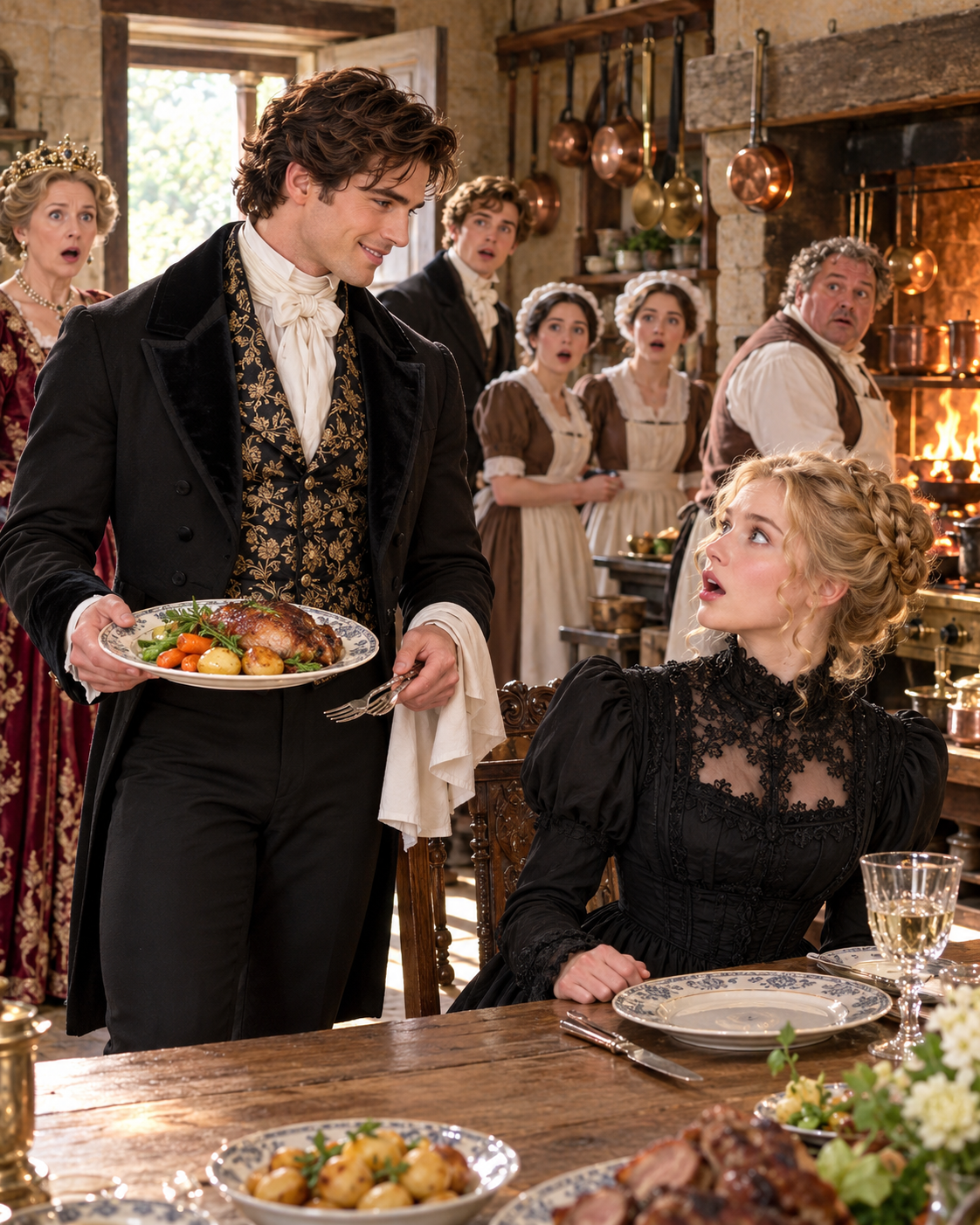
The housekeeper looked toward Lady Ashdown.
“Mr. Harcourt came here after Sir Edmund’s death. He brought papers for Her Ladyship to sign.”
Nicholas’s gaze sharpened.
“Edward Harcourt?”
Mrs. Bell nodded.
Nicholas knew the name.
Harcourt was a solicitor in Bath, respectable in appearance and particularly skilled at managing the affairs of families who preferred their difficulties kept private.
He had also represented Lady Ashdown in the years following Frederick’s death.
“Where are the trust accounts?” Nicholas asked.
Lady Ashdown said nothing.
Grace looked at her mother-in-law.
“Did you know?”
Lady Ashdown’s eyes moved toward the marriage certificate.
“Yes.”
The answer came without hesitation.
Grace felt the simplicity of it more sharply than any excuse.
“All this time?”
“Yes.”
“Then why?”
Lady Ashdown approached the window.
Outside, the garden paths had disappeared beneath darkness and rain.
“Because everything your husband touched became yours.”
Her voice was low and controlled.
“My son was educated to inherit this estate. His father expected him to marry wisely, to strengthen our position, to restore what generations before him had spent.”
She turned.
“Instead, he returned with a woman who had served ale to strangers.”
Grace remained still.
Lady Ashdown continued, each word measured.
“He would not listen to reason. Neither would Sir Edmund. By the time I understood what your presence had cost us, it was too late.”
Nicholas set the papers on the desk.
“What it cost you?”
Lady Ashdown looked at him.
“You have never had to watch an estate collapse around you, Your Grace.”
He glanced toward the painted ceiling, the silk-covered chairs, the expensive carpet beneath their feet.
“From what I have seen this evening, the collapse has been remarkably comfortable.”
For the first time, Lady Ashdown’s composure cracked.
“You know nothing of what I endured.”
Grace spoke before Nicholas could answer.
“I know what Frederick endured.”
Lady Ashdown fell silent.
“He spent his last months trying to make certain I would be safe,” Grace continued. “And while he was dying, you were planning how to make me disappear.”
“No.”
The word came too quickly.
Nicholas looked up.
“No?”
Lady Ashdown’s eyes flickered.
“I never wished Frederick dead.”
“Then what did you wish?” Grace asked.
A long silence followed.
Lady Ashdown pressed a hand against the mantel.
“I wished he had never married you.”
Grace looked down at the green ribbon.
She had expected anger to come.
Instead, she felt a deep and unfamiliar quiet.
At last, the truth stood plainly before her, stripped of polite excuses.
Frederick’s mother had not misunderstood her.
She had seen Grace clearly enough.
She had simply decided that Grace’s life mattered less.
Nicholas gathered the papers.
“We will have these examined by an independent solicitor. Until then, nothing in this room is to be removed.”
Lady Ashdown gave a thin laugh.
“And you imagine I will allow you to take possession of my son’s affairs?”
“No,” Nicholas replied. “I imagine you will attempt to stop us.”
He looked toward the door.
“That is why I sent my man for the magistrate before we came upstairs.”
Lady Ashdown’s face changed.
Grace turned toward him.
“You sent for someone?”
“When I saw her recognize the note.”
Nicholas paused.
“Frederick trusted me to deliver his letter. I have already failed him for two years. I do not intend to fail him again.”
A distant knock sounded from the entrance hall.
Mrs. Bell closed her eyes.
Lady Ashdown gripped the mantel.
And then, from somewhere below, a man’s voice called out.
“Your Ladyship? I was told you required me urgently.”
Nicholas recognized the voice before the footsteps reached the stairs.
Edward Harcourt.
The solicitor had arrived.
And he was carrying a leather document case.
Harcourt entered the blue room with the brisk confidence of a man accustomed to being welcomed.
That confidence lasted until he saw Nicholas.
“Your Grace.”
His smile faltered.
“I was not informed you would be visiting.”
“Clearly.”
Nicholas gestured toward the desk.
“We have discovered several documents that require explanation.”
Harcourt’s gaze moved over the papers.
For the briefest moment, his eyes stopped on the green ribbon.
Grace saw it.
So did Nicholas.
“How fortunate,” Harcourt said, recovering himself. “I should be pleased to examine them.”
He extended his hand.
Nicholas did not pass them over.
“First, perhaps you might explain why Mrs. Ashton has been denied the income provided under Sir Edmund’s settlement.”
Harcourt became very still.
“I am not sure I understand.”
“The trust accounts,” Nicholas said. “Where are they?”
Harcourt glanced toward Lady Ashdown.
She looked away.
Grace stood beside Frederick’s old desk.
“Did you know my husband had left instructions for my protection, Mr. Harcourt?”
The solicitor adjusted his cuffs.
“Captain Ashton was not in sound health toward the end.”
“That wasn’t my question.”
He looked at her properly then.
Perhaps it was the first time he had done so.
Grace wore a plain brown dress, its sleeves carefully mended. A faint burn marked one wrist, and flour remained caught beneath one fingernail.
But she stood beside the Duke of Aldridge, with legal documents spread before her, and she did not lower her eyes.
Harcourt cleared his throat.
“Financial arrangements of this nature are frequently complicated.”
Nicholas opened the leather case resting beside the solicitor’s chair.
Harcourt caught his wrist.
“You have no right—”
“Then you will open it yourself.”
The two men looked at each other.
Slowly, Harcourt released his grip.
He unfastened the case.
Inside lay a ledger, several envelopes, and a folded deed bearing a dark blue seal.
Nicholas lifted the ledger.
The first pages contained estate expenses.
Repairs.
Wages.
Land rents.
Then came a series of payments marked simply as household administration.
Each had been charged against the funds intended for Grace.
There were purchases from London dressmakers.
Bills for private dinners.
A new carriage.
Interest payments on Lady Ashdown’s personal debts.
And, scattered among them, small entries labeled Widow’s Maintenance.
Grace leaned closer.
The sums were barely enough to cover a servant’s monthly wages.
Beneath each entry appeared her name.
And beside it, a signature.
Grace Ashton.
She stared at the ink.
“I never signed these.”
Harcourt opened his mouth.
No words followed.
Nicholas turned another page.
The same forged signature appeared again.
And again.
Mrs. Bell stepped closer.
“Those are the papers Her Ladyship made me witness.”
Lady Ashdown turned sharply.
“You signed nothing without reading it?”
“I was told they concerned kitchen accounts.”
Harcourt began closing his case.
“I believe this discussion should continue with professional counsel present.”
Nicholas placed a hand upon the ledger.
“It shall.”
Footsteps approached.
A uniformed magistrate appeared in the doorway, accompanied by Nicholas’s valet.
The solicitor’s face lost its color.
The magistrate, Mr. Pembroke, was a careful man with silver spectacles and a habit of listening longer than most people found comfortable.
He surveyed the room.
Nicholas explained what had been discovered.
Pembroke examined the signatures, the marriage certificate, and the settlement papers.
Then he turned to Grace.
“Mrs. Ashton, did you authorize any of these payments?”
“No, sir.”
“Did you receive them?”
“No.”
“Were you informed that such a fund existed?”
Grace looked toward Lady Ashdown.
“I was told my husband had left me nothing.”
Pembroke wrote something in his notebook.
Harcourt shifted.
“There are circumstances that require clarification.”
“I have no doubt,” Pembroke said.
He closed the ledger.
“Until those circumstances are examined, these records will be secured. Mr. Harcourt, you will be expected to provide the original trust instruments and complete accounts.”
Harcourt’s mouth tightened.
“You cannot assume misconduct merely because a widow misunderstands her position.”
Grace reached for the forged payment receipt.
She placed it beside Frederick’s letter.
“The handwriting is different.”
Pembroke examined both.
Grace touched the final curve of her name.
“Frederick always teased me because I wrote my capital G like an ordinary C. He said one day I would sign my name and nobody would know who I was.”
She looked at Harcourt.
“Whoever wrote this gave me a beautiful G.”
Nobody laughed.
Pembroke took the receipt from her.
“An observation worth recording.”
Lady Ashdown sank into a chair.
The room had grown cold.
Grace realized that Frederick’s mother had begun trembling.
For a moment, pity stirred in her.
Then she remembered the winter when she had asked for coal and been told to wear another shawl.
She remembered eating alone while music drifted down from the drawing room.
She remembered believing that poverty was the final judgment of everyone who had ever doubted her marriage.
She allowed the pity to remain.
She did not allow it to guide her.
By midnight, the magistrate had arranged for the documents to be secured.
Harcourt was required to remain available for further inquiry, and Lady Ashdown was instructed not to interfere with estate records.
It was not a dramatic arrest.
No chains appeared.
No declarations filled the corridor.
Instead, the first consequences arrived in the quiet language of inventories, witnesses, and legal obligations.
Grace found that more satisfying than she had expected.
Nicholas accompanied her downstairs.
In the kitchen, the fire had burned low.
Her broken plate had been swept away.
Someone had left a fresh cup of tea beside her stool.
Grace stopped in the doorway.
For two years, this room had been both her workplace and her refuge.
She knew every crack in its walls.
She knew which floorboard creaked near the pantry and which window rattled before a storm.
Now, for the first time, she could imagine leaving it.
Nicholas stood beside the table.
“You needn’t remain here tonight.”
Grace looked at him.
“Where would I go?”
“My sister has a house in Bath. She would be glad to receive you.”
Grace smiled faintly.
“You have not seen me in years, Nicholas. Your sister has never met me.”
“She has heard of you.”
“From whom?”
“Frederick.”
The name settled gently between them.
Nicholas pulled out a chair.
“He wrote to me often after returning to England.”
Grace sat.
Outside, the rain had softened.
“What did he say?”
Nicholas removed a small packet of letters from his coat.
“He complained about the weather. He complained about the doctors. He complained, with considerable enthusiasm, about your insistence that he drink terrible herbal remedies.”
Grace gave a small, surprised laugh.
“He hated those remedies.”
“He wrote that you threatened to put them in his soup.”
“I did.”
Nicholas smiled.
Then his expression changed.
“He also wrote that he had never been happier.”
Grace looked down.
For a while, she said nothing.
Then she touched the edge of the packet.
“May I read them?”
“They’re yours.”
Nicholas placed the letters in her hands.
The kitchen clock struck one.
Grace opened the first.
Frederick’s voice seemed to rise from the paper with painful familiarity.
There were ordinary things.
A description of a horse he hoped to buy.
A complaint about a leaking roof.
A ridiculous argument over whether the English countryside could ever produce a proper mango.
And there were quieter passages.
Frederick had written that Grace was becoming increasingly isolated at Ashdown Park.
His mother would not invite her to dinners.
Old acquaintances had stopped calling.
He had begun to suspect that servants were being instructed to carry false messages between the rooms.
In the final letter, written shortly before his illness worsened, Frederick had added a single sentence.
“I fear that when I am gone, they will try to convince her she was never truly one of us.”
Grace read it twice.
Nicholas watched her fold the page.
“He knew,” she whispered.
“He suspected.”
“And I thought he had stopped noticing.”
Nicholas leaned forward.
“Grace, Frederick noticed everything about you.”
Her lips trembled.
She turned away before he could see the tears.
He did not reach for her.
Instead, he moved the tea closer.
It had gone lukewarm, but she drank it anyway.
For the first time in years, she was allowed to grieve without first asking whether there was work waiting.
The weeks that followed were neither swift nor simple.
Harcourt retained counsel and protested that the disputed payments had been authorized by Lady Ashdown.
Lady Ashdown maintained that she had acted to preserve the estate.
Their explanations contradicted one another so frequently that Pembroke began recording the discrepancies separately.
An independent solicitor, Mr. Whitcomb, examined Sir Edmund’s will and confirmed that Grace’s marriage had never been lawfully invalidated.
The forged note found beneath the bedroom floor had no legal standing.
The original settlement was valid.
And the accounts revealed that substantial sums had been diverted over several years.
Grace received the news in Nicholas’s sister’s drawing room, where sunlight fell across pale green curtains.
Lady Eleanor Fane had welcomed her without ceremony.
She had asked whether Grace preferred tea or coffee, shown her a comfortable bedroom, and never once demanded an explanation for the roughness of her hands.
That kindness had nearly undone her.
Now Mr. Whitcomb sat opposite Grace, his papers arranged in careful stacks.
“You have a strong claim for restoration of the funds, Mrs. Ashton. Certain assets may have to be sold.”
Grace looked toward the window.
“Will the servants lose their employment?”
The solicitor paused.
“That depends upon the estate’s future arrangements.”
Grace nodded slowly.
“Then I should like to understand them before deciding anything.”
Whitcomb adjusted his spectacles.
“Most people in your position would be eager to recover every penny.”
“I am.”
Grace folded her hands.
“But the stable boys did not forge my name.”
Nicholas, seated beside the fireplace, looked up.
Something in his expression softened.
Grace continued.
“Nor did the maids. Whatever happens to Lady Ashdown, I don’t want innocent people punished in her place.”
Whitcomb considered her.
“Then we shall structure the recovery accordingly, where the law permits.”
The investigation eventually established that Harcourt had knowingly accepted false signatures and had allowed unauthorized withdrawals from the trust.
Proceedings were brought against him.
His professional standing collapsed before the case reached its final hearing.
Lady Ashdown faced civil claims for the diverted money, and her personal property was placed under considerable financial pressure.
When Grace next saw her, winter had arrived.
Ashdown Park looked smaller beneath the gray sky.
The rose bushes stood bare.
Several windows had been shuttered to save heating costs.
Lady Ashdown received her in the morning room.
There were no servants present.
Nicholas waited outside at Grace’s request.
For a while, neither woman spoke.
Lady Ashdown’s hair had grown noticeably grayer.
She sat beside the fireplace wearing a plain dark gown, her hands resting upon an unopened book.
“I understand the settlement has been confirmed,” she said.
“Yes.”
“And you intend to take what is owed.”
“Yes.”
Lady Ashdown looked toward the window.
“Your husband would have hated this.”
Grace remained standing.
“No. Frederick would have hated that it was necessary.”
A faint line appeared between the older woman’s brows.
“You think you knew him better than his mother?”
Grace considered the question.
“I knew the man he chose to become.”
Lady Ashdown’s fingers tightened around the book.
“He was my only son.”
“I know.”
“I gave him everything.”
Grace looked at the room around them.
The expensive curtains.
The carved mantel.
The portraits of generations who had worn the Ashton name.
“Except permission to be happy in a way you hadn’t chosen.”
Lady Ashdown closed her eyes.
For an instant, Grace saw not the commanding woman who had ruled Ashdown Park, but someone exhausted by a battle she had mistaken for duty.
“I thought if you left,” Lady Ashdown said slowly, “he would eventually return to himself.”
Grace lowered her gaze.
“He did return to himself.”
She touched the wedding ring on her finger.
“He was himself when he married me.”
Lady Ashdown turned away.
There was nothing left to argue.
Grace approached the door.
“Mrs. Bell told me you have been unwell.”
“It is of no consequence.”
“I hope you recover.”
Lady Ashdown looked up, startled.
“After everything?”
Grace rested her hand upon the door handle.
“I don’t wish you ill. But I won’t pretend you did me no harm.”
She opened the door.
Behind her, the older woman spoke once more.
“Grace.”
She stopped.
Lady Ashdown stared into the fire.
“I did love him.”
Grace’s eyes filled.
“I know.”
Then she left.
Spring returned slowly.
Grace spent much of it visiting the estate with Mr. Whitcomb, examining cottages, meeting tenants, and learning the practical details of the income Sir Edmund had intended for her.
She discovered leaking roofs, neglected drainage, and families who had been quietly struggling while money vanished into Lady Ashdown’s accounts.
The more she learned, the less interested she became in silk gowns and grand carriages.
She wanted repairs.
She wanted reliable wages.
She wanted the small estate cottages made habitable before another winter arrived.
Nicholas accompanied her on several visits.
He never attempted to direct her decisions.
When she asked his opinion, he gave it plainly.
When she disagreed, he listened.
Their friendship settled into something that belonged neither to their years in India nor to the painful months after Frederick’s death.
They spoke of ordinary things.
Gardens.
Books.
Weather.
The peculiar stubbornness of English cooks when asked to use unfamiliar spices.
Once, while walking along the edge of the estate, Nicholas remarked that he still had not found anyone capable of making milagu thani quite as she did.
Grace glanced at him.
“That is because you insist on adding pepper before the oil is hot.”
He looked offended.
“I have never made such a mistake.”
“You did it twice in Madras.”
“Frederick told you?”
“Frederick told everyone.”
Nicholas laughed.
It was the first time she had heard him laugh without restraint since their reunion.
The sound brought back a veranda in India, the heavy scent of rain, and Frederick sitting between them with his sleeves rolled up.
For a moment, grief returned so sharply that Grace stopped walking.
Nicholas stopped beside her.
Neither spoke.
Then Grace looked toward the hills.
“I still miss him.”
“I know.”
“Sometimes I feel disloyal when I laugh.”
Nicholas considered his answer.
“Frederick was never particularly pleased when people behaved solemnly around him.”
A small smile touched her mouth.
“No. He would have made a terrible joke.”
“Almost certainly.”
They continued walking.
The wind moved softly through the new leaves.
By midsummer, Grace had recovered enough of the diverted settlement to begin a project she had been considering for months.
At the edge of Ashdown village stood an abandoned coaching house.
Its roof sagged, its windows were cracked, and weeds had overtaken the courtyard.
Grace purchased it with her own funds.
She called it Ashton House.
Not because she wished to preserve the family’s grandeur.
But because she wanted the name to mean something different.
The building became a place where widows and women without family support could find temporary work, meals, and practical instruction.
Some learned sewing.
Others managed accounts or prepared food.
A few needed nothing more than a safe room until they could find a place of their own.
Grace insisted that every worker be paid.
She also insisted that no woman be questioned about her birthplace or parentage before being offered a meal.
Mrs. Bell, now retired from Ashdown Park, volunteered to supervise the kitchen.
On the morning Ashton House opened, she watched Grace arrange bowls along a long wooden table.
“You ought to be wearing something finer, ma’am.”
Grace looked down at her simple blue dress.
“Why?”
“You are the lady who owns the place.”
Grace smiled.
“Then I suppose I may decide what its lady wears.”
Mrs. Bell shook her head, though her eyes were bright.
Outside, children gathered beside the gate.
The smell of bread drifted through the open windows.
Grace stood still for a moment, listening.
Laughter.
Footsteps.
The scrape of chairs.
The steady, ordinary sounds of people entering somewhere they were welcome.
Nicholas arrived shortly before noon.
He carried a small parcel wrapped in brown paper.
“For the kitchen,” he said.
Grace eyed it suspiciously.
“If it is another attempt at pepper soup, I shall refuse.”
“It is not soup.”
She opened the parcel.
Inside lay a polished wooden box containing a collection of spices from India, each carefully labeled.
Beneath them was a folded letter.
Grace recognized the handwriting.
Frederick’s.
She looked up.
Nicholas nodded.
“I found it among my papers last month. It was written years ago, before either of us knew how matters would turn.”
She unfolded the letter.
Frederick had written to Nicholas during their final months in India, when they were discussing the future with the careless confidence of young men.
There were jokes about promotions and the discomforts of sea travel.
Then came a passage that made Grace’s vision blur.
“If you ever find Grace convinced she is of no consequence, remind her that she taught me the difference between being admired and being loved. I hope I spend the rest of my life deserving her.”
Grace pressed the paper gently against her chest.
Nicholas stood beside her, looking toward the busy courtyard.
“He always spoke of you that way.”
She drew a long breath.
“I wish he had said it to me more often.”
Nicholas turned.
“He thought he had.”
Grace laughed softly through her tears.
“Yes. That sounds like him.”
They stood together for a while.
Then the bell above the entrance rang, and a young woman stepped inside carrying a sleeping child.
Her dress was damp from the road.
She hesitated beneath the doorway, taking in the clean tables and warm kitchen.
“I was told there might be work here,” she said.
Grace folded Frederick’s letter and placed it safely in her pocket.
“There is.”
The woman glanced at the child in her arms.
“I cannot leave him.”
“Then bring him with you.”
The young woman stared.
Grace pulled out a chair.
“Have you eaten?”
A moment passed.
Then the woman shook her head.
Grace turned toward Mrs. Bell.
“Two bowls, please.”
The older housekeeper smiled and moved toward the stove.
Years later, people in Ashdown village would remember many things about Grace Ashton.
They would remember that she repaired the cottages before improving her own rooms.
That she listened carefully when servants spoke.
That she never permitted a widow to be dismissed as a burden.
They would remember the small green ribbon she kept inside her writing desk, and the silver cufflink resting beside it.
Some would speak of the Duke of Aldridge, who remained her devoted friend and frequent visitor.
There were rumors, naturally.
Villages rarely allowed a friendship between a duke and a widow to pass without speculation.
Grace paid them little attention.
Whatever the future held, she had learned not to let other people name her life for her.
On the fifth anniversary of Ashton House, Nicholas found her standing beside the garden gate after the evening meal.
The sunset had turned the windows gold.
Inside, Mrs. Bell was arguing affectionately with a young cook about the correct amount of cumin.
Nicholas stood beside Grace.
“Frederick would have loved this place.”
Grace watched two children racing along the garden path.
“I hope so.”
“He would have complained that you work too hard.”
“He complained about that when I did very little.”
Nicholas smiled.
Then he reached into his coat and withdrew a small leather-bound book.
“What is that?”
“The original account of your soup recipe, as written by Frederick.”
Grace opened it.
The pages were stained, the ink faded.
Frederick’s handwriting wandered across the margins, accompanied by absurd comments and corrections.
At the bottom of the first page, he had written:
“Grace says the secret is patience. Nicholas says the secret is pepper. I suspect the secret is that neither of us can cook.”
Grace laughed.
A real laugh, warm and unguarded.
She closed the book and held it against her chest.
For a few moments, she watched the last light settle over the garden.
Then she spoke.
“For a long time, I thought everything ended when Frederick died.”
Nicholas said nothing.
“I thought I had lost my place in the world because I had lost the person who gave it to me.”
She looked toward Ashton House, where the windows glowed and voices rose from the dining room.
“But he never gave me my worth, did he?”
Nicholas turned toward her.
“No.”
Grace smiled faintly.
“He was simply the first person who made me believe I had it.”
The evening bell rang.
Someone called for Grace from inside.
A pot had boiled over.
One of the children had misplaced a shoe.
Mrs. Bell wanted to know where the extra blankets had been stored.
Life, in all its untidy abundance, was waiting.
Grace tucked Frederick’s little book beneath her arm.
“Will you come in?”
Nicholas offered his arm.
“With pleasure.”
Together, they walked toward the house.
At the threshold, Grace paused.
She remembered another doorway, years before, when she had stood in a plain dress while a woman in silk told her to remain unseen.
She remembered the cold kitchen, the broken plate, and the letter that had brought her husband’s voice back across two years of silence.
Once, she had believed that dignity was something a family could grant or withdraw, like an invitation to dinner.
Now she knew better.
A title could open doors.
Money could purchase comfort.
A grand name could fill a room with people willing to bow.
But none of those things could make a person honorable.
Honor lived in the choices made when no one important was watching.
In wages paid fairly.
In promises kept.
In the courage to tell the truth when silence would be easier.
And sometimes, it lived in something as simple as offering a warm bowl of soup to someone who had nowhere else to go.
Grace stepped inside.
The kitchen was bright, the table crowded, and there was room for another chair.
She set Frederick’s book beside the stove, rolled up her sleeves, and reached for the pepper.
This time, nobody asked her to hide.
THE END.