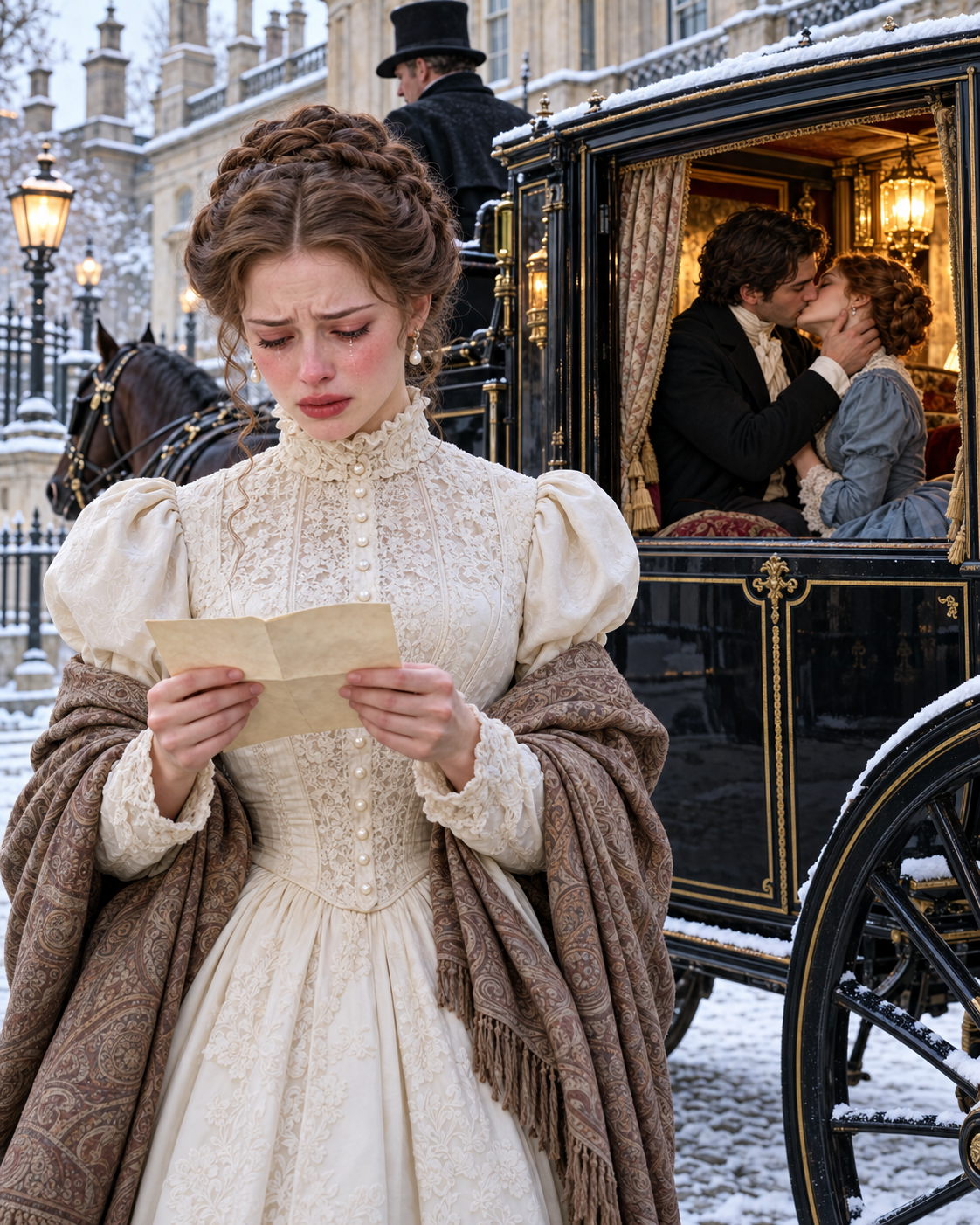
The Duchess discovered her husband’s mistress had been living on her money when she found a payment bearing her signature.
The six words beneath her mother’s signature seemed to drain every sound from the library.
“Arthur was not the first one.”
Eleanor Whitcomb stared at the faded ink, her fingers resting against the edge of the paper. Across the desk, her husband stood perfectly still.
For a long moment, neither spoke.
Then Arthur reached for the letter.
Eleanor moved it away before his fingers could touch it.
“Sit down.”
“Eleanor, you have no idea what you’re dealing with.”
“Then perhaps you should explain.”
His eyes shifted toward the door. The fire had nearly burned out, leaving a narrow ribbon of orange light beneath the blackened logs.
“Your mother was not the woman you believed her to be.”
Eleanor studied him.
It was an extraordinary thing to say about a woman he had once praised at every family dinner, whose portrait still hung above the great staircase.
“Be careful,” she said quietly.
Arthur swallowed.
“Some things were arranged long before our marriage.”
“By whom?”
He said nothing.
Eleanor folded the letter and placed it inside her desk.
“Then I shall discover them without your assistance.”
Arthur gave a short, humorless laugh.
“You think a few bank managers and solicitors can protect you from this?”
“No,” Eleanor replied. “But I think they can protect my property from you.”
His expression hardened.
“You have made a serious mistake.”
She reached for the bell.
“Perhaps. But it is mine to make.”
The door opened almost immediately.
Her steward, Mr. Bennett, appeared in the doorway.
“Your Grace?”
“His Grace is leaving.”
Arthur looked at her as though waiting for some familiar softness to return.
It did not.
He collected his gloves, crossed the library, and stopped beneath the doorframe.
“If you pursue this, Eleanor, you may regret what you find.”
She met his gaze.
“I already regret what I trusted.”
He left without another word.
Only after his footsteps disappeared did Eleanor allow herself to look down at her hands.
They were trembling.
She clasped them together until they became still.
By morning, the rain had passed, leaving the estate beneath a pale October sky.
Eleanor had slept less than three hours.
At breakfast, she received three messages.
The first was from the bank, confirming that Arthur had attempted to withdraw funds shortly after midnight. His request had been refused.
The second came from her solicitor, Edmund Hale, who requested an immediate meeting.
The third was delivered without a name.
It was a narrow envelope of inexpensive gray paper, damp at one corner.
Inside lay a single photograph.
A woman stood on the steps of a modest London townhouse, holding the hand of a little boy.
Eleanor recognized the woman from a miniature portrait she had found among Arthur’s possessions months earlier.
His mistress.
But it was the boy who held her attention.
He could not have been older than seven.
His coat was neatly buttoned, and he stood with one hand tucked inside the woman’s glove.
On the reverse of the photograph, someone had written an address.
Beneath it were four words.
Ask her about Margaret.
Eleanor read them twice.
Margaret had been her mother’s name.
She rang for Bennett.
“Have the carriage prepared.”
“Will you be visiting Mr. Hale, Your Grace?”
“Eventually.”
She slipped the photograph into her handbag.
“First, I intend to meet someone my husband has spent a great deal of money keeping comfortable.”
The townhouse stood on a quiet London street lined with bare trees and polished brass door knockers.
Nothing about it suggested scandal.
A maid opened the door, glanced at Eleanor’s carriage, and hesitated when she heard her name.
“Is Mrs. Vale expecting you?”
“No.”
The maid looked over her shoulder.
Eleanor waited.
After a moment, the woman stepped aside.
The drawing room was warm and tastefully furnished. Fresh flowers stood beside the fireplace, and an expensive silk shawl had been left across the back of a chair.
Eleanor recognized the shawl.
She had seen its purchase recorded in the estate accounts.
A few minutes later, a young woman entered.
She was perhaps thirty, with dark hair pinned loosely at her neck and a face that suggested she had spent the morning worrying about something she could not control.
“Duchess Whitcomb.”
“Mrs. Vale.”
The woman’s eyes moved toward the doorway.
“My maid said you wished to speak with me.”
“I do.”
Eleanor placed the photograph on the table between them.
“Who sent me this?”
Mrs. Vale looked at the picture.
The color left her face.
“Where did you get it?”
“It was delivered to me this morning.”
The woman picked it up with unsteady fingers.
For the first time, Eleanor noticed that the corner had been creased, as though someone had carried it for a long time before placing it in the envelope.
“Is the child Arthur’s?” Eleanor asked.
Mrs. Vale looked up sharply.
“No.”
The answer came too quickly to be rehearsed.
Eleanor believed her.
“Then whose child is he?”
“My brother’s.”
“Where is your brother?”
Mrs. Vale lowered her eyes.
“Dead.”
A clock ticked above the mantelpiece.
Eleanor waited.
“My name is Clara Vale,” the woman said at last. “And I believe your husband has told both of us a great many lies.”
Eleanor sat down.
Clara remained standing.
“Arthur told me you were aware of our arrangement.”
“What arrangement?”
“That he would provide for me until certain family matters had been settled.”
Eleanor glanced toward the silk shawl.
“And did he explain where the money came from?”
“He said it was his inheritance.”
“He has no inheritance of that size.”
Clara’s fingers tightened around the photograph.
For several seconds, she looked as though she might deny everything.
Instead, she sat opposite Eleanor.
“My brother was employed by your mother’s household,” she said.
Eleanor felt something shift beneath the familiar shape of the conversation.
“In what capacity?”
“He worked in the estate office. His name was Thomas Vale.”
She remembered the name.
Not clearly, but enough.
An efficient young clerk, her mother had once called him.
Thomas had disappeared from the estate shortly before Margaret’s death. Eleanor had been told he had taken employment abroad.
“Thomas died three years ago,” Clara continued. “Before he died, he gave me a packet of papers and made me promise never to surrender them to anyone named Whitcomb.”
Eleanor kept her voice level.
“Why?”
“Because he believed someone had killed your mother.”
Outside, carriage wheels passed over the wet street.
For a moment, Eleanor could hear them more clearly than her own breathing.
“My mother died after a long illness.”
“That is what everyone was told.”
Clara looked toward the closed door.
“My brother believed her illness began after she discovered money missing from the estate.”
Eleanor leaned back slightly.
It was not the accusation alone that disturbed her.
It was the way it fitted around the forged signatures, the unexplained accounts, and the letter her mother had hidden.
“Where are the papers?”
Clara’s expression changed.
“That is why Arthur came to me.”
She spoke quietly now, with the exhausted precision of someone who had repeated these events many times in her head.
Arthur had appeared at Clara’s lodging shortly after Thomas’s death. He knew about the documents, knew about her nephew, and offered financial protection in exchange for the packet.
He had been charming at first.
Then persistent.
Eventually, threatening.
“He told me my brother had stolen from your family,” Clara said. “That the papers were evidence of a crime. He said if they became public, my nephew might lose everything Thomas left him.”
“And you believed him?”
“I wanted to.”
The answer was so simple that Eleanor had no immediate reply.
Clara glanced at the expensive room.
“He made it very easy to believe him.”
Eleanor followed her gaze.
For the first time, the furnishings seemed less like signs of luxury than objects purchased to keep someone from leaving.
“Do you still have the papers?”
Clara hesitated.
“Some of them.”
“Where?”
Before Clara could answer, footsteps sounded in the hallway.
A small boy appeared in the doorway, carrying a wooden horse with one broken leg.
“Aunt Clara?”
She stood immediately.
“Henry, darling, go back upstairs.”
The boy looked curiously at Eleanor.
Then he approached the table.
“Are you the lady from the picture?”
Eleanor went still.
Clara’s face changed.
“Henry.”
But the child had already pointed toward Eleanor.
“The lady Grandmother Margaret used to visit?”
Silence settled over the room.
Eleanor slowly turned toward Clara.
“Grandmother?”
Clara closed her eyes.
And Eleanor understood that the photograph had not been sent merely to expose an affair.
It had been sent to lead her here.
“Henry,” Clara whispered, “please go upstairs.”
The boy hesitated, then obeyed.
When his footsteps faded, Eleanor remained seated.
“Tell me everything.”
Clara took a long breath.
“Thomas was not my brother by blood.”
Eleanor said nothing.
“He was the son of your grandfather.”
Eleanor’s eyes narrowed.
“My mother’s father?”
Clara nodded.
“Born before your grandparents married. He was raised under another name, but your mother discovered who he was when she was young.”
Eleanor remembered Thomas Vale standing beside the estate carriage, quietly holding her mother’s account books.
Her mother had always treated him with unusual warmth.
At the time, Eleanor had thought nothing of it.
“She brought him into the household,” Clara continued. “Not because he needed employment, but because she wanted him near his family.”
“And Henry?”
“Thomas’s son.”
Eleanor glanced toward the doorway.
The little boy was her distant cousin, bound to her through a history no one had bothered to explain.
“Why conceal him?”
“Because Thomas discovered that someone had been using your mother’s money for years. He believed the theft began before Arthur entered the family.”
Eleanor looked toward the photograph.
Her mother’s hidden words returned with terrible clarity.
Arthur was not the first one.
“Who was?”
Clara reached beneath the cushion of her chair and drew out a small brass key.
“My brother believed the answer was inside your mother’s private correspondence.”
Eleanor took the key.
“Where?”
“In a locked cabinet at the old hunting lodge.”
The lodge stood on the northern edge of the Whitcomb estate, nearly an hour from the main house.
Eleanor had not visited it since her mother’s funeral.
For years, the building had remained shuttered, its garden overgrown and its furniture covered in white linen.
She arrived there the following afternoon with Bennett and Edmund Hale.
The solicitor had listened to her account without interruption.
Now, standing beneath the lodge’s weathered stone entrance, he looked deeply troubled.
“Your Grace, there are serious implications if these documents are genuine.”
“I am aware.”
“The bank may not be the only institution involved.”
“Then we shall discover how many others there are.”
Inside, the house smelled of cold wood and old paper.
Bennett opened the shutters, allowing pale daylight to fall across the furniture.
Eleanor led them into her mother’s former sitting room.
The cabinet stood beside a narrow bookshelf.
She remembered it immediately.
Her mother had kept botanical drawings inside, along with letters Eleanor had once been forbidden to touch.
The brass key turned with difficulty.
Inside were three wooden compartments.
Two were empty.
The third contained a sealed leather folio.
Eleanor lifted it out.
The wax bore her mother’s initials.
She broke the seal.
There were letters, account statements, and a handwritten record of payments extending back nearly twenty-five years.
Edmund moved closer as Eleanor examined the first pages.
The sums were substantial.
Properties had been transferred, loans secured, and investments redirected through a chain of private companies.
At the center of the arrangements appeared one name.
Sir Reginald Ashcombe.
Eleanor’s uncle.
Her mother’s younger brother.
He had been the charming, generous figure of her childhood, the man who brought her books from Paris and taught her how to ride.
After her mother’s death, he had managed several estate matters until Eleanor married Arthur.
Then he had stepped aside.
Or appeared to.
“Good heavens,” Edmund murmured.
He had found a contract dated two years before Margaret’s death.
It authorized Reginald to manage a portion of the family holdings.
The signature was Margaret’s.
At first glance, it appeared genuine.
Eleanor examined the final stroke.
The ink continued without a break.
Her fingers tightened around the paper.
“He forged hers too.”
Edmund looked up.
“Your Grace?”
Eleanor placed the document beside the signatures bearing her own name.
The same subtle mistake appeared on both.
But there was something else.
On the earliest documents, the forged signature lacked confidence. Later examples were smoother, more practiced.
Someone had been perfecting the technique for years.
Arthur had not invented it.
He had learned it.
Near the bottom of the folio lay a letter addressed to Eleanor.
Her name was written in her mother’s unmistakable hand.
She opened it carefully.
The paper had yellowed along its folds.
Her mother had written only a few pages, but every line carried the strain of someone attempting to finish an important task before time ran out.
Margaret explained that she had discovered Reginald’s fraudulent transactions shortly before her illness.
She had confronted him privately, hoping to protect the family from public disgrace.
Reginald had promised to return the money.
Instead, he had persuaded her to sign temporary agreements that placed more property under his control.
When she realized the deception, she began collecting evidence.
Thomas had helped her.
Then her health deteriorated.
Doctors came and went.
Medicines were prescribed.
Her access to visitors became increasingly restricted.
The final paragraph was written in a visibly unsteady hand.
Eleanor read it twice.
Then she lowered the letter.
“What does it say?” Edmund asked.
She handed it to him.
He read silently.
At the bottom, Margaret had written:
If I do not survive long enough to correct this, do not trust anyone who tells you the family name matters more than the truth.
Bennett stood beside the window, his face drawn.
He had served Margaret for nearly thirty years.
“Your mother asked me to deliver a letter to her solicitor shortly before she died,” he said quietly.
Eleanor turned.
“Did you?”
“I tried.”
His hands were clasped behind his back.
“Sir Reginald told me the matter had already been settled. He said Her Ladyship was confused because of her medication.”
“Why did you believe him?”
Bennett looked at the floor.
“Because he was her brother.”
The words lingered in the cold room.
Eleanor thought of all the years in which suspicion might have been dismissed simply because the accused man belonged to the family.
Then Edmund reached the final sheet in the folio.
“Your Grace, there is something else.”
He held out a document bearing Arthur’s signature.
It was dated six months before their wedding.
A private agreement.
Arthur had accepted a substantial payment from Reginald in exchange for persuading Eleanor to grant him financial authority after their marriage.
Eleanor stared at the date.
Six months before the ceremony.
Before the flowers.
Before the vows.
Before Arthur had stood beneath the chapel windows and promised to protect her.
She took the document from Edmund.
There was no tremor in her hand this time.
“Make a copy of everything,” she said.
“And the originals?”
“They remain with me.”
That evening, Eleanor returned to the main house to find an unexpected visitor waiting in the drawing room.
Sir Reginald Ashcombe rose when she entered.
He was approaching seventy, impeccably dressed, with silver hair and the mild expression that had made him welcome in drawing rooms throughout England.
“My dear Eleanor.”
He approached with his arms slightly open.
She did not move.
His smile faltered.
“I hear you’ve been upsetting everyone with accusations about the estate.”
“Have I?”
“Arthur is beside himself.”
“That is unfortunate.”
Reginald sighed.
“Marriages experience difficulties. It does not mean every disagreement must become a scandal.”
Eleanor removed her gloves.
“Did Arthur send you?”
“He is concerned for you.”
“How thoughtful.”
Reginald studied her face.
For the first time, his pleasant expression seemed carefully arranged.
“I knew your mother very well, Eleanor. She would have been distressed to see you behaving this way.”
Eleanor placed her gloves on the mantelpiece.
“My mother left me a letter.”
Reginald stopped smiling.
She watched his eyes.
There it was.
Not surprise.
Recognition.
“What letter?”
“The one she wrote shortly before she died.”
He slowly lowered himself into a chair.
“Your mother was very unwell toward the end.”
“Yes. Everyone keeps reminding me.”
“Her judgment was affected.”
“Was her handwriting?”
Reginald looked at her.
Eleanor took a folded document from her handbag.
“Because someone spent many years imitating it.”
His gaze dropped to the paper.
For a moment, the old man’s face seemed to age.
Then he recovered.
“I suggest you speak to your solicitor before making allegations you cannot prove.”
“I already have.”
He stood.
“Then you are choosing a very unpleasant road.”
Eleanor stepped aside, leaving the doorway clear.
“I imagine it has been unpleasant for everyone who traveled it before me.”
Reginald took his hat and left.
He did not kiss her cheek.
By the following morning, the first attempt to silence Eleanor had begun.
A London newspaper published a short article suggesting the Duchess of Whitcomb was suffering from nervous exhaustion following domestic difficulties.
Another reported that she had dismissed longtime advisers without explanation.
By noon, several acquaintances had sent concerned letters.
At two o’clock, Arthur requested an immediate meeting.
Eleanor declined.
At four, Edmund arrived carrying a formal notice.
Reginald and Arthur had petitioned the court for temporary authority over certain estate decisions, arguing that Eleanor’s recent conduct demonstrated impaired judgment.
Eleanor read the application without changing expression.
“They intend to make me appear incapable.”
Edmund nodded.
“They will likely rely on medical testimony and statements from household acquaintances.”
“Can they succeed?”
“They may cause considerable difficulty. But we can contest it.”
She placed the notice on her desk.
“Then we shall.”
Over the next week, the estate became a place of quiet preparation.
Edmund assembled the forged documents.
Bennett secured the household records.
Clara provided Thomas’s remaining papers, including letters showing that Reginald had repeatedly threatened to accuse him of theft.
Eleanor also requested an independent examination of her mother’s medical records.
That inquiry produced a disturbing detail.
In the final months of Margaret’s life, a physician recommended by Reginald had replaced her usual doctor.
He had prescribed increasing quantities of a sedative commonly used at the time for pain and sleeplessness.
The records did not establish that Margaret had been deliberately poisoned.
They did, however, show that her confusion and weakness had intensified after the medication began.
More troubling still, the physician had received payments from one of Reginald’s private companies.
Eleanor sat alone with the report long after Edmund left.
She had spent years remembering her mother’s final days as a slow, unavoidable disappearance.
Now even those memories had become uncertain.
The next morning, she instructed Edmund to refer the medical records to the appropriate authorities.
“Even if they find nothing criminal,” she said, “the question deserves an honest answer.”
The court hearing took place two weeks later.
Eleanor entered the building wearing a dark blue gown and a plain pearl brooch that had belonged to her mother.
Reporters gathered outside.
She did not acknowledge them.
Inside, Arthur sat beside Reginald.
Her husband looked exhausted.
His collar was slightly crooked, and there were dark shadows beneath his eyes.
Reginald, by contrast, appeared composed.
The proceedings began with the presentation of their claims.
Arthur described Eleanor’s sudden involvement in estate finances, her dismissal of established advisers, and her refusal to consult him.
Reginald spoke gently of family concern.
He suggested that grief over her mother’s death had never fully left her.
Eleanor listened.
She made no interruption.
When Edmund rose, he presented the bank’s confirmation that Eleanor had lawfully restricted access to her own property.
Then came the forged authorizations.
The examiner explained the similarities between the false signatures and their differences from genuine examples.
Additional witnesses confirmed that payments had been transferred without Eleanor’s knowledge.
Reginald remained still.
But when Edmund introduced the older documents bearing Margaret’s forged signature, the old man’s fingers began tapping against his knee.
The court examined the private agreement between Reginald and Arthur.
Arthur’s head dropped.
Edmund turned toward him.
“Did you receive money from Sir Reginald before marrying the duchess?”
Arthur said nothing.
The question was repeated.
Finally, he answered.
“Yes.”
A murmur moved through the room.
Eleanor looked at the man she had married.
He would not meet her eyes.
“Was that payment connected to obtaining authority over her finances?”
Arthur’s lips parted.
Reginald shifted beside him.
“Yes,” Arthur whispered.
Reginald rose abruptly.
“This is absurd. My nephew by marriage is confused, and these documents have been taken entirely out of context.”
But the court had heard enough to reject the request for temporary control.
The financial evidence would be examined in separate proceedings, and the allegations of forgery and fraud were referred for investigation.
Outside, the reporters crowded forward.
Eleanor continued walking.
Only when she reached her carriage did she hear Arthur call her name.
She turned.
He stood several feet away, his hat held awkwardly in both hands.
“Eleanor.”
She waited.
“I never intended it to become this.”
She looked at him for a long moment.
“Which part?”
He had no answer.
“The money?” she asked. “The marriage? Or the attempt to take away my right to manage my own life?”
Arthur stared at the pavement.
“I did love you.”
Eleanor watched a carriage pass behind him.
Then she said, very quietly, “Perhaps you loved being loved by someone who trusted you.”
He flinched.
She entered her carriage and closed the door.
The investigations continued through winter.
Reginald’s accounts revealed a pattern of fraudulent transfers extending back decades.
His private companies had concealed losses through loans secured against family property, some supported by forged documents.
Arthur’s involvement was more recent, but substantial.
He had knowingly assisted in concealing transactions, provided false authorizations, and diverted Eleanor’s funds toward his personal expenses and Clara’s household.
Clara testified about the documents Thomas had left her.
Her testimony was uncomfortable and deeply public.
But Eleanor made one matter clear through her solicitor.
Clara would not be pursued for money she had received without knowing its source.
She would, however, surrender the property purchased through the fraudulent arrangements and cooperate in recovering the assets.
Clara accepted without argument.
The townhouse was sold.
The proceeds were returned toward the losses.
Eleanor arranged for Henry’s legitimate inheritance from his father to be protected separately, beyond Reginald’s reach.
Their relationship never became an easy friendship.
Too much had happened.
But when Clara wrote to thank her, Eleanor answered with a single handwritten note.
Children should not inherit the debts of other people’s dishonesty.
In February, the inquiry into Margaret’s medical treatment reached its conclusion.
The evidence did not establish that Reginald had ordered her death.
The physician’s records were incomplete, and too many years had passed for certainty.
But the inquiry found serious irregularities in the prescriptions and undisclosed financial relationships.
Further proceedings followed.
Eleanor read the findings alone.
She had wanted an answer.
Instead, she received something less comforting.
A reason to question what had happened, without the certainty of knowing everything.
For several days, she found herself returning to the last afternoon she had spent with her mother.
Margaret had been lying beside the bedroom window, too weak to sit upright.
Eleanor remembered arranging the blankets around her shoulders.
Her mother had held her wrist.
“Promise me something.”
“What is it, Mama?”
“Never let someone persuade you that being good means being silent.”
At the time, Eleanor had thought it was the medication speaking.
Now, years later, she understood.
Spring arrived slowly.
The estate accounts were still being corrected, the legal proceedings still unfolding.
Reginald faced substantial civil claims and criminal charges arising from the fraudulent transactions.
Arthur’s position had collapsed.
He no longer controlled the money that had sustained his comfortable life, and many of the acquaintances who had praised him publicly now avoided his name.
Eleanor pursued a formal separation and the restoration of her financial rights.
She did not celebrate when the first judgment was entered in her favor.
She simply placed the papers in a drawer and returned to work.
There were roofs to repair.
Wages to review.
Tenants whose requests had been postponed while money disappeared into false accounts.
On a clear morning in April, Eleanor visited the cottages near the eastern boundary.
The elderly tenant who had once begged Arthur for a roof repair stood outside his home, watching workmen fit new tiles.
He removed his cap when her carriage stopped.
“Your Grace.”
“Mr. Cooper.”
He looked toward the men on the roof.
“I never thought I’d see it done.”
Eleanor followed his gaze.
Water stains still marked the upper wall, but the damaged beams had been replaced.
“It should have been done years ago.”
The old man rubbed his hands together.
“Well, it’s being done now.”
Eleanor smiled faintly.
“Yes,” she said. “It is.”
That evening, she returned to the library.
The same room where she had discovered the first forged signature.
The desk had been cleared.
Fresh flowers stood beside the window, and the curtains were open to the fading spring light.
Bennett entered carrying a small parcel.
“This arrived from London, Your Grace.”
There was no return address.
Inside lay a plain wooden box.
Eleanor opened it.
It contained her mother’s silver fountain pen.
The very pen Margaret had used to sign her final letters.
Beneath it was a note from Thomas Vale, written years earlier and preserved among the papers Clara had finally recovered.
It was addressed to the daughter of Margaret Ashcombe.
Eleanor unfolded it carefully.
Thomas explained that Margaret had known the danger of confronting Reginald.
She had also known that silence would leave Eleanor vulnerable to the same deception.
The pen had been given to Thomas for safekeeping, with instructions that it should be returned when Eleanor was finally able to make her own decisions about the estate.
At the bottom, Thomas had copied a sentence Margaret had spoken during one of their last conversations.
“A name may open doors, but character is what remains after the doors are closed.”
Eleanor held the pen for a long time.
Then she took a fresh sheet of paper.
She began drafting instructions for a new arrangement of the estate.
Independent oversight would replace the unchecked authority previously entrusted to relatives.
Major expenditures would require documented approval.
The accounts would be examined regularly, and no individual’s position in the family would place them above scrutiny.
She also established a fund for the education and welfare of children whose families worked on the estate.
It would be supported by recovered assets and income from property that had finally returned to her control.
The following month, Clara visited with Henry.
The little boy had grown taller.
He entered the library holding a book beneath his arm and looked with considerable interest at the shelves.
“Are all these yours?” he asked.
Eleanor smiled.
“Most of them.”
“Have you read them all?”
“Not yet.”
He seemed relieved.
Then he noticed the silver pen lying beside her writing paper.
“That’s Grandmother Margaret’s.”
Eleanor looked at him.
“How do you know?”
“Father used to show me a picture of it.”
She picked up the pen.
“Would you like to see it?”
Henry nodded solemnly.
She placed it in his hand.
He examined it with the serious concentration of a child who understood that an object mattered, even if he did not yet know why.
“Does it still work?”
Eleanor dipped the nib into the ink.
Then she gave him a small piece of paper.
“Shall we find out?”
Henry carefully wrote his name.
The letters were uneven, but perfectly legible.
Clara watched from the doorway.
For a brief moment, Eleanor thought of Margaret, Thomas, and the many choices that had led them all to this room.
So much could not be undone.
But not everything that survived the past had to remain damaged by it.
Later, after Clara and Henry departed, Bennett appeared with the evening correspondence.
Among the letters was one from Arthur.
Eleanor recognized his handwriting immediately.
She opened it beside the window.
There were several pages.
He described his diminished circumstances, his isolation, and the humiliation of seeing their marriage discussed in public.
He wrote that he had made foolish choices.
That Reginald had pressured him.
That he had never expected matters to go so far.
At the end, he asked whether they might meet privately and consider beginning again.
Eleanor read the letter once.
Then she folded it.
For a while, she stood watching the last light settle across the gardens.
The woman she had been several months earlier might have searched those pages for evidence of remorse.
She might have mistaken regret over consequences for regret over the harm itself.
Now she understood the difference.
Arthur had written at length about what he had lost.
He had written almost nothing about what he had taken.
Eleanor returned to her desk.
She placed a clean sheet of paper before her and picked up her mother’s pen.
Her reply was brief.
“Arthur, I hope you eventually become a man capable of living honestly. But I will not surrender the peace I have fought to recover simply because you have discovered the discomfort of your own choices.”
She signed her name.
Eleanor Whitcomb.
The letters flowed smoothly beneath the nib.
At the final stroke, she lifted the pen.
Outside, the church bells began ringing across the valley.
She handed the reply to Bennett and turned back toward the open window.
Beyond the gardens, the estate stretched into the evening light.
There were fields still needing attention, families rebuilding their lives, and decisions waiting on her desk.
There would be difficult days ahead.
Some losses could not be recovered, and some questions about her mother’s death would never receive certain answers.
But Eleanor no longer confused certainty with the ability to move forward.
She had once believed that loyalty meant protecting the people she loved from shame, even when doing so required her silence.
Her mother had learned the cost of that belief.
So had she.
Now Eleanor understood that loyalty without honesty could become another name for captivity.
She could acknowledge the years she had loved Arthur without permitting him to take another year of her life.
She could grieve what her family had concealed without passing its burden to the next generation.
And she could rebuild what remained without pretending that the damage had never existed.
Bennett returned quietly.
“Will there be anything else tonight, Your Grace?”
Eleanor looked at the estate accounts, the letters, and the small sheet of paper on which Henry had written his name.
“No, Bennett. Thank you.”
He bowed and withdrew.
She remained beside the window as the last bell faded.
For the first time in many years, the silence of the great house did not feel like something waiting to be filled by someone else’s wishes.
It belonged to her.
And when Eleanor finally extinguished the library lamp, she left her mother’s pen on the desk—not locked away as a relic of the past, but ready for the next morning’s work.
Because the true measure of freedom was not simply escaping the people who had deceived her.
It was learning to trust her own judgment again, to use it wisely, and to build a life in which love would never again require the surrender of her dignity.
The End.