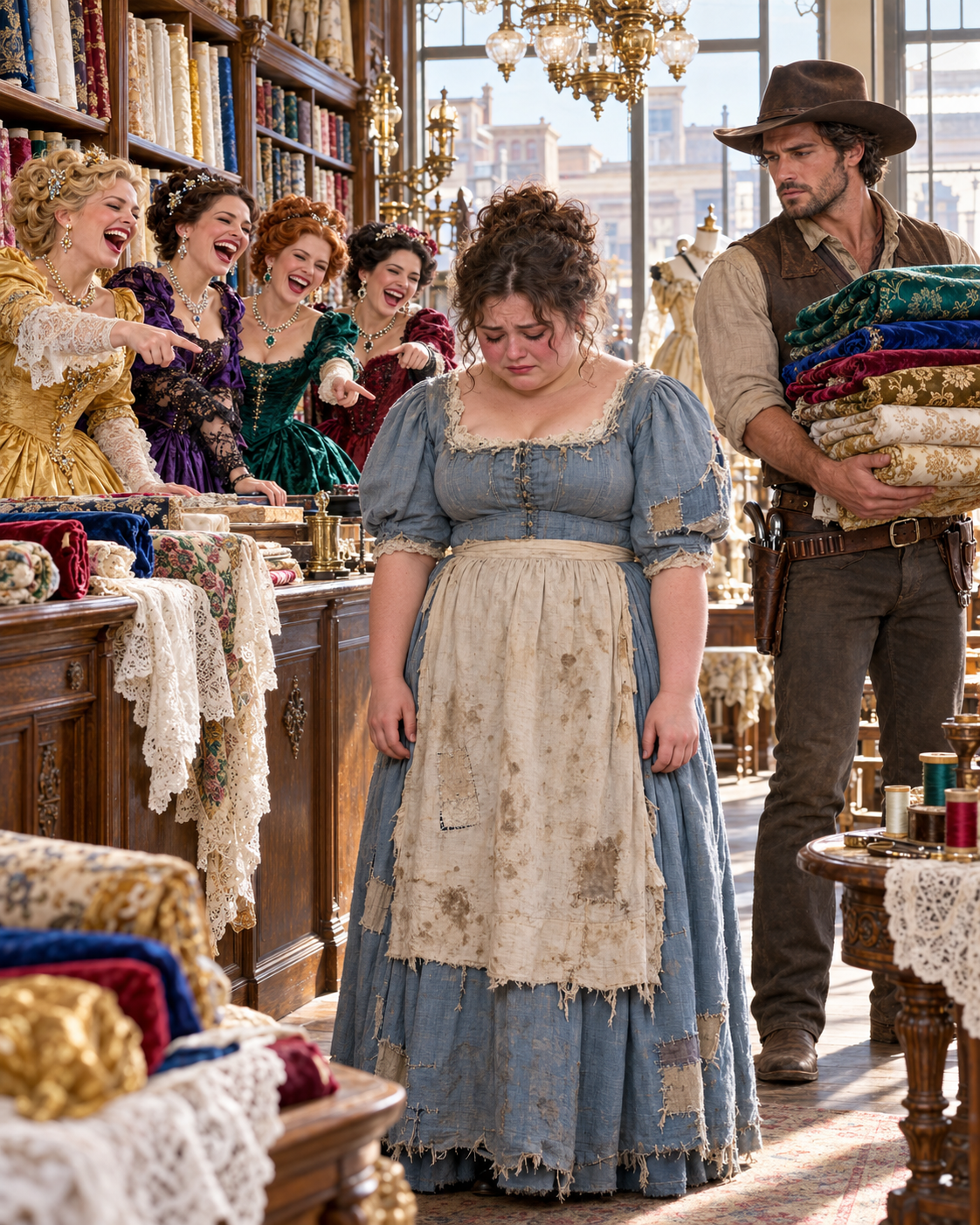
The banker’s daughter slapped a bolt of silk from my hands in Miller’s General Store, smiling coldly, unaware I knew the secret behind her father’s fortune.
The silver wedding ring lay in the prisoner’s trembling palm, catching the pale courthouse light like a piece of my childhood pulled from the grave.
I knew every scratch on that ring.
Father had worn it for seventeen years, and when I was little, he would let me twist it around his finger while he told stories beside the fireplace.
Mother had searched for it after his death.
The sheriff claimed the river must have swallowed it.
Yet here it was, eleven years later, in the hands of a stranger who claimed my father had still been alive when they pulled him from the freezing water.
“Where did you get that?” I whispered.
The prisoner swallowed, his eyes shining beneath his tangled gray hair.
“Your father gave it to me, Miss Sutton. He told me to keep it until I found someone brave enough to learn what really happened.”
The courthouse seemed to grow colder.
Everett moved closer, but I barely noticed him.
“If my father was alive, why didn’t he come home?”
The old man lowered his head.
“Because I was a coward, and because the people who took him were powerful enough to make a man disappear.”
Sheriff Harlan stepped between us.
“That’s enough, Daniel. You’ve said more than you should.”
Something about the sheriff’s voice made me look up.
It wasn’t anger.
It was fear.
The prisoner raised his head again.
“My name is Daniel Mercer. I worked for Benjamin Whitmore before your father discovered what was happening at the bank.”
I remembered that name.
Father had once mentioned a quiet clerk who helped him balance the ledgers after dark.
Mother had called him a decent man.
Now he stood before me in chains.
Daniel glanced toward the courtroom doors.
“Eleven years ago, your father found proof that Whitmore had stolen land from families who trusted him. But the worst crime wasn’t written in the bank’s records.”
Sheriff Harlan grabbed his arm.
“Mercer, be quiet.”
Daniel pulled away.
“The worst crime was what they did to the people who refused to surrender their property.”
For the first time that evening, I noticed the courthouse benches were filled with frightened faces.
Widows.
Farmers.
Men whose homes had been sold after mysterious debts appeared.
They weren’t there because of one banker.
They were there because some part of their own suffering had finally begun to make sense.
Daniel looked straight at me.
“Your father wanted to give those people their homes back. That’s why they tried to kill him.”
My knees weakened.
Everett caught my elbow before I fell.
Then Daniel said something that turned my blood to ice.
“But your father wasn’t the only Sutton who knew the truth.”
Before I could speak, Sheriff Harlan ordered two deputies to take him downstairs.
“He’s confessed to attempted murder and several other offenses. You’ll hear the rest when the court is ready.”
I stepped forward.
“You’ve kept this secret for eleven years. You don’t get to decide when I’m ready.”
The room went silent.
Sheriff Harlan stared at me with a coldness I recognized.
It was the same look Benjamin Whitmore had given me whenever I questioned his accounts.
The same look Clara had worn when she crushed my silk beneath her boot.
The look of someone who believed poverty meant obedience.
Everett guided me outside before my anger carried me further.
Snow drifted across the courthouse steps, gathering in the folds of my worn dress.
I stood beneath the dark sky, struggling to breathe.
“Do you believe him?” I asked.
Everett looked toward the courthouse windows.
“I believe he knows more than Harlan wants anyone to hear.”
“Then help me find out.”
He turned toward me.
There was something in his expression I hadn’t seen before.
Not pity.
Not the quiet generosity he’d shown in Miller’s store.
It was respect.
“Whatever it takes, Mabel.”
For a moment, I wanted to rest against him and let someone else carry the weight of my life.
But I had spent too many years watching powerful men make promises they could afford to break.
“I need the truth, Everett. Even if it leads to your family.”
He held my gaze.
“Especially if it leads to mine.”
That night, I barely slept.
I spread Mother’s letter, Father’s receipts, and the old deed across my kitchen table.
The lamp burned low while winter pressed against the windows.
At first, the papers revealed nothing new.
Then I noticed something strange about the deed.
The legal description mentioned forty acres bordering the north fork of the river.
Those acres had once belonged to my grandfather.
According to Whitmore’s records, Father had surrendered them to settle an unpaid loan.
But Father’s receipts proved that loan had been paid.
I turned the deed over.
Along its bottom edge was a faint line of handwriting, almost hidden beneath a brown stain.
I held it close to the lamp.
“If anything happens, look beneath the third stone.”
There was no signature.
There didn’t need to be.
I knew Father’s handwriting as surely as I knew my own name.
The third stone.
I whispered the words aloud.
Then I remembered the abandoned Sutton farmhouse.
Before we moved into town, our family had lived beside the river in a small house with a stone fireplace.
Father had built that fireplace himself.
He always said the third stone above the hearth was crooked because I’d tried to help him set it when I was five.
My heart began to pound.
By dawn, I knew where I had to go.
Everett arrived just as I was wrapping Mother’s letter in cloth.
He found me pulling on Father’s old winter coat.
“You’re going somewhere.”
“To the house by the river.”
His expression tightened.
“That’s Whitmore property now.”
“Only because he stole it.”
Everett watched me for a moment.
Then he took his hat from the peg.
“Then we’d better leave before anyone notices.”
We rode beneath a gray morning sky, following a narrow trail through fields covered in snow.
The prairie stretched around us, silent except for the creak of saddle leather and the distant call of crows.
I hadn’t visited the farmhouse since Mother’s funeral.
When its broken roof finally appeared beyond the cottonwoods, my throat tightened.
The house looked smaller than I remembered.
Its windows were empty.
The porch had collapsed.
Weeds pushed through the snow around the foundation.
But the fireplace still stood.
Everett helped me climb over the fallen doorway.
Inside, sunlight slipped through holes in the roof, illuminating the place where our kitchen table had once stood.
I could almost see Mother kneading bread.
Father laughing beside the fire.
My younger self running across the wooden floor, certain that nothing terrible could ever reach us.
I knelt before the fireplace.
The third stone was still crooked.
My fingers shook as I brushed away years of dust.
Everett used his pocketknife to loosen the mortar.
The stone shifted.
Behind it was a narrow compartment containing a tin box wrapped in oilcloth.
For a moment, neither of us moved.
Then I lifted the lid.
Inside lay a small leather notebook, three sealed envelopes, and a photograph.
The photograph showed Father standing beside Daniel Mercer and another man.
I recognized the third face immediately.
Sheriff Harlan.
Only he wasn’t wearing a sheriff’s badge.
He wore the dark suit of a bank employee.
I turned the photograph over.
A date was written across the back.
May 1865.
Eleven years before Father’s death.
“Everett,” I whispered, “Harlan worked for Whitmore long before he became sheriff.”
Everett studied the photograph.
“My father told me Harlan had been a deputy in Missouri before coming here.”
“Then someone lied.”
I opened the notebook.
Page after page contained names, dates, property descriptions, and payments.
Some entries were marked with a small cross.
Others had the word removed written beside them.
My stomach turned when I recognized the names of three farmers who had supposedly died in accidents.
Their land had passed into Whitmore’s possession within weeks.
Then I found Father’s name.
Beside it were three words.
“Refused final agreement.”
Below those words was another entry.
“Lawson payment rejected.”
I looked at Everett.
He read the line twice.
“What does that mean?”
I handed him the notebook.
For the first time since meeting him, Everett looked genuinely afraid.
“I don’t know.”
Before either of us could speak, a gunshot cracked through the trees.
The tin box slipped from my hands.
A second shot struck the fireplace, scattering stone dust across the floor.
Everett pulled me behind the chimney.
“Stay down.”
Through the broken window, I saw two riders approaching.
One wore a long black coat.
The other carried a rifle.
They stopped beside the collapsed porch.
“Come out, Lawson,” someone shouted. “We only want the papers.”
Everett drew his revolver.
His face was pale, but his hands were steady.
“Who sent you?”
The man laughed.
“You already know.”
Everett glanced toward the back wall.
There was a narrow opening where the kitchen door had once stood.
He pushed the tin box into my arms.
“Go through there. Follow the creek until you reach the cottonwoods.”
“I’m not leaving you.”
“Mabel, listen to me.”
His voice softened.
“Your father risked everything to protect those papers. Don’t let his sacrifice die here.”
I looked into his eyes.
Then I ran.
Snow swallowed my boots as I stumbled through the ruined doorway.
Behind me, another gunshot echoed.
I wanted to turn back.
Every part of me wanted to.
But I kept running, clutching the box against my chest.
The creek was frozen along its edges.
I followed it until my lungs burned and the trees began to blur.
Then I heard hoofbeats.
Someone was coming.
I crouched behind a fallen cottonwood, praying the snow would hide my tracks.
A horse stopped nearby.
“Mabel?”
I recognized the voice.
It was Everett.
I stepped out, relief nearly bringing me to my knees.
Blood stained his sleeve.
“You’re hurt.”
“Just a graze.”
He climbed down, wincing.
“One man fled when I fired back. The other abandoned his horse and ran.”
“Did you recognize them?”
Everett hesitated.
“One was Harlan’s deputy.”
The world seemed to narrow around us.
The sheriff had known where we were going.
Or someone had told him.
We rode back toward town by a longer trail, avoiding the main road.
Every mile felt dangerous.
But something had changed inside me.
For eleven years, I’d believed Father’s death was a tragedy that had simply happened to our family.
Now I understood it had been a choice.
Someone had chosen to silence him.
Someone had chosen to steal our home.
And someone was still choosing to protect those crimes.
By the time we reached my shop, I was no longer frightened in quite the same way.
I was furious.
Mrs. Bell was waiting outside with a basket of fresh bread.
Her face changed when she saw Everett’s bloody sleeve.
“Merciful heavens. What happened?”
I looked down the empty street.
Then I made a decision.
“Mrs. Bell, can you keep a secret?”
She straightened.
“At my age, dear, keeping secrets is practically a profession.”
I brought her inside and showed her Father’s notebook.
She turned the pages slowly.
When she reached the name of her late husband, she stopped.
For several seconds, she didn’t speak.
Then tears slipped down her cheeks.
“My Thomas didn’t lose our farm because he was careless,” she whispered.
The entry listed a payment he’d made in full.
Whitmore had recorded it as unpaid.
Mrs. Bell pressed a hand over her mouth.
“After he died, Benjamin told me Thomas had gambled everything away. I spent twelve years believing my husband had left me with nothing because he didn’t love us enough.”
I reached across the table and took her hand.
“He loved you. He paid what he owed.”
She began to cry.
Not loudly.
Not dramatically.
She simply folded over the notebook, grieving the years she’d spent hating a man who had never betrayed her.
That was when I realized what Father had truly been fighting.
Not merely stolen land.
Stolen dignity.
Stolen memories.
The cruelty of making innocent people believe their suffering was somehow deserved.
Mrs. Bell wiped her eyes.
“Then we must tell the others.”
Before sunset, six women gathered inside my little dressmaking shop.
By midnight, there were twelve.
They came carrying old receipts, letters, canceled notes, and stories they’d never dared tell aloud.
Mrs. Bell’s sister brought a ledger her husband had hidden beneath their mattress.
A schoolteacher named Abigail Reed brought correspondence between Whitmore and the county land office.
Every document revealed another piece of the same terrible pattern.
Whitmore had not acted alone.
Sheriff Harlan had intimidated families who protested.
A county clerk had altered property records.
And several wealthy investors had purchased stolen land at suspiciously low prices.
Among them was Everett’s father.
When I showed Everett the evidence, he sat silently by the stove.
His face seemed older in the lamplight.
“I always thought Father built the ranch honestly,” he said.
I didn’t know what to tell him.
He had helped me when nobody else would.
But kindness could not erase the past.
“Then you have to decide what to do with what you know.”
He looked up.
“I already have.”
The following morning, Everett rode to the county seat with copies of the documents.
He sent a telegram requesting an independent investigation by state authorities and sought a prosecutor outside Whitmore’s circle.
Meanwhile, I kept the originals hidden beneath a false bottom in my sewing cabinet.
For three days, we heard nothing.
Then the bank closed without warning.
Families gathered outside its locked doors, demanding access to their savings.
Benjamin Whitmore was released from custody after Sheriff Harlan claimed the evidence against him had been improperly obtained.
Daniel Mercer disappeared from his cell that same evening.
The sheriff said he’d escaped.
I knew better.
That night, Clara Whitmore came to my shop.
She stood in the doorway wearing a dark cloak, her face pale and exhausted.
I remembered her boot crushing my silk.
Her laughter when she mentioned Mother’s death.
I wanted to shut the door.
Instead, I stepped aside.
She entered without speaking.
For a long moment, she studied the dresses hanging along my wall.
Then she began to cry.
“I came to apologize.”
I folded my arms.
“For which part?”
Her cheeks reddened.
“The store. The things I said. What I told the other women.”
“Why now?”
She looked at me helplessly.
“Because I’m beginning to understand who my father really is.”
She removed a small key from her glove.
“I heard him speaking with Harlan. There’s a locked cabinet behind his office. He keeps certain papers there.”
I stared at the key.
“Why would you give this to me?”
Clara’s voice broke.
“Because my mother died believing she was worthless. Father made her feel that way every day.”
The confession surprised me more than her tears.
“I used to think if I became important enough, beautiful enough, cruel enough, he would finally be proud of me.”
She looked around my shop.
“But all I became was someone I hated.”
I thought of how easily humiliation could spread from one wounded person to another.
How cruelty could become an inheritance if nobody dared refuse it.
I took the key.
“An apology doesn’t undo what you did.”
“I know.”
“But it can be where you start doing something different.”
Clara nodded.
For the first time, I saw not the banker’s powerful daughter, but a frightened young woman who had spent her life mistaking fear for respect.
We entered the bank through its rear door after midnight.
Everett insisted on accompanying us.
The building smelled of cold ashes and furniture polish.
Clara led us to her father’s office, where a portrait of Benjamin Whitmore hung above the desk.
Behind a bookcase stood the locked cabinet.
The key turned.
Inside were several ledgers and a packet of letters tied with black ribbon.
Everett opened the packet.
As he read, his expression hardened.
One letter carried his father’s signature.
It confirmed that Lawson money had helped finance Whitmore’s early land purchases.
But another document revealed something different.
Years before his death, Everett’s father had discovered the fraud.
He had offered to repay the families and testify against Whitmore.
Benjamin had refused.
Then Lawson had died in a barn fire officially ruled accidental.
Everett read the letter again.
“My father wasn’t innocent,” he whispered.
I stood beside him.
“No.”
He closed his eyes.
“But he tried to make it right.”
I touched his arm.
“Then perhaps that’s where you begin.”
A floorboard creaked behind us.
We turned.
Sheriff Harlan stood in the doorway with a revolver.
Beside him was Benjamin Whitmore.
Clara gasped.
“Father?”
Whitmore barely looked at her.
“You foolish girl.”
Harlan raised his weapon.
“Put the papers down.”
Everett stepped in front of me.
“These records are already in other hands.”
Whitmore smiled thinly.
“Then we’ll have to discover whose.”
He moved toward Clara.
“You’ve embarrassed this family enough.”
She flinched, but didn’t retreat.
“No, Father. You did that yourself.”
For a moment, something dangerous flashed across his face.
Then Harlan grabbed Everett by the collar.
The gun swung toward his chest.
I acted before I could think.
I hurled the heavy brass lamp from the desk.
It struck Harlan’s wrist.
The revolver discharged, shattering the window behind us.
Everett lunged forward.
Both men crashed against the cabinet.
Papers scattered across the floor.
Clara screamed.
Whitmore seized my arm and dragged me toward the door.
“You have no idea what you’ve destroyed,” he hissed.
I struggled, but his grip tightened.
Then a voice sounded from the hallway.
“Let her go, Benjamin.”
Daniel Mercer stood beneath the gas lamp, holding a shotgun.
His face was bruised.
One eye was swollen nearly shut.
But his hands were steady.
Behind him stood Mrs. Bell, Abigail Reed, and several townsmen carrying lanterns.
Daniel had not escaped.
He’d been freed by a deputy who could no longer stomach Harlan’s orders, and Mrs. Bell had hidden him until he was strong enough to speak.
Whitmore released me.
For the first time, I saw genuine terror in his eyes.
Daniel took a breath.
“Tell them what happened at the river.”
Whitmore shook his head.
Daniel’s voice trembled.
“Tell Mabel what you did after I pulled her father from the water.”
Silence filled the room.
Then Whitmore spoke.
“Her father was dying anyway.”
My heart seemed to stop.
Daniel stepped closer.
“No. He wasn’t.”
I could barely breathe.
“What happened to him?”
Whitmore stared at the floor.
Daniel answered.
“Your father confronted Harlan at the river. Harlan struck him and pushed him into the water. I dragged him out before he drowned.”
I felt the room sway.
“He was badly hurt, but he was alive. He begged me to take him home.”
Daniel’s eyes filled with tears.
“I tried, Mabel. I swear I tried.”
Whitmore had arrived with two men.
They took Father away in a wagon, promising to bring a doctor.
Instead, they carried him to an abandoned hunting cabin beyond the eastern ridge.
There, Benjamin demanded the location of the documents.
Father refused.
Daniel’s voice broke.
“He survived until morning.”
I pressed a hand against my mouth.
“He kept asking for you.”
A terrible sound escaped me.
I had been twelve years old when Father disappeared.
I remembered sitting at the kitchen window with Mother’s hand around mine, waiting for the sound of his horse.
He had been alive while we waited.
He had been thinking of me.
“Did he suffer?” I whispered.
Daniel looked away.
His silence was answer enough.
Then he reached into his coat and handed me a folded scrap of paper.
“He wrote this before he died.”
I unfolded it carefully.
The handwriting was weak and uneven.
“My little Mabel, if you are reading this, I have gone where I cannot follow you home. Be good to your mother. Never let anyone make you ashamed of honest work. And remember that being poor is not the same as being small.”
The words blurred.
I sank into Father’s old office chair, clutching the letter against my chest.
For eleven years, I’d wondered whether he knew how much I loved him.
Now I knew his final thoughts had been of me.
When I looked up, Everett was kneeling beside me.
He didn’t speak.
He simply held my hand while I cried.
By morning, Whitmore and Harlan were in custody.
The evidence, supported by Daniel’s testimony and the newly recovered bank records, reached the state authorities.
The investigation lasted months.
I attended every hearing I could, though listening to strangers discuss Father’s death as evidence was almost unbearable.
Whitmore was convicted of serious financial crimes and conspiracy connected to Father’s murder.
Harlan was convicted for his part in the killing.
Other officials lost their positions, and several stolen properties were placed under court supervision while ownership claims were reviewed.
Not every wrong could be repaired.
Some families had scattered across the country.
Others had buried loved ones before the truth emerged.
But the lies that had destroyed their reputations were finally exposed.
The town changed slowly.
People who once lowered their eyes when I passed began greeting me in the street.
Some apologized.
Others pretended they’d always believed in me.
I learned that public admiration could be as unreliable as public humiliation.
Neither would determine who I was.
That spring, I returned to the old Sutton farmhouse.
Everett came with me.
We stood beside the river where the cottonwoods were beginning to bloom.
I carried Father’s wedding ring and the silver thimble Mother had left behind.
For a long time, I said nothing.
Then I knelt and pressed my hand against the earth.
“I kept my promise, Papa.”
The wind moved gently through the trees.
I imagined him standing beside me, smiling as he used to when I finally managed a perfect stitch.
“I didn’t let them make me small.”
Everett waited until I rose.
Then he handed me a folded document.
It was the corrected deed to our family property.
My name stood clearly across the bottom.
Mabel Sutton.
The land was mine again.
I stared at it, scarcely believing what I saw.
Everett smiled.
“Your father would be proud.”
I looked across the neglected fields.
For years, I’d dreamed of reclaiming that house.
But now I understood something I hadn’t before.
Home wasn’t simply a building someone could steal.
It was the place where a person could live without surrendering their dignity.
I decided to restore the farmhouse and turn it into a workshop where women could learn dressmaking.
Mrs. Bell offered to teach embroidery.
Abigail Reed volunteered to teach reading and bookkeeping.
Even Clara came, quietly asking whether I might teach her how to sew.
Her first stitches were crooked.
She pricked her finger twice.
But she returned every morning and worked without complaint.
One afternoon, she held up a finished child’s dress and laughed through tears.
“I’ve never made anything useful before.”
I smiled.
“Then you’ve chosen a fine place to begin.”
By summer, Sutton Dressmaking employed six women.
Some were widows.
Some had husbands who couldn’t find work.
One was a young mother who’d been told she had no talent beyond keeping house.
They came carrying burdens I recognized.
And slowly, stitch by stitch, they discovered what it felt like to earn money with their own hands.
I paid them fairly.
I taught them to keep records.
And I made certain every woman understood that her work had value, whether anyone wealthy admired it or not.
One warm evening, Everett visited after the others had gone home.
He found me beside the open window, finishing a pale blue wedding gown.
Sunset gilded the wooden floor.
The familiar rhythm of my sewing machine filled the room.
He watched quietly until I stopped.
“That color looks familiar,” he said.
I smiled.
“It should.”
It was the same shade Clara had trampled in Miller’s store.
The same color that had once represented everything I believed I could never have.
Everett stepped closer.
“Mabel, there’s something I’ve been wanting to ask.”
I looked up.
He was holding a small velvet box.
My breath caught.
He opened it, revealing a simple gold ring.
“I cannot promise you a life without hardship,” he said. “And I would never ask you to give up what you’ve built.”
His voice grew unsteady.
“But if you’ll allow it, I’d like to spend the rest of my life standing beside you.”
I looked at the ring.
Then at the shop around us.
The shelves of fabric.
The order books.
The little sign above the door.
Everything I’d built with blistered hands and a heart that had nearly given up.
A year earlier, I might have believed marriage meant surrendering the independence I’d fought so hard to earn.
But Everett had never asked me to become smaller so he could feel important.
He had offered help when I needed it, trusted me when I doubted myself, and stood beside me when the truth threatened everything he knew.
I took his hand.
“Only if you understand one thing.”
He smiled nervously.
“Anything.”
“Sutton Dressmaking keeps its name.”
Everett laughed, his eyes shining.
“I wouldn’t dream of changing it.”
I kissed him before he could say another word.
We married that autumn beneath the cottonwood trees beside the restored farmhouse.
Mrs. Bell cried louder than anyone.
Clara arranged the flowers.
And the women from my workshop made my wedding dress, each sewing a small piece of her own story into its seams.
As I walked toward Everett, I wore Mother’s silver thimble on a ribbon beneath my gown.
Father’s ring rested safely in my pocket.
I carried them both because I wanted my parents with me on the happiest day of my life.
Years later, people would still tell the story of the wealthy rancher who bought an entire store’s finest fabric for a poor seamstress.
Some called it a beautiful romance.
Others called it extraordinary generosity.
But whenever I heard the story, I remembered the part they usually left out.
Everett’s gift had opened a door.
It had not built my business.
It had not worked through freezing nights, endured cruel gossip, or found the courage to challenge the people who controlled our town.
Those things had come from my own two hands.
From the lessons Mother taught me.
From the stubborn honesty Father died defending.
And from the women who stood beside me when silence would have been easier.
On the tenth anniversary of Sutton Dressmaking, a young girl came into my shop wearing a patched dress and shoes too small for her feet.
She stood near the doorway, staring at the beautiful gowns as though afraid someone might ask her to leave.
I recognized that look.
I’d worn it myself in Miller’s store.
“May I help you?” I asked.
She lowered her eyes.
“I haven’t any money, ma’am. I only wanted to see the dresses.”
I walked toward her and placed a length of blue silk in her hands.
“Do you know how to sew?”
She shook her head.
“Would you like to learn?”
Her eyes widened.
“Do you think I could?”
I looked at the girl, and for one beautiful moment, I saw the child I’d once been.
The child who’d waited for her father to come home.
The young woman who’d believed she was worth less because her pockets were empty.
The seamstress who’d stood in a crowded store while another woman laughed at her shame.
I knelt so our eyes were level.
“My dear, you can learn anything you’re willing to work for.”
She smiled.
And as the late-afternoon sunshine fell across the blue silk, I realized that the finest thing Everett Lawson had ever given me was not fabric, money, or even love.
It was the chance to remember what my parents had tried to teach me all along.
No one can give you your worth, because it was never theirs to give.
And the greatest victory over those who once humiliated you is not watching them fall.
It is building a life so full of purpose, kindness, and dignity that their cruelty no longer has the power to define you.
I opened the workshop door wider and invited the girl inside.
For once, there was no reason to be afraid of what waited on the other side.
THE END.