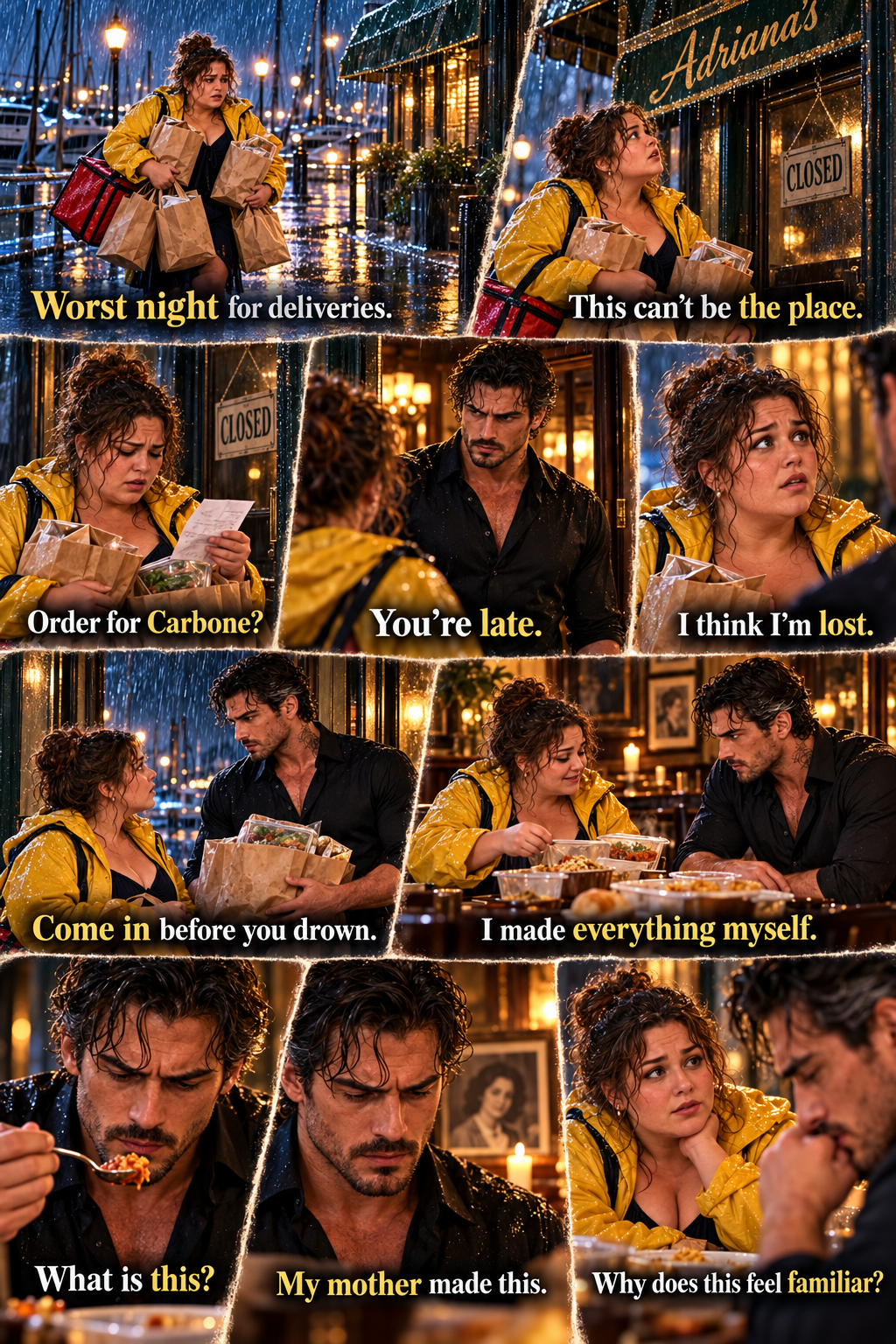
Ruby Navarro was halfway through a delivery in the pouring rain when she realized the restaurant at the address had been closed for almost eight years
Ruby stared at Nico’s message until the screen went dark.
Outside her rented kitchen, the rain had finally stopped, but water still dripped from the gutters onto the cracked pavement. Her overdue bills sat on the passenger seat, held together by a rubber band that had nearly snapped.
She picked up her phone and typed four words.
“I’ll be there Sunday.”
Then she added something else.
“But I’m bringing help.”
Nico replied almost immediately.
“Bring whoever you trust.”
Ruby read that message twice.
She hadn’t expected a man like Nico Carbone to understand that trust was something people needed to earn.
The next morning, Ruby called her grandmother, Rosa Navarro, who lived forty minutes outside Baltimore.
Rosa was seventy-three, walked with a cane, and had spent most of her life feeding people who never remembered to thank her.
When Ruby explained what had happened, Rosa listened without interrupting.
Then she asked, “Is this man offering you a restaurant or offering you a problem?”
“Honestly? I don’t know.”
“Good. At least you’re thinking.”
Ruby smiled despite herself.
“I told him I wouldn’t sign anything without an attorney.”
“Then you’ve already made one smart decision.”
Rosa agreed to come Sunday, but only after making Ruby promise that she wouldn’t confuse gratitude with obligation.
“A person can help you without owning you,” she said. “But sometimes you have to remind them.”
By Sunday morning, Carbone’s looked a little less abandoned.
Nico had hired a cleaning crew, brought in portable lighting, and arranged for a licensed electrician to make sure the areas they planned to use were safe. The kitchen itself was still unsuitable for commercial cooking, so Ruby prepared the food at her rented kitchen and brought everything over in insulated containers.
Nothing about it was glamorous.
The old dining room smelled faintly of cleaning solution. Several chairs wobbled, the ceiling had water stains, and one window was covered with plywood.
But someone had uncovered Elena Carbone’s photographs.
And someone had placed fresh flowers beneath the largest one.
Ruby suspected Nico.
She didn’t ask.
By eleven, Rosa arrived carrying a battered recipe box.
She walked straight past Nico, examined the dining room, and nodded toward the kitchen.
“Your mother worked back there?”
“Every day,” Nico answered.
Rosa studied his face.
“Then don’t dishonor her by pretending sentiment is a business plan.”
For a moment, Ruby thought Nico might take offense.
Instead, he laughed.
“Yes, ma’am.”
Rosa pointed her cane at him.
“And don’t ‘ma’am’ me unless you intend to listen.”
That was the first time Ruby saw Nico look genuinely intimidated.
The trial dinner was scheduled for five.
They expected twelve people.
Twenty-seven showed up.
Some were former customers who remembered Elena’s cooking. Others came because they’d heard the restaurant might reopen. A retired longshoreman named Frank Bell arrived wearing the same Orioles jacket he’d worn for fifteen years.
He stood in the doorway for a long time.
“Never thought I’d see lights in here again,” he said.
Nico shook his hand.
“Neither did I.”
Ruby served braised beef, roasted vegetables, homemade bread, and lemon ricotta cake.
Nothing elaborate.
Just the kind of food people recognized before tasting it.
At first, everyone ate quietly.
Then conversations began moving from table to table.
Frank told a story about Elena sending him home with enough food for three days after he’d lost his job.
A woman named Denise remembered bringing her children there after her husband died.
Another man recalled how Elena used to argue with him because he always tried to pay for coffee she’d already decided was free.
Ruby listened from the doorway.
She had dreamed about owning a restaurant for years.
But she hadn’t understood that a restaurant could hold so many pieces of other people’s lives.
At the end of the evening, Nico stood beside her as customers slowly gathered their coats.
“What do you think?” he asked.
Ruby looked at the empty plates.
“I think they missed your mother.”
Nico nodded.
“But that doesn’t mean they’ll come back every week,” she added.
He looked at her.
“You’re determined not to make this easy.”
“I’m determined not to go bankrupt.”
“Fair point.”
They collected feedback cards, counted the money from voluntary meal payments, and reviewed the expenses.
The results were encouraging.
They were also nowhere near enough to justify reopening.
Ruby refused to pretend otherwise.
Two days later, the first real problem arrived.
Ruby’s rented kitchen landlord informed her that her lease would not be renewed at the end of the month.
The building was being sold.
She sat across from him in his small office, trying to keep her voice steady.
“You couldn’t have told me sooner?”
“I’m sorry, Ruby. The buyer wants the space vacant.”
She left carrying a cardboard box of supplies and a notice that gave her thirty days to find somewhere else.
Thirty days.
The same amount of time she’d asked Nico for.
By the time she reached her car, her hands were trembling.
Without that kitchen, she couldn’t legally prepare the meals her customers depended on.
Without those customers, she had no income.
And without income, she couldn’t afford another kitchen.
She called three rental facilities before lunch.
All were too expensive.
A fourth had a six-month waiting list.
By evening, she was sitting outside Carbone’s, staring at the dark windows.
She didn’t go inside.
She knew how it would look.
The struggling cook who’d insisted on independence, suddenly asking the wealthy man for somewhere to work.
Her phone rang.
Nico.
“Everything okay?”
Ruby almost said yes.
Instead, she told him.
He listened.
Then he said, “I can help.”
“That’s exactly what I’m afraid of.”
Silence settled between them.
Finally, Nico asked, “Do you want help finding another kitchen, or do you want me to stop asking?”
Ruby swallowed.
“Finding another kitchen.”
“Then that’s what we’ll do.”
The next morning, Nico sent her a list of commercial kitchens within twenty miles.
No money.
No offer to move into Carbone’s.
Just addresses, phone numbers, and contact information.
Ruby found that strangely reassuring.
Then she noticed the final name on the list.
Harbor Community Center.
She recognized it immediately.
The center operated a licensed kitchen used for cooking classes, fundraisers, and small catering events.
Ruby called.
A woman named Margaret answered.
After hearing Ruby’s situation, Margaret said they could offer evening rental hours at a reduced rate, provided Ruby supplied the required insurance and documentation.
It wasn’t perfect.
But it was possible.
For the first time in three days, Ruby could breathe.
That Friday, she returned to Carbone’s with actual numbers.
She had calculated renovation costs, equipment expenses, staffing requirements, projected food sales, insurance, payroll taxes, and enough contingency money to account for surprises.
Nico looked through her spreadsheet.
“You’re expecting trouble.”
“I’m expecting reality.”
He turned another page.
“These labor costs are higher than what my accountant estimated.”
“Because I’m planning to pay people properly.”
He raised his eyes.
Ruby held his gaze.
“I’m not building a restaurant where everyone works sixty hours and pretends we’re one big happy family while nobody can afford rent.”
Nico studied the numbers again.
“Keep them.”
Ruby blinked.
“Just like that?”
“You explained your reasoning. That’s what I asked you to do.”
For a moment, she didn’t know what to say.
Then Nico’s office door opened.
A broad-shouldered man in a gray coat walked inside without knocking.
“Nico, we need to talk.”
His name was Vincent Moretti.
Ruby had heard it before.
Vincent managed several of Nico’s properties and had been involved in the restaurant sale.
He glanced at Ruby’s spreadsheets.
“You’re still entertaining this?”
Nico closed the folder.
“We’re reviewing our options.”
Vincent gave a dry laugh.
“The developer walked away. You’ve already cost yourself serious money. And now you’re listening to someone who’s never operated a restaurant?”
Ruby felt heat rise into her face.
“Actually, I’ve operated a food business for four years.”
“Out of a rented kitchen.”
“Yes.”
Vincent looked at Nico.
“This is exactly what I’m talking about.”
Ruby slowly gathered her papers.
Nico noticed.
“Ruby, sit down.”
She didn’t.
“No. He’s entitled to question whether the numbers work. He’s not entitled to treat me like I’m stupid.”
She turned toward Vincent.
“And for the record, the most dangerous person in a business meeting is usually the one who thinks experience makes him incapable of being wrong.”
Then she walked out.
She expected Nico to call and apologize on Vincent’s behalf.
Instead, an hour later, she received a message.
“You were right about the meeting. I should have stopped him sooner.”
Ruby answered, “You should have.”
His reply came quickly.
“I know.”
Two days later, Vincent was removed from the restaurant project.
But the confrontation exposed a much larger problem.
When Nico ordered an independent review of the property records, his attorney discovered that Vincent had been pushing the sale while withholding information about a pending waterfront improvement assessment.
The assessment could leave the property facing additional expenses.
Vincent hadn’t invented the cost.
He simply hadn’t disclosed it when recommending the sale or when criticizing Ruby’s estimates.
Nico confronted him privately.
Vincent admitted he had wanted the deal completed before the assessment complicated negotiations.
He argued that selling quickly had still been the financially responsible decision.
Maybe it had been.
But Nico had trusted him to present the entire picture.
That trust was gone.
When Ruby learned what happened, she didn’t celebrate.
She understood that the newly discovered expense made reopening even riskier.
And that evening, she told Nico something he clearly didn’t want to hear.
“You may have to sell.”
He looked at her across the dining room.
“After everything we’ve done?”
“We haven’t reopened anything. We’ve served one dinner.”
He stared at Elena’s photograph.
Ruby softened her voice.
“Your mother built a place people loved. That doesn’t mean she would want you to destroy your finances keeping the building.”
Nico didn’t answer.
Then he asked, “What would you do?”
Ruby thought about her grandmother, her tiny business, and the customers who had ordered from her even when delivery took too long.
“I’d find out what can survive without risking everything else.”
That became their new plan.
Instead of renovating the entire restaurant immediately, they investigated whether they could reopen only a small, code-compliant portion of the property, provided inspectors approved the work.
They would operate on limited days, keep the menu short, and expand only when the business could support itself.
No expensive grand opening.
No unnecessary renovations.
No promises they couldn’t pay for.
Ruby also insisted on a clear written agreement.
Her attorney, a woman named Andrea Mills, reviewed every page.
Under the proposed arrangement, Nico would remain the property owner and fund approved building repairs.
Ruby would manage the food operation for a salary and have the option to buy a minority ownership interest if agreed-upon financial targets were met.
Business debts would remain separated from her personal finances.
Major expenses required documented approval.
And either party could end the arrangement under clearly defined conditions.
Andrea looked up from the contract.
“This is better than I expected.”
Ruby smiled.
“That’s comforting.”
“But there’s something you need to understand.”
“What?”
“Even a good contract can’t make a bad partnership work.”
Ruby knew.
That was what frightened her most.
Over the next six weeks, Carbone’s slowly changed.
Inspectors evaluated the building. Contractors repaired damaged wiring and plumbing. The front dining room received new flooring, while the kitchen was rebuilt in stages.
Ruby kept running her delivery business from the community center in the evenings.
During the day, she worked with Nico on the restaurant.
Sometimes they agreed.
Often they didn’t.
Nico wanted to preserve the original dining room exactly as his mother had left it.
Ruby insisted that the worn carpeting needed to go.
He wanted a large menu featuring every dish Elena had served.
Ruby reduced it to twelve items.
He argued about the price of the Sunday dinner.
She argued back about food costs.
One afternoon, after a particularly exhausting meeting, Nico said, “My mother never needed spreadsheets to run this place.”
Ruby stopped writing.
“Your mother also worked herself sick.”
The room went silent.
She immediately regretted how sharply she’d said it.
But she didn’t take it back.
Nico stood by the window for several minutes.
Finally, he said, “You’re right.”
Ruby looked up.
He turned toward Elena’s photograph.
“She missed holidays. Birthdays. Doctor’s appointments. We called it dedication because admitting it was exhaustion would have meant helping her.”
His voice grew quieter.
“I don’t want to make that mistake again.”
From that day forward, he stopped arguing against scheduled days off.
By early December, they were almost ready.
Then came the setback that nearly ended everything.
A contractor discovered extensive water damage beneath part of the kitchen floor.
The repairs would cost thousands more than expected and delay the opening.
Nico could cover the expense.
But doing so would push his investment beyond the limit he and Ruby had agreed upon.
He called an emergency meeting.
Ruby arrived with Andrea and found Nico sitting beside his accountant.
The numbers were spread across the table.
There was no easy solution.
They could postpone the opening indefinitely.
They could abandon the project.
Or Nico could invest more money, breaking the financial boundary they’d established to keep emotion from controlling the business.
For nearly an hour, nobody spoke above a normal conversational tone.
That somehow made the situation feel worse.
Finally, Nico said, “I’ll pay for it.”
Ruby shook her head.
“We agreed on a limit.”
“It’s my building.”
“And it’s our business plan.”
He pushed back his chair.
“So what do you expect me to do? Let the place rot?”
“No. I expect us to make the decision we said we’d make when things got hard.”
Nico stared at her.
“Which is?”
“We stop.”
The words hurt more than Ruby expected.
She had spent weeks imagining customers walking through those doors.
She’d helped choose the tables.
She’d tested recipes.
She’d watched Nico become a little less guarded every time someone mentioned his mother.
But she wouldn’t build her dream on a financial decision neither of them could defend.
Nico looked away.
For the first time since she’d met him, he seemed completely defeated.
The meeting ended without an agreement.
That evening, Ruby went to Rosa’s house.
Her grandmother was sitting at the kitchen table peeling apples.
Ruby told her everything.
When she finished, Rosa pushed a bowl toward her.
“Help me with these.”
“Grandma, did you hear what I said?”
“Every word.”
“So?”
“So you’re asking me whether protecting yourself makes you selfish.”
Ruby looked down.
Rosa continued peeling.
“When I was young, I thought love meant never disappointing anybody. I cooked for relatives who never visited unless they needed something. I lent money I couldn’t afford to lose. I said yes until there wasn’t much of me left.”
“What changed?”
“I got tired.”
Ruby laughed weakly.
Rosa reached across the table and squeezed her hand.
“You can care about somebody’s dream without agreeing to every sacrifice it demands.”
The next morning, Ruby called Nico.
“I’ve been thinking.”
“So have I.”
“I don’t want to abandon the restaurant. But we need a different plan.”
Nico told her to come over.
When she arrived, he was standing beside a stack of old boxes he’d brought down from the upstairs storage room.
Inside were Elena’s menus, photographs, handwritten supplier lists, and years of records.
He showed Ruby an old neighborhood newsletter.
The headline read, “Carbone’s Sunday Table Brings Harbor Families Together.”
Below it was a photograph of Elena serving dinner to a long line of customers.
Nico tapped the picture.
“My mother didn’t build this place alone.”
Ruby looked at the image.
Then she understood what he was suggesting.
Not a rescue.
A smaller beginning.
They contacted local businesses, former customers, and neighborhood organizations to see whether anyone would support occasional community dinners while the restaurant remained under renovation.
Ruby made one condition clear.
They would not collect donations under false promises or pretend the restaurant was a charity.
Any fundraising would disclose exactly where the money went, and paid work would remain paid work.
Within days, several people offered practical help.
A restaurant equipment supplier agreed to sell refurbished appliances at a discount.
A retired contractor offered a reduced rate for nonstructural finishing work.
Frank Bell organized a community cleanup day.
Denise volunteered to coordinate reservations for a future benefit dinner.
Nico initially struggled to accept the offers.
He was used to being the person who provided help, not the person receiving it.
One afternoon, Frank pulled him aside.
“Your mother fed my family when I couldn’t,” he said. “You think I’m going to stand here and watch you struggle because you’re too proud to let me hold a paintbrush?”
Nico laughed.
Then he handed Frank a paintbrush.
The reduced costs helped, but they didn’t erase the financial problem.
So Nico made a difficult choice.
He sold one of his smaller investment properties and used part of the proceeds to pay for the essential structural repairs.
Before proceeding, he reviewed the decision with his accountant and attorney.
Ruby didn’t pressure him.
She didn’t thank him as if he were making a sacrifice for her.
She simply asked whether the sale was financially responsible.
Nico answered, “It is. I should have sold that property two years ago. I’ve been holding on to it because I don’t like admitting when an investment isn’t working.”
Ruby smiled.
“That sounds familiar.”
He smiled back.
By February, Carbone’s passed its final inspections and received the approvals needed to operate.
The opening date was set for March 14.
Ruby barely slept the week before.
She worried about staffing, food orders, reservations, and whether anyone would actually return once the excitement faded.
Nico worried about everything else.
He checked the doors three times every night.
He examined invoices that had already been approved.
He called contractors about repairs they’d completed weeks earlier.
Finally, Ruby caught him standing in the kitchen at midnight.
“You’re going to wear a hole in the floor.”
He looked embarrassed.
“Couldn’t sleep.”
“Me neither.”
She handed him a cup of coffee.
They sat at the small kitchen table beneath a photograph of Elena.
After a while, Nico spoke.
“You know what scares me?”
“Plenty of things, apparently.”
He gave a tired smile.
“I’m afraid people will come here expecting my mother’s restaurant.”
Ruby considered that.
“They probably will.”
“And what happens when they realize it isn’t?”
“Then they’ll decide whether they like ours.”
Nico looked at her.
Ruby continued.
“We can’t bring your mother back. We can’t cook exactly like her. And we shouldn’t pretend we can.”
She pointed toward the kitchen.
“But we can make something worth coming back for.”
Nico stared at his coffee.
“I think she would have liked you.”
Ruby smiled.
“She might have. Although I probably would’ve argued with her about payroll.”
Nico laughed so hard he had to set down his cup.
Opening night arrived cold and windy.
By four-thirty, the dining room was ready.
Fresh flowers stood on the counter. Warm lights glowed above the tables, and the smell of rosemary and garlic drifted from the kitchen.
Ruby wore a clean black apron.
Her hands shook as she checked the reservation list.
Every table was booked.
At five, the first customers entered.
Then more.
By six-thirty, every seat was occupied.
Ruby moved between the kitchen and dining room, watching plates leave and empty ones return.
The staff worked hard, but the service held together.
Then, at seven-fifteen, something went wrong.
A large party arrived claiming they’d made a reservation for ten.
Their name wasn’t on the list.
The host tried to explain.
The man leading the group became angry.
“We’ve been coming here since before you were born.”
Ruby came forward.
“I’m sorry about the confusion. We’re completely booked tonight, but I can check our next available opening.”
The man looked past her.
“Where’s Nico?”
Nico appeared from the office.
The man immediately changed his tone.
“Mr. Carbone, I didn’t realize this was your place again.”
Nico glanced at Ruby.
Then at the crowded dining room.
“Ruby runs the restaurant,” he said. “If she says we’re full, we’re full.”
The man frowned.
“After all the years my family supported yours?”
Nico’s expression hardened.
For a second, Ruby saw the intimidating figure everyone had warned her about.
Then he took a breath.
“I appreciate your family’s history here. But that doesn’t give you the right to disrespect my staff.”
The room went quiet.
The man looked around, suddenly aware that people were watching.
He muttered something and left.
Ruby returned to the kitchen without saying a word.
Nico followed a minute later.
“Are you okay?”
She nodded.
Then she smiled.
“That was a pretty good answer.”
He leaned against the doorframe.
“I’m learning.”
But the real test came three weeks later.
Opening-night enthusiasm had faded.
Reservations became inconsistent.
Some evenings were busy.
Others were painfully slow.
Food prices increased.
A dishwasher quit without notice.
One weekend, a refrigeration problem forced Ruby to throw away hundreds of dollars’ worth of ingredients.
At the end of the first month, the restaurant had lost money.
Not catastrophically.
But enough to make everyone nervous.
Nico’s accountant recommended cutting labor expenses.
Ruby refused to reduce wages.
Instead, she examined every item on the menu.
Several dishes required expensive ingredients and sold poorly.
She removed them.
She adjusted portion sizes without reducing quality, negotiated more predictable supplier deliveries, and introduced a limited weekday takeout menu.
She also expanded catering, using the customer base she’d built before opening.
Little by little, the numbers improved.
But not quickly enough.
One evening in May, Nico found Ruby alone in the kitchen, sitting beside a stack of unpaid invoices.
She looked exhausted.
“Go home,” he said.
“I can’t.”
“Why?”
“Because if I stop thinking about these numbers, they’ll still be here tomorrow.”
Nico pulled out a chair.
“Then we’ll look at them together.”
They spent three hours reviewing expenses.
Near midnight, Ruby noticed something strange.
Several older customers had stopped coming on Sundays.
When she checked the reservation records, she realized many of the people who’d attended the trial dinner had visited only once or twice since reopening.
The next morning, she called Denise.
“I wanted to ask you something. You used to come here with your kids, right?”
“Every Sunday.”
“Why haven’t you been back?”
Denise hesitated.
Then she answered honestly.
“Ruby, your food is wonderful. But Sunday dinner used to be something people like me could afford.”
Ruby looked at the new menu.
Sunday dinner cost thirty-two dollars per person.
It wasn’t unreasonable for the ingredients and labor involved.
But it was too much for some of the families Elena had welcomed.
Ruby ended the call and sat quietly.
They had preserved Elena’s name.
They had preserved her recipes.
But somewhere along the way, they’d begun pricing out the people who’d made her restaurant special.
That afternoon, Ruby brought Nico a proposal.
One Sunday each month, Carbone’s would host a community meal with a simple set menu, a limited number of seats, and a sliding suggested contribution.
Customers who could pay more would be welcome to do so.
Those who couldn’t would still receive dinner.
The restaurant would set a monthly budget for the program rather than making promises it couldn’t sustain.
Nico studied the proposal.
“Will it work?”
“If we fund it properly and keep it separate from regular operations, I think we can make it work.”
He looked toward Elena’s photograph.
“She would have loved this.”
Ruby shook her head gently.
“Then let’s make sure we can afford to keep doing it.”
The first community dinner was held in June.
Frank came.
Denise brought her daughter.
Families filled the dining room, children colored on paper placemats, and the kitchen worked steadily through the evening.
Near the end of the meal, an elderly man approached Nico.
He was holding an old photograph.
“Your mother gave me my first job,” he said.
Nico took the picture.
It showed Elena standing beside a teenage dishwasher.
The boy was thin, awkward, and smiling.
“That’s you?”
The man nodded.
“I was sixteen. Nobody wanted to hire me. Your mother did.”
He looked around the room.
“She made me believe I was worth giving a chance.”
After the man left, Nico remained standing beside the counter.
Ruby approached him.
“You okay?”
He nodded slowly.
“I spent years thinking this building was all I had left of her.”
He looked toward the dining room, where Frank was helping a little girl put on her coat.
“I was wrong.”
By late summer, Carbone’s had finally begun covering its operating expenses.
The restaurant wasn’t making anyone rich.
There were still difficult weeks, unexpected repairs, and nights when Ruby went home too tired to cook for herself.
But the business had customers who returned.
It had employees who stayed.
And it had a purpose that extended beyond the dining room.
One afternoon, Andrea called Ruby into her office.
The restaurant had met the first financial milestone in her contract.
Ruby was now eligible to purchase a small ownership stake.
Andrea placed the paperwork in front of her.
“You’ve earned this opportunity.”
Ruby stared at the documents.
For years, she’d imagined owning a restaurant.
Now the possibility was sitting on an ordinary desk beside a half-empty cup of coffee.
But purchasing the stake would require her to commit money she’d carefully saved.
It would also mean accepting the risks that came with ownership.
She asked Andrea to explain everything again.
The attorney did.
Then Ruby went home and called Rosa.
Her grandmother listened patiently.
When Ruby finished, Rosa said, “Are you afraid?”
“Terrified.”
“Good.”
Ruby laughed.
“Why is that good?”
“Because it means you understand what you’re signing.”
Ruby looked at the paperwork.
“I keep thinking about everything that could go wrong.”
“Of course.”
“What if I lose the money?”
“Then you’ll deal with that. But you won’t be dealing with it blind.”
Rosa paused.
“Just remember, you don’t have to buy a dream all at once.”
Ruby took another week to think.
She reviewed the restaurant’s financial statements, kept enough savings for emergencies, and negotiated a payment schedule she could realistically manage.
Then she signed.
Not because Nico had saved her.
Not because she owed him for opening the doors.
But because she’d helped build a business she believed in, and the numbers finally supported taking that next step.
That evening, Nico waited for her at Carbone’s.
He had prepared dinner.
Or attempted to.
The roasted potatoes were unevenly cut, the beef was slightly overcooked, and he’d forgotten to warm the bread.
Ruby looked at the plates.
“Did you actually cook this?”
“Don’t sound so surprised.”
She took a bite.
Then another.
“Not bad.”
“That’s the nicest thing you’ve ever said to me.”
She laughed.
Nico poured two glasses of sparkling water.
“I wanted to celebrate.”
Ruby looked around the restaurant.
The windows were clean.
The tables were full of people laughing.
A young server was helping an elderly couple into their seats.
From the kitchen came the familiar sounds of pans, voices, and someone reminding a cook that an order needed extra sauce.
Ruby remembered the first night she’d walked through those doors.
The rain.
The darkness.
The strange man staring at a plate of food as if he’d seen a ghost.
She hadn’t known then that the delivery address was wrong.
She hadn’t known who had placed the original order or why it led her there.
The mystery had bothered her occasionally, but life had become too busy to investigate.
Now, almost a year later, she finally asked.
“Nico, did you ever find out who ordered those meals?”
He looked surprised.
“No. I assumed it was a delivery app mistake.”
Ruby shook her head.
“It wasn’t through an app. It was a direct order on my website. Someone typed that address manually.”
Nico set down his glass.
“Do you still have the record?”
“Probably.”
She opened her phone and searched through her archived orders.
After a moment, she found it.
The customer had used a prepaid card and provided an email address.
Ruby read the address aloud.
Nico’s face changed.
“That’s my sister’s email.”
Ruby looked up.
“You have a sister?”
“Hadn’t spoken to her in almost ten years.”
His name for her was Sofia.
She lived in Philadelphia.
After Elena died, Sofia and Nico had argued bitterly about the restaurant.
Sofia wanted to keep it open.
Nico couldn’t stand entering the building.
Their disagreement eventually became a silence neither knew how to break.
Ruby stared at the order record.
“Why would she send food here?”
Nico shook his head.
“I don’t know.”
But he called her.
The conversation was awkward at first.
Then painful.
Sofia admitted that she’d been following news about the restaurant’s possible sale.
She knew Nico sometimes visited the building alone.
She’d ordered meals from Ruby after seeing photographs of her food online because the recipes reminded her of their mother.
She’d hoped Nico might taste something familiar.
She hadn’t expected Ruby to deliver the meals herself during a storm.
And she certainly hadn’t imagined what would happen afterward.
“I didn’t know how else to reach you,” Sofia said quietly.
Nico closed his eyes.
“You could’ve called.”
“I tried. For years.”
He didn’t answer.
Sofia continued.
“I didn’t want the building, Nico. I wanted my brother back.”
Ruby stepped away to give him privacy.
When she returned twenty minutes later, Nico was sitting alone.
His eyes were red.
“She’s coming Sunday,” he said.
Ruby smiled.
“That’s good.”
He looked frightened.
“What if we start fighting again?”
“Then you stop and listen before it gets that far.”
He gave a weak laugh.
“You make everything sound simple.”
“No. I just know avoiding something doesn’t make it disappear.”
That Sunday, Sofia Carbone walked into the restaurant for the first time in nearly a decade.
She stood in the doorway, looking at the photographs and the freshly painted walls.
Nico approached slowly.
For several seconds, neither spoke.
Then Sofia looked at the picture of Elena.
“You kept her flowers.”
Nico nodded.
“Fresh ones every week.”
Sofia’s eyes filled with tears.
“I didn’t know.”
He swallowed.
“There are a lot of things you don’t know.”
She looked at him.
“Then maybe we should start talking.”
Nico opened his arms.
Sofia stepped into them.
The embrace was awkward, uncertain, and long overdue.
It didn’t erase ten years of resentment.
They still had difficult conversations ahead.
But that afternoon, they sat at their mother’s old table and shared a meal.
Ruby watched from the kitchen doorway.
Rosa came to stand beside her.
“You did good, sweetheart.”
Ruby shook her head.
“I just delivered dinner to the wrong address.”
Rosa smiled.
“Sometimes getting somewhere by accident still leaves you responsible for what you do when you arrive.”
A year after Carbone’s reopened, Ruby stood outside beneath the restored red awning.
Inside, Sunday dinner was beginning.
Nico was helping Frank set extra chairs at a long table.
Sofia was laughing with the servers.
Rosa sat near the window, criticizing the way someone had chopped the parsley.
The restaurant still had bills.
Ruby still worked too many hours sometimes.
Nico still struggled with letting go of control.
And no one could promise that business would always be good.
But Ruby had learned something she wished she’d understood years earlier.
A dream didn’t become less meaningful because it needed boundaries, careful planning, and help from other people.
And accepting an opportunity didn’t mean surrendering the right to make her own choices.
Nico had learned something different.
For years, he’d confused protecting his mother’s memory with protecting the building she’d left behind.
But Elena’s legacy had never been the walls, the furniture, or even the recipes.
It was the way people felt when they walked through the door.
Safe.
Welcome.
Worth feeding.
That evening, just before closing, a young delivery driver appeared at the entrance, soaked from an unexpected rainstorm.
He was holding a paper bag.
“Sorry,” he said, checking his phone. “I think I’ve got the wrong address.”
Ruby looked at him.
Then at the rain running down the windows.
For a moment, she remembered exactly how it felt to stand outside an unfamiliar restaurant, exhausted and worried about the next bill.
She opened the door wider.
“Come inside and dry off. We’ll help you figure it out.”
The young man hesitated.
“Are you sure?”
Ruby smiled.
“Yeah. I’m sure.”
And as she led him toward a warm table, Nico watched from across the room with a quiet smile.
Because sometimes the most valuable thing a person can leave behind isn’t money, property, or a family name.
It’s the example they set for someone who comes after them.
And sometimes a second chance doesn’t arrive with a grand announcement.
Sometimes it knocks on the door in the middle of a storm, carrying dinner to the wrong address.
The End.