Roy Briggs slammed my dinner plate onto the Carter Ranch floor, called me a fat mistake, and laughed—until the ranch owner recognized my mother’s secret recipe.
Roy Briggs’s fingers tightened around my arm, and for the first time since I’d arrived at Carter Ranch, the old cowboy looked genuinely afraid.
“The man responsible is still alive,” he whispered again, glancing toward the windows as though someone might be listening.
William Carter stepped between us, his expression darkening.
“Then you’ve got twenty-seven years of explaining to do, Roy.”
I pulled my arm free and looked at the two men standing in front of me.
Three days earlier, I’d been a desperate woman searching for a job.
Now I was holding a photograph of my dead mother, a mysterious letter, and a financial ledger suggesting that someone had paid to keep me safe before I was even born.
“Start talking,” I said.
Roy lowered himself into a chair, his weathered hands trembling against the wooden tabletop.
For several seconds, he stared at the ledger without speaking.
Then he looked directly at me.
“Your mother didn’t leave this ranch because she stole anything, Emma. She left because she discovered what kind of man was running it.”
William’s jaw tightened.
“My father?”
Roy nodded.
“Not entirely. Your father was being manipulated by someone he trusted.”
I felt the room grow colder.
Roy explained that twenty-seven years earlier, Carter Ranch had nearly collapsed under a series of mysterious financial losses.
Cattle disappeared from grazing land, equipment invoices doubled without explanation, and money vanished from accounts that only a few trusted employees could access.
William’s father, Thomas Carter, believed someone inside the ranch was stealing from him.
Margaret Dawson had been working in the kitchen when she noticed something unusual.
The ranch accountant, a polished man named Charles Whitmore, regularly visited the kitchen after midnight to burn papers in the stove.
At first, she assumed they were ordinary records.
Then one evening, she found a half-burned invoice showing that the ranch had paid for cattle that had never existed.
“Your mother was smarter than any of us realized,” Roy said quietly.
“She started keeping copies.”
I looked down at my mother’s handwriting in the old cookbook.
She had spent her life carefully recording recipes, grocery expenses, and even the smallest household purchases.
Of course she would have noticed numbers that didn’t make sense.
“Why didn’t she go to the sheriff?” I asked.
Roy looked toward William.
“Because Whitmore wasn’t working alone.”
William’s face drained of color.
“Who was helping him?”
Roy swallowed.
“Your uncle, Daniel Carter.”
The silence that followed seemed to stretch across the entire ranch.
I knew William had an uncle because his name appeared occasionally on old photographs hanging in the main house.
But William had never spoken about him.
“My uncle died fifteen years ago,” William said.
“Daniel did,” Roy replied. “Whitmore didn’t.”
I glanced at the ledger.
The final payment, dated the month I was born, suddenly felt like a warning written across time.
“Then why did they pay my mother to leave?”
Roy rubbed his forehead.
“Because she wasn’t the only person who knew.”
He looked at me with an expression I couldn’t understand.
“Your father knew too.”
My heart stopped.
I had grown up believing my father was a traveling mechanic who had abandoned my mother before I was born.
She rarely spoke about him.
Whenever I asked, she’d tell me that some people were better remembered for the good they left behind than for the pain they caused.
I’d always assumed she was protecting me from the truth about an irresponsible man.
Now I wasn’t sure.
“What was his name?” I whispered.
Roy stared at the floor.
“Samuel Bennett.”
The name meant nothing to me.
But William suddenly turned toward the window, pressing one hand against his mouth.
“Sam Bennett was my father’s ranch foreman.”
Roy nodded.
“He was also the man who discovered Whitmore’s false accounts.”
I felt my knees weaken.
William pulled out a chair, but I remained standing.
“What happened to him?”
Roy’s eyes filled with tears.
“He disappeared the night your mother left Montana.”
For a moment, all I could hear was the ticking clock above the kitchen door.
I thought about every birthday when I’d secretly hoped my father might appear.
Every school event when I’d watched other girls run into their fathers’ arms.
Every Christmas when my mother had worked extra shifts and smiled through exhaustion so I wouldn’t notice the empty chair.
“Did they kill him?” I asked.
Roy shook his head slowly.
“I don’t know.”
William stared at him.
“You told my father Sam ran away with stolen money.”
“I told him what Whitmore ordered me to say.”
The admission landed like a stone.
I stepped backward.
“You knew my mother was innocent?”
Roy nodded.
“And you let her carry that shame?”
His eyes closed.
“I was twenty-nine, Emma. I had a wife and a baby girl. Whitmore threatened to make them disappear if I opened my mouth.”
I wanted to understand his fear.
But all I could see was my mother standing behind the counter of our little Colorado restaurant, working through pain she never complained about.
She had died believing her daughter would never know why she’d been forced to leave the place she’d once called home.
“You had twenty-seven years to tell the truth,” I said.
Roy couldn’t look at me.
“I know.”
I left the kitchen before either man could stop me.
Outside, the Montana morning stretched across the mountains, bright and beautiful and impossibly indifferent to the way my world had just changed.
I walked past the horse corrals until I reached the orchard beside my cottage.
There, beneath an old apple tree, I finally cried.
Not because I’d learned my father might have been murdered.
Not because someone had stolen my mother’s reputation.
I cried because I suddenly understood how much she’d carried alone.
She had raised me, built a restaurant, survived poverty, and fought cancer while keeping a terrible secret locked inside her heart.
And somehow, through all of it, she’d taught me to be kind.
I sat beneath that tree until the morning sun climbed above the barn.
When I finally returned, William was waiting on the porch.
He held two cups of coffee.
“I owe you an apology,” he said.
I accepted the cup without answering.
“My father died believing your mother betrayed him. I believed it too, until I found those records years later.”
“Why didn’t you look for her?”
William stared toward the mountains.
“I did.”
He explained that after discovering irregularities in the ranch accounts, he’d hired an investigator to locate Margaret Dawson.
The investigator had found our restaurant in Colorado.
But when William tried contacting her, she’d refused to speak with him.
“She sent one letter,” he said.
“She told me to leave the past buried because her daughter deserved a life untouched by it.”
I looked at him.
“Then why did you hire me?”
William hesitated.
“I recognized your last name when your application arrived. I wasn’t certain you were Margaret’s daughter until you told me where you came from.”
My chest tightened.
“You knew before I did?”
“I suspected. And I wanted to help without making you feel like charity.”
I thought about the cottage, the wages, and the way he’d defended me against Roy.
For the first time, I understood that William had been carrying guilt of his own.
“Don’t protect me by hiding things,” I said.
He nodded.
“I won’t.”
That afternoon, William and I entered the old study in the main ranch house.
The room smelled of dust, leather, and wood that hadn’t seen sunlight in years.
A large stone fireplace dominated one wall.
William unlocked a cabinet beside it and removed several old photographs.
One showed his father standing beside Daniel Carter and Charles Whitmore.
Whitmore was tall and thin, with silver hair and a smile that never reached his eyes.
Even in the faded photograph, something about him unsettled me.
William examined the fireplace.
“The letter mentioned this place for a reason.”
We searched the mantel, the hearth, and the surrounding stonework.
Nothing.
Then I remembered something my mother used to say whenever she hid birthday presents.
“The best hiding place is somewhere everyone looks but nobody sees.”
I crouched beside the fireplace and studied the stones near the floor.
One had a small scratch shaped like a cross.
When I pressed it, the stone shifted.
William fetched a screwdriver.
Together, we carefully loosened the mortar and removed the block.
Behind it was a narrow cavity.
Inside lay a metal biscuit tin wrapped in yellowed cloth.
My hands shook as I lifted it out.
The tin contained several bank statements, a bundle of handwritten letters, and a small silver necklace.
I recognized the necklace immediately.
My mother had worn an identical one until the day she died.
Hers had contained a tiny photograph of me as a baby.
This necklace held a photograph of a young man.
He had dark hair, gentle eyes, and a crooked smile.
On the back were two words.
“For Margaret.”
I couldn’t breathe.
William leaned closer.
“That’s Sam Bennett.”
For twenty-seven years, I’d imagined my father’s face.
Now I was holding it in my hands.
I touched the photograph with one trembling finger.
“He looks kind,” I whispered.
William nodded.
“He was.”
Beneath the necklace lay a letter addressed to me.
The envelope had never been sealed.
I opened it carefully.
The handwriting belonged to my mother.
“My darling Emma, if you are reading this, then the truth has finally found its way home.”
I pressed my lips together as tears blurred the page.
She explained that Samuel Bennett had been the kindest man she’d ever known.
He’d worked long hours, rescued injured horses, and secretly left food outside the bunkhouse for men too proud to admit they were hungry.
They’d planned to marry after the spring cattle drive.
Then Samuel discovered the stolen money.
Charles Whitmore had been using ranch accounts to conceal profits from illegally sold cattle, while Daniel Carter helped falsify ownership records.
When Samuel threatened to expose them, Whitmore offered him money to disappear.
Samuel refused.
Two nights later, Margaret found his horse wandering near the north pasture without him.
The sheriff searched for a week.
No body was found.
Then Whitmore visited Margaret in the kitchen.
He told her Samuel had taken money and abandoned her.
But he also showed her a bloodstained handkerchief belonging to Samuel.
He threatened to hurt her unborn child if she contacted the authorities.
My mother had been three months pregnant with me.
I lowered the letter.
William stood motionless beside the fireplace.
I continued reading.
Eleanor Carter, William’s mother, had secretly discovered the fraud and helped Margaret escape.
She’d given Margaret enough money to start over, recording the payment in the ranch ledger under my mother’s name.
It hadn’t been hush money.
It had been protection.
The note telling someone to keep me safe had been written by Eleanor.
And the letter in my hands contained one final warning.
“Emma, if Charles Whitmore is still alive, never meet him alone.”
I looked up.
William had gone pale.
“What’s wrong?”
He walked to the desk and opened a drawer.
Inside was a recent business card.
Charles Whitmore.
Financial Consultant.
Bozeman, Montana.
“He contacted me last month,” William said.
“He wanted to buy the northern grazing land.”
I felt the floor shift beneath me.
“The land where my father’s horse was found?”
William nodded.
“And I refused.”
The following morning, we drove to the county sheriff’s office with the documents.
Sheriff Elena Brooks listened carefully as William explained the old financial records and the missing foreman.
She was a practical woman in her fifties who asked questions without making promises.
“The disappearance is decades old,” she said. “But these records may establish a fraud investigation, and the threats deserve attention.”
She arranged for the documents to be copied and examined.
Then she asked whether Whitmore knew we’d discovered anything.
William shook his head.
“Not yet.”
Sheriff Brooks leaned forward.
“Then keep it that way until we understand what we’re dealing with.”
But secrets have a way of escaping.
Two evenings later, I returned from feeding the horses and found my cottage door slightly open.
I knew I’d locked it.
Inside, drawers had been pulled out and my mother’s cookbook lay open on the floor.
Someone had searched the entire room.
The photograph of my parents was missing.
And on the kitchen table sat a single sheet of paper.
“Your mother should have stayed silent.”
I called William immediately.
Within minutes, ranch hands surrounded the cottage while the sheriff’s deputies searched the property.
No one had seen a stranger.
But Tommy remembered a dark pickup driving slowly past the north gate that afternoon.
The sheriff took the note.
William insisted I move into a guest room inside the main house.
I agreed, though fear followed me through every hallway.
That night, I lay awake staring at the ceiling.
I had spent years surviving things I couldn’t control.
My mother’s illness.
The restaurant closing.
The humiliation of losing our home.
But this was different.
Someone was trying to frighten me into abandoning the truth.
And for the first time, I wasn’t sure courage would be enough.
The next morning, Roy appeared outside the kitchen before breakfast.
He looked as though he hadn’t slept.
“I need to show you something,” he said.
William joined us as Roy led us toward the old equipment shed.
Behind a stack of rusted horseshoes, he uncovered a wooden box.
Inside were several letters, a broken pocket watch, and a folded map.
“I kept these because I couldn’t bear to destroy them,” Roy admitted.
The pocket watch had belonged to Samuel Bennett.
Its glass was cracked.
The hands had stopped at 11:17.
Roy explained that on the night Samuel disappeared, Whitmore had ordered him to transport a wagon toward the abandoned limestone quarry beyond the north pasture.
Roy had obeyed.
But when he reached the quarry, he heard two men arguing.
One voice belonged to Samuel.
The other belonged to Whitmore.
“I heard Sam say he had copies of everything,” Roy whispered.
“Then I heard a gunshot.”
My stomach turned.
Roy wiped his eyes.
“I ran. I told myself I was protecting my family. But the truth is, I was a coward.”
William looked furious.
“You let us search for him knowing where he’d been?”
Roy nodded.
“I went back the next morning. The wagon was gone, and there was blood on the rocks. I never saw Sam again.”
I stared at the old man who’d humiliated me in front of thirty ranch hands.
His cruelty suddenly seemed smaller than the terrible secret he’d been carrying.
“You can’t undo what you did,” I said.
Roy lowered his head.
“I know.”
“But you can tell the sheriff everything.”
He nodded.
“I will.”
By noon, Sheriff Brooks had Roy’s statement.
She contacted investigators experienced in old missing-person cases and arranged a search of the abandoned quarry.
I wanted to go.
William insisted it wasn’t safe.
For once, I listened.
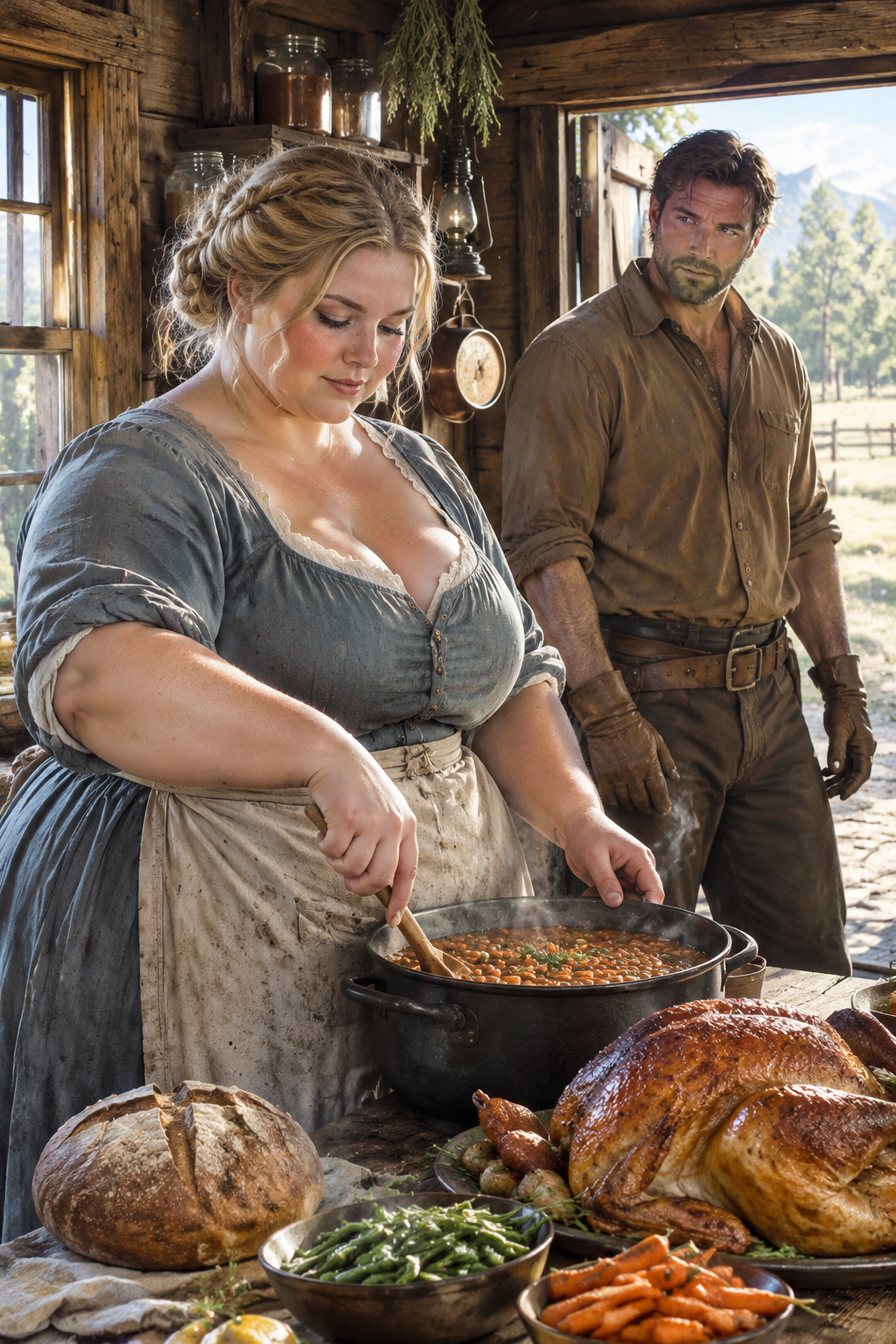
Instead, I stayed in the ranch kitchen and cooked.
I made beef stew, cornbread, roasted vegetables, and enough biscuits to feed every man working the property.
Cooking had always been the place where my hands knew what to do when my heart didn’t.
As the afternoon passed, ranch hands came through the kitchen offering quiet encouragement.
Tommy squeezed my shoulder.
An older cowboy named Hank told me my mother would have been proud.
Even Roy stopped at the doorway.
He didn’t ask for forgiveness.
He simply said, “I’m going to make this right, Emma.”
That evening, Sheriff Brooks called.
Investigators had found evidence of an old campsite near the quarry.
Beneath a collapsed storage shelter, they’d discovered a rusted metal case containing damaged papers.
Several pages appeared to be financial records.
But there were no human remains.
I didn’t know whether to feel relieved or devastated.
Then the sheriff said something that made my heart race.
“Emma, one of the documents contains a handwritten note suggesting Samuel Bennett may have been transported out of Montana.”
I gripped the telephone.
“Transported where?”
“We don’t know yet.”
For the first time, a possibility I’d never allowed myself to imagine entered my mind.
What if my father hadn’t died?
What if he’d survived?
And what if he’d spent twenty-seven years believing my mother had abandoned him?
The next several days passed in a blur.
Investigators traced old bank transfers, property records, and medical expenses connected to Whitmore’s businesses.
They discovered that a private medical facility in Idaho had received payments from one of his companies shortly after Samuel disappeared.
The facility had closed years earlier.
Its surviving records were incomplete.
But one patient had been admitted under the name John Miller with severe head injuries and no identification.
His age matched Samuel’s.
The admission date was four days after the gunshot.
I sat beside William as Sheriff Brooks explained the discovery.
“There’s no proof it’s your father,” she cautioned.
“But it’s worth investigating.”
I held the silver necklace until its edges pressed into my palm.
For the first time since childhood, I whispered a prayer that felt almost too frightening to finish.
Meanwhile, Charles Whitmore learned that the sheriff was examining the old ranch accounts.
His attorney contacted William, accusing him of spreading defamatory allegations.
Then Whitmore arrived at Carter Ranch in person.
I saw his black SUV pull through the gate just after lunch.
He stepped out wearing an expensive gray coat, polished shoes, and a smile that made my skin crawl.
William met him on the porch.
I stood behind the screen door.
“William,” Whitmore said pleasantly. “I hear you’ve been digging into family history.”
William folded his arms.
“Some history deserves to be uncovered.”
Whitmore’s smile faded.
“Your father understood the importance of leaving certain matters alone.”
“And my mother understood the importance of telling the truth.”
Whitmore’s eyes shifted toward me.
For a second, his expression changed.
Then he smiled again.
“You must be Margaret’s daughter.”
I stepped onto the porch.
“Emma Dawson.”
He studied my face.
“You have her eyes.”
Something about the way he said it made my stomach tighten.
“My mother remembered you,” I replied.
“Did she?”
“Not kindly.”
His smile disappeared.
William moved closer to me.
Whitmore looked between us, then slowly adjusted his gloves.
“Be careful, William. Old accusations can ruin innocent people.”
He returned to his SUV without another word.
I watched him drive away.
My hands were shaking, but I refused to let him see.
That evening, the sheriff informed us that Whitmore had been questioned and denied wrongdoing.
The financial investigation continued.
Two days later, investigators obtained enough evidence to seek warrants related to the old fraud.
Whitmore’s offices were searched.
Several accounts connected to his businesses were frozen.
And Roy Briggs formally gave his statement under oath.
But the most important discovery came from Idaho.
A retired nurse named Patricia Wells remembered the unidentified patient.
He’d arrived unconscious, badly injured, and suffering from memory loss.
After months of treatment, he’d begun recovering fragments of his past.
“He kept asking about a woman named Maggie,” Patricia told investigators.
My mother.
Everyone who loved her had called her Maggie.
I cried when Sheriff Brooks repeated those words.
Patricia explained that the patient had eventually been transferred to a rehabilitation center in eastern Oregon.
After that, the trail disappeared.
But the investigators kept searching.
They found an old employment record from a small horse sanctuary outside Bend.
A man named John Miller had worked there for nearly twenty years.
He was quiet, hardworking, and exceptionally gentle with injured animals.
The sanctuary’s owner remembered that John occasionally spoke about mountains, cattle, and a woman who made the best biscuits in the world.
My heart felt as though it might break.
Then came the news I’d barely dared hope for.
John Miller was still alive.
I was standing in the ranch kitchen when William told me.
The spoon slipped from my hand and struck the floor.
“Alive?” I whispered.
William nodded.
“He lives in Oregon. The sheriff is arranging a meeting.”
I covered my mouth.
Twenty-seven years.
Twenty-seven birthdays.
Twenty-seven Christmases.
My mother had died believing the man she loved was gone forever.
And he had been living only a few states away.
I didn’t sleep that night.
I imagined meeting him.
I imagined discovering he didn’t remember me.
I imagined looking into his eyes and finding a stranger.
But beneath all those fears was something stronger.
Hope.
Three days later, William drove me to Oregon.
The journey seemed endless.
Mountains rose beyond the highway, and every passing mile carried me closer to a man whose face I’d known only from a tiny photograph.
When we reached the sanctuary, an elderly woman named Helen greeted us near the stables.
She looked at me for a long moment.
Then her eyes filled with tears.
“You look like the woman in his dreams,” she whispered.
I couldn’t speak.
Helen led us toward a paddock where a gray-haired man was brushing a chestnut horse.
He stood with a slight limp.
His shoulders were broad, his movements patient.
When Helen called his name, he turned.
I recognized his eyes immediately.
The same gentle eyes in the photograph.
The same crooked smile, though age had softened it.
He looked at me with polite confusion.
“Can I help you?”
My throat closed.
I stepped forward, holding the silver necklace.
“My name is Emma Dawson.”
His expression changed.
I saw him notice the necklace.
Then my face.
Then the tears running down my cheeks.
“Dawson?” he whispered.
“My mother was Margaret Dawson.”
The brush fell from his hand.
He stared at me as though the ground had disappeared beneath his feet.
“Maggie?”
I shook my head.
“I’m her daughter.”
His lips trembled.
For several seconds, he couldn’t move.
Then he whispered something I will remember for the rest of my life.
“She had the baby?”
I nodded through my tears.
“She had me.”
He pressed both hands against his face.
When he finally lowered them, his eyes were overflowing.
“I tried to find her,” he said.
“I remembered her name, but not where she lived. Every time I thought I knew, the memories slipped away.”
I stepped closer.
“She waited for you.”
He began crying.
I told him about our restaurant.
About my mother’s kindness.
About the way she’d taught me to cook and never let anyone leave her table hungry.
Then I told him she’d died.
He sank onto a wooden bench.
For a long time, neither of us spoke.
I sat beside him and placed my hand over his.
He held it as though he was afraid I might disappear.
“I’m sorry,” he whispered.
I shook my head.
“You didn’t leave us.”
He looked at me.
“I lost everything.”
“Not everything,” I said.
And when he opened his arms, I finally stepped into the embrace I’d spent my entire childhood imagining.
I didn’t know him yet.
He didn’t know me.
But somehow, beneath the grief and the missing years, there was still something familiar.
Something that felt like coming home.
The weeks that followed were not easy.
Samuel’s memories returned in fragments, sometimes painfully, sometimes not at all.
He remembered the argument at the quarry.
He remembered Whitmore demanding the documents.
He remembered trying to escape.
But he couldn’t remember who fired the gun.
Investigators pieced together the remaining evidence through records, witness statements, and financial documents.
Whitmore was eventually charged in connection with the historic fraud and the violent attack on Samuel.
His attorney denied the allegations, but the recovered records and testimony provided the prosecution with a substantial case.
The legal proceedings would take time.
I understood that justice wasn’t always a dramatic confession or a single moment in a courtroom.
Sometimes it was patient work.
Sometimes it meant facing uncomfortable truths after decades of silence.
And sometimes it began with one frightened man finally admitting what he’d seen.
Roy Briggs testified.
He accepted responsibility for his silence and for the false statements he’d made years earlier.
Afterward, he came to find me in the ranch kitchen.
He stood awkwardly beside the doorway, holding his hat.
“I know an apology doesn’t fix anything,” he said.
I continued kneading dough.
“No, it doesn’t.”
He nodded.
“I was cruel to you because seeing you reminded me of your mother. Every time you walked into this kitchen, I remembered what I let happen.”
I looked at him.
“You could have chosen kindness.”
His eyes filled.
“I know.”
I wiped flour from my hands.
“Then choose it now.”
Roy lowered his head.
“I will.”
I didn’t forgive him that day.
But over the following months, I watched him change.
He stopped mocking the younger hands.
He helped Tommy’s family when their truck broke down.
He began treating people with the respect he’d once withheld so easily.
And every morning, he quietly carried the heavy flour sacks into my kitchen without being asked.
I learned that forgiveness didn’t mean pretending the past hadn’t happened.
It meant deciding whether someone who had truly changed deserved the chance to live differently.
Samuel eventually moved to Montana, renting a small cottage near the ranch while we slowly learned how to be father and daughter.
Our first conversations were awkward.
He asked about my favorite foods.
I asked about his horses.
Sometimes we sat together without speaking because twenty-seven years couldn’t be repaired in a few afternoons.
But one Sunday, I taught him how to make my mother’s biscuits.
He watched carefully as I mixed the dough.
“She used to hum while she cooked,” he said.
I smiled through sudden tears.
“She never stopped.”
He closed his eyes.
For a moment, I could almost hear her humming between us.
That winter, William offered me a partnership in the ranch kitchen.
He wanted to renovate the old dining hall and open it to travelers during weekends, creating a small restaurant that would serve the surrounding community.
He’d already spoken with local suppliers and neighboring ranchers.
But he wanted me to make the final decision.
I stood in the empty dining hall, looking at the long wooden tables where I’d once been humiliated.
It was difficult to believe that the same room could become the beginning of something beautiful.
“What would you call it?” William asked.
I thought of my mother.
Her tired hands.
Her warm smile.
The little restaurant in Colorado where every stranger had been welcomed like family.
“Margaret’s Table,” I whispered.
William smiled.
“Then Margaret’s Table it is.”
We spent months restoring the building.
Tommy painted the walls.
Hank repaired the windows.
Roy rebuilt the kitchen shelves.
Samuel crafted a wooden sign by hand, carving my mother’s name into the polished surface.
And William worked beside us every evening, never acting as though being the ranch owner placed him above anyone else.
On opening day, snow fell softly over the Montana mountains.
Thirty ranch hands filled the dining room.
Neighbors arrived carrying flowers and homemade pies.
The sheriff stopped by with her family.
Even Helen traveled from Oregon to celebrate.
I stood behind the counter wearing my mother’s old apron.
It had been washed and repaired so many times that the fabric was nearly transparent.
But I couldn’t imagine wearing anything else.
Samuel approached me holding a small wooden box.
“I found something in my belongings,” he said.
Inside was a simple gold ring.
He explained that he’d bought it for Margaret shortly before disappearing.
He’d kept it through every hospital transfer, every forgotten year, and every lonely season afterward.
Somehow, even when he couldn’t remember her face, he’d known the ring belonged to someone important.
I held it in my palm.
For a moment, the grief returned so sharply that I couldn’t breathe.
“She would have loved this,” I whispered.
Samuel nodded.
“I know.”
I slipped the ring onto a chain and placed it around my neck beside the silver locket.
Then I walked into the dining room.
Thirty men stood.
William raised his glass.
“To Margaret Dawson,” he said.
“To the woman who taught us that kindness can outlive cruelty.”
The room filled with applause.
I looked around at the faces that had once been strangers.
At Roy, standing quietly near the back.
At Tommy, grinning beside the fireplace.
At William, whose kindness had given me a second chance.
And at Samuel, my father, who was finally standing where he belonged.
For the first time in years, I didn’t feel like a woman trying to survive the next disaster.
I felt like someone who had a future.
Later that evening, after the last guests had gone, I sat beside Samuel on the porch.
Snow covered the orchard, and warm light spilled from the restaurant windows.
He reached for my hand.
“Your mother would be proud of you, Emma.”
I looked toward the wooden sign hanging above the entrance.
For years, I’d believed losing our restaurant meant losing the last piece of her.
But I understood something now.
My mother had never been the building.
She’d been the warmth inside it.
She’d been the food placed before hungry strangers.
The dignity she gave people who had none left.
The courage she carried when the world tried to make her small.
And those things had survived.
They’d traveled with me from Colorado to Montana, through humiliation, fear, grief, and the discovery of truths I’d never expected to face.
I had arrived at Carter Ranch with eighty-three dollars and a suitcase full of broken dreams.
I’d been mocked for my body, doubted for my abilities, and reminded of everything I’d lost.
But none of those things had determined my worth.
The people who judged me had seen only my appearance.
My mother had taught me to see what was inside a person.
And in the end, that difference had changed all our lives.
Samuel squeezed my hand.
“Are you happy here?”
I looked through the window at the kitchen where fresh bread was cooling on the counter.
I thought about the little girl who’d once waited for a father who never came home.
The young woman who’d buried her mother and believed she had nobody left.
And the frightened cook who’d stood silently while a cruel man threw her dinner onto the floor.
Then I looked at the father I’d found, the home we’d rebuilt, and the future waiting beyond the snow-covered hills.
“Yes,” I whispered.
“For the first time in a long time, I really am.”
The next morning, I opened Margaret’s Table before sunrise.
I lit the stove, tied my mother’s apron around my waist, and began preparing biscuits just as she’d taught me.
Outside, the ranch slowly awakened.
Inside, the kitchen filled with the smell of butter, warm bread, and coffee.
I placed an extra plate at the end of the counter, the way my mother always had.
Not because I expected anyone in particular.
But because somewhere beyond those mountains, someone might be hungry, frightened, lonely, or searching for a place to belong.
And I wanted them to know there would always be room at our table.
Because my mother had taught me one truth that no amount of cruelty, money, or time could ever erase.
A person’s worth is not measured by their appearance, their possessions, or the mistakes others have made against them.
It is measured by the kindness they choose to give when life has given them every reason to become bitter.
And sometimes, the smallest act of kindness doesn’t just change one person’s day.
Sometimes it travels across generations, survives decades of darkness, and leads a lost daughter all the way home.
THE END.