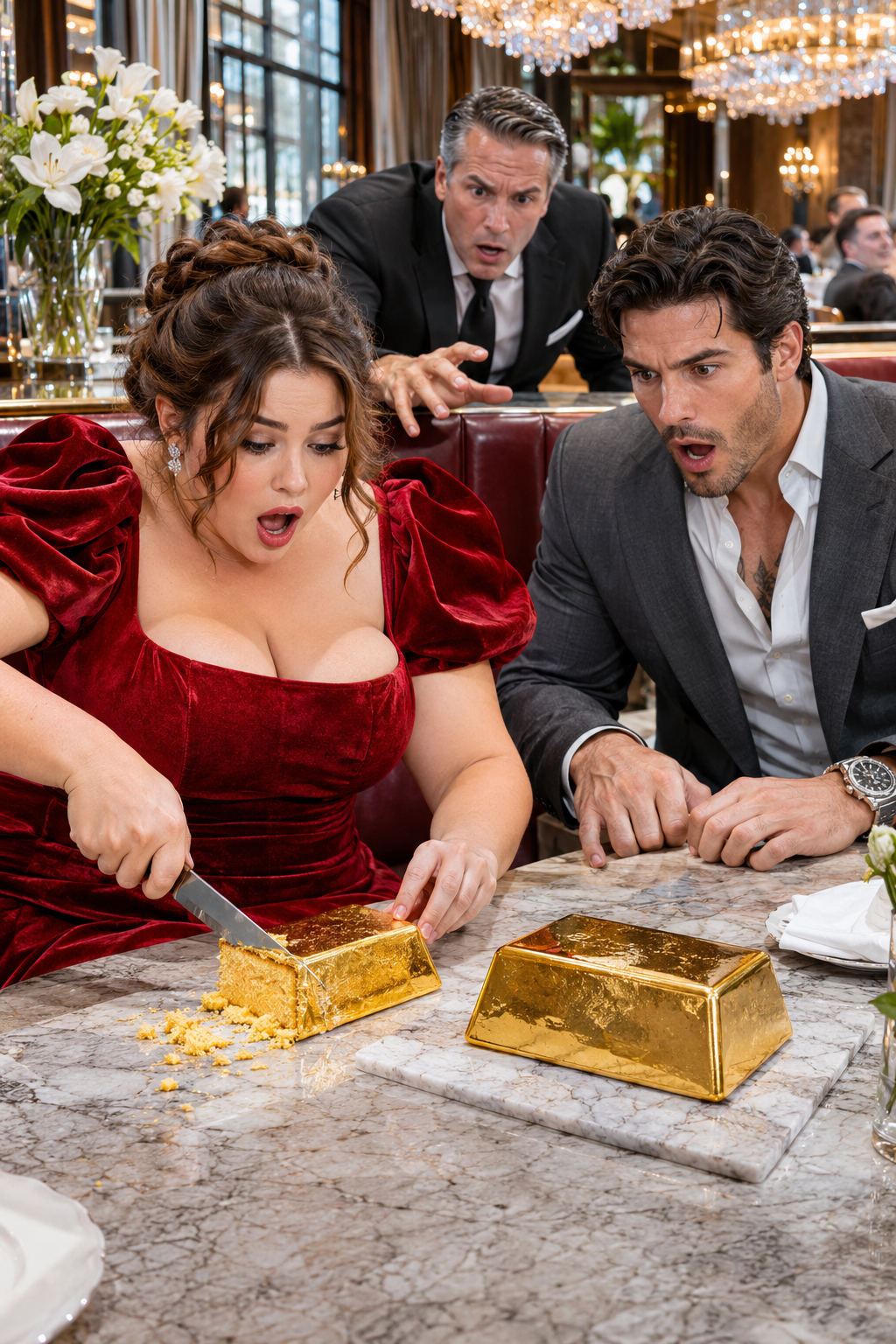
Renata was halfway through the worst blind date of her life when she picked up a gold bar from the next table and accidentally exposed a $3 million scam.
She stood, smoothing her dress with nervous fingers.
Victor was already near the door.
He had apparently decided the date was over.
Renata couldn’t blame him.
But as she turned to leave, Morandi spoke again.
“Miss Alvarez.”…
She stopped.
“One last question.”
“Yes?”
“Why did you say anything? You must have understood that it could be dangerous.”
Renata thought about her little laboratory. About the countless hours she had spent correcting tiny imperfections nobody else would ever notice.
About her father, who had worked as a machinist and taught her that ignoring a problem didn’t make it disappear.
“Because I knew something wasn’t right,” she said. “And I didn’t want to pretend I hadn’t seen it.”
Morandi studied her.
Then he inclined his head.
“Thank you.”
Outside, the Chicago evening felt wonderfully ordinary.
Cars moved along the street.
A couple argued gently over where to get dessert.
Someone laughed into a phone.
Renata stood on the sidewalk and realized her hands were shaking.
Victor approached.
“Do you have any idea what you just did?”
“Apparently.”
“That man could have had us killed.”
“Then I’m glad he didn’t.”
Victor stared at her.
“You’re unbelievable.”
Renata looked at him for a moment.
Then she said, “You know, I don’t think we’re a good match.”
He opened his mouth.
She raised a hand.
“Please don’t explain cryptocurrency again.”
She called a cab and went home.
By the following morning, she had almost convinced herself the entire evening had been a strange dream.
Then a black sedan appeared outside her dental laboratory.
A man in a dark coat entered the reception area.
Renata recognized Dominic, the metals specialist.
He carried a small envelope.
“Mr. Morandi asked me to deliver this personally.”
Her stomach tightened.
“Is something wrong?”
“No. Actually, things went rather well.”
He explained that Morandi’s associates had located the private vault using the shipping documents and Arthur’s confession.
The genuine gold had been recovered.
Independent specialists were verifying the inventory.
Arthur had surrendered the access credentials and signed a statement documenting the fraud.
“What happens to him?” Renata asked.
Dominic hesitated.
“That’s being handled.”
She didn’t like the answer.
“Handled how?”
“I don’t know all the details.”
Renata looked at the envelope.
“What’s this?”
“A thank-you.”
Inside was a cashier’s check for fifty thousand dollars.
She stared at it.
Then she pushed it back across the counter.
“I can’t accept this.”
Dominic looked surprised.
“Why not?”
“Because I didn’t do fifty thousand dollars’ worth of work. I noticed a scratch.”
“You prevented a three-million-dollar loss.”
“I helped identify a problem. That’s different.”
Dominic smiled faintly.
“Mr. Morandi expected you might say that.”
He produced another envelope.
Inside was a handwritten note.
Miss Alvarez,
Your integrity is worth more than the gold you helped recover.
I understand that you may not wish to accept a reward. Nevertheless, I would consider it an honor if you allowed me to compensate you for your time and expertise.
Respectfully,
Cesare Morandi.
Renata read it twice.
She had never imagined receiving a handwritten letter from a man whose name made entire rooms fall silent.
She looked at Dominic.
“Tell him I appreciate the gesture. But I don’t want money that comes with expectations.”
Dominic nodded.
“That’s fair.”
He took the check back.
For several days, nothing happened.
Renata returned to her ordinary routine.
She repaired chipped crowns, adjusted porcelain veneers, and ate sandwiches at her workbench.
Her coworkers teased her about her disastrous blind date.
She told them only that Victor had been boring.
But on Friday afternoon, she received a phone call from an unfamiliar number.
“Miss Alvarez?”
She recognized Morandi’s voice immediately.
“Yes?”
“I hope I’m not disturbing you.”
“Actually, I’m working.”
“Then I’ll be brief.”
He explained that the recovered gold had been fully authenticated and secured.
Arthur had been removed from his position and was cooperating with an attorney-led investigation into the fraudulent transactions.
Morandi did not explain what consequences Arthur might face beyond that.
Renata was relieved he didn’t.
“I wanted you to know,” Morandi continued, “that the matter has been resolved as far as the gold is concerned.”
“I’m glad.”
“And I wanted to thank you again.”
“You already did.”
“Apparently, not sufficiently.”
She smiled despite herself.
“Mr. Morandi, you don’t owe me anything.”
“Perhaps not. But I have a question.”
“Go ahead.”
“Would you consider consulting for a legitimate precious-metals verification business I’m helping finance? The owner believes someone with your experience in dental alloys could be valuable.”
Renata leaned against her workbench.
She had spent years wishing someone would recognize the technical skill involved in her profession.
Now recognition had arrived from the last person she would ever have chosen.
“What exactly would the job involve?”
“Training, material inspection, and helping develop better screening procedures. Nothing outside the law.”
“And the business?”
“Independently operated. Properly registered. You would be free to review everything before making a decision.”
Renata remained quiet.
She thought about her modest paycheck.
The aging equipment in her laboratory.
The student loan she was still paying.
An opportunity like this could change her life.
But she also thought about Arthur.
About the fear in his eyes.
About how quickly ordinary business could become something dangerous when Morandi was involved.
“I’d need to speak with a lawyer first,” she said.
“Of course.”
“And I’d need everything in writing.”
“I would expect nothing less.”
After the call ended, Renata sat alone for several minutes.
On her workbench lay a dental crown she had been polishing when the phone rang.
It was tiny, precise, and familiar.
She picked it up and examined the surface under her inspection light.
For eleven years, her world had been measured in fractions of millimeters.
Now a single observation had opened a door into a world she had never wanted to enter.
And she couldn’t decide whether walking through it would be the smartest decision of her life or the beginning of a terrible mistake.
On Monday morning, a formal consulting proposal arrived at her laboratory.
The salary was nearly three times what she currently earned.
The contract included independent legal oversight and the right to refuse any assignment.
Everything looked professional.
Everything looked reasonable.
But tucked inside the paperwork was one detail that made her stop reading.
The company was partly financed through a holding firm connected to Cesare Morandi.
Renata reached for her phone.
She had two calls to make.
One to an attorney who could help her understand the offer.
And another to the man who had made it.
For the first time since that strange dinner, she understood that identifying counterfeit gold had been the easy part.
Deciding whom to trust would be much harder.
And this time, there would be no tiny scratch to reveal what was hiding underneath.
Renata stared at the consulting agreement on her kitchen table for nearly an hour before she finally picked up her phone.
The salary was $142,000 a year.
More than three times what she earned at the dental laboratory.
There was health insurance, paid vacation, a retirement plan, and a signing bonus large enough to replace her aging Honda and pay off most of her student loans.
For a woman who had spent eleven years carefully calculating whether she could afford new winter tires, the offer felt almost impossible to refuse.
But one name kept drawing her attention.
Cesare Morandi.
Not directly, of course. His name appeared nowhere on the employment agreement. Instead, a holding company called Westbridge Capital Partners owned thirty percent of the business.
Renata had researched Westbridge.
Two minutes of searching had revealed its connection to Morandi’s financial network.
She pushed the paperwork aside and called her older sister, Elena.
“Tell me I’m being ridiculous,” Renata said when Elena answered.
“That depends. What did you do?”
“Nothing yet.”
“Renata.”
“I’ve been offered a job.”
“That’s wonderful!”
“By a company partly financed by Cesare Morandi.”
Silence.
Then Elena said, “The man from the restaurant?”
“Yes.”
“The one everybody’s afraid of?”
“That’s the one.”
Another silence.
“Please tell me you’re joking.”
Renata explained the position, the salary, the benefits, and the promise of independent oversight.
Elena listened without interrupting.
When Renata finished, her sister asked one question.
“Would you consider this job if his name weren’t attached to it?”
Renata looked at the contract.
“Absolutely.”
“Then you need to find out whether the job is legitimate or whether you’re being paid to ignore things.”
That sentence stayed with Renata long after they hung up.
The next morning, she made an appointment with an employment attorney named Margaret Ellis.
Margaret was a practical woman in her sixties who wore reading glasses on a silver chain and seemed entirely unimpressed by large salaries.
She reviewed the agreement carefully.
“The employment terms are unusually generous,” she said.
“Is that bad?”
“Not necessarily. But generous contracts can still contain dangerous obligations.”
She tapped a paragraph near the bottom of page seven.
“This concerns me.”
Renata leaned forward.
The provision required employees to maintain confidentiality regarding business operations, internal investigations, and proprietary information.
“Isn’t that normal?”
“Parts of it are. But this language is broader than it needs to be. I want an explicit exception for reporting suspected criminal activity or regulatory violations.”
Renata nodded.
“And this section,” Margaret continued, “allows the company to assign you to affiliated businesses.”
“Meaning?”
“Meaning you could accept a job inspecting metals and discover that you’re expected to perform services for companies you’ve never heard of.”
Renata felt her excitement fading.
“Can we change it?”
“We can ask.”
Margaret removed her glasses.
“Before you make any decision, I want to meet the actual owners. Not Mr. Morandi. The people who will supervise you.”
“Do you think I should walk away?”
“I think you should stop being impressed by the number at the top of the page until you understand everything underneath it.”
Renata almost laughed.
It sounded remarkably similar to something she might say about a dental crown.
Three days later, she arrived at the headquarters of Sterling Materials Verification, a modest two-story building in Elk Grove Village.
There were no marble floors, expensive paintings, or men in dark suits guarding the entrance.
Instead, she found a receptionist eating yogurt, a technician arguing with a printer, and a laboratory that smelled faintly of machine oil and cleaning solvent.
The company’s founder, Dr. Evelyn Mercer, greeted her personally.
Evelyn was fifty-one, with short brown hair and the distracted manner of someone who spent more time examining instruments than attending meetings.
“I’ve wanted to meet you since Dominic told me what happened,” she said.
Renata smiled nervously.
“I hope he didn’t exaggerate.”
“He said you noticed a coating defect on a counterfeit gold bar during dinner.”
“That’s accurate.”
“And you understood why the underlying material mattered.”
“I understood enough to ask questions.”
Evelyn grinned.
“Good. I don’t need people who think they know everything. I need people who notice what doesn’t make sense.”
She showed Renata the laboratory.
There were ultrasonic testing instruments, X-ray fluorescence analyzers, precision scales, and microscopes powerful enough to reveal microscopic scratches.
Sterling verified precious metals for jewelers, estate dealers, manufacturers, and financial institutions.
The work was fascinating.
Renata found herself asking questions she hadn’t expected to ask.
Within twenty minutes, she and Evelyn were discussing plating thickness, alloy composition, and the difficulty of identifying sophisticated counterfeits.
For the first time since receiving the offer, Renata forgot about Morandi.
Then Evelyn led her into a conference room.
“I should tell you something,” she said.
Renata sat down.
“Mr. Morandi invested in this company six months ago. He provided capital for equipment and expansion. But he doesn’t manage our laboratory.”
“Does he send you work?”
“Occasionally.”
“Does he influence your findings?”
“No.”
“Has he ever tried?”
Evelyn hesitated.
Renata noticed.
“That’s an important question,” she said.
Evelyn folded her hands.
“His representatives once asked whether we could expedite a verification report. I refused to change our testing schedule without proper documentation.”
“And?”
“They accepted my decision.”
Renata studied her.
“Why are you telling me this?”
“Because I know what his reputation is. And because I wouldn’t work here if I couldn’t say no.”
That answer mattered more than the salary.
But Renata still wasn’t ready.
She asked Evelyn whether Sterling would accept the contract changes her attorney proposed.
“Send them over,” Evelyn replied. “If they’re reasonable, we’ll make them.”
For the first time, Renata felt she might actually have a choice.
Then, two days later, Arthur’s attorney called her.
His name was Leonard Price.
He spoke politely, almost apologetically.
“Miss Alvarez, I’m representing Arthur Bell in connection with the gold substitution investigation.”
Renata stood beside her laboratory workbench, holding the phone tightly.
“Why are you calling me?”
“My client has made certain statements concerning the events at Bellissimo. I would like to clarify your observations.”
“I already told everyone what I saw.”
“I understand. But Mr. Bell claims that the counterfeit bars were deliberately introduced by another party.”
Renata frowned.
“Another party?”
“Yes.”
“Who?”
Leonard paused.
“He believes Mr. Morandi knew about the substitution before the dinner.”
Renata felt the room tilt slightly.
“That doesn’t make sense.”
“Perhaps not. But my client maintains that he was being used to conceal irregularities in a separate financial transaction.”
“Arthur admitted he arranged the replacement.”
“He acknowledges participating in the transfer. He disputes the circumstances and the extent of his responsibility.”
Renata remembered Arthur’s shaking hands.
His confession.
The look on Morandi’s face.
“Why would he say that now?”
“That’s what we’re trying to establish.”
Leonard asked whether she would agree to a voluntary interview.
Renata said she would speak with her attorney first.
After hanging up, she stood motionless for several minutes.
She had thought the matter was finished.
The gold had been recovered.
Arthur had confessed.
Morandi had thanked her.
Now someone was suggesting that the truth might be more complicated.
That evening, Renata called Margaret.
“Don’t speak to Arthur’s lawyer without me,” Margaret said immediately.
“Do you think he’s telling the truth?”
“I have no idea.”
“Could Morandi have known?”
“Possibly. But an accusation isn’t evidence.”
Renata rubbed her forehead.
“Then why would Arthur confess?”
“People confess for different reasons. Sometimes because they’re guilty. Sometimes because they’re frightened. Sometimes because they believe admitting part of the truth will protect them from something worse.”
Renata looked at Sterling’s employment agreement.
“Should I reject the job?”
“Not yet. But we need more information.”
The following Monday, Renata received an unexpected visitor.
Cesare Morandi himself.
He arrived at her dental laboratory shortly before closing, accompanied by a driver who remained outside.
Her supervisor, Mr. Feldman, nearly dropped a tray of ceramic crowns when he recognized him.
Morandi wore a simple dark overcoat.
“Miss Alvarez,” he said, “may I have five minutes?”
Renata glanced at her supervisor.
Mr. Feldman nodded so quickly that she almost felt sorry for him.
She led Morandi into the small break room.
He declined coffee.
“I understand Arthur’s attorney contacted you.”
Renata’s stomach tightened.
“How did you know?”
“His attorney informed mine that he intended to interview witnesses.”
“Did you come here to tell me what to say?”
Morandi looked genuinely surprised.
“No.”
“Then why are you here?”
“Because I thought you deserved to hear something directly from me.”
Renata waited.
“Arthur’s allegations are false,” he said. “But I understand why you might question my involvement.”
“Did you know the gold was counterfeit before that dinner?”
“No.”
“Did you suspect Arthur?”
“Not until you pointed out the defect.”
“Then why is he saying otherwise?”
Morandi looked toward the break room window.
“Arthur is trying to reduce his responsibility. He believes accusing me of arranging the transaction will help him negotiate with prosecutors.”
“Will it?”
“That depends on what he can prove.”
Renata crossed her arms.
“And what about the original gold? Where did it come from?”
Morandi returned his attention to her.
“A private investment purchase. The transaction itself was lawful.”
“Can you prove that?”
“Yes.”
“Would you?”
For several seconds, neither spoke.
Then Morandi smiled faintly.
“You ask questions that most people avoid.”
“I’ve noticed that.”
“I can have my attorney provide the relevant records to yours.”
Renata nodded.
“That would help.”
Morandi stood.
“One more thing. The employment offer is genuine. Evelyn Mercer requested you because she believes you’re qualified.”
“Did you suggest my name?”
“Yes.”
“Then it’s not entirely independent.”
“No,” he admitted. “It isn’t.”
She appreciated that he didn’t pretend otherwise.
“Why me?”
Morandi considered the question.
“Because you were the only person in that restaurant who had nothing to gain by telling me the truth.”
Renata looked down.
“That’s not completely true. I wanted to leave my date.”
Morandi laughed.
“Then perhaps I owe Victor an apology.”
She smiled despite herself.
But as he reached the door, she spoke again.
“Mr. Morandi?”
He turned.
“If I take that job, and I find something wrong with one of your transactions, what happens?”
His expression became serious.
“You report it.”
“Even if it costs you money?”
“Especially then.”
Renata studied him.
“That’s easy to promise.”
“Yes,” he replied. “It is.”
Then he left.
For the next two weeks, Renata tried to concentrate on her regular work.
But the situation refused to settle.
Margaret received financial records confirming that the original gold purchase had been made through a registered dealer, with invoices and payment documentation.
Nothing in those records established that Morandi had arranged the substitution.
Arthur’s attorney continued suggesting otherwise, but provided no supporting evidence.
Meanwhile, Sterling accepted every substantial change Margaret requested.
The confidentiality clause was narrowed.
Assignments to affiliated businesses required Renata’s written consent.
She would report directly to Evelyn.
She would have the right to refuse questionable work and disclose suspected wrongdoing to authorities without contractual penalty.
Margaret reviewed the revised agreement.
“This is much better.”
“Would you sign it?”
Margaret leaned back.
“If I were interested in the work, and I understood the reputational risks, I’d consider it.”
Renata stared at her.
“That’s not an answer.”
“It’s the only honest one I can give you.”
On Friday evening, Renata visited her father.
He lived in a small bungalow in Jefferson Park, surrounded by tools he refused to throw away.
At seventy, Miguel Alvarez still repaired lawnmowers for neighbors, although his arthritis made the work difficult.
Renata found him in the garage, examining an old engine.
“You’re supposed to be resting,” she said.
“I am resting.”
“You’re holding a wrench.”
“Very relaxing wrench.”
She laughed and sat beside him.
For a while, they talked about ordinary things.
The weather.
Elena’s children.
A neighbor who had painted his garage door an unfortunate shade of purple.
Then Renata told him everything.
The job.
The money.
The lawyer.
Arthur’s accusation.
Morandi’s visit.
Miguel listened quietly.
When she finished, he placed the wrench on his workbench.
“Do you remember when you were fourteen and helped me repair Mrs. Kowalski’s washing machine?”
Renata frowned.
“Vaguely.”
“I told you the motor was fine.”
“And it wasn’t.”
“No. You noticed the damaged wire.”
“You were angry.”
“I was embarrassed.”
He smiled.
“But you were right.”
Renata looked at him.
“What’s your point?”
“Being right doesn’t mean people will thank you. Sometimes it makes them angry. Sometimes it costs you something.”
“I know.”
“Then don’t take the job because a powerful man likes you. Take it because it’s work you believe in, and because you can still tell the truth when that powerful man doesn’t like what you find.”
Renata sat silently.
Miguel reached for her hand.
“Money can make life easier, sweetheart. But it can’t make a bad decision good.”
Three days later, Renata signed the revised contract.
She gave Mr. Feldman four weeks’ notice.
He was disappointed but proud.
“You’ve earned this,” he told her.
Renata wasn’t entirely sure.
But she was ready to find out.
Her first month at Sterling was exhausting.
She learned new instruments, unfamiliar testing standards, and documentation procedures far more detailed than anything she’d encountered in dental work.
She made mistakes.
She asked embarrassing questions.
Once, she accidentally entered the wrong sample identification number and spent two hours correcting the resulting paperwork.
Evelyn never mocked her.
Instead, she insisted that every error be documented.
“A mistake you admit can be fixed,” she told Renata. “A mistake you hide becomes someone else’s disaster.”
Renata began to understand why she liked working there.
Then, six weeks after her arrival, Sterling received a large verification order from a precious-metals distributor called Northstar Bullion.
The shipment contained twenty-four gold bars.
The client requested expedited testing.
Renata was assigned to assist a senior analyst named Peter Walsh.
At first, everything appeared normal.
The bars had matching serial numbers, consistent weights, and convincing surface finishes.
The ultrasonic readings were within expected ranges.
Peter began preparing the report.
But Renata noticed something unusual.
Three bars had microscopic surface marks near their stamped serial numbers.
Under magnification, the marks resembled tiny parallel scratches.
She asked Peter to examine them.
“Probably handling damage,” he said.
“Maybe.”
“All the major readings passed.”
“I know.”
He glanced at the clock.
“We’re already behind schedule.”
Renata hesitated.
Then she remembered the restaurant.
“Can we check the serial numbers against the manufacturer’s original records?”
Peter sighed.
“That’ll take time.”
“I’d rather be late than wrong.”
He studied her for a moment.
Then he nodded.
“Fine.”
The manufacturer responded the following morning.
The serial numbers were genuine.
But the production dates didn’t match the documentation supplied by Northstar.
Three bars had been recorded as sold to a different institution years earlier.
Renata brought the discrepancy to Evelyn.
Evelyn immediately suspended certification of the shipment.
Within hours, Northstar’s representative called.
He was furious.
“Your company is holding up a major transaction over a paperwork discrepancy?”
Evelyn remained calm.
“We’re verifying ownership and authenticity.”
“The bars passed your tests.”
“That doesn’t establish their provenance.”
“We’ll take our business elsewhere.”
“You’re welcome to do so after the documentation issues are resolved.”
The representative hung up.
Renata felt a familiar uneasiness.
“Did I make a mistake?”
Evelyn shook her head.
“You identified a discrepancy. That’s your job.”
Two days later, a lawyer representing Northstar demanded the return of the shipment.
Sterling’s legal counsel arranged its release under documented chain-of-custody procedures, while preserving test records and notifying the appropriate authorities about the inconsistent provenance information.
Renata expected the matter to end there.
It didn’t.
That Friday, Dominic appeared at Sterling.
He looked unusually serious.
“Renata, we need to talk.”
She followed him into Evelyn’s office.
Evelyn was already there.
Dominic placed a folder on the desk.
“Northstar Bullion is connected to Arthur Bell.”
Renata stared at him.
“What?”
“Not directly. The company has several layers of ownership. But one of its beneficial owners is Arthur’s brother-in-law.”
The same brother-in-law connected to the counterfeit gold shipment.
Renata felt cold.
“Why would they send bars here?”
“We don’t know,” Evelyn said.
Dominic opened the folder.
“The company has been under financial pressure. There are questions about the ownership records of several shipments.”
Renata looked at the photographs.
“Are you saying those bars were stolen?”
“We’re saying their provenance needs investigation.”
“Does Morandi know?”
Dominic hesitated.
“Yes.”
Renata immediately understood the problem.
A company connected to Arthur had submitted suspicious gold to a laboratory partly financed by the man Arthur had betrayed.
Even if Sterling’s findings were completely legitimate, the situation could look like retaliation.
“We need to keep Morandi out of this,” she said.
Evelyn nodded.
“Agreed.”
But the next morning, Renata received a message from an unfamiliar number.
It contained a photograph.
Her father’s house.
Underneath were seven words.
Tell your boss to release the report.
Renata’s hands went numb.
She called Elena.
“Is Dad home?”
“Yes. Why?”
“Can you go check on him?”
“Renata, what’s wrong?”
“Please. Just go.”
Then she called the police.
She showed them the message, explained the connection to the disputed shipment, and provided every detail she could remember.
An officer took her statement.
Another arranged for additional patrols near her father’s street while investigators assessed the threat.
Renata also informed Evelyn and Margaret.
By noon, Sterling had suspended all nonessential contact with Northstar.
Renata went to her father’s house.
Miguel was sitting at the kitchen table, drinking coffee as though nothing unusual had happened.
Elena stood beside him, furious.
“You should have told us immediately,” Elena said.
“I did.”
“After somebody photographed Dad’s house!”
Miguel raised a hand.
“Enough.”
He looked at Renata.
“Are you afraid?”
She nodded.
“Yes.”
“Good.”
Elena stared at him.
“Dad!”
“Fear tells you something matters,” Miguel said. “It doesn’t tell you what to do.”
Renata sat down.
For the first time since the restaurant, she wondered whether she’d made a terrible mistake.
Her family had never asked to be involved.
They hadn’t chosen her job.
They hadn’t chosen Morandi.
And now someone had brought the danger to their front door.
That evening, Morandi called.
“I heard about the threat,” he said.
Renata closed her eyes.
“Please don’t send anyone to my father’s house.”
“I wasn’t going to.”
“Don’t confront Northstar. Don’t contact Arthur’s family. Don’t do anything.”
Morandi was silent.
Then he said, “You think I would make things worse.”
“I think you have a reputation for solving problems in ways I don’t want near my family.”
Another silence.
Finally, he replied, “That’s fair.”
Renata hadn’t expected that.
“The police are handling it,” she said.
“Then let them.”
“Will you?”
“Yes.”
She wanted to believe him.
But belief was becoming a dangerous thing.
Over the following week, investigators traced the threatening message to a prepaid phone purchased near Northstar’s warehouse.
Security footage eventually identified the buyer as a former employee of the distributor.
The man was questioned.
He admitted sending the message after being instructed by a supervisor to pressure Sterling into clearing the shipment.
The supervisor denied authorizing the threat.
But investigators obtained internal communications showing that Northstar executives had been discussing ways to force Sterling to issue a favorable report.
The investigation expanded.
Records revealed that the three disputed bars had been transferred through several companies using inconsistent ownership documents.
The bars themselves were genuine gold.
The problem was not their composition.
It was their history.
A portion of Northstar’s inventory appeared to have been pledged as collateral for multiple loans, with some assets represented as available for sale despite competing claims.
The company had been using the same physical gold to support transactions that could not all be honored.
When Renata learned this, she sat quietly in Evelyn’s office.
“So the bars weren’t fake.”
“No,” Evelyn said.
“But the paperwork was.”
“Exactly.”
Renata thought about Arthur’s counterfeit shipment.
There, genuine-looking bars had hidden worthless metal.
Here, genuine metal had been wrapped in misleading documents.
Different deception.
Same principle.
Something valuable on the surface could conceal a dangerous truth underneath.
Three weeks later, federal investigators executed search warrants at Northstar’s offices and related storage facilities.
Several executives were charged with financial crimes.
Arthur’s brother-in-law was among those arrested.
Arthur himself, already cooperating in the earlier gold-substitution investigation, provided additional records that helped investigators understand the overlapping business arrangements.
His claim that Morandi had orchestrated the original substitution was not supported by the evidence investigators developed.
That didn’t erase Morandi’s reputation or answer every question about his other businesses.
But it clarified the particular transaction that had brought Renata into his world.
The threatening employee was also charged.
Renata’s father was safe.
Sterling’s findings had been preserved.
And for the first time in months, Renata could sleep through the night.
Then Morandi invited her to lunch.
She nearly declined.
But Margaret suggested that a brief meeting in a public place might allow her to establish clear boundaries.
So Renata returned to Bellissimo.
The same restaurant where everything had begun.
This time, she wore a simple gray sweater and black slacks.
Morandi was already seated.
There was no briefcase.
No gold.
No nervous accountant.
Just a small table beside the window.
“Miss Alvarez,” he greeted her.
“Mr. Morandi.”
“Thank you for coming.”
Renata sat down.
A waiter brought water.
For a moment, neither spoke.
Then Morandi said, “I owe you an apology.”
She looked up.
“For what?”
“For bringing you into a situation that affected your family.”
“You didn’t send the threat.”
“No. But my investment and my history made the situation more complicated.”
Renata appreciated the distinction.
“I chose the job,” she said.
“Yes. You did.”
He folded his napkin.
“I’ve spent much of my life believing that loyalty meant people doing what I asked.”
Renata waited.
“Arthur was loyal for fourteen years. Or so I thought.”
“He may have been loyal for some of them.”
“Perhaps.”
Morandi looked toward the window.
“When I learned what he’d done, I was angrier about the betrayal than the money.”
“That’s understandable.”
“But anger doesn’t tell you the truth.”
Renata smiled slightly.
“My father says something similar about fear.”
Morandi nodded.
“Your father sounds wise.”
“He can also be very stubborn.”
“So can you.”
She laughed.
Then Morandi became serious.
“Evelyn tells me you insisted that Sterling report the Northstar discrepancies even after the threats.”
“Of course.”
“She also tells me you insisted I have no involvement.”
“Yes.”
“Why?”
Renata considered her answer.
“Because I wanted the findings to stand on their own. If the evidence was real, it didn’t need your influence.”
Morandi looked at her for a long time.
Then he said, “I wish someone had told me that twenty years ago.”
Renata didn’t know what to say.
He reached into his jacket.
For one uncomfortable second, she remembered the first dinner.
But he only removed a folded sheet of paper.
It was a letter from Sterling’s board of directors.
The company had decided to create a new position.
Director of Technical Integrity.
The role would oversee testing standards, quality assurance, and the independent reporting of irregularities.
Evelyn had recommended Renata.
The board had approved the position.
Renata read the letter carefully.
“Why are you giving me this?”
“Because Evelyn asked me to deliver it.”
“Did you influence the decision?”
Morandi smiled.
“I voted to abstain.”
She looked up.
“Really?”
“Really.”
Renata laughed softly.
“That’s probably the nicest thing you’ve done for me.”
He seemed amused.
“I’ve been told my gifts are occasionally excessive.”
“They are.”
The waiter arrived with lunch.
For the next hour, they spoke about ordinary things.
Morandi asked about her father’s health.
Renata asked about the restaurant’s tiramisu.
He admitted he had been eating there for twenty-three years and had never ordered dessert.
She told him that was a serious mistake.
When lunch ended, Morandi stood.
“Miss Alvarez, may I ask one final question?”
“Of course.”
“Do you regret speaking up that evening?”
Renata thought carefully.
She remembered Victor’s expression.
Arthur’s trembling hands.
The counterfeit gold.
The threatening photograph.
The nights she’d spent worrying about her father.
Then she remembered Evelyn’s laboratory.
The work she loved.
The colleagues who respected her.
The opportunity to make a real difference.
“Sometimes,” she admitted.
Morandi nodded.
“That’s an honest answer.”
“But I would still do it again.”
“Why?”
“Because if I hadn’t said anything, I would have known I was pretending not to see something wrong.”
Morandi smiled.
“Then I suppose I should be grateful you had such a terrible date.”
Renata laughed.
“You have no idea.”
Six months later, Renata accepted the position of Director of Technical Integrity.
Not because Morandi had offered it.
Not because the salary was impressive.
But because Evelyn and the board agreed to something Renata considered essential.
The laboratory’s technical findings would remain independent of investors, clients, and commercial pressure.
A written policy gave analysts the authority to flag questionable results without retaliation.
Every significant discrepancy required documented review.
No one, regardless of wealth or influence, could purchase a favorable conclusion.
Renata helped develop the procedures herself.
She also established a training program for technicians entering the precious-metals industry from other fields.
One of her first recruits was a young woman named Jasmine, who had spent five years working in a jewelry repair shop.
During her interview, Jasmine admitted she didn’t have a college degree.
Renata looked at her portfolio.
The craftsmanship was excellent.
“Can you tell when a metal surface has been repaired?” Renata asked.
Jasmine nodded.
“Usually.”
“Can you explain why?”
Jasmine spent ten minutes describing changes in texture, polishing patterns, and microscopic tool marks.
Renata listened with growing admiration.
When Jasmine finished, she looked embarrassed.
“Sorry. I get carried away.”
Renata smiled.
“Don’t apologize for knowing your work.”
Jasmine was hired.
Within three months, she identified a manufacturing defect in a batch of silver components that several experienced analysts had overlooked.
Renata made sure she received credit.
That evening, Renata visited her father’s house.
Miguel was sitting in the garage, examining a lawnmower that had clearly seen better days.
“You promised you’d stop working on those,” she said.
“I promised I’d consider stopping.”
“That’s not the same thing.”
“Exactly.”
She sat beside him.
For a while, they listened to the neighborhood sounds.
A dog barking.
Children riding bicycles.
Someone mowing a lawn down the street.
Then Miguel asked, “Are you happy?”
Renata considered the question.
She had a better job.
A reliable car.
A growing savings account.
She had finally paid off her student loans.
But those weren’t the first things that came to mind.
“I think I’m doing something useful,” she said.
Miguel nodded.
“That’s a good start.”
She looked at his workbench.
The old tools.
The stained wooden surface.
The countless objects he had repaired rather than thrown away.
“Do you remember what you told me about that washing machine?”
“That I was right?”
Renata laughed.
“You were wrong.”
“I remember it differently.”
“You told me that being right doesn’t always make people happy.”
Miguel smiled.
“Still true.”
“I used to think being good at my job meant never making mistakes.”
“And now?”
“Now I think it means being willing to notice them. Even when they’re inconvenient.”
Her father nodded slowly.
“That’s better.”
A few weeks later, Renata received an unexpected letter.
It came from Arthur Bell.
His attorney had forwarded it after confirming that Renata was willing to receive correspondence.
Arthur was awaiting sentencing after pleading guilty to charges related to the gold-substitution scheme.
He had agreed to cooperate with investigators and surrender assets connected to the fraud.
His letter was only two pages.
He didn’t ask for forgiveness.
He didn’t try to excuse what he’d done.
Instead, he described the moment Renata had noticed the damaged gold bar.
He wrote that he’d spent months convincing himself the deception was temporary.
That he would replace the money.
That no one would be harmed.
That he was simply borrowing against a future he expected to improve.
By the time he realized how badly he’d trapped himself, he had begun believing his own lies.
Then a woman he’d never met noticed a scratch.
And everything collapsed.
Near the end, he wrote:
“I hated you that night. I blamed you for ruining my life. It took me a long time to admit that I had already ruined it myself.”
Renata read the sentence several times.
She felt no satisfaction.
Arthur had betrayed someone who trusted him.
He had caused enormous damage.
He would have to live with the consequences.
But he was also a frightened, flawed human being who had made a series of choices and then convinced himself he had no way back.
She folded the letter.
For several days, she considered whether to respond.
Finally, she wrote a short note.
“Mr. Bell,
I appreciate your letter. I hope you continue taking responsibility for what happened and use whatever opportunities you have to make better choices.
I didn’t expose the counterfeit gold because I wanted to hurt you. I spoke because something was wrong.
I hope you understand the difference.
Renata Alvarez.”
She mailed it without expecting an answer.
Life continued.
The laboratory expanded.
Jasmine earned a promotion.
Evelyn began discussing plans for a second location.
Morandi remained an investor, but Renata rarely saw him.
Occasionally, a holiday card arrived at Sterling with his signature.
There were no expensive gifts.
No special favors.
Just a brief message wishing the staff well.
Renata preferred it that way.
One Saturday afternoon, almost a year after the disastrous blind date, Elena persuaded her to attend a neighborhood charity dinner.
Renata resisted.
“I don’t need another setup.”
“It’s not a setup.”
“You said that about Victor.”
Elena winced.
“Fair point.”
But she insisted, and Renata eventually agreed.
The dinner was held in a community center decorated with inexpensive flowers and strings of warm lights.
There were folding tables, homemade desserts, and volunteers rushing around with trays of food.
Nothing about it resembled Bellissimo.
Renata loved it immediately.
While helping arrange chairs, she met a man named Daniel.
He was a high school science teacher who had volunteered to organize a fundraising auction.
He wore a slightly wrinkled shirt and had a habit of pushing his glasses up when he became excited about something.
They began talking about the auction.
Then about teaching.
Then about materials science.
When Renata mentioned her work, Daniel became genuinely interested.
“So you can tell whether a metal is what someone claims it is?”
“Sometimes. With the right equipment.”
“That’s fascinating.”
She smiled.
“Most people think it’s boring.”
“Most people are wrong.”
They talked for nearly an hour.
Daniel never asked about her salary.
He didn’t make jokes about fake teeth.
And when she explained how dental technicians worked with different alloys, he listened as though she were describing something extraordinary.
At the end of the evening, he asked whether she’d like to get coffee sometime.
Renata hesitated.
Then she smiled.
“I’d like that.”
Their first date took place at a small coffee shop near Lincoln Square.
The coffee was excellent.
The chairs were uncomfortable.
Daniel accidentally spilled sugar across the table.
Renata laughed so hard she nearly spilled her own drink.
Nobody opened a briefcase.
Nobody mentioned three million dollars.
And when Daniel asked about her job, she found herself talking enthusiastically for twenty minutes.
He listened to every word.
Months later, when she finally told him the full story of the gold bars, he stared at her in astonishment.
“You interrupted a mafia boss’s business meeting because you noticed a scratch?”
“Technically, I interrupted my own terrible date.”
Daniel laughed.
“That might be the most Renata thing I’ve ever heard.”
She looked at him.
“What’s that supposed to mean?”
“It means you notice things other people ignore. And you care enough to do something about them.”
Renata smiled.
For years, she’d thought her careful attention to tiny details made her ordinary.
Now she understood that the same quality had changed her life.
Not because it had impressed a powerful man.
Not because it had led to a better salary.
But because it had reminded her that expertise mattered, integrity mattered, and ordinary people could make extraordinary differences simply by refusing to ignore what they knew was wrong.
One evening, Renata returned to Bellissimo for a professional dinner with Evelyn and several colleagues.
The restaurant looked exactly as she remembered.
The white tablecloths.
The soft lighting.
The polished silverware.
Even the piano music seemed familiar.
As she passed the table near the windows, she paused.
That was where Morandi had sat.
Where Arthur had opened the briefcase.
Where a small gray scratch had changed everything.
Evelyn noticed her expression.
“Everything okay?”
Renata smiled.
“Yes.”
“Remembering something?”
“A very expensive lesson.”
Evelyn laughed.
They continued toward their table.
But before sitting down, Renata glanced once more toward the window.
She thought about how easily she could have remained silent that first night.
How simple it would have been to look away.
To finish her dinner.
To go home.
To tell Elena that Victor was unbearable and forget the strange men at the next table.
Her life would probably have continued much as before.
There would have been no threats.
No difficult decisions.
No unexpected opportunities.
No reason to question what courage actually meant.
But she would also have carried the uncomfortable knowledge that she’d seen something wrong and chosen not to speak.
And that, she realized, would have stayed with her far longer than the fear.
Evelyn pulled out a chair.
“Renata, are you joining us?”
“Of course.”
She sat down, unfolded her napkin, and smiled at her colleagues.
For the first time in her life, she wasn’t waiting for someone powerful to recognize her worth.
She knew it herself.
And somewhere across Chicago, in a small dental laboratory, another technician was probably examining a tiny imperfection that nobody else had noticed.
Perhaps it would turn out to be nothing.
Perhaps it would save someone from a costly mistake.
Either way, the work deserved to be done carefully.
Because the truth doesn’t always arrive with a dramatic announcement.
Sometimes it appears as a small gray mark beneath a beautiful golden surface.
And the most important decision isn’t whether you’re brave enough to change the world.
It’s whether you’re willing to tell the truth about what you see, even when looking away would be easier.
Renata had learned that courage wasn’t the absence of fear.
It was refusing to let fear decide what kind of person she would become.
And in the end, that was worth more than three million dollars in gold.
the end.