On the morning of her wedding, Hester Low finished writing the last chapter of a novel that had made half of England fall in love with a woman who refused to marry the wrong man.
The name beneath the second document was Eleanor Low.
Hester’s mother.
For a moment, the crowded ballroom seemed to lose its shape. The chandeliers continued to glitter, the musicians continued their gentle performance, and somewhere behind her a gentleman laughed at a remark she could not hear. Yet Hester remained motionless, staring at the familiar letters written across the page.
Her mother had been dead for five years.
And according to the document in the Duke’s hand, Eleanor Low had witnessed a property agreement signed only three months earlier.
“That is my mother’s name,” Hester said.
The Duke looked at her, his expression changing as he understood what she meant.
Frederick’s face had gone pale.
“An unfortunate clerical error,” he said quickly. “These things occur when old documents are copied.”
“Dead women do not witness contracts, Mr. Mallory.”
The Duke’s voice was quiet enough that only those nearest could hear it, but something in his manner made Frederick stop speaking.
Hester reached for the document. Her fingers trembled as she examined the signature, searching for the familiar downward curve of her mother’s final letter.
It was almost perfect.
Almost.
Her mother had always written her surname with a small space between the final two letters, a habit Hester had inherited and never questioned.
The signature before her contained no such space.
Someone had studied her mother’s handwriting.
Someone had copied it.
And someone had expected Hester to be too frightened to notice.
“Who prepared this?” she asked.
Frederick adjusted his cuffs. “My solicitor.”
“His name.”
“That is hardly relevant.”
“Then you will have no objection to telling me.”
A murmur moved through the surrounding guests. Frederick glanced toward the doors, but the Duke had already stepped aside, leaving the path open.
It was a deliberate gesture.
Hester noticed.
The Duke was not preventing Frederick from leaving. He was allowing the man to decide whether he wished to flee in front of half of Bath’s most influential families.
Frederick remained where he stood.
“Mr. Percival Thorne,” he said at last.
The publisher made a small, involuntary sound.
Hester turned toward him.
“You know that name.”
Mr. Bellamy, the man who had handled her anonymous manuscripts for nearly two years, removed his spectacles and polished them with a handkerchief that was already perfectly clean.
“I have encountered him professionally.”
“In what capacity?”
Bellamy looked toward Frederick.
That single glance was enough.
Hester felt something cold settle beneath her ribs.
“Mr. Bellamy,” she said, “what have you done?”
The publisher opened his mouth, but no words emerged.
Frederick suddenly laughed.
“Really, Hester. Must you turn every ordinary business matter into a theatrical performance?”
She looked at him for a long moment.
Then she turned toward the assembled guests.
“Ladies and gentlemen, I believe you were promised the identity of the author of The Patience of Miss Ward.”
The conversations stopped.
The musicians faltered, their final notes dissolving beneath the high ceiling.
Hester removed the manuscript from her reticule.
“My name is Hester Low. I wrote the book.”
Silence.
Then a woman near the fireplace pressed her hand against her mouth.
Another guest whispered something to her husband.
Hester could see recognition spreading across the room, followed by astonishment and the uncomfortable realization that many of those present had spent the previous weeks discussing her abandoned wedding.
Frederick stared at her.
“You?”
Hester met his eyes.
“Yes.”
His expression changed from disbelief to calculation so quickly that she almost admired the efficiency of it.
“Then perhaps,” he said, recovering his smile, “we have been unnecessarily hasty in ending our engagement.”
A few guests exchanged startled looks.
Hester closed the manuscript.
“No, Frederick. For once, we were precisely on time.”
A woman’s laughter escaped from somewhere near the windows.
The Duke lowered his head, concealing a smile.
But Bellamy was no longer smiling.
He had begun moving toward the side entrance.
Hester noticed him first.
“Mr. Bellamy.”
The publisher stopped.
“You have not answered my question.”
He turned slowly, his face shining with perspiration.
Before he could speak, a servant entered carrying a sealed message for the Duke.
The Duke broke the seal, read its contents, and immediately looked toward the doors.
“What is it?” Hester asked.
He folded the paper.
“Mr. Thorne has been found.”
Frederick’s expression emptied.
“Found where?”
The Duke’s gaze remained on him.
“At the coaching inn on Milsom Street, attempting to leave Bath with three trunks of documents.”
For the first time that evening, Frederick had nothing to say.
The Duke turned to Hester.
“Miss Low, I believe we should speak privately.”
She glanced at Bellamy.
“And I believe our publisher should accompany us.”
They withdrew into a small library adjoining the ballroom, leaving behind a gathering that would undoubtedly remember the evening for decades.
The room smelled of polished walnut and extinguished candles. Rain tapped softly against the tall windows.
Hester stood beside a writing desk while the Duke examined the stolen letter.
Bellamy remained near the door.
Frederick had refused to accompany them, claiming an urgent engagement elsewhere.
The Duke had allowed him to leave.
Hester did not understand why.
“You knew he would try to escape,” she said.
“I suspected it.”
“And you let him?”
“A frightened man often leads us toward the evidence he most wishes to conceal.”
Hester studied him.
“You have been investigating Frederick.”
“Yes.”
“For how long?”
The Duke hesitated.
“Since I discovered that someone was using your father’s property to secure loans.”
Hester’s hands went still.
“Loans?”
Bellamy closed his eyes.
The Duke placed a document on the desk.
“Three substantial loans, obtained against the supposed future transfer of your bookshop and the adjoining property. Mr. Mallory presented himself as your intended husband and eventual manager of the business.”
Hester stared at the figures.
They were enormous.
More money than her shop could earn in twenty years.
“But the property was never his.”
“No. Which is why he required a marriage agreement. When you refused him at the altar, the entire arrangement became considerably more difficult.”
Hester remembered Frederick’s questions about the lease, the accounts, the neighboring building.
She remembered his insistence that a wife ought not concern herself with financial matters.
She had mistaken his interest for arrogance.
It had been something far more deliberate.
“And my mother’s signature?”
“An attempt to establish that your family had agreed to certain conditions years ago. The forged deed would have given his creditors a claim against the property if the marriage agreement failed.”
Hester slowly sat down.
For years, she had believed the bookshop was the one secure thing her father had left her.
Now she understood how close she had come to losing it.
Bellamy cleared his throat.
“There is something else.”
The Duke turned.
Bellamy removed a small leather notebook from his coat.
“I kept records.”
Hester looked at him.
“Of what?”
“Payments. Instructions. Letters.”
“From Frederick?”
“From Mr. Thorne.”
Bellamy’s fingers shook as he opened the notebook.
“I was approached last spring. Mr. Thorne knew I represented the author of The Patience of Miss Ward. He believed the writer might be connected to the Low family.”
Hester felt the blood drain from her face.
“How?”
Bellamy looked miserable.
“Your manuscript contained a description of the bookshop’s rear courtyard. The old pear tree. The cracked stone basin. Someone recognized it.”
Hester remembered the passage.
She had written it on a winter evening when she missed her father so fiercely that she could scarcely hold her pen.
The courtyard had been transformed into a fictional garden, but the details had remained.
“Who recognized it?”
Bellamy hesitated.
“Frederick Mallory.”
Hester looked toward the rain-streaked window.
Frederick had read her novel.
He had never mentioned it.
“He knew?”
“Not certainly. He suspected. He asked me to confirm your identity.”
“And you did?”
Bellamy’s silence answered.
The Duke’s expression hardened.
“Mr. Bellamy, you assured me her identity was protected.”
“I know.”
“You gave your word.”
“I was threatened.”
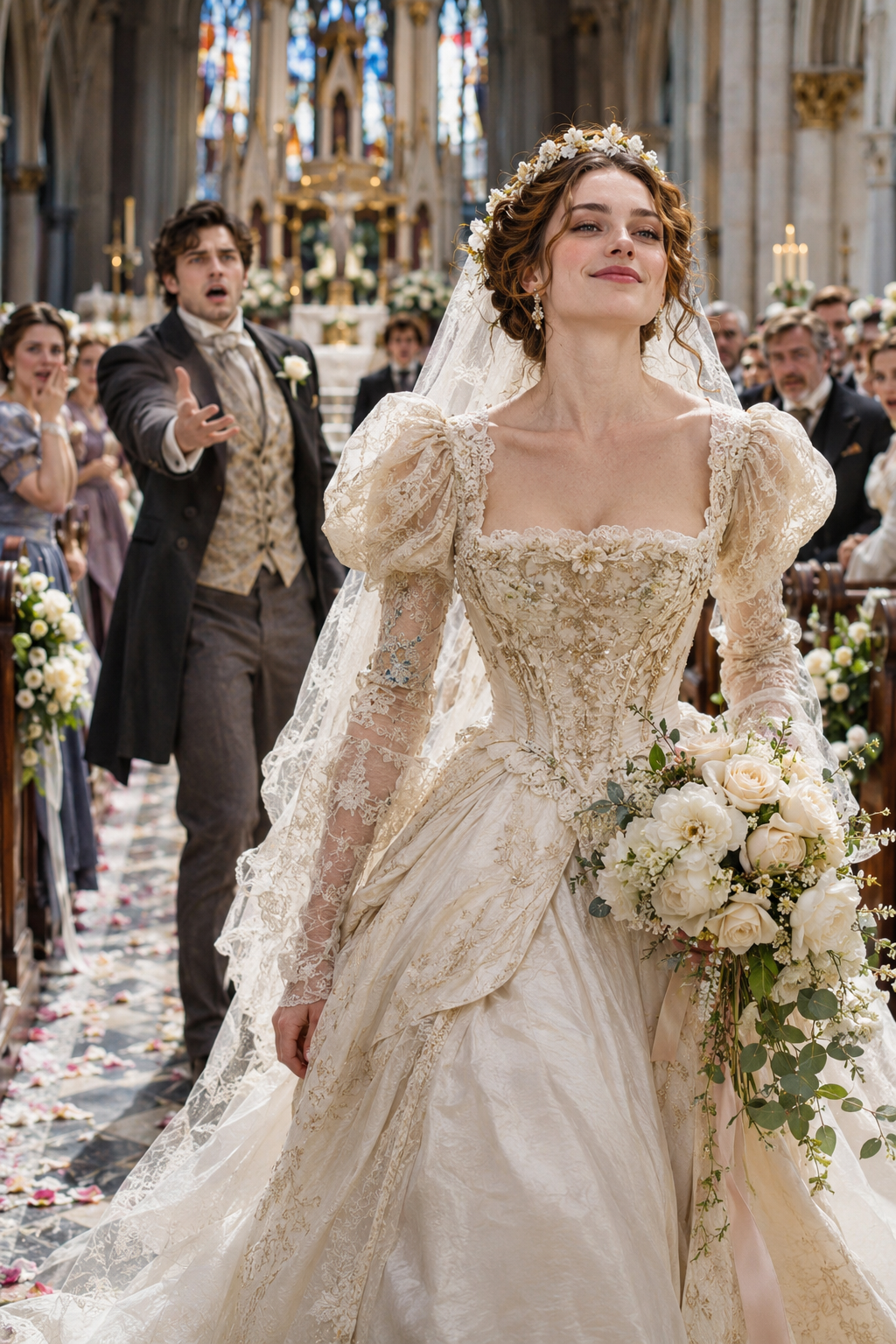
Hester looked back at him.
“With what?”
Bellamy swallowed.
“My publishing house was failing. Mr. Thorne held the debts. He promised to ruin me unless I cooperated.”
The room grew quiet.
Hester thought of the countless hours she had spent writing beneath the shop’s flickering lamps, trusting that her manuscripts would travel safely through Bellamy’s hands.
“Did you give them my letters?”
“Only copies.”
The words struck harder than she expected.
“Only?”
Bellamy lowered his head.
“I am sorry.”
Hester looked at the Duke.
“And the letter from my desk?”
Bellamy shook his head.
“That was not my doing.”
The Duke placed the envelope beneath the lamp.
“The seal belongs to Thorne’s office. Someone delivered this to him before it reached me.”
Hester remembered the evening she had written the letter.
She had placed it beneath her father’s account book, locked the drawer, and gone upstairs.
The following morning, Mrs. Finch, her elderly housekeeper, had mentioned that a gentleman had called while Hester was away.
A gentleman who claimed to have come on legal business.
Hester rose.
“I must go home.”
The Duke reached for his coat.
“I shall accompany you.”
She looked at him.
For the first time, she was uncertain whether his kindness belonged to the man she had come to know or to the anonymous correspondent who had been quietly investigating her life.
“Why did you not tell me?” she asked.
He stopped.
“Because I had no proof.”
“You had enough to suspect that someone was trying to take my home.”
“Yes.”
“And you allowed me to continue speaking to you as though nothing were wrong.”
The Duke accepted the accusation without protest.
“I believed I was protecting you.”
Hester looked away.
“Frederick believed the same thing.”
The words remained between them.
The Duke’s face tightened, but he did not defend himself.
After a moment, he said, “You are right.”
That surprised her more than an argument would have.
“I should have trusted you with the truth. I am sorry.”
Hester took her shawl from the chair.
“Then perhaps you will understand why I must discover the rest for myself.”
She left the library without waiting for his reply.
Outside, the rain had become a steady silver curtain.
By the time Hester reached the bookshop, the street was almost deserted.
The brass bell above the door was silent.
She stopped beneath the awning.
The door stood slightly open.
Hester had locked it herself that afternoon.
She pushed it inward.
The familiar scent of paper and leather met her, but something was wrong.
A chair lay overturned near the counter.
Several books had been pulled from their shelves.
The drawer beneath her writing desk hung open.
“Mrs. Finch?”
No answer.
Hester stepped farther inside.
A faint scraping sound came from the rear room.
She reached for the heavy brass candlestick beside the counter.
“Who is there?”
The door opened.
Mrs. Finch emerged, her gray hair escaping its pins, a small cut visible above her eyebrow.
Hester dropped the candlestick.
“Good heavens. What happened?”
The older woman caught her arm.
“Lock the door, my dear.”
Hester obeyed.
Mrs. Finch sank into a chair.
“A man came looking for your father’s papers. He said he had permission from Mr. Mallory.”
“Did he hurt you?”
“He pushed me aside when I tried to stop him.”
Hester knelt beside her.
“Did he take anything?”
Mrs. Finch looked toward the rear room.
“I don’t think he found what he wanted.”
“What was he looking for?”
“Your father’s original deed.”
Hester frowned.
“The deed is with the solicitor.”
Mrs. Finch shook her head.
“Not the important one.”
She reached into her apron and produced a small iron key.
“Your father gave me this shortly before he died. He said I was to keep it until you needed to know why he refused to sell the adjoining building.”
Hester stared at the key.
Her father had spoken little of the neighboring property. She knew only that he had purchased it during the final years of his life, despite having barely enough money to maintain the shop.
“Why did he buy it?”
Mrs. Finch’s eyes filled.
“Because he made a promise to your mother.”
She pointed toward the old bookcase beside the fireplace.
“Third shelf. Behind the blue volumes.”
Hester moved the books aside.
A narrow wooden panel appeared.
The key fitted a small iron lock concealed beneath the frame.
Inside lay a tin box.
She carried it to the counter.
The lid opened with a soft metallic click.
There were letters, a folded legal deed, and a small packet tied with faded green ribbon.
Hester recognized her mother’s handwriting on the first envelope.
For Hester, when she is ready to understand.
She unfolded the letter.
Her mother had written it during the final months of her illness.
The words were simple, but Hester could almost hear her voice.
Eleanor Low had inherited a modest sum from an aunt. Rather than placing it under her husband’s control, she had asked him to purchase the neighboring building in trust for their daughter.
She wanted Hester to possess something no future husband could claim merely through marriage.
But there was more.
The adjoining building had once housed a small printing workshop.
Eleanor had dreamed of reopening it as a place where women could publish under their own names, without requiring the approval of husbands, fathers, or brothers.
Hester lowered the letter.
Her mother had never spoken of such ambitions.
She remembered a gentle woman who mended dresses by candlelight, corrected her spelling, and occasionally disappeared into the back room with a notebook.
Only now did Hester understand that silence had not meant an absence of dreams.
She opened the next envelope.
Inside was the original deed.
The property had been placed in a trust for Hester’s sole benefit, with two independent trustees named to oversee it until she reached twenty-five.
One trustee had been her father.
The other was a solicitor named Nathaniel Vale.
Hester stared at the signature.
She had seen that name before.
On the second document the Duke had carried.
Nathaniel Vale.
The man she had believed buried five years earlier.
But the date beside his signature was recent.
Someone had been using the name of a dead man.
She heard footsteps outside.
Then three sharp knocks.
“Hester?”
The Duke.
Mrs. Finch looked toward the door.
Hester hesitated before opening it.
He stood in the rain, his coat soaked, his expression grave.
“Mr. Thorne has disappeared,” he said. “And Frederick has been arrested while attempting to remove documents from his solicitor’s office.”
Hester stepped aside.
“I have found something.”
The Duke entered, stopping when he saw Mrs. Finch’s injury.
His expression changed.
“Who did this?”
“We do not know,” Hester replied. “But I believe I know what they wanted.”
She showed him the deed.
He read it carefully.
Then he examined the letters.
When he reached Nathaniel Vale’s name, his face became very still.
“Do you recognize it?” Hester asked.
“Yes.”
“Who was he?”
The Duke looked toward the window.
“My father’s solicitor.”
Hester felt a sudden chill.
“Your father?”
“He handled several family trusts before his death. I remember him well.”
“Then why is his name on my mother’s property?”
The Duke did not answer immediately.
Instead, he unfolded the final page of the deed.
His eyes moved across the writing.
Then he looked at Hester.
“Because your mother was not the only person who helped establish this trust.”
He pointed toward a second signature.
It belonged to the late Duke of Somerton.
Hester sat down slowly.
The room seemed to tilt beneath her.
“Why would your father have anything to do with my family?”
The Duke studied the signature.
“I do not know.”
But Hester noticed something in his expression.
Not recognition.
Concern.
He knew more than he was saying.
“Your Grace.”
He looked up.
“Please do not protect me from another truth.”
For a moment, he remained silent.
Then he removed a small folded paper from his inner pocket.
“My father left me a letter shortly before his death. I found it among his private papers last winter.”
He placed it before her.
The handwriting was elegant and precise.
The letter described a debt of gratitude owed to a bookseller named Thomas Low.
Years earlier, Thomas had discovered that a trusted estate manager was stealing from several families, including the Duke’s.
Rather than accept money for his silence, Thomas had delivered the evidence directly to the authorities.
The estate manager had been dismissed.
Several families had been spared financial ruin.
And the Duke had quietly helped Thomas secure the neighboring property when Eleanor wished to establish the trust.
Hester read the final paragraph twice.
If ever the Low family requires assistance, offer it without seeking gratitude. Their honesty preserved more than my fortune.
She looked at the Duke.
“Is that why you came to Bath?”
“At first.”
The admission hurt.
He continued before she could speak.
“I learned that your father’s shop might be in danger. I intended to investigate quietly and leave once the matter was settled.”
“And the letters?”
He looked at her.
“I began writing to the author of The Patience of Miss Ward long before I knew she was Thomas Low’s daughter.”
Hester lowered her eyes.
“Then you discovered the truth.”
“Yes.”
“And continued visiting.”
“Yes.”
“Why?”
The Duke’s voice softened.
“Because the woman who argued with me about poetry was considerably more interesting than the mystery I had come to solve.”
Hester looked away.
Rain traced narrow paths down the window.
For several moments, neither spoke.
Then Mrs. Finch cleared her throat.
“As touching as this is, I believe someone is trying to steal a building.”
Hester almost laughed.
The Duke turned toward her.
“Mrs. Finch is correct.”
He examined the deed again.
“The original trust is valid. Frederick cannot lawfully claim the property through the forged documents.”
“Then why was he so desperate?”
“Because the property is worth far more than he expected.”
Hester frowned.
The Duke pointed toward the rear of the shop.
“The city has approved improvements to the adjoining street. The neighboring buildings will soon become valuable commercial premises.”
Hester understood.
Frederick had intended to obtain the property before its value became widely known.
He could have sold it, paid his debts, and emerged as a wealthy gentleman.
Instead, she had refused to marry him.
And everything had begun to unravel.
A sudden pounding shook the front door.
Mrs. Finch flinched.
The Duke moved toward the entrance.
“Who is there?”
A man’s voice answered.
“Percival Thorne. I must speak to Miss Low.”
Hester looked at the Duke.
He opened the door only after securing the chain.
Thorne stood outside, hatless and drenched, his face marked by exhaustion.
“I have evidence,” he said. “Evidence that will put Mallory in prison.”
“Then take it to the magistrate,” the Duke replied.
“I cannot.”
“Why?”
Thorne swallowed.
“Because Mallory has threatened my daughter.”
Hester stepped forward.
The solicitor looked at her through the narrow opening.
“Miss Low, I helped forge those papers. I will admit everything. But you must promise that my family will be protected.”
The Duke studied him.
“Where is your daughter?”
“At my sister’s house.”
“Then we shall send someone to ensure her safety.”
Thorne shook his head.
“You do not understand. Mallory has another man working for him. Someone who knows this shop.”
Hester felt her skin tighten.
“Who?”
Thorne looked toward Mrs. Finch.
“The man who entered here tonight.”
Mrs. Finch gripped the back of her chair.
Thorne continued.
“His name is Edwin Pike. He worked for your father years ago.”
Hester remembered him.
A quiet young assistant who had been dismissed after money disappeared from the accounts.
Her father had refused to prosecute him.
Pike had vanished from Bath shortly afterward.
“Where is he now?” she asked.
Thorne’s eyes moved toward the dark street.
“He followed me.”
A crash sounded from the rear courtyard.
The Duke turned.
Hester heard glass breaking.
Then footsteps.
“Stay here,” the Duke ordered.
But Hester was already moving.
She knew the building better than anyone.
She knew the narrow passage behind the storeroom, the door that opened beneath the staircase, and the old iron latch her father had installed after a burglary.
She reached the rear corridor just as a shadow moved through the broken window.
A man stepped inside.
Edwin Pike.
Older now, his face lined and his coat stained with mud.
He held a small pistol.
“Where is the deed?” he demanded.
Hester stopped.
Behind her, the Duke appeared in the doorway.
Pike raised the weapon.
“Do not come closer.”
The Duke remained still.
Hester looked at the pistol, then at the man’s shaking hand.
“You worked for my father,” she said.
Pike’s expression flickered.
“He dismissed me.”
“He gave you money when you left.”
“Not enough.”
“He could have sent you to prison.”
Pike’s jaw tightened.
“Give me the deed.”
Hester glanced toward the narrow passage beside the storeroom.
She had once hidden there as a child while playing games with her father.
At the far end was the iron latch.
If she could reach it, she could trap Pike inside the rear corridor.
But the pistol remained pointed toward the Duke.
“Frederick cannot pay you,” she said.
Pike’s eyes narrowed.
“You know nothing.”
“His loans are exposed. His solicitor has confessed. Whatever he promised you is gone.”
For an instant, Pike hesitated.
Hester moved.
She seized the heavy wooden shutter beside the window and slammed it toward him.
The pistol discharged.
The sound shattered the room.
A book fell from the shelf.
The Duke lunged forward, catching Pike’s wrist before he could fire again.
Hester stumbled into the passage, reached the iron latch, and pulled.
The old mechanism dropped with a tremendous clang.
Pike struggled, but the Duke forced the weapon from his hand.
Within moments, Thorne and two men from the neighboring watch station, alerted by the gunshot, rushed inside.
Pike was restrained.
Only then did Hester notice the blood on the Duke’s sleeve.
She stared.
“You are hurt.”
He glanced down.
“A scratch.”
“It is bleeding.”
“An observation worthy of your most perceptive heroine.”
Hester gave him a look so severe that he stopped smiling.
She fetched clean linen and insisted he sit while she bound the wound.
His hand rested quietly in hers.
Neither spoke about what might have happened.
They did not need to.
By morning, Frederick Mallory’s schemes had become the principal subject of conversation throughout Bath.
Thorne surrendered his records to the magistrate.
Bellamy provided the correspondence he had concealed.
Pike confessed that Frederick had paid him to search the shop and recover the original trust deed.
The forged documents were examined, and the false signatures exposed.
Frederick’s creditors withdrew their claims against Hester’s property.
His debts, however, remained very real.
The legal proceedings continued for months.
Frederick was eventually convicted of fraud and conspiracy, while Thorne’s cooperation earned him a lesser punishment.
Bellamy lost Hester’s confidence and, with it, the right to represent her work.
Hester found another publisher.
A woman named Margaret Ashcombe, who had recently established a small publishing house in London.
Their first meeting lasted three hours.
By the end, Hester had signed an agreement granting her control over her manuscripts and a fair share of the profits.
For the first time, her name appeared openly on the title page.
Hester Low.
No disguise.
No apology.
Spring arrived slowly in Bath.
The pear tree behind the bookshop blossomed, scattering pale petals across the courtyard.
Workmen began repairing the adjoining building.
Its old printing presses were restored, its windows cleaned, and its walls painted a warm cream.
Above the entrance, Hester placed a modest wooden sign.
LOW HOUSE PRESS.
The first manuscripts arrived within weeks.
Some were written by widows.
Others by governesses, teachers, and young women whose families considered writing an unsuitable ambition.
Hester read every submission herself.
She accepted some.
She declined others with thoughtful letters.
And whenever a writer arrived trembling with uncertainty, Hester offered tea before asking to see the pages.
Mrs. Finch managed the household with increasing authority and frequently reminded Hester that successful women still required proper meals.
The Duke continued visiting.
At first, he came to discuss business.
Then books.
Then nothing in particular.
Sometimes he sat beside the window while Hester worked, reading quietly until the afternoon light faded.
He never interrupted her writing.
And she never asked him to leave.
One evening in June, he arrived carrying a small parcel wrapped in brown paper.
“I found something you might like.”
Hester untied the string.
Inside was a beautifully preserved first edition of her father’s favorite collection of essays.
She opened the cover.
On the first page, someone had written a familiar sentence.
The finest inheritance is not what we possess, but what we enable another person to become.
Hester recognized her father’s handwriting.
She looked up sharply.
“Where did you find this?”
“In my father’s library. It appears your father gave it to him many years ago.”
Hester touched the inscription.
For a moment, she could not speak.
The Duke waited.
At last, she closed the book.
“My father would have liked you.”
“I should have been honored.”
“He would also have argued with you constantly.”
“I suspect I should have enjoyed that.”
Hester smiled.
Outside, the evening bells began to ring.
The Duke rose and walked toward the window.
“There is something I have wished to ask you.”
Hester’s smile faded slightly.
She knew that tone.
She had heard it once before, in a drawing room where Frederick had announced his intentions as though discussing the purchase of furniture.
The Duke turned.
“I have spent much of my life believing that affection was something best kept at a safe distance.”
He paused.
“Then I met a woman who corrected my opinions, criticized my favorite poets, and refused to let me carry a ladder.”
Hester lowered her eyes, hiding a smile.
“I had managed that ladder perfectly well.”
“I know.”
He approached her slowly.
“I love you, Hester.”
The words were simple.
No elaborate declaration.
No promises of palaces or jewels.
Only the truth, offered without ornament.
Hester looked at him.
She thought of the church, the ink on her fingers, the laughter of the congregation.
She thought of Frederick’s hand gripping hers and the terrible certainty that marriage would mean surrendering everything she had built.
Then she looked at the man standing before her.
He was waiting.
Not demanding.
Not assuming.
Waiting.
“I love you too,” she said.
His expression softened.
“But there is something you must understand.”
“Anything.”
“I will not give up the bookshop.”
“I would never ask it.”
“Or the publishing house.”
“Nor should you.”
“And I intend to continue writing.”
“I should be deeply disappointed if you did not.”
Hester studied him.
“Then what exactly are you offering me?”
The Duke smiled.
“A life in which neither of us must become smaller to make room for the other.”
For a long moment, she said nothing.
Then she reached for his hand.
“That,” she whispered, “sounds rather promising.”
They married the following autumn.
Not in a grand cathedral.
Not before a congregation assembled to judge the bride’s suitability.
They chose a small church outside Bath, surrounded by autumn trees and a handful of people who genuinely loved them.
Mrs. Finch cried throughout the ceremony.
Margaret Ashcombe stood beside Hester, holding a bouquet of white roses.
And when the Duke took his bride’s hand, he noticed a faint blue stain on her forefinger.
He looked at it.
Then at her.
“Writing this morning?”
Hester smiled.
“Only a little.”
He lifted her hand and kissed the stained finger.
“Then I hope it was a particularly good chapter.”
“It was the ending.”
“Of your new novel?”
“Yes.”
“Was it happy?”
Hester considered the question.
“Not entirely.”
He raised an eyebrow.
“Should I be concerned?”
She laughed softly.
“No. It was honest.”
After the ceremony, they returned to the bookshop for a modest celebration.
The shelves were decorated with flowers, the tables crowded with cakes, and the old brass bell rang so frequently that Mrs. Finch threatened to remove it.
Hester stood for a moment beside the counter, watching the people she loved fill the rooms that had once seemed so painfully empty.
Her father’s portrait hung above the fireplace.
Beside it rested her mother’s letter, carefully framed.
The publishing house was flourishing.
Her books were selling.
And the man she loved was speaking with a young apprentice about the proper care of old bindings.
Hester looked down at her hands.
The ink stains remained.
They always would.
Once, she had believed they were evidence of something she ought to conceal.
Now she understood that they marked the work through which she had discovered her own voice.
Years later, when readers asked why the heroine of her most beloved novel refused a wealthy marriage, Hester would smile and answer that the question had been misunderstood.
The heroine had not refused happiness.
She had refused to mistake obedience for love.
And when a young woman once wrote to Hester asking whether it was selfish to pursue a life her family did not approve of, Hester answered with unusual care.
She told her that kindness mattered.
That duty mattered.
That love, when freely given, could make an ordinary life extraordinary.
But she also told her that no one had the right to demand the surrender of another person’s gifts as proof of devotion.
The letter ended with a sentence Hester had spent much of her life learning to believe.
You need not make yourself less in order to be worthy of being loved.
That evening, after the letter was posted, Hester returned to her writing desk.
The Duke sat across from her, reading beside the fire.
Outside, rain brushed softly against the windows of Bath.
The brass bell above the shop door was still.
The pear tree stirred in the courtyard.
And Hester dipped her pen into the ink.
For a moment, she looked at the blank page.
Then she began.
Not because anyone had given her permission.
Not because she wished to prove anything to the people who had once laughed at her.
But because there were still stories inside her, waiting to be told.
And she had finally built a life in which she was free to tell them.
The End.