Luca Ferraro had won cars, houses, and fortunes at poker tables. But when a desperate gambler pushed a woman across the table to settle a $400,000 debt, even the most feared mob boss in Atlantic City stopped smiling.
Luca had until midnight to decide whether two women would live or whether the evidence against Silas Quinn’s trafficking operation would survive.
For a man who had spent twenty years making other people choose between terrible options, it was an unfamiliar feeling.
Norah stood across from his desk, watching him study the shipping records.
“You already know what I’m going to say,” she told him.
Luca rubbed his forehead.
“You’re going to tell me to save them.”
“I’m going to tell you that Marco doesn’t intend to keep his promise.”
He looked up.
Norah moved closer and pointed to the photograph of Elena sitting on the concrete floor.
“Look at the wall behind her.”
The room was poorly lit, with exposed pipes running along the ceiling. Elena sat beside another young woman whose face was partly hidden by her hair.
“What am I looking at?”
“That yellow marking. It’s not a room number. It’s a maintenance code.”
Luca enlarged the photograph.
A faded yellow square had been painted beside a steel door. Inside it were three numbers.
Norah recognized the marking from the maintenance reports she had processed while working for Quinn.
“I’ve seen that numbering system before,” she said. “It’s used in one of his older storage buildings. The company stopped renting it last year, but Quinn never returned the keys.”
“Where?”
“Outside Pleasantville.”
Luca reached for his phone.
Norah caught his wrist.
“Don’t send anyone yet.”
He stared at her hand until she released him.
“Marco knows you’ll look for them,” she continued. “He gave us proof they’re alive because he wants us to make a move. That photograph might be real, but we don’t know when it was taken.”
Luca looked at the timestamp beneath the image.
The video had been recorded that morning.
Or at least that was what the file claimed.
He had men who could check whether it had been altered. He had people who could watch the building.
What he didn’t have was time.
By midnight, Marco would either receive what he wanted or decide that the two women were no longer useful.
Luca turned toward the windows.
For years, he had believed that power meant never allowing anyone else to determine his choices.
Now his oldest lieutenant had trapped him with the one thing he couldn’t replace.
Two human lives.
“Get me Daniel,” Luca said.
Daniel Reyes was the closest thing Luca had to a conscience, though neither man would have described him that way.
At forty-six, Daniel had spent nearly twenty years working as Luca’s attorney. He knew where the Ferraro organization’s legitimate businesses ended and its criminal operations began.
He had warned Luca more than once that eventually those boundaries would collapse.
When Daniel arrived, he found a table covered with shipping documents and a woman who looked as though she hadn’t slept in days.
Luca explained everything.
Daniel listened without interrupting.
Then he removed his glasses.
“Tell me you’ve already made copies.”
“Three sets,” Luca answered.
“And where are they?”
“Somewhere Marco can’t reach.”
Daniel nodded.
“Good. Because destroying these records won’t save those women. It will only guarantee that Marco knows he can use them against you.”
Norah folded her arms.
“Then what do we do?”
Daniel considered her for a moment.
“We stop treating this like a negotiation between criminals.”
Luca gave a humorless laugh.
“You think the police will solve this before midnight?”
“I think the people who rescued fifteen women last night have become witnesses to a federal trafficking investigation. And I think those women deserve something better than being passed from one criminal’s custody into another’s.”
The words landed harder than Daniel intended.
Luca looked away.
He had arranged safe shelter and doctors for the rescued women, but it was still his money, his employees, and his security.
He had made decisions for them without asking what they wanted.
Norah noticed the change in his expression.
“He’s right,” she said quietly.
Luca turned toward her.
“You think I don’t know that?”
“I think you’ve spent so long being the person everyone answers to that you’ve forgotten what it feels like to have no choice.”
For several seconds, nobody spoke.
Then Luca reached for the phone.
“Make the call, Daniel.”
Daniel contacted a federal prosecutor he trusted and explained that he represented someone prepared to provide evidence in an urgent human trafficking investigation.
He made no promises about Luca’s immunity.
He made no attempt to hide the fact that his client had serious criminal exposure of his own.
And he insisted that investigators understand two women were still missing.
By late afternoon, a small federal task force had begun reviewing the shipping records, coordinating with local authorities, and arranging independent support for the women already rescued.
Luca disliked every minute of it.
He disliked answering questions.
He disliked explaining why a shipping company connected to his organization had been moving Quinn’s cargo.
Most of all, he disliked realizing how little control he actually had.
But Norah stayed beside him.
When an investigator asked why she had risked going to Luca’s poker game, she told the truth.
“Because I couldn’t find another way to make someone listen.”
The investigator looked at her for a long moment.
“How long had you known about the women?”
“Almost three weeks.”
“And you didn’t contact the authorities?”
“I tried.”
She described the anonymous messages she’d sent, the information she’d left with a local office, and the fear that Quinn’s employees were monitoring her.
Some of her reports had lacked enough detail to identify a location.
Others had received no response she knew about.
She had no proof that police officers were working for Quinn.
Only a growing suspicion that every attempt to get help somehow made her situation worse.
“I should have done more,” she said.
The investigator shook his head.
“You did more than the people who were paid to protect them.”
Norah didn’t answer.
She was thinking about Elena.
About the first time she’d met her in Quinn’s shipping office.
Elena had been sitting on a bench outside a locked room, holding a paper cup of water in both hands.
She couldn’t have been much older than twenty.
Norah had been told the women were temporary workers waiting for transportation.
But Elena had looked up at her and whispered, “Can you call my sister?”
Before Norah could answer, a guard had pulled Elena away.
Two days later, Norah found documents identifying the women by numbers instead of names.
That was when she understood.
And once she understood, she couldn’t pretend otherwise.
At six that evening, Marco called again.
Luca answered with Norah and Daniel listening.
“Have you made your decision?” Marco asked.
“I’m ready to talk.”
“There’s nothing to discuss. Destroy the records.”
“How do I know you’ll release them?”
“You don’t.”
Luca tightened his grip on the phone.
“Then you’re asking me to trust a man who betrayed me.”
Marco was silent for a moment.
“You taught me something a long time ago, Luca. Trust is a luxury. Leverage is what keeps people honest.”
“Funny. I remember teaching you to keep your word.”
Marco laughed bitterly.
“That was before I learned how expensive loyalty could get.”
Luca forced himself to remain calm.
“What happened to you?”
“You really want to know?”
“I wouldn’t have asked.”
Marco exhaled.
“Three years ago, Quinn found out about the money I was taking from the waterfront contracts. He had proof. Enough to put me away for a long time.”
Luca closed his eyes.
“So you started working for him.”
“At first, it was just schedules. Then access codes. Then he wanted me to keep certain containers off the inspection lists.”
“You knew what was inside?”
“Not in the beginning.”
“And later?”
Marco didn’t answer.
That silence told Luca everything.
“You could have come to me.”
“And told you I’d been stealing from you?”
“I might have let you live.”
“Exactly,” Marco said. “Might have.”
Norah moved closer to the phone.
“Where are Elena and the other woman?”
Marco heard her.
“Still trying to save everybody, Norah?”
“Let me speak to Elena.”
“She’s alive.”
“That’s not what I asked.”
Marco’s voice hardened.
“Tell Luca midnight means midnight.”
The call ended.
Luca remained motionless.
He had known Marco since before the waterfront deals, before the casinos, before the Ferraro name carried the kind of weight that made people lower their voices.
Marco had attended Luca’s father’s funeral.
He had eaten dinner in Luca’s home.
He had helped Luca through the aftermath of a shooting that nearly killed him years earlier.
And somewhere along the way, their loyalty had turned into something uglier.
Fear.
Greed.
And the belief that everyone had a price.
At seven fifteen, investigators confirmed something important.
The storage facility near Pleasantville was connected to a company Quinn had used in the past. A nearby camera had captured a vehicle entering the property that afternoon.
But no one could confirm the women were inside.
Norah insisted they had to act.
The lead investigator, Special Agent Rebecca Shaw, disagreed.
“If we go in without confirming their location, we may send a warning to whoever is holding them.”
“Then confirm it,” Norah snapped.
“We’re trying.”
Norah stood abruptly.
“Every minute you’re trying is another minute they’re trapped somewhere.”
Luca watched her.
Then he spoke.
“Norah. Come with me.”
She followed him into the hallway.
The moment the door closed, she turned on him.
“Don’t tell me to calm down.”
“I wasn’t going to.”
“Then what?”
Luca leaned against the wall.
“I need you to understand something. If you go looking for those women yourself, you may get them killed.”
Norah’s eyes filled, though her voice remained steady.
“And if I sit here doing nothing?”
“You’re not doing nothing.”
“It feels like it.”
For the first time, Luca saw beyond her determination.
He saw a woman who had been carrying seventeen strangers’ lives in her conscience for weeks.
Fifteen were safe.
But in her mind, the other two were still her responsibility.
“You don’t owe them your life,” he told her.
Norah looked at him.
“Maybe not. But I promised I would try.”
Luca nodded slowly.
“Then we keep trying.”
At eight forty, a new piece of information arrived.
One of the rescued women recognized the second missing woman in the video.
Her name was Tessa.
She was twenty-two, from Pennsylvania, and had disappeared after accepting what she believed was a housekeeping job.
But the rescued woman knew something else.
Tessa had a medical condition that required daily medication.
She hadn’t received it for several days.
That changed the urgency of the search.
The investigators had already been treating the situation as life-threatening.
Now they knew Tessa might be in danger even without Marco carrying out his threat.
Norah listened as the information was relayed.
Then she noticed something in the photographs taken from Quinn’s shipping office.
A receipt.
It was folded between two pages of inventory records.
She had overlooked it because the address belonged to a medical supply company rather than a warehouse.
But she remembered seeing its delivery driver at Quinn’s office.
Twice.
Always after dark.
She showed it to Shaw.
The address belonged to a distribution facility near the White Horse Pike, several miles from the storage property everyone had been watching.
Shaw took the receipt.
Within minutes, investigators were comparing it with recent business and vehicle records.
One of Quinn’s transport vehicles had been recorded near that facility earlier in the evening.
The location was suddenly more than a possibility.
It was the strongest lead they had.
At nine thirty-five, Luca received another message.
This time, there was no photograph.
Only six words.
“Come alone. Bring proof. Eleven o’clock.”
Below the message was the address of the same distribution facility.
Luca showed it to Shaw.
She read it twice.
“He wants you there.”
“Obviously.”
“He may want you dead.”
“That’s also obvious.”
Norah looked from one to the other.
“Then why give us the address?”
Luca knew Marco well enough to understand.
“Because he thinks I won’t involve the police. He thinks I care more about protecting the organization than saving two women.”
Shaw studied him.
“Is he wrong?”
Luca looked at the photograph of Elena and Tessa.
“Tonight, he is.”
They spent the next hour preparing for the meeting.
Shaw made it clear that Luca would not be allowed to improvise a private rescue or use his own men to interfere with the operation.
He agreed, though the agreement cost him more pride than he cared to admit.
Norah wanted to go with him.
Everyone objected.
“He knows me,” she argued. “If Elena hears my voice, she’ll know someone came for her.”
Shaw shook her head.
“You’re a witness. We cannot risk putting you in his hands.”
Norah looked at Luca.
For once, he did not overrule the decision.
“Stay here,” he told her. “Help them identify anyone who comes out of that building.”
She wanted to argue.
Instead, she sat down and opened the folder of employee photographs.
At ten fifty-eight, Luca stood outside the distribution facility.
The building was a low concrete structure surrounded by loading bays and chain-link fencing.
One overhead light flickered near the entrance.
Luca could hear traffic in the distance.
It was a strangely ordinary place for something so terrible.
Marco appeared in the doorway.
He looked older than he had that morning.
His suit was wrinkled, and there were dark circles under his eyes.
“Where are the records?” he asked.
“Safe.”
“That’s not what I told you to do.”
“And you didn’t tell me where the women were.”
Marco glanced toward the parking lot.
“You came alone?”
“Just like you asked.”
Marco studied him.
Then he shook his head.
“You always were a terrible liar when you wanted something badly enough.”
Luca said nothing.
Marco reached inside his jacket.
For one second, Luca thought he was reaching for a gun.
Instead, Marco pulled out a phone.
He held up a live video feed.
Elena and Tessa were sitting in a small room.
Elena had one arm around Tessa, who appeared barely able to keep her head upright.
Luca felt his stomach tighten.
“She’s sick,” he said.
“Then we should finish this quickly.”
“Let them go.”
“Delete the records.”
“Marco, Quinn isn’t going to protect you.”
Marco’s expression changed.
“You don’t know that.”
“He’s already sacrificing people to stay free. What makes you think you’re different?”
Marco looked down.
For a moment, something like uncertainty crossed his face.
Then a vehicle approached the far side of the building.
Marco turned sharply.
“Who is that?”
Luca followed his gaze.
A dark SUV stopped beside a loading bay.
Two men stepped out.
Marco’s face drained.
“No,” he whispered.
One of the men began walking toward them.
Marco stepped backward.
“He wasn’t supposed to come.”
“Quinn?” Luca asked.
Marco didn’t answer.
The man approaching them was one of Quinn’s senior enforcers.
Luca recognized him from previous disputes along the waterfront.
He carried himself with the relaxed confidence of someone who assumed everyone else was unarmed.
“Mr. Ferraro,” he called. “Quinn appreciates you coming.”
Marco stared at him.
“You said he’d wait.”
The man ignored him.
Luca understood then that Marco had never been running the negotiation.
He had been repeating instructions from someone who planned to dispose of him when he stopped being useful.
“You brought me here to trade me for your freedom,” Luca said quietly.
Marco swallowed.
“I thought if I gave him what he wanted—”
“He’d let you walk?”
Marco looked away.
The enforcer stopped several feet from them.
“Mr. Quinn wants the records.”
“They’re not here,” Luca answered.
The man’s smile disappeared.
“That’s unfortunate.”
He reached beneath his jacket.
Before he could do anything else, armed federal agents emerged from concealed positions and ordered everyone to show their hands.
The next few seconds were chaos.
Marco dropped to the pavement.
The enforcer hesitated, then surrendered as agents moved in.
Another man tried to retreat through the loading bay but was intercepted.
Inside the building, agents began searching for the women.
Luca stood where he was, his heart hammering.
He could hear shouted commands, footsteps, and the metallic crash of a door being forced open.
Then silence.
An agonizing stretch of silence.
Finally, a voice came over the radio.
“Two women located. We need medical assistance immediately.”
Luca closed his eyes.
He hadn’t realized how tightly he’d been holding his breath.
But the relief lasted only a moment.
Because another report followed.
“One victim is responsive. The second is in serious condition.”
Tessa.
Luca looked toward the building as paramedics hurried inside.
For all his wealth, he could do nothing now but wait.
At the command center, Norah heard the update and stood so suddenly that her chair fell backward.
“Which one?”
Shaw’s colleague hesitated.
“We don’t know yet.”
Norah pressed her hands against her mouth.
She had imagined this moment hundreds of times.
The doors opening.
The women walking out.
The nightmare finally ending.
She hadn’t imagined that rescue could still arrive too late.
When Elena was brought outside, she was conscious, frightened, and exhausted.
She asked about Tessa before accepting a blanket.
A paramedic assured her that Tessa was receiving treatment.
Elena kept looking toward the building.
“She was talking to me this afternoon,” she said. “She was okay this afternoon.”
A few minutes later, Tessa was carried out on a stretcher.
Her eyes were closed.
An oxygen mask covered her face.
Norah received the news through the radio, unable to see either woman.
When Shaw finally told her both had been transported to a hospital, she sat down and cried.
Not because everything was fixed.
Not because the danger was over.
But because, for the first time in weeks, all seventeen women had been found alive.
Just after midnight, Luca returned to the federal office with an agent.
Norah was waiting in the hallway.
She stood when she saw him.
“Elena?”
“Safe.”
“Tessa?”
“At the hospital. They’re treating her.”
Norah closed her eyes.
“Thank God.”
Then she looked at Luca’s face.
“Marco?”
“In custody.”
“And Quinn?”
Luca’s silence answered her.
Quinn had not been at the distribution facility.
The enforcer had refused to say where he was.
And Marco, now realizing that Quinn had intended to betray him, was asking for a lawyer.
The operation had saved the missing women.
It had not yet ended the trafficking network.
Norah sank into a chair.
Luca sat beside her.
For a long time, neither spoke.
Then Norah asked something he wasn’t prepared for.
“Why did you really help me?”
Luca looked at her.
“Because seventeen women needed help.”
“That’s why you kept helping. But that night at the casino, you didn’t know anything about them.”
He thought about Grant Holloway, the poker table, and the moment Norah had stood in front of him like a woman refusing to let the world decide her worth.
“I could see you were terrified,” he said.
“Everybody could see that.”
“Maybe. But you were more afraid of what would happen if you stayed silent.”
Norah stared at her hands.
“My mother used to say courage wasn’t about being fearless. It was about doing what mattered while your hands were shaking.”
Luca smiled faintly.
“She sounds smarter than most people I know.”
“She was.”
The past tense made him turn.
Norah took a breath.
“She died when I was nineteen. After that, I spent a long time thinking I couldn’t handle anything on my own.”
“And now?”
Norah considered the question.
“Now I think I handled more than I should ever have had to.”
Luca didn’t argue.
Two days later, Silas Quinn was arrested after investigators traced communications and financial transactions connecting him to the trafficking operation.
The charges were extensive.
The evidence included shipping records, testimony from survivors willing to speak, and information recovered from Marco’s communications.
Several employees and associates were also detained.
Grant Holloway was found in a motel outside Philadelphia.
Investigators discovered he had helped Quinn’s associates move money through gambling debts and had knowingly assisted in arranging the poker-room encounter, though Norah had turned that encounter toward her own plan.
Grant tried to claim he had only been a desperate man trying to survive.
Norah had little patience for his explanation.
When she learned he’d been arrested, she said only, “He had choices. He just didn’t like any of the decent ones.”
For Luca, the investigation brought consequences he could no longer postpone.
The records that exposed Marco also revealed irregularities in Ferraro-controlled businesses.
There were illegal payments, concealed income, and transactions Luca had approved without asking enough questions.
Daniel warned him that prosecutors would follow the evidence wherever it led.
“They aren’t going to forget what you’ve done because you helped those women,” he said.
Luca nodded.
“I know.”
“You could lose a great deal.”
“I know that too.”
Daniel leaned across the desk.
“Then tell me why you’re not fighting this harder.”
Luca looked toward the empty chair where Marco used to sit.
“Because I spent years telling myself that as long as I wasn’t personally doing the worst things, I was better than the men who were.”
He paused.
“Turns out, giving terrible people room to operate isn’t much better.”
Daniel said nothing.
“I built a system where people were afraid to tell me the truth,” Luca continued. “And then I acted surprised when someone used that system against me.”
For once, he wasn’t looking for an excuse.
He began cooperating through his attorney, providing records and accepting that he might face charges for his own conduct.
He also transferred responsibility for supporting the rescued women to independent organizations and legal advocates.
There were no photographs.
No publicity.
No newspaper interviews about his generosity.
Norah had insisted on that.
“Those women don’t owe you a public thank-you,” she told him. “They deserve the chance to decide what happens next.”
Luca agreed.
It was one of the first decisions in his adult life that didn’t involve asking what he would receive in return.
Three weeks after the rescue, Tessa was released from the hospital.
Her recovery would take time.
Some days she could talk about what had happened.
Other days, even ordinary noises frightened her.
Elena stayed nearby while both women worked with advocates to reconnect with people they trusted.
Not every family reunion went smoothly.
Not every survivor wanted to return home.
Some were afraid their relatives wouldn’t understand.
Others needed legal assistance, counseling, or simply a safe place where no one would demand that they tell their story before they were ready.
Norah learned that rescue was not the same thing as recovery.
Getting someone out of a locked room was only the beginning.
Helping them believe they had a future could take much longer.
She began volunteering with a victim-support organization, using her knowledge of shipping operations to help advocates understand how traffickers hid people behind ordinary business paperwork.
She didn’t speak publicly about her own experience.
She didn’t want to become a symbol.
She wanted to be useful.
One afternoon, Elena asked to meet her at a quiet café.
Norah arrived expecting questions about the investigation.
Instead, Elena had brought an envelope.
Inside was a photograph.
It showed Elena standing beside her younger sister in front of a small house.
They were smiling awkwardly, like two people who hadn’t quite remembered how to be comfortable in front of a camera.
“My sister took this yesterday,” Elena said.
Norah touched the corner of the photograph.
“She must be so happy you’re home.”
Elena looked down at her coffee.
“She is. But I’m not the same person I was.”
“You don’t have to be.”
“Sometimes she expects me to be.”
Norah nodded.
They sat in silence for a while.
Then Elena asked, “Do you ever wish you hadn’t gotten involved?”
Norah looked through the window.
Cars moved slowly along the street. A woman pushed a stroller past the bakery. Someone inside the café laughed at a joke.
Ordinary things.
Things Elena had nearly lost forever.
“I wish there had been another way,” Norah answered. “I wish someone had listened sooner. I wish none of you had needed me.”
Elena waited.
“But I don’t wish I’d walked away.”
Elena reached across the table and took her hand.
“You know what I remember?”
Norah shook her head.
“The first time I saw you at Quinn’s office, you asked if I was okay. You couldn’t do anything then, but you asked.”
Norah’s throat tightened.
“I thought you’d forgotten.”
“I remembered because nobody else asked.”
That evening, Norah visited Luca for what she believed would be the last time.
He was no longer living in his waterfront penthouse.
The property had become part of the financial investigation, and he had moved into a modest rented house outside the city while his lawyers dealt with the authorities.
When he opened the door, Norah almost laughed.
The man who had once commanded an entire room with a glance was wearing an old sweater and holding a grocery bag.
“You’re shopping for yourself now?”
Luca glanced at the bag.
“I’m discovering that eggs are surprisingly fragile.”
She laughed.
He stepped aside to let her in.
The house smelled of coffee.
There were no guards by the entrance, no men waiting for instructions, and no expensive artwork on the walls.
Only a kitchen table covered with legal documents.
“How are the women?” he asked.
“Some are doing better. Some aren’t ready to talk. Tessa’s recovering.”
“And Elena?”
“She saw her sister.”
Luca smiled.
“That’s good.”
Norah sat down.
“I wanted to thank you.”
He shook his head.
“You don’t have to.”
“I know. That’s why I wanted to.”
Luca poured her a cup of coffee.
She watched him for a moment.
“Daniel says you may be charged.”
“He says many things. Unfortunately, he’s usually right.”
“Are you scared?”
Luca considered lying.
It would have been easy.
He had spent years convincing people that nothing frightened him.
Instead, he nodded.
“Very.”
Norah looked at him with an expression he couldn’t quite read.
“Good.”
He raised an eyebrow.
“Good?”
“Maybe it means you finally understand what the people around you have been feeling all these years.”
Luca sat opposite her.
“That’s a terrible thing to say to a man offering you coffee.”
“It’s terrible coffee.”
He laughed.
It was a small sound, but genuine.
Then his expression grew serious.
“I keep thinking about Marco.”
Norah waited.
“He didn’t wake up one morning and decide to help traffickers. It started with stealing money. Then hiding it. Then doing favors for the man who caught him.”
“That doesn’t excuse him.”
“No. It makes it worse. He had chances to stop.”
Luca turned his cup slowly.
“So did I.”
Norah studied him.
“Do you think you can become a different person?”
“I don’t know.”
“Neither do I.”
He looked surprised.
She continued.
“I don’t think people change because something terrible happens and they suddenly understand everything. I think they change when they have the opportunity to make the same bad choice again, and they do something else.”
Luca said nothing.
“You’re going to have a lot of those opportunities.”
He nodded.
“So are you,” he said.
Norah smiled faintly.
“Probably.”
As she stood to leave, Luca reached into a drawer.
He removed a small white envelope.
“Before you go.”
Norah looked suspicious.
“What is it?”
“A letter.”
“From whom?”
“Me.”
She opened it.
Inside was a handwritten apology.
It wasn’t long.
Luca apologized for allowing her to be treated as something that could be exchanged in a poker game, even for the minutes it had taken him to understand what was happening.
He apologized for building an organization where men like Grant and Marco believed they could use women as bargaining chips.
And he acknowledged that helping rescue the women did not erase the harm he had helped make possible.
Norah read it twice.
When she looked up, Luca was staring at the floor.
“You could have just said this,” she told him.
“I’ve never been very good at saying things that matter.”
She folded the letter carefully.
“Thank you.”
Then she walked toward the door.
“Norah?”
She turned.
“Do you think they’ll ever forgive me?”
She knew he meant the women.
Maybe Marco’s other victims.
Maybe people harmed by the Ferraro organization over the years.
Norah held the envelope against her chest.
“That’s not something you get to ask them for.”
He lowered his eyes.
“You can make things right where you can,” she continued. “You can accept the consequences where you can’t. But forgiveness belongs to the people who were hurt.”
Luca nodded slowly.
For the first time in a long time, he didn’t try to negotiate.
Norah left him standing in the doorway.
Six months later, Luca entered a courtroom to answer for his part in the criminal activities of his organization.
Marco had agreed to cooperate with prosecutors, but his testimony did not erase his own responsibility.
Quinn faced prosecution for trafficking and related crimes.
The legal proceedings would take time, and not every question had been answered.
There were still people who had profited from the operation whose names had not yet been uncovered.
But the seventeen women were no longer hidden in warehouses, trailers, or locked rooms.
They were living in places they had chosen, with the support they needed and the right to decide how much of their stories they wanted to share.
On the morning of Luca’s hearing, Norah sat in the back of the courtroom.
She hadn’t come to defend him.
She hadn’t come to condemn him.
She had come because she wanted to see what accountability looked like when nobody could purchase their way out of it.
Luca noticed her as he walked toward the front.
Their eyes met briefly.
He gave her a small nod.
She returned it.
Nothing more.
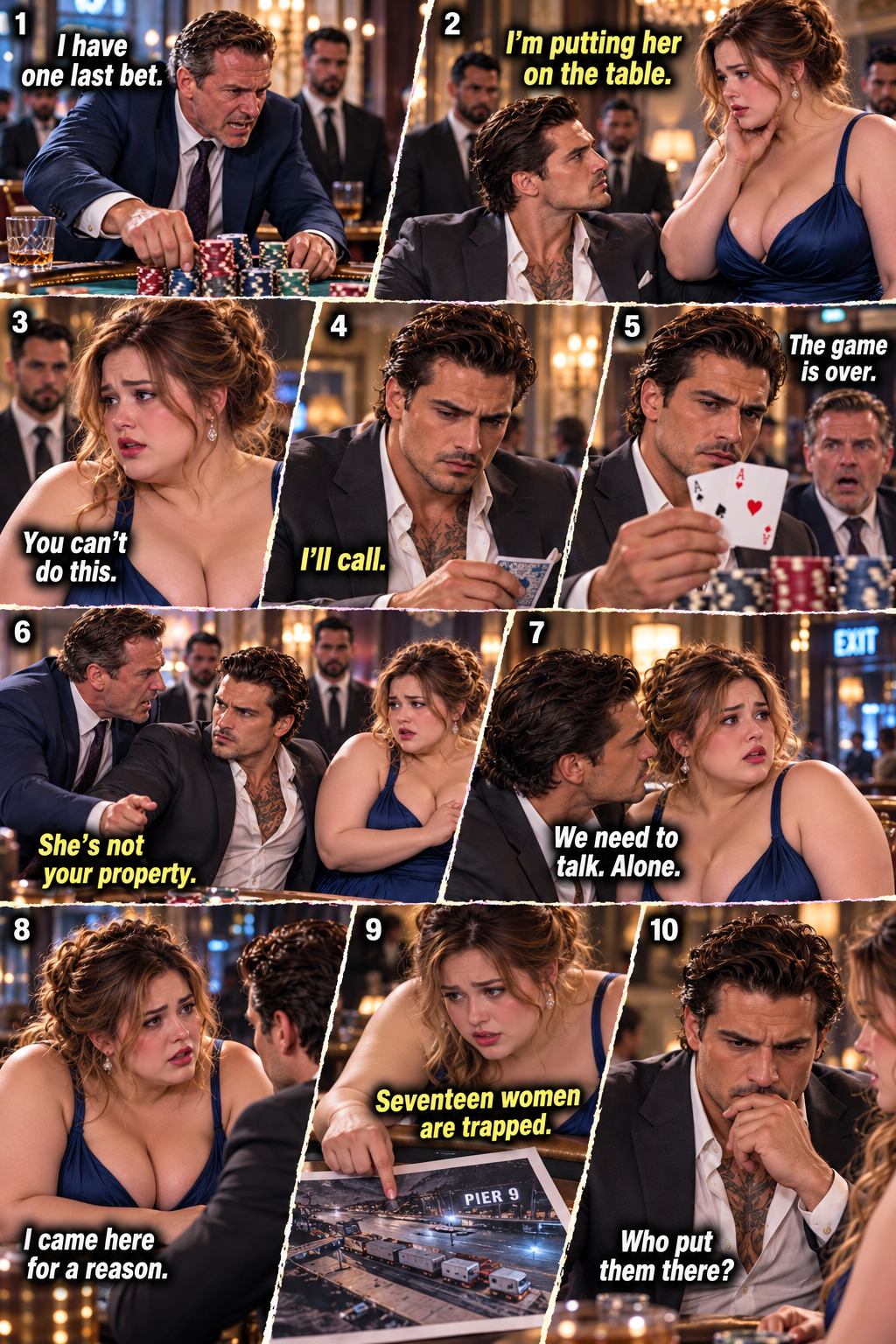
Months earlier, Grant Holloway had pushed Norah toward Luca across a poker table, believing that a woman could be used to settle a debt.
Marco had used two women’s lives to bargain for his freedom.
Quinn had built an entire operation around the belief that vulnerable people could be bought, moved, and discarded.
And Luca had spent much of his life believing that power gave him the right to decide what happened to other people.
Every one of those men had misunderstood something important.
A person’s value was never theirs to assign.
Norah had entered that casino without money, protection, or influence.
She had walked into a room full of dangerous men carrying nothing but a few stolen documents, a desperate plan, and a promise she’d made to seventeen strangers.
She hadn’t known whether Luca would listen.
She hadn’t known whether she’d survive.
She had simply decided that doing nothing was no longer an option.
That morning, as the hearing began, Norah took Elena’s photograph from her handbag.
She looked at the two sisters standing together outside their home.
Then she slipped it back into the envelope.
The picture didn’t mean that Elena’s suffering had disappeared.
It didn’t mean that justice would be simple or that every wound could heal.
It meant that Elena had made it home.
And sometimes, after everything that has been taken from a person, the chance to choose where to go next is the beginning of getting a life back.
Luca had once believed he won Norah at a poker table.
But nobody had won her.
She had never belonged to Grant, to Luca, or to any man who thought power gave him ownership over another human being.
And in the end, the most important thing Luca Ferraro learned wasn’t how to defeat an enemy or protect his empire.
It was how to step aside and let someone else reclaim what had always been theirs.
Their freedom.
Their future.
Their right to choose.
Because real power isn’t measured by how many people fear you or how many lives you can control.
It’s measured by what you’re willing to give up when doing the right thing finally costs you something.
And sometimes the bravest person in the room isn’t the one holding all the cards.
It’s the one who refuses to let another human life become part of the game.
THE END.