Leo Rossi fired the woman who controlled every dollar in his organization just three hours before the biggest merger of his life.
Donatella stood beside the conference table, holding Marco Lombardi’s business card between two fingers while Leo Rossi watched her as though she had just threatened to destroy everything he owned.
For six years, Leo had depended on her judgment without respecting the woman who provided it. Now, with his merger hanging by a thread, he suddenly remembered how much he needed her.
“Donatella,” he said, lowering his voice, “we should discuss this privately.”
She looked at him.
“That’s what you said when you cut my salary three years ago.”
Cordelia shifted uncomfortably.
Leo’s expression hardened. “This isn’t the time to bring up old grievances.”
“Then don’t ask me to forget them.”
Marco remained near the door, observing the exchange with the patience of someone accustomed to letting others reveal their weaknesses.
“Ms. Greco,” he said, “my offer stands. But I suggest you have your attorney review anything before making a commitment.”
Donatella slipped the card into her purse.
“I intend to.”
Leo stared at Marco. “You’re seriously considering hiring the woman who just put my company in jeopardy?”
Marco adjusted his cuff.
“Your company was in jeopardy long before I walked through that door.”
Then he left.
The silence that followed was almost unbearable.
Cordelia broke it first.
“Well, that was unnecessarily dramatic.”
Donatella reached for her coat.
“Good afternoon.”
“You’re not leaving,” Leo snapped.
She stopped.
“Excuse me?”
“You can’t just walk out in the middle of this.”
“You terminated my employment twenty minutes ago.”
“That was before—”
“Before you understood what I did?”
Leo said nothing.
Donatella picked up her handbag.
“Then perhaps you should spend the afternoon learning.”
She walked out without looking back.
For the first time in six years, nobody followed her down the hallway asking her to fix something.
And somehow, that silence frightened her more than Leo’s anger.
By the time she reached the street, Manhattan was settling into its late-afternoon rush. Delivery trucks crowded the curb, pedestrians hurried past, and someone outside a coffee shop was arguing about a parking ticket.
Life was continuing as though her entire world hadn’t just shifted.
Donatella stood beneath the awning of her office building and opened her phone.
There were already eleven missed calls.
Seven from Leo.
Three from his assistant.
One from a number she didn’t recognize.
She turned the phone off.
Then she walked six blocks to a little Italian restaurant where her mother used to take her for birthday dinners.
She ordered chicken soup, a sandwich, and coffee.
For the first time in years, she ate without checking a financial report.
Halfway through her meal, however, her hands began to shake.
She set down her spoon.
It wasn’t fear of Leo.
Not exactly.
It was the sudden realization that she no longer knew who she was when nobody needed her to rescue them.
That evening, Donatella called her attorney, Evelyn Hart.
Evelyn had represented her privately for almost four years, ever since Donatella discovered that Leo had been quietly shifting responsibilities onto her while taking credit for the organization’s financial recovery.
When Evelyn answered, Donatella explained everything.
There was a long silence.
Then Evelyn asked, “Did you sign anything today?”
“No.”
“Did you agree to transfer authorization?”
“No.”
“Did you promise Marco anything?”
“No.”
“Excellent. For once, you’ve followed every piece of advice I’ve given you.”
Donatella laughed despite herself.
Evelyn continued, “Tomorrow morning, we review your employment agreement, the separation provisions, and every document relating to those offshore holdings.”
“Leo says people could lose their jobs.”
“That may be true.”
Donatella closed her eyes.
“Then how do I walk away?”
“You stop confusing responsibility with ownership,” Evelyn replied. “You are responsible for your own actions. You are not responsible for every consequence of Leo’s decisions.”
The words stayed with Donatella long after the call ended.
The following morning, Leo’s first message arrived at 6:12.
We need to talk.
At 6:38:
This is getting out of hand.
At 7:04:
You’re making a serious mistake.
And at 7:19:
Think about the employees.
That final message made her put down her coffee.
Leo had always known where to press.
At nine o’clock, Donatella met Evelyn at her law office overlooking Madison Avenue.
Evelyn spread the documents across a polished wooden table.
“Your position is stronger than Leo realizes,” she said.
Donatella frowned. “Because of the authorization agreement?”
“Partly. The agreement remains effective regardless of your employment status. More importantly, Leo cannot unilaterally appoint Cordelia as your replacement. The independent administrator must approve any new authorized representative.”
“How long could that take?”
“With a competent candidate and complete documentation? Potentially weeks. With Cordelia?”
Evelyn raised an eyebrow.
“Much longer.”
Donatella looked down at the documents.
“I didn’t create those requirements to punish anyone.”
“I know. They were approved specifically to prevent unauthorized transfers.”
“Then why does this feel like revenge?”
“Because Leo has spent years teaching you that protecting yourself is an act of betrayal.”
Donatella sat quietly.
Evelyn slid another document toward her.
“There’s something else.”
It was a copy of Donatella’s original employment agreement.
A clause near the bottom outlined compensation tied to the organization’s financial restructuring.
Donatella recognized it immediately.
“That incentive provision was never activated,” she said.
“According to Leo.”
Evelyn pointed to an attached financial statement.
“The milestones were achieved eighteen months ago. Based on the language here, you may be owed substantial deferred compensation.”
Donatella stared at the numbers.
She had spent years watching Leo purchase expensive watches, luxury cars, and vacations while telling her the company couldn’t afford to increase her salary.
“How substantial?”
Evelyn answered carefully.
“Enough that you won’t need another employer immediately.”
For a moment, Donatella couldn’t speak.
Then her phone vibrated.
A message from an unfamiliar number.
Ms. Greco, this is Adrian Bell, counsel for Marco Lombardi. Mr. Lombardi would appreciate a meeting at your convenience. Your attorney is welcome.
Donatella showed Evelyn.
“Well,” Evelyn said, “at least one man in this situation understands how professional negotiations work.”
They agreed to meet the following afternoon.
But before that meeting could happen, Leo made his next mistake.
At 11:43 that morning, an automated security notification appeared in Donatella’s email.
A request had been submitted to replace the authorized financial administrator for one of the organization’s holding companies.
The replacement listed was Cordelia Bennett.
Donatella read the notification twice.
The request claimed that the previous administrator had resigned voluntarily and that a new appointment was urgently required to complete a pending transaction.
But Donatella hadn’t resigned.
She had been terminated.
And the distinction mattered.
“Evelyn,” she said quietly, turning her laptop around.
Her attorney studied the screen.
“Did you authorize this?”
“No.”
“Did you sign a resignation letter?”
“No.”
Evelyn reached for her phone.
“Then we’re going to preserve this immediately.”
Within an hour, the independent administrator had been notified that the request contained inaccurate information.
The proposed change was suspended pending verification.
Donatella wanted to believe Leo had simply misunderstood the procedure.
But something bothered her.
The request included a digital certification that should have required review by Leo’s legal department.
Someone had deliberately tried to push it through.
That afternoon, Evelyn received a call from Leo’s attorney, Daniel Mercer.
He sounded exhausted.
“Ms. Hart, we’d like to resolve this informally.”
“Then start by withdrawing the inaccurate filing.”
“It was an administrative misunderstanding.”
“Your client certified that my client resigned voluntarily.”
A pause.
“I understand.”
“Does he?”
Another pause.
Then Mercer said, “I think we both know Mr. Rossi is under considerable pressure.”
Evelyn’s reply was immediate.
“Pressure doesn’t make false information accurate.”
The filing was withdrawn an hour later.
But the damage had already been done.
For the first time, Donatella wondered whether protecting Leo’s organization might require protecting it from Leo himself.
The next afternoon, Donatella and Evelyn arrived at Marco Lombardi’s office in a renovated building near Bryant Park.
The reception area was understated, almost surprisingly ordinary.
No dramatic displays of wealth.
No unnecessary security theater.
Just dark wood, quiet staff, and an atmosphere suggesting that important decisions happened behind closed doors.
Marco greeted them personally.
“Ms. Greco. Ms. Hart.”
He offered both women seats.
Adrian Bell joined them carrying a slim folder.
“I understand you’ve had an eventful forty-eight hours,” Marco said.
Donatella studied him.
“I assume Leo has contacted you.”
“Repeatedly.”
“What did he say?”
“That you’ve become emotionally unstable because of a personal disagreement.”
Donatella’s face remained still.
Evelyn, however, gave a short, humorless laugh.
“Convenient.”
Marco continued.
“He also suggested that you installed financial restrictions to maintain control over his company.”
“Do you believe him?” Donatella asked.
Marco leaned back.
“My attorney reviewed the records. Those controls were recommended during a documented compliance review and approved by the relevant parties. You followed the agreed process.”
He paused.
“Leo apparently believes that repeating an accusation makes it true.”
Donatella relaxed slightly.
“What exactly are you offering?”
Marco folded his hands.
“An independent financial advisory position. You would help evaluate several legitimate operating businesses and oversee a restructuring proposal.”
“And the rest of your organization?”
“Outside your assignment.”
Donatella met his gaze.
“I know your reputation, Mr. Lombardi.”
“Then you know enough to ask difficult questions.”
“I won’t disguise transactions, conceal beneficial ownership, or approve funds I cannot trace.”
Marco didn’t immediately answer.
Adrian glanced toward him.
Finally, Marco said, “Those conditions may make this arrangement more complicated.”
“Then perhaps there shouldn’t be an arrangement.”
Marco smiled faintly.
“Now I understand why Leo found you inconvenient.”
He pushed the folder toward Evelyn.
“Review it. Make whatever changes you consider necessary. If we cannot agree, we part respectfully.”
Donatella did not touch the folder.
“What about the merger?”
“Suspended.”
“How many employees are affected?”
“Potentially several hundred across the combined businesses.”
She felt her stomach tighten.
Marco noticed.
“You’re thinking about the payroll.”
“Someone should.”
“That’s what I wanted to discuss.”
He produced another document.
It outlined a temporary operating agreement that would allow certain legitimate businesses to continue functioning independently while the larger merger remained on hold.
A separate escrow arrangement would cover verified payroll and essential operating expenses.
No release of the disputed offshore assets would be required.
Donatella reviewed the structure.
It was carefully designed, subject to legal review and independent administration.
“Why would you do this?” she asked.
Marco shrugged.
“Because destroying a functioning business to punish an incompetent executive is expensive.”
“Only because it’s expensive?”
He considered her question.
“My father owned a small trucking company,” he said. “When one of his biggest customers collapsed, thirty-seven families lost their income. I remember what that did to our neighborhood.”
For a moment, something almost human softened his expression.
Then it disappeared.
“I learned that power is most useful when you understand what breaking things actually costs.”
Donatella wasn’t sure whether she believed all of it.
But the proposed structure was worth examining.
Evelyn looked at her.
“We can review this. Nothing more today.”
Donatella nodded.
Marco accepted the answer.
As they stood to leave, he added, “One more thing, Ms. Greco.”
She turned.
“Don’t accept responsibility for a business unless you also have the authority to protect it.”
That evening, Donatella sat alone in her apartment, surrounded by folders.
Outside, rain streaked the windows.
Her apartment was beautiful but strangely impersonal. She had purchased it four years earlier, then spent so little time there that the living room still looked like a furniture showroom.
She opened a kitchen drawer and found an unopened packet of birthday candles.
Her forty-first birthday.
She remembered buying them because she had promised herself a proper dinner with friends.
Instead, she’d spent that night correcting an error in Leo’s financial projections.
The candles had never been used.
She held the packet for a long moment.
Then her phone rang.
It was Maria Alvarez, the payroll manager.
Maria had worked alongside Donatella for five years.
“Donna?” she whispered.
Donatella immediately sat straighter.
“What’s wrong?”
“Leo called an emergency management meeting.”
“What happened?”
“He says you’re trying to destroy the company.”
Donatella closed her eyes.
Maria continued.
“Cordelia told everyone you might be taking confidential financial information to a competitor.”
“That’s not true.”
“I know.”
“Then why are you whispering?”
“Because they’re checking who talks to you.”
Donatella felt anger rise in her chest.
“Maria, listen carefully. Don’t send me anything confidential. Don’t put your job at risk for me.”
“That’s not why I’m calling.”
“What is it?”
Maria hesitated.
“They’re talking about delaying payroll.”
Donatella stood.
“When?”
“Next Friday.”
“Why?”
“They say the merger delay has created a cash shortage.”
Donatella knew the company’s cash position better than anyone.
There should have been enough operating cash to cover at least two regular payroll cycles.
Unless something had changed.
“Maria, do they have a written payroll forecast?”
“Not one they’ve shown us.”
“Then ask for one through the normal process. And document any instructions you receive.”
“Are you coming back?”
The question hurt more than Donatella expected.
“I don’t know.”
Maria’s voice trembled.
“People are scared.”
After the call ended, Donatella opened the last financial reports she had lawfully retained as part of her separation records.
She compared the figures.
Something didn’t fit.
The company should not have been facing an immediate payroll crisis.
The next morning, she brought her concerns to Evelyn.
“I think Leo is exaggerating the cash shortage.”
“Can you prove it?”
“Not with my current access.”
“Then we don’t accuse him of anything.”
Donatella nodded.
“But if he really is withholding payroll funds?”
“Then the company’s current finance department, its auditors, or the appropriate authorities need to examine the records.”
Donatella stared out the window.
She knew how to find the answer.
But for once, she didn’t have the right to enter the system and look.
That limitation was frustrating.
It was also necessary.
She had spent years insisting that financial controls applied to everyone.
They had to apply to her, too.
Three days later, Leo requested a formal mediation.
The meeting took place at Evelyn’s office.
Leo arrived with Daniel Mercer and Cordelia, who carried a designer handbag and an expression of carefully maintained confidence.
Donatella sat opposite them.
There was no Marco.
No audience.
Just lawyers, documents, and the accumulated weight of six difficult years.
Leo began almost pleasantly.
“Donna, we’ve all had time to cool down.”
She disliked the nickname now.
“Please call me Donatella.”
He blinked.
“Fine. Donatella.”
Daniel opened a folder.
“We’re prepared to offer a generous settlement in exchange for cooperation.”
Evelyn reviewed the first page.
Then the second.
Her expression changed.
“You’re offering three months of salary.”
Leo spread his hands.
“That’s more than fair.”
“And in exchange,” Evelyn continued, “my client would waive all deferred compensation claims, accept a broad nondisparagement obligation, assist with authorization changes, and remain available for six months of unpaid consultation.”
Donatella almost laughed.
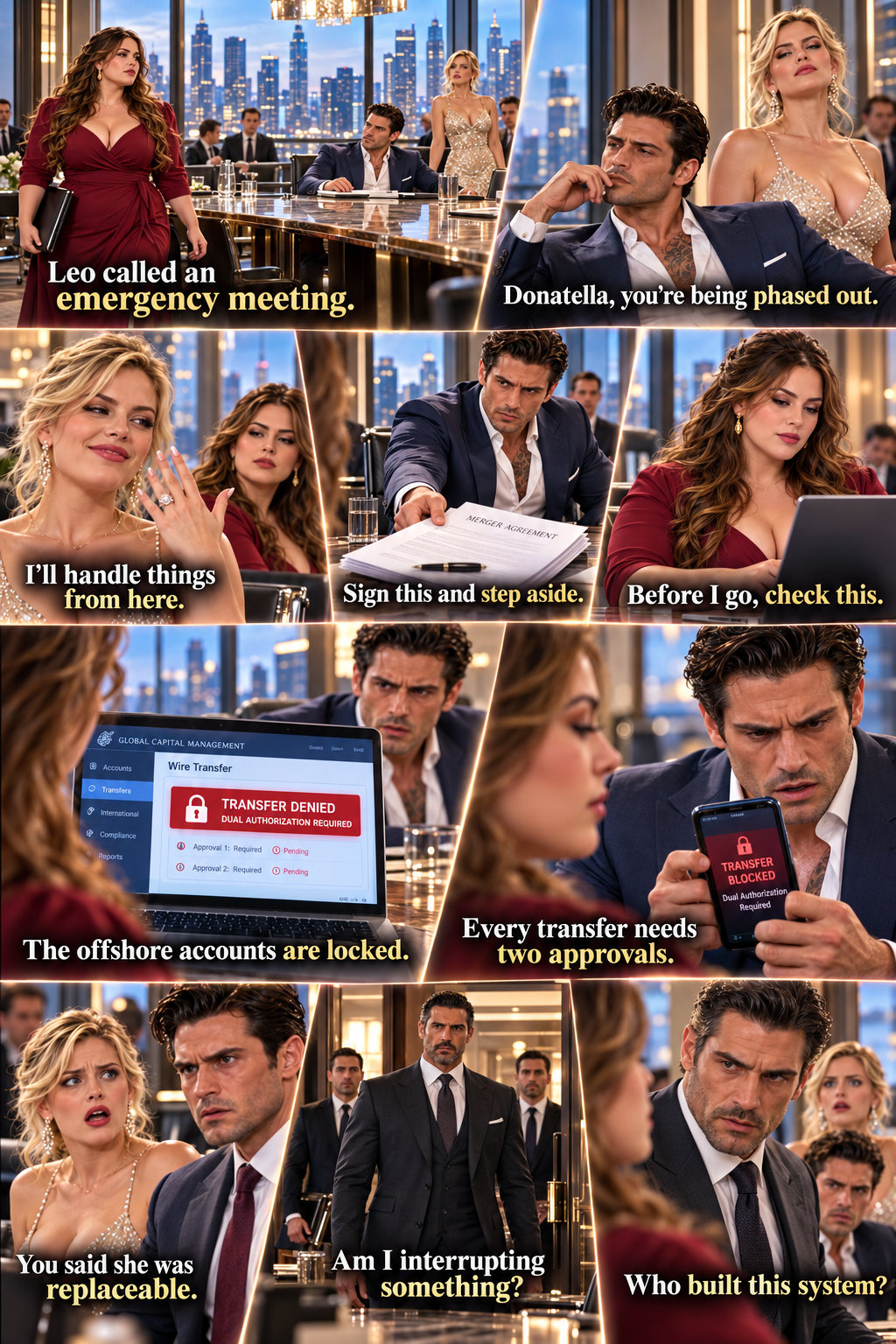
It was so familiar.
Leo had taken the same approach for years: offer something small, describe it as generous, then bury an enormous demand underneath.
“No,” Donatella said.
Leo frowned.
“You haven’t even considered it.”
“I have.”
Cordelia leaned forward.
“You know, at some point, you have to stop making everything personal.”
Donatella turned to her.
“You’re right.”
Cordelia appeared surprised.
“So let’s discuss the actual financial obligations.”
Evelyn placed a separate document on the table.
“This is the deferred compensation provision from Ms. Greco’s employment agreement. These are the audited milestones that triggered it.”
Daniel read the document.
His face tightened.
Leo glanced at him.
“What is that?”
“An outstanding contractual obligation,” Evelyn replied.
Leo scanned the numbers.
“That can’t be right.”
“It is,” Donatella said.
“Why didn’t you bring this up before?”
“I did. Twice. Both times, you told me we would revisit it after the merger.”
Daniel cleared his throat.
“Leo, we’ll need to review this separately.”
Cordelia looked between them.
“How much money are we talking about?”
No one answered.
Then Evelyn turned to the next document.
“We also need to address the inaccurate authorization filing submitted after Ms. Greco’s termination.”
Leo’s eyes narrowed.
“That was a misunderstanding.”
“Who prepared it?”
“Cordelia was coordinating with the advisors.”
Cordelia went pale.
“I forwarded paperwork. That’s all.”
Donatella looked directly at Leo.
“Did you know it said I resigned voluntarily?”
Leo avoided her eyes.
That was answer enough.
Daniel put down his pen.
“I strongly recommend that we pause this discussion until I can speak privately with my clients.”
But Donatella wasn’t finished.
“I have one proposal.”
Everyone looked at her.
“I will consider a thirty-day transition agreement solely to protect payroll continuity and essential business operations.”
Leo sat forward.
“Good. That’s reasonable.”
“I’m not finished.”
His expression changed.
“The arrangement must be approved by independent counsel. I will not waive my compensation claims. I will not authorize unsupported asset transfers. And I will not report to Cordelia or accept instructions that bypass existing controls.”
Cordelia flushed.
“That’s insulting.”
“No,” Donatella replied. “It’s governance.”
Evelyn added, “The transition would also require independent verification of current cash balances and any claimed payroll shortfall.”
Leo’s face darkened.
“You’re treating me like a criminal.”
“I’m treating you like someone requesting access to controlled assets without adequate documentation,” Donatella said.
For several seconds, nobody spoke.
Then Leo stood.
“This meeting is over.”
Daniel looked exhausted.
“Leo—”
“I said it’s over.”
He walked out.
Cordelia followed him.
Daniel remained seated.
He glanced at Donatella.
“For what it’s worth, I think your proposal was reasonable.”
Evelyn closed her folder.
“Then advise your client accordingly.”
Four days passed.
Donatella heard nothing from Leo.
Then, on Thursday afternoon, Evelyn received an unexpected call from an independent accounting firm retained by the company’s board.
Leo’s lenders had demanded updated cash information before extending additional credit.
The accountants had found discrepancies between the payroll forecasts presented to management and the available operating funds.
They wanted to speak with Donatella about the systems she had designed.
The interview took place the next morning, with Evelyn present.
Donatella explained the reporting framework, approval procedures, and reconciliation process.
She did not speculate about activity after her departure.
She did, however, identify exactly which records would establish whether the claimed shortage was genuine.
By Monday, the accountants had their answer.
The company had sufficient unrestricted cash to meet the upcoming payroll, but management had directed that certain available funds be excluded from the forecast presented to department heads.
The evidence did not establish that anyone intended to steal the money.
It did establish that employees had been warned of a possible payroll delay using an incomplete picture of the company’s finances.
The board demanded an explanation.
Leo blamed a communication error.
Cordelia blamed the finance department.
The finance department produced emails showing that Cordelia had specifically instructed staff to circulate the restricted forecast.
When Donatella learned what had happened, she felt neither satisfaction nor surprise.
She just felt tired.
That afternoon, Marco called her.
“I understand the payroll situation has been clarified.”
“Yes.”
“And that you refused Leo’s settlement.”
“Yes.”
“Good.”
Donatella leaned against her kitchen counter.
“Mr. Lombardi, I don’t need congratulations every time I disagree with him.”
Marco chuckled.
“Fair enough.”
“Why are you calling?”
“Because the board has approached my representatives about preserving the transaction without Leo controlling financial operations.”
Donatella straightened.
“What?”
“They’re considering an independent restructuring committee.”
“And?”
“They asked whether you would serve as financial advisor.”
She was silent.
Marco continued.
“I told them they’d have to ask you themselves.”
Donatella looked toward the rain-darkened window.
“If I accept, Leo will say I stole his company.”
“He may.”
“If I refuse, the business might fail.”
“It might.”
“And you’re perfectly comfortable letting me make that choice?”
“Ms. Greco, I don’t need another person who follows orders without thinking.”
For the first time, Donatella understood something important about Marco.
He respected competence.
But respect from a powerful man was not the same thing as safety.
She would still need boundaries.
And those boundaries would have to exist on paper.
“I’ll consider a proposal from the board,” she said. “But only with genuine independence, transparent reporting, and no involvement in anything unlawful.”
Marco’s answer was immediate.
“Then make those your conditions.”
Two days later, Donatella attended a meeting with the board’s independent directors.
The atmosphere was tense.
Three directors sat opposite her with the tired expressions of people who had recently discovered how little they understood their own organization.
The chairwoman, Helen Price, spoke first.
“Ms. Greco, we owe you an apology.”
Donatella said nothing.
Helen continued.
“For years, we relied on Mr. Rossi’s assurances about the organization’s financial health. We now understand how much of its stability depended on your work.”
Donatella glanced at Evelyn.
Then she asked the question she’d been carrying for years.
“If you relied on my work, why did no one ever ask to hear directly from me?”
The directors exchanged uncomfortable looks.
Finally, Helen answered.
“Because we allowed Leo to control the information we received.”
It wasn’t a satisfying answer.
But it was an honest one.
Helen continued.
“We want you to help establish independent financial oversight during the restructuring.”
“What happens to Leo?”
“His operational authority would be restricted while the board reviews management practices. Any permanent change would follow the applicable corporate procedures.”
“And the employees?”
“Payroll is being prioritized.”
Donatella folded her hands.
“Then I have conditions.”
She outlined them carefully.
Independent reporting.
A direct line to the board.
Full cooperation with external auditors.
No private instructions overriding approved controls.
A defined term.
Fair compensation.
And written authority to refuse any transaction that could not pass legal and financial review.
Helen listened without interrupting.
When Donatella finished, the chairwoman nodded.
“Those conditions are demanding.”
“They’re the conditions that should have existed before.”
Nobody argued.
The negotiations continued for another week.
Then the board approved an independent restructuring committee and offered Donatella a six-month advisory contract.
Her deferred compensation claim would be handled separately.
Leo was removed from day-to-day financial decision-making pending the board’s review.
The merger with Marco remained conditional, subject to renewed due diligence and regulatory compliance.
Nothing was magically fixed.
There were creditors to satisfy, expenses to reduce, contracts to renegotiate, and years of careless decisions to untangle.
But the organization finally had something it had lacked for too long.
A process that didn’t depend on protecting Leo’s pride.
On Donatella’s first day back, Maria Alvarez met her at the entrance.
“You’re really here,” Maria said.
“For six months.”
Maria hugged her before Donatella could protest.
Then she stepped back, wiping her eyes.
“People were afraid you wouldn’t come.”
Donatella looked around the familiar lobby.
The same marble floors.
The same reception desk.
The same elevator that had carried her upstairs at midnight more times than she wanted to remember.
But something was different.
She wasn’t returning to save Leo.
She was returning under terms she had chosen.
“Come on,” she told Maria. “Let’s make sure everyone gets paid.”
The first month was brutal.
The accountants uncovered neglected reporting obligations, poorly negotiated vendor contracts, and several expensive commitments Leo had approved without consulting the finance department.
Donatella worked long days, but she refused to return to the habits that had consumed her life.
At six-thirty, she went home.
She delegated.
She insisted that department heads make decisions within their authority instead of sending every problem to her desk.
And when someone called her on a Sunday about a minor spreadsheet error, she told them it could wait until Monday.
It felt almost revolutionary.
Then Leo requested a meeting.
Donatella nearly refused.
But Evelyn advised her that a brief conversation, with clear boundaries, might be useful.
They met in a conference room with glass walls.
Leo looked older.
His expensive suit hung loosely across his shoulders, and the confidence that once filled every room seemed to have drained away.
“Thank you for seeing me,” he said.
Donatella sat opposite him.
“What did you want to discuss?”
He studied his hands.
“Cordelia left.”
Donatella didn’t respond.
“She said she couldn’t live with the uncertainty.”
“I’m sorry to hear that.”
Leo gave a bitter smile.
“No, you’re not.”
She considered her answer.
“You’re right. I’m not sorry that your relationship ended. But I wouldn’t wish humiliation on you.”
Leo looked up.
“I thought you’d enjoy this.”
“I don’t.”
“Why?”
“Because I spent too many years building my life around your mistakes. I don’t want to spend the rest of it celebrating them.”
He looked away.
For a moment, the old Leo appeared—the man who once brought her coffee during eighteen-hour workdays and made her laugh when everything seemed impossible.
Then he spoke.
“I never realized how much you were doing.”
Donatella felt something tighten in her chest.
“You knew.”
He shook his head.
“Not all of it.”
“You knew enough to take credit.”
That landed.
Leo rubbed his face.
“I suppose I did.”
He hesitated.
“Can you ever forgive me?”
Donatella looked at him for a long time.
She had imagined this moment more than once.
In those imaginary conversations, Leo apologized beautifully. He acknowledged every sacrifice, every betrayal, every cruel little dismissal.
And she found the perfect words that left him ashamed and her completely free.
Reality was quieter.
“I don’t know,” she admitted.
Leo nodded slowly.
Then he asked, “Do you think there’s any chance I can come back?”
There it was.
The question beneath the apology.
Donatella felt the familiar disappointment, but this time it didn’t consume her.
“That isn’t my decision.”
“But you could recommend it.”
“I could.”
Hope flickered across his face.
“And I won’t.”
Leo stared at her.
She continued.
“If the board determines you can return in some capacity, that decision needs to be based on evidence, not my feelings. You’ve spent years asking me to make exceptions for you.”
He looked wounded.
“I thought we meant more to each other than that.”
“We did,” Donatella said softly. “That’s why it took me so long to stop.”
Leo lowered his head.
For once, he didn’t have an answer.
Three months later, the organization was still standing.
The renewed restructuring agreement had preserved its viable operating businesses, though several nonessential ventures were sold to reduce debt.
Marco’s firm proceeded only with a narrower transaction involving independently verified assets and legitimate operating companies.
The board implemented stronger oversight procedures, and Leo remained outside operational management.
Cordelia never returned.
Donatella heard she’d taken a position with a marketing firm in Connecticut, far from the financial world she had once expected to control.
Donatella wished her no harm.
She had learned that another woman’s failure did not make her own success more valuable.
Meanwhile, the deferred compensation dispute was settled through negotiations.
It wasn’t everything Evelyn initially believed Donatella might recover, but it was substantial, documented, and enough to change her future.
For the first time in her adult life, Donatella could make decisions without calculating how many months she could survive if everything went wrong.
And still, she struggled with a strange emptiness.
For years, she had measured her worth by how much disaster she could prevent.
Now there were evenings when nobody called.
Weekends without emergencies.
Mornings when she woke up without dread.
At first, she didn’t know what to do with them.
Then one Saturday, she went back to the little Italian restaurant where she’d eaten after Leo fired her.
She ordered coffee and sat by the window.
The owner, an older woman named Teresa, recognized her.
“You’re looking better,” Teresa said.
Donatella smiled.
“Am I?”
“Last time you were here, you looked like you were waiting for somebody to tell you the building was on fire.”
Donatella laughed.
“That sounds about right.”
Teresa placed a slice of lemon cake on the table.
“On the house.”
“I didn’t order cake.”
“Sometimes you don’t know what you need.”
Donatella looked at the cake.
Then she did something she hadn’t done in years.
She stayed.
She sat for nearly two hours, reading a novel, drinking coffee, and watching people pass outside.
Nobody needed anything from her.
The world didn’t collapse.
When her six-month contract approached its end, the board offered her a permanent executive position.
The salary was exceptional.
The authority was significant.
And for a brief moment, the old Donatella wanted to accept immediately.
It was everything she’d once fought to earn.
Recognition.
Respect.
Security.
But that evening, she looked around her apartment.
On the kitchen counter sat fresh flowers she’d bought for herself.
A half-finished painting leaned against the wall.
Her calendar contained plans with friends, a weekend trip to Vermont, and a cooking class she’d finally stopped postponing.
She thought about the woman she’d been on the day Leo dismissed her.
That woman had believed losing her job meant losing her purpose.
Now Donatella understood that her purpose had never belonged to Leo’s organization.
She declined the permanent position.
Instead, she proposed a different arrangement.
She would help recruit and train a qualified financial executive, complete the transition, and remain available as an independent advisor under limited terms.
The board accepted.
Maria cried when Donatella told her.
“You’re leaving again?”
“Eventually.”
“But what will you do?”
Donatella smiled.
“Something I’ve wanted to do for a very long time.”
Six weeks later, she opened a small financial consulting practice.
Her first clients were family-owned businesses that had grown too quickly and needed someone who understood how to build reliable financial systems.
Her second client was a woman who had inherited her father’s manufacturing company and discovered that nobody had explained its finances to her.
Donatella spent three hours helping her understand the numbers.
At the end of the meeting, the woman asked, “How do I know who to trust?”
Donatella considered the question.
“Don’t trust someone simply because they sound confident,” she said. “Trust the people who can explain what they’re doing, show you the evidence, and accept being questioned.”
The woman nodded, writing it down.
Donatella watched her and felt a quiet satisfaction unlike anything she’d experienced during Leo’s grandest deals.
She was helping someone become stronger instead of making herself indispensable.
Several months later, a letter arrived from Leo.
It was handwritten.
He said he had started working with a professional mentor, was cooperating with the board’s continuing review, and had begun to understand how often he’d mistaken other people’s loyalty for an obligation to rescue him.
He apologized without asking for anything.
Donatella read the letter twice.
Then she placed it in a drawer.
She didn’t write back immediately.
Perhaps she would someday.
Perhaps she wouldn’t.
Forgiveness, she was beginning to understand, wasn’t a deadline.
And reconciliation wasn’t a debt she owed simply because someone finally recognized what he’d done.
On the anniversary of the day she was fired, Donatella hosted dinner at her apartment.
Maria came with her husband.
Evelyn arrived carrying a bottle of sparkling cider and a ridiculous bouquet of sunflowers.
A few old friends brought homemade desserts.
The apartment was noisy, crowded, and wonderfully imperfect.
At one point, Maria raised her glass.
“To Donatella,” she announced. “The woman who saved an entire company.”
Everyone cheered.
Donatella shook her head.
“Actually,” she said, smiling, “I’d like to change that.”
The room quieted.
“I helped build something strong enough to survive without me. That’s what I’m proud of.”
Evelyn lifted her glass.
“That’s a much better toast.”
Later, after the guests had gone, Donatella stood by the kitchen window with the last piece of cake.
The city glittered beyond the glass.
Somewhere downtown, Leo’s former headquarters was still operating. People were working, invoices were being paid, and financial reports were being prepared by a team that no longer depended on one exhausted woman to keep everything together.
Marco had moved on to other negotiations.
Leo was facing a future he would have to rebuild himself.
Cordelia had chosen a different life.
And Donatella?
She had finally stopped waiting for someone else to decide what she was worth.
She thought back to that afternoon in the conference room, when Leo had fired her with a smile and Cordelia had looked so pleased.
They had believed that removing Donatella would erase her influence.
Instead, the systems she built had outlasted their authority.
But the greatest victory hadn’t been watching Leo lose control.
It hadn’t been Marco’s respect, the board’s apology, or even the money she’d finally received.
It was discovering that she could walk away from a place that needed her without believing she had abandoned herself.
For years, Donatella had confused being needed with being valued.
Now she understood the difference.
People can depend on your strength while taking advantage of your kindness.
They can praise your loyalty while refusing to honor your boundaries.
And sometimes, the people who call you indispensable are the very ones who never intend to give you the respect you deserve.
She placed her empty plate in the sink.
Then she switched off the kitchen light.
Tomorrow, she had a meeting with a new client, lunch with Evelyn, and tickets to a concert she’d wanted to attend for years.
Nothing extraordinary.
Just a life that finally belonged to her.
And as Donatella headed toward her bedroom, she smiled at one last realization.
Leo had believed that firing her would prove she was replaceable.
In a way, he had been right.
The company eventually found someone else to do her job.
But there was one thing Leo could never replace.
The years Donatella had given him.
She couldn’t recover that time.
She could only decide what to do with the years still ahead.
And this time, she intended to spend them on a life worth living.
Because the most powerful thing Donatella Greco ever did wasn’t controlling millions of dollars.
It was learning that she no longer had to sacrifice herself to prove her value.
The End.