Fifteen years ago, a young Boston doctor stitched up a bleeding nineteen-year-old stranger without asking his name.
Damiano Vieri stared at the faded photograph in Nora Sullivan’s trembling hand, and for the first time since entering her little Boston clinic, the powerful billionaire seemed genuinely afraid.
The woman standing beside his nineteen-year-old self had long dark hair, gentle eyes, and a familiar smile. She wore a volunteer’s winter coat and held a cardboard cup of coffee between her hands.
Nora turned the photograph over again, studying the six handwritten words.
“She knew him before you did.”
The handwriting belonged unmistakably to Margaret.
“Who is she?” Nora whispered.
Damiano reached for the photograph, but his fingers stopped just short of touching it.
“Her name was Elena Moretti.”
“Was?”
He looked toward the clinic window, where pedestrians hurried along the sidewalk beneath a gray Massachusetts sky.
“She was my sister.”
Nora felt something shift inside her.
Damiano had never mentioned a sister. Even the newspaper articles she had reluctantly searched after their reunion described him as an only child who had inherited nothing and built his fortune through relentless determination.
“Your sister was at the shelter that night?”
“She brought me there,” he answered. “I was too stubborn to ask for help. Elena wasn’t.”
Nora looked again at the young woman in the photograph.
“Then why did Margaret write that message?”
Damiano’s expression darkened.
“Because your sister knew Elena. And because there’s something about that night I’ve never told you.”
Before Nora could question him further, his phone rang.
His security director, Luca Romano, spoke urgently enough that Nora could hear fragments of the conversation.
A vehicle had been following Margaret’s car since early morning. Two unfamiliar men had approached Benjamin’s hospital floor, claiming to represent the insurance company.
Damiano’s entire demeanor changed.
“Get someone to the hospital immediately. Nobody approaches that child without his mother’s permission.”
He ended the call and turned toward Nora.
“We need to leave.”
Nora stood so quickly that her chair scraped against the floor.
“Benjamin?”
“He’s safe for now. But Ethan knows someone is looking into his paperwork.”
She grabbed her coat.
“Then we’re going to my nephew.”
Damiano nodded, and for the first time, Nora noticed something remarkable about the man whose name frightened half of Boston.
He wasn’t trying to control her.
He was following her lead.
Twenty minutes later, their SUV pulled into the covered entrance of a private medical center overlooking the Charles River.
Margaret Sullivan was waiting in a quiet family consultation room, her face pale and exhausted.
The moment she saw Nora, she began crying.
“Nora, I can explain.”
Nora stood in the doorway, caught between the anger that had consumed her all morning and the sight of her older sister looking as though she had aged ten years.
“Did you sign away my research?”
Margaret closed her eyes.
“I signed papers. Ethan told me they were guarantees for Benjamin’s treatment.”
“Why didn’t you come to me?”
“Because you were already losing your clinic. You had barely enough money to pay your nurses. I couldn’t ask you to sacrifice anything else.”
Nora’s anger broke into something more painful.
“You don’t get to decide what I’m willing to do for my family.”
Margaret covered her face.
“I know.”
For several moments, neither sister spoke.
Then Margaret looked toward Damiano.
“I wondered when you would finally come back.”
Nora turned sharply.
“You know him?”
Margaret nodded.
“Not the man he is now. But I knew the boy.”
Damiano remained silent.
Margaret explained that fifteen years earlier, she had volunteered at the same emergency shelter where Nora treated a wounded teenager during a February snowstorm.
Elena Moretti had arrived with her younger brother, desperate to find someone willing to help him without asking questions.
But Elena had not simply been protecting Damiano from an ordinary street confrontation.
She had been carrying evidence against a financial organization that exploited vulnerable families through fraudulent medical loans.
Margaret had helped Elena copy several documents before the young woman disappeared.
“Disappeared?” Nora repeated.
Damiano’s jaw tightened.
“Elena was found dead three weeks later. The investigation concluded that she had been involved in a highway accident.”
Margaret shook her head.
“That’s what they told everyone.”
She reached into her handbag and removed a small silver key.
“Elena gave me this before she vanished. She said that if anything happened to her, I should keep it until Damiano was old enough to understand.”
Damiano stared at the key.
“Why didn’t you contact me?”
“I tried. But every number I found led to people who told me to stay away.”
Her voice trembled.
“Then, years later, I learned you had become involved with the very kind of people Elena feared.”
The accusation hung between them.
Damiano accepted it without protest.
“I made choices I’m not proud of.”
Nora studied him.
“And now?”
“Now I’m trying to make different ones.”
Margaret placed the key on the table.
“Elena told me it opened a safe-deposit box at a bank in downtown Boston. I never opened it.”
Damiano picked it up carefully, as though it were the most fragile object in the room.
Before anyone could speak, the consultation-room door opened.
A nurse appeared, her expression concerned.
“Mrs. Sullivan? Your son is asking for you.”
Margaret hurried away.
Nora followed, but Damiano gently touched her elbow.
“There’s something else.”
She stopped.
“Elena was the person who first told me about your work. She believed you were going to become an extraordinary doctor.”
Nora frowned.
“I was barely out of medical school.”
“She saw something in you that night.”
His voice softened.
“After she died, I kept thinking about the way you treated me. You never asked whether I deserved your help.”
Nora felt tears gathering again.
“Everyone deserves medical care, Damiano.”
“I know that now.”
He hesitated.
“But I didn’t know it then.”
That afternoon, while Benjamin rested comfortably and Margaret met with hospital administrators, Damiano and Nora traveled to the old financial district.
The bank occupied a historic stone building near State Street.
Inside, a senior manager escorted them to a private room after verifying the necessary records and identification.
The safe-deposit box was smaller than Nora expected.
Inside lay a sealed envelope, a faded photograph, and a narrow leather journal.
Damiano opened the envelope first.
His sister’s handwriting covered three pages.
He read silently.
Nora watched the color drain from his face.
Finally, he handed her the letter.
Elena had discovered that a network of medical financing companies was purchasing distressed debts from hospitals and clinics, then using those obligations to pressure patients, physicians, and researchers into signing away valuable assets.
One company was called Meridian Health Capital.
Nora recognized the name immediately.
It was one of the corporate entities supporting Ethan’s pharmaceutical venture.
But the letter contained something even more unsettling.
Elena had identified a young financial consultant who helped organize the network’s transactions.
His name was Richard Caldwell.
Ethan’s father.
Nora slowly lowered the paper.
“His father?”
Damiano nodded.
“Richard Caldwell was investigated years ago. Nothing was ever proven.”
Elena’s journal contained dates, payment records, and descriptions of meetings. Some entries referenced shell companies whose names matched those appearing in Margaret’s recent financial documents.
The pattern was unmistakable.
The same network that had exploited desperate families fifteen years earlier was still operating, only now through polished corporate offices and sophisticated contracts.
Nora felt sick.
“Did Ethan know?”
“I don’t know,” Damiano answered. “But we’re going to find out.”
He closed the journal.
“And we’re going to do it properly.”
Nora looked at him.
“What does that mean?”
“It means attorneys, investigators, financial records, and witnesses. No threats. No shortcuts.”
A faint smile touched her lips.
“That doesn’t sound like the Damiano Vieri people whisper about.”
“Perhaps they should get used to someone different.”
By evening, Nora’s clinic had become the center of a carefully organized legal effort.
Damiano brought in a respected Boston attorney named Rebecca Hayes, whose firm specialized in intellectual-property disputes and corporate fraud.
Rebecca arrived carrying two briefcases and an expression that suggested she had little patience for intimidation.
After reviewing Nora’s laboratory notebooks, she looked up.
“These are excellent records, Doctor.”
Nora blinked.
“Really?”
“Dates, formulations, revisions, witness signatures, patient-consent documentation. You’ve preserved the development history exceptionally well.”
For the first time in days, Nora felt hope.
Rebecca continued.
“Ownership and patent rights still require careful examination, but these records give us a strong foundation. We can seek emergency relief to prevent misleading claims at the summit.”
Damiano leaned forward.
“How quickly?”
“We’ll file tonight.”
Then Rebecca turned toward him.
“And you will stay out of my courtroom strategy.”
Nora almost laughed.
Damiano merely raised an eyebrow.
“Understood.”
The next morning, Ethan Caldwell called Nora.
His voice carried the smooth confidence she had once mistaken for kindness.
“Nora, I’ve heard you’ve hired lawyers.”
“Yes.”
“That’s unfortunate. We could have resolved this privately.”
“You stole my research.”
“I developed its commercial potential.”
“You took eleven years of my work and put your name on it.”
Ethan sighed.
“You’re emotional. That’s always been your problem.”
Nora felt the familiar sting of his words.
During their engagement, Ethan had repeatedly dismissed her concerns as emotional, impractical, or naïve.
For years, she had believed him.
Not anymore.
“My attorney will contact yours.”
His tone changed.
“Be careful, Nora. Powerful people have invested in this project.”
She looked across the clinic, where her nurses were preparing examination rooms for the afternoon.
“So have I.”
Then she ended the call.
Damiano, standing nearby, smiled.
“What?”
“Nothing.”
“You’re smiling.”
“I like watching you remember who you are.”
Nora shook her head, but warmth spread through her chest.
That evening, Rebecca received an unexpected message.
A former Meridian Health Capital accountant wanted to speak.
His name was Samuel Pierce, and he claimed to possess internal records showing that Ethan’s company had knowingly used misleading agreements to obtain research rights.
Rebecca arranged a meeting in a conference room at her law firm.
Samuel arrived looking nervous.
He was a thin man in his forties, with tired eyes and a briefcase clutched against his chest.
“I should have come forward years ago,” he admitted.
He explained that Meridian’s executives routinely targeted researchers facing financial pressure.
Their contracts were designed to appear helpful while quietly transferring control over valuable discoveries.
Nora listened in disbelief.
“How many people?”
Samuel looked down.
“More than you would want to know.”
He opened his briefcase.
Inside were copies of emails, financial statements, and internal memoranda.
One email contained Ethan’s instructions to secure Nora’s formula before the Boston summit.
Another referenced Margaret’s son’s medical expenses as leverage.
But the most revealing document was a message from Richard Caldwell.
It instructed executives to make certain that Nora Sullivan had no opportunity to challenge the transfer before the international presentation.
Samuel swallowed.
“I worked for these people because I needed money. Then I kept working because I was afraid of losing everything.”
Rebecca studied him carefully.
“Why come forward now?”
He looked at Nora.
“My daughter was treated at your clinic three years ago. You never sent us a bill.”
Nora remembered a little girl with severe asthma and a frightened father who had recently lost his job.
“You were her father?”
Samuel nodded.
“She’s healthy now.”
His voice cracked.
“I couldn’t keep helping them destroy the woman who helped my family.”
For several seconds, Nora could not speak.
Damiano looked toward the window.
He understood the feeling better than anyone.
By Thursday afternoon, Rebecca had filed emergency motions and supplied relevant evidence to the appropriate authorities.
A judge scheduled an expedited hearing for Friday morning, only hours before the summit’s opening session.
But Ethan was not finished.
That night, Nora received a message from an unknown number.
It contained a photograph of her clinic’s front entrance.
Beneath it were five words.
“Walk away while you can.”
Her stomach tightened.
Damiano examined the message, then immediately contacted the police and his security director.
“We document everything,” he told her. “And nobody takes unnecessary risks.”
Nora nodded.
But she was no longer thinking only about herself.
“What about Margaret and Benjamin?”
“They’re safe. Hospital security has been informed, and Rebecca has arranged additional precautions.”
Nora sat down heavily.
“I’m frightened.”
Damiano pulled a chair beside her.
“So am I.”
She looked at him in surprise.
“You?”
“Fear doesn’t disappear because people think you’re powerful.”
He paused.
“It simply becomes something you learn to hide.”
For a moment, the intimidating billionaire disappeared, and Nora saw the frightened nineteen-year-old boy from the snowstorm.
She reached for his hand.
“You don’t have to hide it from me.”
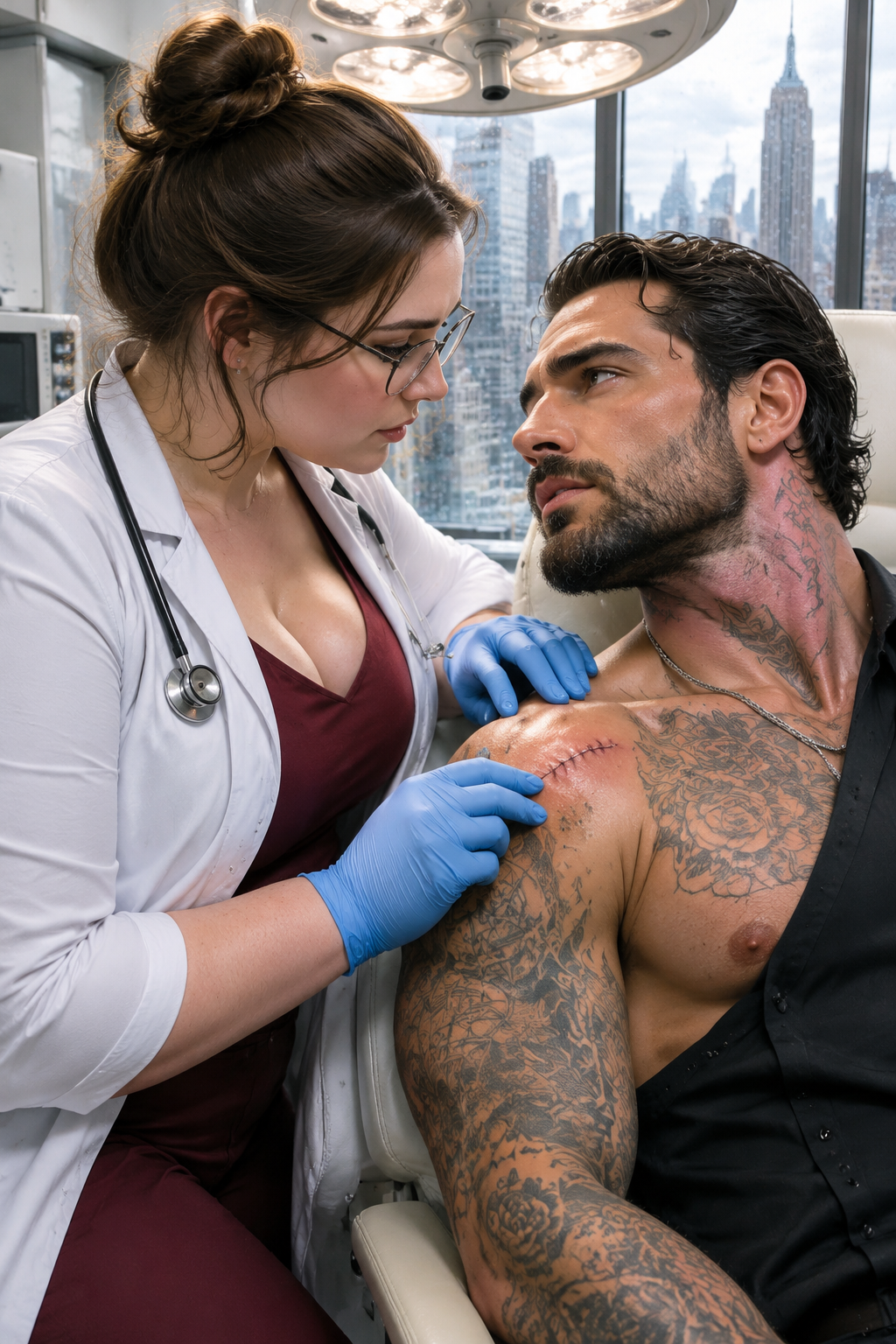
Damiano looked at their joined fingers.
Then he gently turned his hand over and held hers.
Outside, rain began falling against the clinic windows.
For the first time in years, neither of them felt entirely alone.
Friday morning arrived beneath a brilliant blue Boston sky.
The courthouse was crowded with attorneys, corporate representatives, and journalists who had learned that a major intellectual-property dispute threatened one of the medical summit’s headline presentations.
Nora wore a simple navy dress beneath her winter coat.
She had slept barely three hours.
Damiano stood beside her near the courtroom entrance.
“You ready?”
“No.”
He smiled.
“Good. Neither am I.”
Rebecca approached.
“Remember, Doctor, we’re not asking the court to decide every issue today. We’re asking it to prevent further harm while the evidence is examined.”
Nora nodded.
Inside the courtroom, Ethan sat beside his attorneys, looking immaculate in an expensive gray suit.
He barely glanced at Nora.
Richard Caldwell occupied the seat behind him.
An older man with silver hair and a commanding expression, Richard watched Damiano with unmistakable hostility.
The hearing began.
Rebecca presented Nora’s research records, the disputed transfer documents, and evidence that Margaret had been misled about the agreements she signed.
She then introduced Samuel Pierce’s testimony and supporting financial records.
Ethan’s attorney objected repeatedly, challenging the documents’ meaning and arguing that the company’s licensing rights were legitimate.
The judge listened carefully.
Then Rebecca produced an email showing that Ethan had discussed presenting Nora’s research under his own name before obtaining her informed consent.
The courtroom became silent.
Ethan leaned toward his attorney.
Richard Caldwell’s expression hardened.
Rebecca continued.
“Your Honor, Dr. Sullivan is not attempting to prevent scientific advancement. She is asking that her work not be misrepresented while serious questions concerning its ownership are resolved.”
Nora felt tears gathering.
For eleven years, she had worked late into the night, testing formulations, reviewing results, and trying to create something that might help patients who could not afford expensive treatments.
Now someone was finally speaking about that work as though it mattered.
The judge reviewed the evidence.
After a brief recess, the court issued temporary restrictions preventing Ethan’s company from representing itself as the undisputed owner of Nora’s research or entering new licensing agreements based on the contested rights.
Further proceedings would determine the underlying claims.
It was not a final victory.
But it was enough.
Nora covered her mouth.
Rebecca squeezed her shoulder.
“We have a chance.”
Across the courtroom, Ethan rose abruptly.
He turned toward Nora.
“You have no idea what you’ve done.”
Damiano stepped forward, but Nora touched his arm.
“I can answer him.”
She faced the man she had once planned to marry.
“For years, you made me believe that standing up for myself was selfish.”
Ethan said nothing.
“But protecting what I’ve earned isn’t selfish. And neither is refusing to let you take it.”
She turned away before he could respond.
Outside the courthouse, the cold air felt almost sweet.
Damiano offered her his arm.
“Ready for the summit?”
Nora looked at him.
“I thought Ethan controlled the presentation.”
“He did.”
“Did?”
Damiano’s smile widened.
“Rebecca has been busy.”
The medical summit occupied an enormous convention center near Boston’s waterfront.
Researchers, physicians, investors, and pharmaceutical executives filled its brightly illuminated halls.
Nora had attended smaller conferences before, usually carrying homemade sandwiches and worrying about hotel expenses.
This time, she entered beside Damiano Vieri, whose presence drew immediate attention.
But what happened next surprised her more.
A distinguished woman with silver-streaked hair approached them.
“Dr. Sullivan?”
“Yes?”
“I’m Professor Evelyn Hart from the Massachusetts Biomedical Research Council.”
Nora recognized the name immediately.
Professor Hart was a respected researcher whose work had influenced Nora’s early medical training.
“I’ve reviewed the documentation your attorney submitted to our scientific committee,” Hart continued. “We understand there are unresolved ownership issues, but we’d like to offer you an opportunity to discuss your independent research history and the clinical questions your work raises.”
Nora stared at her.
“Me?”
“Yes, Doctor. You.”
Damiano remained silent.
He had helped arrange introductions and ensure that Nora’s materials received a fair review, but the scientific committee had made its own decision.
Her work had earned their attention.
And for Nora, that distinction mattered more than any favor.
The presentation was scheduled for three o’clock.
At two forty-five, Nora stood backstage, staring at the slides she had prepared with Rebecca’s guidance.
Her hands shook.
“What if they don’t believe me?”
Damiano adjusted the collar of her jacket.
“Then you show them your evidence.”
“What if I forget everything?”
“You’ve spent eleven years learning it.”
She laughed nervously.
“You’re making this sound simple.”
“It isn’t.”
He looked directly into her eyes.
“But you are more prepared than anyone in that room.”
Then he reached into his coat pocket.
He removed a small folded piece of paper.
Nora opened it.
Inside was a handwritten sentence.
“One bad night doesn’t have to decide the rest of your life.”
Her breath caught.
“You kept it?”
“I wrote it down after Elena died. I carried it through every difficult year that followed.”
Nora looked at him through tears.
“Damiano…”
He gently kissed her forehead.
“Go remind them what a real doctor looks like.”
When Nora stepped onto the stage, the auditorium lights seemed impossibly bright.
Hundreds of faces turned toward her.
She took a breath.
Then another.
And began.
She spoke about the patients who inspired her research.
About chronic wounds that kept elderly people from walking comfortably.
About low-income workers who delayed treatment because missing a paycheck could mean losing their apartments.
About the need for accessible, evidence-based therapies that could complement established medical care.
She explained that her herbal formulation remained under investigation, that larger controlled studies were necessary, and that promising preliminary findings were not the same as proven clinical effectiveness.
Her honesty impressed the audience.
She presented laboratory records, research methodology, limitations, and the questions she hoped future studies would answer.
Then she showed a photograph of her clinic.
The little brick building between the laundromat and grocery store appeared on the enormous screen.
“This is where my research began,” she said.
Her voice grew steadier.
“Not in a corporate laboratory. Not in a building with marble floors. But in a neighborhood where people sometimes have to choose between medicine and groceries.”
The room became quiet.
“I believe medical innovation matters most when it reaches the people who need it.”
She paused.
“And I believe the people who develop that innovation deserve to have their work recognized honestly.”
Applause began near the front.
Then spread.
Within moments, the entire auditorium was standing.
Nora stood motionless, overwhelmed.
Near the back, Damiano watched with an expression no one in his business empire had ever seen.
Unrestrained pride.
But the afternoon held one final surprise.
As Nora stepped down from the stage, Professor Hart approached with three members of the scientific committee.
“We’d like to discuss a potential independent research partnership,” she said.
Nora blinked.
“What kind of partnership?”
“A university-affiliated study, subject to ethics review and appropriate regulatory oversight. Your preliminary work deserves careful evaluation.”
One of the other researchers smiled.
“And we’d like you to lead the project.”
Nora felt the world tilt.
For eleven years, she had struggled to keep her clinic open while conducting research with limited resources.
Now a respected scientific institution wanted to help her continue.
She looked toward Damiano.
He nodded encouragingly.
“Ask them the questions you need answered.”
Nora turned back to Professor Hart.
“Would the research remain focused on affordable treatment?”
“That would be an important part of our discussions.”
“And would my clinic be involved?”
“We certainly hope so.”
Nora smiled.
“Then I’d love to talk.”
By evening, the news had spread through Boston’s medical community.
A charity-clinic physician had challenged a powerful pharmaceutical venture and received recognition for her independent research.
The legal investigation into Meridian Health Capital continued.
Samuel Pierce cooperated with investigators, and additional witnesses came forward.
Several months later, authorities announced charges against Richard Caldwell and multiple executives involving financial fraud and falsified records.
Ethan faced separate civil claims and professional scrutiny.
The proceedings took time, and not every allegation resulted in a conviction.
But the network that had exploited vulnerable families began to unravel.
For Nora, the most meaningful victory came when her clinic’s eviction proceedings were withdrawn after an investigation revealed serious irregularities in the property transaction.
The building remained hers to operate under a newly negotiated long-term lease.
And Benjamin Sullivan received the specialized treatment he needed.
His recovery was gradual, filled with anxious appointments and difficult days, but eventually he returned to school and began dreaming about becoming a doctor.
One afternoon, Nora visited him at Margaret’s home.
Benjamin looked up from his homework.
“Aunt Nora?”
“Yes, sweetheart?”
“Mom says you saved our family.”
Nora sat beside him.
“Your mom worked very hard to protect you.”
“But she made a mistake.”
Nora nodded.
“Yes. Sometimes people make mistakes because they’re frightened.”
Benjamin considered this.
“Does that mean we should forgive them?”
Nora thought carefully.
“Forgiveness doesn’t mean pretending nothing happened. It means deciding whether someone is willing to take responsibility and rebuild trust.”
He smiled.
“Mom says she’s trying.”
“She is.”
Margaret stood in the doorway, tears shining in her eyes.
Nora opened her arms.
Her sister crossed the room and embraced her.
Neither needed to say anything more.
As spring arrived in Boston, Nora’s clinic began changing.
A local foundation offered funding for additional nurses.
A university research team helped establish a small laboratory.
Volunteers repaired the waiting room, painted the walls, and planted flowers outside the entrance.
Damiano offered to purchase an entirely new medical building.
Nora refused.
“I love this place.”
He looked around at the worn floors and mismatched chairs.
“I’ve noticed.”
“It’s where people know they belong.”
“Then we’ll make it better without changing what matters.”
And he did.
But not by simply writing checks.
At Nora’s insistence, any support came through transparent charitable grants with independent oversight.
Damiano agreed to every condition.
His own life was changing as well.
The investigation into Meridian forced him to confront uncomfortable truths about the businesses and relationships he had maintained over the years.
He began separating himself from criminal associates, cooperating with legal advisers, and restructuring his companies under independent compliance oversight.
It was neither easy nor immediate.
Some people questioned his motives.
Others doubted that a man with his reputation could truly change.
Damiano understood their skepticism.
He had spent years building power because he believed power was the only protection against helplessness.
But watching Nora stand before hundreds of researchers had taught him something he had never fully understood.
Respect could not be purchased.
And real strength did not require making others afraid.
One warm evening in June, he arrived at the clinic carrying a small paper bag.
Nora was finishing her final patient notes.
“You’re late,” she said without looking up.
“I was told the doctor might forgive me if I brought dinner.”
She glanced inside the bag.
Two sandwiches from her favorite neighborhood deli.
“And dessert?”
He produced a small box containing two cannoli.
Nora smiled.
“You’re learning.”
They ate together on the clinic’s back steps, watching the evening sunlight settle over the rooftops.
For a while, neither spoke.
Then Damiano reached into his pocket.
Nora raised an eyebrow.
“If that’s another enormous donation, I’m sending you home.”
He laughed.
“No.”
He placed a small silver key in her palm.
She recognized it immediately.
Elena’s safe-deposit key.
“I’ve been thinking about my sister,” he said.
Nora waited.
“She spent her life trying to protect people who had no one else. For years, I believed the best way to honor her was to become powerful enough that nobody could hurt me again.”
He looked toward the fading sky.
“But I think she would have wanted something different.”
Nora closed her fingers around the key.
“What are you planning?”
“A foundation in her name. Independent trustees. Grants for families facing medical debt, and legal assistance for people pressured into unfair financial agreements.”
Nora smiled slowly.
“That sounds like Elena.”
“Would you help me build it?”
She looked at him.
“Only if you promise not to put your name on every wall.”
Damiano laughed.
“Agreed.”
“And no enormous portraits of yourself.”
“That seems unnecessarily restrictive.”
She nudged his shoulder.
He caught her hand.
Their laughter faded into a comfortable silence.
Then Damiano became serious.
“Nora, there’s something I’ve wanted to tell you for a long time.”
Her heart quickened.
He looked at their joined hands.
“Fifteen years ago, you saved a frightened boy who believed the world had nothing good left to offer him.”
“You were injured. I was a doctor.”
“You were kind.”
He paused.
“And you never asked for anything.”
Nora’s eyes softened.
“Damiano…”
“I spent years confusing gratitude with the need to protect you from a distance. But I’ve learned that caring about someone means respecting their choices, even when you wish you could solve every problem for them.”
He turned toward her.
“I don’t want to be the man who rescues you, Nora. I want to be the man who stands beside you while you build the life you choose.”
Tears filled her eyes.
For so long, Nora had believed love required sacrifice.
With Ethan, she had made herself smaller to protect his pride.
She had hidden her ambitions, apologized for her independence, and convinced herself that being loved meant being agreeable.
But Damiano had watched her become stronger without ever asking her to become less.
She squeezed his hand.
“Then stay beside me.”
He smiled.
“I’d like that.”
Nora leaned toward him.
Their first kiss was gentle, uncertain, and wonderfully ordinary.
No dramatic declarations.
No promises of impossible perfection.
Just two people who had survived difficult years and finally discovered that love could feel peaceful.
A year later, the Elena Moretti Foundation opened its first community assistance center in Boston.
Margaret joined its patient-support advisory committee, using her painful experience to help other families recognize misleading financial agreements.
Benjamin, healthier and full of energy, volunteered on weekends.
Samuel Pierce became an advocate for stronger protections against predatory medical financing.
And Nora’s research entered a carefully monitored clinical study under university supervision.
The results would take years to evaluate.
She welcomed that.
Good medicine, she reminded her students, required patience, evidence, and the courage to admit what remained unknown.
Her clinic continued serving people regardless of their ability to pay.
On the wall near the entrance hung a simple framed photograph.
It showed a young woman with dark hair standing beside a frightened nineteen-year-old boy outside a Boston shelter during a winter storm.
Beneath it was a small handwritten inscription.
“Kindness is never wasted.”
One snowy February evening, fifteen years and many seasons after their first meeting, Nora found Damiano standing before that photograph.
He had been unusually quiet all day.
She approached and slipped her hand into his.
“Thinking about Elena?”
He nodded.
“I wish she could see this.”
Nora looked around the waiting room.
A mother held a sleeping toddler.
An elderly man laughed with a nurse.
A college student filled out volunteer paperwork.
Beyond the windows, snow drifted softly through the Boston streets.
“Maybe this is what she hoped you’d become,” Nora said.
Damiano looked at her.
“A man who spends his evenings waiting for a doctor who refuses to finish work on time?”
She smiled.
“Among other things.”
He laughed and pulled her gently closer.
Then the clinic door opened.
A teenage boy stepped inside, shivering beneath a thin jacket.
He looked frightened and exhausted.
“I’m sorry,” he said. “I don’t have insurance. I don’t even know if I can pay.”
Nora glanced at Damiano.
For a heartbeat, neither moved.
Then Damiano approached the boy and offered him a chair.
“Sit down,” he said kindly. “We’ll make sure you get the help you need.”
Nora watched him with tears in her eyes.
The boy looked uncertain.
“Why would you help me?”
Damiano smiled.
“Because someone once helped me.”
And as Nora reached for her medical gloves, she realized that the greatest thing she had ever created was not the formula that brought her recognition, the research that restored her career, or even the clinic that had become her life’s work.
It was the kindness she had given away without expecting anything in return.
That kindness had traveled through fifteen years of grief, fear, ambition, betrayal, and forgiveness before finding its way back to her.
Not as a debt to be repaid.
But as a life transformed.
Outside, Boston disappeared beneath a soft blanket of snow, while inside the little clinic, another frightened stranger discovered that one difficult night did not have to determine the rest of his life.
And Damiano Vieri, once a boy who believed survival required becoming feared, finally understood the lesson his sister and Nora had tried to teach him all those years ago.
The measure of a person’s life is not how much power they accumulate, how many people obey them, or how much wealth they leave behind. It is how many lives become better because they chose to care.
For Nora and Damiano, that was more than a lesson.
It was the beginning of the life they had always deserved.
THE END.