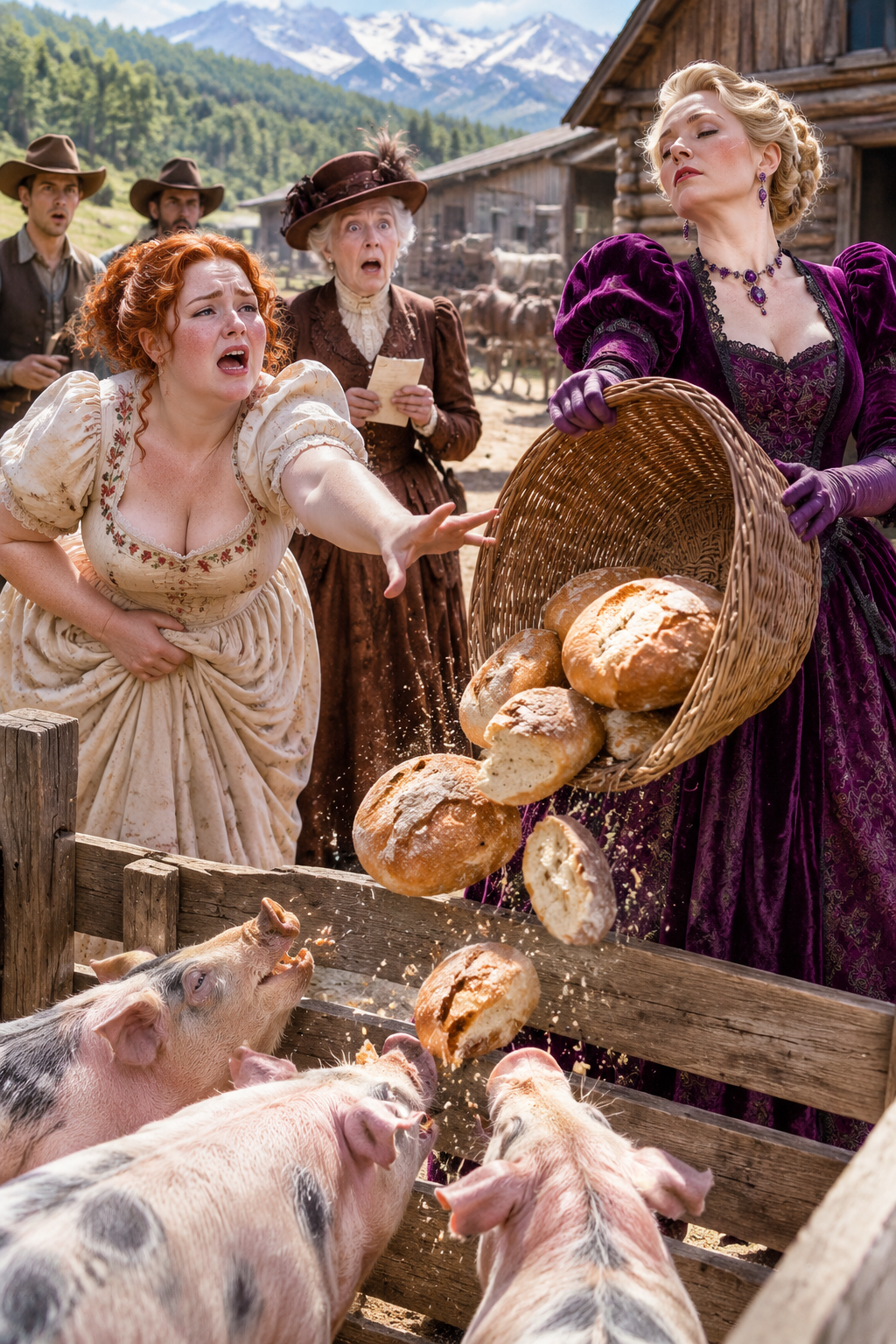
Evelyn Rusk dumped my forty-eight loaves into a filthy bakery dumpster while flood volunteers watched, then smiled, unaware her husband had hidden something far worse.
The second message appeared before I could even ask Miriam what she meant, and this time it contained a link to an audio recording that had apparently been hidden for eleven years.
I stared at my phone, my fingers trembling so badly that I nearly dropped it onto the bakery floor.
Miriam stood across from me, her face drained of color, watching the screen as though it were something dangerous.
“June, please don’t open that until we can talk.”
Her voice was barely above a whisper, but something about the desperation in it made my chest tighten.
For six months, I had believed Miriam Calder was the woman who saved my life when Evelyn Rusk destroyed forty-eight loaves of bread meant for flood victims.
She had given me a kitchen, a contract, and the courage to build something that finally belonged to me.
Now I was standing inside that very business, wondering whether the woman I trusted most had been keeping the darkest secret of my mother’s life.
I pressed play.
At first, there was nothing but static, the faint scraping of chairs, and the distant sound of rain against a window.
Then I heard a man’s voice.
“Margaret, you’re making this unnecessarily difficult.”
I recognized Richard Rusk immediately.
Another voice answered, soft but unmistakably determined.
“I baked every loaf, Richard, and I built the relationships with those shelters before you ever offered me a delivery truck.”
My knees nearly gave way.
It was my mother.
Eleven years had passed since I last heard her voice, and for one impossible moment, I forgot about the contract, the warning, and the woman standing beside me.
I could almost see my mother at our kitchen table, pushing a loose strand of hair behind her ear while she worked dough beneath her palms.
I remembered how she used to hum when she was tired, how she always saved the warmest piece of bread for me, and how she insisted that nobody should ever feel ashamed of being hungry.
Then Richard spoke again.
“The agreement says the depot contracts belong to my company.”
My mother’s response came sharply.
“The agreement you changed after I signed the original.”
There was a sudden movement in the recording, followed by the sound of papers striking a table.
A second woman spoke.
“Richard, that’s enough.”
I looked at Miriam.
Her eyes were filled with tears.
The recording continued.
“Margaret deserves to see the original accounts,” Miriam’s younger voice said.
Richard laughed.
“Then perhaps Margaret should explain why the county has been paying her through my company for the past three years.”
My mother answered immediately.
“Because you told me it was the only way to keep the program operating.”
A long silence followed.
Then Richard said something that made every muscle in my body turn cold.
“If you challenge this arrangement, Margaret, I’ll make certain no depot in this county buys another loaf from you.”
The recording ended abruptly.
I stood motionless, listening to the silence that followed.
My mother had spent her final years worrying about money, apologizing whenever she couldn’t afford something, and pretending she wasn’t exhausted.
I had believed she was simply unlucky.
Now I knew someone had deliberately made her life harder.
“How much did you know?” I asked.
Miriam pressed her hands together.
“More than I should have kept to myself.”
I felt something inside me crack.
“Did you know he was stealing from her?”
“I suspected it.”
“Did you know he threatened her?”
Miriam looked toward the window.
“I was there when he said it.”
I stepped backward.
For a moment, the bakery seemed unfamiliar, as though the walls had been built around a lie.
“You watched my mother lose everything, and you never told me?”
Miriam began crying.
“I tried to help her afterward.”
“But you didn’t tell me.”
“No.”
That single word hurt more than any explanation could have.
I thought about the day Evelyn threw my bread into the dumpster, the humiliation of standing before the volunteers, and Miriam appearing just when I needed someone.
I had called her my guardian angel.
Now I wondered whether she had spent six months trying to pay a debt she had owed my mother for eleven years.
“Please leave,” I whispered.
Miriam looked at me with an expression I had never seen before.
“June, there’s something else.”
I shook my head.
“Not today.”
She hesitated, then placed a small business card on the table.
“Whatever you decide about me, don’t confront Richard alone.”
After she left, I locked the front door and sat on the floor behind the counter.
For the first time since opening Rowan Bread Company, I couldn’t bear the smell of fresh bread.
It reminded me too much of my mother.
I stayed there until the afternoon sunlight faded, listening to the refrigerators hum and wondering how many times she had swallowed her pride so I could believe our life was normal.
When I finally stood, I noticed a missed call from an unfamiliar number.
A voicemail waited beneath it.
“Miss Rowan, my name is Thomas Bell. I believe I know who sent you those documents.”
I listened twice.
Thomas was Mr. Bell’s nephew, a former bookkeeper who had worked for Rusk Family Bakery before moving out of state.
He said he was back in town because his uncle had told him about my business.
He also said something that made me grab my keys.
“Your mother left behind a box of records, June, and Richard has been looking for it for years.”
I drove to the Methodist church, where Mr. Bell had first opened his kitchen to me on the night my bread was destroyed.
The building was quiet when I arrived, its old windows glowing beneath the evening lights.
Mr. Bell greeted me at the side entrance.
He looked worried.
“Thomas said you might come.”
Inside the fellowship hall, a man in his early forties stood beside a cardboard box filled with yellowing folders.
He had tired eyes and the cautious posture of someone who had spent years avoiding an uncomfortable memory.
“I’m sorry I didn’t come sooner,” he said.
I looked at the box.
“Did you send the messages?”
Thomas nodded.
“I didn’t know whether you’d believe me if I called.”
He explained that he had been a junior bookkeeper when my mother supplied bread to the depot.
Richard had handled the billing, and Thomas had initially assumed the complicated arrangements were ordinary business practices.
Then he noticed invoices for deliveries that had never appeared in the bakery’s production logs.
He had also found payments marked as administrative fees, though nobody could explain what services those fees covered.
When he questioned Richard, he was told to stop looking.
A week later, he lost his job.
“I kept copies because I thought somebody might eventually need them,” Thomas said.
I opened the first folder.
There were delivery receipts, payment records, and correspondence between my mother and the county.
Several documents carried her signature.
Others appeared to have been signed by someone imitating her handwriting.
Thomas pointed toward a particular page.
“That’s the one that bothered me most.”
It was an assignment transferring my mother’s supply rights to Rusk Family Bakery.
The document claimed she had accepted a one-time payment of twenty-five thousand dollars.
I stared at the number.
My mother had struggled to pay our electricity bill that winter.
“She never received that money,” I whispered.
Thomas nodded.
“I couldn’t find any record that she did.”
Then he showed me the bank information attached to the transaction.
The account belonged to a holding company connected to Richard.
I felt sick.
For years, I had remembered my mother sitting at the kitchen table, sorting bills into piles while telling me everything would work out.
I had believed her because children are supposed to believe their mothers.
Now I understood how much fear she had hidden behind those words.
“Why didn’t you tell the authorities?” I asked Thomas.
“I tried.”
He lowered his eyes.
“I sent a letter to the county purchasing office. Nobody responded, and Richard’s attorney threatened me after I requested the records.”
He explained that he had a young family then and had been frightened of losing another job.
“I convinced myself that someone with more power would eventually handle it.”
His voice broke.
“Nobody did.”
I wanted to be angry with him, but the regret on his face looked painfully familiar.
He had made the same choice Miriam had made.
He had seen something wrong and hoped someone else would stop it.
Mr. Bell gently placed a hand on my shoulder.
“Your mother trusted me with those records after Thomas left town.”
I turned toward him.
“She knew you?”
He smiled sadly.
“She used to bring bread here every Thursday.”
I looked around the church kitchen, remembering the night I had worked there with volunteers to replace the ruined forty-eight loaves.
The same ovens that helped save my business had once baked bread beside my mother.
“Why didn’t you tell me?”
“Because she asked me not to involve you while she was alive, and afterward I thought the matter was finished.”
He swallowed.
“When you came here that night, I recognized her eyes in your face.”
I pressed my hands against the edge of the table.
My mother had left pieces of herself everywhere, and somehow I had spent years walking past them without knowing.
Thomas opened the final folder.
Inside was a handwritten letter addressed to me.
The paper had yellowed at the edges.
I recognized my mother’s handwriting immediately.
My name appeared across the envelope in the same careful letters she had used on birthday cards.
I couldn’t open it.
Mr. Bell pulled out a chair.
“Take your time, June.”
I sat down and unfolded the paper.
My mother had written it during the final months of her illness.
She explained that she had tried to build a business that would allow her to feed people in emergencies while earning enough to provide a secure future for us.
She had trusted Richard because he offered transportation and accounting help when she couldn’t afford either.
By the time she understood how much control he had taken, the agreements were tangled in legal language she couldn’t afford to challenge.
But the part that broke me came near the end.
She wrote that she had been offered a settlement if she agreed never to speak publicly about the dispute.
She refused.
She had wanted me to know that our family name was worth more than whatever money Richard offered.
Then came the sentence I read again and again.
“June, if you ever open your own bakery, promise me you will never let fear decide what kind of woman you become.”
I covered my mouth.
I had spent years believing my mother died disappointed in what she had failed to build.
Instead, she had been fighting to preserve something she hoped I might one day inherit.
Not a building.
Not a bank account.
The right to stand behind our name without shame.
I cried until my chest hurt.
When I finally looked up, Thomas was wiping his eyes.
“There is one more thing,” he said.
He explained that Richard had recently contacted him, offering money in exchange for any surviving documents.
Thomas refused.
Two days later, someone searched his rented storage unit.
Nothing valuable was taken, but several boxes had been opened.
“That’s why I sent the messages,” he said.
“I thought Richard was preparing to destroy whatever evidence remained.”
I looked at the folders spread across the table.
“What do we do now?”
Thomas answered carefully.
“We give copies to someone who can investigate them properly.”
The next morning, I contacted an attorney named Rebecca Shaw, who specialized in commercial disputes and had previously represented small businesses in county contracting cases.
She listened without interrupting as I explained the recordings, the suspicious invoices, and my mother’s letter.
When I finished, she remained quiet for several seconds.
“June, some of these documents may support serious allegations, but we need to establish which records are authentic and what actually happened to the money.”
I nodded.
“I don’t want revenge.”
Rebecca studied me.
“What do you want?”
I thought about my mother standing in our kitchen after midnight, kneading dough with swollen hands.
“I want the truth to have somewhere to stand.”
Rebecca agreed to review the evidence and contact the appropriate investigators.
She also warned me not to discuss the accusations publicly before the records could be verified.
I promised.
Unfortunately, Richard Rusk had no intention of waiting.
Three days later, I arrived at my bakery to find a printed notice taped to the front window.
It claimed Rowan Bread Company was under investigation for violating food safety regulations.
Customers stood outside reading it.
My manager, Elena, rushed toward me.
“June, somebody posted copies all over town.”
I examined the notice.
It had no official seal, no agency contact information, and several strange grammatical errors.
Rebecca confirmed over the phone that it was not a legitimate government notice.
But by lunchtime, the damage had begun.
Two wholesale customers called to postpone their orders.
A local restaurant canceled its standing delivery.
Someone had created an anonymous social media account accusing me of stealing recipes and manipulating county officials.
Then Evelyn Rusk walked into my bakery.
She wore the same expensive coat she had worn when she destroyed my bread.
For one terrible second, I was back in that alley, staring into the dumpster while strangers watched.
Evelyn looked around the storefront.
“Business seems quieter than usual.”
Elena stepped forward, but I raised my hand.
“What do you want, Evelyn?”
She smiled.
“Richard says you’ve been asking questions about old contracts.”
I said nothing.
“Some things are better left buried, June.”
I felt my mother’s letter inside my apron pocket.
“Did you know what he did to my mother?”
Her expression changed.
“Your mother made her own choices.”
“Did she?”
Evelyn looked toward the empty tables.
“Be careful. You have employees depending on you now.”
Then she left.
I stood motionless until the bell above the door stopped ringing.
For the first time, I understood why my mother had been afraid.
Richard didn’t need to destroy my ovens or steal my recipes.
He only needed to make enough people doubt me that my business would collapse under the weight of suspicion.
That evening, Elena found me reviewing canceled orders.
“You can’t keep carrying this alone,” she said.
I rubbed my tired eyes.
“I have seven people who need their paychecks.”
“And seven people who believe in you.”
I looked at her.
Elena had been one of the volunteers who helped me bake those forty-eight loaves in the church kitchen.
She had left a better-paying job to become my first employee.
“I won’t let you lose your job because of my family,” I whispered.
She pulled up a chair.
“Then stop treating us like we’re strangers.”
The next morning, every employee arrived early.
Without asking for extra pay, they helped organize a community bread sale to support families still recovering from the flood.
Elena contacted local churches.
Another employee reached out to neighborhood businesses.
Mr. Bell offered the fellowship hall if we needed additional space.
I hesitated, worried that the rumors would follow us.
But Elena reminded me of something my mother had always said.
“People can argue about your name, June, but they can’t argue with what you put into their hands.”
By Saturday morning, a line stretched down the sidewalk outside Rowan Bread Company.
Some customers came because they had heard the rumors and wanted to show support.
Others came because they remembered receiving our bread at the shelter.
A woman in a blue coat approached the counter holding the hand of a little boy.
I recognized him immediately.
He was the child who had shared his slice of bread with me after the flood.
His mother smiled.
“He insisted we come.”
The boy placed three crumpled dollar bills on the counter.
“For the people who still need breakfast.”
I knelt beside him.
“You don’t have to give me your money.”
He shook his head.
“You gave us bread when our house was underwater.”
My eyes filled with tears.
Behind him, the line continued growing.
By closing time, we had sold nearly everything we baked.
More importantly, several customers had signed up for weekly deliveries.
The next morning, Miriam came to see me.
She waited outside until I invited her in.
For several moments, neither of us spoke.
Then she placed a thick envelope on the counter.
“I brought copies of my correspondence with Margaret.”
I opened it carefully.
There were letters requesting audits, complaints about missing payments, and records showing that Miriam had repeatedly questioned Richard’s billing practices.
One letter had been sent to the county administrator shortly before my mother became ill.
Another contained Miriam’s resignation from the depot oversight committee.
I looked up.
“You really did try.”
“Not hard enough.”
Her voice trembled.
“I should have gone further. I should have told someone outside the county when they ignored me.”
She wiped her eyes.
“I was afraid of losing the program, June. I thought if Richard lost the contract, the shelters might lose their food supply.”
I thought about all the people who had made decisions out of fear.
My mother had refused to surrender her name.
Thomas had remained silent.
Miriam had walked away.
And I had nearly let Evelyn frighten me into abandoning everything I built.
“I can’t pretend you didn’t hurt me,” I said.
Miriam nodded.
“I know.”
“But I don’t want to spend the rest of my life hating you.”
She began crying.
I reached across the counter and took her hand.
It wasn’t forgiveness in a single miraculous moment.
It was simply the beginning of something more honest.
Two weeks later, Rebecca called with news that made my heart pound.
Investigators had reviewed the documents and opened a formal inquiry into the old depot contracts and the more recent questionable invoices.
The county had also agreed to examine how its purchasing procedures had allowed so many discrepancies to go unnoticed.
Richard was required to produce financial records.
Thomas agreed to give a statement.
Miriam provided her correspondence and the recording.
I supplied my mother’s original documents.
For the first time, the story no longer depended on one frightened person’s word against Richard Rusk’s.
Then came the discovery nobody expected.
A bank record obtained during the investigation showed that the supposed twenty-five-thousand-dollar settlement had been transferred into the holding company’s account.
Additional records indicated that Richard had authorized payments from that company to cover expenses unrelated to my mother’s work.
Rebecca explained that the documents would need further examination, but the evidence was becoming difficult to dismiss.
Richard’s attorney contacted her within days.
He proposed a private settlement.
The offer included a substantial payment to me if I agreed to withdraw my civil claims and sign a confidentiality agreement.
When Rebecca told me the amount, I sat down.
It was more money than I had ever imagined having.
Enough to purchase my bakery building outright.
Enough to expand production.
Enough to guarantee my employees’ wages for years.
For one moment, I pictured the relief of never worrying about another overdue bill.
Then I remembered my mother’s letter.
I asked Rebecca whether accepting the offer would prevent me from discussing what happened.
“Yes,” she said.
I looked toward the framed recipe hanging beside the entrance.
“Then tell them no.”
Rebecca studied me carefully.
“Are you certain?”
I nodded.
“My mother already paid too much for silence.”
The civil case continued while the investigators examined the financial records.
During that time, Richard’s business began losing customers as the county reviewed its contracts and suppliers reconsidered their arrangements.
I never celebrated those losses.
I knew the bakery employed people who had nothing to do with his decisions.
Some had worked beside me for years.
When two former Rusk employees came asking whether I had any openings, I interviewed them without mentioning Evelyn.
One of them, a quiet woman named Carol, began crying when I offered her a position.
“I thought you’d hate anyone who worked there.”
I shook my head.
“I know what it’s like to need a paycheck.”
Months passed before the case reached its turning point.
Rebecca called me into her office on a rainy Thursday afternoon.
She had received copies of additional accounting records and a statement from Richard’s former outside accountant.
The accountant acknowledged that certain charges had been recorded under misleading descriptions and that Richard had directed him to treat the disputed settlement as completed.
Investigators were still determining the full extent of the misconduct, but the financial trail now supported much of what my mother had claimed.
The county formally terminated the remaining Rusk supply agreements after its review.
Richard eventually agreed to a civil settlement that included compensation for my mother’s unpaid contractual interests, without requiring me to remain silent.
Separate proceedings concerning the questionable billing practices continued.
I didn’t receive a dramatic apology.
Richard never looked me in the eye.
Evelyn didn’t appear at the final settlement conference.
But when Rebecca handed me the signed agreement, I felt something loosen inside my chest.
Not because the money could replace what my mother lost.
It couldn’t.
Nothing could give back the evenings she spent worrying or the years she believed nobody would listen.
But the record now acknowledged that her work had value.
And her daughter had refused to let that work disappear.
I used part of the settlement to purchase the building where Rowan Bread Company operated.
Another portion went into an emergency assistance fund for employees facing unexpected hardship.
I also established a small community baking program at Mr. Bell’s church.
Every Thursday, volunteers prepared bread for families experiencing food insecurity.
We called it Margaret’s Table.
On the morning of its opening, Miriam arrived early and quietly began washing mixing bowls.
Thomas helped organize deliveries.
Elena supervised the volunteers.
Mr. Bell stood near the ovens, smiling as though he had been waiting years to see the kitchen filled with people again.
I watched them work together and thought about how strangely life sometimes returns us to the places where unfinished stories began.
My mother had once baked in that kitchen.
Years later, it had sheltered me on the worst night of my life.
Now it was becoming a place where other people could find help without having to explain why they needed it.
That afternoon, a young woman entered carrying a toddler on her hip.
Her coat was worn, and she looked embarrassed when she approached the counter.
“I’m sorry,” she whispered. “Someone told me there might be bread available.”
I smiled.
“Of course.”
She glanced toward the baskets.
“How much?”
“Nothing.”
Her eyes filled with tears.
“I can pay you next week.”
I shook my head.
“You don’t owe us anything.”
She held the warm loaf against her chest as though it were something precious.
Then she said words I would remember for the rest of my life.
“My little boy hasn’t had a proper breakfast in two days.”
I felt my mother’s presence so strongly that I had to turn away for a moment.
I remembered her standing in our tiny kitchen, dividing the last loaf so everyone had enough.
I remembered how she never let me see her take the smallest piece.
And suddenly, I understood something I had spent years trying to learn.
My mother hadn’t failed because Richard stole her business.
She had succeeded every time someone ate because she refused to look away.
Her kindness had survived the contracts, the threats, the unpaid bills, and even her death.
It had survived in the hands of people who remembered what she gave them.
That evening, after the volunteers went home, I remained alone in the church kitchen.
The ovens had cooled.
The counters were clean.
A faint smell of honey and warm wheat lingered in the air.
I opened my mother’s recipe notebook and turned to the page where she had written her favorite bread recipe.
Near the bottom, beneath a stain from some long-forgotten afternoon, I noticed a sentence I had overlooked.
“Always leave enough dough for one more loaf.”
I ran my finger across the faded handwriting.
For years, I had thought she meant it as a baking instruction.
Now I understood it was how she had chosen to live.
No matter how little she had, she always believed there should be something left to share.
I closed the notebook and looked around the quiet kitchen.
For the first time since her death, I didn’t feel that I was chasing the life she had lost.
I was continuing the life she had started.
A year later, Rowan Bread Company had expanded into a second location and employed eighteen people.
We supplied schools, shelters, restaurants, and community organizations across the county.
The bakery that began with forty-eight destroyed loaves had become something larger than I ever imagined.
But the moment that mattered most came on an ordinary Tuesday morning.
I was arranging fresh bread near the front window when an elderly man entered.
He wore a faded work jacket and carried a small photograph.
“Are you Margaret Rowan’s daughter?” he asked.
I nodded.
He placed the photograph on the counter.
It showed my mother standing beside a delivery truck, smiling as she handed bread to a group of flood volunteers.
The man pointed toward himself in the picture.
“I drove that truck for her.”
I looked at him in surprise.
“She never mentioned you.”
He smiled.
“Your mother helped a lot of people who never made it into her stories.”
He explained that years earlier, he had lost his job and nearly his home.
My mother hired him for deliveries even though she barely had enough money to pay herself.
When he finally found steady work elsewhere, she refused to accept repayment for the groceries she had bought his family.
He had kept the photograph because he wanted to remember the woman who treated him with dignity when he had none left.
“I heard what happened with the Rusks,” he said.
“I thought you should know something.”
My heart tightened.
He looked around the bakery, his eyes shining.
“Your mother would have loved this place.”
I couldn’t speak.
He reached into his jacket and handed me a small, worn envelope.
Inside was a handwritten receipt for a single loaf of bread.
Across the bottom, my mother had written three words.
“Paid in kindness.”
I began crying right there behind the counter.
The man gently squeezed my hand before leaving.
That evening, I placed the receipt beside my mother’s framed recipe.
I stood looking at both for a long time.
I thought about Evelyn throwing my bread into the dumpster, Richard trying to erase my mother’s work, and Miriam finding me when I believed I had lost everything.
I thought about Thomas finally speaking, Mr. Bell opening his church, Elena refusing to let me struggle alone, and a little boy sharing half his breakfast with me.
For so long, I had believed my story was about what someone powerful could take away.
But standing there in the warm light of my bakery, I finally understood it was about what they couldn’t.
They could destroy forty-eight loaves.
They could steal contracts, hide money, spread rumors, and frighten people into silence.
They could make a hardworking woman believe her dreams were too small to matter.
But they couldn’t erase the lives she touched.
They couldn’t destroy the kindness she planted in people who remembered.
And they couldn’t stop her daughter from learning that courage isn’t the absence of fear.
Sometimes courage is simply getting up before sunrise, turning on the ovens, and making another loaf when someone has thrown the first one away.
I switched off the bakery lights and paused beside the front door.
Outside, rain began falling softly against the sidewalk.
For a moment, I could almost hear my mother humming in the kitchen behind me.
I smiled through my tears.
“Goodnight, Mom.”
Then I turned the key and walked home, knowing that tomorrow morning, somewhere in our county, someone would wake up hungry.
And because of the woman who taught me to bake, there would be bread waiting for them.
The greatest inheritance my mother left me wasn’t a business, a recipe, or even the truth about what had been stolen from her.
It was the understanding that success means very little unless someone else’s life becomes better because you were here.
And every morning, when the first warm loaf comes out of my oven, I remember the promise I made beside her grave.
I would build something no cruelty could destroy.
Not because it was protected by money or powerful people.
But because it was built on something they had never understood.
A kindness shared becomes a kindness remembered, and sometimes the smallest act of generosity returns years later to save the very person who gave it.
That was my mother’s real legacy.
And now, finally, it was mine to carry forward.
THE END.