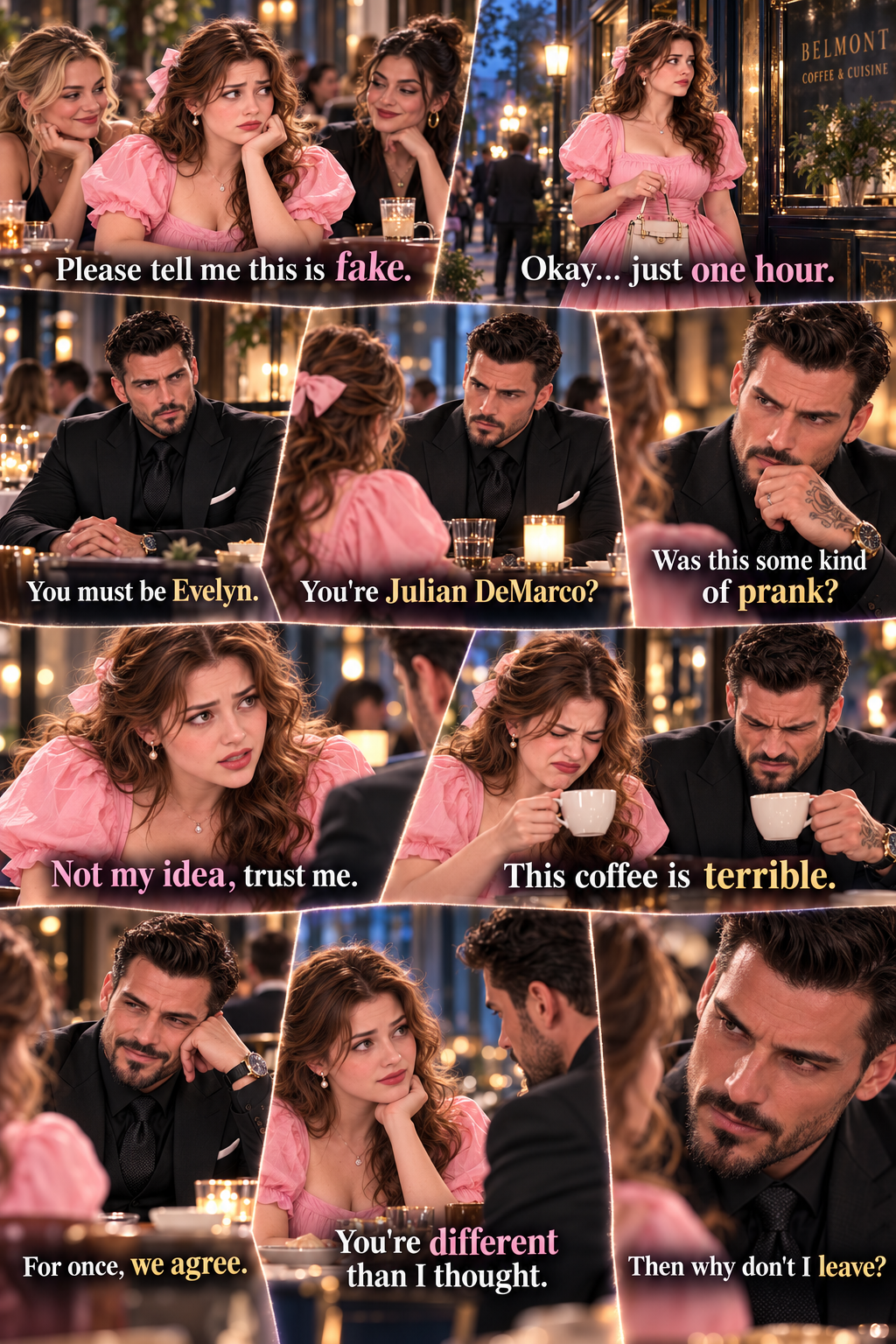
Evelyn Harper knew her blind date was going badly when the man across from her looked at his watch and said, “You have five minutes to explain why you’re here.”
Evelyn Harper arrived at the diner seventeen minutes early.
She told herself it was because traffic had been lighter than expected. In reality, she’d spent the entire drive rehearsing questions she wasn’t sure she wanted answered.
Outside, Chicago was settling into a cold Sunday evening. The wind pushed fallen leaves along the sidewalk, and the diner’s windows glowed warmly against the darkening street.
Evelyn slid into their usual corner booth.
The waitress, a gray-haired woman named Ruth who had somehow adopted both Evelyn and Julian after their second visit, appeared with a coffee pot.
“Your usual, honey?”
“Please.”
Ruth poured the coffee, studied Evelyn’s face, and set down an extra napkin.
“Whatever he’s done, don’t let him get away with it just because he’s handsome.”
Evelyn almost smiled.
“Is it that obvious?”
“Sweetheart, I’ve been married thirty-eight years. Men only look that worried when they’ve broken something they can’t fix with money.”
She nodded toward the entrance.
Julian DeMarco stood just inside the door.
For once, he wasn’t wearing one of his perfectly tailored suits. He had on dark jeans, a charcoal sweater, and an expression Evelyn had never seen before.
Uncertainty.
He approached the booth but didn’t sit immediately.
“Can I?”
Evelyn nodded.
Julian slipped into the seat across from her.
Neither reached for the menu.
“I don’t want you to tell me what you think I can handle,” Evelyn began. “I want the truth. Even if it makes me leave.”
Julian looked at his hands.
“Then I need to start with something I’ve never told anyone I’ve dated.”
Evelyn’s stomach tightened.
“My father ran organized crime operations on the South Side for nearly thirty years,” Julian said. “Gambling, illegal lending, protection rackets. He also owned legitimate businesses, but those weren’t always separate from the criminal ones.”
Evelyn remained silent.
“When he died, I inherited everything. The restaurants, warehouses, transportation companies, and the people who worked for him.”
“And the criminal operations?”
“Some of them.”
She felt her fingers tighten around her coffee mug.
Julian didn’t look away.
“I spent years shutting parts of it down. Gambling operations. Illegal collections. Anything that involved threatening families. I thought I could dismantle the rest slowly without putting people in danger.”
“Thought?”
“Some of the men who worked for my father didn’t want things to change. And I made compromises because I convinced myself keeping control was safer than walking away.”
“What kind of compromises?”
He swallowed.
“I let men stay on the payroll when I knew what they’d done. I kept quiet about money I suspected was dirty. I looked the other way when people used my father’s reputation to intimidate others.”
Evelyn stared at him.
The man who remembered her favorite tea.
The man who carried boxes for elderly waitresses.
The man who had quietly helped her find discounted books for her library.
He was also a man admitting he’d tolerated things she couldn’t excuse.
“Did you ever hurt anyone?”
“Not with my own hands.”
“That isn’t what I asked.”
Julian closed his eyes briefly.
“No. It isn’t.”
For several seconds, the only sound between them was the hiss of the coffee machine.
“I’ve given orders that frightened people,” he admitted. “I’ve let consequences happen because I was too concerned about keeping control. I never ordered someone killed, Evelyn. But I can’t pretend my hands are clean.”
Her throat tightened.
“Then why are you still involved?”
“Because leaving isn’t as simple as handing over my keys. There are employees whose paychecks depend on these companies. There are people who’d get hurt if the wrong men took over. And there are things my father left behind that could destroy more lives if they fell into the wrong hands.”
“That sounds like something you’ve told yourself for a long time.”
“It is.”
“And maybe you’ve started believing it because the alternative is admitting you’re afraid.”
Julian’s face changed.
Not anger.
Recognition.
“Yes,” he said quietly.
Evelyn looked toward the window.
She’d imagined this conversation ending with either a reassuring explanation or a devastating revelation.
Instead, she’d gotten something more difficult.
A man who was telling the truth, and a truth that didn’t make him innocent.
“I can’t be your excuse to become a better person,” she said.
“I know.”
“No, Julian. I need you to understand. I won’t stand beside you while innocent people get hurt and call it love.”
He nodded.
“And I won’t ask you to.”
She pushed her untouched coffee aside.
“Then what happens now?”
“I start fixing what I should’ve fixed years ago.”
“And if you can’t?”
Julian’s answer was barely audible.
“Then you walk away.”
Evelyn stood.
For one frightening second, Julian looked as though he might reach for her.
He didn’t.
“I care about you,” she said. “But I need to see what you do when doing the right thing costs you something.”
Then she walked out.
Julian remained in the booth long after she disappeared.
Ruth approached with the check.
He reached for his wallet.
She stopped him.
“Coffee’s on the house.”
“Thank you.”
“Don’t thank me. Just don’t waste that girl’s time.”
For the next eleven days, Evelyn didn’t see Julian.
He sent one message asking whether she’d gotten home safely.
She answered yes.
After that, silence.
It was harder than she’d expected.
She missed his ridiculous opinions about movies. She missed the way he listened to her explain why children who hated reading usually just hadn’t found the right book.
More than anything, she missed the version of herself who’d laughed without wondering what secrets might be sitting across the table.
At school, Evelyn threw herself into work.
The library’s annual literacy fundraiser was approaching, and budget cuts had left them desperately short of money for new books.
She spent evenings sorting donations, emailing local businesses, and trying to convince sixth graders that historical fiction wasn’t a punishment.
On Thursday afternoon, the school principal, Dr. Elaine Morris, appeared in the library doorway.
“Evelyn, do you have a minute?”
“Sure.”
Dr. Morris closed the door.
“We received a rather substantial anonymous donation.”
Evelyn’s heart immediately sank.
“How substantial?”
“Twenty-five thousand dollars.”
She already knew.
Or thought she did.
“From whom?”
“The donor requested confidentiality.”
Evelyn pulled out her phone.
She typed Julian’s number and called.
He answered on the second ring.
“Evelyn?”
“Did you donate twenty-five thousand dollars to my school?”
A pause.
“No.”
“Julian.”
“I haven’t donated anything to your school since we met.”
That answer surprised her.
Then he added, “But I know someone who might have.”
“Who?”
“My aunt.”
Evelyn blinked.
“Your aunt?”
“She’s been involved with children’s literacy programs for years. I mentioned the funding problems you were having before everything happened.”
“So you asked her to send money?”
“No. I told her about your work. She makes her own decisions.”
Evelyn leaned against the bookshelves.
“Why didn’t you tell me?”
“Because I didn’t know she’d done it. And because I figured the last thing you wanted was another DeMarco making decisions around you without asking.”
For the first time in days, Evelyn heard something familiar in his voice.
That dry, understated humor.
She almost laughed.
Almost.
“Thank you for telling me.”
“You’re welcome.”
Neither hung up.
Finally, Julian said, “How are the kids?”
Evelyn looked across the library, where a crooked cardboard dragon stood beside a display of fantasy novels.
“They’re good. One of them tried to convince me dragons were historically misunderstood.”
“Sounds reasonable.”
“Of course you’d side with the dragon.”
“Depends. Was the knight trespassing?”
She laughed before she could stop herself.
Then silence returned.
“I miss you,” Julian said.
Evelyn closed her eyes.
“I know.”
She couldn’t bring herself to say it back.
Not yet.
Two nights later, Julian discovered just how expensive telling the truth could become.
His chief financial officer, Anthony Russo, stood across from his desk holding a folder.
Anthony had worked for the DeMarco family for twenty-two years. He’d been Julian’s father’s closest adviser and was one of the few people Julian had once trusted without hesitation.
“You’re making a mistake,” Anthony said.
Julian continued reading the documents.
“For once, we agree about something.”
Anthony frowned.
“What?”
“I made a mistake letting these accounts remain open.”
Inside the folder were records of payments made through a transportation subsidiary. The amounts were carefully disguised among legitimate freight expenses.
Julian had suspected the operation was being used to move illegal money.
Now an independent forensic accountant had confirmed it.
Millions had passed through accounts Anthony controlled.
Some of the money came from illegal lending operations Julian had explicitly ordered shut down.
Other payments were connected to businesses whose owners had complained about intimidation.
“You can’t just hand this over to lawyers,” Anthony said.
“Watch me.”
“Your father would never have allowed this.”
“My father built the mess I’m trying to clean up.”
Anthony stepped closer.
“You think you can wash your hands and become respectable because some librarian looked at you like a disappointed schoolteacher?”
Julian’s jaw tightened.
“Leave Evelyn out of this.”
Anthony smiled.
“There it is.”
Julian slowly closed the folder.
“What does that mean?”
“It means you’ve become sentimental. You think loving a decent woman makes you decent.”
Julian stood.
“No. I think what I do next determines that.”
“Then you’re choosing a dangerous road.”
“So be it.”
Anthony studied him for a long moment.
“You’ll regret this.”
Julian walked to the door and opened it.
“Your access to company accounts has been suspended. My attorney will contact yours.”
Anthony’s smile disappeared.
“You can’t do that.”
“I already have.”
As Anthony left, Julian felt something he hadn’t experienced in years.
Not victory.
Fear.
Because he knew Anthony wasn’t bluffing about danger.
And for the first time, Julian had decided fear wouldn’t make the decision for him.
The following Monday, Evelyn arrived at school to find two police officers speaking with Dr. Morris.
Her heart jumped.
A window near the school’s rear entrance had been broken over the weekend.
Inside the library, several shelves had been overturned.
Books lay scattered across the floor.
Nothing valuable appeared to be missing.
But taped to her desk was a photograph.
It showed Evelyn and Julian standing outside the diner, taken weeks earlier.
Across the photograph, someone had written:
TELL YOUR BOYFRIEND TO MIND HIS BUSINESS.
Evelyn stared at it.
Her hands went cold.
Dr. Morris immediately arranged for the building to be checked and the damaged area secured. The police collected the photograph and reviewed the school’s security footage.
Evelyn answered questions for nearly an hour.
Was anyone threatening her?
Did she know why someone might leave this message?
Did she feel safe going home?
She told them everything she could.
Then she called Julian.
He answered immediately.
“Evelyn?”
“Someone broke into my school.”
He went silent.
“They left a picture of us with a warning.”
“Are you safe?”
“I’m with the police.”
“Stay there. I’m coming.”
“No.”
He paused.
“Evelyn—”
“Listen to me. If this has anything to do with your business, I need to know. And I need you to let the police handle it.”
A long silence.
“All right.”
“You won’t send anyone after whoever did this?”
“No.”
“Promise me.”
“I promise.”
Then Julian said something that frightened her more than his anger would have.
“I think I know why this happened.”
By the time Julian arrived, Evelyn had finished her statement.
He stopped several feet away from her, careful not to touch her without invitation.
“Anthony Russo,” he said.
Evelyn frowned.
“Who’s that?”
“My former chief financial officer. I suspended him after discovering he’d been running illegal operations through one of my companies.”
“And you think he did this?”
“I think he’s capable of arranging it. But I don’t have proof.”
“Then tell the police what you know.”
“I will.”
She looked at him for a moment.
“Why would he target me?”
Julian’s face tightened.
“Because he thinks you’re the reason I finally stopped making compromises.”
Evelyn felt anger rise through her fear.
“I’m not responsible for his crimes. And I’m not responsible for your decisions.”
“I know.”
“Then don’t let him turn me into an explanation for any of this.”
Julian looked exhausted.
“You’re right.”
That was the moment Evelyn realized something had changed.
A month earlier, Julian would have tried to solve the problem quietly, using favors, threats, or whatever influence he’d inherited.
Now he stood beside her in a school hallway, waiting to speak with two police officers.
It wasn’t glamorous.
It wasn’t particularly romantic.
But it mattered.
He gave the officers Anthony’s name, explained the financial investigation, and offered the relevant records through his attorney.
When the interview ended, Julian looked at Evelyn.
“I’ll make sure you have whatever support you need.”
“Support is fine. Surveillance without my permission isn’t.”
He nodded.
“Understood.”
She hesitated.
“I’m scared.”
Julian’s expression softened.
“I know.”
“And I’m angry.”
“You should be.”
“And part of me wants you to hold me, which makes me even angrier.”
A small, sad smile crossed his face.
“You can be angry and still want a hug.”
Evelyn stepped forward.
He wrapped his arms around her.
For a few seconds, the hallway, the police, and the broken window seemed very far away.
Then Evelyn stepped back.
“This doesn’t mean everything’s fixed.”
“I know.”
But neither of them pretended the embrace had meant nothing.
Three days later, Anthony Russo was arrested.
Investigators had obtained evidence connecting him to the financial operation and the intimidation of several business owners. A man suspected of vandalizing Evelyn’s school had also been identified.
The case was far from over.
Anthony’s attorney denied the allegations, and investigators still had questions about Julian’s knowledge of the businesses involved.
Julian answered those questions through his lawyer.
He turned over financial records.
He gave statements.
And when investigators asked about decisions made during his father’s leadership, he didn’t hide behind the excuse that he hadn’t personally committed every offense.
Some of his choices could carry consequences.
He accepted that.
His legal team warned that cooperating wouldn’t automatically protect him from prosecution.
Julian understood.
For years, he’d mistaken controlling a situation for doing the right thing.
Now he was learning that the two were often very different.
Meanwhile, Evelyn’s life became considerably less peaceful.
A local reporter heard about the school vandalism and began asking questions about her connection to Julian DeMarco.
By Friday, a photograph of them appeared in an online article about the investigation.
The headline described her as the mysterious woman linked to a Chicago businessman under scrutiny.
Evelyn hated every word.
She wasn’t mysterious.
She worked in a school library, forgot to water her houseplants, and occasionally ate cereal for dinner.
She hadn’t asked to become part of somebody else’s scandal.
When a parent complained that a woman associated with organized crime shouldn’t work around children, Dr. Morris called Evelyn into her office.
Evelyn sat down, bracing herself.
Instead, the principal placed a cup of tea in front of her.
“You haven’t done anything wrong,” Dr. Morris said.
Evelyn exhaled shakily.
“But I understand this has been difficult.”
“That’s one word for it.”
“Would you like some time away?”
Evelyn considered the offer.
Then she thought about the children waiting for new books and the frightened sixth grader who’d asked that morning whether the library was safe.
“No,” she said. “I’d rather stay.”
Dr. Morris nodded.
“Then we’ll make sure you can do your job.”
For the first time in days, Evelyn felt steady.
Her life had become tangled with Julian’s.
But it still belonged to her.
Madison appeared at Evelyn’s apartment the following Saturday.
She didn’t arrive with flowers, wine, or a speech.
She brought a cardboard box.
Evelyn opened the door but didn’t invite her inside immediately.
“What is that?”
“Your stuff,” Madison said. “The sweater you left at my place. Your cookbook. That ugly mug you love.”
“It’s not ugly.”
“It has a raccoon wearing a graduation cap.”
“An educated raccoon.”
Madison smiled weakly.
Then her eyes filled with tears.
“I miss you.”
Evelyn looked down.
“I miss you, too.”
Madison swallowed.
“I know you don’t owe me forgiveness. I just wanted to say something without trying to make myself feel better.”
Evelyn waited.
“I wasn’t a good friend to you. I told myself it was a joke because admitting it was cruel would’ve meant admitting something ugly about myself.”
Madison wiped her cheek.
“I was jealous.”
Evelyn looked up.
“Of what?”
“Not your job or your apartment. You were always so comfortable being yourself. Even when dates went badly, you never pretended to be somebody else just to impress a man.”
She gave a bitter little laugh.
“I used to make fun of that because I didn’t understand it.”
Evelyn felt something ache in her chest.
Madison continued.
“And when someone offered us money to embarrass you, I treated you like you were less important than a stupid joke.”
“Did you spend the money?”
“No. We offered to return it after everything happened. The man who arranged it stopped answering.”
“Have you told the police?”
“Yes. I gave them the messages and the payment records.”
Evelyn nodded slowly.
It didn’t undo anything.
But it was a beginning.
Madison stepped back.
“I won’t ask you to pretend we’re fine.”
“Good. Because we’re not.”
“I know.”
Evelyn looked at the box.
Then at the woman she’d known for thirteen years.
“I don’t know if we’ll ever be the same.”
Madison’s voice broke.
“I don’t expect us to be.”
Evelyn took the box.
“Maybe someday we can get coffee.”
Madison nodded quickly.
“I’d like that.”
“But not yet.”
“Whenever you’re ready.”
After Madison left, Evelyn sat on her couch holding the raccoon mug.
She’d once believed forgiveness meant restoring things to the way they were.
Now she was beginning to understand that sometimes forgiveness simply meant putting down the anger without handing someone the same access to your life.
Winter arrived early that year.
Chicago turned gray, the lake grew angry, and Evelyn bought a coat she couldn’t really afford because the old one had finally surrendered.
Julian’s world changed even more dramatically.
He stepped down from daily management of his companies while independent professionals reviewed their finances.
Several employees were dismissed after investigators uncovered misconduct.
Some legitimate businesses were sold, and others were reorganized under independent oversight.
The process cost Julian millions.
It also cost him relationships he’d spent years believing were permanent.
Men who’d once called him brother stopped answering his calls.
Former associates accused him of betraying his father’s legacy.
And one afternoon, standing in the nearly empty office he’d occupied for a decade, Julian realized he no longer knew what his life would look like when the investigations ended.
He called Evelyn.
Not to ask her to rescue him.
Just to ask whether she’d like to have dinner.
She agreed.
They met at the diner.
Ruth looked between them, then silently placed two menus on the table.
Julian ordered a cheeseburger.
Evelyn stared.
“Are you feeling all right?”
“Perfectly.”
“You ordered a cheeseburger.”
“I’ve eaten cheeseburgers before.”
“Not without giving me a lecture about the importance of proper food preparation.”
He gave her a tired smile.
“I’m trying something new.”
“Recklessness?”
“Normalcy.”
Evelyn looked at him.
He seemed different.
Not weaker.
Just less guarded.
“How are you really?” she asked.
Julian considered lying.
She saw the temptation cross his face.
Then he said, “Terrified.”
Evelyn set down her fork.
“Of prison?”
“Partly.”
“Of losing your businesses?”
“Already happening.”
“Then what?”
He looked at her.
“Of discovering that without my name, my money, and the reputation I’ve spent my entire life defending, there’s nothing particularly worthwhile left.”
Evelyn felt her throat tighten.
“Julian.”
“I’m not asking you to tell me that’s ridiculous.”
“Good. Because I was going to tell you something else.”
He waited.
“You’ve spent your life confusing being feared with being valuable. Those aren’t the same thing.”
He looked down.
“You can lose all your money and still have something to offer,” Evelyn continued. “But you can’t keep hurting people and expect love to make up for it.”
Julian nodded slowly.
“I know.”
“And I don’t need a powerful man.”
“What do you need?”
She smiled faintly.
“Someone who tells me the truth. Someone who shows up. Someone who knows that when I say I want fries, I mean I want my own fries.”
Julian laughed.
A real laugh.
It felt like hearing an old song after months of silence.
He reached across the table, palm facing upward.
Evelyn looked at his hand.
Then she placed hers in it.
It wasn’t a promise of forever.
It was permission to keep trying.
The real test came in February.
Julian received a call from his attorney while Evelyn was helping children prepare for a reading competition.
The investigation had reached a crucial point.
Prosecutors were prepared to resolve part of the case, but Julian would have to formally acknowledge his role in allowing improper financial activity to continue under his leadership.
The agreement carried substantial penalties and legal consequences.
It also required continued cooperation with investigators pursuing Anthony Russo and others involved.
Julian listened without interrupting.
When the call ended, he sat alone for nearly an hour.
Then he drove to the cemetery where his father was buried.
He stood before the large granite headstone, surrounded by snow.
For most of his life, he’d imagined his father as an impossible standard.
A powerful man.
A respected man.
A man whose name opened doors and closed mouths.
But standing there, Julian remembered other things.
His mother crying behind a locked bedroom door.
Employees lowering their voices when his father entered.
A restaurant owner begging for more time to repay money.
Julian had spent years protecting the family name.
He’d never seriously asked whether it deserved protecting.
“I thought I owed you everything,” he said quietly.
The wind moved through the bare trees.
“But I don’t owe you the rest of my life.”
The following morning, Julian instructed his attorney to proceed with the agreement.
He didn’t tell Evelyn immediately.
Not because he intended to hide it.
But because he wanted to make the decision without turning her approval into his reward.
When the paperwork was signed, he called her.
“I did it,” he said.
She was quiet for a moment.
“How do you feel?”
“Like I’ve jumped off a building without knowing how far down the ground is.”
Evelyn leaned against her kitchen counter.
“Are you glad you did?”
Julian looked at the signed documents.
“Yes.”
“Then I think that’s a good place to start.”
By spring, Evelyn’s school library had changed.
The anonymous donation from Julian’s aunt had funded new books, updated computers, and a reading corner with soft chairs that the students fought over.
The broken window had been repaired months earlier.
The frightening photograph was evidence in an ongoing case, not something Evelyn had to look at every morning.
And life, slowly, had begun to feel ordinary again.
Julian visited the library one Saturday during a community volunteer event.
He carried boxes.
Assembled shelves.
And spent twenty minutes trying to understand why a children’s bookshelf required fourteen different screws.
A ten-year-old boy named Caleb watched him struggle.
“You’re doing it wrong.”
Julian looked up.
“I’ve assembled furniture before.”
“Not good furniture, apparently.”
Evelyn nearly fell off a ladder laughing.
Caleb took the instruction sheet.
“See? This part goes here.”
Julian studied the diagram.
“You’re right.”
Caleb grinned.
“Adults never say that.”
“Then you’ve been dealing with the wrong adults.”
Evelyn watched from across the room.
There was something unexpectedly moving about seeing Julian sitting cross-legged on the floor, allowing a child to correct him without the slightest embarrassment.
Later, when the last volunteers had left, Evelyn found him arranging books on a shelf.
“You alphabetized those backward,” she said.
Julian stared at the titles.
“Of course I did.”
She stepped beside him.
Their shoulders touched.
“Thank you for coming.”
“Thank you for inviting me.”
Evelyn hesitated.
“Can I ask you something?”
“Anything.”
“Do you ever wish you’d never met me?”
Julian turned.
“No.”
“Even after everything?”
“Especially after everything.”
She looked at him.
He continued carefully.
“I don’t think you saved me, Evelyn. That wouldn’t be fair to either of us. I made my decisions. I’m responsible for what comes next.”
She swallowed.
“But meeting you made it harder to keep lying to myself.”
Evelyn’s eyes filled with tears.
Julian gently brushed a strand of hair behind her ear.
“I don’t know what my future looks like,” he admitted. “There may be more legal consequences. People may never forget who I was.”
“I won’t forget, either,” Evelyn whispered.
“I don’t want you to.”
She looked around the little library.
At the new books.
At the crooked shelf.
At the afternoon sunlight spilling across the carpet.
For months, she’d worried that loving Julian meant accepting everything he’d done.
But she was beginning to understand that love didn’t have to erase accountability.
Sometimes it meant insisting on it.
She reached for his hand.
“Then maybe we can see what comes next.”
They didn’t move in together that summer.
They didn’t get engaged.
And Julian didn’t suddenly become an ordinary man with an uncomplicated past.
His legal obligations continued.
His finances were dramatically different.
There were still difficult conversations, uncomfortable headlines, and evenings when Evelyn wondered whether the future they’d begun building could withstand the weight of his history.
But there were also Sunday mornings.
Grocery shopping.
Arguments about whether a dishwasher needed to be loaded strategically.
Trips to the lake when the weather was warm.
And one unforgettable afternoon when Julian attempted to make pancakes from scratch.
Evelyn stood in his kitchen watching smoke drift toward the ceiling.
“What exactly are you making?”
“Breakfast.”
“For whom? The fire department?”
Julian opened a window.
“The recipe was misleading.”
“The recipe said medium heat. You used the surface temperature of the sun.”
He gave her a wounded look.
“You’re very unsupportive.”
“I’m extremely supportive. I’m supporting us ordering bagels.”
They laughed until Julian had tears in his eyes.
Later, while eating bagels at the kitchen counter, he asked whether she’d like to meet his aunt properly.
Evelyn raised an eyebrow.
“The one who anonymously donated twenty-five thousand dollars?”
“The very one.”
“Does she know about us?”
“She keeps asking whether you’re still tolerating me.”
“Smart woman.”
Julian smiled.
“She’d like you.”
“How do you know?”
“Because she’d be the first person in my family to tell me when I’m being an idiot.”
Evelyn took another bite of her bagel.
“Then I suspect we’ll get along beautifully.”
In September, almost a year after the disastrous blind date, Evelyn received an invitation.
Not to a fancy restaurant.
Not to a charity gala.
And definitely not to anything involving suspiciously expensive watches.
Julian had reserved their corner booth at the diner for Saturday evening.
When Evelyn arrived, Ruth greeted her with an enormous smile.
“Your table’s ready, honey.”
Evelyn narrowed her eyes.
“Why are you smiling like that?”
“Because I’m beautiful.”
“Ruth.”
“Because your boyfriend tips well. Go sit down.”
Julian was waiting with two cups of coffee.
Evelyn slipped into the booth.
“Please tell me this isn’t a surprise party.”
“No.”
“An anniversary extravaganza?”
“Definitely not.”
“Are you secretly a terrible magician?”
“Only with financial paperwork.”
She gave him a look.
He smiled.
Then he slid a small envelope across the table.
Evelyn stared at it.
“Julian, if that’s an engagement ring disguised as stationery, I’m going to be very annoyed.”
“It’s not a ring.”
She opened the envelope.
Inside was a photograph.
The two of them, outside the diner, taken on one of their earliest dates.
They were laughing.
Evelyn remembered the moment perfectly.
She’d just told Julian that his expensive haircut made him look like a man who argued with hotel managers.
On the back, he’d written a few sentences.
“I spent most of my life believing respect came from power. Then I met a woman who wasn’t impressed by any of it. You didn’t make me a better man. You made it impossible to pretend I already was one. Thank you for staying long enough to see me try.”
Evelyn read the note twice.
When she looked up, Julian was watching her nervously.
“Too sentimental?”
“Disgustingly.”
“Should I take it back?”
“Touch this photograph and lose a finger.”
He laughed.
Then she reached across the table and took his hand.
“I have something for you, too.”
Julian blinked.
“You do?”
She pulled a small gift bag from her purse.
Inside was a cheap ceramic coffee mug.
It read:
WORLD’S SECOND-BEST COFFEE DRINKER.
Julian examined it.
“Second-best?”
“I refuse to encourage your ego.”
“Who’s first?”
“Ruth.”
From behind the counter, Ruth shouted, “Damn right!”
The entire diner laughed.
And Evelyn suddenly realized something.
A year earlier, she’d walked into an expensive restaurant believing a date was supposed to prove whether she was desirable.
Her friends had exploited that insecurity.
Julian had mistaken control for safety.
And both of them had spent too much time allowing other people to define their worth.
Now they were sitting in a diner with terrible coffee, holding hands across a scratched table.
Nothing about their future was guaranteed.
But what they had was real enough to be worth protecting honestly.
A few weeks later, Evelyn met Madison for coffee.
Their friendship hadn’t returned to what it once was.
Perhaps it never would.
But Madison had spent the year doing something Evelyn hadn’t expected.
She’d changed.
She’d stopped making jokes at other people’s expense.
She’d admitted what happened to their mutual friends instead of inventing excuses.
And she’d accepted that rebuilding trust would take time.
They sat by a window, discussing work, family, and the small ordinary things they’d once shared without thinking.
Eventually, Madison asked, “Are you happy?”
Evelyn considered the question.
“Yes,” she said.
Madison smiled.
“I’m glad.”
Evelyn looked at her.
“I forgive you.”
Madison’s eyes immediately filled.
“But I need you to understand something,” Evelyn continued.
Madison nodded.
“Forgiving you doesn’t mean what happened was harmless. It means I don’t want to carry it around forever.”
“I understand.”
“And if we’re going to be friends again, I need to trust that you’ll never treat my feelings like entertainment.”
“You have my word.”
Evelyn smiled faintly.
“Then we can start with coffee.”
Madison laughed through her tears.
“Coffee sounds good.”
It wasn’t a perfect reconciliation.
There were still awkward moments and old hurts.
But it was honest.
And Evelyn had learned that honest beginnings were worth more than beautiful promises.
The following Sunday, Julian picked Evelyn up for a walk along Lake Michigan.
The afternoon was crisp and bright, with sunlight sparkling across the water.
They walked slowly, shoulder to shoulder, occasionally stopping to watch the waves crash against the shore.
Julian had news.
He’d accepted a position advising a small logistics company owned by an old college friend. The role had strict compliance requirements, no connections to his father’s former network, and a salary that would’ve made his younger self laugh.
“I’ll probably have to learn how to use the office printer,” he said.
Evelyn looked horrified.
“You? Working a normal job?”
“Tragic, isn’t it?”
“What if someone asks you to make your own coffee?”
“I’ll resign immediately.”
She laughed.
Then her expression softened.
“Are you happy about it?”
Julian looked out at the lake.
“I think so. I spent years trying to preserve an empire I never really wanted. Now I get to find out what building something ordinary feels like.”
Evelyn squeezed his hand.
“Ordinary can be pretty wonderful.”
He turned toward her.
“I’ve noticed.”
For a while, they walked without speaking.
Then Julian stopped.
“Evelyn?”
“Hmm?”
“I love you.”
She froze.
He’d never said it before.
Not during their happiest moments.
Not when things seemed hopeless.
He’d waited until he could say it without using those words to ask her for anything.
Evelyn looked at him.
The man standing before her wasn’t the untouchable figure she’d met in that expensive restaurant.
He was still complicated.
Still imperfect.
Still responsible for a past that couldn’t be erased.
But he was also willing to face consequences, admit mistakes, and make choices that no longer depended on fear.
“I love you, too,” she whispered.
Julian closed his eyes for a moment, as though the words had reached somewhere inside him that he’d forgotten existed.
Then he pulled her gently into his arms.
They stood beside the lake while the wind tugged at Evelyn’s hair.
After a while, she leaned back.
“One condition.”
Julian smiled.
“Only one?”
“For now.”
“I’m listening.”
“No more secrets disguised as protection.”
His expression turned serious.
“Agreed.”
“And no trying to solve my problems by throwing money at them.”
“Understood.”
“And if you ever make pancakes again, I’m supervising.”
Julian sighed.
“That’s three conditions.”
“I’m a librarian. Counting is part of the job.”
He kissed her.
And Evelyn kissed him back.
Years later, when people asked how they’d met, Julian usually said it was a blind date.
Evelyn always added, “A spectacularly bad one.”
He’d smile.
She’d tell everyone about the expensive restaurant, his terrible manners, and the argument about pizza.
Sometimes someone would ask whether she’d known who he was.
Evelyn would answer truthfully.
“I knew what people said about him. I didn’t know the whole story.”
Then she’d glance at Julian.
“And neither did he.”
They never turned the beginning of their relationship into a cute story about a cruel prank that magically led to happiness.
What Madison and the others had done was wrong.
What Julian had hidden was wrong.
And the harm connected to his old business hadn’t disappeared because he’d fallen in love.
There were consequences.
There were people who chose not to forgive him.
There were years of work that couldn’t be reduced to one romantic gesture.
But there was also change.
Real change, the kind that required sacrifice when nobody was watching.
Evelyn eventually understood that the most important moment in their relationship hadn’t been their first kiss or their first declaration of love.
It had been the night she walked out of the diner after telling Julian that she couldn’t be his excuse to become a better man.
Because she hadn’t tried to save him.
She’d given him the freedom to choose who he wanted to become.
And she’d given herself permission to leave if his choices didn’t match his promises.
That was the lesson they carried into their life together.
Love could inspire someone to change, but it couldn’t do the changing for them.
Forgiveness could open a door, but trust had to be earned on the other side.
And sometimes the bravest thing a person could do wasn’t holding on or walking away.
It was knowing the difference between loving someone’s potential and respecting the person they were actually becoming.
As for the terrible coffee?
They never found a reason to stop drinking it.
Every Saturday they could, Evelyn and Julian returned to the same little diner, ordered the same disappointing coffee, and sat in the booth where they’d learned how to tell each other the truth.
One afternoon, Ruth watched them argue over whether pineapple belonged on pizza and shook her head.
“After all these years, you two still haven’t settled that?”
Julian looked at Evelyn.
“Some things are worth fighting for.”
Evelyn smiled.
“And some things are worth learning how to disagree about.”
Ruth rolled her eyes and refilled their cups.
Outside, Chicago carried on with its noise, its hurry, and its endless complications.
Inside, Julian reached across the table.
Evelyn took his hand.
Not because their story had become perfect.
But because they had finally learned that a good love story isn’t about finding someone who makes every problem disappear.
It’s about two people who keep choosing honesty, responsibility, and kindness, even when those choices are difficult.
And for Evelyn Harper, the woman who’d once been sent on a blind date as someone else’s cruel joke, that was a much better ending than any fairy tale could have promised.
THE END.