At Sunday supper, Wade slammed my homemade bread onto the ranch floor and called me a stranger, but his dead brother’s ledger held a devastating secret.
I stood in the kitchen with Daniel’s final warning trembling between my fingers, unable to look at Wade without hearing my father’s voice telling me not to trust him.
Outside, the Wyoming wind pressed against the farmhouse windows, and somewhere beyond the barn, a stranger was moving through the darkness with enough determination to cut our telephone line.
Wade noticed the change in my expression before I could hide it.
“What does it say, Nora?”
I wanted to hand him the paper because some part of me had already begun to love the man standing before me, but another part remembered how easily love could make a person ignore danger.
I folded the note and slipped it into my apron pocket.
“Something about my father.”
Wade watched me for a long moment, then stepped away from the door.
“You don’t have to tell me until you’re ready.”
His answer should have comforted me, but instead it made the secret feel heavier.
Curtis Bell stood beside the kitchen table, staring at the documents scattered beneath the lamp.
“We need to get those papers somewhere safe,” he whispered.
Earl returned from the porch carrying a muddy length of telephone wire, his weathered face unusually pale.
“Whoever cut this knew exactly where the line entered the house.”
Wade checked the back door while Earl gathered the ranch hands from the bunkhouse.
Within minutes, lanterns glowed inside the barn, and the men began watching the roads leading toward the property.
I had never seen the ranch so alive after dark, yet I had never felt so completely surrounded by danger.
Curtis insisted that we leave immediately, but Wade refused to abandon the place his family had worked for three generations.
Instead, he brought the documents into the old pantry, where a narrow wooden staircase led to a storage room above the kitchen.
“My mother used to hide Christmas presents up here,” he explained.
I followed him upstairs, carrying my father’s letter against my chest.
The room smelled of cedar and forgotten winters, and beneath the sloping ceiling stood several trunks covered in dust.
Wade moved a small cabinet away from the wall, revealing a narrow compartment between two wooden beams.
“Daniel found this when we were boys.”
For a moment, his expression softened with a memory.
“He used to hide things here whenever he thought I’d take them.”
I watched him place the financial records inside, and something about that simple act nearly broke my heart.
Two brothers had once shared secrets in this room, never imagining that one day those secrets would become the reason they stopped speaking.
When we returned downstairs, Curtis was sitting beside the stove with his face buried in his hands.
I placed Daniel’s warning on the table.
“Tell me what happened the night my father disappeared.”
Curtis looked up sharply.
Wade stopped beside the doorway.
For several seconds, neither man spoke.
Then Curtis said something that made the room seem to tilt beneath my feet.
“Your father didn’t disappear, Nora. He was hiding.”
I stared at him.
“My father was sick.”
“Yes, but he wasn’t sick when he first went into hiding.”
Curtis explained that four years earlier, my father had uncovered a scheme involving fraudulent ranch loans and forged land agreements.
A wealthy investor named Charles Whitcomb had been purchasing distressed properties across Wyoming, often through companies that concealed his involvement.
When ranchers refused to sell, their debts mysteriously increased, insurance payments disappeared, or business accounts showed withdrawals nobody remembered authorizing.
My father had traced several of those transactions to Whitcomb’s private lending operation.
He had also discovered that the Callahan ranch was being used as collateral for loans Wade’s father had never knowingly approved.
Daniel had helped him obtain copies of the records.
“Why didn’t they go to the sheriff?” I asked.
Curtis lowered his gaze.
“Because Whitcomb had friends in places where ordinary men couldn’t afford enemies.”
The words sounded like something from a terrible movie, except my father had lived inside that fear while I believed he was simply growing old.
Curtis admitted that he had worked for Whitcomb while managing the Callahan accounts.
At first, he believed he was processing legitimate transactions, but eventually he discovered that several signatures had been forged.
When he threatened to resign, Whitcomb reminded him that his own name appeared on the paperwork.
Curtis had been frightened enough to remain silent.
Daniel had not.
“He wanted to expose everything,” Curtis said.
“He thought your father had enough evidence to stop Whitcomb.”
I looked toward Wade.
His face had become almost colorless.
“And you accused him of stealing.”
Wade swallowed.
“I saw his signature on the transfers.”
Curtis shook his head.
“Daniel was gathering proof. He signed some documents because he thought he was helping your father trace the money.”
The silence that followed was unbearable.
Wade turned toward the window, his shoulders stiff beneath his worn flannel shirt.
I wanted to comfort him, but there was still one question I could not ignore.
“Why did my father warn me against Wade?”
Curtis looked at me with genuine confusion.
“I don’t know.”
For the first time that night, I believed him.
But believing Curtis about one thing did not mean I trusted him with everything.
I took my father’s letter upstairs and read it again beside the small bedroom lamp.
Most of the pages described financial records, missing deeds, and names I barely recognized.
Then I noticed something written near the bottom of the final sheet.
My father had underlined a single sentence.
“The man she marries must never be allowed to sign away her inheritance.”
I read it three times.
My inheritance?
My father had died with almost nothing.
I had sold his furniture, his tools, and eventually his little house to pay the bills left behind by his illness.
There had been no inheritance.
Unless someone had made certain I never knew about it.
I barely slept that night.
At sunrise, I found Wade standing beside the northern pasture fence, staring toward the distant ridge where Daniel had died.
Frost silvered the grass around his boots.
I approached quietly, but he heard me before I reached him.
“Daniel was twenty-nine,” he said.
“He hated being told what to do, and he could make a horse trust him faster than anyone I’ve ever known.”
I stood beside him.
Wade looked toward the ridge.
“The morning we fought, he told me I was becoming someone our father wouldn’t recognize.”
His voice cracked.
“I told him he was no brother of mine.”
I felt the pain of those words settle between us.
“He rode out before breakfast.”
Wade pressed his palm against the fence.
“I never got to tell him I was sorry.”
For a long time, neither of us spoke.
Then I reached for his hand.
“Maybe the truth won’t change what happened, Wade, but it can change what happens next.”
He looked at me with such exhausted tenderness that I almost told him everything.
Instead, I asked about the northern pasture.
“Was Daniel’s horse found near the old creek?”
Wade nodded.
“About half a mile from the abandoned line cabin.”
I remembered the note mentioning hidden financial records.
“We need to go there.”
Wade studied my face.
“What aren’t you telling me?”
I hesitated.
Then I handed him Daniel’s warning.
He read it slowly, his expression tightening.
“Your father disappeared the night Daniel and I went to see him,” he said.
My breath caught.
“You were there?”
Wade nodded.
“Daniel said your father had evidence that could save the ranch, so I drove him to a hunting cabin outside Laramie.”
He explained that they had arrived after sunset and found the cabin empty, with broken glass near the back door.
Daniel wanted to search the surrounding woods, but Wade insisted they call the authorities.
When they returned the next morning, the cabin had been cleaned and the broken window replaced.
Nobody admitted knowing anything.
“Why didn’t you tell me?”
“Because I didn’t know he was your father until Curtis mentioned his name last night.”
I searched Wade’s face for deception.
There was grief there, and shame, but no sign that he was inventing an answer.
“Did you see anyone at the cabin?”
Wade thought carefully.
“A dark truck leaving the property.”
“Did you recognize it?”
“No.”
Then his expression changed.
“But Daniel did.”
I waited.
“He said the driver worked for Whitcomb.”
By noon, Wade, Earl, and I were riding toward the northern pasture.
Curtis remained at the farmhouse under the watch of two ranch hands, and Earl had arranged for another man to ride into town and contact the county sheriff.
The sky was painfully blue, the kind of beautiful Wyoming morning that made danger seem impossible.
As we crossed the creek, Wade pointed toward a rocky slope where Daniel’s horse had been discovered.
I tried to imagine the young man riding through those hills, carrying secrets that might destroy everything he loved.
The line cabin stood beneath a cluster of cottonwood trees, its roof sagging beneath years of weather.
Inside, dust covered the floor, and mice had made nests inside the old stove.
Wade searched the shelves while Earl examined the fireplace.
I studied the wooden walls, remembering how Daniel had hidden things inside the farmhouse when he was a boy.
Then I noticed one floorboard near the window was slightly different from the others.
Its nails were newer.
I knelt and pressed my fingers against the edge.
“Wade.”
He crossed the room.
Together, we lifted the board.
Beneath it lay a small metal box wrapped in oilcloth.
Wade stared at it as though he had discovered a piece of his brother still waiting to be found.
Inside were bank records, photographs, and a leather notebook.
The first page carried Daniel’s handwriting.
“If something happens to me, don’t let Wade believe I betrayed him.”
Wade made a sound I had never heard from another human being.
It was not quite a sob.
It was the sound of eleven months of grief finally finding somewhere to go.
He sat on the floor with the notebook pressed against his chest.
I knelt beside him and wrapped my arms around his shoulders.
For once, he did not pull away.
We stayed that way until Earl quietly cleared his throat.
“There’s more.”
He had found a folded map beneath the papers.
Several ranches were circled in red, including the Callahan property and a smaller parcel near the southern boundary.
Beside that parcel was my father’s name.
I recognized the location immediately.
It was the land where my father had taken me fishing when I was little.
He always called it our secret place.
According to the documents, he had purchased that land through a family trust years before his death.
But the trust had been concealed beneath a complicated agreement.
Its beneficiary was me.
I stared at the deed, unable to understand how I could have spent years believing I had nothing while owning hundreds of acres of Wyoming countryside.
Then Wade found the final page.
It contained a signed agreement authorizing the transfer of that land to Whitcomb’s company.
The signature was mine.
Except I had never signed it.
Wade looked at me.
“Someone forged your name.”
I felt anger rise through the shock.
They had taken my father’s peace, destroyed Daniel’s reputation, and nearly stolen the last thing my father had wanted to leave me.
But there was something even worse.
The transfer required confirmation from my legal spouse if I married before the trust was distributed.
Suddenly, the timing of my marriage no longer seemed accidental.
Wade had received a letter from an estate attorney offering to resolve his inheritance difficulties if he married before the end of the year.
I had been referred to that same attorney after losing my home.
Two desperate people had been brought together through circumstances neither understood.
Someone had expected our marriage to make the fraudulent land transfer easier.
I looked at Wade.
“Who arranged our marriage?”
His expression changed as he remembered.
“An attorney named Martin Heller.”
The name appeared three times in Daniel’s notebook.
Each time, it was connected to Whitcomb.
Before we could say another word, Earl stepped outside and shouted.
A truck was approaching through the pasture.
Wade hurried to the doorway.
The vehicle stopped beside the fence, and a man in a dark coat climbed out.
I recognized him from the office where Wade and I had signed our marriage agreement.
Martin Heller.
He smiled when he saw us.
“Mr. Callahan. Mrs. Callahan. I’ve been trying to reach you.”
Wade stepped onto the porch.
“That’s strange, Martin. Nobody told you we’d be here.”
Heller’s smile weakened.
He glanced toward the cabin.
“I was checking on a property matter.”
“On private land?”
Heller adjusted his coat.
“I represent parties with an interest in this acreage.”
I moved beside Wade, holding Daniel’s notebook against my chest.
“Do those parties include Charles Whitcomb?”
Heller looked at me for a fraction too long.
That was answer enough.
He recovered quickly.
“I think you’ve misunderstood some complicated legal arrangements.”
I had heard that tone before.
It was the voice of men who expected frightened women to accept explanations they would never dare offer another man.
“Then you won’t mind explaining why my signature appears on a deed I never signed.”
Heller’s expression hardened.
“I suggest you speak with an attorney before making accusations.”
“I intend to.”
Wade stepped forward.
“And I suggest you leave my property.”
Heller looked from Wade to Earl, then back at the notebook in my hands.
For the first time, he seemed genuinely nervous.
“You have no idea what you’re interfering with.”
Wade’s voice remained quiet.
“Then perhaps you should explain it to the sheriff.”
Heller returned to his truck without another word.
We watched him drive away, leaving a long trail of dust across the pasture.
Earl shook his head.
“That man didn’t come out here by accident.”
I knew he was right.
Somebody had been watching us.
And somebody was frightened of what Daniel had left behind.
We returned to the ranch by a different trail.
By late afternoon, Sheriff Rebecca Hayes arrived with a deputy and listened while Wade explained everything we had discovered.
She examined the financial records carefully, then asked whether anyone else knew about the box.
“Curtis Bell,” I answered.
Her expression sharpened.
“Curtis Bell is here?”
When Wade nodded, she requested to speak with him immediately.
I expected Curtis to become frightened when the sheriff entered the kitchen.
Instead, he looked relieved.
He admitted that he had processed false payments and helped conceal documents under pressure from Whitcomb.
He also confessed that he had kept copies of the records because he feared becoming the next person blamed.
Sheriff Hayes listened without interrupting.
Then she asked about Daniel’s accident.
Curtis went pale.
“I wasn’t there.”
“That wasn’t my question.”
He stared at his hands.
Finally, he admitted that Daniel had called him the night before his death.
Daniel believed someone had tampered with the ranch accounts to make him appear responsible for the missing money.
He planned to meet my father and deliver the evidence.
But my father had already disappeared into hiding.
Daniel had become frightened that the same people were following him.
Curtis claimed he had warned Daniel not to ride alone.
Sheriff Hayes studied him.
“Why did you disappear the morning he died?”
Curtis swallowed.
“Because someone left a photograph of my daughter on my windshield.”
The room fell silent.
He explained that the photograph had been taken outside her school, with a message warning him to leave Wyoming.
He had fled to Colorado and spent months living under a different name.
Only after his daughter moved overseas did he begin gathering the courage to return.
I wanted to hate him for his cowardice.
But looking at the exhausted man sitting across from me, I understood that fear could make ordinary people do terrible things.
That did not excuse his silence.
It only made the tragedy more human.
Sheriff Hayes collected the documents and arranged for the county prosecutor to review them.
She also promised to reopen the investigation into Daniel’s death.
But she warned us that proving financial fraud would be easier than proving someone had deliberately caused his accident.
Wade accepted that without argument.
For him, even the possibility of clearing Daniel’s name was more than he had dared hope for.
That evening, after the sheriff left, I found Wade sitting alone at the dining table.
Daniel’s photograph rested beside an untouched cup of coffee.
I sat across from him.
“There’s something I need to tell you.”
He looked up.
I explained what I had discovered about our marriage and the hidden trust.
I told him that Heller had likely arranged our introduction because he believed our marriage would help complete the land transfer.
Wade listened in silence.
When I finished, he stared at our wedding rings.
“So even this was part of their plan.”
I felt tears gathering.
“I don’t know how much of it was planned.”
He looked at me.
“Did you ever want to marry me?”
The question hurt because it deserved an answer I could not give easily.
“Not at first.”
He nodded slowly.
“Neither did I.”
I reached across the table.
“But I didn’t know you then.”
Wade looked at my hand.
“And now?”
I took a shaky breath.
“Now I know you leave coffee for a brother you miss, and you pretend not to care when Earl’s knees hurt, even though you secretly bought him a better saddle.”
His mouth trembled.
“I know you listen outside the kitchen when the ranch hands laugh, because you want to join them but don’t know how.”
A tear slipped down my cheek.
“And I know you are a good man who made a terrible mistake and has been punishing himself ever since.”
Wade covered my hand with his.
“I don’t know how to be a husband, Nora.”
“Neither do I know how to be a wife in a marriage that started with a contract.”
He gave a small, broken laugh.
“Then maybe we could learn.”
For the first time since arriving at the ranch, I kissed him.
It was gentle and uncertain, without promises neither of us was ready to make.
But when he rested his forehead against mine, I knew something had changed.
We were no longer two strangers surviving under the same roof.
We were two wounded people choosing to stay.
The next morning, Sheriff Hayes called from town.
Her deputies had located records showing that Heller’s law office had prepared the forged deed.
Whitcomb’s company had used the fraudulent transfer as collateral for a loan, then attempted to force the Callahan ranch into default.
But the most important discovery concerned Daniel.
A mechanic in Laramie had found an old invoice showing that someone had requested unauthorized work on Daniel’s saddle shortly before his death.
The mechanic remembered the customer because the man had paid cash and insisted the work remain off the official records.
The description matched one of Whitcomb’s longtime employees.
Sheriff Hayes was careful not to promise an outcome.
But she said investigators now had reason to examine whether Daniel’s death had been an accident at all.
Wade sat down when I told him.
For several minutes, he could not speak.
Then he whispered, “He was trying to save us.”
I held him while he cried.
There was no dignity lost in those tears.
Only love that had been trapped behind regret for too long.
Over the following weeks, the investigation moved slowly.
Bank records were subpoenaed, witnesses were interviewed, and the county prosecutor requested assistance from state investigators.
Heller stopped answering calls.
Whitcomb denied everything through his attorneys.
Curtis agreed to cooperate in exchange for consideration regarding his own involvement.
The ranch continued operating while we waited.
Cattle still needed feeding, fences still broke, and winter storms did not care about legal investigations.
Some mornings, the ordinary work felt almost comforting.
Wade began eating breakfast with the ranch hands.
Earl started telling stories about Daniel again.
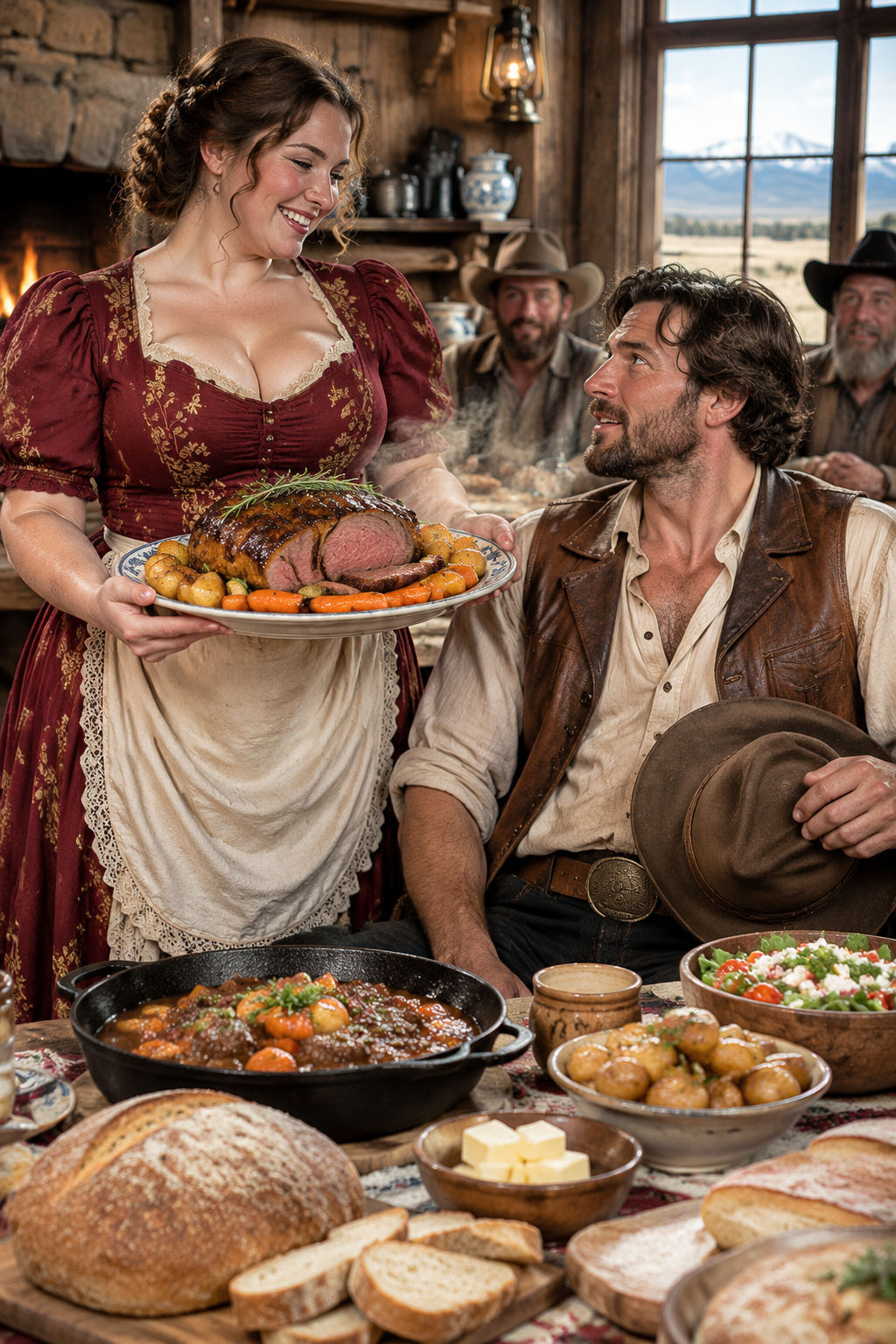
And every Sunday, I cooked enough food to fill the long dining table.
One evening, Wade brought me a small wooden box.
Inside was Daniel’s pocketknife, polished smooth from years of use.
“He would have liked you,” Wade said.
I ran my thumb across the worn handle.
“How do you know?”
“Because you never let me get away with being stubborn.”
I laughed through my tears.
Wade smiled.
“Neither did he.”
Three months later, Sheriff Hayes returned with news that changed everything.
Investigators had obtained testimony from the employee who had arranged the unauthorized saddle work.
He admitted that Whitcomb had ordered him to weaken a fastening on Daniel’s riding equipment.
The employee claimed he believed the intention was to frighten Daniel into abandoning his investigation, not to cause a fatal accident.
But the evidence showed that the alteration had contributed to Daniel’s fall.
Whitcomb and Heller were arrested on charges connected to the fraud scheme, and Whitcomb faced additional charges relating to Daniel’s death.
When Wade heard the news, he did not celebrate.
He walked outside and stood beside the old oak tree where Daniel had carved their initials as children.
I followed him.
He touched the weathered bark.
“All this time, I thought he died hating me.”
I stood beside him.
“He died trying to protect you.”
Wade closed his eyes.
“I wish I’d believed him.”
I took his hand.
“I know.”
There was nothing else to say.
Some grief cannot be repaired by justice.
It can only be carried differently.
The criminal proceedings lasted nearly another year.
Whitcomb’s financial records revealed a network of fraudulent loans involving several ranches across the region.
Heller eventually pleaded guilty to charges related to the forged documents and testified about Whitcomb’s involvement.
Whitcomb was convicted of multiple fraud offenses and of charges arising from the deliberate interference with Daniel’s riding equipment.
The court ordered restitution where recoverable, although several families had already lost properties that could never truly be replaced.
My father’s trust was finally recognized as valid.
The fraudulent deed was canceled, and the land he had intended for me was restored to my name.
When the attorney handed me the official documents, I thought about my father sitting alone in his little house, carrying secrets he believed would protect me.
I wished he had trusted me enough to share them.
But I also understood how fear had shaped his decisions.
He had spent his final years trying to preserve something for a daughter who believed he had nothing left to give.
I drove to the old fishing spot the following morning.
The creek moved quietly beneath the cottonwoods, just as it had when I was a little girl.
Wade came with me but waited near the truck.
I knelt beside the water and opened the letter my father had written.
This time, I read every word without anger.
His warning about Wade had not been an accusation that Wade was dangerous.
He had learned about Heller’s plan to arrange a marriage between the trust beneficiary and the Callahan heir.
He feared Wade might unknowingly sign documents that would surrender my inheritance.
My father had never met Wade.
He had been warning me about the arrangement, not the man.
The distinction made my chest ache.
For so long, I had carried that sentence like a knife between us.
Now I understood that my father had been trying to protect both of us from a deception neither could see.
I folded the letter carefully and placed it back inside my coat.
Then I walked toward Wade.
He held out his hand.
I took it.
“Do you want to keep the land?” he asked.
I looked across the valley.
“Yes.”
He nodded.
“Good.”
“But I want to do something with it.”
Wade waited.
I told him about the families who had lost their ranches through Whitcomb’s fraudulent loans.
Some had received restitution, but others were still struggling.
I wanted to use part of my inheritance to establish a small agricultural assistance fund in my father’s name.
It would help families facing temporary financial hardship obtain independent legal and accounting advice before they lost their homes.
Wade listened carefully.
Then he smiled.
“Your father would be proud.”
I looked at the creek.
“I hope so.”
Wade squeezed my hand.
“Daniel would be, too.”
That spring, we planted two cottonwood trees beside the farmhouse.
One was for Daniel.
The other was for my father.
Earl insisted on helping, although his knees complained the entire afternoon.
The ranch hands gathered around with shovels, laughter, and enough unsolicited advice to make the task take twice as long.
When we finished, Wade stood between the young trees and looked toward the house.
For the first time, he seemed to see the ranch not as a place haunted by everything he had lost, but as a home that could still hold happiness.
That evening, I found him in the dining room, studying the long wooden table.
“Something wrong?” I asked.
He shook his head.
“I was thinking about Daniel.”
I waited.
“He always said this room was too big for just our family.”
Wade smiled faintly.
“He wanted us to invite the neighbors every Sunday.”
I looked around the room.
“Then perhaps we should.”
And we did.
By summer, Sunday supper had become a tradition that stretched beyond the ranch hands.
Neighbors came with casseroles, fresh bread, and children who chased each other through the yard.
Earl brought his widowed sister.
The schoolteacher from town arrived with her elderly mother.
Families who had once avoided the Callahan property began filling the house with conversation.
Sometimes I caught Wade standing quietly in the doorway, watching everyone laugh.
But now, instead of walking away, he pulled out a chair and joined them.
One Sunday, after the guests had gone, Wade asked me to meet him beneath the two young cottonwoods.
The evening sky glowed pink above the pasture.
He stood there wearing the same worn boots and faded shirt he had worn on our wedding day.
In his hands was a small velvet box.
My heart began beating so hard I could barely breathe.
Wade looked nervous.
“I’ve been trying to figure out how to say this.”
I smiled.
“That would be a first.”
He laughed softly.
Then his expression grew serious.
“When I married you, I thought I was making a business arrangement.”
I remembered the cold office, the signed contract, and the silence during our drive back to the ranch.
“I know.”
“I thought I had nothing left to give anyone.”
His voice trembled.
“Then you walked into my house and started opening doors I’d spent a year keeping closed.”
Tears filled my eyes.
“You made me angry because you reminded me what living felt like.”
He opened the box.
Inside was a simple gold ring with a tiny engraved cottonwood leaf.
“I don’t want our marriage to be something arranged by a man who tried to steal from us.”
Wade took my hand.
“I want it to be something we choose.”
I could barely speak.
“Nora Bennett Callahan, would you marry me again, this time because we love each other?”
I laughed and cried at once.
“Yes.”
He slipped the ring onto my finger, then pulled me into his arms.
Behind us, the farmhouse windows glowed warmly against the approaching dusk.
I thought about the woman who had arrived there months earlier, carrying one suitcase and believing she had nothing worth keeping.
She had been wrong.
I had inherited land, yes, but I had also discovered something no document could measure.
A family could be built from people willing to tell the truth, admit their mistakes, and make room for one another.
We renewed our vows beneath the cottonwoods that autumn.
There were no expensive decorations or elaborate speeches.
Earl stood beside Wade, wearing a jacket he complained was too tight.
The ranch hands lined the fence, grinning like schoolboys.
And when Wade promised to love me through whatever storms came next, I believed him.
Not because he had become perfect.
But because I had watched him face the worst parts of himself and choose to become better.
After the ceremony, we gathered around the dining table.
Wade placed Daniel’s photograph near the window, beside a small framed picture of my father.
Then he raised his glass.
“To the people who should have been here.”
The room grew quiet.
“And to the people who helped us find our way back.”
I looked around at the faces gathered beneath the warm lights.
For years, I had believed that a home was something you owned.
Now I understood it was something you made.
A home was Earl laughing over burnt biscuits.
It was muddy boots by the kitchen door.
It was a husband reaching for your hand when the memories became too heavy.
And sometimes, it was an empty chair that no longer meant loneliness because the love behind it had finally been allowed to remain.
Later that night, after everyone had gone, Wade and I stood together on the porch.
The stars stretched across the Wyoming sky, brighter than I had ever seen them.
He wrapped his arm around my shoulders.
“Do you ever regret coming here?”
I leaned against him.
I thought about the bread he had thrown onto the floor, the cold marriage contract, and the terrible secrets buried beneath the ranch.
Then I remembered the first time he had taken my hand at supper.
The first time he had cried in my arms.
The first time the house had filled with laughter.
“No,” I whispered.
“Not even the beginning?”
I looked up at him.
“Especially not the beginning.”
He frowned.
“Why?”
“Because it taught us something.”
I turned toward the windows, where the dining room lights were still glowing.
“Love isn’t always the thing that brings people together, Wade. Sometimes it’s what they build after everything else falls apart.”
He kissed my forehead.
We stood there until the night grew cold, listening to the distant cattle and the gentle rustling of the young cottonwoods.
And for the first time in years, the Callahan ranch felt peaceful.
Not because the past had been forgotten.
Not because justice had erased every wound.
But because the truth had finally been given a place at our table.
The next morning, I found Wade in the kitchen preparing two cups of coffee.
For a moment, my heart tightened at the familiar sight.
Then he turned toward me and handed me one.
“Morning, Mrs. Callahan.”
I smiled.
“Morning, husband.”
He pulled out the chair beside him.
Daniel’s old cup still rested on the shelf above the stove, clean and carefully preserved.
Wade glanced toward it, then back at me.
“I think he’d be happy.”
I sat beside him.
“I think he would.”
Outside, sunlight spread across the pasture, touching the fence posts, the barns, and the two young trees growing beside the house.
I had come to that ranch because I needed somewhere to survive.
I stayed because we had made somewhere worth living.
And whenever someone asked how a marriage that began without love could become the happiest part of my life, I remembered the lesson Daniel, my father, and Wade had taught me.
The truth may break your heart before it sets you free, but the people who love you enough to face it beside you are the ones who turn a house into a home.
THE END.