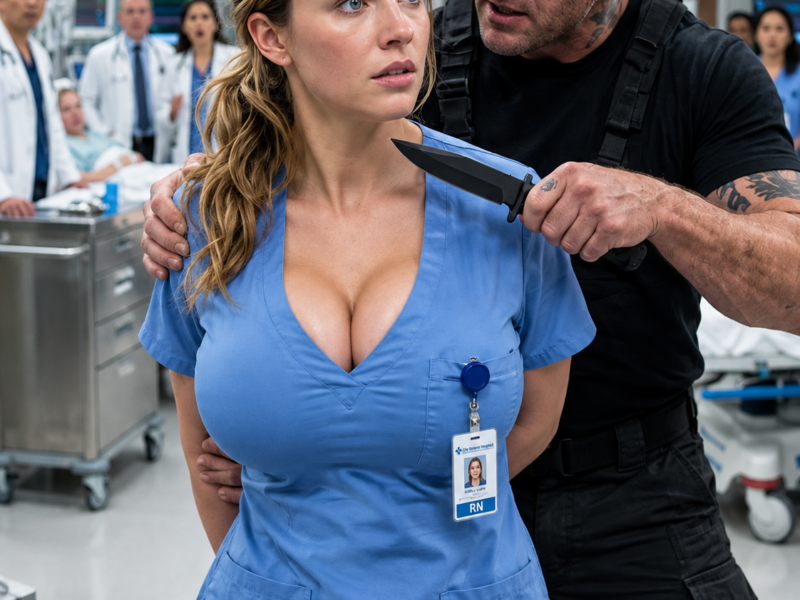
“With a gunman standing outside the pediatric ward at Mercy General in Denver, my attending physician ordered me to hide behind the nurses’ station
The voice on the radio repeated my name.
“Emily, listen to me. You have less than four minutes before they reach the pediatric ward.”
I pressed the transmit button so hard my finger hurt.
“Identify yourself.”
A burst of static answered me, followed by a breath I recognized immediately.
“It’s Daniel.”
For three years, I had dreamed about hearing that voice again. In every dream, Daniel Mercer was standing somewhere I couldn’t reach, calling for help while gunfire swallowed his words.
I had watched him disappear behind a wall of smoke during a mission in Syria. I had heard the explosion. I had seen the official report declaring him dead.
Now he was speaking through my hospital radio.
“Daniel,” I whispered. “That’s impossible.”
“I’m sorry, Em.”
The armed man at the end of the corridor tilted his head, studying me.
“Touching reunion,” he said. “But he’s lying to you.”
I kept my eyes on him.
“Why are you here?”
“Because someone decided the past should stay buried, and you were the one person who walked away.”
His rifle remained pointed toward the floor, but his finger rested close to the trigger.
“What’s your name?” I asked.
He smiled without warmth.
“You used to call me Bishop.”
The name struck a place in my memory I had spent years trying to seal off.
Bishop had been our team’s communications specialist, a lean, quiet man who could make an entire operation disappear from the official record with a few keystrokes. He had been declared missing after the same mission that supposedly killed Daniel.
I remembered Bishop sitting across from me in a transport aircraft, turning a wedding ring around his finger while he talked about his daughter.
I remembered that ring because he had told us he never took it off.
The man in front of me wore one.
“Put the rifle down,” I said.
He gave a short laugh.
“You haven’t changed much.”
“Neither have you.”
“That’s where you’re wrong.”
His gaze moved beyond me toward the pediatric ward.
“There’s a little girl in this hospital. Six years old. Her name is Sophie Vale. Do you know why she’s here?”
I didn’t answer.
“Because her father stole something that doesn’t belong to him. Something powerful people would rather kill a hospital full of innocent people than let the world see.”
My stomach tightened.
Sophie had been admitted two days earlier after a car accident outside Denver. Her father, Michael Vale, had died at the scene. The little girl had suffered a fractured wrist and a concussion, but she was recovering.
I’d checked on her that afternoon.
She had asked whether her father would be waiting when she woke up.
I had sat beside her bed and told her the truth as gently as I could.
Now a man with a rifle was telling me that her presence had brought an armed attack to our hospital.
“She’s a child,” I said.
“She’s a witness.”
“To what?”
Bishop glanced toward the ceiling as another alarm sounded.
“Ask Daniel.”
The radio crackled.
“Emily, don’t let him take her,” Daniel said. “And whatever he tells you about Michael Vale, don’t believe him.”
Bishop’s expression hardened.
“See? That’s his problem. He always thinks he can make everyone else carry the consequences of his choices.”
I had heard enough.
I raised the radio again.
“Daniel, where are you?”
“Outside the west service entrance. I came in with the first response team, but the building’s communications are compromised. I’m trying to reach you through an old emergency frequency.”
“Why should I trust you?”
The silence that followed hurt more than I expected.
“Because I should have come back for you.”
Before I could answer, a gunshot cracked from somewhere behind Bishop.
He turned instinctively.
I moved.
I shoved a rolling supply cart across the corridor and dropped behind the concrete corner as bullets tore through a cabinet above me. Metal trays clattered to the floor.
Bishop disappeared into the smoke and red emergency light.
I crawled toward the nurses’ station, keeping low until I reached the cluster of staff and patients.
Dr. Hayes was crouched beside a frightened nursing assistant, one hand pressed against a patient’s shoulder.
When he saw me, anger flashed across his face.
“Are you out of your mind?”
“Probably,” I said. “But I need you to listen.”
I told him about Sophie, the armed men, and the possibility that someone was targeting a child in our care.
His face changed when I mentioned the west service entrance.
“That’s where the backup generator controls are.”
“Can you get the patients moved to the inner recovery rooms?”
“I can try.”
“Don’t try. Do it.”
He stared at me for a beat, perhaps recognizing that the quiet nurse he had been ordering around for three months had vanished.
Then he nodded.
“Come back alive, Carter.”
I almost smiled.
“That’s the plan, Doctor.”
I found Noah’s mother near the pediatric ward, crying as she searched for her son. She had been separated from him when the shooting started, and a security officer had helped move him into a small treatment room.
I guided her there, checked that the door was secure, and knelt beside Noah.
He clutched his blue elephant against his chest.
“Are the bad guys coming in here?” he whispered.
I looked at his frightened face and felt the familiar weight of a promise.
“Not if I can help it.”
His mother grabbed my hand.
“Please don’t leave us.”
I wanted to stay. Every instinct that had brought me into nursing told me that these were the people who needed me most.
But somewhere in this building, a little girl was being hunted because her father had apparently discovered something worth killing for.
And I knew what happened when good people waited for someone else to make the first move.
I took the hospital radio and headed for Sophie’s room.
The corridor outside her room was empty.
Her bed stood beneath a dim emergency light, the blankets pulled back, an IV line dangling from the rail.
A small paper cup sat on the bedside table.
Sophie was gone.
For a second, I couldn’t make sense of what I was seeing. She was six years old, recovering from a concussion, and barely able to walk without help.
Then I noticed the window.
It hadn’t been broken. It hadn’t even been opened.
But the security panel beside the door showed that her room had been unlocked using an employee access card.
Someone inside Mercy General had helped take her.
I looked at the digital access record.
The card belonged to Dr. Richard Hayes.
Behind me, a voice said, “I told you not to trust anyone.”
I turned so quickly that my shoulder struck the doorframe.
Daniel stood at the far end of the corridor, wearing a dark jacket over a tactical vest. His face was thinner than I remembered, and a pale scar ran from his hairline to his left eyebrow.
But his eyes were the same.
For a moment, I was twenty-six again, standing in the dust and smoke of a ruined building, listening to him promise that we’d all make it home.
Then the memory broke.
“You’re alive,” I said.
He nodded once.
“I’m sorry.”
I wanted to hit him. I wanted to grab him. I wanted to demand three years of explanations before allowing him to take another breath.
Instead, I held up the access record.
“Why does Hayes’s card show up on Sophie’s door?”
Daniel glanced at the screen.
“Because someone is framing him.”
“You expect me to accept that without an explanation?”
“No.” His voice softened. “I expect you to make your own decision. That’s what I should have let you do three years ago.”
A distant burst of gunfire cut through the hallway.
Daniel checked the corridor behind him.
“We have to move.”
“Not until you tell me what happened in Syria.”
He looked at me, and for the first time since he’d appeared, I saw fear in his face.
“Michael Vale wasn’t a civilian engineer who accidentally stole a file. He was working with a defense contractor that built a system capable of overriding secure military communications. The system could falsify orders, erase recordings, and make an entire unit appear to have committed acts it never committed.”
My mouth went dry.
“Our mission was supposed to recover the system and bring Vale in for questioning,” he continued. “But our orders changed halfway through. We were told to eliminate the target and destroy everything in the building.”
“Who changed the orders?”
“Someone using command authentication codes that belonged to our own unit.”
I remembered the radio traffic from that night, the conflicting instructions, the voice insisting that we abandon the eastern exit.
We had followed those orders.
We had walked into an ambush.
“Why didn’t you tell anyone?”
“I tried. The reports were altered before I could submit them. By the time I understood what had happened, Bishop had disappeared, two members of our team were dead, and I was being blamed for the operation.”
“You were declared dead.”
“Because the people hunting me had access to the same system. I survived the explosion, but I couldn’t prove who had set us up. Every time I contacted someone I trusted, they were either compromised or disappeared.”
“And you let me believe you were dead.”
His jaw tightened.
“I thought keeping you away from me was the only way to keep you alive.”
“You don’t get to make that choice for me.”
“I know.”
His answer was so quiet that it left me with nothing to fight against.
Then he added, “Michael Vale contacted me six weeks ago. He said he’d found evidence connecting the attack on our unit to a private intelligence network operating inside the government. He wanted to hand it over to someone who could expose it.”
“And Sophie?”
“His daughter. He hid a copy of the evidence where only she would know how to find it.”
I stared at him.
“She is six.”
“Her father used a story and a set of pictures to teach her how to recognize the hiding place. He never intended her to be involved in any of this.”
A bitter taste rose in my mouth.
“So her father died trying to protect her, and now armed men are tearing through a hospital to find something he left behind.”
Daniel nodded.
“And someone inside this building is helping them.”
I looked again at Hayes’s access record.
I had spent three months watching that man dismiss junior staff, snap at frightened patients, and pretend that compassion was a weakness. I had never once imagined him helping armed strangers abduct a child.
But I had also learned that evidence could be manipulated.
“Where would they take her?” I asked.
Daniel’s expression changed.
“There’s an underground loading area beneath the old surgical wing. It connects to the service tunnels.”
“Why didn’t security mention it?”
“Because the public plans don’t show it.”
He reached into his jacket and pulled out a small folded map.
I recognized the building layout immediately. Mercy General had expanded over an older medical facility, and several service corridors had been sealed during renovations.
One passage ran directly beneath the pediatric ward.
“You knew about this hospital before tonight,” I said.
“I knew Vale was receiving treatment here. I didn’t know the attack would happen tonight.”
“Then why were you here?”
“Because I received a message from Michael’s contact saying Sophie was in danger.”
“From whom?”
He hesitated.
That hesitation was enough.
“Daniel.”
“I can’t give you a name until I know whether the channel is secure.”
I stepped closer.
“You don’t get to disappear for three years, walk into my hospital during an attack, and start deciding what information I’m allowed to know.”
He looked down at the radio in my hand.
“You’re right.”
He pulled a small data drive from an inner pocket.
“This is a copy of the evidence Michael sent me. The original is supposed to be with Sophie.”
I took the drive but didn’t put it in my pocket.
“What’s on it?”
“Fragments of the original orders. Audio recordings. Payment records. And one file I haven’t been able to open.”
“Why bring it here?”
“Because the person who sent me the message said Michael’s daughter was the only person who could authenticate the original recording.”
Before I could ask another question, the emergency lights went out again.
This time, they didn’t return.
A hand closed around my arm.
I turned, ready to strike, but Daniel whispered, “Down.”
We dropped behind a supply cabinet as footsteps approached from the stairwell.
Two men passed the doorway.
One wore tactical gear. The other wore a white hospital coat.
The man in the coat spoke quietly.
“She’s in the lower corridor. The doctor has her.”
My skin went cold.
“Hayes,” I whispered.
Daniel shook his head.
“Could be.”
The men moved on.
I waited until their footsteps faded before standing.
“I’m going after Sophie.”
“I’m coming with you.”
“No. You find a way to restore communications and get the police inside. If the people behind this can manipulate official orders, I want someone outside this building who isn’t relying on their network.”
He studied me.
“You sound like your old self.”
“I was never a different person.”
For a moment, something like pride crossed his face.
Then he nodded.
“Take the western stairwell. There’s a maintenance door at the bottom. It should lead to the old surgical wing.”
“And Daniel?”
He stopped.
“If you’re lying to me about any of this, I’ll find out.”
“I know.”
He disappeared toward the emergency operations room, and I headed for the stairs.
The lower level smelled of damp concrete and old disinfectant. Pipes ran along the ceiling, and the emergency lighting had been reduced to a few battery-powered fixtures.
I followed the maintenance corridor until I heard a child crying.
“Daddy said someone would come,” a small voice whispered.
I stopped outside a half-open door.
Inside, Sophie sat on a wooden chair with her injured wrist wrapped against her chest. Dr. Hayes stood beside her, pale and sweating. A man in tactical clothing watched the doorway.
Hayes held both hands up.
“I told you I’d bring her down here. I did what you asked. Let the other patients go.”
The armed man laughed.
“You’re in no position to negotiate.”
“You said nobody would get hurt.”
“I said you wouldn’t get hurt.”
Hayes flinched.
The man turned toward Sophie.
“Now, sweetheart. Your father gave you something before he died. We need you to tell us where it is.”
Sophie shook her head, tears slipping down her cheeks.
“I don’t know.”
“Think carefully.”
“He told me to remember the pictures.”
The man’s expression sharpened.
“What pictures?”
Sophie squeezed her eyes shut.
“The ones with the lighthouse.”
I felt a chill travel down my spine.
The man took a step toward her.
“Where is the lighthouse?”
“I don’t know. Daddy said it was a game.”
The man grabbed the back of her chair.
I moved before I could think.
I stepped into the doorway.
“Take your hand off her.”
All three turned.
Hayes stared at me as if he had seen a ghost.
“Carter, get out of here!”
The armed man lifted his rifle.
“You really do have a talent for showing up where you’re not wanted.”
“Funny,” I said. “I was about to say the same thing.”
He pointed toward the floor.
“Hands where I can see them.”
I raised my hands slowly.
Sophie was crying too hard to speak.
I kept my eyes on the gunman and my voice calm.
“She’s a child. Whatever you think she knows, she isn’t going to tell you anything while you’re pointing a weapon at her.”
“Then perhaps I should point it at you.”
“Perhaps.”
I took one slow step forward.
“You have an injured girl, a frightened doctor, and a hospital full of witnesses. Whatever your employers promised you, this isn’t going to end the way you think.”
He smiled.
“You still believe people care about witnesses.”
That sentence told me more than his weapon had.
He wasn’t a desperate man improvising under pressure. He believed he had protection. He believed someone powerful would erase the consequences.
I’d met men like him before.
I needed him to keep talking.
“Who sent you?” I asked.
He laughed.
“You’re still asking the wrong questions, Wraith.”
The room seemed to shrink around me.
Hayes looked from him to me.
“Wraith?”
I ignored him.
“Then give me the right question.”
The gunman leaned closer.
“Ask yourself why your own government buried the mission that killed your team.”
My breath caught, but I kept my expression still.
“Because someone wanted the truth hidden.”
“Closer.”
“Who?”
He glanced toward Hayes.
“Ask your doctor friend. He knows more than he admits.”
Hayes shook his head violently.
“I don’t know what he’s talking about.”
The gunman turned back to me.
“Of course you don’t. That’s why they made you the perfect scapegoat.”
I felt the old anger rising, hot and immediate. I forced it down.
“Let Sophie go, and we can talk.”
“No.”
“Then you’re not interested in the truth. You’re interested in silencing a witness.”
His smile disappeared.
For the first time, I had reached him.
He raised the rifle.
I moved sideways as the shot struck the metal cabinet behind me. The sound filled the small room, and Sophie screamed.
I lunged for his weapon, caught the barrel, and forced it away from the child. We crashed into the table. His elbow struck my cheek, and white light burst across my vision.
He was stronger than I expected.
But I knew how to use the narrow space, the furniture, the split second when someone believed they had already won.
I drove my shoulder into his chest and twisted the rifle away from Sophie’s chair. It hit the floor and slid beneath a cabinet.
He struck me across the face.
I tasted blood.
Then Hayes grabbed a metal tray and swung it into the man’s arm.
The gunman staggered.
“Get the girl!” Hayes shouted.
I pulled Sophie from the chair and moved behind the concrete support column as the man recovered.
“There’s a service door,” Hayes said, pointing toward the rear wall. “It leads to the old laundry corridor.”
“Come with us.”
He shook his head.
“I have to stop him.”
“You’re unarmed.”
“I know.”
There was something in his face I hadn’t seen before. Not courage, exactly. Shame.
I took Sophie through the door.
We had barely reached the corridor when another gunshot sounded behind us.
I stopped.
“Dr. Hayes!”
No answer.
Sophie clutched my hand.
“Please don’t leave me.”
I looked at the child beside me and forced myself to keep moving.
The laundry corridor ended at a steel door with a manual release. I pulled the handle, but it wouldn’t move.
A red light glowed above the lock.
The door had been sealed remotely.
Someone was still controlling the hospital’s security system.
I checked the access panel. Its screen flickered, displaying a series of failed authentication attempts.
Then a new message appeared.
**WRAITH: RETURN THE DRIVE, AND THE CHILD LIVES.**
Sophie stared at the screen.
“That’s my daddy’s game,” she whispered.
I turned toward her.
“What do you mean?”
She wiped her face with her sleeve.
“Daddy used to make pictures with secret words. He said if I ever got lost, I should look for the little lighthouse.”
I knelt beside her.
“Do you remember what he told you about it?”
She nodded uncertainly.
“He said the lighthouse was where the truth stayed safe.”
“Where did you see it?”
She pointed toward the ceiling.
“In the pictures on my hospital room wall.”
I remembered the drawings taped beside her bed: a blue ocean, a yellow sun, and a white lighthouse with a tiny red door.
Her father had given them to her before the accident.
“Did he tell you anything else?”
Sophie bit her lip.
“He said if bad people came, I should remember the number under the lighthouse.”
I closed my eyes for a moment.
The drawings were back upstairs, in the room where Sophie had been staying. If the number mattered, we needed to reach them.
But first, we needed to get out of the corridor.
I pulled the data drive from my pocket and looked at it.
The message on the access panel changed.
**THIRTY SECONDS.**
A loud metallic click sounded inside the door.
The lock was preparing to release.
I stepped between Sophie and the doorway.
“Stay behind me.”
The door opened.
Bishop stood on the other side.
His rifle was gone, but he held a pistol in one hand. Blood darkened the sleeve of his jacket.
Behind him stood Dr. Hayes, alive but with his hands bound.
Bishop looked at the drive in my hand.
“Give it to me.”
“No.”
His eyes moved to Sophie.
“You’re making this difficult for everyone.”
“She is six years old.”
“And her father made her the key to a very dangerous secret.”
Hayes’s voice came from behind him.
“Emily, don’t hand him the drive.”
Bishop struck him across the face.
I tightened my grip on the data drive.
“Why do you need it if you’ve already taken Sophie?”
“Because the drive contains the evidence that can destroy the people who paid for this operation.”
“Then why not destroy it?”
“Because I don’t work for the people you think I work for.”
He held out his free hand.
“I work for the people who want the truth to survive.”
I stared at him.
“You broke into a hospital with armed men. You abducted a child. You shot at medical staff.”
“I did what I had to do.”
“That’s what every man says when he wants someone else to forgive him.”
For a moment, his expression softened.
Then it hardened again.
“You have no idea what happened in Syria.”
“I was there.”
“You were given a story. So was I.”
He looked at the data drive.
“Michael Vale was not the only person who discovered the system. Three years ago, your unit was sent to recover a prototype. The prototype was already gone. The orders to kill Vale’s contact came from someone inside your command.”
“I know.”
“No, you know what Daniel told you. You don’t know who authorized it.”
He leaned closer.
“Your mission commander was General Thomas Reed.”
The name landed like a physical blow.
Reed had personally approved my transfer out of the unit. He had attended the memorial service for the two teammates we lost. He had shaken my hand and told me I had done everything I could.
He had looked me in the eye and called me a survivor.
“You’re lying,” I said.
“Then open the file.”
He nodded toward the drive.
“Everything you need is there. But the file won’t open without the original key, and the original key is hidden in Sophie’s drawings.”
I glanced at Sophie.
She was staring at Bishop with the rigid, exhausted fear of a child who had been forced to listen to adults talk about things she couldn’t understand.
“Why not take the drawings yourself?”
“Because I don’t know which one contains the key.”
“You expect me to believe you broke into a hospital and endangered dozens of people because you couldn’t find a picture?”
“I expect you to understand that someone else has been pulling the strings from the beginning.”
A new voice came from the corridor behind him.
“That’s enough, Bishop.”
Daniel stepped into view, holding his weapon low but ready.
Bishop’s face twisted.
“You always did arrive late.”
Daniel ignored him and looked at me.
“Emily, get Sophie behind the door.”
I moved the girl behind me.
Bishop raised his pistol toward Daniel.
“You should have stayed dead.”
Daniel’s expression didn’t change.
“You should have stayed missing.”
For several seconds, neither man moved.
Then Bishop lowered the weapon a fraction.
“I have proof, Mercer. The original orders. The authorization records. The names of everyone involved.”
“Then put the gun down and show us.”
“And let your people take it?”
“I’m not asking you to trust the government.”
Daniel glanced at me.
“I’m asking you to trust her.”
Bishop’s eyes shifted to me.
I could see the conflict in his face. Whatever he had become, some part of the man who once sat across from me in a transport aircraft was still there.
Then he slowly lowered the pistol.
“General Reed is coming,” he said. “He’s been told the evidence is here. If he reaches this building before we expose him, none of us will leave alive.”
Daniel’s jaw tightened.
“How do you know?”
“Because I received the order myself.”
He reached inside his jacket and pulled out a folded sheet of paper.
It was an official transfer authorization, bearing Reed’s signature and a timestamp from less than an hour earlier.
At the bottom was a single line.
**All witnesses and compromised personnel are to be neutralized.**
Hayes stared at the page.
“That’s not a military order.”
“No,” Bishop said. “It’s a murder list.”
I looked at the names.
Daniel Mercer.
Bishop.
Emily Carter.
And, beneath them, Michael Vale.
The final line had been added in handwriting rather than printed text.
Sophie Vale.
I felt the little girl’s hand tighten around mine.
“We’re getting her out,” I said.
Daniel nodded.
“There’s an emergency exit through the old surgical wing. We can reach it if the security system stays down.”
“And the evidence?”
“We take it with us.”
Bishop shook his head.
“If we leave without the original key, the drive is useless.”
Sophie looked up at us.
“The lighthouse.”
We all turned toward her.
She swallowed.
“Daddy said the lighthouse was in the picture with the blue boat. He said the number was the way home.”
I remembered the drawings taped to her hospital wall.
The lighthouse had a tiny red door. Beneath it, barely visible in the corner, was a string of numbers.
I had assumed it was a child’s attempt at writing a phone number.
Now I understood why Michael Vale had made sure his daughter could remember it.
“Where are the pictures?” Daniel asked.
“In my room,” Sophie said.
Bishop glanced toward the stairwell.
“Then we have one chance to get them before Reed arrives.”
We moved together through the laundry corridor, Daniel leading while I kept Sophie close beside me. Bishop followed behind Hayes, who had refused to be left behind after learning his name appeared on the order.
The hospital above us had become a maze of darkness and alarms.
Somewhere in the distance, I heard sirens approaching. Daniel said the emergency frequency had finally reached an outside team, but we couldn’t know whether the incoming responders had received the real orders or a fabricated version.
At the pediatric ward, we found Noah and his mother still inside the treatment room. Hayes helped guide them toward a safer section of the hospital while I returned to Sophie’s room.
The drawings were scattered across the floor.
Someone had searched the room.
I knelt beside the bed, gathering the papers one by one. A picture of a yellow sun. A blue boat. A white lighthouse.
On the lighthouse drawing, beneath the tiny red door, Sophie had written a series of numbers in uneven pencil marks.
She pointed at them.
“That’s it.”
Daniel read the sequence twice.
“It’s not a password,” he said. “It’s a set of coordinates.”
Bishop took the drawing, his face tightening.
“An offshore storage facility.”
“Where?” I asked.
“Near the Virginia coast. A site used by the contractor that built the communications system.”
Daniel looked at the drive.
“The key must be encoded in the original recording stored there.”
I turned to Bishop.
“You said you had proof.”
“I have the authorization records. The original recording is what proves Reed ordered the ambush.”
“Then why didn’t you expose him?”
“Because the file is encrypted, and the people who can decrypt it have spent three years making sure nobody gets close.”
Sophie tugged my sleeve.
“Daddy said the lighthouse was where the truth stayed safe.”
I crouched beside her.
“He wanted someone to find it.”
She nodded, tears welling in her eyes.
“He said if he couldn’t come back, I should remember the pictures. He said there would be a lady who would know what to do.”
My throat tightened.
“Did he tell you who the lady was?”
Sophie shook her head.
“He just said she would be kind.”
For the first time that night, I had to look away.
I had spent years believing my past had made me dangerous, that the best thing I could do was hide it behind a nurse’s badge and never let anyone see the person I used to be.
But Michael Vale had trusted a stranger to protect his daughter.
And that trust had somehow reached me.
A sudden burst of static came from Daniel’s radio.
“Mercer, this is command. Stand down immediately. General Reed has authorized a full lockdown. All personnel are to surrender their weapons and remain in place.”
Daniel looked at me.
The voice sounded official. The identification code was correct.
But the timing was wrong.
Bishop raised his pistol again, this time toward the ceiling.
“That’s Reed’s voice.”
“Can you prove it?” I asked.
“I’ve heard him give orders for twenty years.”
Daniel reached for the radio.
“Command, identify the independent verification phrase.”
The reply came instantly.
“Verification unnecessary. This is a direct order.”
Daniel’s face went hard.
“That’s not how our protocol works.”
The radio crackled again.
“Mercer, you are hereby relieved of command.”
Then the transmission ended.
I looked at the access panel beside the door. The security system was coming back online.
One by one, the corridor lights turned green.
Someone was regaining control.
“Reed is here,” Bishop said.
A loudspeaker clicked on.
A calm, older voice filled the ward.
“This is General Thomas Reed. The armed suspects inside Mercy General are to be considered hostile. Hospital personnel should remain in their assigned areas and await instructions.”
My hands began to tremble.
I had heard that voice at my team’s memorial service. I had heard it in the briefing room before the mission that destroyed our lives.
It was the voice of a man who had taught me that discipline meant following orders even when they hurt.
And now he was using the hospital’s own system to make us the enemy.
Daniel looked toward the stairwell.
“We can’t stay here.”
Hayes stepped beside us.
“There’s a service elevator behind the supply room. It leads to the ambulance bay.”
“Will it work?” I asked.
“If the lockdown hasn’t sealed it.”
Bishop handed me the data drive.
“Take this. If I don’t make it out, get it to someone who can publish the evidence.”
I stared at him.
“Why should I trust you now?”
His expression was tired.
“You shouldn’t. Not completely.”
For the first time, he sounded like the man I remembered.
“But you can trust what the evidence proves.”
We moved toward the service elevator.
Halfway there, the lights flickered, and a group of armed men appeared at the far end of the corridor.
Daniel pushed Sophie and me behind the wall.
Bishop stepped into the open, raised his hands, and shouted, “Don’t shoot! I have the evidence!”
The men hesitated.
Then a shot rang out.
Bishop fell.
Daniel fired back, forcing the men behind a corner, and Hayes pulled me toward the elevator.
I caught Bishop’s hand as we passed him.
He was still breathing, his eyes fixed on the ceiling.
“Tell my daughter,” he whispered.
I leaned closer.
“Tell her what?”
He tried to speak, but blood filled his mouth.
Then his fingers went slack.
Daniel pulled me away before the gunmen could return.
The elevator doors opened, and we pushed inside with Sophie and Hayes.
As the doors closed, I looked at the data drive in my hand.
Bishop had spent three years running from the truth. Whatever else he had done, he had chosen to die trying to keep it alive.
I didn’t know whether that made him a good man.
I only knew I wasn’t going to let his last choice be wasted.
The elevator shuddered as it descended.
Daniel stood beside me, his face pale under the emergency lights.
“Emily, when we get outside, you need to understand something.”
“Not now.”
“It’s about the mission.”
I looked at him.
“Then it can wait until we’re somewhere safe.”
He nodded, accepting the boundary without argument.
The elevator stopped.
The doors opened onto the ambulance bay, where rain blew through the open loading doors. Sirens wailed outside, and red-and-blue lights flashed across the wet concrete.
Two police officers stood near the entrance with their weapons raised.
“Hands up! Step away from the child!”
Daniel lifted his hands.
“She’s a civilian. We have evidence of an armed attack and an attempted abduction.”
One officer shouted into his radio.
“Command says these suspects are armed and wanted.”
I stepped forward, keeping my hands visible.
“My name is Emily Carter. I’m a registered nurse at Mercy General. There are injured patients inside, and the people responsible are using the hospital’s security system to impersonate emergency command.”
The officers exchanged a glance.
Then a third voice came from behind them.
“Stand down.”
General Thomas Reed walked into the ambulance bay wearing a dark overcoat, flanked by two men in plain clothes.
He looked older than I remembered, his silver hair neatly combed, his expression composed.
For a moment, I saw the man who had pinned a medal to my uniform and told me I had served with honor.
Then his gaze settled on me.
“Emily,” he said. “You’ve caused enough trouble.”
Daniel stepped between us.
“It’s over, General.”
Reed looked at him with something close to pity.
“You should have stayed dead, Mercer.”
“You should have told the truth.”
Reed sighed as if we were disappointing children.
“You have no idea how many lives were protected by the decisions I made.”
I held up the data drive.
“Then you won’t mind explaining them.”
His eyes fixed on it.
For the first time, his composure slipped.
“Give me the drive, Emily.”
“No.”
He turned toward the officers.
“These people are compromised. They have stolen classified material and endangered hospital personnel.”
I could see the officers struggling to reconcile his authority with the chaos they had witnessed.
Then Hayes stepped forward.
“I saw his men abduct a child. I heard them threaten to kill witnesses. I have the access logs showing that someone used my credentials to unlock her room.”
Reed barely glanced at him.
“Doctor, you are frightened and confused.”
“No,” Hayes said. His voice shook, but he held his ground. “I’m finally paying attention.”
I pulled out the drawing Sophie had given me.
“The evidence is on this drive, but the key is stored elsewhere. If you want it destroyed, you’ll have to explain why.”
Reed’s gaze flicked to Sophie.
She hid behind my leg.
Something in his face changed when he saw her.
Not anger.
Recognition.
“You shouldn’t have brought the child into this,” he said.
I felt the last piece settle into place.
“You knew her father.”
Reed said nothing.
“You knew Michael Vale was trying to expose the system.”
His silence answered me.
Daniel took a step forward.
“You ordered our team to kill him.”
“I ordered the recovery of a classified asset.”
“You changed the mission orders after we were deployed.”
“I prevented a national security disaster.”
“You killed two of our people.”
Reed’s jaw tightened.
“Your team was operating in a hostile environment. Casualties were inevitable.”
I looked at the officers.
“That’s the same excuse he used three years ago.”
Reed turned on me.
“You were a good soldier, Emily. You followed orders. You understood that the world isn’t divided into good people and bad people.”
“Then why did you need to erase the records?”
For the first time, he had no immediate answer.
Daniel took the drawing from my hand and held it up.
“The coordinates lead to the original recording. We don’t need to open it here. We need independent investigators, a secure evidence chain, and witnesses who aren’t under your command.”
Reed’s face grew cold.
“You think anyone will believe you over me?”
I looked at the armed men beside him.
Then I looked at the police officers, the hospital staff gathering near the entrance, and Sophie, who had lost her father and been hunted through the place where she was supposed to be safe.
“Maybe not tonight,” I said. “But they’ll hear the recording.”
Reed took a step toward me.
One of the officers moved to block him.
“General, stay where you are.”
Reed stared at the officer in disbelief.
“You are obstructing a lawful military operation.”
“I’m a Denver police officer,” the man replied. “This is a hospital. You can explain your operation to the people investigating the shooting.”
For a moment, nobody moved.
Then another officer approached from the ambulance entrance.
“Dispatch has confirmed multiple unauthorized transmissions. The hospital security logs are being preserved, and federal investigators are on their way.”
Reed looked from one officer to the other.
His expression remained controlled, but I saw the calculation behind his eyes. He was searching for another order, another credential, another person who would accept his version of events without asking questions.
For the first time in three years, he couldn’t find one.
The officers took him into custody pending an investigation into the attack and the falsified orders. His two escorts surrendered their weapons.
It wasn’t justice yet.
But it was the first time I had seen him lose control of a room.
As the paramedics checked Sophie, I stepped away from the crowd and leaned against the ambulance.
My hands were shaking so badly that I had to press them against the cold metal.
Daniel came to stand beside me.
“I’m sorry,” he said again.
I watched the rain wash blood from the concrete near the loading bay.
“You don’t get to fix three years with two words.”
“I know.”
“Do you understand what it was like to bury you without a body? To read a report saying you had died because of a decision you made?”
He looked down.
“I thought if I stayed away, you’d have a chance to live without looking over your shoulder.”
“I was looking over my shoulder anyway.”
His face tightened.
“I should have trusted you with the truth.”
“Yes,” I said. “You should have.”
He didn’t defend himself. He didn’t tell me he had done it for my own good.
That mattered more than an apology.
A paramedic approached with Sophie wrapped in a blanket. She had been examined and appeared physically stable, though she was exhausted and frightened.
She reached for my hand.
“Are you going to leave?”
I crouched beside her.
“Not until I know you’re safe.”
“Daddy said the lady would know what to do.”
My eyes burned.
“I don’t know everything, sweetheart.”
She considered that.
“That’s okay. You came anyway.”
I pulled her into a careful hug, mindful of her injured wrist.
For the first time that night, I let myself cry.
The investigation lasted eleven months.
The original recording was recovered from the offshore storage facility using the coordinates and the authentication sequence hidden in Michael Vale’s drawings. Independent forensic experts verified the audio against surviving communications records and established that the mission orders had been altered after deployment.
The evidence linked Reed to the operation and to a network of contractors who had used the communications system to falsify orders, conceal illegal missions, and eliminate people who threatened their business.
Bishop’s records helped investigators trace the payments. His daughter received the message he had asked me to deliver, along with an explanation of why her father had died trying to expose the truth.
Dr. Hayes testified about the hospital attack and admitted that he had once accepted an anonymous warning to keep quiet about irregular security access at Mercy General. He had not known who was behind it, but he had ignored signs that should have prompted him to speak up.
He apologized to the staff he had endangered and stepped away from his leadership role while the hospital reviewed its security procedures.
It was the first time I had heard him apologize without adding an excuse.
Daniel testified too.
He told investigators what he knew, including the parts that made him look foolish, frightened, and wrong. Rebuilding his life was not as simple as proving he had been framed. He had spent three years surviving under a false identity, and trust didn’t return just because a file had finally been opened.
Neither did it return between us overnight.
We spoke cautiously at first, sometimes for ten minutes, sometimes for an entire afternoon. I told him what his absence had done to me. He listened without asking me to make it easier for him.
Slowly, I stopped seeing the man who had disappeared and began seeing the man who had returned.
Sophie went to live with her aunt in Oregon. Before she left Denver, she gave me the lighthouse drawing.
“I don’t need it anymore,” she said. “I know where home is.”
I framed it and hung it in my apartment.
Not because it reminded me of the attack, but because it reminded me of a little girl who had been terrified and still remembered what her father had asked her to do.
I stayed at Mercy General.
Some coworkers treated me differently after the truth about my military past became public. A few were curious. Others were uncomfortable. I answered what I could and refused to turn the worst years of my life into a story for the break room.
Dr. Hayes eventually returned to patient care, no longer as the man who had all the answers but as a physician willing to ask questions.
One evening, several months after the investigation began, I found him sitting alone outside the pediatric ward.
“Carter,” he said.
“Doctor.”
He glanced at the framed drawing I had brought in to show the staff before taking it home again.
“I owe you an apology.”
“You do.”
He nodded, accepting the blunt answer.
“I thought being in charge meant never showing uncertainty. I treated your questions as challenges because I was afraid of looking weak.”
I sat beside him.
“Being afraid doesn’t make you a bad person. What you do with it matters.”
He stared at the floor for a while.
“I nearly let that little girl die.”
“But you helped us get her out.”
“After I helped put her in danger.”
“Yes.”
He took a slow breath.
“I don’t expect you to forgive me.”
“Good,” I said. “Because forgiveness isn’t a receipt you get for finally admitting what you did.”
He gave a small, tired smile.
“Fair enough.”
When I returned to the pediatric ward, Noah was there for a follow-up appointment with his mother. His dinosaur bandage had been replaced with a small scar near his hairline, and he was proudly showing a nurse a drawing of a rocket ship.
He recognized me immediately.
“Hey! You’re the sticker nurse!”
I laughed.
“I thought I was the rookie.”
“Nope,” he said. “You’re the brave one.”
His mother looked embarrassed.
“He’s been telling everyone that since the night of the attack.”
I knelt beside him and handed him a gold star sticker.
“Being brave doesn’t mean you aren’t scared.”
Noah thought about that.
“Then I was brave too.”
“You were.”
He stuck the star on his shirt and ran back to his mother.
I watched them walk toward the elevator, then turned toward the nurses’ station.
For years, I had believed the only way to survive my past was to bury it so deeply that no one could ever use it against me. I thought becoming a nurse meant becoming someone entirely different, someone untouched by the things I had done and the things I had lost.
But the woman who had walked into that dark corridor was not a stranger to me.
She was the same woman who had carried wounded teammates through smoke, who had made a terrible decision under impossible pressure, and who had spent years wondering whether she deserved a quieter life.
She was also the woman who had knelt beside a frightened child and promised to stay.
I still have nightmares about Syria sometimes. I still hear the alarms from Mercy General when the hospital is unusually quiet. And there are mornings when I wake before dawn, convinced I have missed a signal that could cost someone their life.
Healing has not been a straight road.
But I no longer believe that my past disqualifies me from the future I chose.
Daniel and I are still finding our way toward something neither of us is ready to name. We have learned to tell each other the truth even when it is uncomfortable, and to leave room for the answers we don’t yet have.
Sometimes, after a long shift, I stand in the pediatric ward and look at the little lighthouse drawing.
The pencil lines are uneven. The boat is too large, the sun has eight crooked rays, and the red door is barely more than a mark.
It isn’t much to look at.
But it carried a father’s trust across a distance he knew he might never cross himself.
And whenever a frightened patient asks whether someone will stay, I pull up a chair, take their hand, and tell them the only promise I know how to keep.
“I’m here.”
The end.









