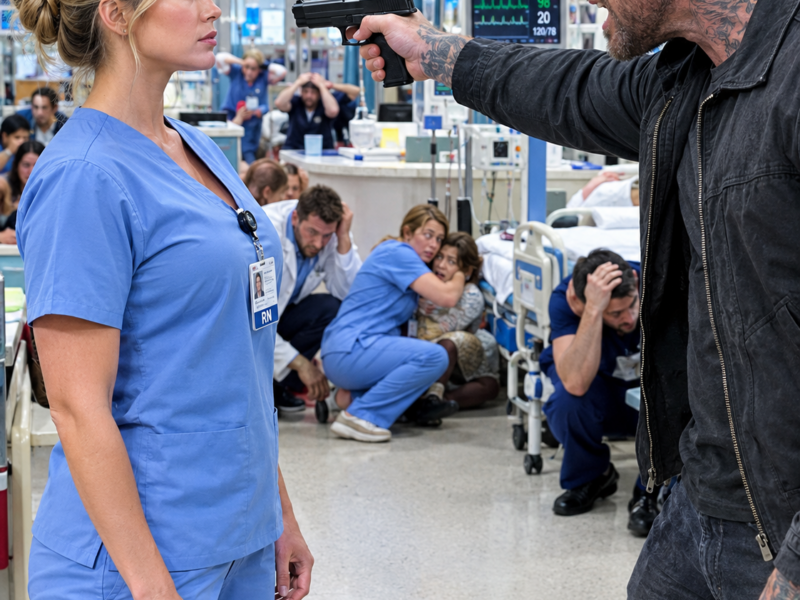
“When the armed robber pointed his gun at my chest and sneered, ‘Just a scared nurse,’ the customers inside the Cleveland grocery store lowered their eyes
The photograph trembled in my hands before I realized I had taken it from him.
It showed six people standing outside a temporary field hospital in Afghanistan, their uniforms streaked with dust and their faces hollow from too many sleepless nights.
I stood at the far left, younger by eleven years, my hair tucked beneath a helmet.
Beside me was Daniel Mercer.
He was smiling at the camera, one arm resting on my shoulder, as if the mountains behind us were nothing more than a vacation backdrop.
But it wasn’t Daniel’s face that made my fingers tighten around the paper.
It was the man standing behind him.
Captain Thomas Reed, our commanding officer, had been officially listed as killed during the same evacuation.
And someone had drawn a red circle around his face.
“Where did you get this?” I asked.
The robber looked toward the front windows.
“Put it down.”
“Tell me where you got it.”
His eyes hardened, and for a moment the frightened man disappeared behind the gunman again.
“You don’t get to ask questions while I’m holding the gun.”
He was right about that.
I lowered the photograph but kept it in my hand.
Outside, a police officer called through the megaphone, ordering the gunman to release the hostages and come out with his hands raised.
The robber flinched at the word hostages.
That reaction told me something important.
He hadn’t entered Miller’s Market intending to kill anyone.
He had come for a reason, and whatever that reason was, it had begun slipping out of his control.
“What’s your name?” I asked quietly.
He hesitated.
“Caleb.”
“Caleb, Frank needs medical attention. Let me finish helping him.”
He glanced at the elderly man, whose wife was holding his hand and whispering a prayer.
For a moment, Caleb looked almost ashamed.
“Five minutes,” he said.
Then he pointed the gun toward the back of the store.
“And after that, you’re coming with me.”
I didn’t ask where.
I already suspected the answer would have something to do with the photograph, the green fabric around his wrist, and a valley I had spent eleven years trying to forget.
I returned my attention to Frank.
His pulse was still irregular, but his breathing had improved slightly. His wife found a small bottle of medication in her purse and handed it to me with shaking fingers.
I helped her explain what he had taken and when, then asked one of the employees to relay the information to the police if they could do so safely.
I couldn’t make Frank’s condition disappear, but I could keep him talking until the paramedics reached us.
“You’re a good person,” his wife whispered.
I didn’t answer.
I wasn’t sure what a good person was supposed to do when the past walked into a grocery store carrying a gun.
When I finally looked up, Caleb was watching me.
“You still do that,” he said.
“Do what?”
“Count people. Check exits. Watch everybody’s hands.”
My throat tightened.
“How do you know that?”
He glanced at the photograph.
“Because Daniel told me.”
The name struck harder than the gunshot had.
I stood too quickly, and the room tilted for a moment.
“Daniel is dead.”
Caleb’s expression changed.
“That’s what they told you.”
“His convoy was lost in the flood. The report confirmed it.”
“Reports can say whatever the people writing them need them to say.”
He spoke with a bitterness that sounded practiced, as though he had repeated those words to himself for years.
I looked at the photograph again.
“Who circled Captain Reed?”
Caleb’s gaze moved to the windows.
“Not me.”
“Then who?”
“The person who sent me here.”
A fresh burst of police commands interrupted us.
Caleb swore under his breath, then grabbed the brown paper sack from the counter.
“Back room. Now.”
I looked at Frank and his wife.
“Please don’t hurt them.”
“I haven’t hurt anybody.”
“You fired a gun inside a crowded store.”
His face tightened.
“I fired into a shelf. I could have shot somebody.”
“That isn’t the defense you think it is.”
For one brief second, I saw something like humiliation in his eyes.
Then he motioned toward the rear corridor.
I followed because I needed answers, and because I had learned long ago that fear could be useful if you refused to let it make every decision for you.
The stockroom smelled of cardboard, detergent, and old coffee.
A narrow window sat high on the wall, too small for anyone to climb through. Metal shelves crowded the space, stacked with paper towels and boxes of canned goods.
Caleb shut the door but left it unlocked.
He kept his gun pointed at the floor.
“Tell me what happened after the flood,” he said.
“I was evacuated.”
“That’s all?”
“I spent three days in a field hospital. I had a fractured collarbone and a concussion. After that, I was transferred out.”
“Did anybody question you?”
“Military investigators.”
“What did they ask?”
I stared at him.
“Why are you asking me these questions?”
“Because Daniel needs to know whether you remember.”
The room seemed to contract around those words.
“Daniel is alive?”
Caleb didn’t answer quickly enough.
I grabbed the edge of a shelf.
“Is he alive?”
“I haven’t seen him in person.”
The answer was not what I wanted, but it was the first honest thing he had said.
“Then how do you know he needs to know anything?”
“Because he sent me the photograph.”
I looked down at it.
The paper had been folded into quarters, and the creases were worn almost white.
On the back, in my handwriting, were the words I had written the night before the evacuation.
If we get out, breakfast is on me.
Beneath them was a date.
October 14, 2015.
I remembered that night.
Daniel and I had sat on overturned supply crates behind the field hospital, sharing a tin of peaches because the kitchen had run out of everything else.
He had been unusually quiet.
When I asked what was wrong, he told me he had discovered that some medical supply shipments were being recorded as delivered even though they never reached our unit.
I remembered laughing at first.
Bureaucratic mistakes were common. Boxes got lost. Paperwork was duplicated.
Then he told me that the missing supplies included blood products, antibiotics, and trauma equipment.
People were dying while someone made money pretending they had received the tools needed to save them.
I had wanted to report it.
Daniel asked me to wait until he had proof.
“Did he ever tell you what he found?” I asked.
Caleb nodded.
“He found the shipment records. Names, dates, signatures. Enough to connect the missing supplies to people who were supposed to be protecting the operation.”
“Captain Reed?”
“Among others.”
I thought of the red circle.
“Who else?”
Caleb shook his head.
“Daniel didn’t tell me everything. He said the fewer people who knew, the safer they’d be.”
“That makes no sense if he sent you to me.”
“He didn’t send me to you directly.”
Caleb reached into his hoodie and pulled out a small black phone.
The screen was cracked down the middle.
“Three days ago, I received a message from an encrypted account. It had this photograph and a set of instructions. I was told to find you, confirm you remembered the valley, and bring you somewhere safe.”
I stared at him.
“Somewhere safe? You robbed a grocery store.”
“I didn’t know what else to do.”
“That is the worst excuse I’ve ever heard.”
He looked away.
“I know.”
For the first time, his voice sounded like that of a man rather than someone trying to intimidate a room full of strangers.
“Whoever contacted me knew my address, my sister’s name, and where she works. They said if I didn’t cooperate, she’d be next.”
His eyes dropped to the gun in his hand.
“I was supposed to get you out before the police arrived. I thought if I made it look like a robbery, nobody would connect it to the photograph.”
“You thought pointing a gun at me would make me trust you?”
“No.”
He swallowed.
“I thought you’d be too frightened to resist.”
At least he wasn’t pretending his choices had been noble.
I could understand being afraid for someone you loved. I could understand making a terrible decision under pressure.
I could not forgive him for making twenty-three strangers pay for it.
“What’s your sister’s name?”
“Anna.”
“Does she know what you’re doing?”
“No.”
“Then the first thing you need to do is stop putting her in more danger by following instructions from someone you can’t identify.”
He gave a bitter laugh.
“You think I haven’t figured that out?”
A hard knock sounded against the stockroom door.
“Police! We need to speak with you.”
Caleb raised the gun instinctively.
I stepped between him and the door.
“Don’t.”
“Move.”
“No.”
His eyes widened, not because I had shouted, but because I hadn’t.
For eleven years, I had imagined what I would do if I ever encountered someone connected to the valley. In those imaginings, I had always been brave and certain.
Now my hands were shaking, my shoulder ached where an old injury had stiffened in the cold, and an armed stranger stood three feet away.
I was terrified.
But I was not going to let another frightened man decide who deserved to live.
“Caleb,” I said, keeping my voice low, “you can put the gun down and tell the truth. Or you can keep holding it until someone decides there is no other way to stop you.”
He looked at the door.
Then at the photograph.
For several seconds, neither of us moved.
Finally, he lowered the weapon.
“Tell them I need a lawyer,” he said.
I stepped aside and called to the officers that we were coming out.
Caleb placed the gun on a shelf and raised both hands before I opened the door.
The officers entered quickly, secured him, and guided him away from me.
As they led him past the checkout lanes, I saw Emily watching from behind the counter, tears drying on her cheeks.
I wanted to tell her I was sorry.
I wanted to tell Frank’s wife that her husband would be all right.
Instead, I watched Caleb disappear through the front doors into a wash of red and blue lights.
The photograph was still in my hand.
A police officer approached me.
“Ma’am, we need to get you checked by the paramedics.”
“I’m fine.”
“That’s not what I asked.”
His tone was gentle, and something about that nearly undid me.
I looked down at Daniel’s face.
“No,” I whispered. “I don’t think I am.”
The paramedics took me to the hospital where I worked.
My coworkers knew me well enough not to ask unnecessary questions when I arrived in an ambulance, but the emergency department physician insisted on checking my blood pressure and examining my old shoulder injury.
I sat on an exam bed beneath a thin blanket while the hospital moved around me.
Monitors beeped. Wheels rattled over the floor. Somewhere behind a curtain, a baby cried.
Ordinary sounds.
I held on to them because they belonged to the life I had built after Afghanistan.
At 11:46 p.m., Detective Laura Bennett entered the room.
She was in her early forties, with short brown hair and the composed expression of someone who had spent years listening to people explain why they hadn’t done what they were accused of doing.
She introduced herself, then sat in the chair beside my bed.
“Mr. Caleb Turner is in custody,” she said. “He’s cooperating, although we haven’t established whether his account is accurate.”
“Did he tell you about Daniel Mercer?”
“He did.”
She placed a clear evidence sleeve on the tray beside me.
Inside was a second photograph.
This one showed a convoy stopped on a muddy road in the mountains.
The image was grainy, probably taken with an old phone, but I could see the military vehicles and the steep rock walls rising on either side.
A date had been printed at the bottom.
October 16, 2015.
Two days after the photograph I had been holding.
I leaned closer.
A figure stood near the back of the second vehicle, partly hidden by a canvas cover.
His face was turned away from the camera.
But I recognized his posture.
Daniel always leaned slightly to his left because of an old knee injury.
My mouth went dry.
“Where did this come from?”
“Turner says it arrived with the message that led him to you.”
“Who sent it?”
“We don’t know yet.”
I looked at Detective Bennett.
“Have you ever investigated the evacuation in the Korengal Valley?”
Her expression changed just enough for me to notice.
“I’ve reviewed the preliminary records connected to your case.”
“My case?”
She folded her hands.
“Eleven years ago, an inquiry was opened into the disappearance of military records related to that operation. It was closed after the investigators concluded there was insufficient evidence of criminal activity.”
“Disappearance of records?”
“Several shipment logs and radio transcripts were missing from the final archive.”
I felt the blood drain from my face.
“What happened to the investigators?”
“One retired. Another was reassigned. The third died in a car accident several months after the inquiry closed.”
The hospital room became very quiet.
“Are you telling me the investigation was covered up?”
“I’m telling you that I have questions, and I don’t want to make claims I can’t support.”
It was the sort of answer I might have given a patient’s family when the diagnosis was uncertain.
Careful. Honest. Unsatisfying.
I appreciated it more than I wanted to admit.
“Why are you showing me the photograph?”
“Because there is something else.”
She removed a folded document from her case.
It was a copy of an official report, its edges worn and the ink faded.
At the bottom was my signature.
I remembered signing the original in a small administrative office after I was transferred out of the valley. I had been exhausted, medicated, and desperate to put the evacuation behind me.
I read the statement slowly.
According to the report, Daniel Mercer had been last seen entering a transport vehicle at 04:20 on October 16.
I had supposedly witnessed his departure.
I read it again.
Then a third time.
“I never said this.”
Detective Bennett didn’t interrupt.
“I never saw Daniel enter a transport vehicle. I was unconscious by then. They gave me medication for the pain, and I woke up in a different facility two days later.”
“Did you tell the investigators that?”
“Yes.”
“Do you have a copy of your original statement?”
“No. I assumed the military had it.”
She nodded.
“That’s consistent with what we found. Your original interview notes are missing.”
I pressed my fingers against the paper.
My signature looked real.
The slant of the letters was mine. The way the final s in Hayes curved beneath the line was mine.
But the words were not.
“Someone used my signature to make it look like I had seen him leave.”
“That’s one possibility.”
I looked up.
“What other possibility is there?”
“Someone may have altered the record after you signed a different statement. We need the original documents before we can establish exactly what happened.”
I wanted to demand that she promise to find Daniel.
I wanted to tell her to arrest every officer whose name appeared in the old records.
But eleven years of silence had taught me that anger could make a person easy to manipulate.
So I asked the only question that mattered.
“If Daniel is alive, why wait this long?”
Detective Bennett studied the photograph.
“Perhaps he couldn’t safely contact you.”
“Or perhaps this is a trap.”
“That is also possible.”
She stood and handed me her card.
“If you remember anything else about the evacuation, call me. Don’t contact anyone connected to the operation until we know more.”
I nodded.
At the door, she paused.
“Rebecca, one more thing. Turner says the person who contacted him knew you worked at Miller’s Market every Thursday evening.”
I stared at her.
“I don’t work at Miller’s Market.”
“He said the message described a woman in blue scrubs carrying a medical bag. He assumed it meant you were there regularly.”
I looked down at my clothing.
I had come straight from a hospital shift, still wearing my blue scrubs and carrying my work bag.
The message hadn’t predicted where I would be.
It had described how to recognize me.
Someone had known I would be there that night.
Someone had sent an armed man to find me.
And someone had wanted to know whether I remembered the valley.
After Detective Bennett left, I called my younger brother, Michael.
He answered on the fourth ring.
“Becca? It’s almost midnight. What’s wrong?”
Hearing his voice made my eyes sting.
“Nothing I can explain over the phone.”
“Are you hurt?”
“Not badly.”
“Where are you?”
“At St. Vincent’s.”
“I’m coming.”
“Michael, wait—”
He had already hung up.
Twenty minutes later, he entered the room carrying two coffees and wearing the old Cleveland Browns sweatshirt he refused to throw away.
He took one look at me and set the cups down.
“Who do I need to call?”
“No one.”
“Then tell me what happened.”
I told him about the robbery, the photograph, and Daniel.
I left out some of the details about the gun because Michael had a temper, and I didn’t want him driving across town looking for Caleb Turner.
When I finished, he sat very still.
“You think Daniel survived?”
“I don’t know what I think.”
Michael rubbed his palms against his jeans.
“You never told me about that report.”
“I didn’t know it existed.”
“You told me Daniel was gone.”
“I believed he was.”
He looked at the floor.
“Do you remember what Mom said after you came home?”
I did.
Our mother had stood in the kitchen while I stared at an untouched plate of lasagna. She had wanted me to tell her what happened overseas.
I had told her I couldn’t.
She had put her hand over mine and said, “Then you don’t have to talk until you’re ready.”
Michael had been seventeen at the time.
He had quietly taken over the grocery shopping, driven Mom to appointments, and learned how to cook three meals because I could barely get through a day without waking from nightmares.
He had never asked me to explain what I wasn’t ready to explain.
Now he looked at me with an expression I couldn’t quite read.
“There’s something I never told you,” he said.
I turned toward him.
“What?”
“About the months before you came home.”
He reached into his jacket and removed a small envelope.
It was old, the paper yellowed and the corners softened by years of handling.
My name was written across the front.
Rebecca.
I recognized the handwriting before I touched it.
Daniel’s.
My brother placed it on the bed between us.
“Mom found it in the mailbox about six weeks after the military notified us that Daniel was missing. There was no return address.”
I stared at him.
“Why didn’t you give it to me?”
“Because you were barely sleeping. You’d wake up screaming and ask me whether the house was shaking. Mom thought another reminder might make things worse.”
“Where was it?”
“In her desk.”
“Michael, that’s not yours to decide.”
“I know.”
His voice cracked.
“I know that now.”
For a moment, I saw the seventeen-year-old boy who had stood in our kitchen watching his sister come home with a body that had survived and a mind that had not yet caught up.
He wasn’t trying to hurt me.
He had been trying to protect me in the only way he knew how.
That didn’t make the years of silence hurt less.
I picked up the envelope.
The seal had never been broken.
Daniel had written my name in the same uneven letters he used on supply labels, coffee cups, and the notes he left beside my bunk when I worked overnight.
My hands trembled as I opened it.
Inside was a single sheet of paper.
Rebecca,
If you are reading this, something went wrong.
I can’t explain everything yet, and I can’t ask you to trust me without telling you why.
The shipment records are not the only thing missing. Someone changed the evacuation list before we left the valley. The names of three people were removed, and three others were added.
I think Captain Reed knows.
I don’t know who else is involved.
If they tell you I died, please don’t risk your life trying to prove otherwise.
There is one thing you need to remember.
The radio call at 03:12 was not an evacuation order.
It was a warning.
I stopped reading.
The room tilted slightly, and I gripped the edge of the bed.
03:12.
The time I had woken from nightmares for eleven years.
I had always believed the repeated time was a meaningless remnant of trauma, a number my brain had attached to the worst night of my life.
But Daniel had written it down.
He had known.
I forced myself to continue.
If I can’t come back, find the original log from Station Seven.
Don’t trust the copy.
And, Rebecca, I’m sorry I let you believe I had a choice.
Daniel.
For a long time, I couldn’t speak.
Michael sat beside me, his shoulder touching mine.
I read the letter again, slower this time.
Station Seven.
The original log.
The radio call that wasn’t an evacuation order.
The names removed from the list.
A new shape was emerging from the pieces, but the center remained hidden.
I folded the letter carefully.
“I need to find Station Seven.”
Michael shook his head.
“You need to sleep.”
“I’ve slept for eleven years.”
“No. You’ve survived for eleven years. That’s not the same thing.”
I looked at him.
He was right, and I hated him for saying it because I knew he was right.
But I also knew that if I put the letter away and tried to return to ordinary life, I would spend the rest of my days wondering whether Daniel had been alive somewhere, waiting for me to understand.
“I won’t go alone,” I said.
Michael leaned back.
“That’s not exactly reassuring.”
Despite everything, I laughed.
It was a small, unsteady sound, but it was the first time that night I had felt like myself.
The next morning, Detective Bennett called.
Caleb had provided the account information for the encrypted messages, along with a location where he had been instructed to deliver me.
It was a storage facility outside Akron.
The unit had been rented under a false name and paid for in cash.
Police had obtained a warrant and found several boxes of old military documents, a laptop, and a satellite phone with its memory erased.
There was also a handwritten list of names.
Mine was at the top.
Daniel Mercer’s name was beneath it.
Captain Thomas Reed’s name had been crossed out.
I asked Detective Bennett whether she had found Station Seven.
“Not yet,” she said. “But the records indicate it was a temporary communications post established near the evacuation route. It was dismantled after the operation.”
“Who was assigned there?”
“We’re checking the personnel records.”
“Can I see the list?”
“Not yet.”
“Detective, somebody has been sending threats, manipulating records, and using an armed man to get to me. I have a right to know what’s happening.”
“You have a right to be safe. That is why I’m asking you not to investigate this on your own.”
I wanted to argue.
Instead, I asked her to tell me as soon as she learned anything about Daniel.
By noon, I had returned home.
My apartment looked exactly as I had left it the previous morning: a pair of running shoes beside the door, unopened mail on the kitchen counter, and a dying basil plant on the windowsill.
I stood in the doorway for several minutes.
Nothing had changed.
Everything had.
I put Daniel’s letter on the kitchen table and spread the photographs beside it.
The first showed the field hospital.
The second showed the convoy.
I examined them under a desk lamp, searching for details I might have missed.
On the back of the convoy photograph, I noticed a small notation in the lower corner.
S7.
It had been written in pencil, almost rubbed away.
Station Seven.
I turned the photograph over again.
The figure near the second vehicle stood partly behind a canvas cover, but his left hand was visible.
He wore a wristwatch with a dark leather strap.
Daniel had worn that watch for years.
His father had given it to him before he enlisted.
I remembered him complaining that the clasp kept coming loose.
The photograph wasn’t proof that he had survived.
But it was proof that someone wanted me to believe he had.
At 2:37 p.m., my phone rang from an unknown number.
I almost let it go to voicemail.
Then I answered.
“Rebecca Hayes?”
A man’s voice.
Low. Older. Familiar in a way that made my skin tighten.
“Who is this?”
“You need to stop looking for Station Seven.”
I stood very still.
“Captain Reed?”
Silence.
Then a short breath.
“I wondered how long it would take you.”
I gripped the phone.
“You’re supposed to be dead.”
“Apparently, so is Daniel.”
“Did you change the evacuation records?”
“You don’t understand what happened.”
“Then explain it.”
“I can’t do that over the phone.”
“Why not? Afraid someone will hear you?”
“I’m afraid you’ll do exactly what you did eleven years ago.”
The words cut deeper than they should have.
“What did I do?”
“You trusted the wrong person.”
The line went dead.
I stared at the phone.
My first instinct was to call Detective Bennett.
My second was to call the number back.
I did neither.
Instead, I searched the number online and found nothing. Then I sent it to Detective Bennett with a brief message explaining what had happened.
She called less than two minutes later.
“Do not respond to any further calls,” she said. “We are tracing the number.”
“Was that Reed?”
“We don’t know yet.”
“He knew about Station Seven.”
“Rebecca, listen to me. We found evidence that someone accessed the archived records last week. Whoever did it knew exactly which files were missing.”
“Then someone has been planning this for a long time.”
“Possibly.”
“How long?”
She paused.
“Long enough that I don’t think the robbery was the beginning.”
I looked at the photographs on the table.
No. It had begun eleven years earlier, in a mountain valley where an evacuation list had been altered and a radio call had been mistaken for an order.
The robbery was simply the first time someone had forced me to look directly at it.
That evening, Detective Bennett called again.
They had identified a former communications specialist who had been assigned to Station Seven during the evacuation.
His name was Marcus Bell.
He had left the military shortly after the operation and moved to Ohio. He had died two years earlier.
But his daughter, Elise Bell, had recently reported that someone had broken into her father’s storage unit and stolen several boxes of documents.
One of those boxes had contained his personal field journal.
Detective Bennett sent me a scanned page.
The handwriting was cramped and hurried.
October 16, 2015.
03:12 — Emergency transmission received from Command. Not an evacuation order. Repeated instruction to seal the western route and hold all personnel at the checkpoint.
03:17 — Mercer disputes the order. Says command is directing vehicles into the flood channel.
03:21 — Reed requests the original radio recording.
03:26 — Recording removed from station archive.
03:31 — Mercer takes a copy of the dispatch log and leaves with two local guides.
03:44 — Communications failure.
There were more entries, but the scan ended there.
I read the page until the words blurred.
Daniel hadn’t simply disappeared in the flood.
He had challenged an order that may have sent our convoy into danger.
He had taken a copy of the dispatch log.
And then he had left with two local guides.
I called Detective Bennett.
“Does the journal say where they went?”
“There’s a reference to an abandoned relay station north of the route. We believe that may be Station Seven.”
“Then that’s where we need to look.”
“No,” she said firmly. “That’s where my team needs to look.”
I almost argued, but she continued.
“We have a possible witness, a missing recording, and evidence of tampering with military records. If we move too quickly, we could lose the trail. Let us do this properly.”
For the first time, I understood that patience wasn’t the same thing as surrender.
I agreed to wait.
Two days later, Detective Bennett called me into her office.
On the table lay a small metal case recovered from the storage facility outside Akron.
Inside was an old digital audio recorder, a bundle of dispatch sheets, and a plastic identification card bearing Daniel’s name.
The recorder had been damaged by moisture, but a technician had recovered part of its contents.
Detective Bennett placed a set of headphones in front of me.
“We need you to identify the voices if you can,” she said. “You can stop at any time.”
I put on the headphones.
At first, there was only static.
Then a series of clicks, followed by a man’s voice.
“Station Seven, this is Command. Seal the western route. Hold all personnel at the checkpoint.”
Another voice answered.
“Command, confirm. The western route runs through the flood channel.”
A pause.
“Order stands.”
I recognized Daniel’s voice.
“That order will put our people in the water.”
The first voice returned.
“Do you acknowledge the order, Mercer?”
“I acknowledge that I heard you. I do not acknowledge that it’s safe.”
A faint burst of static.
Then another voice, one I recognized immediately.
Captain Thomas Reed.
“Mercer, stand down. You have no authority to countermand this instruction.”
Daniel answered, his voice tight but controlled.
“Then put the order in writing and sign it.”
There was a long silence.
When Reed spoke again, the coldness in his voice made my stomach turn.
“Remove Mercer from communications. Secure the original log. Nobody leaves this station without authorization.”
The recording ended in static.
I removed the headphones.
Detective Bennett watched me carefully.
“Is that Captain Reed?”
“Yes.”
“And Daniel Mercer?”
“Yes.”
She made a note.
“There’s another file.”
The next recording was shorter.
It began with footsteps and the sound of a door opening.
Then Daniel spoke, much closer to the microphone.
“Rebecca, if you ever hear this, I need you to know that I tried to get back to you.”
My fingers tightened around the headphones.
“I took the log because it was the only evidence that the order had been changed. Reed knew the route was flooding. I don’t know who gave him the instruction, but I know he wasn’t acting alone.”
A pause.
“I couldn’t take the original recording with me. They were watching the station. I made a copy of the dispatch log and left with two guides who knew the mountain paths.”
His breathing was audible.
“If I come back, they’ll take it from me. If I stay, I may never get home. I’m sorry, Rebecca. I should have told you what I was doing.”
Another pause.
Then, quietly:
“I didn’t choose to leave you. I chose to keep you from being dragged into this.”
The recording ended.
I stared at the blank screen.
For eleven years, I had believed Daniel’s final words were a warning that I had failed to understand.
Now I knew they had been a promise he hadn’t been able to keep.
Detective Bennett waited until I looked up.
“We’ve also located Elise Bell. She remembers her father mentioning a man who came to their house in 2016. He was injured and used a different name. Her father helped him get medical treatment and arrange transportation.”
“Was it Daniel?”
“We can’t prove that yet.”
“But you think it was.”
“I think we have enough evidence to keep looking.”
For the next week, the investigation moved slowly.
The recovered records established that the evacuation order had been altered and that the original dispatch log had disappeared. They also revealed that several medical supply shipments had been recorded as delivered despite never reaching the field hospital.
A procurement officer had approved the payments.
A contractor had collected them.
And Captain Reed had signed the final reconciliation report.
But the money trail didn’t end with him.
Detective Bennett discovered that the contractor had been linked to a private logistics company whose board included a former military official now serving as a consultant to several defense firms.
That official had died the previous year.
His records were being reviewed by federal investigators.
The case was bigger than one missing medic or one falsified report.
It was a network of people who had used the chaos of war to hide money, erase evidence, and silence anyone who noticed.
Daniel had found the beginning of it.
Reed had tried to stop him.
And someone had spent eleven years making sure the truth stayed buried.
Then, on a rainy Thursday morning, I received a message from an unfamiliar number.
No greeting.
No explanation.
Just an address and a time.
Underneath it were five words.
I think you deserve the truth.
I forwarded the message to Detective Bennett.
She told me not to go.
I agreed.
Then she arranged for two officers to meet me at the address, an old church community center on the edge of town.
The building stood between a laundromat and a boarded-up furniture store. Rainwater streamed down the windows, and the parking lot was nearly empty.
I waited in an unmarked car while the officers checked the building.
Ten minutes later, Detective Bennett called.
“There’s someone here who wants to speak with you.”
“Who?”
She hesitated.
“He’s using the name David Cole.”
My hands went numb.
“Is he alone?”
“Yes.”
“Does he have identification?”
“Not yet.”
I stared at the entrance.
“Ask him whether he remembers the breakfast he promised me.”
There was a pause.
Then I heard a muffled conversation.
Detective Bennett returned.
“He says you always ordered coffee before you looked at the menu, even when you knew there was nothing you wanted to eat.”
A sound escaped me that was almost a laugh.
It was such a stupid, ordinary detail.
So perfectly Daniel.
I opened the car door.
The man standing inside the community center was thinner than I remembered, with gray threaded through his dark hair and a scar running from his jaw to the collar of his shirt.
He leaned heavily on a cane.
For several seconds, I couldn’t make myself move.
He looked at me as if he were afraid that one wrong word would send me running.
“Hi, Rebecca.”
I had imagined this moment a thousand times.
In some versions, I slapped him. In others, I cried. Sometimes I demanded an explanation before allowing him to say my name.
In none of those versions did I feel the crushing weight of eleven years settling into the space between us.
I crossed the room and struck his chest with the flat of my hand.
Once.
Then again.
“You were dead.”
He closed his eyes.
“I know.”
“I buried you.”
“I know.”
“I spent eleven years believing you were dead.”
His face twisted.
“I’m sorry.”
I wanted to hit him again.
Instead, I grabbed his jacket and held on as my knees weakened.
He wrapped his arms around me carefully, as though he wasn’t certain he had the right.
For a long time, neither of us spoke.
When I finally stepped back, I saw that his eyes were wet.
“Why?” I asked.
He looked down at his cane.
“Because the people behind the operation knew you had heard me question the order. They knew you were on the radio that night. After I disappeared, I learned that someone had used your name in a report saying you had witnessed my departure.”
“I never signed that statement.”
“I know.”
“Then why didn’t you come back and tell me?”
His jaw tightened.
“Because the first time I tried to contact you, someone followed the person carrying my message. He was beaten badly enough that he spent a month in the hospital.”
I stared at him.
“Who was it?”
“Marcus Bell.”
The communications specialist.
“He helped me after I left the valley. He got me medical treatment and helped me disappear. When he tried to deliver my first message to you, they found him.”
Daniel swallowed.
“He survived, but he was afraid they’d come after his daughter. He told me to stay away from you until we had evidence strong enough to protect you.”
“Eleven years?”
“I thought it would be a few months. Then I thought it would be a year. Every time I got close to finding the original records, something happened. A witness disappeared. A document was destroyed. Someone warned me that you were being watched.”
He looked at me.
“Eventually, I stopped believing I could come home without bringing the danger with me.”
I wanted to understand.
I also wanted to tell him that protecting someone by removing their choices was not the same thing as loving them.
“Did you ever think about what it was like for me?” I asked.
“Every day.”
“That’s not an answer.”
“No,” he whispered. “It isn’t.”
Detective Bennett gave us a few minutes before asking Daniel to provide a formal statement.
He agreed.
Over the next several hours, he explained how he had escaped the valley with the dispatch log, how Marcus Bell had helped him, and how he had spent years trying to identify the people who had altered the evacuation order.
He had never intended to disappear permanently.
But the network was larger than he had imagined, and every attempt to expose it had brought new threats.
The message to Caleb Turner had been his last desperate attempt to reach me.
Daniel had sent the photograph and asked Caleb to find me, but he had not instructed him to rob the store or threaten anyone.
Caleb had received a second message from an unknown source, warning him that his sister would be harmed unless he forced me to cooperate.
That second message had turned a dangerous plan into a criminal act.
Caleb had made his own choices.
He would have to answer for them.
But his account gave investigators another lead: a phone number that had been used to contact both him and several people connected to the old procurement company.
Detective Bennett said federal agents were now tracing it.
“What about Reed?” I asked Daniel.
He looked toward the rain-streaked window.
“I saw him once, years ago, outside a hotel in Virginia. I followed him, but he disappeared before I could confront him.”
“Why did he call me?”
“I don’t know.”
“Do you think he knows where the original log is?”
Daniel nodded slowly.
“I think he knows where I left it.”
He explained that the copy he had carried out of the valley was incomplete. The original dispatch log had remained at Station Seven when he fled.
He had returned to the area once, months later, but the station had been dismantled and the records removed.
The only clue was a note from Marcus Bell suggesting that the original log had been transferred to a secure archive before the inquiry was closed.
If it still existed, it could establish who had issued the order, who had altered the evacuation list, and who had authorized the missing supply shipments.
It could also reveal why the people involved had spent eleven years trying to bury the evidence.
Detective Bennett arranged for Daniel to enter protective custody while federal investigators reviewed his statement.
I left the community center with Michael, who had been waiting outside in the rain.
He took one look at my face and pulled me into a hug.
“He’s alive,” I whispered.
“I know.”
“I don’t know what to do with that.”
“You don’t have to decide today.”
For the first time in eleven years, I believed him.
The investigation lasted several more months.
Captain Reed was located in a small town in West Virginia, living under his own name but keeping a low profile. He denied ordering anyone to falsify records, yet the recovered recordings contradicted his account.
When federal investigators presented him with the original dispatch log, he stopped cooperating.
The log had been found in a sealed archive maintained by a former military records officer who had retained copies of documents scheduled for destruction.
It contained the original radio order, the names of personnel removed from the evacuation list, and a handwritten notation showing that Reed had received a warning about the rising water nearly forty minutes before the convoy entered the route.
The evidence did not answer every question.
Some of the people involved had died. Others denied knowing anything about the operation. The contractor who had received the supply payments was charged with fraud, and several former officials faced investigations into falsified records and obstruction.
Reed was charged with offenses related to the falsification and concealment of evidence. The final legal proceedings took time, and not every person who had benefited from the scheme was held accountable.
But the report that had declared Daniel dead was formally challenged, and my original testimony was restored to the record.
For the first time, the official file acknowledged that I had never witnessed his departure.
The truth did not undo what had happened in the valley.
It did not bring back the people who had died, restore the years Daniel and I had lost, or make the nightmares disappear.
But it gave the dead their names back.
And it gave the living something they had been denied for too long: a record that did not lie.
Daniel and I began meeting in a quiet diner outside Cleveland.
At first, we talked only about practical things.
His rehabilitation. My shifts at the hospital. Michael’s latest attempt to convince me to take a vacation.
We avoided the past until avoiding it became more exhausting than facing it.
One afternoon, Daniel placed a small envelope on the table between our coffee cups.
Inside was a photograph of the field hospital.
The same one I had seen in Miller’s Market.
“I kept it because I couldn’t bear to throw it away,” he said.
I traced the edge of the picture.
“Why didn’t you send it with your first message?”
“Because I thought you would recognize it and start searching before I could make sure you were safe.”
I looked at him.
“You don’t get to make every decision for me anymore.”
“I know.”
“And if you’re frightened, you tell me. You don’t disappear.”
He nodded.
“I can promise to try.”
It wasn’t a grand declaration.
It wasn’t enough to repair eleven years.
But it was honest, and honesty was the only place we could begin.
We didn’t immediately return to the relationship we had before the valley.
Too much had happened, and too much remained unsaid.
Some days, I was angry with him. Some days, I was angry with myself for wanting him near me.
There were moments when I missed the man he had been before the evacuation, and moments when I had to remind myself that the man sitting across from me was not simply a memory brought back to life.
He was a survivor.
So was I.
Neither of us owed the other an instant forgiveness.
Months later, I returned to work at St. Vincent Medical Center.
On my first night back, a young nurse approached me in the break room.
“I heard you were involved in that grocery store robbery,” she said. “People are saying you disarmed the guy.”
I laughed.
“I didn’t disarm anyone.”
“But you stayed calm.”
I thought of the gun, the photograph, and the frightened man who had mistaken desperation for courage.
“I was scared,” I told her. “I just had something more important to do than show it.”
She considered that, then nodded and returned to her shift.
After she left, I stood by the window overlooking the ambulance bay.
A storm was moving across the city, turning the streetlights into blurred halos.
For a moment, I heard the radio static from the valley.
I saw the floodwater rising between the rocks.
I remembered the names on the evacuation list, the voices over the communications line, and the men who had trusted orders they had no reason to doubt.
Then I took a breath.
I was in Cleveland.
I was thirty-eight years old.
My brother was waiting at home with groceries he had probably forgotten to put away, and Daniel had promised to meet me for breakfast on Sunday.
The past was still there.
It simply no longer had the right to tell me what the present had to be.
On Sunday morning, Daniel arrived at the diner before I did.
Two cups of coffee sat on the table, one black and one with a little cream.
He had remembered.
I slid into the booth across from him.
“You’re early,” I said.
“Didn’t want you to think I’d disappeared.”
I looked at him for a long moment.
Then I reached across the table and took his hand.
I couldn’t give him back the eleven years he had lost, and he couldn’t give me back the years I had spent grieving someone who was still alive.
We could not make the past fair by pretending it had never happened.
But when the waitress came to take our order, Daniel opened the menu and looked at me with the smallest hint of his old smile.
“So,” he said, “am I buying breakfast, or are you?”
For the first time in eleven years, I smiled without forcing it.
“You’re buying,” I said. “You owe me a lot of breakfasts.”
Outside, the rain had stopped, and the morning light spread across the wet pavement.
I held his hand while the coffee cooled between us, knowing that forgiveness would take time, that trust would have to be earned, and that some wounds would always ache when the weather changed.
But I was no longer waiting for a dead man to come home.
I was sitting across from a living one, with the truth between us at last.
THe ENd.









