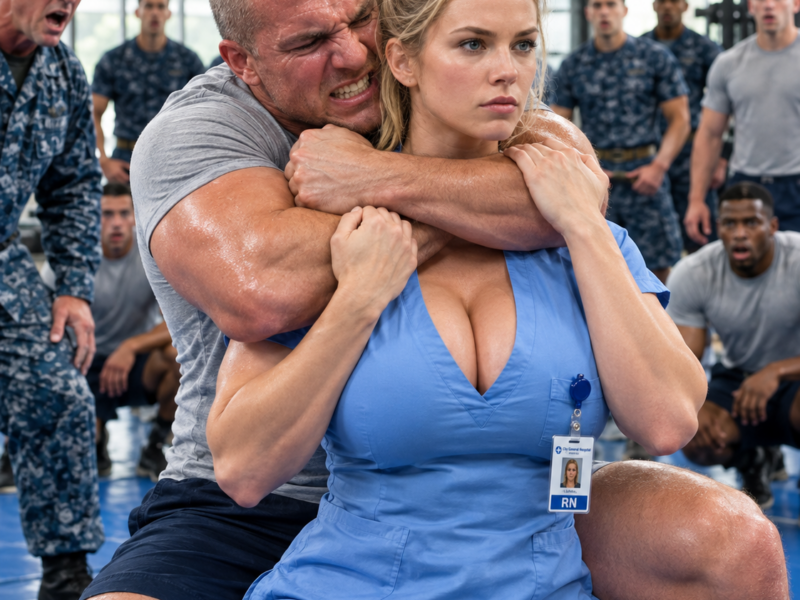
“When a 220-pound Army cadet wrapped both hands around my throat in front of 31 soldiers at Fort Campbell
The colonel turned the photograph toward me.
“Your call sign was Viper,” he said quietly. “You were listed as killed in action four years ago. Yet here you are, standing in a training facility in Kentucky, wearing nursing scrubs and telling me your previous assignment isn’t relevant.”
I stared at the photograph.
Four soldiers stood beside a Black Hawk helicopter beneath the pale Afghan sky. I was on the far right, younger by four years, my hair tucked beneath a helmet and a rifle slung across my chest.
Beside me stood Sergeant Marcus Cole, Lieutenant James Walker, and Staff Sergeant Daniel Brooks.
All three had been declared dead.
I had attended the memorial service for two of them.
The third had no grave.
“Where did you get that file?” I asked.
“Military personnel command sent it to me after I requested verification of your service record.”
“Why?”
“Because your reaction to Cadet Pierce wasn’t the reaction of an ordinary clinic nurse.”
I lowered my hand from my throat.
“He was choking me, sir.”
“I know. Thirty-one witnesses have already confirmed that.”
“Then you have your answer.”
“Not entirely.”
Colonel Harlan closed the folder.
“Your file contains a sealed operational report. The report says your team was killed during an operation near Kandahar. It also says you were the only member whose body was never recovered.”
I felt the room tilt slightly.
“I wasn’t the only one who survived.”
His expression sharpened.
“What did you say?”
I looked at the photograph again.
For four years, I had kept my mouth shut because I had been told that speaking about the mission could endanger the people responsible for it. I had followed the instructions, changed my name, left the service, and built a new life around the simple belief that silence was safer than truth.
But the truth had just walked into a training hall wearing a colonel’s insignia.
“I need to know something first,” I said. “Did you personally authorize the report that declared my team dead?”
“No.”
“Did you know Marcus Cole?”
“Only by his record.”
“Then you don’t know what happened.”
He leaned back against the table.
“Perhaps you should tell me.”
I looked toward the closed doors.
Somewhere outside, thirty-one cadets were probably retelling the story of how a nurse had put a larger soldier on the mat in six seconds.
They would remember the movement.
They wouldn’t understand the years behind it.
“I’ll tell you,” I said. “But I want the recording preserved, and I want an independent investigator present.”
The colonel studied me for several seconds before nodding.
“That’s reasonable.”
He reached for the phone on the table.
“And Sarah?”
“Yes, sir?”
“Whatever happened in Afghanistan, I don’t think the report tells the whole story.”
For the first time that morning, I wondered whether someone might finally be willing to listen.
***
Two hours later, I sat in a secure conference room with Colonel Harlan and Major Rebecca Shaw, an Army investigator assigned to review the incident involving Cadet Pierce.
My throat had been examined at the clinic. The physician had documented bruising and swelling consistent with pressure from hands, and Pierce had been placed on temporary suspension pending a formal disciplinary review.
I didn’t feel triumphant.
I felt tired.
Major Shaw opened a notebook.
“Let’s begin with the training hall. Did you use any military techniques against Cadet Pierce?”
“I used a defensive response to escape an assault.”
“Were you attempting to injure him?”
“No.”
“Could you have caused serious injury?”
I considered the question carefully.
“Any physical confrontation carries risk. My goal was to break his grip, stop the immediate threat, and disengage.”
She wrote something down.
“Did you recognize him as a threat before he grabbed you?”
“I recognized that he was angry and escalating. I told him not to touch me.”
“Why didn’t you leave the room?”
“Because I was carrying medical supplies, and he approached me before I could get past him. More importantly, I shouldn’t have to abandon my workplace because someone threatens me.”
Major Shaw paused, then nodded.
“That makes sense.”
She turned to a new page.
“Now let’s discuss your previous service.”
I folded my hands on the table.
“My legal name is Sarah Mitchell. I served in the Army under that name. My last operational assignment was with a small reconnaissance team deployed to Afghanistan.”
“What was the team’s designation?”
“Raven Six.”
Colonel Harlan exchanged a glance with the investigator.
Major Shaw continued.
“Your record says the team was conducting surveillance on a suspected weapons-transfer route when its communications failed. A subsequent engagement resulted in three fatalities, one missing soldier, and one presumed fatality. That final designation appears to refer to you.”
“Yes.”
“Were you present when the other soldiers were declared dead?”
“I saw two of them die. I did not see Marcus Cole die.”
“Yet he was listed among the fatalities.”
“Yes.”
“Why?”
“Because someone wanted the team erased.”
The words sounded harsher aloud than they had in my head.
Major Shaw set down her pen.
“That’s a serious allegation.”
“I know.”
“Do you have evidence?”
“Not in this room.”
“Do you know where evidence might exist?”
I hesitated.
For four years, I had carried a memory that refused to settle into a clear sequence. A radio transmission that came from the wrong frequency. An order that contradicted our original mission. A helicopter that arrived too early. A face I had seen in the darkness just before the explosion.
And a voice on the radio telling me to run.
“I have a partial account of what happened,” I said. “But I need to know whether the original operational logs still exist.”
Colonel Harlan answered before Major Shaw could.
“They should.”
“Then I want them examined by someone who wasn’t involved in the mission.”
Major Shaw closed her notebook.
“We can request the records. I can’t promise how quickly they’ll be released.”
“I’ve waited four years. I can wait a little longer.”
But even as I said it, I knew I was lying.
Because the moment I saw that photograph, I remembered something I had spent years trying not to remember.
Three days before our mission, Marcus Cole had pulled me aside after a briefing.
“If anything goes wrong,” he’d said, “don’t trust the first report you hear.”
I had laughed at the time.
“That’s reassuring, Sergeant.”
He hadn’t laughed back.
“I’m serious, Viper. Someone is changing the mission parameters.”
I had asked him who.
He had looked toward the briefing room door.
“That’s what I’m trying to find out.”
Two days later, our team was sent into a valley under orders that didn’t match the original intelligence.
The next night, everything fell apart.
***
By late afternoon, the incident involving Pierce had spread through the training wing.
Nobody called me a rookie anymore, at least not where I could hear it.
Some cadets avoided looking at me. Others offered awkward nods. One young soldier approached while I was restocking the clinic and quietly apologized for laughing when Pierce challenged me.
I told him he didn’t owe me an apology for being surprised.
He shook his head.
“I wasn’t surprised, ma’am. I just thought it was funny when he was making you uncomfortable.”
I stopped sorting the bandages.
“That distinction matters,” I said. “Remember it next time.”
He nodded and left.
A few minutes later, Sergeant Miller appeared at the clinic entrance.
“Got a moment?”
“Of course.”
He glanced at the empty hallway.
“Pierce has been suspended from training while the incident is reviewed. He’s facing disciplinary action for the assault.”
“Good.”
Miller rubbed the back of his neck.
“I should have stepped in sooner.”
“Yes,” I said.
He seemed startled by the directness.
“I saw him getting aggressive, but I thought he’d back down when Captain Reeves ordered him to stop.”
“So did I.”
Miller looked at the floor.
“I’ve trained hundreds of soldiers. Sometimes you convince yourself that a little intimidation is part of the process.”
“Intimidation isn’t discipline.”
“No. I suppose it isn’t.”
He stood there a moment longer.
“Are you all right, Mitchell?”
I touched the tender skin beneath my jaw.
“I will be.”
He nodded.
“There’s one more thing. Pierce asked whether he could speak with you before he leaves the facility.”
I returned to the supplies.
“Not today.”
“I thought you’d say that.”
“Sergeant, I don’t need him to feel better about what he did. I need him to understand it was unacceptable.”
“I’ll make sure that’s clear.”
After he left, I stood alone in the clinic and stared at the examination chair where Pierce had sat that morning.
I had treated soldiers with broken bones, burns, infections, and injuries they were too ashamed to explain. I had listened to young men whisper that they were afraid of failing their families. I had watched people pretend they weren’t in pain because they believed pain made them weak.
I knew fear could turn into anger.
I knew humiliation could make people cruel.
But none of that made violence acceptable.
For years, I had believed my old life had left me with only two choices: hide what I knew or let it consume the person I was trying to become.
That afternoon, I began to suspect there might be a third.
Tell the truth.
Then live with whatever it cost.
***
At 6:20 p.m., my phone rang.
The number was blocked.
I almost ignored it, but something in me insisted I answer.
“Hello?”
A man’s voice came through, low and rough.
“Viper.”
My fingers tightened around the phone.
“Who is this?”
“You shouldn’t have let Harlan open that file.”
I stood very still.
“Identify yourself.”
“You have no idea what you’ve started.”
“Then explain it.”
A short, humorless laugh.
“Still giving orders. Some things never change.”
I walked into the supply room and shut the door.
“Marcus?”
Silence.
Then the voice said, “You need to stop asking about Raven Six.”
The air seemed to disappear from the room.
“Marcus, is that you?”
“You were supposed to stay buried, Sarah.”
I gripped the shelf beside me.
“Where are you?”
“I can’t tell you that.”
“Are you alive?”
He exhaled sharply.
“That’s the wrong question.”
My eyes burned.
“You were my team leader. I watched the official investigation close. I believed you were dead.”
“You were supposed to.”
“Who told you to call me?”
“No one.”
“Then why now?”
For several seconds, I heard only faint static.
“Because the colonel is going to receive a report tomorrow morning. When he reads it, he’s going to think he’s found the answer.”
“What report?”
“The final operational transcript from Kandahar.”
I swallowed.
“Is it real?”
“Parts of it.”
“What does that mean?”
“It means the transcript will show that you abandoned the team.”
My grip on the phone became painful.
“That isn’t true.”
“I know.”
“Then why would they put it in the report?”
“Because the people who altered our mission have had four years to build a story around your disappearance.”
I closed my eyes.
I remembered crawling through dust, my ears ringing, my uniform soaked with blood that wasn’t all mine. I remembered reaching for Daniel Brooks and finding no pulse. I remembered trying to drag James Walker toward the extraction point while Marcus shouted over the radio.
And I remembered the last order.
Leave them.
I had refused.
The explosion had thrown me into a ravine, and when I woke, the team was gone.
I had spent the next three days moving through hostile territory with a broken rib and a damaged radio before a local aid worker helped me reach a medical evacuation point.
By the time I returned to the United States, the official report had already been written.
I was listed as dead.
When I finally made contact with military authorities, I was told to cooperate with a classified debriefing and not discuss the mission while the investigation continued.
Then the investigation vanished into sealed files.
“What do you want me to do?” I asked.
“Nothing.”
“That’s not an answer.”
“Stay away from the transcript. Stay away from Harlan. And if anyone asks about the last radio transmission, tell them you don’t remember it.”
My blood ran cold.
“Who sent the final order?”
He didn’t answer.
“Marcus, who ordered us to leave?”
A sharp sound came through the line, as though a door had slammed somewhere near him.
Then his voice returned, quieter.
“I’m sorry, Viper.”
The call ended.
I stared at the phone.
For four years, I had believed I was the only surviving member of Raven Six.
Now Marcus Cole was alive, and he was warning me that the truth was about to be used against me.
***
The next morning, Colonel Harlan summoned me to his office.
Major Shaw was already there, standing beside a computer with a sealed document displayed on the screen.
Harlan looked exhausted.
“The operational transcript has arrived.”
I sat down.
“Have you read it?”
“Twice.”
“And?”
He turned the monitor toward me.
The report described the engagement in clinical, detached language. It listed the time of each radio transmission, the location of each team member, and the orders allegedly issued by command.
Near the end was a paragraph stating that Sergeant Sarah Mitchell had abandoned the assigned extraction route and failed to respond to repeated calls.
I read it twice.
Then I pointed to the time stamp.
“This is wrong.”
Major Shaw leaned closer.
“How?”
“At 0214, the report says I acknowledged an order to withdraw. I was unconscious at 0214. The blast knocked me into a ravine, and I didn’t regain consciousness until daylight.”
“Can you substantiate that?”
“The medical records from my evacuation should show the injuries. My rib was fractured, and I had a severe concussion.”
Harlan nodded.
“We’ve requested those records.”
I continued reading.
“There’s another problem. This transcript says Daniel Brooks transmitted the final order.”
Major Shaw checked the report.
“That’s what it states.”
“Daniel’s radio was destroyed before the final engagement.”
“How do you know?”
“Because I was carrying the spare battery when his set took the blast. I saw the casing split open. He couldn’t have transmitted anything after that.”
The room fell silent.
Harlan folded his arms.
“So either your memory is wrong, or this transcript has been altered.”
“There’s a third possibility.”
“What?”
“Someone fabricated the transmission and used Daniel’s call sign to make it look authentic.”
Major Shaw moved to the computer.
“Can we verify the original audio?”
“Not from this copy. I need the raw communications archive, including the server logs.”
Harlan picked up the phone.
“I’ll make the request.”
Before he could dial, the office door opened.
Cadet Logan Pierce stood in the doorway, accompanied by Sergeant Miller.
His face was pale, and the arrogance that had filled the training hall was gone.
“Sir,” he said, “I was told I could provide a statement about the incident.”
Harlan looked irritated.
“This isn’t the time, Cadet.”
“Sir, I think it is.”
Pierce glanced at me.
“I owe Nurse Mitchell an apology. But there’s something else you should know.”
Sergeant Miller stepped forward.
“Pierce reported that he heard two instructors discussing the incident last night. They were talking about Nurse Mitchell’s service record.”
Harlan’s expression hardened.
“Which instructors?”
“Captain Reeves and Lieutenant Colonel Grant.”
I recognized Grant’s name from the roster of officers assigned to the training wing.
Pierce swallowed.
“They said the colonel had opened a file that was supposed to stay sealed. Then one of them said the nurse should have stayed dead.”
No one spoke.
Harlan slowly put down the phone.
“Did you hear anything else?”
Pierce nodded.
“They mentioned a meeting at the old motor pool tonight. They said someone was coming to collect the original transcript.”
Major Shaw stood.
“Did you hear who?”
Pierce looked at me.
“Marcus Cole.”
The name seemed to drain the warmth from the room.
Harlan reached for his phone again.
“Major, contact base security. Nobody leaves this installation without authorization.”
I stood.
“Sir, I need to be at that meeting.”
“Absolutely not.”
“Marcus is alive, and he knows what happened in Afghanistan.”
“He may also be the person who falsified the report.”
“He called me because he knew the transcript was coming. If we arrest him before we hear what he has to say, we may lose the only person who can explain how the mission was altered.”
Harlan’s expression remained firm.
“You’re a witness in an investigation, not an operative assigned to conduct one.”
“Then assign me as a witness. But let me be there.”
Major Shaw studied me.
“She has a point, sir. We can control the scene and record the meeting.”
Harlan looked from Shaw to me.
Finally, he nodded.
“You will remain under the investigator’s direction. You will not initiate contact, pursue anyone, or engage unless there is an immediate threat to life.”
“Understood.”
“And Mitchell?”
“Yes, sir?”
“If you see anything that suggests this is a setup, you withdraw.”
I met his eyes.
“I will.”
I wasn’t sure I believed myself.
***
At 9:30 that evening, we approached the old motor pool in two unmarked vehicles.
The facility sat at the edge of the installation, beyond a row of aging maintenance sheds and a fence that had not been replaced in years. Most of the lights were off, leaving the concrete bays in deep shadow.
Major Shaw positioned two investigators near the north entrance. Colonel Harlan remained in the vehicle with the communications equipment.
I stood beside Shaw, listening to the quiet.
“You’re sure you can identify Cole?” she whispered.
“Yes.”
“Even after four years?”
“I’d recognize his voice in a crowded stadium.”
She nodded.
“Then let me do the talking.”
A figure appeared near the far bay.
He was taller than I remembered, with a slight limp and gray at his temples. His beard was untrimmed, and he wore a dark jacket instead of a uniform.
But the way he held his shoulders was unmistakable.
Marcus Cole.
He stopped beneath a broken light.
“Viper?”
I stepped into the open.
“Marcus.”
He stared at me for a long moment.
Then he shook his head.
“You shouldn’t have come.”
“You called me.”
“I told you not to get involved.”
“You told me to let them blame me for abandoning my team.”
His expression tightened.
“I was trying to keep you alive.”
“You’ve had four years to explain that.”
He looked past me, scanning the shadows.
“Are you alone?”
“No.”
His hand moved toward his jacket.
Major Shaw immediately raised her voice.
“Sergeant Cole, keep your hands visible.”
Marcus stopped.
He looked at me with something close to disappointment.
“You brought investigators.”
“I brought people who can preserve the evidence.”
“You don’t understand what you’re dealing with.”
“Then help me understand.”
For a moment, he seemed ready to speak.
Then headlights swept across the motor pool.
A black SUV rolled through the open gate and stopped near the center bay.
Two men stepped out.
One was Lieutenant Colonel Grant.
The other was a civilian in a charcoal suit carrying a thin black case.
Grant looked directly at Marcus.
“You have the transcript?”
Marcus didn’t answer.
The civilian opened the case.
Inside lay a sealed envelope and a small digital recorder.
“The original recording,” he said. “As agreed.”
Major Shaw whispered into her radio.
“Hold positions. Do not move until I give the signal.”
I watched Marcus.
His face had gone pale.
“That’s not what you promised,” he said.
Grant gave a thin smile.
“Plans change.”
The civilian lifted the recorder.
“The transcript will confirm that Mitchell abandoned the team. The recording will confirm that the order came from her call sign.”
I stepped forward.
“That recording is fake.”
All three men turned toward me.
Grant’s expression changed first.
“Sarah Mitchell. I wondered how long you’d stay hidden.”
Marcus took one step toward me.
“Get back, Viper.”
But I didn’t move.
The civilian closed the case.
“You should have stayed in the clinic, Nurse.”
Major Shaw stepped out of the shadows.
“Military investigators. Nobody move.”
For one suspended second, everyone held their position.
Then Grant reached inside his jacket.
Marcus lunged toward him.
A gunshot cracked across the motor pool.
Marcus staggered and fell against the concrete pillar.
I ran toward him as Major Shaw’s team rushed the other men. Grant was forced to the ground, and the civilian dropped the case.
Marcus slid down the pillar, one hand pressed against his side.
I knelt beside him.
“Marcus, look at me.”
His breathing was shallow.
“I tried,” he whispered.
“Don’t talk. We have medics coming.”
He caught my wrist.
“No. You need to hear this.”
“Save your strength.”
He shook his head.
“The recording isn’t the original.”
I looked at the black case lying several feet away.
“Then where is it?”
His fingers tightened around mine.
“Walker.”
My breath caught.
“James Walker is dead.”
Marcus stared at me.
“No, Viper. That’s what they wanted you to believe.”
He reached inside his jacket and pulled out a small metal key.
His hand shook as he pressed it into my palm.
“Locker 117. Old communications depot. The original transmission is there.”
“Who changed the orders?”
Marcus’s eyes moved toward the men being restrained by Major Shaw’s team.
Then he looked back at me.
“Someone you trusted.”
His grip loosened.
I leaned closer.
“Who, Marcus?”
His lips moved, but no sound came out.
The medics arrived seconds later, pushing me aside so they could work. I stood with the key clenched in my hand while they treated the man I had mourned for four years.
As they carried him toward the ambulance, Marcus opened his eyes one last time.
“Don’t trust Harlan,” he whispered.
Then the doors closed.
***
By midnight, Grant and the civilian were in custody. The recorder in their case contained a fabricated transmission designed to make it sound as though I had ordered the team to abandon its position.
The audio was convincing.
It was also impossible.
The investigators confirmed that the recording had been assembled from fragments of my voice taken from previous briefings. The timing had been altered, and the transmission had been inserted into a copied operational log.
Someone had spent years building a false story around my name.
Colonel Harlan ordered the original files preserved and requested a formal review of every person who had handled the Raven Six investigation.
I didn’t tell him about Marcus’s warning.
Not yet.
At 2:15 a.m., Major Shaw drove me to the old communications depot.
The building was a low concrete structure behind a row of decommissioned vehicles. The lock on the main entrance had been replaced recently, but Marcus’s key opened a narrow storage room at the rear.
Locker 117 stood beneath a broken fluorescent light.
Inside was a small encrypted drive, a paper notebook, and a photograph of our team.
On the back of the photograph, someone had written four words.
**The last order was false.**
Major Shaw photographed everything before allowing me to examine the notebook.
The first pages contained dates, radio frequencies, and short notes in Marcus’s handwriting. He had been documenting irregularities in the mission logs long before the operation.
One entry caught my attention.
*Command authentication verified. Order conflicts with original mission. Request confirmation.*
Below it was a reply.
*Proceed as directed. Do not question the authority code.*
The signature field was blank.
I turned the page.
A second entry contained a name.
**Colonel David Harlan.**
My fingers went numb.
Major Shaw noticed my expression.
“What is it?”
I showed her the page.
She read it carefully.
“This doesn’t prove he changed the orders.”
“No,” I said. “But it explains why Marcus told me not to trust him.”
We connected the encrypted drive to an isolated forensic computer. The system rejected the first password, then displayed a prompt asking for a verification phrase.
I thought of the photograph.
The four words on its back.
I typed: THE LAST ORDER WAS FALSE.
The drive unlocked.
Inside was a folder containing audio files, transmission logs, and a short video recorded inside a military briefing room three days before the mission.
Marcus appeared on the screen, seated at a table with a stack of maps.
Across from him sat Lieutenant Colonel Grant and a man whose face I couldn’t see clearly.
The audio began with Grant saying, “The team won’t question the order if it comes through the authenticated channel.”
The other man answered, “And Mitchell?”
“She’ll follow the mission plan.”
A pause.
“She’s the only one who might notice the discrepancy.”
“Then make sure she doesn’t come back with enough evidence to explain it.”
The video ended.
Major Shaw stared at the screen.
“That’s evidence of conspiracy, but we need to establish who the second man is.”
I didn’t answer.
I had recognized the voice.
It belonged to Colonel Harlan.
***
I watched the recording three times.
On the fourth, I stopped listening to the words and focused on the details. The conference room had a dark wooden table, a wall clock, and a framed photograph of a helicopter unit.
I remembered that room.
I had been called there two days before deployment to confirm our team’s equipment list. Harlan had been a lieutenant colonel then, assigned to operational coordination. He had reviewed our maps and reminded us that the mission depended on accurate communications.
He had looked me in the eye and said, “If the order changes, confirm it through a second channel. Never assume an authenticated signal is automatically a legitimate one.”
It was the same advice I had followed when the orders changed in the valley.
And someone had used that very principle to lure us into an ambush.
Major Shaw closed the laptop.
“We need to notify the colonel’s command.”
I stared at the photograph of my team.
“Not until we verify the recording.”
“Sarah, this is a direct implication of a senior officer.”
“I know.”
“If we sit on this evidence, we could compromise the investigation.”
“I’m not asking you to hide it. I’m asking you to make a forensic copy and verify the metadata before anyone tells Harlan what we found.”
She considered that, then nodded.
“We’ll send the original to the independent lab and secure the access records.”
I looked at the small metal key in my palm.
Marcus had risked his life to get me here. He had spent years trying to prove that our mission had been manipulated, and someone had tried to kill him before he could tell the whole story.
I wasn’t going to let his last act become another sealed report.
***
The forensic results arrived two days later.
The recording was authentic.
The metadata matched the date of the briefing, and the audio contained background sounds that corresponded with the room’s original security recording. The investigators identified the second man as Harlan through voice comparison and corroborating personnel records.
The evidence didn’t prove that he had ordered the ambush, but it established that he had participated in planning a false operational narrative before the mission.
A separate audit uncovered messages between Harlan and Grant discussing the removal of the team’s communications records.
The investigation widened.
Colonel Harlan was removed from his supervisory duties and ordered to surrender his credentials pending a formal inquiry. He was not arrested immediately, and he denied directing the operation, claiming that his comments had referred to a contingency plan rather than a deliberate ambush.
But the investigators had more than the video.
The original transmission logs from Locker 117 showed that the final withdrawal order had been sent using a command credential assigned to Harlan’s office. The transmission originated from a terminal that should have been inactive during the mission.
The order had been issued.
It had not come from the command center listed in the report.
And the person who sent it had known our team would follow it.
Marcus survived surgery.
When I visited him at the military hospital, he was pale and exhausted, with a bandage wrapped around his torso. He looked older than he had in the motor pool, and for the first time since I had known him, he seemed uncertain what to do with his hands.
“You look terrible,” I told him.
He gave a weak smile.
“You always were good at bedside manner.”
I sat beside his bed.
“Why didn’t you tell me sooner?”
He looked toward the window.
“Because I was afraid.”
The answer surprised me.
“Of Harlan?”
“Of what would happen if I got it wrong. I had fragments, not proof. I knew the orders had been altered, but I couldn’t prove who had done it. Every time I tried to reach someone, the records disappeared or the person I contacted stopped answering.”
“You could have trusted me.”
“I should have.”
He swallowed.
“When the report came back saying you had abandoned us, I knew they were trying to make you the center of the story. I thought if I stayed hidden, they wouldn’t have a reason to come after you.”
“They came after me anyway.”
“I know.”
I looked down at my hands.
“Do you remember the last order?”
His face tightened.
“I remember you refusing it.”
I closed my eyes.
The radio had crackled through the valley, and a voice using command authentication had ordered us to withdraw immediately. The order said the extraction point had been compromised and that we were to leave the eastern route.
Marcus had challenged it.
I had requested confirmation through the second channel.
The response came back using a code only a small number of officers knew.
We followed the order.
It led us straight into the ambush.
“You knew it was false?” I asked.
“I suspected it. By the time I was certain, the first explosion had already hit.”
“Why did you tell me to leave?”
“Because you were the only one still moving.”
I looked at him.
“You told me to abandon you.”
“I told you to survive.”
The room fell quiet.
For four years, I had carried the belief that I had failed my team because I had been the one who returned. I had replayed the mission in my head until every decision looked like a mistake.
Marcus reached for my hand.
“You didn’t abandon us, Sarah. Someone used our trust against us.”
I stared at him for a long time.
Then I finally allowed myself to believe that he might be telling the truth.
***
Cadet Pierce returned to the training wing three weeks later, after completing the initial disciplinary process. He had been formally reprimanded, removed from the current training cycle, and ordered to complete additional conduct training before his future assignment could be reconsidered.
I was preparing a medication cart when he appeared at the clinic entrance.
“Ma’am?”
I looked up.
“Cadet.”
He stood with his hands at his sides.
“I wanted to apologize in person.”
I waited.
“I grabbed you because I was angry that you called me out in front of everyone. I thought if I made you back down, I’d get my respect back.”
“Did it work?”
He looked down.
“No, ma’am.”
“Why not?”
“Because I wasn’t trying to earn respect. I was trying to force people to give it to me.”
I studied him.
He looked uncomfortable, but he wasn’t making excuses.
“I’m glad you understand the difference.”
“I know an apology doesn’t fix what I did.”
“No, it doesn’t.”
He nodded.
“I’ll accept that.”
I returned to the medication cart, then paused.
“Pierce.”
He looked up.
“You have a chance to become a good soldier. But if you ever put your hands around someone’s throat again, you may destroy more than your career. You may destroy someone else’s life.”
His face tightened.
“Yes, ma’am.”
He left without asking me to forgive him.
That mattered.
Not because I had suddenly decided he was a good man, but because he had finally stopped treating the consequences of his choices as an injustice done to him.
***
Six months later, the investigation into Raven Six reached a formal hearing.
The evidence established that operational orders had been altered and that senior personnel had attempted to conceal the resulting deaths. Several officers were disciplined or removed from their positions, and criminal proceedings began against those implicated in the cover-up.
The inquiry did not answer every question.
Some records had been destroyed before the investigation began. Some people who might have known more were no longer alive. The full chain of authorization remained disputed in several places.
But the official finding that I had abandoned my team was withdrawn.
My name was cleared.
The military corrected my service record and acknowledged that the report declaring me dead had been based on incomplete and manipulated information.
I received the notice in a plain envelope delivered to the clinic.
I read it once, then set it on my desk.
I had imagined that the truth would bring a great wave of relief, that the weight I had carried for four years would suddenly disappear.
Instead, I sat very still and listened to the ordinary sounds of the clinic: a telephone ringing, someone laughing in the hallway, the soft rattle of a cart rolling over tile.
My team was still gone.
No document could return Marcus’s years in hiding or undo the deaths of James Walker and Daniel Brooks. No official apology could give me back the nights I had spent wondering whether I had been the one who failed them.
But I no longer had to carry a lie written by someone else.
Marcus eventually began rehabilitation. He told investigators everything he could remember and accepted that his silence had allowed the false report to survive longer than it should have.
We didn’t pretend those four years had left our friendship untouched.
Some conversations were difficult. Some ended before either of us had found the right words.
But we kept having them.
Colonel Harlan’s case proceeded separately, and he continued to deny that he had knowingly sent the team into an ambush. I never learned whether he had convinced himself that the operation was justified or whether he had simply believed his career mattered more than the people under his command.
I stopped trying to guess.
For a long time, I had thought closure meant knowing every answer.
Now I understood that sometimes closure meant knowing enough to stop blaming yourself for questions someone else had deliberately left unanswered.
I stayed at the clinic.
I kept treating sprained ankles, stitching small wounds, and reminding young soldiers that pain wasn’t a test of character.
I also continued my work with the training staff, helping them develop safer procedures for handling confrontational situations and making sure cadets understood that physical strength without self-control was a liability, not an achievement.
I never demonstrated the six-second takedown for entertainment.
When people asked about it, I told them the truth: the incident should never have happened.
One afternoon, I found the photograph of Raven Six on my desk.
The edges had softened from being handled, and someone had placed a new note beneath it.
*You brought the truth home.*
I didn’t know who had written it.
I placed the photograph in a drawer beside the corrected service record and the small metal key from Locker 117.
Then I returned to the clinic.
A young soldier was waiting outside the examination room, nervously rubbing his injured wrist. When I called his name, he stood too quickly and nearly knocked his chair over.
“Sorry, ma’am.”
“Sit down before you injure something else.”
He laughed, relieved.
I examined his wrist, asked him what had happened, and listened as he explained that he had been afraid to report the injury because his squad leader might think he was weak.
I wrapped the joint and handed him the referral.
“Taking care of an injury isn’t weakness,” I told him. “Ignoring it doesn’t make you stronger.”
He nodded, looking at the bandage.
“Thank you, ma’am.”
When he left, I stood for a moment beside the window.
The afternoon sun fell across the clinic floor, warm and ordinary.
For years, I had believed my past was a room I could never leave. I had carried the dead with me into every new place, convinced that if I stopped remembering them for even a moment, I would be betraying them.
But remembering them didn’t mean I had to keep living inside the worst day of my life.
I could be the soldier who survived.
I could be the nurse who helped people heal.
And I could be the woman who finally stopped apologizing for coming home.
The next time someone at Fort Campbell called me the quiet nurse, I didn’t correct them.
I simply smiled, tightened the strap on my medical bag, and walked toward the next person who needed help.
THe end.









