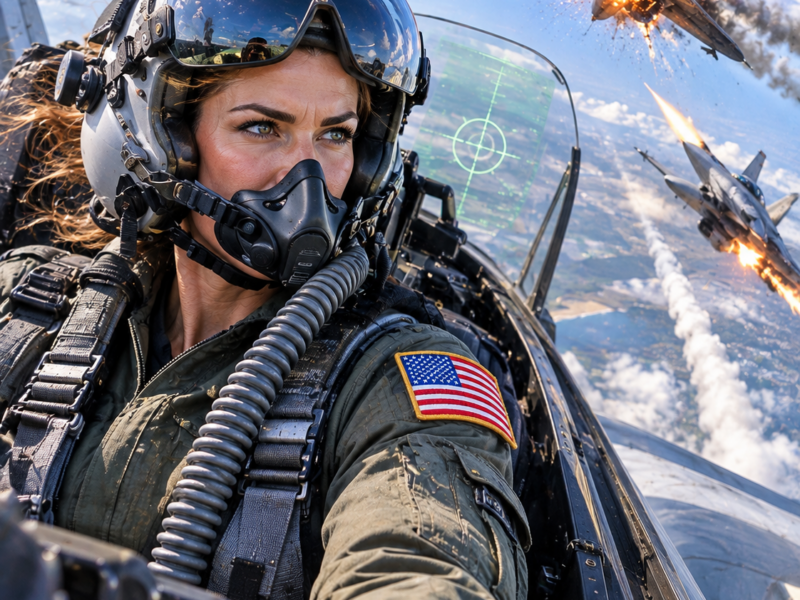
“They took my wings, gave me a desk, and told me my flying days were over. I didn’t argue. I just kept my old call sign buried
The seventh aircraft was still coming.
The six fighters that had turned away were disappearing beyond the northern boundary, but the seventh contact continued toward Falcon Ridge.
I stared at the radar.
“Daniels, confirm its altitude.”
“Low-level approach, Captain. It’s moving beneath the main radar coverage.”
“Speed?”
“Too fast for a conventional transport. Much slower than the fighters.”
I leaned closer.
“That’s not an attack aircraft.”
Commander Blake stepped beside me.
“How can you possibly know that?”
“Because if they wanted to strike the runway, they wouldn’t send one aircraft in alone after the rest of the formation retreated.”
Mason looked at the screen.
“Then what is it?”
I didn’t answer immediately.
The transmission had used my old call sign.
Ghost Hawk.
And the voice had spoken as though it knew exactly who I was.
I reached for the microphone.
“Viper Lead, this is Captain Elena Hayes. Identify the seventh aircraft.”
Static.
Then the older voice returned.
“Still asking questions before you act, Ghost Hawk?”
My fingers tightened around the microphone.
I knew that voice.
I had heard it eleven years earlier, over a different radio, during a mission that had officially never happened.
“Commander Adrian Cross,” I whispered.
Blake turned toward me.
“Who?”
“An enemy flight commander. He led the squadron that ambushed us over the northern sea.”
“That operation was classified.”
“Apparently, not to him.”
The voice came again.
“Your government told the world you were responsible for the loss of your wingman. Did they tell you why he died?”
I felt the air leave my lungs.
“Where is the seventh aircraft?”
“Look at your western perimeter.”
Daniels immediately adjusted the radar.
A moment later, he found it.
The contact was approaching the old maintenance runway, a section of the base that had been closed for years.
“That’s impossible,” Blake said. “Nobody has clearance to use that runway.”
“Someone does,” I replied.
I turned toward the communications officer.
“Open a secure channel to the aircraft. Tell them to identify themselves and maintain their current course.”
Blake stepped in front of me.
“You’re not authorized to issue orders.”
“Then authorize me.”
He stared at me.
For six months, he’d treated me like a clerk who had accidentally wandered into a command center.
Now he was looking at the radar, at the approaching aircraft, and at the woman who had recognized an enemy commander before anyone else knew his name.
“Hayes,” he said, “what are you not telling us?”
I looked at him.
“Everything you need to know is about to land on that runway.”
***
The seventh aircraft appeared through the morning haze.
It was a small military transport, dark gray, with no visible identification markings.
It crossed the outer fence and descended toward the abandoned runway.
The command center fell silent.
“Sir, we need to stop it,” Mason said.
Blake grabbed the microphone.
“Unidentified aircraft, you are entering a restricted military installation. Abort landing immediately.”
The pilot didn’t respond.
Instead, a new transmission came through.
“Ghost Hawk, this is Raven One. Requesting permission to land.”
My heart stopped.
Raven One.
That had been my wingman’s call sign.
Lieutenant Daniel Mercer.
The man the official report said had died eleven years ago.
I gripped the edge of the console.
“Repeat your identification.”
“Raven One. Requesting permission to land.”
I couldn’t speak.
Mason looked at me.
“Captain?”
I closed my eyes for one second.
Then I pressed the microphone.
“Raven One, this is Ghost Hawk. State your name.”
A pause.
Then a voice I had spent eleven years trying to forget answered.
“Hello, Elena.”
My knees almost gave way.
It was Daniel.
Not a recording.
Not a memory.
Daniel Mercer was alive.
“Where have you been?” I whispered.
“Somewhere I couldn’t call you.”
“Why now?”
“Because they’re coming for the evidence.”
I looked at the radar.
The six fighters had disappeared beyond the boundary, but the seventh aircraft was still descending.
“Who is coming?”
“The people who arranged the ambush. And they know I have proof.”
The landing gear deployed.
The aircraft touched down hard, bounced once, and rolled toward the far end of the runway.
Blake immediately ordered security to the landing area.
“Nobody approaches that aircraft until we know what’s inside.”
I grabbed my jacket.
“Commander, I’m going with the security team.”
He shook his head.
“Absolutely not.”
“That’s my wingman.”
“That doesn’t change the security procedure.”
I looked directly at him.
“Then change the procedure.”
For several seconds, neither of us moved.
Finally, he turned toward the security officer.
“Take Captain Hayes with you. Keep her behind the perimeter until the aircraft is secured.”
I was already heading for the door.
***
The transport stopped near the old hangar.
Two armed security vehicles approached from either side.
I followed them in a utility vehicle, my old flight jacket folded across my lap.
When we reached the runway, the aircraft’s side door opened.
A man appeared.
He was thinner than I remembered.
His hair was almost completely gray, and he leaned heavily on a metal walking stick.
But I recognized his face.
Daniel Mercer.
He looked at me and smiled.
“Still wearing that jacket?”
I stepped out of the vehicle.
“Still making terrible landings?”
He laughed.
Then we stood facing each other.
Eleven years of unanswered questions stood between us.
I wanted to ask where he’d been.
I wanted to ask why he’d never contacted me.
I wanted to ask why I’d been forced to attend a memorial for a man who was standing right in front of me.
Instead, I said the only thing I could manage.
“I thought you were dead.”
His smile disappeared.
“I know.”
He reached into his jacket and pulled out a small metal identification tag.
It had my old call sign engraved on one side.
GHOST HAWK.
I stared at it.
“Where did you get that?”
“You dropped it when you ejected.”
I remembered the night instantly.
My aircraft had been hit.
I had struggled with the harness, fought the smoke, and finally pulled the ejection handle.
The last thing I remembered before losing consciousness was seeing Daniel’s aircraft disappear into the clouds.
“I found it after the crash,” he said. “I’ve kept it ever since.”
I swallowed.
“Why didn’t you come home?”
His eyes moved toward the hangar.
“Because the men who ordered that mission wanted both of us gone.”
Before I could ask another question, the security officer approached.
“Captain, the commander wants the passenger secured and questioned.”
Daniel shook his head.
“Not here.”
“Why?” I asked.
He looked at me.
“Because this base has already been compromised.”
***
Back in the command center, Daniel placed a small black case on the table.
Commander Blake stood opposite him.
Mason remained near the door.
“Start talking,” Blake said.
Daniel opened the case.
Inside was a collection of storage devices, printed flight records, and a damaged communications module.
“This is the original mission archive from the northern sea operation eleven years ago.”
Blake looked at the items.
“How did you obtain classified military records?”
“I was there.”
“Your service record says you died.”
“Your records are wrong.”
Blake’s expression hardened.
“Then explain why.”
Daniel looked at me.
“Tell him what happened that night.”
I took a breath.
“We were assigned to escort a reconnaissance aircraft through an international monitoring corridor. Our orders were to observe and report. No engagement unless directly threatened.”
Daniel nodded.
“About twenty minutes into the mission, our communications system received a new target designation.”
I remembered it.
A cluster of unidentified aircraft.
A sudden change in altitude.
A command to hold formation.
“Command said the contacts were hostile,” I continued. “But their flight pattern didn’t match the identification.”
Daniel placed a recording device on the table.
“Because they weren’t hostile.”
He pressed a button.
A crackling voice filled the room.
“Ghost Hawk, maintain course. Target identification confirmed.”
It was the voice of our former mission controller.
I remembered answering.
“Command, we have visual discrepancies. Request confirmation.”
Then came the response.
“Maintain course. Authorization confirmed.”
Daniel stopped the recording.
“That was the moment everything changed.”
Blake looked at him.
“What was the target?”
Daniel turned the screen toward us.
A photograph appeared.
It showed a military transport aircraft carrying a sensor package.
Our mission had been ordered to intercept it.
But the aircraft belonged to a friendly intelligence unit.
It had been carrying evidence of an unauthorized weapons program.
I stared at the photograph.
“They told us it was an enemy aircraft.”
“Yes,” Daniel replied.
“Why?”
“Because the people behind the program wanted the aircraft destroyed before it reached its destination.”
Mason looked confused.
“What program?”
Daniel opened another file.
“An experimental combat system called NIGHTFALL. It was designed to coordinate aircraft, radar installations, and automated targeting platforms without requiring direct approval from a human commander at every stage.”
Blake frowned.
“That system was never deployed.”
“Not officially.”
Daniel enlarged a series of documents.
“The system was being tested in live operations. It could alter target identification, interfere with communications, and issue false engagement orders.”
I felt cold.
“You’re saying it turned our squadron against a friendly aircraft?”
“I’m saying it tried.”
I looked at the old recording.
The sudden targeting warning.
The communications failure.
The explosion.
“Who was responsible?”
Daniel hesitated.
Then he pointed to a signature at the bottom of the document.
General Marcus Voss.
The name was familiar.
Voss had been the senior commander overseeing our northern operations.
He had also chaired the investigation that ended my flying career.
“He’s retired,” Blake said.
Daniel shook his head.
“Retired officers can still have influence. And Voss never stopped protecting NIGHTFALL.”
Blake leaned closer.
“Why bring this here?”
“Because the system is active again.”
A warning tone sounded from the radar station.
Daniels’ voice came through the speakers.
“Commander, we’re detecting new contacts beyond the northern boundary.”
I turned toward the display.
Six aircraft.
The same formation.
Only this time, they weren’t retreating.
They were coming back.
***
“How many?” Blake asked.
“Six confirmed,” Daniels replied. “Possibly more beyond the current scan.”
I moved toward the screen.
Their formation was tighter now.
They were approaching from two different altitudes, with one aircraft moving ahead of the others.
I recognized the pattern.
“That’s Cross’s squadron.”
Blake turned.
“You said they retreated.”
“They did. But they weren’t leaving. They were repositioning.”
Daniel looked at the radar.
“Cross wants us focused on the fighters.”
“What’s the real objective?” I asked.
He pointed to the southern side of the base.
“The data center.”
Blake immediately reached for his radio.
“Security, protect the data center. Lock down all access points.”
The response came quickly.
“Sir, we have an issue. The security network is not responding.”
Blake looked at Daniel.
“Can NIGHTFALL do that?”
Daniel nodded.
“It can interfere with the network if someone gives it the correct access.”
Mason looked at me.
“Then how do we stop it?”
I studied the radar.
The six aircraft were approaching in a familiar pattern.
The first pair was moving high.
The second pair was splitting toward the eastern side.
The final two were staying behind.
They were trying to force our attention in three directions.
I had seen this before.
Eleven years earlier, the same tactic had nearly killed us.
“They’re using a diversion,” I said.
Blake turned toward me.
“Explain.”
“The first pair wants us to launch interceptors. The second pair will draw our radar toward the eastern perimeter. The last two will approach the data center from the north.”
Daniel nodded.
“That’s Cross.”
I pointed to the screen.
“Except there’s one thing he hasn’t changed.”
“What?”
“He always leaves a gap in the center.”
Mason looked again.
“Why?”
“Because he expects someone to chase the lead aircraft and open the middle of the formation.”
I looked at Blake.
“We need to keep our aircraft on the ground until we know exactly what they’re targeting.”
“Then what do you propose?”
I hesitated.
The answer was something I had avoided thinking about for six months.
“Let me fly.”
Blake stared at me.
“Your flight status is suspended.”
“I know.”
“You’re not cleared for combat operations.”
“I know that, too.”
“Then why would you ask?”
I looked at the radar.
“Because Cross knows my call sign. He knows I understand his tactics. And he won’t believe anyone else is capable of challenging him.”
Blake shook his head.
“This isn’t a movie, Hayes. We can’t put someone in a cockpit just because the enemy knows her name.”
I turned toward him.
“Then don’t put me in a cockpit. Give me control of the air-defense coordination system.”
Daniel looked up.
“That’s the right move.”
Blake frowned.
“Why?”
“Because Ghost Hawk wasn’t famous for winning dogfights,” Daniel said. “She was famous for seeing the whole battlefield before anyone else.”
I looked at the display.
For the first time in six months, I felt something other than anger.
I felt useful.
***
The command center began to fill with officers.
The radar team worked to restore the damaged security network.
Mason took his position beside me.
“Captain, what do you need?”
I looked at him.
“Every radar source that still works. Civilian tracking, weather stations, neighboring airfields. Anything that can give us a second picture of the sky.”
He nodded and began moving.
Blake approached.
“Regional command is demanding an explanation. They want to know why I haven’t launched our reserve fighters.”
“Tell them we’re assessing an electronic interference threat.”
“They won’t accept that.”
“Then tell them the truth.”
He lowered his voice.
“They may remove me from command.”
I met his eyes.
“Would you rather lose your command or lose the base?”
He looked at the radar.
Then he picked up the phone.
“Regional command, this is Commander Blake. I am declaring an immediate security emergency. No aircraft is to launch without direct confirmation from this command center.”
He listened.
His expression tightened.
“Understood.”
He hung up.
“They’ve ordered me to transfer command authority to General Voss.”
Daniel went pale.
“That’s exactly what he wants.”
Blake looked at the screen.
“I refused.”
A new message appeared on the command display.
**REMOTE COMMAND ACCESS REQUESTED.**
Then another.
**AUTHORITY: GENERAL MARCUS VOSS.**
Blake stepped toward the console.
“Reject it.”
The system didn’t respond.
Mason looked up.
“Sir, someone has locked the interface.”
I moved closer.
“Can you isolate the external connection?”
“Trying.”
The display flashed again.
**REMOTE AUTHORITY ACCEPTED.**
Blake stared at the screen.
“How is that possible?”
Daniel looked at me.
“Because Voss doesn’t need the base commander to approve anything. NIGHTFALL has a secondary command channel.”
“Where?”
Daniel pointed toward the old communications facility.
“The original control system is still there.”
I remembered the abandoned building at the western end of the base.
It had been closed after the investigation.
Nobody had used it for years.
Or so we’d been told.
I turned to Blake.
“We need to disconnect that facility physically.”
He grabbed his radio.
“Security team to the western communications building. Move now.”
The response came after several seconds.
“Commander, we have movement outside the facility.”
“Identify.”
“Multiple personnel. They’re wearing base security uniforms.”
Blake looked at me.
I understood immediately.
“They’re not our security team.”
***
The radar screen flashed.
The six enemy aircraft were now approaching the northern perimeter.
At the same moment, a second alert appeared.
**UNAUTHORIZED PERSONNEL INSIDE WESTERN FACILITY.**
Mason looked at me.
“We have two problems.”
“Three,” Daniel said.
He pointed to the radar.
A new contact had appeared behind the enemy formation.
It was climbing rapidly.
“That’s the aircraft that was carrying the NIGHTFALL relay,” he said.
I leaned toward the display.
“Can you identify it?”
“Not yet.”
The radio crackled.
A familiar voice came through.
“Ghost Hawk, I know you’re listening.”
Adrian Cross.
I picked up the microphone.
“Cross.”
“Eleven years. I wondered when we’d speak again.”
“You’ve had plenty of chances.”
“I was told you were no longer flying.”
“I was told you were dead.”
He laughed.
“Then we have both been disappointed.”
I watched his aircraft approach the boundary.
“What do you want?”
“The archive.”
“You’re too late.”
“Not yet.”
He paused.
“Your friend has brought something that belongs to my government.”
Daniel leaned toward the microphone.
“Your government doesn’t own the truth.”
Cross ignored him.
“Elena, you know what happened the last time we met. Don’t make the same mistake.”
I looked at the radar.
“You’re the one repeating old tactics.”
“Am I?”
His formation changed.
The lead pair climbed.
The second pair moved outward.
The final two dropped low.
I felt my pulse quicken.
It was exactly the same pattern.
But this time, I knew what he was trying to hide.
“Daniels,” I said, “check the space between the second and third groups.”
He adjusted the scan.
A small contact appeared.
It was moving toward the base at low altitude.
“There,” I said.
Mason leaned closer.
“Another aircraft?”
“No. It’s a relay drone.”
Daniel’s face changed.
“That’s how they’re connecting to NIGHTFALL.”
I pointed to the display.
“Cross isn’t trying to attack the base directly. He’s trying to keep the relay drone close enough to restore the targeting network.”
Blake looked at the screen.
“Can we stop it?”
“Not with the main radar offline.”
I looked toward the western facility.
“Unless we cut the relay before it connects.”
Blake picked up his radio.
“Security team, status.”
A burst of static.
Then a voice answered.
“Commander, we’re pinned down outside the western building. The personnel inside have taken control of the access corridor.”
I turned toward Daniel.
“Is there another way into the facility?”
He nodded.
“An old maintenance tunnel. It connects the western building to the underground service area.”
“Can you get us there?”
“I can show you.”
Blake stepped forward.
“You’re not going anywhere.”
I looked at him.
“Then the relay stays active.”
He hesitated.
Mason spoke.
“Sir, let them go. I’ll coordinate the radar team.”
Blake looked at the young lieutenant.
Then at me.
Finally, he nodded.
“Take two security officers. Get in, identify the relay connection, and shut it down. Do not engage unless absolutely necessary.”
I picked up my jacket.
Daniel smiled faintly.
“Still following orders, Ghost Hawk?”
I looked at him.
“Only the sensible ones.”
***
The maintenance tunnel smelled of dust and old metal.
Daniel walked slowly, leaning on his stick.
I stayed close behind him, with two security officers following.
“How did you find this route?” I asked.
“I used to work at the facility.”
“Doing what?”
“Trying to prove NIGHTFALL was dangerous.”
I glanced at him.
“Before the mission?”
“After it. I was held at a restricted research site for years. They wanted to know how much I had discovered.”
I stopped walking.
“Who held you?”
“People working for Voss.”
“Why didn’t you escape?”
“I tried.”
He looked down at his injured leg.
“That’s how I got this.”
I swallowed.
“Daniel, I’m sorry.”
He shook his head.
“You don’t owe me an apology.”
We reached a metal door.
One of the security officers checked the lock.
“Access panel is active.”
Daniel leaned toward it.
“That’s not good.”
“Why?”
“Because this section was supposed to be disconnected.”
He examined the small control panel.
Then he looked at me.
“They’ve reactivated the old system.”
I heard a faint mechanical sound from the other side.
A door unlocking.
The officer raised his weapon.
“Someone’s coming.”
I stepped behind the wall.
Two men entered the corridor.
They wore base security uniforms, but their movements were wrong.
One of them carried a small electronic case.
The second held a radio.
“Control, we’re at the relay room,” he said. “Preparing connection.”
Daniel looked at me.
The relay room.
We were close.
I waited until the two men passed the doorway.
Then I moved.
“Stop!”
Both men turned.
One reached for his weapon.
The security officers moved between us.
A brief struggle followed.
The first man was disarmed.
The second tried to run, but Daniel blocked the corridor with his walking stick.
He stumbled and fell.
I secured the radio.
“Command center, this is Hayes. We have two unauthorized personnel detained. We’re entering the relay room.”
Blake answered immediately.
“Copy. Be careful.”
I opened the case the first man had been carrying.
Inside was a compact transmitter connected to a portable power unit.
Daniel stared at it.
“That’s the relay.”
“Can we shut it down?”
“Yes.”
He examined the connections.
Then his expression changed.
“Wait.”
“What?”
“It’s not just a relay. It’s also transmitting the archive.”
I looked at the transmitter.
“Whose archive?”
“Your original mission recordings.”
I felt my stomach tighten.
“They’re trying to erase them?”
“No. They’re trying to send them somewhere.”
“Where?”
Daniel looked at the display.
“An offshore command vessel.”
Before he could explain further, the transmitter began flashing.
**REMOTE PURGE INITIATED.**
“Get away from it!” Daniel shouted.
The screen started counting down.
Thirty seconds.
Twenty-nine.
I looked at the controls.
“Can you stop it?”
Daniel shook his head.
“Not from here.”
“Then what do we do?”
He pointed to the main power connection.
“Disconnect the local power.”
I reached for the cable.
The security officer stopped me.
“Captain, that could trigger the backup system.”
Daniel nodded.
“He’s right.”
The countdown reached twenty seconds.
I looked at the transmitter.
Then at the portable power unit.
“Can we isolate the backup battery?”
Daniel examined the side panel.
“Yes, but the access switch is locked.”
I looked at the two detained men.
“Who has the key?”
Neither answered.
The countdown reached twelve seconds.
Daniel leaned against the wall.
“Elena, listen to me. If the purge completes, the original archive will be destroyed.”
I looked at the control panel.
Then I noticed a small service label beneath the access switch.
It had a manual override code printed in faded ink.
I recognized the format.
It was the same code system used in our old aircraft.
“Daniel, what was our emergency maintenance code?”
He looked at me.
“Why?”
“Just tell me.”
He gave me the six digits.
I entered them.
The panel beeped.
**MANUAL ACCESS GRANTED.**
The countdown froze.
I opened the battery compartment and disconnected the backup supply.
The transmitter went dark.
For several seconds, nobody moved.
Then Daniel laughed softly.
“Still seeing things nobody else notices.”
I smiled.
“Some habits survive a desk job.”
***
When we returned to the command center, the radar display was almost entirely clear.
The six enemy aircraft had broken formation.
Two were turning north.
Two were climbing away from the base.
The final pair had disappeared from the primary screen.
“Where are the last two?” I asked.
Daniels answered.
“Moving west. They’re leaving the boundary.”
I looked at the screen.
“That’s too easy.”
Blake stepped beside me.
“Why?”
“Cross hasn’t confirmed his withdrawal.”
The radio crackled.
“Ghost Hawk.”
I picked up the microphone.
“Still here.”
“You’ve shut down the relay.”
“Yes.”
“Then you know what comes next.”
I looked at the radar.
The remaining aircraft were turning toward the coast.
“You’re retreating.”
Cross laughed.
“No. I’m giving you a chance.”
“To do what?”
“To hand over Mercer and the archive. If you refuse, the next time I come, there won’t be a warning.”
I stared at the screen.
“You’ve already lost your advantage.”
“Have I?”
The radar flashed.
A new signal appeared from the offshore direction.
Daniels looked alarmed.
“Commander, we’re detecting a long-range transmission.”
Daniel moved toward the console.
“That’s Voss.”
A message appeared.
**REMOTE DESTRUCTION AUTHORIZATION — PENDING.**
Blake stepped forward.
“What’s that?”
Daniel’s face went pale.
“Voss has another control system. If he activates it, the archive will be erased from every connected location.”
“Can he do that?”
“Yes.”
I looked at the display.
“Where is the command coming from?”
Daniels traced the signal.
“Offshore. Near the northern maritime boundary.”
Cross’s voice returned.
“Now you understand, Ghost Hawk. You can keep your base safe, or you can keep your evidence. You cannot have both.”
I pressed the microphone.
“You’re wrong.”
“Then prove it.”
The transmission ended.
I turned toward Daniel.
“Where is the offshore vessel?”
He pointed to the map.
“Approximately seventy miles north of the coast.”
“Can we reach it?”
Blake answered before he could.
“Not without authorization from regional command.”
I looked at him.
“Then request it.”
He shook his head.
“Voss controls regional command.”
I studied the map.
There was one other option.
The civilian maritime monitoring network.
It was independent of the military system.
If we could send the archive there, Voss couldn’t erase every copy.
“Daniels, can you establish an external data connection?”
“Through the civilian network?”
“Yes.”
He frowned.
“Possibly. But we’d need to restore the secure transmission system.”
I looked at the damaged communications module Daniel had brought.
“Can we use this?”
Daniel nodded slowly.
“That’s the original NIGHTFALL interface.”
“Then let’s use it against them.”
***
The next twenty minutes were the longest of my life.
Mason worked with the communications team to establish a connection through the civilian monitoring network.
Daniel prepared the archive.
Blake contacted neighboring installations and requested independent verification of the incoming aircraft.
I watched the radar.
Cross’s fighters were still in the area.
They had not fully withdrawn.
They were waiting.
“Connection established,” Mason announced.
Daniel inserted the storage device.
“Sending the archive.”
A progress bar appeared.
Ten percent.
Twenty.
Thirty.
Then the screen froze.
“What’s happening?” I asked.
Mason shook his head.
“External interference.”
Daniel looked at the signal display.
“Voss is trying to block the transmission.”
I leaned over the console.
“Can we switch to another channel?”
“Not without losing the connection.”
The progress bar moved again.
Forty percent.
Then fifty.
A warning appeared.
**REMOTE PURGE AUTHORIZATION RECEIVED.**
Blake grabbed the microphone.
“All units, prepare for emergency network isolation.”
I shook my head.
“Not yet.”
“Hayes, we may lose everything.”
“If we disconnect now, the archive won’t finish sending.”
The progress bar reached sixty percent.
Then the screen flashed red.
**PURGE IN TEN SECONDS.**
Daniel stared at the display.
“We need more time.”
I looked at the signal map.
The interference was coming from the offshore vessel.
But the civilian monitoring network had a second relay point farther south.
“Can we route through the southern station?”
Mason nodded.
“Yes, but it will take a few seconds to reconfigure.”
“Do it.”
He moved quickly.
The progress bar stopped.
The countdown continued.
Eight seconds.
Seven.
Six.
Then the route changed.
The connection stabilized.
Seventy percent.
Eighty.
Ninety.
The countdown reached one.
The screen went black.
For a moment, I thought we had lost.
Then a message appeared.
**ARCHIVE TRANSFER COMPLETE.**
Nobody spoke.
Daniel slowly lowered his head.
“It’s out.”
Blake looked at the screen.
“Where?”
Mason checked the confirmation.
“Three independent civilian monitoring stations. The original records have been duplicated.”
I exhaled.
For eleven years, the truth had existed in a handful of hidden files.
Now it was beyond the reach of the people who had buried it.
Then the radio crackled.
“Ghost Hawk.”
Cross.
I picked up the microphone.
“Go ahead.”
A long pause followed.
Then he spoke.
“You have made a serious mistake.”
I looked at the radar.
His six aircraft were now moving away from the boundary.
“Maybe. But at least this time, the truth will survive.”
The transmission ended.
***
The investigation began before sunset.
Independent monitoring stations confirmed the archive had been received.
Regional command was forced to acknowledge the unauthorized transmission.
General Marcus Voss was removed from his position pending investigation.
Within forty-eight hours, investigators secured the offshore command vessel and recovered additional NIGHTFALL records.
Adrian Cross and his squadron withdrew beyond the northern boundary.
The enemy had not been defeated in a conventional battle.
No missiles were fired.
No aircraft were lost.
But the operation they had come to protect had collapsed.
And for the first time in eleven years, the truth was no longer classified.
Daniel gave his testimony.
So did I.
The original investigation was reopened.
The report that had blamed me for the loss of my wingman was officially withdrawn.
The military acknowledged that the mission had been compromised by unauthorized command interference.
My flight suspension was lifted.
But the most important moment came when Daniel and I visited the memorial wall.
His name was still there.
Engraved among the pilots who had died in the northern sea operation.
I stood in front of it for a long time.
Then I touched the letters.
“How does it feel?” Daniel asked.
I swallowed.
“Strange.”
“Because they said you were dead?”
“Because they made us both disappear in different ways.”
He nodded.
We stood in silence.
Then I turned toward him.
“Are you going to fly again?”
He looked down at his damaged leg.
“Probably not.”
“I’m sorry.”
He smiled.
“Don’t be. I’ve spent eleven years trying to get home. I think I’ve earned the right to stay on the ground.”
I laughed.
Then he pointed at the wall.
“Besides, one of us should probably keep you out of trouble.”
***
Two weeks later, I was called into Commander Blake’s office.
He was standing beside a folder.
“Captain Hayes, take a seat.”
I sat.
He opened the folder.
“Your flight status has been formally restored.”
I looked at him.
“All restrictions?”
“All operational restrictions related to the previous investigation have been removed.”
He slid a second document across the desk.
“There’s also an offer from the training command. They want you to lead a new tactical awareness program.”
I raised an eyebrow.
“A desk job?”
He smiled.
“Not exactly.”
I read the assignment.
It involved training fighter pilots to recognize electronic interference, false targeting data, and coordinated aerial deception.
In other words, everything that had nearly killed us eleven years earlier.
“I’ll accept,” I said.
Blake nodded.
“I thought you might.”
Then he leaned back.
“There’s something else.”
I waited.
“Lieutenant Reed has requested to join your program as an assistant instructor.”
I smiled.
“Mason?”
“Apparently, he thinks he has something to learn.”
“Good. He does.”
Blake laughed.
For the first time since I’d arrived at Falcon Ridge, I felt that I belonged there.
Not because of my call sign.
Not because of what I had done in the past.
Because I finally had the chance to make sure the next generation of pilots would never have to endure what we had.
***
On my first morning back in the flight operations building, I found my old jacket hanging behind the office door.
The GHOST HAWK patch was faded.
One corner had begun to peel away.
Mason stood in the doorway.
“Captain, the new pilots are waiting.”
I looked at the jacket.
Then at him.
“Give me a minute.”
He nodded.
As he turned to leave, he stopped.
“Ma’am?”
“Yes?”
“Can I ask you something?”
“Go ahead.”
“Is it true that the enemy squadron turned away just because they heard your call sign?”
I considered the question.
“They didn’t turn away because they were afraid of a name.”
“Then why?”
“Because they remembered what happened the last time they underestimated the person behind it.”
Mason smiled.
“That’s a good answer.”
I put on the jacket.
The fabric felt familiar against my shoulders.
For six months, I had walked past it every morning, pretending that the woman who wore it no longer existed.
But she had never disappeared.
She had simply been waiting for a reason to return.
I followed Mason into the briefing room.
Twenty young pilots stood beside their seats.
Some looked confident.
Others looked nervous.
One glanced at my jacket and whispered something to the person beside him.
I placed my notebook on the table.
“Good morning.”
The room became quiet.
“I’m Captain Elena Hayes. Some of you may have heard stories about a pilot called Ghost Hawk.”
A few heads turned.
I looked around the room.
“Most of those stories are wrong. Some are exaggerated. And a few are true.”
I paused.
“But there’s one thing I want you to remember before we begin.”
I walked to the radar display.
“An aircraft can be fast. A weapon can be powerful. A command system can be advanced. But none of those things can replace a pilot who is willing to question what doesn’t make sense.”
I looked at Mason.
He nodded.
I turned back to the class.
“Your job is not simply to follow the picture on a screen. Your job is to understand what that picture is telling you—and what it might be hiding.”
Outside, a fighter jet roared down the runway.
I listened until the sound faded into the distance.
Then I opened the first training file.
For eleven years, the world had believed Ghost Hawk was gone.
For six months, Falcon Ridge had treated me as though my best days were behind me.
But the enemy had remembered.
And now, so had everyone else.
I wasn’t returning to the sky to prove that I could still fly.
I was returning because no one should ever again be forced to choose between obeying a false order and saving the people beside them.
My wings had never really been taken.
They had only been waiting for the truth to set them free.
And this time, when the radio called Ghost Hawk, I was ready to answer.
THE END.









