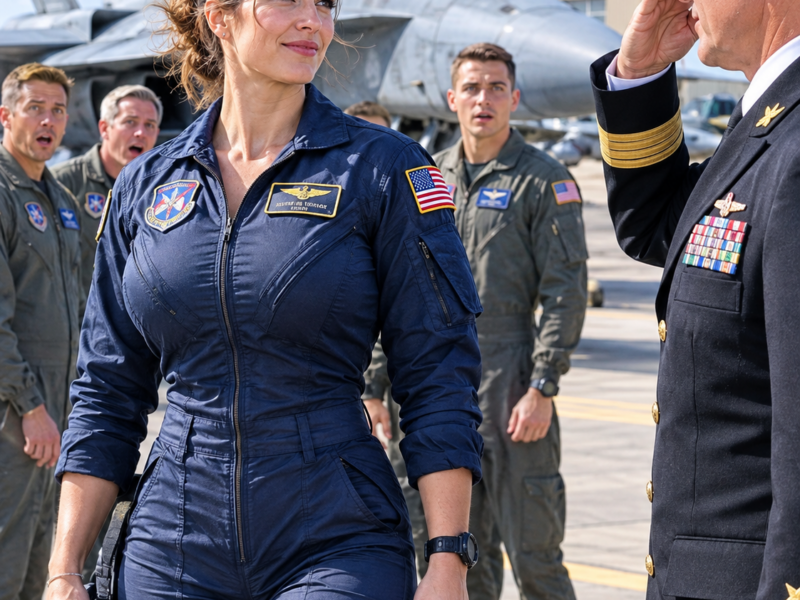
“They laughed when I was introduced as the admiral’s backup pilot, and one senior officer told me to stay away from the flight controls
“Three minutes until final authorization.”
I stared at the message on the screen.
Admiral Coleman still had his hand around my wrist.
“Rebecca, listen to me. If you answer that transmission, there’s no guarantee you’ll be able to control what happens next.”
I slowly pulled my arm away.
“Sir, a man who has been officially dead for eleven years just called me by my first name. I think we’re past the point of pretending this is a routine exercise.”
Coleman looked toward the communications officer.
“Clear the room. Everyone except Commander Hayes, Lieutenant Brooks, and the communications team.”
Several officers exchanged nervous glances.
Nobody argued.
When the door closed, the admiral leaned toward the console.
“Tell me exactly what you recognize.”
I pointed to the encrypted frequency.
“That’s an old Raven emergency channel. The signal pattern is specific to our original flight coordination system. It was discontinued after the incident eleven years ago.”
“Who had access?”
“Six pilots, two mission coordinators, and the senior command officer.”
“Names?”
I looked at him.
“One of them is speaking to us right now.”
The radio crackled.
“Raven Six, respond. We don’t have much time.”
Michael Reeves.
Eleven years earlier, he had been my wingman, my closest friend, and the person who had pulled me out of a burning aircraft after our mission went wrong.
At least, that was what I remembered.
The official report said his aircraft had exploded over the Pacific.
His remains were never recovered.
I had spent months refusing to believe the report.
Then the military held a memorial.
I stood beside his family and listened to people describe a man who, according to everything I knew, might still be alive.
Now his voice was coming through my radio.
“Admiral,” I said, “I need to answer him.”
Coleman shook his head.
“Not until I know what you’re dealing with.”
“With respect, sir, he knows my call sign. He knows I’m here. Whoever he is, he has access to information that should no longer exist.”
The admiral stared at the screen.
Then he gave a reluctant nod.
“One transmission. Nothing more.”
I put on the headset.
“Ghost Actual, this is Raven Six. Identify your location.”
Static filled the room.
Then Michael answered.
“Rebecca. Thank God.”
I gripped the edge of the console.
“Where are you?”
“Not safe.”
“That’s not an answer.”
“I know. Listen to me. The three aircraft you see aren’t hostile. They’re trying to reach the base.”
The radar operator looked up.
“Ma’am, their flight paths are changing.”
Michael continued.
“They’re carrying the original Raven mission archive. The system has been programmed to classify them as hostile if they cross the eastern boundary.”
“Who programmed it?”
A pause.
“Someone at your command center.”
I turned toward the admiral.
He looked genuinely surprised.
“That’s impossible,” he said.
Michael’s voice returned.
“Rebecca, don’t trust the authorization countdown.”
The communications officer pointed at the display.
“Sir, two minutes and twenty seconds.”
The message beneath the countdown changed.
**FINAL AUTHORIZATION: COMMAND APPROVAL REQUIRED.**
I looked at the admiral.
“Who has authorization to approve this?”
He frowned.
“Only the base commander and the regional command authority.”
“Can you cancel it?”
“Not without knowing what we’re canceling.”
I pressed the transmit button.
“Michael, what happens when the countdown reaches zero?”
His answer came immediately.
“The three aircraft will be designated hostile, and your own pilots will receive an interception order.”
I looked at the radar.
Brooks and the other demonstration pilots were still airborne.
If they followed that order, they could end up attacking aircraft carrying the only surviving evidence of what happened during Raven Six.
“How do we stop it?”
“You need to revoke the original field command authorization.”
I glanced at the admiral.
He had gone very still.
“That’s not possible,” he said.
I turned toward him.
“Why?”
He didn’t answer.
Then Michael spoke again.
“Because the person who issued the original authorization is still listed as the system’s controlling officer.”
I looked at the screen.
The old records appeared beneath the countdown.
One name.
One signature.
One command authority.
Admiral Richard Coleman.
I slowly turned toward him.
“Sir?”
His expression changed.
Not with surprise.
With recognition.
And something that looked very much like regret.
***
“Everyone out,” Coleman ordered.
The communications officer hesitated.
“Sir?”
“Now.”
The technicians left, followed by Ryan Brooks.
Ryan was the last one through the door.
Before it closed, he looked at me.
I gave him a small nod.
Then the admiral placed both hands on the console.
“Rebecca, there’s something I should have told you when you arrived.”
I waited.
“Eleven years ago, I was the senior operations commander responsible for Raven Six.”
“I know.”
“No. You know what your mission records say. You don’t know what happened afterward.”
He opened a secure file.
A photograph appeared on the screen.
It showed six pilots standing beside three naval aircraft.
I recognized every face.
Mine.
Michael’s.
And four others.
One of them was Commander Daniel Price, the officer who had led our final mission briefing.
Coleman pointed at him.
“Price was not just your mission coordinator. He was the person who approved the revised flight plan that sent your formation into the interference zone.”
I frowned.
“That route was supposed to be safe.”
“It wasn’t.”
“Then why did you approve it?”
“Because I was told the electronic interference was part of the exercise.”
I stepped closer.
“Who told you?”
Coleman hesitated.
“Admiral Thomas Harlan.”
I knew the name.
Harlan had been the regional commander at the time.
He had retired several years earlier after a distinguished career.
According to his official biography, he had overseen multiple successful aviation modernization programs.
“Why would he send us into an unsafe zone?”
Coleman looked at the photograph.
“Because Raven wasn’t just an experimental communications system.”
I felt my jaw tighten.
“Then what was it?”
“A test of autonomous combat coordination.”
I stared at him.
“We were told the system was designed to protect pilots when communications failed.”
“That was the public explanation.”
“And the real purpose?”
Coleman closed the file.
“To determine whether a command network could identify and engage targets without waiting for human authorization.”
I shook my head.
“That was never approved.”
“No.”
“Then why were we flying it?”
“Because the people funding the program wanted operational results.”
I remembered the night of the mission.
The strange radar readings.
The sudden loss of communication.
The aircraft that appeared on our screens without identification.
And the final order that had sent us toward the interference zone.
“Michael found out,” I said.
Coleman nodded.
“He discovered that the system had been modified. He tried to report it.”
“And the others?”
“Some of them knew. Others didn’t.”
“What happened to the formation?”
Coleman looked down.
“Your aircraft was hit by debris after the system malfunctioned. You managed to eject. Michael disappeared while attempting to help you.”
“That isn’t what the report said.”
“I know.”
“Why did you let them call him dead?”
His voice became quieter.
“Because I believed he was.”
I stared at him.
“That’s not enough.”
“No,” he admitted. “It isn’t.”
He opened another file.
It contained a series of messages from the week following our mission.
One had been sent to him by Harlan.
**ALL SURVIVING PERSONNEL MUST BE REMOVED FROM ACTIVE OPERATIONS.**
Beneath it was another instruction.
**RAVEN ARCHIVE TO REMAIN UNDER RESTRICTED CONTROL.**
I read it twice.
“Did you know Michael was alive?”
Coleman shook his head.
“Not then.”
“Then when?”
“Three years ago.”
The words landed harder than I expected.
I stepped away from the console.
“Three years?”
“I received an encrypted transmission from him. He claimed the original mission data still existed.”
“And you did nothing?”
“I tried to verify it.”
“How?”
“Through an independent investigation.”
“Did you tell anyone?”
“No.”
“Why?”
“Because the transmission included evidence that senior officers were still protecting the program.”
I stared at him.
“You could have contacted me.”
“I considered it.”
“But you didn’t.”
“No.”
I looked at the countdown.
One minute and forty seconds.
“Then you can explain the rest to investigators.”
I reached for the microphone.
Coleman caught my attention.
“Rebecca, wait.”
I turned.
“There’s one more thing.”
He brought up the authorization record.
The system displayed his name as the controlling officer, but a second credential was active beneath it.
A field commander authorization.
Mine.
I stared at the screen.
“Why is my identity in this system?”
“Because you were the last surviving Raven field commander.”
“I never agreed to remain part of the program.”
“I know.”
“Then who activated my credentials?”
Coleman looked at the screen.
“I don’t know.”
The radio crackled.
Michael’s voice came through.
“Rebecca, they’re trying to force the authorization.”
I leaned toward the microphone.
“Who is?”
“Price.”
My stomach tightened.
“Daniel Price?”
“Yes. He’s alive, and he’s running the operation.”
The countdown reached one minute.
***
I opened the flight-control interface.
“Michael, tell me where the three aircraft are.”
“Approximately twelve miles northwest of your base.”
“Are they carrying pilots?”
“Yes. Two are crewed. The third is operating remotely.”
I looked at the radar.
The contacts were moving closer.
“What’s in the archive?”
“Original flight recordings, command logs, and the authorization trail from the night of the incident.”
“Can you transmit it directly?”
“Not while the system is active. The network is blocking external access.”
Ryan’s voice suddenly came through the door.
“Commander Hayes!”
I turned.
He entered with a tablet in his hand.
“Sorry, ma’am. The communications team found something.”
“What?”
He placed the tablet on the console.
“An encrypted command was sent from inside the base seven minutes before the unidentified aircraft appeared.”
The sender information was partially hidden.
But the access terminal was clear.
**REGIONAL OPERATIONS — AUTHORIZED USER.**
“Who has access to that terminal?” I asked.
Ryan hesitated.
“Only senior command personnel.”
The admiral looked at the tablet.
“That’s my operations office.”
I glanced at him.
“Then someone used your credentials.”
He shook his head.
“I never authorized this.”
Ryan enlarged the transmission details.
“There is another signature attached.”
The name appeared.
COMMANDER DANIEL PRICE.
The room went silent.
I looked at Coleman.
“Where is Price now?”
“He’s retired.”
“That’s not what I asked.”
The admiral immediately reached for his radio.
“Security, locate Commander Price. Check his current access records and secure all restricted terminals.”
The response came seconds later.
“Sir, we have a problem.”
“What?”
“Commander Price entered the base twenty minutes ago.”
I looked at the clock.
“Where is he?”
“Last seen near the primary communications facility.”
Coleman turned toward me.
“Lock down the building.”
The radio crackled again.
“Sir, we can’t.”
“Why not?”
“Someone has disabled the internal access controls.”
The countdown reached forty seconds.
Then the screen flashed.
**FINAL AUTHORIZATION IN PROGRESS.**
Michael’s voice broke through.
“Rebecca, you have to stop the command!”
I stared at the authorization panel.
There were two options.
ACCEPT.
REVOKE.
The problem was that neither was simple.
Accepting would authorize the interception order.
Revoking would shut down the entire Raven network, including the communication system carrying Michael’s transmission.
If I chose incorrectly, the three aircraft could be destroyed.
And if I lost contact with Michael, we might never recover the evidence.
I looked at Coleman.
“Can you authenticate the original command?”
He shook his head.
“Not without the second authorization.”
“Mine.”
“Yes.”
I placed my hand on the console.
Then I stopped.
Something about the screen bothered me.
The system wasn’t asking for my authorization to cancel the mission.
It was asking for my authorization to continue it.
I had seen that wording before.
Eleven years earlier, during the final mission briefing, Price had used the same language.
He had told us that if communications failed, the system would automatically request confirmation from the field commander.
At the time, we believed it was a safety feature.
Now I understood.
The system wasn’t waiting for me to stop an attack.
It was waiting for me to approve one.
“Ryan,” I said, “can you trace the authorization source?”
He moved to the secondary terminal.
“Give me thirty seconds.”
“We have twenty.”
“Then I need you to trust me.”
I stepped aside.
Ryan began typing.
The countdown reached twenty seconds.
Fifteen.
Ten.
Then his screen changed.
“I found it!”
“What?”
“The authorization is being transmitted from the primary communications facility.”
“Can you block it?”
“Yes, but I need the physical access code.”
I looked at Coleman.
“Who has that code?”
He answered immediately.
“Commander Price.”
The countdown reached five seconds.
Then the system displayed a new message.
**FIELD COMMANDER AUTHORIZATION ACCEPTED.**
The room erupted in alarms.
I stared at the screen.
“I didn’t authorize anything.”
Ryan looked at his tablet.
“Someone copied your credentials.”
The radar display changed.
All three unidentified aircraft were now marked hostile.
And an interception order appeared beside Lieutenant Brooks’s aircraft.
***
“Falcon Two, break formation immediately!”
I grabbed the microphone.
Brooks answered at once.
“Control, we’re receiving an order to intercept the three unknown aircraft.”
“Disregard that order.”
“Ma’am, the order carries regional command authorization.”
“Lieutenant, this is Commander Hayes. Disregard it.”
There was a pause.
“Understood.”
The admiral moved toward the main console.
“All units, hold position. No weapons release without direct confirmation from this command.”
A second voice interrupted.
“Negative. Interception order remains valid.”
I recognized it.
Daniel Price.
His voice came through the command channel.
“Admiral Coleman, you are interfering with an authorized security operation.”
Coleman took the microphone.
“Commander Price, identify yourself and explain your presence on this installation.”
“That is not necessary.”
“It is now.”
Price gave a short laugh.
“Richard, you should have stayed retired.”
I leaned toward the microphone.
“Daniel.”
The line went quiet.
Then he answered.
“Rebecca Hayes.”
“You’ve been using my credentials.”
“I’ve been using the authority you abandoned.”
“I didn’t abandon anything.”
“You walked away from the program.”
“Because the program was dangerous.”
“Because you couldn’t accept what happened.”
I felt my fingers tighten around the microphone.
“You sent us into an operation without telling us the truth.”
“We were testing a system.”
“You were testing a weapon without authorization.”
“We were advancing military technology.”
“You almost killed your own pilots.”
Price’s voice hardened.
“War doesn’t wait for people to feel comfortable.”
I looked at the radar.
The three aircraft were approaching the boundary.
“Call off the interception.”
“I can’t do that.”
“Can’t or won’t?”
“Those aircraft are carrying classified material.”
“They’re carrying evidence.”
“They’re carrying stolen military property.”
I glanced at Coleman.
He was watching the console with a grim expression.
Price continued.
“Rebecca, you have no idea what you’re interfering with.”
“Then explain it.”
“The program was never intended to be perfect. It was intended to be effective.”
“By attacking unidentified aircraft?”
“By removing human hesitation from combat decisions.”
I shook my head.
“Human hesitation is sometimes the only thing that prevents a mistake from becoming a tragedy.”
For a moment, nobody spoke.
Then Price said something I hadn’t expected.
“You should have died that night.”
The words were quiet.
Almost casual.
I stared at the radio.
“What?”
“Your aircraft was never supposed to make it back.”
Coleman stepped closer.
“Price, stop talking.”
But Price continued.
“The system had already identified your formation as a threat. Michael interfered with the command sequence. You were never supposed to survive the resulting engagement.”
I felt the room tilt.
Eleven years of memories rearranged themselves.
The failed identification.
The sudden targeting lock.
The command to maintain course.
Michael’s desperate warning.
The explosion.
I had spent years believing we had been victims of a malfunction.
But it hadn’t been a malfunction.
It had been an authorized test.
“Did you know?” I whispered.
Price didn’t answer.
I turned toward Coleman.
He looked devastated.
“I suspected,” he said. “I never had proof.”
I looked back at the console.
The interception order was still active.
I couldn’t allow another pilot to become part of that experiment.
“Ryan, can you cut the external authorization?”
“I’m trying.”
“How long?”
“Ten seconds.”
Price’s voice came through again.
“Don’t do this, Rebecca.”
I pressed the microphone.
“You had eleven years to tell the truth.”
Then I turned toward the admiral.
“Sir, I need your command authorization to revoke the Raven network.”
Coleman hesitated.
“If we do that, we lose the entire system.”
“Yes.”
“And we may lose contact with the aircraft.”
“Yes.”
He looked at the radar.
Then at the names of the pilots.
“Do it.”
I entered the cancellation command.
The system rejected it.
**ADMINISTRATIVE AUTHORITY REQUIRED.**
Coleman placed his hand on the console.
“Richard Coleman. Regional command authority. Revoke Raven authorization.”
The screen flashed.
**AUTHORITY ACCEPTED.**
I pressed the final command.
For one second, nothing happened.
Then every Raven-related channel went silent.
The targeting markers disappeared.
The interception order vanished.
And the three unidentified aircraft returned to their original status.
FRIENDLY — IDENTIFICATION PENDING.
The communications officer looked up.
“Sir, the weapons authorization has been disabled.”
I exhaled.
“Contact the aircraft. Tell them to maintain their current course and prepare for a controlled landing.”
The radio crackled.
Brooks’s voice came through.
“Control, Falcon Two. We have visual confirmation of the incoming aircraft. No hostile behavior observed.”
The admiral nodded.
“Bring them home.”
***
The three aircraft landed twenty minutes later.
The first two were conventional naval aircraft carrying two pilots each.
The third was an unmanned test platform, modified to transport a secure data module.
When the cockpit of the lead aircraft opened, Michael Reeves climbed down.
He looked older.
His hair had turned gray at the temples, and he moved with a slight limp.
But he was alive.
I stood beside the hangar doors.
For a moment, I couldn’t move.
Then he saw me.
“Raven Six.”
I laughed through the tears I hadn’t realized were there.
“You’re late, Ghost Actual.”
He smiled.
“Traffic.”
I walked toward him.
He opened his arms, and I hugged him.
Not carefully.
Not formally.
I held on the way I had wanted to eleven years earlier when they told me he was gone.
When we finally stepped apart, he looked at me.
“You look different.”
“So do you.”
“Still flying?”
“Apparently, I’m just the backup pilot now.”
He laughed.
Then his expression softened.
“I’m sorry, Rebecca.”
I looked at him.
“For what?”
“For letting you believe I was dead.”
“You didn’t have much choice, did you?”
He looked away.
“No.”
I didn’t ask him to explain everything there.
There would be time for that.
For now, he was standing in front of me.
And that was enough.
***
The investigation began the following morning.
The archive recovered from the aircraft contained thousands of pages of records, audio files, flight logs, and authorization documents.
It showed that the Raven system had been modified to conduct unauthorized weapons trials.
It also revealed that the original mission eleven years earlier had been deliberately redirected into an electronic interference zone.
Daniel Price had approved the change.
Several senior officials had known about the program.
Some had actively protected it.
Others had looked away because they believed the technology would eventually justify the risks.
The most important evidence was a recording from the night of our mission.
I listened to it in a secure interview room with Michael sitting beside me.
The audio began with the familiar sound of cockpit communications.
Then Price’s voice came through.
“Raven formation, maintain course. Target identification is confirmed.”
Michael answered.
“Negative. We’re seeing friendly identification codes.”
Price replied.
“Disregard. Maintain course.”
I heard my own voice.
“Command, confirm authorization.”
There was a pause.
Then Price said:
“Authorization confirmed.”
Michael spoke again.
“Rebecca, break right. Something’s wrong.”
A warning alarm sounded.
Then the recording ended.
I sat very still.
Michael looked at me.
“You didn’t know.”
“No.”
“You followed the order you were given.”
I stared at the table.
“People died because I trusted it.”
“People died because someone lied to us.”
I closed my eyes.
For years, I had replayed that mission in my head, searching for the decision I could have made differently.
I had blamed myself for surviving.
I had wondered whether I should have recognized the danger sooner.
Now I finally had the evidence.
The system hadn’t failed us.
The people controlling it had.
And that distinction mattered more than I could explain.
***
Daniel Price was detained before he could leave the country.
The investigation later resulted in multiple criminal charges related to the unauthorized weapons testing, falsification of military records, and obstruction of the investigation into Raven Six.
Admiral Coleman voluntarily stepped aside while his actions were reviewed.
He admitted that he had received warnings about the program and had failed to pursue them aggressively enough.
He didn’t try to defend himself.
During one of our final conversations, he told me something I hadn’t expected.
“I thought keeping the program contained would prevent more people from getting hurt.”
I looked at him.
“Sometimes silence protects the people causing the damage.”
He nodded.
“I know that now.”
I didn’t hate him.
But I couldn’t pretend his choices hadn’t mattered.
The memorial records were corrected.
Michael Reeves and the other surviving members of the original unit were officially recognized.
The families of those who had died finally received the truth about the mission.
It didn’t bring anyone back.
But at least their names were no longer attached to a lie.
***
Three months later, I was summoned to a formal ceremony at the naval air station.
I expected a small gathering.
Instead, the auditorium was full.
Pilots, maintenance crews, senior officers, and several families of the original Raven Six personnel were present.
Michael sat in the front row.
Ryan Brooks stood with the other young pilots.
Admiral Coleman had returned to attend as a witness, although he no longer held operational command.
The new commander stepped to the podium.
“Today, we recognize the service of Lieutenant Commander Rebecca Hayes.”
I shifted uncomfortably in my chair.
I had never enjoyed ceremonies.
He continued.
“Eleven years ago, Commander Hayes survived an operation that was misrepresented and concealed. Her actions during the recent incident prevented an unauthorized weapons system from targeting friendly aircraft and helped expose the truth behind that operation.”
The room applauded.
I walked to the stage.
A medal was placed in my hand.
But what caught my attention was the next announcement.
“The Navy has also approved the restoration of Commander Hayes’s operational flight status, subject to her own decision.”
I looked at the commander.
He smiled.
“The choice is yours.”
For a moment, I couldn’t speak.
I had spent eleven years believing that my career had ended because of what happened during Raven Six.
Now I was being offered the opportunity to return.
I looked toward Michael.
He nodded.
Then I saw Ryan.
The young lieutenant who had laughed when I first walked into the briefing room was standing at attention.
He gave me a small, respectful smile.
I looked back at the commander.
“Thank you, sir.”
He handed me the microphone.
“Do you accept?”
I thought about the aircraft.
The people who had trusted me.
The people who had never come home.
And the young pilots who were still learning that the hardest part of flying wasn’t always controlling the aircraft.
Sometimes it was knowing when to question the person giving the orders.
“Yes, sir,” I said. “But I’d like to keep teaching, too.”
He nodded.
“I believe we can arrange that.”
***
The following morning, I returned to the briefing room.
The same room where Tyler Brooks had once asked where the actual backup pilot was.
Ryan was waiting beside the instructor’s desk.
He stood up when I entered.
“Good morning, Commander.”
“Morning, Lieutenant.”
He handed me a folder.
Inside was the new flight schedule.
My name appeared beside the lead instructor assignment.
I smiled.
“Looks like someone made a mistake.”
Ryan frowned.
“Ma’am?”
“Apparently, they gave me more work.”
He laughed.
Then he became serious.
“Commander, can I ask you something?”
“Go ahead.”
“When you heard Michael’s call sign that morning, did you know you were going to take control?”
I thought about it.
“No.”
“Then how did you know what to do?”
I placed the folder on the desk.
“I didn’t know everything. I just knew that ignoring what I recognized would have been worse.”
He nodded.
I looked around the room.
A new group of pilots was beginning to arrive.
Some were confident.
Some were nervous.
And a few were already trying to prove they belonged.
I understood them better than they realized.
“All right,” I said, opening my notebook. “Let’s begin.”
Outside, an aircraft engine started.
I could hear the familiar roar through the windows.
For eleven years, my call sign had existed only in sealed files and the memories of people who had been told to forget it.
Now it had a different meaning.
Not a secret.
Not a weapon.
Not a reminder of the people who had betrayed us.
It was a reminder of the people who had survived, the truth that had finally been heard, and the pilots who would never again have to choose between following an order and protecting the lives entrusted to them.
I had arrived at Fallon as the backup pilot nobody respected.
I stayed because I had finally found something worth flying for again.
And when the radio crackled that morning, I no longer needed anyone to tell me who I was.
I was Raven Six.
The end.









