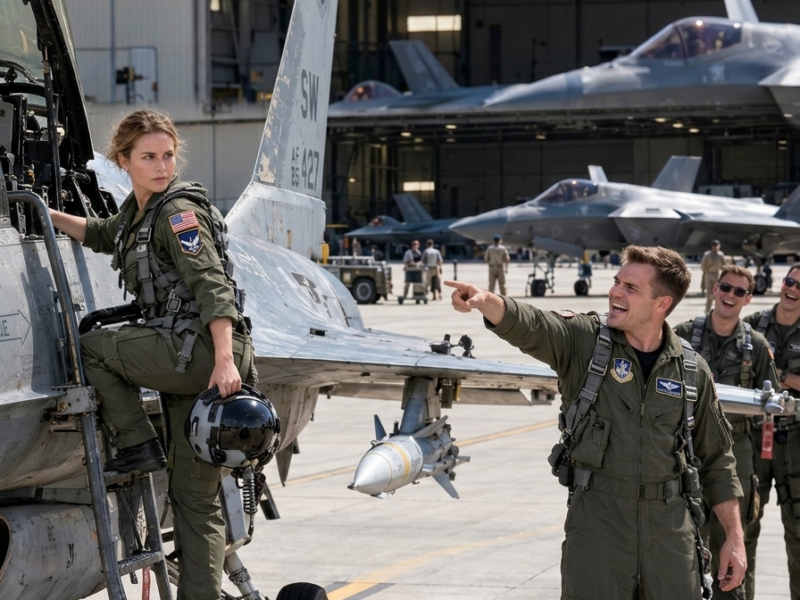
They laughed when I climbed into the F-16 at Nellis Air Force Base, and the squadron commander even ordered someone to record my embarrassing first flight
“You’re seriously letting her take that aircraft?”
Captain Brooks stood beside the hangar, shaking his head as I pulled on my flight gloves.
I kept my eyes on the F-16 waiting beneath the Nevada sun, its gray fuselage reflecting the harsh desert glare.
“I was assigned the aircraft, sir.”
He laughed, a sharp, dismissive sound that bounced off the corrugated metal walls.
“Being assigned a fighter doesn’t mean you belong in one.”
A few pilots chuckled behind him, leaning against the side of a utility cart with coffee cups in hand. They had been watching me since dawn, whispering among themselves, treating my arrival like a sideshow act.
I had heard worse. Much worse.
At twenty-nine, I was the newest arrival at Nellis Air Force Base, a quiet woman with a plain flight suit, a weathered helmet that had seen better days, and a personnel file most of the squadron had apparently judged without reading a single page. Nobody knew why I had transferred here from my previous post. Nobody asked why the base commander had personally approved my paperwork late last night without consulting the flight operations officer. And I certainly had no intention of offering explanations to men who judged a pilot by their swagger rather than their instrument scan.
“Just bring it back in one piece,” Brooks said, his tone dripping with patronizing condescension. “We don’t need a maintenance bill and a rescue mission on a Tuesday morning.”
I climbed the metal ladder without answering, my boots finding the familiar footholds with practiced ease.
Inside the cockpit, the canopy lowered with a heavy hydraulic hiss, sealing out the dry desert heat. The familiar smell of ozone, hot avionics, and leather instantly settled my nerves in a way human company never could. The multi-function displays flickered to life, bathing the confined space in a soft green glow. Switch by switch, system by system, I brought the Fighting Falcon to life. The Pratt & Whitney engine spooled up behind me, a low, steady rumble vibrating through the airframe and right into my bones.
For the first time that morning, the corners of my mouth lifted in a faint smile. This was the only place where the past couldn’t reach me, where ghosts had no jurisdiction.
Then the master warning alarm shattered the rhythm of the cockpit.
“All stations, unidentified aircraft approaching restricted airspace,” the base controller announced over the emergency circuit. “Three high-speed contacts, heading directly toward the installation on vector zero-four-zero.”
The laughter vanished from the flight line instantly.
I watched through the reinforced glass as Brooks and his men dropped their coffee cups and sprinted toward the operations building, their casual posture replaced by frantic urgency as radar tracks appeared on the primary monitors overhead.
“Are they responding to our hails?” Brooks’s voice crackled over the tactical frequency, laced with sudden panic.
“Negative, sir. No transponders, no radio response. They are maintaining military-grade cruise speed.”
“Scramble the alert fighters immediately!”
A tense, agonizing pause followed in the control room. Through the canopy, I saw an operations officer running out toward the radio relay cart.
“Commander, the alert crews are unavailable,” the controller’s voice trembled slightly. “Two aircraft are currently stripped down for phase maintenance, and the third has an unresolvable fuel-feed fault.”
“Then get somebody airborne! Anyone!”
The controller hesitated, a long agonizing beat of silence. “There’s one aircraft fully fueled and ready on the runway.”
Every head in the operations group turned simultaneously, looking through the thick observation glass directly toward my F-16 idling at the threshold.
Brooks grabbed his handheld radio, his face flushed red with stubborn pride and disbelief.
“Lieutenant Bennett, abort your launch,” he barked. “You are not cleared for an interception. Shut down the engine and clear the runway.”
I heard him clearly. Every syllable was crisp in my headset.
I also glanced down at my tactical display. The three radar contacts weren’t just wandering near the edge of the restricted zone anymore. They had accelerated, changing course in a synchronized formation. They weren’t a stray civilian flight or a navigational error. They were coming straight for the heart of the installation.
“Tower, this is Falcon One,” I transmitted, my voice level and cold. “Requesting immediate authorization to launch. Intercept vector is optimal right now.”
“Falcon One, stand by,” the tower replied, clearly caught in the crossfire between protocol and panic.
“Negative,” Brooks snapped over the radio, his voice overriding the controller. “You will remain on the ground, Lieutenant. That is a direct order. You have no combat clearance in this sector.”
I stared at the approaching electronic blips on my screen, and suddenly the Nevada sun faded away. The cockpit dissolved. I was back in another theater, another night, staring at another radar screen while the radio hissed with the sound of a voice begging me not to leave him behind to burn in the wreckage.
I had followed orders that night. I had stayed on the tarmac while my wingman flew out into a trap. A good man had died because of rigid protocols and bureaucratic cowardice.
I had carried that crushing silence for six long years. I swore I would never stand down again while threats closed in.
“Tower,” I said quietly, gripping the flight stick until my knuckles turned white, “if those aircraft reach the perimeter, we won’t have time for another discussion. Open the gate.”
For several seconds, nobody answered. The entire base seemed to hold its breath.
Then a different voice came over the radio channel. It didn’t belong to the tower controller, and it certainly didn’t belong to Captain Brooks. It was older, steady, weathered by decades of command, and unmistakably authoritative.
“Falcon One, this is Air Operations Command. Authenticate your identity.”
I didn’t hesitate. I gave the required cryptographic response without blinking.
The control room fell completely silent. Through the radio feed, I heard hurried whispers in the background, followed by the scraping sound of a heavy chair being pushed back across a linoleum floor.
“Confirm the pilot’s name,” the older voice demanded, dropping all formal detachment.
“Lieutenant Claire Bennett, sir.”
Another heavy pause hung in the air, thick enough to touch.
Then the voice returned, stripped of all official coldness, sounding almost stunned.
“Good God. Is that really you?”
Captain Brooks stared at the radio console near the hangar as though it had suddenly begun speaking an alien language. He reached for his own mic, his expression twisting in absolute outrage.
“Who is that?” he demanded, stepping toward the open window. “This is Captain Brooks! Who authorized this breach of command?”
The answer didn’t come from Brooks’s radio. It boomed through every speaker across the entire flight line, echoing off the concrete revetments.
“Falcon One, you are authorized to launch. All stations, this is Air Operations Command. The pilot currently in that aircraft is operating under direct presidential and strategic directive. She is not to be interfered with, questioned, or delayed under any circumstances.”
My hands tightened around the controls. The runway stretched out before me like a gray ribbon disappearing into the shimmering haze of the desert.
“Copy, Air Operations,” I whispered.
“Falcon One, one more thing,” the commander added, his voice dropping to a somber, warning register. “Those three bogies on your screen may not be your only problem today. Watch your six.”
I slammed the throttles forward into full military power, feeling the violent kickback as the afterburners ignited. The F-16 surged down the runway with terrifying acceleration, lifting off the pavement just as the base fell away beneath my wings.
Seconds later, the three unidentified enemy jets resolved on my tactical display, sharp green triangles cutting through the blue sky.
And then, right behind them, a fourth signal flickered into existence.
It wasn’t broadcasting a standard identification code. It wasn’t squawking a civilian signal. It was transmitting an old, encrypted military distress frequency—a frequency I hadn’t heard whispered across an open channel since the night my former wingman disappeared from the world.
A text block blinked onto my multi-function display screen, flashing amber in the dim cockpit.
“CLAIRE, IF YOU CAN HEAR ME, DO NOT TRUST YOUR COMMANDER.”
My breath caught in my throat, freezing the air in my lungs.
Because the message was signed with the unique personal call sign of a man who had been officially declared dead in action six years ago to the day.
The altimeter spun upward, the digital numbers blurring as the F-16 climbed through ten thousand feet in a matter of seconds. My heart hammered against my ribs, each beat sounding like a sledgehammer blow inside my helmet. I stared at the amber text glowing on the display screen, refusing to blink. The call sign attached to the transmission was unmistakable—Ghostrider-Actual. Major Liam Vance. The man who had vanished off the radar screens over the contested border during a black-ops escort mission that the Pentagon had classified, buried, and erased from official history.
“Tower, Falcon One,” I called out, forcing my voice to remain deadpan and steady despite the chaos inside my head. “Confirming visual on three inbound contacts at twenty-five miles. Requesting tactical update on the fourth signal.”
A heavy silence stretched across the frequency. The tactical controller back at Nellis sounded hesitant, his breathing audible over the static.
“Falcon One, we show three primary targets on our scopes,” the controller replied. “We have no record of a fourth aircraft in that sector. Your radar must be picking up ground clutter or atmospheric interference.”
“Negative,” I snapped back, banking the fighter sharply to the left to intercept the vector. “The fourth signal is broadcasting a secure military transponder signature. I repeat, there is an unidentified fourth aircraft shadowing the formation.”
“Lieutenant Bennett,” Captain Brooks’s voice suddenly cut in, overriding the controller with sharp authority. “Cut the chatter and focus on the intercept. Those three bogies are closing fast on restricted airspace. Do not get distracted by phantom anomalies on your screen. Clear the sky.”
His voice grated on my nerves. There was a desperate edge to his tone now, an underlying strain that didn’t sound like a standard commanding officer managing a routine scramble. It sounded like a man who knew far more than he was letting on, a man sweating under the weight of a secret he was terrified would surface.
“Captain Brooks,” I replied coldly, keeping my eyes locked on the horizon where the sun glinted off distant metal. “My radar doesn’t hallucinate. And neither do I.”
I pushed the stick forward, letting the nose drop slightly to build kinetic energy. The three leading aircraft were heavy, twin-engine configurations—not standard export fighters, but advanced stealth airframes painted in a matte black finish that absorbed radar waves like a sponge. They weren’t flying standard patrol patterns. They were locked in a tactical wedge, maintaining absolute radio silence, moving with the cold precision of automated drones or elite mercenaries.
As I closed to within ten miles, my threat warning receiver suddenly shrieked.
A piercing, high-pitched tone flooded my headset. Radar lock. Someone had just painted my aircraft with a fire-control radar.
“Break!” I muttered, hauling hard on the stick.
The F-16 responded instantly, pulling nine Gs in a violent split-S maneuver that pressed my spine deep into the ejection seat. The blood rushed from my head, my vision graying at the edges as the crushing gravitational force threatened to pull me into unconsciousness. Two missile plumes erupted from the belly of the leading stealth jet, twin white streaks of death tearing through the thin upper atmosphere, tracking the heat signature of my exhaust.
“Incoming missiles! Flares away!” I shouted, slamming the countermeasure button on the throttle.
A cascade of magnesium flares burst from the aircraft’s tail, blooming like blinding artificial stars against the deep blue sky. The heat-seeking missiles took the bait, veering off toward the brilliant decoys and detonating in a pair of silent, orange blossoms of fire miles beneath me.
“Falcon One! Report!” Air Operations Command broke through the radio traffic, the older commander’s voice razor-sharp. “Are you engaged?”
“Engaged multiple hostiles!” I gasped, fighting to regain my breath as the G-force subsided. “They fired active-radar missiles. These aren’t standard interceptors. They’re equipped with active-array targeting systems.”
“Understood,” the voice replied grimly. “All secondary defense units in the region are being placed on maximum alert. Claire… do whatever it takes to survive up there. But do not let them cross the ridge.”
“Understood, Command,” I said, leveling out and pushing the throttle back toward the firewall.
The three black jets split apart, executing a classic pincer maneuver designed to trap an adversary in a crossfire. They thought they were dealing with an ordinary pilot caught by surprise. They didn’t know about the five hundred hours of classified combat flight testing I had logged in experimental airframes before my sudden transfer. They didn’t know why I had earned my call sign Viper.
I ignored the pincer movement and threw the F-16 into a vertical climb, trading altitude for potential energy. The engine screamed, burning fuel at an astonishing rate as I punched straight up into the blinding glare of the sun.
In the cockpit mirror, I caught a brief glimpse of the fourth aircraft—the one the tower claimed didn’t exist.
It was trailing far behind the formation, flying an erratic, Ghost-like flight path, its wings rocking gently in a silent signal. As I watched, another text burst across my display screen, overriding the tactical map.
“THEY PLANNED THE AMBUSH SIX YEARS AGO, CLAIRE. BROOKS WAS THERE. HE SIGNED THE ORDER.”
The words hit me like a physical blow to the chest. The altimeter numbers blurred as my vision swam. Six years ago. The exact date, the exact hour, the exact betrayal that had cost Liam his life and left me branded as the scapegoat of a failed black-ops operation.
Brooks was there. Brooks had signed the order.
Before I could process the terrifying implication of the message, my radar screen flared red. The lead enemy jet had abandoned its pincer sweep and was climbing straight up after me, its nose pointed directly at my cockpit with ruthless intent.
“You want me?” I whispered, arming the AIM-120 AMRAAM missiles on my wing rails. “Let’s dance.”
The G-force slammed into me again as I rolled the F-16 over the top of a loop, diving straight down toward the desert floor in a screaming vertical plunge. The wind shrieked against the canopy, the airframe vibrating with a metallic groan as we breached the sound barrier. The digital airspeed indicator ticked past Mach 1.4, Mach 1.5, climbing higher as gravity pulled us downward like a falling stone.
The black stealth jet followed me down, refusing to break pursuit. Its silhouette filled my rear-view HUD, sleek and menacing, trailing faint vapor trails from the tips of its delta wings. It was closing the distance with terrifying speed, possessing an engine thrust-to-weight ratio that defied conventional aeronautical engineering.
“Come on, closer…” I muttered, my eyes darting between the altimeter and the locking reticle on my targeting display.
At six thousand feet, the ground rushed up to meet us in a blur of gray dust and jagged mountain ridges. The red pull-up warning began flashing furiously on the dash, accompanied by an automated computerized voice chanting, Altitude! Pull up! Altitude! Pull up!
I ignored the warning, waiting until the very last microsecond.
“Now,” I breathed.
With a violent yank, I pulled the stick back into my stomach and kicked hard on the rudder pedals. The F-16 executed a brutal, knife-edge split-S evasion, bleeding off speed as it inverted and rocketed back up toward the sky in a blinding vertical climb.
The enemy pilot, caught off guard by the suicidal maneuver, tried to mimic the pull-up, but his heavier airframe lacked the lightning-fast pitch authority of my Falcon. For a split second, the black jet overshot its trajectory, plunging low across the desert floor.
That was all the opening I needed.
“Fox Three!” I screamed, squeezing the trigger on the control stick.
An AIM-120 missile dropped from the wing rail, its rocket motor igniting with a deafening roar as it streaked forward in a jagged trail of white smoke. The missile tracked the heat and radar reflection of the enemy jet with merciless precision, closing the gap in less than two seconds.
Boom.
The fireball erupted across the desert floor, a billowing plume of black smoke and twisted metal fragments scattering across the dry riverbed.
“Target one destroyed,” I reported, my voice echoing hollowly in the headset.
Before I could even celebrate the victory, the remaining two black jets opened fire from the flanks. Twin streams of 20mm cannon rounds chewed up the air around my right wing, ripping tiny holes through the trailing edge of the flap. The cockpit filled with the acrid smell of scorched wiring and hydraulic fluid.
“Falcon One is taking damage!” I shouted, wrestling with the bucking controls as the flight stabilization system fought to keep the aircraft level. “I’m hit in the right auxiliary actuator!”
“Lieutenant Bennett, abort the engagement immediately!” Captain Brooks’s voice boomed over the frequency, sounding less like a commanding officer and more like a man on the verge of total panic. “Do not engage the remaining units! Return to base right now or face immediate court-martial!”
“Court-martial?” I laughed bitterly, dodging another burst of tracer fire by snapping the jet into a violent barrel roll. “Captain, they tried to shoot me out of the sky! If I land now, I won’t be facing a court-martial—I’ll be facing a firing squad!”
“That is a direct order, Lieutenant! You have no idea what you’re interfering with!” Brooks shouted, his voice cracking with unfiltered rage. “Those aircraft are operating under high-level national security clearance!”
“National security?” I sneer-yelled back, my eyes locked on the two remaining attackers circling back for another pass. “Since when do American security forces deploy unmarked stealth fighters to assassinate their own pilots over Nevada airspace?”
Silence met my question from the tower. Brooks didn’t answer. He couldn’t.
Suddenly, my radio hissed with static, and the mysterious fourth aircraft—the one trailing the formation—chimed in on an unencrypted guard frequency. The voice was distorted by heavy electronic filters, raspy and mechanical, but the cadence, the rhythm, the deliberate cadence of speech was unmistakable.
“He’s lying to you, Claire,” the voice rasped softly through the headset. “Just like he lied to us six years ago.”
My blood ran cold. The instruments on my dash flickered, the green displays dying for a fraction of a second before rebooting into a diagnostic screen.
“Liam?” I whispered, my fingers trembling on the throttle. “Liam, is that really you? Where are you?”
“I never left, sweetheart,” the voice replied, faint and distant, as if broadcasting from miles above the troposphere or deep within the encrypted bowels of a secure military relay station. “They didn’t rescue us that night in the canyon, Claire. They sold us out. Brooks traded our flight telemetry to cover up the illegal drone-testing program, and when we stumbled onto the data cache, they tried to bury us in the sand. I survived… but they locked me away in the black-site below Nellis.”
My mind reeled. The black-site beneath the base. Rumors had circulated for years among enlisted personnel about subterranean levels beneath the main hangars—levels that didn’t appear on any architectural blueprints.
“The fourth aircraft isn’t a ghost, Claire,” the raspy voice continued, growing stronger as the signal locked onto my tactical datalink. “It’s an automated decoy relay connected to my old transponder frequency. And it’s broadcasting the exact coordinates of the underground command bunker where Brooks and his superiors are currently monitoring this entire operation.”
On my display, a new set of glowing GPS coordinates materialized, flashing directly over the center of the Nellis Air Force Base flight line—specifically, right beneath the main operations tower.
“You’re flying right into their trap, Claire,” Liam’s voice warned, a sudden urgency cutting through the static. “The two remaining jets aren’t trying to shoot you down anymore. They’re herding you back toward the base. They want you on the ground, and they want that aircraft—and your flight recorder—secured permanently.”
I glanced down at my fuel gauge. Fifty percent remaining. Not enough to run to another state, and certainly not enough to outlast two stealth interceptors in a dogfight.
“If I run, they win,” I whispered, gripping the flight stick with terrifying resolve. “If I land, they bury me.”
“Then don’t run,” Liam’s voice echoed, accompanied by the sound of heavy static clearing to reveal the distinct click of a secure weapon system arming. “Let’s crack open the vault.”
The two remaining black stealth jets converged on my position from opposite sides, their delta wings tilted in a synchronized pincer sweep designed to force me into a nose-down descent. They weren’t firing missiles now; they were using electronic jamming arrays, flooding my cockpit displays with rolling waves of static and blinding green interference lines.
“Avionics failing! Radar offline!” I shouted into the mic, watching as my primary multi-function display flickered out entirely, leaving me flying by manual analog backup instruments alone.
“Falcon One, status report!” Air Operations Command demanded, the older officer’s voice cutting through the electronic distortion with fading clarity. “We are losing your telemetry feed! What is your position?”
“I’m being jammed!” I yelled back, hauling my stick hard to the left to slip beneath the radar sweep of the leading interceptor. “They’re blinding my navigation systems! I’m heading back toward the base airspace—visual approach only!”
“Negative, Falcon One! Do not approach the installation!” Air Operations warned urgently. “We are receiving conflicting override signals from base command! Captain Brooks has declared a localized security lockdown under emergency directive—”
“Brooks doesn’t have command authority anymore!” I interrupted, my voice ringing with absolute finality. “He’s compromised! Check his secondary authorization codes against the 2018 black-ops archive!”
A tense pause followed on the secure command frequency. I could imagine the frantic scramble in the distant operations bunker as analysts cross-referenced old classified files from the incident that had cost Liam his career and nearly cost me my sanity.
Below me, the sun-baked expanse of Nellis Air Force Base rose rapidly into view. The long gray runways stretched out like concrete scars across the desert floor, surrounded by rows of silent hangars and parked support vehicles. But something was wrong. As I dropped through five thousand feet, I noticed that the perimeter gates were swarming with armed security forces wearing unmarked tactical gear—not standard Air Force security police, but heavy private contractors bearing assault rifles and armored transport vehicles.
They weren’t securing the base against an external enemy. They were sealing it off to contain a witness.
“They’re waiting for me,” I muttered, lining up my approach vector toward the active runway.
“Claire, listen to me,” Liam’s voice crackled back through the headset, cutting through the electronic whine of the jamming array with startling clarity. “The underground bunker entrance is located directly beneath Hangar Four. The heavy freight elevator shaft has a manual override switch accessible from the exterior utility panel. If you set your aircraft down near the taxiway stub and blow your emergency canopy, you can access the service tunnel before their security teams mobilize.”
“Are you insane?” I gasped, banking the F-16 into a steep descent toward the designated hangar. “I’m flying a forty-million-dollar fighter jet, not a getaway car!”
“You asked for the truth six years ago, Claire,” Liam replied softly, his voice carrying a haunting weight that bridged the years between our past life and this moment. “Now I’m giving it to you. But you have to move fast. Brooks has already triggered the facility’s self-destruct purge to wipe the server banks.”
Self-destruct purge. The base command logs, the flight telemetry from the fateful mission, the entire paper trail of corruption and betrayal—everything was about to be incinerated to protect the high-ranking officers who had ordered our squadron into a slaughterhouse.
“I’m coming down,” I said.
I pulled back on the throttle, deploying the airbrakes as the F-16 decelerated rapidly, dropping through two thousand feet. The wind roared against the canopy, the landing gear thumping down into place with a reassuring mechanical lock.
On the ground below, chaos erupted. The tactical vehicles parked near Hangar Four scattered in all directions as my fighter touched down with a shriek of burning rubber, white smoke billowing from the landing gear as I slammed on the brakes.
Captain Brooks stood near the edge of the tarmac, flanked by four heavily armed contractors, his face twisted in a mask of furious desperation. He was screaming into a radio handset, pointing frantically toward my aircraft.
“Stop that plane! Shoot out her engines! Do not let her open that canopy!”
The security contractors raised their rifles, leveling heavy kinetic suppression weapons directly at my cockpit glass.
I didn’t hesitate. I taxied the F-16 straight toward the tarmac barricade, keeping the engine spooled up at high RPM, my thumb resting firmly on the emergency canopy ejection switch.
“This is for Liam,” I whispered.
With a violent pull, I hit the ejection toggle. The canopy blew off with a deafening explosion, rocketing high into the air in a cloud of white smoke and flying debris. Before the security teams could fire, I unbuckled my harness, leaped over the side of the cockpit, and hit the concrete running toward the dark, recessed entrance of the Hangar Four utility tunnel.
The concrete floor of the utility tunnel was damp, echoing with the frantic sound of my combat boots pounding against the ground as alarms wailed overhead in a rhythmic, deafening cadence. Red emergency strobe lights flashed along the low ceiling, casting long, erratic shadows across the rusted pipes and thick bundles of fiber-optic cabling that lined the walls.
Behind me, muffled shouts and the heavy clatter of tactical boots signaled that Captain Brooks’s security detail was closing the distance.
“Halt! Drop your weapon!” a harsh voice echoed down the corridor.
I didn’t look back. I pumped my arms, pushing my legs to their absolute limit as I rounded a sharp corner, my hand sliding along the cold concrete wall for balance. Ahead of me stood a heavy steel security door fitted with an electronic keypad and a manual mechanical override wheel.
According to the coordinates Liam had transmitted through the tactical datalink, this was the primary access bulkhead leading directly into the subterranean command bunker where the encrypted servers were housed.
I slammed against the heavy steel door, my fingers flying across the keypad, punching in the six-digit cryptographic sequence Liam had whispered into my headset moments before my descent.
Beep-beep-beep-click.
The green authorization light flickered on, accompanied by the heavy pneumatic hiss of hydraulic locks disengaging within the frame.
I grabbed the steel override wheel with both hands, throwing my entire body weight into it. The rusted gears groaned loudly, turning half a rotation before the heavy door swung inward, revealing a brightly lit corridor lined with banks of humming server racks and glowing mainframe terminals.
I stumbled inside, slamming the heavy door shut behind me and dropping the locking bolt into place just as a series of heavy thuds echoed against the exterior steel—security had arrived.
“Claire.”
I froze.
Standing at the far end of the server aisle, bathed in the blue glow of hundreds of flashing LED status lights, was a man in a tattered, weathered flight suit. His hair was streaked with gray, his face etched with deep lines of exhaustion and survival, but his eyes—those unmistakable, sharp, defiant eyes—hadn’t changed at all.
“Liam?” I breathed, my voice breaking as a wave of emotion washed over me, threatening to buckle my knees.
Major Liam Vance stepped forward from the shadows, offering a faint, tired smile that mirrored the one we had shared six years ago before we walked out to our jets for the last time.
“You took your time getting here, Lieutenant,” he said, his voice husky with emotion. “I was beginning to think you forgot our flight plan.”
“I followed orders,” I whispered, stepping across the room to stand before him, tears finally spilling over my lashes. “I followed orders that night, and I’ve regretted every second of it since.”
“You survived,” Liam replied gently, placing a warm hand on my shoulder. “And that’s the only order that ever mattered.”
Before I could answer, a loud, synthetic voice echoed through the overhead speakers throughout the subterranean facility.
Warning. Facility self-destruct sequence initiated. Mainframe purge in T-minus three minutes. All personnel evacuate immediately.
The floor beneath our feet trembled as a low, ominous rumble vibrated through the foundation of the bunker. The red emergency lights flared brighter, casting an urgent crimson hue across the entire server room.
“Brooks initiated the purge,” Liam said, his expression hardening instantly. “He’s trying to burn the data before the Pentagon inspection team can access the secure archives.”
“Not on my watch,” I declared, walking swiftly toward the main console terminal near the center of the room.
My fingers flew across the keyboard, bypassing the security firewalls with the administrative override codes I had memorized during my years in tactical software testing. Lines of green code scrolled down the monitor at blinding speed as the automated self-destruct countdown ticked downward: Two minutes, thirty seconds.
“Downloading flight telemetry from the 2018 black-ops incident,” the system announced in a calm, automated monotone. “Transferring files to secure external drive.”
Across the room, the primary server banks whined loudly as gigabytes of classified data—exposing Brooks, the illegal drone programs, and the deliberate framing of our squadron—were sucked into a pocket flash drive plugged directly into the main port.
“Transfer complete,” the monitor flashed in bright green.
I ripped the drive from the port just as the heavy steel door behind us began to buckle inward under the relentless blows of a tactical breaching ram.
“We need to move, now!” Liam shouted, grabbing my arm and pulling me toward the emergency service elevator shaft located at the rear of the bunker.
“Where does this go?” I asked over the roar of the alarms.
“Straight up,” Liam grinned, pulling a heavy pneumatic lever on the elevator wall. “Right into the middle of the main flight line, where Captain Brooks is waiting to explain to the arriving Air Operations Command why his base is currently falling apart.”
The elevator doors slid open with a sharp hiss.
We stepped inside just as the heavy steel door at the front of the bunker finally gave way with a deafening crash, showering the room in a cloud of concrete dust and sparks. Through the smoke, Captain Brooks appeared, his face twisted in absolute fury, a sidearm drawn and pointed directly at us.
“Stop right there!” Brooks screamed, raising his weapon.
I didn’t flinch. I reached out, slammed the elevator’s emergency ascent button, and held up the secure data drive for him to see through the closing doors.
“Tell my story to the investigators, Captain,” I said coldly.
The heavy steel doors sealed shut with a solid thud, cutting off his shout of rage as the elevator surged upward with bone-crushing acceleration.
Seconds later, the elevator doors burst open into the bright Nevada sunlight right in the middle of the Nellis Air Force Base flight line. A dozen military police vehicles and high-command transport helicopters had just touched down on the tarmac, their rotors kicking up a massive cloud of dust as armed investigators poured out onto the pavement.
Captain Brooks’s career, his conspiracy, and his lies were about to crash down around him.
I stepped out into the sunlight beside Liam, taking a deep, clean breath of the desert air. The nightmare of the past six years was finally over, and for the first time in a very long time, the sky belonged to us.
THE END.









