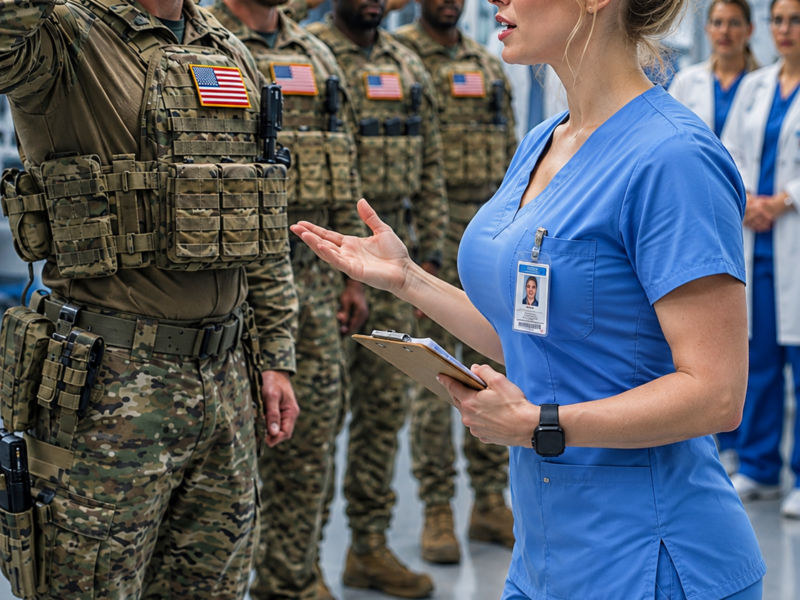
“They called me a relic in front of the entire emergency department, laughed at my outdated methods, and told me I belonged in a retirement home
For several seconds, I couldn’t move.
The handwriting on the photograph was unmistakable.
Commander Thomas Whitaker.
He had been my commanding officer during the operation off the coast of Somalia. He had recruited me, trained me, and trusted me with a team of seventeen sailors.
He had also been the last person to speak to me before I disappeared from the Navy’s active roster.
The official record said Whitaker had died eleven years ago in a helicopter accident over the Arabian Sea.
I had attended his memorial service.
I had stood beside his empty coffin and listened to an admiral describe him as a courageous officer who had given everything for his country.
Now his handwriting was on a photograph recovered twelve years after the mission that destroyed my career.
“Where did you get this?” I asked.
Senior Chief Reeves glanced at Noah.
“From a secure storage unit outside Little Creek. Someone left it for us with instructions to deliver it directly to you.”
“Who gave you those instructions?”
“Admiral Marcus Ellison.”
I looked at him sharply.
“Ellison is dead.”
“He was found dead this morning,” Reeves replied. “But he gave us the assignment three days ago.”
The emergency department seemed to shrink around us.
Behind the nurses’ station, Dr. Mitchell was watching with an expression that had shifted from irritation to disbelief.
“Elizabeth,” he said, “what exactly is going on?”
I folded the photograph and slipped it into my pocket.
“Something that doesn’t belong in your emergency department.”
He stepped closer.
“You can’t just have armed military personnel walking through here and demanding staff members.”
“They aren’t armed,” I said.
Reeves gave a faint smile.
“Not visibly, Doctor.”
“That’s not funny.”
“No, sir. It isn’t.”
I turned to Reeves.
“How did you know I was here?”
“We didn’t. We knew you were somewhere in Norfolk. We searched the hospital network after the admiral’s death.”
“Who authorized that?”
“His written directive.”
“Show me.”
Reeves removed a small black folder from his jacket.
Inside was a document bearing the seal of the Department of the Navy, a handwritten signature, and a date from three days earlier.
I read the first paragraph.
Then I read it again.
The directive named me as the designated recipient of a sealed intelligence package connected to Operation Breakwater.
My throat tightened.
Breakwater.
That was the operation’s real name.
The mission had been officially classified as a maritime security exercise. Our team had been sent to investigate an abandoned communications station on a stretch of Somali coastline where intelligence suggested an armed group was coordinating attacks on commercial shipping.
We found something else.
A detention facility.
Six civilians.
And evidence that a private contractor had been using military communications channels to sell shipping routes and surveillance data to an international weapons network.
I had reported it.
The next morning, my report was gone.
My commanding officer told me the operation had been compromised by faulty intelligence. Then he ordered me to sign a revised statement.
I refused.
Two nights later, the building where our team was staying exploded.
I survived.
Three sailors did not.
Noah Bennett was one of the wounded.
And I was blamed for leading the team into a compromised location.
The Navy quietly removed me from command pending investigation. My clearance was suspended, my service record was sealed, and the official inquiry concluded that I had made an unauthorized operational decision.
I left the Navy two years later.
The truth was that I had never stopped being a captain.
I had simply stopped being allowed to act like one.
“Captain?”
Reeves was watching me.
I closed the folder.
“Why did Ellison wait twelve years?”
“Because he found something.”
“What?”
“A recording.”
I stared at him.
“From Breakwater?”
He nodded.
“An original communications recording. It wasn’t included in the official investigation.”
“Where is it?”
“With the rest of the evidence.”
“Then let’s go.”
Reeves glanced toward the emergency department.
“Ma’am, there’s one more thing.”
I already knew I wasn’t going to like it.
“Say it.”
“The admiral left instructions that the package should only be opened in your presence. He also said we were not to trust anyone who claimed the investigation had been completed.”
I looked at the photograph again.
“Morgan was right.”
Then I turned toward Melissa.
“Can you take my patients for the rest of the shift?”
She looked worried.
“Are you leaving?”
“Temporarily.”
“Are you in trouble?”
I wanted to tell her no.
But after twelve years of hiding the truth, I was tired of making promises I couldn’t guarantee.
“I don’t know yet.”
She nodded slowly.
“Then come back.”
I looked at her.
“I will.”
Dr. Mitchell stepped between us.
“You’re not seriously abandoning your shift because some military men showed up.”
I met his eyes.
“Every patient has been handed over. Their care is documented. The charge nurse has approved the coverage.”
“You’re still responsible for your department.”
“Tonight, I am responsible for something else.”
He shook his head.
“Unbelievable. This is exactly what I mean when I say you’re stuck in another era.”
Reeves turned toward him.
“Doctor, with respect, the woman you’re speaking to commanded people who trusted her with their lives.”
Mitchell folded his arms.
“That doesn’t make her special here.”
“No,” Reeves replied. “Her work here does that.”
I placed my identification badge on the counter.
“Good night, Doctor.”
Then I followed the six SEALs outside.
The October wind cut through my jacket.
A dark government vehicle waited at the curb.
Before I got in, Noah approached me.
“Captain, can I speak with you?”
I looked at him.
“Of course.”
He glanced at the others, then lowered his voice.
“I’ve been trying to find you for years.”
“Why?”
“Because I never believed the official report.”
I studied his face.
He was no longer the frightened nineteen-year-old I remembered carrying through smoke and broken glass. He had become a strong, capable operator.
But his eyes still carried the same question.
“Which part?” I asked.
“That you abandoned us.”
I looked away.
“I didn’t.”
“I know that now.”
He swallowed.
“I just wish I’d known it sooner.”
I put a hand on his shoulder.
“You were nineteen, Noah. You had been injured. You were told what the Navy wanted you to believe.”
“I should have asked questions.”
“You survived. You went home. That’s enough.”
He shook his head.
“Not for me.”
Before I could answer, Reeves opened the vehicle door.
“Captain, we need to move.”
I climbed inside.
The vehicle pulled away from the hospital.
For the first time in twelve years, I was heading toward the truth.
And I was terrified of what it might cost.
We drove to a secure facility near the naval base.
The building was unmarked, surrounded by fencing and cameras. Two guards checked our identification before allowing us through.
Inside, a small conference room had been prepared.
A woman in civilian clothes stood beside a table.
She introduced herself as Commander Sarah Collins, Naval Criminal Investigative Service.
“Captain Morgan,” she said. “I’ve reviewed the preliminary file. I need you to understand that this is now a federal investigation.”
“Then you should know I have questions.”
“I expected that.”
“Why was Admiral Ellison investigating Breakwater?”
Collins opened a folder.
“Three weeks ago, he received an anonymous package containing a copy of the original operational communications log. It included a transmission that contradicted the official inquiry.”
“What transmission?”
“An order to change the extraction coordinates.”
I felt my fingers tighten around the edge of the table.
“Who sent it?”
Collins looked at me.
“Commander Whitaker.”
The room became silent.
“Whitaker was dead.”
“His death was officially recorded. We now have reason to believe the record was falsified.”
I stared at her.
“Why would he fake his death?”
“We believe he discovered that the communications network involved in Breakwater had been infiltrated by a private intelligence group. He may have been trying to disappear before they could reach him.”
“Then why did he let us believe he was dead?”
“We don’t know.”
I looked at the photograph.
“Where is he now?”
Collins didn’t answer immediately.
That was answer enough.
“You think he’s alive.”
“We believe he was alive three days ago.”
“Where?”
“That information is still being verified.”
I leaned back.
“Commander, I’ve waited twelve years. Don’t give me another carefully worded explanation.”
She studied me.
Then she placed a second photograph on the table.
It showed an older man entering a small coastal building.
His hair was gray.
His posture was slightly bent.
But I recognized him.
Thomas Whitaker.
My former commanding officer.
Alive.
I stared at the photograph until the edges blurred.
“Where was this taken?”
“An industrial port outside Portsmouth, England.”
“When?”
“Six days ago.”
I looked at Reeves.
“Why are we in Norfolk?”
“Because the original recording was found here,” Collins said. “And because someone has been searching for it.”
She slid another photograph toward me.
It showed the exterior of the hospital.
Taken from across the street.
The date was that evening.
My stomach tightened.
“Someone was watching me?”
“We believe so.”
“Who?”
“We don’t know.”
Collins pointed to the lower corner.
A dark SUV was parked near the hospital entrance.
I recognized it.
It had been parked outside the employee lot for three nights.
I had noticed it but assumed it belonged to a patient’s family member.
“How long?”
“At least a week.”
“Why didn’t hospital security notice?”
“They may have. We haven’t completed that part of the investigation.”
I looked at her.
“Did the person know I was a nurse?”
“Possibly.”
“Then why didn’t they approach me?”
Collins closed the folder.
“Because they may have been waiting for the right moment.”
I thought of Dr. Mitchell calling me a relic.
Of the patient whose airway had deteriorated.
Of the six SEALs walking through the emergency department.
And then I understood something.
The photograph had not been delivered to the SEALs because someone wanted me to remember the past.
It had been delivered because someone wanted the past to find me.
“Play the recording,” I said.
Collins nodded toward a technician.
A small digital recorder was placed on the table.
The technician pressed a button.
Static filled the room.
Then a voice came through.
“Breakwater command, this is Captain Morgan. We have six civilians secured. Request immediate extraction at the northern access point.”
My own voice.
Twelve years younger.
Tired, but controlled.
A second voice answered.
“Negative, Morgan. New coordinates follow. Proceed to the eastern perimeter.”
I closed my eyes.
I remembered that transmission.
I remembered questioning it.
The eastern perimeter was exposed, and the intelligence we had received did not match the conditions on the ground.
I had refused the order and taken my team north.
That decision had saved the six civilians.
It had also put us in the path of the explosion.
The recording continued.
“Command, this is Morgan. The eastern route is compromised. Confirm the new coordinates.”
Then a voice I recognized.
Whitaker.
“Proceed east. That’s a direct order.”
My stomach twisted.
I had spent twelve years believing he had ordered us into danger.
But the recording wasn’t finished.
A third voice interrupted.
“Thomas, stop. They have the wrong channel.”
Another voice.
Older. Calm. Unmistakably authoritative.
Admiral Ellison.
“Whitaker, do not transmit another coordinate change. Morgan, disregard the last order. Hold your northern position.”
Then the recording ended.
I stared at the machine.
“Why wasn’t this included in the original inquiry?”
Collins answered quietly.
“Because the official recording started thirty seconds later.”
I turned toward her.
“Someone cut it.”
“Yes.”
“Who had access?”
“Three people. Admiral Ellison, Commander Whitaker, and Captain Morgan.”
I almost laughed.
“So I was on the list of suspects.”
“Your original report was used to justify the investigation.”
I stood.
“Then somebody deliberately erased the part that proved I was following the correct order.”
“That’s what it appears to show.”
“Who benefited?”
Collins placed a third folder on the table.
A list of contractors.
Several company names.
And one name that made my heart stop.
Harrington Maritime Systems.
I knew that company.
It had provided communications equipment for Operation Breakwater.
It had also been owned by a man named Charles Harrington.
Harrington had been a civilian adviser to the Navy.
He had attended the briefing before our deployment.
He had shaken my hand and told me how proud he was of the sailors who protected American shipping.
And after the explosion, he had testified that I had ignored valid intelligence.
“Where is he?”
“Retired. Living in Virginia.”
“Is he under investigation?”
Collins nodded.
“His company received payments from a network connected to the arms transfers.”
“Then he needs to answer for it.”
“That’s why we’re here.”
She tapped the folder.
“There’s something else. One of the civilians you rescued during Breakwater has been trying to contact you.”
I froze.
“Which one?”
“Her name is Amira Hassan.”
I remembered the young woman.
She had been barely twenty when we found her in the detention facility. She had a broken wrist, a deep cut above her eye, and a little boy clinging to her coat.
I had carried her out.
“Is she alive?”
“Yes. She lives in Virginia now. She contacted Admiral Ellison two weeks before his death.”
“Why?”
Collins looked at me.
“She says she knows who ordered the attack.”
The room became very quiet.
“Where is she?”
“Under protective supervision.”
“Can I speak with her?”
“Not yet.”
I stepped closer.
“Commander, that woman was a prisoner because someone sold information about her location. She deserves to be heard.”
Collins nodded.
“She will be. But we need to make sure she is safe.”
A knock sounded at the door.
A young intelligence officer entered and handed Collins a message.
She read it.
Her expression changed.
“What is it?” I asked.
“Someone has attempted to access the hospital’s personnel records.”
My pulse quickened.
“Whose records?”
“Yours.”
“From where?”
“The hospital network.”
I looked toward Reeves.
“Then somebody inside the hospital is helping them.”
Collins shook her head.
“Not necessarily. The attempt may have come from outside.”
I thought about the employee access system, the security cameras, and the old staff terminal near the medication room.
Then I remembered something.
The day before the SEALs arrived, Dr. Mitchell had asked me to verify my previous employment dates for an internal staffing review.
He had said the hospital needed to update my professional credentials.
I had given him the information.
It might have been harmless.
Or it might have been the way someone learned where I worked.
I told Collins.
She immediately asked for the hospital’s access logs.
Within minutes, the technician found a login associated with a senior administrative account.
It had been used to access my personnel file at 9:12 p.m.
The account belonged to the hospital’s deputy director of operations.
A man named Peter Lang.
I knew him.
He was the person who had hired me seven years earlier.
“Has he been contacted?” I asked.
“Not yet.”
“Then don’t.”
Collins raised an eyebrow.
“Why?”
“Because if he’s involved, he’ll know the investigation has reached him.”
She studied me.
“You think we should watch him?”
“I think we should find out who he’s talking to.”
The colonel of the operation—Commander Collins—didn’t smile, but I saw the approval in her eyes.
“That’s a reasonable suggestion.”
An hour later, we had a plan.
I would return to the hospital as if nothing had happened. NCIS would monitor the deputy director’s communications and investigate the access attempt. Reeves and his team would remain nearby.
I didn’t like the idea of returning.
But I knew the hospital.
I knew its people.
And I knew that someone who had spent twelve years hiding a military conspiracy might not expect a nurse to notice what happened in a supply corridor.
At 6:20 a.m., I walked back through the emergency department doors.
Melissa was at the nurses’ station, drinking coffee.
She nearly dropped the cup.
“Elizabeth! Where have you been?”
“Handling an old problem.”
“Is it over?”
I looked at her.
“Not yet.”
She studied my face.
“You’re shaking.”
I hadn’t noticed.
I placed both hands on the counter.
“Just tired.”
She didn’t believe me.
But she didn’t push.
Then Dr. Mitchell emerged from the physician’s station.
He looked annoyed.
“Finally. We need to discuss your unexplained absence.”
I glanced at the clock.
“My shift ended at seven. The charge nurse approved my departure.”
“That’s not the point.”
“Then what is?”
He lowered his voice.
“Hospital administration is concerned about the military activity last night. We need to know whether your personal history creates a security risk.”
I stared at him.
“My personal history?”
“Your former military service. Whatever happened before you started working here.”
“Who told you about it?”
He hesitated.
“People talk.”
“Which people?”
He looked toward the corridor.
“Elizabeth, don’t turn this into an interrogation.”
I took a slow breath.
“Dr. Mitchell, if you have a concern about patient safety, put it in writing. If you have a question about my employment, speak to human resources. But don’t use vague rumors to intimidate me.”
His jaw tightened.
“You’re not in the military anymore.”
“No,” I said. “I’m not.”
Then I walked past him.
Melissa followed me into the medication room.
“That was different.”
“What was?”
“You usually let him talk.”
I checked the medication refrigerator.
“Maybe I’m getting too old to listen.”
She laughed.
For a few seconds, things felt normal.
Then the overhead announcement sounded.
“Security to the main entrance. Security to the main entrance.”
A moment later, the emergency doors opened.
Two men in civilian clothes entered.
One approached the reception desk.
The other headed toward the administration corridor.
Melissa looked up.
“Do you know them?”
I shook my head.
But something about the second man’s walk bothered me.
He kept his right shoulder slightly higher than his left.
I had seen that posture before.
In a photograph.
On a man who had been standing beside Charles Harrington during the original Breakwater briefing.
“Melissa,” I said quietly, “stay here.”
I moved toward the corridor.
The man reached the administration door and used a keycard.
I recognized the access badge.
It belonged to Peter Lang.
I didn’t call out.
I simply followed him at a distance.
He entered a small records room.
The door didn’t close completely.
Through the narrow opening, I saw him place a black device beside the computer.
Then he opened my personnel file.
He wasn’t searching for my nursing credentials.
He was searching for something else.
A scanned document.
A document that had been uploaded to my file years earlier.
My original military discharge paperwork.
The man leaned closer to the screen.
Then he spoke into a small earpiece.
“She’s back. The package was delivered.”
A voice answered.
I couldn’t make out the words.
The man replied.
“No, she doesn’t have the recording. Not yet.”
My stomach tightened.
He reached for the device.
I stepped into the doorway.
“Can I help you?”
He spun around.
For a split second, I saw recognition in his eyes.
Then he smiled.
“Sorry. I was looking for Mr. Lang.”
“Who are you?”
“Maintenance.”
“Maintenance doesn’t need access to personnel files.”
His smile vanished.
He reached toward his jacket.
I moved before he could pull anything out.
I pushed the door open with my shoulder, knocked his hand away, and stepped back toward the hallway.
He lunged.
I caught his wrist and turned, using his momentum to send him into the desk.
The black device hit the floor.
He cursed and tried to rise.
I kept my distance.
“Security!” I shouted.
He scrambled toward the door.
Then a second figure appeared behind him.
Senior Chief Reeves.
“Don’t move!”
The man froze.
Two hospital security officers arrived seconds later.
Reeves secured the man’s hands while I stepped away.
My heart was pounding.
Melissa appeared at the end of the corridor.
“Elizabeth!”
“I’m okay.”
She looked at the man on the floor.
“Who is he?”
I stared at the device.
“Someone who should not have been in that room.”
Within minutes, NCIS arrived.
The man was identified as a private security contractor named Martin Vale. He had worked for Harrington Maritime Systems before the company dissolved.
He refused to answer questions.
But the device he had left behind contained a copy of my military record, the original Breakwater investigation, and a list of hospital employees who had accessed my personnel file.
Peter Lang’s name appeared at the top.
Lang was located in his office.
He denied everything.
Then investigators showed him the access logs.
His denial lasted less than a minute.
He admitted that someone had paid him to obtain my records, but insisted he didn’t know what the information would be used for.
He also provided a phone number.
A number registered to an office belonging to Charles Harrington.
By noon, investigators had obtained a warrant.
Harrington was arrested at his home.
But the most important breakthrough came from Amira Hassan.
She agreed to meet us that afternoon at a secure federal building.
When she entered the room, I almost didn’t recognize her.
Her hair was covered with a simple scarf, and she carried herself with the quiet confidence of someone who had survived more than anyone should have to.
But her eyes were the same.
She looked at me.
“Captain Morgan?”
I stood.
“Amira.”
She crossed the room and took both my hands.
“I have waited twelve years to thank you.”
I felt my throat tighten.
“You don’t owe me thanks.”
“You carried my son when I could not walk.”
I remembered the little boy.
“How is he?”
She smiled.
“He’s fourteen now. He wants to be a doctor.”
For a moment, I couldn’t speak.
Then she handed Commander Collins a small envelope.
“This is why I contacted Admiral Ellison.”
Inside was a photograph of a document.
It showed a transfer authorization signed by Charles Harrington and approved by a senior naval official.
The document authorized the movement of six detained civilians to an offshore facility.
The destination was not a military detention center.
It was a private compound operated by a weapons broker.
The same broker whose network had been connected to the attack on our team.
“How did you get this?” Collins asked.
Amira explained that before she was detained, she had worked as an interpreter for a shipping company. She had copied several documents after realizing that civilian prisoners were being transferred without legal authorization.
She had hidden the copies inside a small medical kit.
When our team rescued her, she had given the kit to me.
I remembered it.
A battered red bag with a broken zipper.
I had placed it in the transport vehicle.
I had assumed it was lost during the explosion.
But it hadn’t been.
Someone had recovered it.
And someone had kept the documents hidden for twelve years.
“Who gave you the photograph?” I asked.
Amira looked at me.
“Commander Whitaker.”
I sat down slowly.
“Where is he?”
She took a breath.
“He contacted me two weeks ago. He said he wanted to correct what happened.”
“Did you see him?”
“Yes.”
“Where?”
“England. He came to my home.”
I stared at her.
“Why didn’t he come to me?”
“He said he was afraid you would refuse to meet him.”
That sounded like Thomas.
Always convinced he could predict what people would do.
“Did he tell you why he disappeared?”
Amira nodded.
“He said he had evidence that the operation was deliberately compromised. He believed someone inside the Navy had arranged the attack because the prisoners knew too much.”
“Who?”
“He didn’t say.”
She looked down.
“But he told me one thing. He said Captain Morgan was the only person who could prove that the original rescue order had been changed.”
I felt the weight of twelve years settle over me.
I had spent so long believing that my refusal to follow the eastern coordinates had ruined my career.
Now I understood that it had saved six lives and exposed a conspiracy.
And someone had gone to extraordinary lengths to bury that fact.
That evening, Commander Collins received a secure message.
Whitaker had agreed to meet us.
The location was a small private hangar outside Norfolk.
I arrived with Reeves, Noah, and two NCIS agents.
The hangar was nearly empty.
A single light illuminated a table near the back wall.
An older man stood beside it.
He had gray hair, a walking stick, and a scar running from his temple toward his jaw.
But there was no mistaking him.
Thomas Whitaker.
For twelve years, I had imagined what I would say if I ever saw him again.
I had rehearsed anger.
Accusations.
Questions.
But when he turned toward me, all I could manage was one word.
“Sir.”
He looked at me.
Then he removed his cap.
“Elizabeth.”
His voice broke.
I walked toward him.
“You’re alive.”
“Yes.”
“You let me stand at your memorial.”
His eyes filled.
“I know.”
“You let me believe you were dead.”
“I thought it was the only way to keep you safe.”
I stopped a few feet away.
“Did it work?”
He lowered his head.
“No.”
For a moment, I couldn’t breathe.
Then I asked the question I had carried for twelve years.
“Why did you change the coordinates?”
He looked at Reeves, then Collins.
“They weren’t my coordinates.”
He opened a folder and removed a printed communications log.
“The original order was to hold the northern position. Harrington had access to the system and inserted a false command using my authorization code.”
I stared at the document.
“How?”
“He had a contractor inside the communications unit. Someone copied my credentials before the deployment.”
“Why didn’t you tell the investigators?”
“I tried. The recording had been edited, and the evidence was gone. The admiral was told I had approved the change. When I refused to confirm it, Harrington threatened to expose my family and frame me for the civilian transfers.”
I looked at him.
“So you disappeared.”
“I thought I could gather enough evidence to bring them down.”
“While I was being blamed?”
He closed his eyes.
“Yes.”
“While Noah believed I abandoned him?”
Whitaker looked toward the young SEAL.
“Yes.”
“While three families buried sailors who should have come home?”
His shoulders dropped.
“Yes.”
The silence was unbearable.
Then he said, “I am sorry.”
I wanted that apology to be enough.
It wasn’t.
“Sorry doesn’t give those families their children back.”
“No.”
“Sorry doesn’t give me twelve years of my life back.”
“No.”
“Then why are you here?”
He looked directly at me.
“Because I have the original transmission records. I have the contractor’s payment records. I have the names of everyone involved. And because I can’t keep asking you to live with a lie I helped create.”
He placed a small drive on the table.
“Everything is here.”
Commander Collins took it.
The next weeks were difficult.
Investigators verified the records and interviewed former personnel. Harrington’s company had been part of a network that sold maritime surveillance information and arranged illegal transfers of detainees.
Several people were charged.
Others cooperated.
The evidence confirmed that the false coordinates had been inserted using stolen credentials. It also proved that I had disobeyed an unauthorized order and followed the original extraction plan.
The official inquiry was reopened.
My name was cleared.
The Navy issued a formal correction to my service record, acknowledging that the findings against me had been based on incomplete and altered evidence.
A senior officer contacted me to discuss reinstatement of my rank and possible return to active service.
I declined.
Not because I was ashamed of the Navy.
I wasn’t.
But I had spent seven years building a different life, and I had finally found meaning in it.
The hospital had patients who needed me.
Melissa had become a close friend.
And the young nurses who had once watched Dr. Mitchell ridicule me were beginning to understand that experience wasn’t something to be embarrassed about.
Dr. Mitchell was among the first to apologize.
He found me in the staff break room one afternoon.
He stood awkwardly beside the table.
“Elizabeth, can I talk to you?”
I looked up from my coffee.
“Of course.”
He sat down.
“I owe you an apology.”
I waited.
“I was arrogant. I judged you because you didn’t talk about your past, and I assumed your methods were outdated because they weren’t mine.”
I nodded.
“That’s true.”
He looked uncomfortable.
“I also called you a relic.”
“You did.”
“I was wrong.”
I took a sip of coffee.
“Yes, you were.”
He exhaled.
“I don’t expect you to forgive me.”
“Good.”
He blinked.
Then I smiled slightly.
“But I do expect you to learn from it.”
He nodded.
“I will.”
After that, something changed between us.
He still questioned my decisions when he needed to. I still challenged his when I thought he was wrong.
But he stopped confusing authority with intelligence.
And he began listening when experienced nurses spoke.
A month later, the hospital held a small recognition ceremony for the staff who had helped protect patients during the incident.
I tried to avoid it.
Melissa refused to let me.
“You are going,” she said.
“I don’t need a ceremony.”
“That’s unfortunate. Because we already ordered the cake.”
I laughed.
The ceremony was held in the hospital auditorium.
The chief nursing officer spoke first. Then the hospital administrator thanked the security team and emergency staff.
Finally, Commander Collins stepped onto the stage.
She wore her Navy uniform.
“Today, we recognize someone whose service to this country began long before she joined this hospital.”
I felt every eye turn toward me.
Collins continued.
“Captain Elizabeth Morgan served with distinction in the United States Navy. During Operation Breakwater, she made a decision under extraordinary pressure that saved six civilian lives and protected her team from an unlawful operational order.”
She paused.
“Her record was unfairly damaged by a false investigation. That record has now been corrected.”
Then she looked directly at me.
“Captain Morgan, would you please join me?”
I stood slowly.
Melissa was already crying.
As I walked toward the stage, I noticed Noah standing near the back of the auditorium with Senior Chief Reeves.
Both men wore their dress uniforms.
When I reached the front, Collins presented me with a framed copy of the corrected service record.
Then she stepped back.
Noah moved forward.
He saluted.
“Captain Morgan. Thank you for bringing us home.”
My eyes filled.
I returned the salute.
“At ease, Noah.”
He lowered his hand.
Then he smiled.
For the first time since the night of the explosion, I felt no need to defend myself.
I didn’t need to explain what I had done.
The truth was finally standing in the room with me.
After the ceremony, I found Whitaker waiting near the auditorium doors.
He looked older than he had in the hangar.
He held a small wooden box.
“I thought you should have this.”
Inside was my old Navy insignia.
The captain’s bars I had worn during Operation Breakwater.
I touched them gently.
“I thought these were lost.”
“I kept them.”
“Why?”
He looked down.
“Because I knew one day you might want them back.”
I closed the box.
“Thank you.”
He nodded.
Then he said, “I don’t expect you to forgive me.”
I looked at him for a long moment.
“I don’t know if I can.”
“I understand.”
“But I don’t want to spend the rest of my life carrying anger for what happened.”
He looked up.
“Does that mean…”
“It means I am willing to start with the truth.”
He nodded, his eyes shining.
“That’s more than I deserve.”
“Probably.”
We both smiled faintly.
A week later, I returned to the emergency department for another night shift.
The familiar sounds surrounded me.
Monitors.
Footsteps.
The rolling wheels of stretchers.
A child crying in the waiting room.
Melissa handed me the patient assignment sheet.
“Busy night.”
“Looks like it.”
She glanced at the framed Navy insignia I had placed inside my locker.
“Keeping those?”
I smiled.
“Yes.”
“Does it feel strange?”
I thought about it.
“No. It feels like I finally stopped hiding.”
A new nurse approached us.
She was young, nervous, and clearly overwhelmed.
“Ms. Morgan? I have a patient in room six whose blood pressure is dropping. Dr. Mitchell is tied up in trauma, and I’m not sure what to do.”
I took the chart.
“Show me.”
We walked together toward the room.
The patient was pale and sweating. His monitor showed a rapid heart rate.
I assessed him, called for the attending, and directed the nurse to prepare the necessary equipment.
Within minutes, the team had him stabilized.
When the crisis passed, the young nurse looked at me.
“How did you know?”
I handed her the chart.
“Because I listened.”
She frowned.
“To what?”
“The patient. The monitor. The people around me. And the part of your mind that tells you something isn’t right.”
She nodded slowly.
Then she asked, “Can you teach me that?”
I smiled.
“That’s what we’re here for.”
Later, while I was restocking supplies, a familiar voice came from behind me.
“Captain Morgan?”
I turned.
Senior Chief Reeves stood at the entrance with Noah beside him.
Both were in uniform.
I raised an eyebrow.
“Shouldn’t you two be somewhere else?”
Reeves smiled.
“We had business at the base hospital. We thought we’d stop by.”
Noah stepped forward.
“Just wanted to say hello, ma’am.”
I looked at them.
“Hello, gentlemen.”
Reeves glanced at the younger nurses moving through the department.
“They know who you are?”
I shook my head.
“Most of them don’t.”
“Are you going to tell them?”
I looked toward the treatment rooms.
At the people who came through our doors frightened, hurting, and hoping someone would help.
Then I looked back at him.
“They don’t need to know what I used to be.”
Noah smiled.
“Maybe not.”
I rested one hand on the medication cart.
“But they should know that a person’s worth isn’t measured by how loudly they announce their past.”
Reeves nodded.
“Fair enough, Captain.”
As they turned to leave, Noah paused.
“One more thing.”
“What?”
“Thank you for not giving up on us.”
I felt my throat tighten.
“I never did.”
They walked out through the emergency department doors.
I watched them disappear into the night.
Then the next ambulance arrived.
I put on my gloves and headed toward the entrance.
For twelve years, I had believed that losing my command meant losing the most important part of myself.
I had been wrong.
The Navy had given me a rank.
The battlefield had taught me courage.
But the hospital had reminded me why I had chosen to serve in the first place.
Not for recognition.
Not for applause.
Not for the title before my name.
For the person lying in the bed who needed someone to stand beside them when everything went wrong.
Dr. Mitchell had once called me a relic.
He had looked at my quiet manner, my old-fashioned assessment sheets, and my refusal to advertise my past and decided I had nothing left to offer.
Then six Navy SEALs walked into that emergency department and called me Captain.
But the greatest moment wasn’t the salute.
It was the morning after, when a frightened young nurse asked me to teach her how to save a life.
And I realized that I had never stopped being a captain.
I had simply found a different place to lead.
THE ENd.









