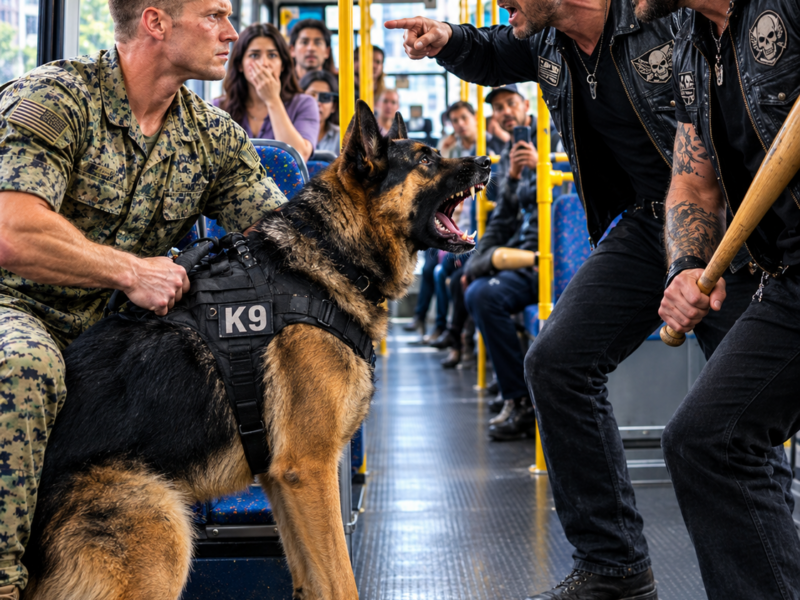
“The three men surrounding me on the city bus laughed when one of them kicked my worn boots and demanded I hand over my wallet
The floorboard outside my apartment creaked again.
Duke rose from beside the couch, his ears forward and his body rigid. I had seen that posture in Afghanistan, in the seconds before a quiet road became a battlefield.
Someone was standing outside my door.
I switched off the lamp and moved toward the hallway, keeping my breathing slow. Duke followed silently, positioning himself between me and the entrance.
The lock rattled once.
Then a woman’s voice whispered, “Mr. Miller? It’s Agent Rebecca Shaw. I’m alone.”
I didn’t touch the door.
“Tell me what you said when you left Michael Torres’s house,” I replied.
There was a brief silence.
“I told you the original mission report might still exist, and that you shouldn’t contact anyone connected to the operation until I verified the names.”
Correct.
“What did you promise?”
“That I would call before coming back.”
“You didn’t.”
“No,” she admitted. “I made a mistake. Someone accessed Michael’s case file, and I think they know what you found.”
I looked through the peephole. Shaw stood beneath the hallway light, holding her badge in one hand. Her other hand was visible, away from her coat.
I unlocked the deadbolt but kept the chain fastened.
“Step back.”
She did.
I opened the door enough to see the hallway behind her. It appeared empty, but an elevator stood open at the far end.
“Come in,” I said.
Shaw entered, and I locked the door behind her.
Duke examined her briefly before returning his attention to the entrance.
“Is he always this alert?” she asked.
“Only when something feels wrong.”
“And does something feel wrong now?”
“He hasn’t decided.”
Shaw lowered her voice. “Someone used a senior credential to access Michael’s investigation. They opened the photographs, witness statements, and evidence inventory. One attachment disappeared.”
“The photograph of me and Duke?”
Her expression tightened.
“You know about it?”
“I saw it at Michael’s house.”
“I saved a copy before it vanished. I wanted you to know that somebody is actively removing evidence.”
She showed me the image on her phone.
I stood beside Duke in Afghanistan, younger and leaner, wearing dusty combat gear. Behind us stood a damaged concrete building. At the edge of the photograph was a man in civilian clothes, his face turned partly away from the camera.
I remembered the building.
I remembered the mission.
And I remembered a man who should never have been there.
“Do you recognize him?” Shaw asked.
“Not yet.”
It was a lie, though I couldn’t explain why.
I recognized his posture and the silver ring on his right hand. The memory remained just beyond reach, buried beneath years of nightmares and official explanations.
Shaw enlarged the image.
“Michael uploaded this photograph six days ago. Someone may have planted it, or he may have recovered it himself.”
“Did you find anything else?”
“His file was accessed from inside the agency. The credentials belonged to an officer who claims he was home asleep.”
“Then either he’s lying or someone has access they shouldn’t have.”
“That’s what I’m trying to establish.”
I glanced through the blinds. A dark sedan sat across the street, parked beneath a broken streetlight.
“Was that car there when you arrived?”
Shaw looked without touching the blinds.
“No.”
“It’s been there since I came home.”
She photographed it through the narrow gap.
“I’m requesting backup.”
“Not from this apartment. If somebody can access your case file, don’t tell them where we are.”
She looked offended, then reconsidered.
“Where do you suggest we go?”
“An old diner near the marina. Leave separately, and don’t follow anyone who follows you.”
“I don’t like operating outside procedure.”
“Neither do I. But Michael followed procedure until someone killed him.”
That silenced her.
Shaw left first. I waited five minutes, took Duke through the rear stairwell, and walked several blocks before reaching my truck.
The sedan had disappeared.
That worried me more than seeing it still parked there.
Someone had been watching my apartment and had decided to move before I could identify them.
At the diner, Shaw was waiting in a booth near the back. She had changed her jacket and left her government vehicle several streets away.
She placed a folder on the table.
Inside was the list recovered from Michael’s house. Six names appeared beside dates, locations, and cryptic notes. Five belonged to men from my former team. The sixth was mine.
Beside my name, someone had written STILL ACTIVE.
Two names had been crossed out.
Michael Torres was one.
Daniel Mercer was the other.
“Daniel’s alive,” Shaw said. “At least, there’s no record of his death.”
“Where is he?”
“He owns a marine electronics business outside Wilmington. We haven’t contacted him yet.”
“Then someone else might have.”
She nodded. “That’s possible.”
I studied the list. Daniel had handled communications during our final deployment. He was cautious, technically brilliant, and so suspicious of unreliable equipment that he kept backups of his backups.
If anyone could have preserved the original mission records, it was Daniel.
“What did Michael find?” I asked.
Shaw opened the folder to several pages of handwritten notes.
“He believed your final operation had been altered after the fact. The official report says your team failed to locate an intelligence source, came under fire, and withdrew. Michael’s notes suggest you found the source and discovered something else inside the compound.”
An old memory stirred.
A narrow staircase.
A locked room.
Duke barking at a metal door.
A radio order telling us to ignore the upper floor.
I gripped the edge of the table.
“What else?”
“He wrote that a second objective was added after your team arrived. The instruction was to identify and secure an archive, with no local transfer.”
I stared at her.
“The archive existed.”
“You remember it?”
“We found hard drives, documents, and communications equipment. Someone ordered us to destroy the material.”
“Who gave the order?”
“Commander David Harris. His voice came over our radio.”
“Was the order recorded?”
“It should have been.”
“But the final report doesn’t mention the archive.”
“No.”
Shaw closed the folder.
“Someone erased an objective, removed evidence, and rewrote the mission as a failed extraction. Michael believed the archive contained information powerful people wanted to hide.”
“Then we need the original report.”
“He may have found it before he died.”
I thought about the note found in Michael’s house: If Jack is alive, tell him why.
Michael had known I would eventually see the evidence. He had also known it could be dangerous.
My phone vibrated.
An unknown number had sent a message.
STOP LOOKING FOR WHAT MICHAEL FOUND. HE DIED BECAUSE HE DIDN’T LISTEN.
I showed Shaw.
She photographed the screen and sent the message to her secure contact.
“Don’t respond,” she said.
“I wasn’t planning to.”
“Someone wants you frightened.”
“They’ve succeeded in making me angry.”
“That can be worse.”
“Only if I let it make my decisions.”
I looked again at the photograph.
The silver ring.
The turned shoulder.
The civilian standing where no civilian was supposed to be.
Suddenly, the name returned.
“Adrian Vale,” I said.
Shaw went still.
“You know him?”
“I saw him at a classified briefing before the deployment. He was introduced as an intelligence liaison. Nobody explained why he attended, and afterward his name disappeared from the records I was allowed to see.”
“I’ve heard of him. Vale worked with a special operations intelligence program. An internal inquiry examined missing records and unauthorized transfers, but the allegations were dismissed.”
“Was he cleared?”
“Officially.”
I looked at the photograph again.
“Then we need to find out what he was doing in that building.”
Shaw agreed, but before she could continue, her phone rang. She listened without speaking, then slowly lowered it.
“What happened?” I asked.
“Daniel Mercer didn’t arrive at his shop this morning. An employee found the office ransacked and a package addressed to you.”
My stomach tightened.
“Is Daniel missing?”
“His truck is gone. His phone is switched off. Police haven’t found evidence of a struggle.”
“What’s in the package?”
“A brass key, a note, and a memory card.”
She turned the phone toward me. The note contained four words.
LOCKER 214. NORFOLK STATION.
I recognized the location immediately. During our training, the team had used an old naval facility where storage lockers held records that rarely appeared in ordinary inventories.
“Can we access it?” she asked.
“Probably. But first, let’s hear the recording.”
The memory card contained a single audio file. Daniel’s voice sounded tired, but unmistakable.
“If you’re hearing this, Michael was right. The original report exists, but the report isn’t the only thing they hid. There was a transfer after the mission, and it was never logged. I don’t know who signed it. I only know the archive was moved before the building was destroyed.”
A pause followed.
“Jack, if it’s you listening, don’t trust the man who says he gave the order. He didn’t have the authority. He was repeating someone else’s words.”
The recording ended.
Shaw looked at me.
“Are you sure Harris was the voice on the radio?”
“Yes.”
“Could he have been passing on orders without knowing their origin?”
“It’s possible.”
“Do you trust him?”
I thought of the man who had helped me through rehabilitation, recommended me for retirement, and checked on me long after I left the service.
“I trust the man I knew,” I said. “I don’t yet know what that means.”
We arranged controlled access to the old facility. Shaw brought one trusted agent, Ellis, and left the wider team out of the immediate plan.
Locker 214 stood in a dim basement corridor. The brass key turned smoothly.
Inside lay a plastic case, a thick envelope, and a portable digital recorder.
The case held three hard drives. The envelope contained a copy of the original mission report.
I opened it carefully.
The first page identified our objective as retrieving an intelligence source and securing a data archive containing financial transfers, intercepted communications, and records of unauthorized operations.
The archive had not been an incidental discovery.
It had been the reason for the mission.
The report identified Adrian Vale as the civilian liaison authorized to oversee the transfer. A separate annex listed the personnel involved.
One name had been crossed out in black ink.
Peter Cole.
Beside it was a handwritten note: TRANSFERRED BEFORE EXTRACTION.
I stared at the words.
Peter had been the youngest member of our team. He laughed too loudly when nervous and volunteered for jobs nobody wanted. The official report said he died in the explosion.
I had never seen his body.
I had spent years believing the blast had taken him from us.
“Jack?” Shaw asked.
“The report says he was transferred before the explosion.”
“Could he have survived?”
“I don’t know. We were told the remains couldn’t be recovered.”
She examined the annex.
“There’s an authorization signature.”
I recognized it before she said the name.
David Harris.
My commander had signed the transfer.
The portable recorder contained a message from Michael.
“Jack, I should have told you sooner. Peter survived the operation. I saw him alive near the eastern gate, inside a vehicle before the explosion. I didn’t know who arranged it, and I didn’t know whether Peter had agreed to leave.”
Michael paused, breathing unevenly.
“Years later, I found the original report and evidence that the archive was transferred to a private intelligence company. The information was used to pressure people and conceal unauthorized activity. I believe someone has been silencing anyone who could prove where the archive came from.”
The recording ended with one final sentence.
“Don’t assume that everyone wearing the same uniform is on the same side.”
I looked at the signature again.
“We need to speak to Harris.”
Shaw hesitated.
“We should consider that he may be involved.”
“I’m considering it.”
“And if he is?”
“Then I’ll hear it from him.”
I called Harris from a secure phone.
He answered on the second ring.
“Jack.”
“How did you know I would call?”
“Because I knew Michael had found the report. I was hoping you would find it too.”
“You signed Peter’s transfer.”
“Yes.”
“Did you know he would be listed as dead?”
“No. I was told he was being moved into protective custody. I signed a document I believed would keep him safe.”
“But you never challenged the false report.”
“I should have.”
“Why didn’t you?”
“Because I was told that revealing Peter was alive would expose people who were still in danger. I believed the warning.”
“Michael is dead. Daniel is missing. Someone is threatening me.”
“I know.”
His voice sounded strained.
“Meet me tonight at the old communications station near Cape Charles. I’ll bring the rest of the documents I kept.”
“Why should I trust you?”
“You shouldn’t trust me blindly. But you deserve to hear what I know.”
I agreed to meet him, with Shaw and Ellis positioned nearby.
The station stood beyond a service road, surrounded by tall grass and wind-bent trees. Harris’s truck was parked beside the building.
He waited inside, looking older than I remembered.
“Jack,” he said.
“Commander.”
He opened a folder containing internal messages and authorization forms.
“Vale wasn’t simply a liaison. He managed an intelligence program that collected information from sources inside hostile organizations. Some of the work was legitimate. Some wasn’t.”
“Why was our team sent to retrieve the archive?”
“Someone believed the data had been compromised. We were told it contained information that could expose our sources.”
“But it also contained evidence of illegal activity.”
“Yes.”
“Who authorized the operation?”
Harris hesitated.
“Deputy Director Malcolm Rusk.”
The name was familiar. Rusk had become a respected public figure, known for his speeches about national security and responsible intelligence work.
“Rusk authorized the program, and Vale controlled the archive,” Harris continued. “Peter discovered that information was being used to threaten people who had cooperated with us. He copied part of the material and tried to preserve proof.”
“Then they removed him from the building.”
“Yes.”
“Who ordered that?”
“I believe Rusk approved it. Vale arranged the transfer.”
“You believe?”
“I never saw the complete order. I only saw the paperwork I was told to sign.”
Harris slid another photograph across the table.
Peter stood outside a small medical facility, older but clearly alive. A date on the back showed the photograph had been taken four months earlier.
“I received this anonymously,” Harris said. “It was the first proof I had that Peter survived.”
“Did you try to find him?”
“Yes, but every lead ended. The message that came with the photograph warned me that direct contact could expose him.”
“Or it could have been a way to keep you silent.”
“I understand that now.”
I wanted to believe him. I also wanted to shake him until the missing years fell out of his memory.
“You could have told us,” I said.
“I know.”
“You let us mourn a man who was alive.”
“I know.”
“Why should I believe anything else you say?”
“Because I’m giving you everything I have, even if it ends my career.”
Outside, Duke suddenly barked.
A vehicle door slammed.
Shaw’s voice came through my earpiece.
“Jack, we’ve got multiple vehicles approaching. Leave the building now.”
I gathered the documents and drive.
Harris took the photograph of Peter.
We moved through a narrow maintenance corridor and exited through a rear door. Floodlights snapped on before we reached the trees.
A man stood beside the building with a pistol held low.
“Stop. Put down the folder.”
Duke moved in front of me, growling.
I held the leash firmly.
“Don’t make this worse,” I said.
The man ignored me.
Then Adrian Vale stepped into the light.
“It’s been a long time, Miller.”
“Not long enough.”
Vale looked at the folder.
“Give it to me, and everyone can go home.”
“Michael Torres is dead.”
“Michael made a choice.”
“Daniel Mercer is missing.”
“Daniel also made a choice.”
“And Peter Cole?”
For the first time, Vale’s calm expression faltered.
“You have no idea what you’re dealing with,” he said. “That archive contains names and intelligence methods. Releasing everything could put lives at risk.”
“Then let independent investigators separate the sensitive information from the evidence of crimes.”
“You still believe institutions can fix their own mistakes.”
“Someone has to.”
Vale gestured to the armed man.
“Take the folder.”
The man advanced.
Duke barked sharply, and I pulled him back to keep him clear of the gun. The man lunged for the documents. I turned aside, blocking his arm and driving him against the wall. His pistol fell and slid beneath a metal platform.
I stepped away rather than continue the fight.
Shaw appeared at the corner with her weapon drawn.
“Vale, don’t move. Hands where I can see them.”
Vale reached inside his coat.
“Hands!” she shouted again.
He froze, then slowly raised both hands. A small black device slipped from his fingers and shattered on the concrete.
Within minutes, Shaw’s team secured the building and detained the men who had arrived with Vale.
No one was killed.
The documents and drives were placed into evidence custody under an independent supervisor, and Vale was taken for questioning.
For the first time, the evidence was beyond his immediate control.
The investigation did not end with Vale’s arrest.
It had only reached the point where people could no longer pretend the evidence did not exist.
The hard drives contained partial copies of the original archive, including financial records connecting the intelligence program to private contractors. Internal messages showed that information gathered during legitimate operations had been used to threaten witnesses and conceal unauthorized transfers.
Malcolm Rusk resigned before investigators announced the first public hearings.
Within days, federal agents searched several properties connected to his associates. Former employees began cooperating, and investigators uncovered evidence that the final mission report had been deliberately rewritten.
The original version identified Peter Cole as alive and under temporary protection.
The final version listed him as dead.
Only a few lines had changed, but those lines had erased a living man from our history.
Vale denied ordering Michael’s death and claimed he had been trying to protect national security. His lawyers argued that releasing the archive would expose intelligence sources and endanger American personnel.
For once, that argument did not stop the investigation.
Independent reviewers separated sensitive operational information from evidence of criminal conduct. The investigation could continue without publishing every name or exposing every source.
Michael’s death remained the hardest part.
Investigators traced a vehicle connected to one of Vale’s contractors to Michael’s neighborhood on the night he died. Messages recovered from the contractor’s devices showed that Michael had been asking questions about the original report.
The evidence supported the conclusion that he had been targeted because he was close to exposing the cover-up.
His family finally received answers, though answers could never return the man they had lost.
I attended his memorial beside the water.
His sister stood near the front row, holding the folded flag presented to him when he retired.
When she saw me, she came forward and took my hand.
“He talked about you,” she said.
“What did he say?”
“That you were the person he trusted to finish something once you understood why it mattered.”
I looked toward Michael’s photograph.
“I wish he’d told me sooner.”
“So do I.”
She didn’t blame me for not knowing. Somehow, that made the grief heavier.
I placed an old brass coin beside his photograph. Michael had given it to me after our first deployment, joking that it would remind me to stay humble.
I had kept it in a desk drawer for years.
“I’ll make sure they remember what you did,” I whispered.
Duke sat quietly beside me.
When I stood, he rose with me.
We left without ceremony.
Three days later, Shaw called with news about Daniel Mercer.
An intermediary had provided a photograph showing Daniel alive inside a small room. The message included a location outside Richmond, but Shaw refused to treat it as reliable without verification.
We arranged a controlled search with local authorities and agents who had not been involved in the original investigation.
The property was empty when we arrived.
Fresh footprints crossed the dusty floor. A blanket lay folded on a narrow cot, and food wrappers sat in a wastebasket.
Daniel had been there recently.
Beneath a table, investigators found a note.
I’M MOVING. FIND THE PLACE WHERE WE LEARNED TO LISTEN.
I knew what he meant.
During training, our team had spent weeks at a remote communications facility where we learned to identify signals hidden inside crowded radio traffic.
The compound had been closed for years, its buildings slowly disappearing beneath weeds and pine needles.
We reached it shortly before dawn.
Duke noticed movement near an equipment shed and stopped, ears raised.
A thin figure emerged from the shadows.
Daniel looked older and exhausted, but he was alive.
For several seconds, neither of us spoke.
Then he gave me a tired smile.
“You took your time, Miller.”
I crossed the distance between us and gripped his shoulder.
“You look terrible.”
“I’ve been told.”
Duke pushed his nose into Daniel’s hand.
Daniel crouched carefully and scratched behind his ears.
“Still the smartest member of the team,” he murmured.
“What happened?” I asked.
Daniel glanced at Shaw, who introduced herself and explained that the evidence was now in independent custody.
He listened without interrupting.
When she finished, he looked back at me.
“Michael was right to contact you.”
“He should have contacted me sooner.”
“He was afraid you’d go straight to Harris.”
“I did go to Harris.”
Daniel closed his eyes briefly.
“Then you know enough to understand why I disappeared.”
“Tell me anyway.”
After Michael discovered the original report, Daniel had searched for records confirming the archive transfer. He found evidence that the data had been copied to a private server before the official report was rewritten.
He also discovered that Peter was alive.
“I helped Peter move once,” Daniel said. “He was living under another name and working with people who helped former sources escape those who wanted to exploit them.”
“Where is he now?”
“I don’t know his exact location. He changed identities whenever he suspected someone had found him.”
“Why didn’t you tell us?”
“Peter believed that anyone who knew where he was could be used to locate him. He asked me not to contact the team.”
“And Michael?”
“He knew Peter survived, but he didn’t know where Peter was living.”
Daniel looked down at his hands.
“I should have gone to the authorities.”
“You were trying to survive.”
“That doesn’t make it right.”
“No,” I said. “But it explains why you were afraid.”
Daniel handed Shaw an encrypted drive.
“These are the records I kept outside the archive. They include the original transfer logs and a message from Rusk instructing Vale to remove Peter’s name from the casualty list.”
Shaw secured the drive.
“This could establish who authorized the cover-up.”
“That’s why I stayed alive long enough to bring it here,” Daniel replied.
Before we left, Daniel gave me one more piece of information.
“The man in your photograph wasn’t the only person inside that building who didn’t belong there. Someone on our team received a message about the eastern service entrance before we arrived.”
“Who?”
“I never proved it. The message used a field identifier that didn’t match any of our call signs.”
He handed me a folded note.
THE DOOR WAS OPEN BEFORE WE ARRIVED.
I read it twice.
The evidence had exposed the cover-up, but questions remained about the mission itself. We knew who authorized the transfer and who altered the report, yet we still didn’t know who had opened the service entrance or whether someone on our team had helped the archive disappear.
For the first time, however, I wasn’t carrying those questions alone.
Daniel received medical care and agreed to provide a formal statement after resting.
Shaw arranged a secure channel through which investigators could contact Peter without demanding that he reveal his location.
A week later, my phone rang from a blocked number.
“Jack Miller?”
The voice was low and cautious.
“Who is this?”
“My name is Peter Cole.”
I gripped the phone so tightly that my fingers hurt.
“Peter?”
“Yes.”
“You’re alive.”
“I am.”
For several seconds, I couldn’t speak.
I had remembered Peter as a young man who laughed when nervous and volunteered for the jobs nobody wanted. I had remembered the explosion and the radio call announcing his death.
I had carried the guilt of surviving him.
“I thought you were dead,” I finally said.
“I know.”
“We mourned you.”
“I know that too.”
I walked toward the window, watching the harbor lights appear across the water.
“Why didn’t you come back?”
“Because I was told my return could expose the people I was protecting. I had copied part of the archive, and the people who moved me wanted to keep me alive without revealing that I had survived.”
“Were you a source?”
“No. I was a witness. I knew what the archive contained, and I had evidence that it was being misused.”
“Who arranged your disappearance?”
“An oversight officer who believed the program had become compromised. She thought hiding me was the only way to protect the sources while someone searched for a way to expose the truth.”
“Did she know Michael was investigating?”
“She tried to warn him to stop.”
“Did she kill him?”
“No.”
His answer came without hesitation.
“Then who did?”
“I don’t know. But I believe Vale’s network was responsible, and I have records that may help prove it.”
I closed my eyes.
“Where are you?”
“I can’t tell you yet.”
I wanted to demand answers. I wanted to ask why he had let us believe he was dead, why he had allowed our team to carry that grief for so many years.
But I remembered what Daniel had said.
Peter was a person, not an objective.
“You don’t have to tell me where you are,” I said.
Silence followed.
“I didn’t expect you to say that,” he admitted.
“I’m not going to force you out of hiding.”
“I want to testify.”
“Shaw can arrange a secure way for you to do that.”
“I want to see you first.”
We agreed to meet three days later at a public waterfront promenade. I told him I would come alone, but I would let Shaw know where I was going.
He accepted that.
When the call ended, Duke came over and rested his head against my knee.
“Looks like we’re not finished yet,” I told him.
He wagged his tail once.
Peter arrived at the appointed time.
He was older than I remembered, his face lined and his hair nearly gray. He walked with a slight limp, but his eyes were unmistakable.
He stopped a few feet away.
“Hey, Jack.”
I stood.
“Hey, Pete.”
We shook hands, then embraced briefly.
Duke sniffed Peter’s hand before pressing his nose into his palm.
Peter closed his eyes.
“I thought I’d never see either of you again.”
“Neither did I.”
We sat together and talked for nearly two hours.
Peter explained how he had been removed from the building before the explosion, transported to a temporary safe location, and given a new identity. He had spent years moving whenever he suspected someone had discovered his whereabouts.
“I was angry at first,” he admitted. “Then I became afraid. Eventually, I couldn’t tell which feeling was keeping me alive.”
“Why didn’t you contact one of us?”
“Because I thought I’d lead Vale to you.”
“Were you right?”
“I think so.”
I looked at the water.
“I wish you’d trusted us enough to let us make that decision.”
“So do I.”
He didn’t offer an excuse.
That mattered.
Peter agreed to provide his records to independent investigators and testify if prosecutors needed him. His evidence corroborated the material recovered from the locker and Daniel’s drive.
The investigation continued for months. Vale’s role became clearer as former employees came forward. Rusk and several associates faced legal consequences for their involvement in unauthorized transfers, evidence tampering, and the misuse of intelligence.
The case did not end with a dramatic confession.
It ended with documents, testimony, and people finally being forced to answer questions they had avoided for years.
Harris also gave a full statement.
He admitted signing the transfer order and failing to challenge the false casualty report when he first discovered discrepancies. His testimony helped establish how the report had been altered.
He was investigated and removed from his advisory position. He was not cleared of responsibility, but neither was he treated as the architect of the conspiracy.
I visited him once before the inquiry concluded.
We sat in a quiet room overlooking the base.
“I spent years telling young officers that integrity means doing the right thing when it’s difficult,” he said. “I didn’t understand how easily fear could make a person invent reasons not to do it.”
“Most people don’t,” I replied.
“Do you forgive me?”
I thought of Michael’s memorial, the list in Torres’s house, and all the years we had spent believing Peter was dead.
“I don’t know if I can.”
Harris nodded.
“But I believe you’re finally telling the truth,” I added.
For him, that seemed both a relief and a punishment.
I returned to my ordinary life as much as I could. I walked Duke beside the water, repaired loose boards on my balcony, and bought groceries without treating every passing vehicle as a threat.
Some nights were still difficult.
I still woke when a car door slammed outside. I still counted exits in unfamiliar rooms. Healing did not mean forgetting, and justice did not erase grief.
But I no longer pretended that silence could make the past disappear.
Nearly a year after Michael’s death, I took Duke to the beach before sunrise.
The tide was low, leaving a smooth stretch of wet sand beneath a pale sky. Duke ran ahead, then turned back to make sure I was following.
For years, I had believed retirement meant leaving the past behind. I thought that if I lived quietly enough, the memories would eventually lose their power.
I had been wrong.
The past had waited until I was ready to face what it had left unfinished.
Duke stopped near the water and looked back at me.
“You knew something was wrong before I did,” I told him.
He leaned against my leg.
On the bus, those three young men had seen a quiet older man they believed they could humiliate without consequence. They hadn’t seen the years of training, the people I had lost, or the choices I had made to survive.
They hadn’t understood the dog beside me.
Duke had never cared about my rank or my record. He recognized tension, danger, and the difference between a threat and a bluff.
He had seen what I was trying not to see.
The man I had been would never return exactly as he was. But the man I had become didn’t have to live in hiding.
I looked out over the water as sunlight reached the horizon.
For the first time in a long while, the silence around me felt peaceful instead of empty.
Duke nudged my hand.
“Come on, partner.”
We walked along the shore, leaving our tracks behind as the tide moved in.
And for once, I didn’t look back.
The end.









