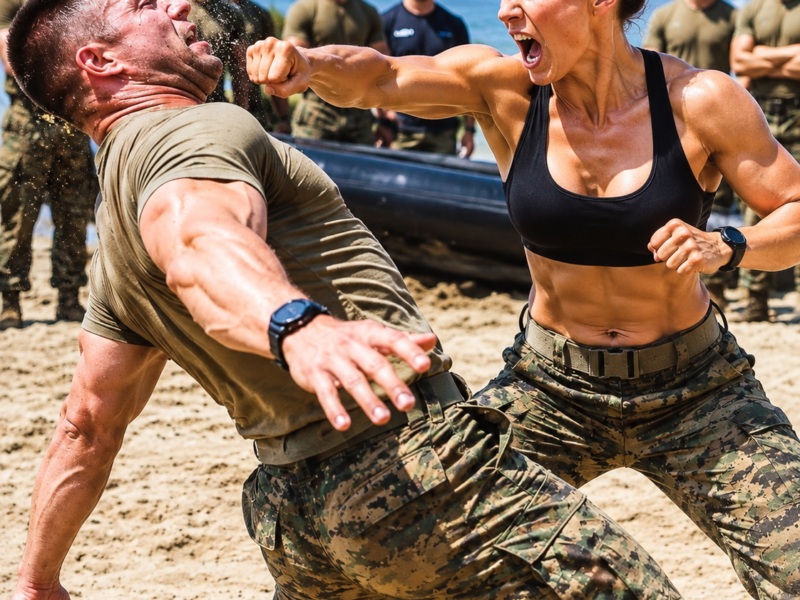
“The senior cadets laughed when I stepped onto the training field at Coronado in my plain, unmarked uniform, and one of them deliberately knocked my gear into the dirt
The man behind the glass didn’t move when I looked directly at him.
He stood with his hands clasped behind his back, his expression hidden by the reflection on the observation room windows. The silver stars on his shoulders were unmistakable.
Admiral Thomas Whitaker.
I’d seen his name on enough classified orders to recognize it immediately, but I had never met him in person.
Chief Hale watched me carefully.
“Do you know him?” he asked.
“I know who he is.”
“Then you understand why I suggested we talk before you start.”
I glanced at the altered protocol sheet tucked into his pocket.
“Did he tell you why he requested this evaluation?”
“No. He sent a directive yesterday afternoon ordering an unscheduled assessment of your leadership and judgment under pressure.”
“Just mine?”
Hale hesitated.
“That’s what the directive says.”
I looked back at the observation room.
Ryan Mercer was standing near the command station, laughing with his teammates. He had apparently decided that watching a woman instructor struggle through his exercise would be the highlight of his week.
He had no idea that the exercise had become something else entirely.
“Chief, I want the original protocol restored,” I said. “No unauthorized changes, no hidden variables that could put a trainee at unnecessary risk.”
Hale nodded.
“And I want the admiral’s directive preserved in the official record.”
“You think this is a setup?”
“I think a training exercise should be about training. If someone wants to evaluate me, they can do it openly.”
Hale studied me for a moment, then headed toward the observation building.
I watched him climb the steps.
The scar beneath my left sleeve began to itch, an old habit that surfaced whenever a memory pushed too close.
Three years earlier, in a dusty village overseas, I had stood in almost exactly the same position: a team waiting for an order, an injured man on the ground, and a senior officer insisting that the mission mattered more than the people carrying it out.
That day had taught me something I had never forgotten.
An order could be official, signed, and delivered through the proper channels and still be wrong.
The whistle blew across the field.
I turned toward the trainees.
“Everyone to the starting line.”
The cadets moved into position, their earlier laughter fading as they realized I wasn’t going to argue with Ryan or attempt to prove my physical abilities.
I pointed toward the course.
“This exercise has three objectives. First, identify the threat. Second, account for every member of your team. Third, reach the extraction point without creating a second casualty.”
Ryan folded his arms.
“That’s it?”
“That’s it.”
“No weapons demonstration? No obstacle race?”
“If you need an obstacle race to demonstrate leadership, Cadet, you have a different problem.”
Several cadets suppressed smiles.
Ryan’s face tightened, but he said nothing.
I selected four trainees from the group and assigned them roles. One would serve as team leader, one as communications operator, one as medic, and one as the simulated casualty.
Ryan’s friend, Cadet Tyler Brooks, was selected as team leader.
Tyler was broader than Ryan and almost as athletic, but he lacked his friend’s easy confidence. He kept glancing toward Ryan for approval.
That alone made him an interesting choice.
“Your objective is to move through the course and extract the casualty,” I explained. “You will receive updates as the situation develops. You are responsible for making decisions based on the information available to you.”
Tyler nodded.
“What happens if we lose communications?”
“You adapt.”
“What if the extraction point changes?”
“You verify the change before committing your team.”
Ryan laughed from the sidelines.
“Sounds simple enough.”
I looked at him.
“Then pay attention. You might learn something.”
The first run began smoothly.
Tyler’s team moved through the initial obstacles, maintained reasonable spacing, and checked the casualty’s condition before proceeding. They weren’t particularly fast, but nobody was trying to win a race.
At the first checkpoint, I delivered a simulated message.
Their original extraction point had been compromised.
They needed to reassess their route.
Tyler stopped the team and studied the map.
“Communications, confirm the new coordinates.”
The operator repeated the information.
“Source?”
“Control station.”
“Authentication?”
The operator looked uncertain.
Tyler turned toward me.
“Lieutenant, we haven’t received an authentication code.”
“Correct.”
“Then we don’t have enough information to change our route.”
I nodded.
“Continue.”
He directed his team toward a covered position while the communications operator attempted to verify the update.
From the sidelines, I saw Ryan’s grin disappear.
Tyler’s team was moving slowly, but they were doing something his team had failed to do: distinguishing an order from a trustworthy order.
Then the second update arrived.
The casualty’s condition had deteriorated.
The team needed to decide whether to continue toward extraction or stabilize the injured member first.
Tyler knelt beside the casualty.
“Can you move?”
The cadet shook his head.
“Not without assistance.”
Tyler looked toward the extraction marker, then back at his team.
“Medic, assess him. Communications, keep trying to verify the route. Nobody leaves him alone.”
The decision cost them time.
It also prevented the exercise from turning into a demonstration of how quickly someone could abandon responsibility.
When the whistle finally sounded, Tyler’s team reached the extraction point with all four members accounted for.
They had made mistakes. They had hesitated at several points. But they had communicated, reassessed, and corrected their decisions.
I turned toward the observation station.
Ryan wasn’t laughing anymore.
Chief Hale approached with his clipboard.
“Good run,” he said.
“An honest run.”
He glanced toward the observation building.
“Whitaker wants to speak with you.”
“Now?”
“Now.”
I handed the clipboard to another instructor and walked toward the building.
Inside, the air smelled of coffee and printer toner. Admiral Whitaker stood beside a large screen displaying the course from several camera angles.
He was in his late fifties, with neatly trimmed gray hair and the composed expression of a man accustomed to having rooms fall silent when he entered.
“Lieutenant Bennett,” he said.
“Admiral.”
He gestured toward a chair.
I remained standing until he sat down.
“Your personnel file is impressive,” he began. “Multiple deployments, advanced tactical qualifications, commendations for operational leadership.”
“Thank you, sir.”
“And yet you have a reputation for questioning orders.”
There it was.
I kept my face neutral.
“I question orders when the information supporting them is incomplete or inconsistent.”
“That sounds admirable in a classroom.”
“It also matters in the field.”
He looked toward the screen, where Tyler’s team was completing the final section of the exercise.
“Do you believe a subordinate should ever refuse an order from a superior officer?”
“I believe a subordinate has a responsibility to raise concerns when an order creates an unacceptable risk. There are circumstances where refusal is necessary.”
“And who decides what constitutes an unacceptable risk?”
“That depends on the situation, sir. But rank alone doesn’t make a decision correct.”
For several seconds, he said nothing.
Then he picked up the altered protocol sheet.
“Did Chief Hale tell you this document had been changed?”
“Yes.”
“Did you know who authorized the change?”
“I was told the authorization came from a superior officer.”
His gaze sharpened.
“You didn’t follow the revised procedure.”
“No, sir. The revision was not properly documented, and it conflicted with the original safety protocol.”
“You could have followed it and filed a report afterward.”
“That would have made the trainees responsible for the consequences of a decision they had no way to verify.”
He leaned back.
“You seem very certain of yourself.”
“No, sir. I’m certain of the process.”
Something in his expression shifted.
He turned off the display.
“Three years ago, you were involved in an operation in which your team failed to follow an extraction directive. A senior officer was injured, and the mission was terminated.”
I felt the old memory settle heavily in my chest.
“Yes, sir.”
“Your report stated that the original extraction point had been compromised and that proceeding would have exposed your team to a serious threat.”
“That was correct.”
“The commanding officer disagreed.”
“He was entitled to disagree.”
“But you disobeyed his order.”
“I requested clarification, proposed an alternative, and refused to move my team into an unverified kill zone.”
Whitaker watched me.
“Your decision saved four lives.”
I hadn’t expected him to say that.
He continued.
“It also ended a mission that had taken months to prepare. The officer who gave the order believed you had undermined his authority.”
I looked at the screen.
“Authority isn’t the same thing as judgment, sir.”
He tapped the protocol sheet against his desk.
“That distinction is precisely why you’re here.”
I turned back toward him.
“Then what is this evaluation actually testing?”
Before he could answer, the door opened.
Chief Hale stepped inside carrying a sealed folder.
“Admiral, we have a problem.”
Whitaker’s expression hardened.
“What kind of problem?”
Hale placed the folder on the desk.
“The revised protocol wasn’t simply an administrative change. Someone altered the electronic exercise controls as well.”
He opened the folder and displayed a printed access log.
The change had been made late the previous evening, using an authorization credential assigned to the training director.
But the director had been off base at the time.
Whitaker studied the document.
“Have you verified this?”
“Yes, sir. The original log and the system backup are both preserved.”
I leaned forward.
“Did the change affect the exercise conditions?”
Hale nodded.
“The simulated casualty sequence was moved forward, and the alternate extraction instructions were configured to appear without the usual verification prompt.”
“Who had access to the system?”
“Four people, including the training director.”
Whitaker closed the folder.
“Seal the exercise data. No one accesses the system until the investigation is complete.”
“Yes, sir.”
He waited until Hale had left.
Then he looked at me.
“Now you understand why I wanted to observe your response.”
I frowned.
“You’re telling me you expected the protocol to be altered?”
“I suspected someone might attempt to interfere with the evaluation.”
“Then why didn’t you stop it before the trainees were exposed?”
His jaw tightened.
“Because I needed to know whether the person responsible would reveal themselves.”
I stared at him.
“You used the cadets as part of an investigation.”
“I believed the existing safety controls would prevent any actual danger.”
“Belief isn’t a substitute for verification, Admiral.”
For the first time, his expression showed something other than authority.
It looked almost like regret.
“You’re right.”
I hadn’t expected that, either.
He opened a drawer and removed another document.
“The evaluation was requested after an incident at a training facility on the East Coast. An instructor reported that a senior officer had pressured trainees to follow an unsafe procedure. The complaint disappeared before it reached the proper review board.”
He slid the document toward me.
“The officer involved had previously served overseas. His operational record was impressive. His performance evaluations were excellent.”
“Until someone challenged him.”
Whitaker nodded.
“We began reviewing other training programs. Your name appeared in a report from a former teammate who said you had refused to approve a procedure you believed would endanger your unit.”
I read the summary.
The report was accurate, but it left out what had happened afterward: the arguments, the investigation, the months of uncertainty while my judgment was questioned by people who had never been present.
“Who filed the complaint at the East Coast facility?” I asked.
“We haven’t established that yet.”
“Then you don’t know whether this incident is connected.”
“Not conclusively.”
I looked at the access log again.
“Who was the training director’s credential assigned to?”
“Commander Paul Donovan.”
The name meant nothing to me.
Whitaker continued.
“Donovan oversees several advanced training programs. He’s due to arrive here tomorrow.”
“And he’s the person you suspect?”
“One of several.”
I set the document down.
“Then I want the cadets removed from this investigation. They came here to train, not to become evidence in a dispute between officers.”
Whitaker regarded me for a long moment.
“Agreed.”
He picked up the phone and issued instructions to suspend the affected exercise and preserve all records.
When he finished, I felt some of the tension leave my shoulders.
Not all of it.
There was still the question of who had altered the protocol and why.
And there was Ryan Mercer.
When I returned to the field, he was standing near the equipment racks, speaking quietly with Tyler.
The conversation stopped as I approached.
“Cadet Mercer.”
He straightened.
“Lieutenant.”
“Walk with me.”
He followed me toward the far edge of the training ground.
For a while, neither of us spoke.
Then he said, “So, how badly did I do?”
I glanced at him.
“Is that what you’re worried about?”
He looked away.
“I made a mistake in the exercise.”
“You made several.”
His jaw tightened.
“Understood.”
“But mistakes can be corrected. The problem is what you do when someone points them out.”
He kicked at a small stone on the path.
“I thought you were trying to embarrass me.”
“Why?”
“Because you challenged me in front of the others.”
“You challenged me first.”
He said nothing.
I stopped near the fence overlooking the water.
“Tell me something, Cadet. Why did you kick my bag this morning?”
He stared at me.
“It was a joke.”
“No. It was a test.”
His eyes narrowed.
I continued.
“You wanted to see whether I’d react emotionally, whether I’d raise my voice, whether you’d be able to turn the other cadets against me if I did.”
He looked down.
“Maybe.”
“Why?”
He took a long breath.
“My older brother went through this training program. He was one of the best people in his class. Then he was assigned to a unit where nobody trusted him because he questioned a senior operator.”
“What happened?”
“He got hurt during a training exercise. A procedure was rushed, and he raised concerns beforehand. The instructor said he was making excuses.”
Ryan’s voice grew quieter.
“My brother spent months recovering. When he returned, people treated him like he couldn’t handle the job.”
I watched him carefully.
“That doesn’t explain why you treated me the way you did.”
“No, ma’am.”
He rubbed the back of his neck.
“I figured if I could make you lose your temper, everyone would know whether you belonged here.”
“And if I had?”
He didn’t answer.
“Then you would have used my reaction to justify what you already believed.”
Ryan swallowed.
“I guess so.”
I let the silence sit between us.
Finally, he asked, “Have you ever had someone under your command get hurt because you made the wrong decision?”
The question reached deeper than he could have known.
“Yes.”
His eyes lifted.
“What did you do?”
“I went back through every part of the decision. I asked what I missed, what I assumed, and what I should have questioned. Then I made sure I didn’t repeat the same mistake.”
“Did you ever stop blaming yourself?”
I considered the question.
“Not completely.”
He looked surprised.
“But blame isn’t the same as responsibility,” I continued. “You can take responsibility for a decision without pretending you controlled every part of what happened.”
Ryan stood very still.
“My brother thinks I shouldn’t try for the teams,” he said. “He says I care too much about proving myself.”
“Do you?”
He looked toward the obstacle course.
“I don’t know.”
“Then that’s what you need to figure out. Not whether you can beat me in a race or make me angry. Whether you can trust your judgment enough to admit when you’re wrong.”
He nodded slowly.
For the first time since we’d met, he looked less interested in winning.
“I’m sorry about your bag, Lieutenant.”
“Don’t apologize to me because you think it will improve your evaluation.”
He almost smiled.
“I’m apologizing because it was wrong.”
I studied him for a moment.
“That’s a better start.”
We returned to the training area, where Chief Hale was waiting.
“Mercer,” he said, “your team is scheduled for a leadership review tomorrow morning.”
“Yes, Chief.”
“And you’re going to lead the debrief.”
Ryan blinked.
“Me?”
“You heard me.”
He looked toward me, then back at Hale.
“Understood.”
That evening, the investigation moved faster than anyone expected.
The access logs showed that Commander Donovan’s credential had been used to alter the exercise controls, but the system had also recorded a second access attempt from a terminal in the observation building.
The terminal was assigned to Admiral Whitaker’s temporary office.
That did not prove the admiral had made the change. Several staff members had access to the room, and the credential could have been copied.
But it meant the investigation could no longer be treated as a simple case of unauthorized interference by one training officer.
The next morning, Whitaker called an emergency meeting with the base commander, Chief Hale, the training director, and the investigators.
I attended as the officer who had identified the altered protocol.
Ryan and the other cadets were told to continue their normal schedule while the investigation proceeded.
Commander Donovan arrived shortly after eight.
He was in his early forties, neatly dressed, with a practiced smile that never quite reached his eyes.
When he saw me, he paused.
“Lieutenant Bennett. I’ve heard about your evaluation.”
“I imagine you have.”
He took a seat opposite Whitaker.
The admiral opened the meeting by displaying the access logs.
“Someone used Commander Donovan’s credentials to modify an active training scenario without authorization. A separate access attempt was recorded from the observation building.”
Donovan barely glanced at the screen.
“Then someone has compromised the system.”
“That’s our working assumption,” Whitaker replied.
“With respect, Admiral, we shouldn’t jump to conclusions based on an electronic record that could have been manipulated.”
I watched him as he spoke.
He was calm, measured, and entirely reasonable.
That was what made the next part so revealing.
Chief Hale placed the original protocol beside the altered version.
“The revised procedure removed a required verification step and changed the timing of the simulated casualty. The change was made shortly after the evaluation directive was issued.”
Donovan folded his hands.
“Whoever did this wanted the exercise to appear unsafe.”
“Or wanted to see whether the instructor would follow an unsafe order,” I said.
Donovan turned toward me.
“You’re assuming intent, Lieutenant.”
“No. I’m identifying the result.”
He gave a faint smile.
“Your reputation suggests you have strong opinions about authority.”
“My opinions aren’t part of the access log.”
A brief silence followed.
Whitaker leaned forward.
“Commander Donovan, were you aware that Lieutenant Bennett’s evaluation had been scheduled?”
“Yes.”
“Did you access the training system yesterday evening?”
“No.”
The answer came without hesitation.
The investigator beside the screen spoke.
“Your credential was used at 1906 hours.”
“Then someone used it without my knowledge.”
“Did you report it missing?”
“No, because I wasn’t aware it had been compromised.”
Whitaker nodded slowly.
“Then we’ll need to examine your access history.”
Donovan’s expression tightened.
“Of course.”
The meeting continued for another hour. The investigators collected devices, preserved records, and suspended access to the training system.
No one was arrested that morning.
There wasn’t enough evidence to establish who had made the changes.
But as the officers filed out, Donovan approached me near the door.
“You seem pleased with yourself,” he said quietly.
“I’m not pleased about anything that happened.”
“You’re making powerful people uncomfortable.”
“I didn’t alter the protocol.”
He stepped closer.
“You don’t know how these things work, Lieutenant. Careers are built on trust. If you keep implying that senior officers can’t be trusted, eventually no one will trust you.”
I met his gaze.
“Trust that depends on silence isn’t worth much.”
His smile vanished.
“Be careful.”
He walked away.
I watched him cross the corridor and disappear around the corner.
Chief Hale appeared beside me.
“That sounded friendly.”
“He’s worried.”
“About the investigation?”
“About what it might reveal.”
Hale rubbed his chin.
“Can you prove it?”
“Not yet.”
“Then don’t let suspicion become certainty.”
I looked at him.
“That’s good advice, Chief.”
He nodded toward the training field.
“Come on. Your cadets are waiting.”
For the next two weeks, I continued teaching while the investigation unfolded.
The atmosphere at Coronado changed.
The cadets were quieter during briefings. Instructors checked every revision to their exercise plans. Nobody made jokes about the new female lieutenant, at least not within my hearing.
Ryan changed, too.
He stopped trying to dominate every conversation and began asking his teammates for input. He still moved quickly, still competed hard, and still struggled when someone challenged his judgment.
But now he listened.
During one exercise, a younger cadet questioned his route selection.
Ryan started to dismiss him, then stopped.
“Explain your concern,” he said.
The cadet pointed to a blind turn on the map.
Ryan studied it.
“You’re right. We’ll take the alternate route.”
It was a small decision.
Nobody applauded.
Nobody needed to.
Afterward, Ryan found me near the equipment racks.
“I almost ignored him,” he admitted.
“But you didn’t.”
“I wanted to.”
“That’s the part you need to work on.”
He nodded.
“Chief Hale says leadership is what happens when nobody is watching.”
“Hale says a lot of useful things.”
Ryan smiled.
Then his expression grew serious.
“Did you really lose someone because of a bad order?”
I looked toward the ocean.
“Yes.”
He waited, but I didn’t elaborate.
Some memories belonged to the people who had lived them. I wasn’t ready to give that one away simply because he had asked honestly.
Ryan seemed to understand.
“I’m sorry,” he said.
“Thank you.”
He turned to leave, then paused.
“Lieutenant?”
“Yes?”
“If I end up leading a team someday, I don’t want anyone under me to be afraid to tell me I’m wrong.”
I studied him.
“Then don’t punish them when they do.”
He nodded once and walked back toward his group.
The investigation finally produced a breakthrough on the seventeenth day.
A systems technician discovered that the altered protocol had been uploaded from a remote administrative account rather than from the terminal assigned to Donovan. The account had been created using credentials associated with a civilian contractor who maintained several training databases.
The contractor was interviewed and admitted that he had received instructions to make the changes.
He claimed the request came through an encrypted message from someone using a senior command authorization code.
The message had been deleted, but a backup server retained its transmission time and destination.
The recipient was a private account linked to Commander Donovan.
That was the first direct connection between him and the unauthorized change.
When investigators confronted him with the evidence, Donovan denied ordering anyone to alter the exercise.
He claimed the contractor had misunderstood a request to test the system’s security.
But the contractor produced a copy of the original instruction, which explicitly directed him to remove the verification prompt and accelerate the casualty scenario.
Donovan was removed from his training position pending a formal investigation.
He did not confess to everything, and the inquiry into the separate access attempt from Whitaker’s office continued. Investigators eventually determined that a staff officer had used the admiral’s temporary credentials to access the system, apparently hoping to make the altered exercise look like an authorized evaluation.
The staff officer resigned before disciplinary proceedings were completed and later cooperated with investigators.
Whitaker accepted responsibility for failing to establish adequate safeguards around the evaluation.
He also issued a written directive prohibiting unscheduled changes to safety-critical training scenarios without independent review.
The changes did not solve every problem at the training facility, but they established something important: no officer, regardless of rank, could quietly alter the rules and then expect everyone else to accept the consequences.
On the final day of my assignment, Chief Hale called the senior cadets together for a leadership debrief.
Ryan stood at the front of the group.
He looked nervous, though he tried to hide it.
“This course taught us how to make decisions under pressure,” he began. “But I think I misunderstood what that meant.”
He glanced toward me.
“I thought leadership meant being the person who had the answer first. I thought hesitation made you weak and that questioning an order meant you didn’t trust the person giving it.”
He paused.
“Now I think leadership means being responsible for the people who have to live with your decisions.”
Nobody moved.
Ryan continued.
“If someone tells you that you’re wrong, you don’t have to agree with them. But you owe them enough respect to hear what they’re saying.”
He finished without looking toward his friends for approval.
Chief Hale nodded.
“Good. Now remember it when things get difficult.”
The cadets were dismissed.
Ryan approached me as the others left the field.
“I wanted to ask you something before you go.”
“Go ahead.”
“Do you think I’m cut out for this?”
I considered him carefully.
“I think you’re capable of becoming a good operator.”
His shoulders relaxed slightly.
“But being capable isn’t the same as being ready.”
He nodded.
“I know.”
“Keep learning how to listen. Keep learning how to admit mistakes. And stop treating every challenge like someone is trying to take something away from you.”
He gave a small, embarrassed smile.
“That last part might take a while.”
“Then start now.”
He held out his hand.
I shook it.
“Thank you, ma’am.”
“Don’t thank me yet. You still have a lot of training ahead of you.”
“I figured.”
He walked away toward his team, and I watched him fall into step beside Tyler.
For the first time, he wasn’t trying to lead the group by walking several feet ahead of everyone else.
He was walking with them.
That afternoon, Admiral Whitaker met me outside the administration building.
“I’ve read the final report,” he said.
“And?”
“You were correct to halt the exercise and preserve the original protocol.”
“Thank you, sir.”
He looked out toward the training field.
“I owe you an apology. I should have disclosed the purpose of the evaluation and ensured the safeguards were independently verified.”
I hadn’t expected him to say that.
“Yes, sir. You should have.”
He accepted the answer without defensiveness.
“I’ve recommended that you continue with the advanced instruction program. Your methods aren’t always comfortable for the people being evaluated.”
“They aren’t supposed to be comfortable.”
“No,” he said. “But they should be fair.”
For the first time since I’d arrived, I felt that we were speaking honestly rather than testing one another.
He offered his hand.
I shook it.
When I left Coronado that evening, the sun was sinking behind the Pacific, turning the water into a long sheet of gold.
I carried my duffel bag over one shoulder, the same bag Ryan had kicked into the dirt on my first morning.
The scuff marks were still visible.
I could have replaced it.
Instead, I had left them there.
They reminded me of how easily people confuse appearances with ability, confidence with leadership, and obedience with courage.
The cadets had thought they were testing the new girl.
The admiral had thought he was testing an instructor.
And someone had believed that a carefully altered order could reveal whether I would follow authority without question.
What they discovered was simpler than any of them expected.
I didn’t need to be the loudest person on the field. I didn’t need to win a race or prove that I could outfight a room full of young men.
I needed to know what the mission required, what the evidence supported, and who would bear the consequences if I got it wrong.
As I reached the parking lot, I heard a familiar voice behind me.
“Lieutenant Bennett!”
Ryan was jogging toward me, holding a pair of gloves.
“You left these in the observation room.”
I took them from him.
“Thanks, Cadet.”
He hesitated.
“Can I ask you one last thing?”
“One.”
He looked toward the water.
“When you first arrived, did you know we’d try to test you?”
I thought about the bag in the dirt, the laughter, and the way he had looked at me as if my presence were an insult.
“I suspected someone would.”
“And you weren’t angry?”
“I was.”
He looked surprised.
I tucked the gloves into my bag.
“Courage doesn’t mean you never feel anger, Ryan. It means you don’t let anger make the decision for you.”
He considered that, then nodded.
“Understood.”
I started toward my car.
Behind me, the training field was filling with the sounds of another class beginning its work. Whistles, shouted instructions, boots striking the ground.
Another group of young men would arrive convinced that strength meant never showing uncertainty.
Some would learn differently.
Others would need more time.
I couldn’t make those choices for them.
But I could leave them with one thing worth remembering.
The strongest leader in the room isn’t always the one who gives the order.
Sometimes, it’s the one willing to ask whether the order is right—and accept the consequences of telling the truth.
The end.









