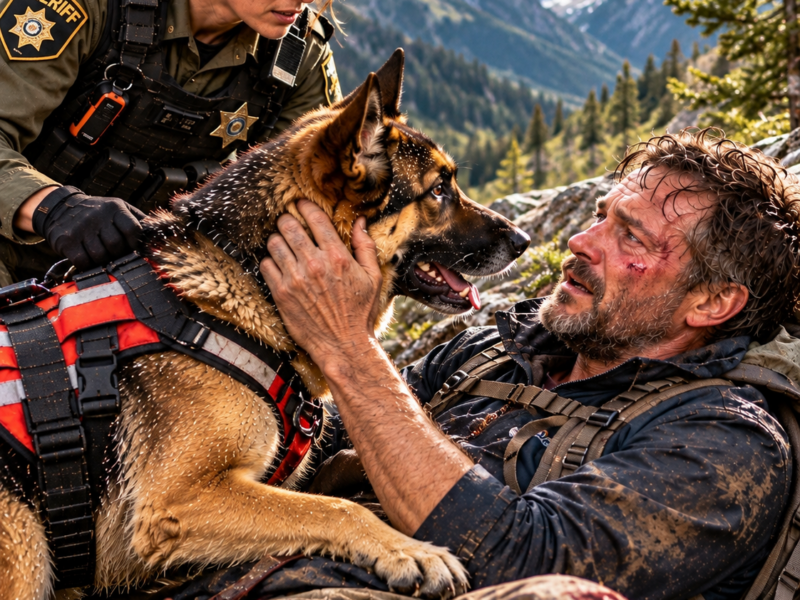
“The rescue K9 broke away from his handler at a crowded shelter event in Tampa, slammed both paws against a homeless man’s chest
Frank Dawson kept staring at the brass key in his palm as though it might burn through his skin.
Bear stood beside him, pressing his shoulder against Frank’s leg, refusing to let the man retreat another step.
I had never seen my dog behave this way. Bear was trained to follow commands even under pressure. Yet when I gave him a quiet signal to return to my side, he looked at me, then back at Frank, and stayed exactly where he was.
That told me something important.
Whatever this reunion meant to Bear, it wasn’t over.
“Frank,” I said, keeping my voice calm, “we’re going somewhere private. You can explain what you mean without an audience.”
He shook his head.
“You don’t understand. I can’t go back there.”
“Back where?”
He looked past me toward the street.
For a moment, I thought he was about to run.
Then a black SUV rolled slowly past the entrance to the parking lot.
Frank went rigid.
Bear’s ears rose, and a low growl rumbled through his chest.
The SUV continued down the street, but Frank watched it until it disappeared around the corner.
“That’s why I couldn’t come back for him,” he whispered.
I stepped closer.
“Who was in that vehicle?”
“I don’t know.”
“Have you seen it before?”
Frank didn’t answer immediately.
Then he nodded.
“Twice this week.”
My stomach tightened.
I had spent years working around emergencies, missing people, and frightened families. I knew the difference between someone who was confused and someone who believed he was in genuine danger.
Frank wasn’t performing.
He was terrified.
I called our event coordinator and asked her to bring the shelter director to the rear office. I also contacted my team supervisor and requested assistance documenting a possible threat. I didn’t have enough information to accuse anyone of anything, and I wasn’t going to let a stranger’s fear turn into an unsupported conclusion.
But I wasn’t going to ignore it, either.
Before we moved, I asked Frank one question.
“Is Bear in danger?”
Frank looked down at my dog.
“No,” he whispered. “Not because of anything he did.”
His eyes lifted to mine.
“But if someone thinks I still have what I took, they might try to use him to get it.”
I felt a chill move through me.
“What did you take?”
Frank closed his fist around the key.
“Something I should have reported six years ago.”
We moved into the shelter’s administrative office, where the director, a woman named Patricia, offered Frank water and a chair. He sat near the door, refusing to put the key down.
Bear lay at his feet, but his eyes never left Frank.
I sat across from them.
“Start at the beginning,” I said.
Frank took a long breath.
“Before my wife got sick, I worked as a maintenance technician for a private storage company outside Tampa. We had contracts with several businesses, including a logistics firm that handled equipment for emergency response teams.”
“What kind of equipment?”
“Vehicles, radios, tracking units, specialized tools. Some of it was ordinary commercial inventory. Some of it wasn’t.”
He rubbed his palms together.
“One evening, I was checking a storage unit after a water leak. The company had told us the unit was empty, but there were boxes inside. They weren’t on the inventory list.”
“Did you open them?”
“One had already been damaged by the water. Inside were documents and electronic equipment. I thought it was stolen property, so I called my supervisor.”
Frank’s expression hardened.
“He told me to forget what I’d seen. Said the paperwork would be corrected and I should keep my mouth shut.”
“Why didn’t you report it?”
“I was afraid of losing my job. My wife had already started treatment. I had bills piling up, and I thought maybe there was a reasonable explanation.”
He looked at Bear.
“Then I came home one night and found my back door open. Nothing valuable was missing. But Buddy was hiding under the kitchen table, shaking so badly he wouldn’t come out.”
My hand tightened around my knee.
“Did someone enter your house?”
“I never found out. There were no signs of forced entry. The police took a report, but nobody followed up.”
He swallowed.
“A week later, a man came to my workplace and asked me about the storage unit. He knew my wife’s name. He knew where she received treatment.”
Frank’s voice became quieter.
“He told me that if I cared about my family, I would stop asking questions.”
Patricia exchanged a worried glance with me.
“Did you keep any of the documents?” I asked.
Frank nodded.
“Copies. A small ledger. Some photographs. I didn’t understand everything I was looking at, but I knew the inventory numbers didn’t match the deliveries.”
“And the key?”
“It opens a second storage compartment. One that wasn’t listed in the company’s records.”
I stared at the brass key.
“Where is it?”
Frank looked toward Bear.
“Under the floor of an old workshop, in a building that was supposed to be demolished years ago.”
“What’s inside?”
“The original paperwork. At least, I hope it is.”
He hesitated.
“And there’s something else. A recording.”
I leaned forward.
“Of what?”
“Two men discussing the inventory. One of them said that if the missing equipment was ever traced back to them, they’d make sure the records showed it had been destroyed.”
“Do you know who the men were?”
“I recognized one. My supervisor. The other one was someone from the logistics company.”
“Do you remember his name?”
Frank nodded slowly.
“Martin Vale.”
The name meant nothing to me, but Patricia immediately picked up her phone and stepped into the hallway to speak with our supervisor.
I watched Frank carefully.
“Why did you surrender Bear?”
His face crumpled.
For the first time since we’d met, he seemed unable to find the words.
“My wife, Linda, had been getting worse for months. Her medication wasn’t working, and I couldn’t keep missing shifts. I was exhausted, frightened, and angry at myself for not being able to fix anything.”
He looked down at his hands.
“Then someone left a message on my phone. They said I had one chance to walk away from the storage issue. If I didn’t, the people I loved could get hurt.”
He drew a shaky breath.
“I thought they meant Linda. I thought they might hurt her. So I started planning to leave town.”
“But you didn’t.”
“Linda was too sick to travel. I couldn’t abandon her.”
His eyes filled.
“When she died, I lost the last thing holding my life together. I couldn’t keep our apartment. I couldn’t keep my job. And I couldn’t keep Buddy somewhere safe.”
He rubbed Bear’s head with trembling fingers.
“I told the shelter I was surrendering him because of financial hardship. That was true. But it wasn’t the whole truth.”
“Why didn’t you come back for him when things improved?”
Frank gave a bitter little laugh.
“Things never improved the way I expected. I spent months moving between temporary jobs and borrowed rooms. Eventually, I got stable work, but I was ashamed. I thought he’d be better off with someone who hadn’t failed him.”
Bear lifted his head and nudged Frank’s palm.
Frank closed his eyes.
“I told myself he wouldn’t remember me.”
I couldn’t help looking at my dog.
For six years, Bear had slept beside my bed, followed me through storm-damaged neighborhoods, and waited outside the bathroom whenever I showered.
I’d believed our bond had been built from the ground up.
Now I understood that I had joined a story that had started long before I entered it.
“Frank,” I said gently, “you didn’t fail him by wanting him to have a safe home.”
He looked at me.
“But I left him.”
“Yes. And it hurt you. I can see that. But surrendering an animal when you can no longer care for him isn’t the same as not loving him.”
Frank looked away, unable to answer.
Bear rested his chin on Frank’s knee.
And for a moment, the room was quiet.
Then Patricia returned.
“Our supervisor is sending two officers to take a report,” she said. “He also checked the name Martin Vale. There’s a former logistics executive by that name who was investigated several years ago over irregular purchasing records.”
Frank’s head snapped up.
“Was he charged?”
“No. The investigation was closed without charges, according to the initial information we have.”
Frank’s fingers tightened around the key.
“That’s because the evidence disappeared.”
Patricia glanced at me.
“We need to be careful here. We don’t know whether the documents Frank describes still exist, or whether they establish a crime. The police will have to investigate.”
“I understand,” I said.
Frank stood abruptly.
“I can’t wait for them to decide whether I’m worth protecting.”
Bear stood with him.
I stepped between Frank and the door, not to block him physically, but to make sure he heard me.
“You don’t have to tell me everything right now. But if you leave without a plan, you could put yourself in more danger.”
Frank’s face tightened.
“You’re asking me to trust people I don’t know.”
“I’m asking you not to face this alone.”
He looked at Bear, and his expression softened.
“That dog trusted you.”
“He did,” I said. “And I’m not going to make him regret it.”
For a long moment, Frank said nothing.
Then he sat down again.
That was the first decision he made that day that seemed to bring him a little peace.
The police arrived twenty minutes later.
A detective named Alvarez took Frank’s statement while another officer reviewed the shelter’s security footage. They documented the key, the photograph, and Frank’s account of the storage unit.
The footage showed the black SUV passing the entrance twice within a fifteen-minute window.
Its license plate was partly obscured by a dirty cover, but the detective believed they might be able to identify it through nearby traffic cameras.
Frank agreed to cooperate, though he refused to let the key out of his sight.
When Detective Alvarez asked why he had waited six years to report the matter, Frank told him the truth.
Fear. Grief. Shame. And the desperate belief that if he stayed quiet, he could finally rebuild a life.
Alvarez listened without judgment.
Then he asked the question that changed everything.
“Mr. Dawson, you said you found documents inside an unlisted storage unit. Did you ever tell anyone else about them?”
Frank stared at the floor.
“One person.”
“Who?”
“My wife.”
The detective waited.
“She made me promise that if anything happened to me, I’d give the documents to someone who could investigate them properly.”
Frank’s voice cracked.
“After she died, I didn’t know who that person should be.”
“Why didn’t you tell the police?”
“Because I believed the men involved had connections inside the company. I didn’t know who I could trust.”
Alvarez nodded slowly.
“That’s something we can investigate. But we can’t promise what we’ll find.”
Frank looked down at Bear.
“I know.”
The detective asked about the old workshop. Frank described the location as best he could, but the property had changed hands several times. A preliminary search showed that the building was still standing, though it had been vacant for years.
Alvarez arranged for a team to inspect it the following morning after obtaining the necessary legal authorization.
He also arranged for Frank to stay somewhere safe while they worked through the information.
Frank agreed, but he had one request.
“Can I see Bear tomorrow?”
I glanced at my partner.
Bear was already sitting beside Frank’s chair.
“That depends on the shelter and the investigation,” I said. “But if it’s safe, I’ll bring him.”
Frank nodded, his eyes wet again.
“Thank you.”
When the officers finally left with copies of the initial report, I walked Frank to the shelter’s side entrance.
The late-afternoon sun had faded behind the buildings, leaving the parking lot washed in pale gold.
Frank stopped beside my truck.
“I need you to know something,” he said.
“What?”
“When I gave him up, I thought I was protecting him. But maybe I was protecting myself, too.”
I didn’t interrupt.
“I couldn’t bear the thought of him watching Linda die. I couldn’t bear the thought of coming home and seeing everything we had lost. And after she was gone, I couldn’t face the one living thing that reminded me of who I’d been before.”
He swallowed.
“I told myself I was doing the right thing because it hurt less than admitting I didn’t know how to keep going.”
Bear stepped forward and pressed his nose into Frank’s hand.
Frank bent down and wrapped his arms around him.
“I’m sorry, Buddy,” he whispered. “I’m so sorry.”
Bear leaned into him without hesitation.
For the first time, I saw Frank smile.
It was small and fragile, but it was real.
Then he pulled away, wiped his face, and followed the officers to their vehicle.
Bear watched him leave.
He didn’t bark or pull at the leash.
He simply stood there, his eyes fixed on the road long after the car disappeared.
That night, Bear refused his usual dinner.
He drank water, circled his bed several times, then settled beside my front door with his head resting on his paws.
I sat on the floor beside him.
“You found him, buddy,” I whispered. “You did what you needed to do.”
His ears twitched, but he didn’t lift his head.
I wondered whether he was remembering the porch in the photograph, the sound of Frank’s voice, or the day he’d been taken away from the only home he’d known.
Perhaps dogs didn’t separate their memories into neat categories the way people did.
Perhaps, to Bear, Frank had never stopped being part of his world.
The following morning, Detective Alvarez called.
The team had reached the old workshop.
Inside a sealed compartment beneath a warped section of flooring, they had found a metal case containing a ledger, several folders of printed emails, a digital recorder, and a small external drive.
The case had been protected from moisture by layers of plastic.
Some of the papers were damaged, but much of the material appeared readable.
“Is it what Frank described?” I asked.
“We’re still reviewing it,” Alvarez replied. “But the inventory numbers match records from the logistics company. There are discrepancies we need to examine.”
“What about the recording?”
“We’ve recovered the file. The audio is being authenticated.”
I glanced at Bear, who had raised his head at the sound of my voice.
“Does Frank know?”
“Not yet. We’ll tell him once we can give him something concrete.”
Before hanging up, Alvarez added one more detail.
“The vehicle from the shelter footage has been identified. It belongs to a private security contractor. We haven’t established why it was there, but we’re looking into it.”
My stomach tightened.
“Do you know who hired them?”
“Not yet.”
That answer followed me through the rest of the morning.
I took Bear to the training field, hoping a familiar routine would help settle him. He completed his scent exercises, followed every command, and retrieved his training object with his usual precision.
But when we returned to the truck, he sat beside the passenger door and looked at me.
He didn’t move until I said Frank’s name.
Then his tail began to wag.
I knew what I had to do.
With the detective’s approval and after confirming Frank was safe, I arranged a supervised visit at a quiet county training facility.
Frank arrived just after noon.
He looked cleaner and more rested than the day before. Someone had given him fresh clothes, and he’d shaved his beard down to a short gray shadow.
But his hands still trembled when he saw Bear.
I kept the leash loose.
“Take your time,” I told him.
Frank knelt on the grass.
“Buddy?”
Bear crossed the distance between them in three long strides.
Frank laughed through his tears as Bear pressed his face into his shoulder, licking his cheek and pushing against him with enough force to make him sit back on his heels.
For several minutes, neither of them seemed aware that I was there.
Frank rubbed Bear’s ears and spoke to him in a low, familiar voice.
He told him about Linda’s favorite flowers.
He told him about the porch where the photograph had been taken.
He told him about the little red ball Bear had once buried beneath a rosebush and then spent an entire afternoon trying to dig up again.
Bear responded to each memory with an excited whine or a wag of his tail.
I felt my eyes sting.
Six years of separation had not erased those small details.
But the reunion also brought questions that affection alone couldn’t answer.
After a while, Frank sat beside me on a bench while Bear rested between us.
“How much do you know about the day he was surrendered?” Frank asked.
“Only what the file says.”
He nodded.
“Then there’s something I should tell you. I didn’t just leave him at the shelter and walk away.”
I turned toward him.
“What do you mean?”
“The shelter staff told me I could stay with him for a while before I signed the papers. I sat in a room with him for nearly two hours.”
Frank looked down at Bear.
“I kept telling him I’d come back. I thought I would. I thought I’d find work, get a place, and return before he forgot me.”
His mouth trembled.
“But when the time came to leave, I couldn’t stand up. One of the staff members finally told me I had to go because the shelter was closing.”
He paused.
“I remember hearing him scratch at the door after I walked out.”
Bear lifted his head as if he recognized the tone, if not the words.
Frank rubbed his face.
“That sound followed me for years.”
I let the silence sit between us.
Then I asked, “What made you come to the shelter event?”
Frank reached into his jacket and pulled out a folded sheet of paper.
It was a flyer advertising the rescue demonstration.
“I saw it at a community center where I’ve been staying. I came because I wanted to see the dogs. I thought maybe I could finally stop imagining what happened to him.”
He gave a sad smile.
“I never expected to find him standing in front of me.”
He folded the flyer again.
“And I didn’t expect the past to follow him.”
That afternoon, Detective Alvarez brought us to a secure interview room at the county office. Frank gave a fuller statement, and the detective explained what the preliminary evidence suggested.
The ledger documented shipments that had been recorded as delivered to emergency-response contractors but could not be matched to receiving records.
Several entries appeared to have been altered after the original transactions.
The emails suggested that employees had raised concerns about discrepancies, only to have the questions dismissed or removed from the official record.
The recording contained a conversation between two men discussing a shipment whose contents did not match its declared inventory.
The voices had not yet been conclusively identified, and the detective stressed that the material was evidence to investigate, not proof of every allegation Frank had made.
But the case was no longer just Frank’s word against a company that had refused to listen.
One name appeared repeatedly in the documents.
Martin Vale.
He had served as the logistics firm’s director of operations at the time of the suspicious shipments.
A preliminary review showed that he had left the company shortly after an internal audit began, citing personal reasons.
The audit itself had been closed without a public report.
“Was he responsible?” Frank asked.
“We don’t know yet,” Alvarez replied. “The evidence gives us grounds to investigate his role. It doesn’t tell us everything that happened.”
Frank nodded, absorbing the distinction.
For years, he’d carried the belief that powerful people had silenced him and escaped consequences.
Now there was a chance to find out what had really happened.
It wasn’t the same as having all the answers.
But it was a beginning.
Over the next several days, investigators interviewed former employees and obtained additional records through proper legal channels.
The company had changed ownership, and some of the original managers had moved out of state. Yet digital backups and financial documents revealed a pattern of irregular transactions.
Several shipments had been invoiced, marked as delivered, and later recorded as destroyed or written off.
The equipment itself could not all be accounted for.
Investigators also found evidence that employees who questioned the transactions had been pressured to withdraw their concerns.
Frank’s name appeared in an internal email.
One manager had described him as “a potential records problem” and recommended that his access to the storage facility be terminated.
Another message referred to his wife’s medical situation in a way that made my skin crawl.
The correspondence didn’t prove that anyone had threatened Frank’s family, but it showed that people inside the company knew more about his personal circumstances than they should have.
When Detective Alvarez explained this, Frank sat very still.
“They knew about Linda,” he said.
“Yes,” Alvarez replied. “And we’re investigating how that information was obtained and whether it was used to intimidate you.”
Frank stared at the table.
For a moment, I thought he might break down.
Instead, he took a slow breath.
“I spent six years thinking I was a coward because I ran.”
He looked up.
“Maybe I was scared. But I wasn’t imagining everything.”
“No,” Alvarez said. “You weren’t imagining the discrepancies. We’ll need evidence for each specific allegation, but your concerns were worth investigating.”
That was the first time Frank seemed to believe someone in authority was taking him seriously.
The investigation didn’t produce an instant victory.
Martin Vale’s attorney denied wrongdoing and argued that the records were incomplete. Several former employees claimed they had followed procedures they did not understand. Investigators had to separate negligence from deliberate misconduct, and missing equipment from equipment that had been misclassified.
Some questions remained unanswered.
But the recovered ledger and digital files gave prosecutors enough evidence to pursue charges against two former managers for falsifying business records and participating in a fraudulent procurement scheme.
A third individual was charged with obstructing the investigation after allegedly attempting to destroy records once the inquiry became public.
Martin Vale was interviewed and later charged in connection with the falsified transactions. He denied the allegations, and the charges would have to be proven in court.
The investigation also found no evidence that anyone had specifically targeted Bear or arranged his surrender.
That mattered to me.
I didn’t want Frank to leave the investigation believing every terrible thing he’d feared had been confirmed. The truth was complicated, and some parts might never be fully known.
But there was one thing we could establish.
Frank had seen irregularities.
He had tried to raise concerns.
And he had been frightened into silence at a time when his family was already falling apart.
As the legal process moved forward, Frank began rebuilding his life with help from a local outreach organization. He found steady work maintaining equipment for a community center and moved into a small apartment where he could finally close the door at night without wondering who might be waiting outside.
He also began seeing a counselor.
He told me later that the hardest part wasn’t talking about the threats or the investigation.
It was talking about Linda.
For years, he’d treated grief like a debt he could never repay. He believed that if he allowed himself to feel happy again, it would mean he had forgotten her.
But the counselor helped him understand that grief didn’t require him to remain broken.
He could miss his wife and still build a future.
He could regret surrendering Bear without spending the rest of his life punishing himself for it.
And he could be grateful that Bear had found a safe home, even if that home was no longer his.
Our visits became a regular part of Bear’s schedule.
At first, they were supervised and brief.
Frank would sit on a bench at the training facility while Bear leaned against him, and they’d spend half an hour together before I took Bear back to work.
Over time, the visits grew more relaxed.
Frank brought small treats approved by our trainer and learned the commands Bear responded to now. Some were different from the words he’d used years earlier, but Bear seemed delighted whenever Frank tried.
I never felt threatened by their bond.
If anything, it helped me understand Bear better.
He wasn’t choosing between us.
He was carrying both of us in the same heart.
One afternoon, several months after the first reunion, Frank arrived with a small wooden box.
“I wanted you to have this,” he said.
Inside was the faded photograph from the shelter event, carefully placed in a protective sleeve. Beside it lay another picture, one I’d never seen before.
It showed Frank, Linda, and a young Bear sitting together on their porch.
Linda was laughing, one hand resting on Bear’s head. Frank had an arm around her shoulders.
They looked tired but happy.
On the back, Linda had written a message in neat handwriting.
“Home is wherever we take care of each other.”
I read it twice.
Frank watched me.
“She wrote that the week before she got sick.”
He swallowed.
“I kept the photograph because I thought it was the only proof that we had ever been happy.”
He looked at Bear, who was lying in the grass with his head on my boot.
“Now I think I kept it because I was afraid I’d forget what happiness felt like.”
I closed the box carefully.
“Do you want me to keep it?”
“I want you to have it,” he said. “You’re part of his life now. And you gave him a home when I couldn’t.”
I shook my head.
“Bear gave me a partner when I didn’t know how much I needed one.”
Frank smiled.
“Then I guess we both got something we needed.”
The legal case continued for months.
Frank attended interviews, reviewed documents, and eventually gave testimony about what he had found in the storage unit.
He was nervous on the day he testified, but he didn’t back away.
When he finished, he walked outside the courthouse and stood in the sunlight for a long time.
I had brought Bear to wait with him after the proceedings, and the moment Frank saw us, his shoulders relaxed.
“That’s done,” he whispered.
“One part of it,” I reminded him gently. “The case still has a way to go.”
He nodded.
“I know. But I finally told the truth without apologizing for being afraid.”
That evening, we walked along a quiet trail beside the water.
Bear trotted between us, stopping now and then to investigate a patch of grass or inspect a bird that had landed too close to the path.
Frank laughed when Bear attempted to follow a duck into the shallows.
“Some things never change.”
I looked at him.
“Do you ever wish you’d fought harder to keep him?”
Frank thought about that for a long time.
“Of course,” he said. “But wishing doesn’t change what happened. I can’t give him those six years back.”
He watched Bear shake water from his coat.
“What I can do is make sure the years ahead are good ones.”
I understood then that the reunion wasn’t really about returning Bear to his old life.
It was about giving Frank a chance to stop running from it.
And it was about allowing Bear to love someone from his past without losing the person who stood beside him now.
A few weeks later, the first major court proceedings began.
Some of the former managers accepted agreements to cooperate with investigators. Financial records helped establish that several shipments had been falsely recorded, and the prosecution presented the ledger and authenticated digital files as part of its case.
The defendants continued to dispute aspects of the allegations, and the court process remained complicated.
But the records that had once been hidden were finally being examined in public.
Frank attended each hearing he was required to attend.
He no longer arrived looking over his shoulder every few seconds.
He still carried the brass key, though the storage compartment had been emptied and secured as part of the investigation. He told me he kept it as a reminder of the years he had spent believing silence was the only way to survive.
One morning, he handed it to me.
“I don’t need this anymore.”
I looked at the small piece of brass resting in my palm.
“What do you want me to do with it?”
“Keep it somewhere safe,” he said. “Not because it’s important now, but because it reminds me that something good can come from opening a door you were afraid to touch.”
I placed it in the wooden box beside the photographs.
Months passed.
Bear continued working with our rescue team, finding missing people and helping frightened families reunite.
Frank became a familiar face at our training facility. Sometimes he helped prepare equipment or brought coffee for the volunteers. Other times, he simply sat on the bench and watched Bear work.
He never asked me to give him his dog back.
He never suggested that the six years I’d spent with Bear were a temporary arrangement.
Instead, he became part of the wider circle of people who loved him.
One afternoon, a little girl who had recently been reunited with her family approached Bear at a community event. She was nervous, hiding behind her mother’s leg.
Bear lowered himself to the ground and waited.
The girl slowly reached out to touch his paw.
Frank stood beside me, watching.
“He’s always been good at knowing when someone needs a little time,” he said.
I smiled.
“He’s taught me that.”
Frank looked toward the girl and her mother.
Then he turned to me.
“Thank you for not pulling him away that day.”
I glanced at Bear.
“How could I? He knew you before I did.”
Frank’s eyes glistened, but he smiled.
“I used to think the worst thing I’d ever done was surrendering him. Now I think the worst thing I did was convince myself that one mistake meant I didn’t deserve another chance.”
He rested a hand on Bear’s back.
“Linda would’ve liked you.”
I felt something catch in my throat.
“I wish I’d met her.”
“She would’ve given you too much food and asked you to stay for dinner,” he said with a soft laugh. “Then she’d have sent you home with leftovers you never asked for.”
We both laughed.
For the first time, his memories of Linda seemed to bring warmth instead of only pain.
That evening, as the sun lowered over the training field, Frank knelt to say goodbye to Bear.
“I’ll see you next week, Buddy.”
Bear licked his cheek, then turned and walked back to me.
Frank watched him go without trying to follow.
I clipped on the leash, and Bear settled at my side.
We had a long drive home, and the next morning would bring another search exercise, another set of commands, another chance to help someone who had lost their way.
But before we left, I looked back at Frank.
He was standing beneath the shelter’s old oak tree, holding the photograph of Linda and Bear against his chest.
He wasn’t smiling because he had recovered everything he’d lost.
He was smiling because he had finally stopped believing that loss was the only thing left for him.
Bear gave a quiet bark from beside me.
I looked down.
His amber eyes met mine, calm and certain.
For six years, Frank had believed his dog was gone forever. For years, I’d believed I understood everything that mattered about the partner beside me.
We had both been wrong.
Bear hadn’t forgotten his first home.
And finding it again hadn’t made the home we’d built together any less real.
I rested a hand on his head.
“Ready, partner?”
His tail swept across the ground.
Then he stepped forward beside me, carrying his old memories into a future neither of us could have imagined.
Sometimes, love doesn’t mean getting back what you lost.
Sometimes, it means discovering that the heart has room for more than one home—and that even after six years of silence, a familiar voice can still lead you back to the people who mattered.
The ENd.









