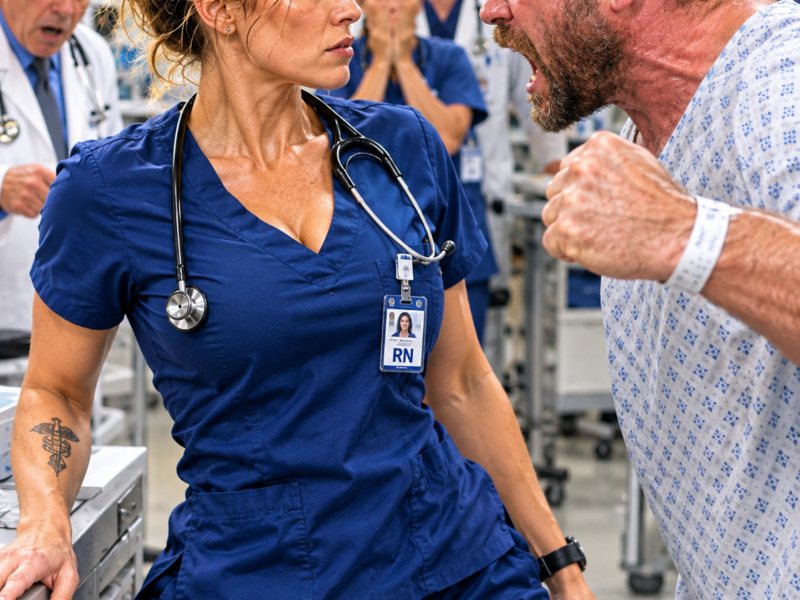
“The moment the wealthy patient shoved me against the medication cart in front of three nurses, he sneered, ‘You’re just a night nurse
The colonel held the photograph between us, his thumb covering the lower corner as if he could somehow keep the words written there from becoming real.
“Tell Morgan the truth before they find him.”
I read the sentence again. Then a third time.
The handwriting belonged to Sergeant First Class Daniel Mercer.
Danny had been my team leader in Afghanistan. He was the man who taught me how to recognize the difference between fear and instinct. He was also the man who had stood beside me five years earlier, looked me directly in the eyes, and promised that what happened during Operation Black Lantern would never leave that valley.
Now he was missing.
“Where did you get this?” I asked.
“Eleven days ago, outside a safe house in northern Virginia.”
“Was Danny there?”
“No.”
“Then how do you know he wrote it?”
The colonel turned the photograph over. A date and a location had been written on the back. Below them was a short message in a different hand.
“Recovered from a vehicle abandoned near the property. The vehicle belonged to a former intelligence contractor named Elias Voss.”
I felt the blood drain from my face.
Voss.
I hadn’t heard that name spoken aloud in five years.
Behind us, Richard Caldwell was still arguing with the security officers. His voice rose and fell in angry bursts, demanding that someone call the hospital administrator, the police chief, and the senator whose number he had listed as his emergency contact.
But suddenly his complaints sounded very far away.
“Colonel, I need to see the original file.”
“You’ll see it.”
“Not tomorrow. Not after some authorization meeting. Now.”
He studied me.
“You understand that this may reopen an investigation that was officially closed?”
“I understand that someone is missing.”
“And if the truth implicates people who are still serving?”
I looked down at the photograph.
“Then I guess it’s time somebody stopped protecting them.”
For several seconds, nobody spoke.
Then Colonel Andrew Hayes nodded toward the hallway.
“There’s a conference room downstairs. We can talk there.”
I glanced at the medication cart, the scattered supplies, and the small red mark forming on my shoulder where Caldwell had shoved me.
“I have a patient assignment.”
“Your charge nurse has already taken over your rooms,” Chief Brooks said quietly. “Melissa is handling the incident report. You’re not leaving this hospital without medical documentation of that injury, either.”
I looked at him.
He gave me a small, reassuring nod.
“Go,” he said. “We’ll take care of things here.”
I followed the colonel.
As we passed Caldwell’s room, he leaned toward the doorway.
“Hey! You can’t just walk away! I want that nurse fired!”
Colonel Hayes stopped.
He turned toward the room, looked at Caldwell, and then glanced at the security officer standing beside him.
“Is this the patient who assaulted her?”
Caldwell’s expression changed.
“Assaulted? That’s ridiculous. She attacked me.”
“Sir, I witnessed you shove her into the medication cart,” Tyler said.
“You’re a security guard. You don’t know what happened.”
Chief Brooks stepped forward.
“Your statement will be included in the incident report. So will the witness statements and the camera footage.”
Caldwell scoffed.
“You have no idea who you’re dealing with.”
Hayes didn’t raise his voice.
“I have a fairly good idea.”
Then he turned away.
I kept walking, but Caldwell called after me.
“You’ll regret this!”
I didn’t turn around.
Five years ago, I had learned that some men mistook fear for respect. I wasn’t going to teach him the difference in a hospital hallway.
The conference room was cold, windowless, and almost painfully familiar.
Three people were waiting inside. A military intelligence officer, a woman in civilian clothes with a laptop, and a younger Army captain whose name I didn’t catch.
The colonel closed the door.
“Rachel Morgan,” he said, “this is Major Olivia Grant. She is assigned to the investigation. Captain Lewis is our liaison with the Special Forces command.”
I sat down.
“Where is Danny?”
Major Grant opened her laptop.
“That’s what we’re trying to determine.”
“Start with what you know.”
She looked at the colonel before continuing.
“Eleven days ago, Daniel Mercer failed to report to a scheduled meeting. His apartment had been searched. There were no signs of forced entry, but several personal items were missing.”
“Phone?”
“Gone.”
“Vehicle?”
“Found abandoned outside a property connected to Elias Voss.”
I leaned forward.
“Voss was supposed to be in federal custody.”
“He was.”
“Was?”
Grant turned the laptop toward me.
A photograph showed a gray-haired man in a dark jacket stepping out of a black SUV.
Elias Voss.
He looked older, but the eyes were unmistakable.
“He was released from federal custody three months ago,” she said. “His cooperation agreement was sealed.”
I stared at the screen.
“What did he tell them?”
“That is classified.”
“Then why am I here?”
“Because your name appeared in a communication recovered from one of his former associates.”
The colonel placed the photograph on the table.
“Your name, Daniel’s, and the phrase Black Lantern.”
I sat very still.
For five years, I had worked hard to bury those words.
Operation Black Lantern had begun as a hostage recovery mission in a remote Afghan valley. Intelligence indicated that a group of armed militants was holding two foreign aid workers in a compound near the village of Darwan.
Our team had been sent to locate the hostages, confirm their identities, and prepare a safe extraction route.
Danny Mercer was our team leader. I was the combat medic. Staff Sergeant Lucas Bennett handled communications. Sergeant Omar Haddad was our weapons specialist. And Sergeant First Class Peter Shaw was responsible for intelligence coordination.
We were told there were two hostages.
There were actually three.
The third was an American civilian named Thomas Reed, a former intelligence analyst who had disappeared six months earlier. He had been working with a private security contractor whose records were connected to Elias Voss.
We found Reed alive.
We also found documents proving that Voss had been selling information about American operations to armed groups in the region.
The mission changed immediately.
Danny ordered us to extract the hostages and preserve the evidence. But before we could move, our position was compromised.
Someone had transmitted our coordinates.
The first explosion killed Omar.
The second destroyed our communications equipment.
And in the confusion, Peter Shaw disappeared.
We eventually reached an extraction point with two hostages and one wounded teammate.
Danny was bleeding from a gunshot wound.
Lucas had shrapnel in his leg.
I had a fractured wrist and a cut across my forehead.
And the evidence we had risked everything to retrieve was gone.
The official report said the documents had been destroyed in the explosion.
It also said Peter Shaw had died during the attack.
But I had seen him.
I had watched him walk away from the compound after the shooting stopped.
He was alive.
And he was carrying a small black case.
“Peter Shaw,” I whispered.
Major Grant looked up.
“You remember him?”
“I remember watching him leave.”
The room became silent.
The colonel sat across from me.
“Your official debriefing said you never saw Shaw after the initial attack.”
“That was the statement I was instructed to give.”
“By whom?”
I looked at the photograph again.
“Danny.”
Grant exchanged a glance with the colonel.
“Why would Mercer tell you to conceal that?”
“Because he believed Peter had saved our lives.”
I swallowed.
“Or because he believed Peter had betrayed us.”
The colonel leaned back.
“Which was it?”
“I never found out.”
That was the part I had spent five years trying not to remember.
After the mission, Danny and I had argued in a military hospital in Germany. He had insisted that Peter had been working undercover and that his actions were part of a larger operation.
I had asked why nobody had told us.
Danny said the truth would get people killed.
I had asked whether Omar’s death was part of the plan.
He had no answer.
Two days later, Danny signed a statement confirming the official version. He told me to do the same.
I refused at first.
Then someone showed me a photograph of my younger brother, Daniel, leaving his apartment in Colorado.
He was twenty-three, working construction, and had nothing to do with the Army.
The message was simple.
People who talked about Black Lantern had families.
Danny convinced me to sign.
I left the military the following year.
My brother never knew why I suddenly stopped sleeping.
He never knew why I changed my phone number twice.
And he never knew that the woman who had spent years treating other people’s injuries had once been terrified that someone would use him to punish her.
Major Grant interrupted my thoughts.
“Rachel, we need you to understand something. This isn’t simply about a missing soldier.”
“Then tell me what it is about.”
She slid another document across the table.
“Three months ago, Elias Voss contacted a federal investigator. He offered information about an unauthorized intelligence network operating through private security contractors.”
“Who was involved?”
“We don’t have the complete list.”
“Does it include Peter Shaw?”
“We believe Shaw was one of its original members.”
I looked at the colonel.
“And Danny?”
“We believe Mercer discovered the network was active again.”
“Why didn’t he contact me?”
The colonel’s expression softened.
“Because he may have been trying to keep you out of it.”
I almost laughed.
“That’s what he said five years ago.”
Grant closed her laptop.
“There’s something else.”
She brought up a second photograph.
It showed a man sitting in a diner booth. His face was partially turned away from the camera, but I recognized the scar near his left ear.
Peter Shaw.
He was alive.
And he was sitting across from someone whose face was clearly visible.
Richard Caldwell.
For a moment, I couldn’t make sense of what I was seeing.
Then I looked closer.
The expensive watch. The distinctive silver ring. The dark jacket.
The patient upstairs.
“That’s Caldwell,” I said.
“Yes.”
“He’s connected to Voss?”
“Financial records show that Caldwell’s development company received payments from two shell corporations associated with Voss.”
I felt something cold settle in my stomach.
“Why was he admitted tonight?”
“We don’t know.”
I stared at the photograph.
“Maybe he wasn’t supposed to be here.”
The colonel nodded.
“That’s one possibility.”
The conference room door opened.
A hospital administrator stood in the doorway with Chief Brooks behind him.
“I’m sorry to interrupt,” the administrator said. “But we have a situation.”
I stood.
“What happened?”
“Mr. Caldwell is refusing further treatment. He’s demanding discharge and threatening legal action.”
“His abdominal pain hasn’t been evaluated completely.”
“He says he’ll leave anyway.”
I looked at Hayes.
“Can you keep him here?”
“No. Not unless a physician determines he lacks capacity or another legal basis applies.”
The administrator cleared his throat.
“He also requested that Nurse Morgan be removed from the hospital.”
I gave a short, humorless laugh.
“He can request whatever he wants.”
Brooks stepped closer.
“There’s one more thing. When security reviewed the hallway footage, they noticed something unusual.”
He held up a tablet.
“Mr. Caldwell arrived at 10:30. At 10:42, someone entered through the service corridor and went directly to his room.”
“Who?”
“We don’t know yet. The person was wearing a maintenance uniform.”
The tablet showed a blurred figure entering the corridor.
Then a second image appeared.
The same figure leaving Caldwell’s room seven minutes later.
In one hand, the person carried a small black case.
I recognized it immediately.
The case from Darwan.
My mouth went dry.
“That’s the evidence container,” I said.
Major Grant moved closer to the screen.
“Are you certain?”
“I saw it in Peter’s hands five years ago.”
The colonel looked at the administrator.
“Can you secure the hospital footage and access records?”
“Yes.”
“Do it. Nobody deletes anything.”
I looked at the image again.
The figure had turned slightly toward the camera.
The face was still obscured, but a small tattoo was visible on the side of the wrist.
Three narrow lines crossing a circle.
Peter’s old unit symbol.
I pointed at it.
“That’s him.”
The colonel’s expression hardened.
“Then we may have a much bigger problem than a missing teammate.”
I looked toward the hallway.
“Caldwell wasn’t here because he was sick.”
“He may still be sick,” Grant said carefully. “We can’t assume his medical condition is fabricated.”
“I’m not saying his pain is fake. I’m saying someone used his hospital room.”
The administrator looked alarmed.
“Are you telling me our hospital was used for a covert exchange?”
“I’m telling you someone brought a case into a patient’s room and walked out with it.”
That was enough.
Within twenty minutes, the hospital’s security team had restricted access to the service corridor. The administrator contacted hospital legal counsel, and the police were notified about the possible theft of evidence.
I returned to the nurses’ station to complete my incident report.
Melissa was waiting.
She looked at my shoulder.
“Are you okay?”
“I will be.”
“I watched the footage,” she said. “You didn’t touch him. He shoved you.”
“I know.”
“Then why does he get to act like you’re the one who did something wrong?”
I looked through the glass toward Caldwell’s room.
“Because some people are used to getting away with it.”
Melissa lowered her voice.
“Rachel, what is happening?”
I considered telling her.
Then I remembered that she had been the one to hand me a cup of water after the shove. She had not asked whether I was a hero or a criminal. She had simply seen a nurse who had been hurt.
“Something from my past,” I said. “Something I thought was over.”
She touched my arm gently.
“Then don’t let it hurt you twice.”
I almost told her that it already had.
Instead, I finished my report.
At 2:17 a.m., Colonel Hayes returned.
“Caldwell has agreed to remain for evaluation,” he said. “His physician believes he needs imaging before discharge.”
“Did he say anything?”
“He requested his attorney.”
“Of course he did.”
Hayes placed a small envelope on the desk.
“This was found in his jacket.”
Inside was a folded piece of paper.
Three words were written on it.
MORGAN KNOWS EVERYTHING.
I read it twice.
“No,” I whispered. “I don’t.”
Hayes watched me carefully.
“Do you recognize the handwriting?”
I shook my head.
“Not Peter’s. Not Danny’s.”
Grant appeared behind him.
“We’ve identified the maintenance worker. His name is Victor Hale. He was employed by a contractor responsible for equipment repairs in this hospital.”
“Where is he?”
“Gone.”
“Did he take the case?”
“We believe so.”
“Then what are we waiting for?”
The colonel looked at me.
“Rachel, you’re a witness. You’re not part of this operation.”
“I know what that case contains.”
“Do you?”
I stared at him.
“It contains the names of people who sold our coordinates.”
“Not necessarily.”
“Then tell me what’s inside.”
He hesitated.
And in that hesitation, I understood that the colonel knew more than he was saying.
“There’s a sealed intelligence report,” he finally said. “It was recovered from a source connected to Voss. We believe it contains evidence of a financial arrangement involving several military personnel and private contractors.”
“Names?”
“Yes.”
“Is Peter’s name on it?”
“Possibly.”
“Is Danny’s?”
He didn’t answer.
I pushed the envelope back toward him.
“You brought me into this because you need me to identify the people involved. But you won’t tell me what I’m supposed to identify.”
“Because the report hasn’t been authenticated.”
“Then authenticate it.”
“We’re trying.”
I stood.
“Five years ago, I watched a good man die because someone decided that the truth was inconvenient. I signed a false statement because I was afraid my family would be hurt. I spent five years believing that my silence had protected them.”
My voice cracked.
“And now someone is missing, and you’re asking me to be patient?”
The colonel lowered his eyes.
“No. I’m asking you to stay alive.”
For a moment, neither of us moved.
Then he reached into his coat and placed a small phone on the desk.
“This was recovered from Mercer’s apartment. It contains one saved audio file. We haven’t been able to unlock it.”
I picked up the phone.
The screen was cracked.
The battery was nearly dead.
And on the back, someone had scratched a tiny letter M.
“Why give this to me?”
“Because the file was recorded five years ago.”
I looked at him.
“By whom?”
“We don’t know.”
I pressed the power button.
The screen flickered.
A password prompt appeared.
Four digits.
I tried Danny’s birthday.
Wrong.
His service number.
Wrong.
The date of Operation Black Lantern.
Wrong.
I stared at the screen.
Then I remembered something.
During our first deployment, Danny had told me that the most important date in his life wasn’t his birthday or the day he joined the Army.
It was the day his younger sister was born.
He had carried the date on a folded piece of paper inside his wallet for years.
I entered the numbers.
The phone unlocked.
A single audio file appeared.
The title was simply RACHEL.
My hands began to shake.
I pressed play.
At first there was static.
Then Danny’s voice filled the room.
“Rachel, if you’re hearing this, it means I couldn’t reach you in person.”
I closed my eyes.
His voice sounded older, tired, and frightened.
“I need you to understand something. Peter didn’t betray us at Darwan. He was trying to get the evidence out. He was working with an internal investigator, and the case contained proof that Voss had been selling our operational information.”
A pause.
Then a faint sound, as if someone had moved near the microphone.
Danny continued.
“The coordinates weren’t leaked by Peter. They were leaked by someone on our own side.”
I gripped the phone.
“The person who gave Voss our location was Captain James Harlan. He was the officer who approved the mission. He knew the route, the extraction point, and the time we would arrive.”
Colonel Hayes went completely still.
I knew that name.
James Harlan had been promoted to colonel two years earlier.
He now held a senior position at a special operations command.
Danny’s voice continued.
“Harlan was working with Voss. Peter discovered it. He took the evidence case because he believed he could expose them both. But after the mission, Harlan told us Peter had died. He threatened to destroy anyone who contradicted the report.”
I felt my throat tighten.
“Omar didn’t die because of bad luck, Rachel. He died because someone sold our lives.”
The audio went quiet for several seconds.
Then Danny spoke again.
“I know what I asked you to do. I know I told you to sign the statement. I thought I was protecting you and your brother. But I was wrong.”
A long breath.
“If something happens to me, find Peter. He has the original case. He knows where the records are. And Rachel… don’t trust anyone who tells you this is already over.”
The recording ended.
Nobody spoke.
I stared at the phone.
The truth had been sitting in my hand for five years.
And now it had a voice.
Colonel Hayes took a slow breath.
“Captain Harlan is still serving.”
“Then he needs to be investigated.”
“Absolutely.”
“Not quietly. Not through another sealed report that disappears into a filing cabinet.”
Hayes nodded.
“I’ll make sure the recording is preserved and transferred through the proper channels.”
I looked at him.
“And what about Danny?”
“We find him.”
The colonel’s phone rang.
He answered, listened, and then looked at me.
“Major Grant has a location.”
“Where?”
“A storage facility outside Colorado Springs. One of Voss’s companies owns the property.”
I was already reaching for my jacket.
Hayes held up a hand.
“You are not going with us.”
“I know Danny.”
“You’re a civilian now, and this is an active investigation.”
“I also know how he thinks.”
“Rachel—”
“If he’s alive, he’ll be expecting Harlan’s people. If he’s been held somewhere, he’ll be watching for anyone who looks official. He won’t trust a uniform.”
Hayes considered that.
Then he looked at Grant.
She shook her head slightly.
“We can bring her as an observer, under protective supervision,” she said. “But she does not enter the site.”
I accepted the condition.
I wasn’t trying to prove I could still be a soldier.
I was trying to make sure my friend came home.
At 4:36 a.m., we left the hospital.
Before I stepped into the vehicle, I looked back through the glass entrance.
The emergency department was still moving.
A mother held a sleeping child.
An elderly man sat beside a vending machine.
A nurse hurried toward a patient room with a chart in her hand.
The world had not stopped because my past had returned.
Somewhere upstairs, Richard Caldwell was receiving the medical care he needed, even after what he had done to me.
I hoped he understood the difference between being treated and being forgiven.
The drive to Colorado Springs took a little over an hour.
Nobody spoke much.
At the storage facility, federal agents had already established a perimeter. The building was a low concrete structure surrounded by empty industrial lots.
A row of metal doors stretched across the front.
Major Grant approached the site supervisor.
Colonel Hayes stayed beside me.
“We have reason to believe Mercer is inside,” he said.
“Alive?”
“We don’t know.”
I stared at the building.
Then I noticed something near the far entrance.
A small strip of white cloth tied around a metal railing.
Three knots.
Danny’s signal.
When we had worked together, he used three knots to indicate that a route was clear but someone was watching.
My heart began to pound.
“Colonel.”
He followed my gaze.
“What?”
“That’s his marker.”
Hayes signaled to the agents.
They moved carefully toward the entrance.
A loudspeaker announced their presence.
“Federal agents. We need everyone inside to come out with their hands visible.”
Nothing happened.
Then a metal door opened.
A man stepped into the light.
He was thin, unshaven, and moving slowly.
But I knew the way he held his shoulders.
I knew the slight tilt of his head.
I knew him.
“Danny.”
He looked toward me.
For a second, he didn’t move.
Then he smiled.
It was a tired, broken smile, but it was his.
“Rachel Morgan,” he said. “I was starting to think you were never going to answer your phone.”
I took one step forward.
Then stopped.
There were agents between us.
Hayes raised his hand.
“Stand down. He’s not a threat.”
Danny lifted both hands.
“I’m not carrying anything.”
Agents approached him and checked him for weapons. When they were satisfied, Hayes allowed me to move closer.
I wanted to hug him.
I wanted to hit him.
I wanted to ask why he had left me alone with five years of nightmares.
Instead, I said, “You look terrible.”
He laughed softly.
“It’s been a rough eleven days.”
I stepped forward and wrapped my arms around him.
He held me tightly.
For a moment, neither of us said anything.
Then I felt his shoulders shake.
Danny was crying.
The man who had once walked through gunfire without blinking was crying in the arms of a former medic.
“I thought you were dead,” I whispered.
“I know.”
“You let me think that.”
“I thought it was safer.”
I pulled back.
“Don’t ever make that decision for me again.”
He nodded.
“I won’t.”
Inside the storage unit, agents found medical supplies, food, several laptops, and a stack of documents.
They also found a photograph of Omar Haddad.
It had been placed carefully on a small table beside a folded American flag.
Danny looked at it.
“I kept thinking I should have been able to save him,” he said.
I stood beside him.
“You did everything you could.”
“Not enough.”
“No,” I said. “It wasn’t enough. But it wasn’t your fault.”
He looked at me.
For the first time in five years, I saw the guilt leave his face for a moment.
Then Major Grant approached.
“We need to know where Peter Shaw is.”
Danny’s expression changed.
“Peter’s alive.”
“Where?”
“He has the original evidence. He contacted me two weeks ago.”
“Why didn’t you tell us?”
“Because I didn’t know who I could trust.”
Grant nodded toward the documents.
“Did you arrange the transfer?”
“No. Peter was supposed to meet me here. He never arrived.”
“Who did?”
Danny looked at the floor.
“Victor Hale.”
“The maintenance contractor?”
“Yes. He said Peter had been compromised. He offered to exchange the case for my location.”
“Did you give it to him?”
“No.”
Danny reached into the inside pocket of his jacket.
He pulled out a small metal key.
“This opens a deposit box at a bank in Denver. Peter gave it to me before he disappeared.”
I looked at the key.
“What’s inside?”
“Copies of everything. The original evidence never left his possession.”
Major Grant took the key.
“Where is the bank?”
Danny told her.
Then he added something that made the colonel’s face tighten.
“There’s another reason Caldwell was at the hospital.”
I looked at him.
“What?”
“He was supposed to identify Peter.”
“Why would he know Peter?”
“Because Caldwell financed the network after Voss went underground. He paid for the contractors, the safe houses, and the surveillance equipment. He wasn’t just laundering money. He was helping Harlan identify people who might expose them.”
I thought about the way Caldwell had looked at me in the hallway.
The anger.
The sudden insistence that I be removed from the hospital.
“He recognized me,” I said.
Danny nodded.
“He saw your name on the nursing assignment board. He knew who you were.”
The room seemed to tilt.
“He came to the hospital because he was looking for me?”
“Maybe. Or maybe he was trying to get to Peter through you.”
I remembered the maintenance worker entering his room with the black case.
“Then why did he shove me?”
Danny’s expression hardened.
“Because he wanted to see whether you’d react like a nurse or a soldier.”
I looked down at my hands.
“He got his answer.”
“No,” Danny said. “He got the wrong one.”
We returned to Denver just after sunrise.
By then, the bank had been secured and the deposit box was opened under federal supervision.
Inside were copies of financial records, mission communications, and a handwritten statement signed by Peter Shaw.
There was also a small digital recorder.
The recording contained Peter’s full account of Operation Black Lantern.
He confirmed that Captain James Harlan had provided the coordinates to Voss. He explained that he had taken the evidence case to prevent its destruction and had been working with an internal investigator to expose the network.
He also admitted something else.
After the mission, he had been ordered to sign a statement confirming that the evidence had been destroyed.
He refused.
Harlan threatened to have him charged with treason and blamed for Omar’s death.
Peter disappeared before he could be arrested.
For five years, he had moved between safe locations, collecting proof and waiting for a chance to expose the people responsible.
The recording ended with a sentence that stayed with me.
“I didn’t leave Darwan because I stopped caring about the team. I left because if they caught me, the truth would die with me.”
The investigation moved quickly after that.
The financial records connected Caldwell’s companies to Voss’s contractors. The digital evidence supported Danny’s account of the mission. The original communications logs confirmed that Harlan had accessed information he had no operational reason to possess.
Federal investigators arrested Victor Hale first.
Then Elias Voss.
Two days later, James Harlan was taken into custody at his office.
He denied everything.
Then investigators played Danny’s recording.
His expression changed when he heard his own name.
He stopped speaking.
The charges took months to resolve. The case was complicated, and not every person involved was convicted. Some had already left the country. Others agreed to cooperate.
But the central truth was no longer buried.
Omar Haddad had not died because of a random operational failure.
He had been killed because someone had sold our location.
The Army formally reopened its investigation into Operation Black Lantern. My original statement was corrected, and my role in the mission was reviewed.
I gave a full account.
I told them about the threats against my brother.
I told them about Danny’s order.
I told them about the night I signed a report I knew was false.
I didn’t ask to be excused.
I asked that the truth be written down.
Danny did the same.
Peter eventually came forward under federal protection. When I saw him again, he looked older than the man in the photograph, but the scar near his ear was still there.
He stood across from me in a quiet office.
For a long time, neither of us spoke.
Then he said, “I owe you an apology.”
I crossed my arms.
“You owe Omar’s family an apology.”
“I know.”
“You owe Danny one.”
“I know.”
“And you owe yourself the truth.”
He lowered his head.
“I should have come back.”
“Yes,” I said. “You should have.”
He looked up.
“Do you think you can forgive me?”
I considered the question.
“Not today.”
He nodded.
“But maybe someday,” I added. “If you spend the rest of your life telling the truth.”
He accepted that.
It was the first honest conversation we had shared in five years.
As for Richard Caldwell, his hospital stay ended with a diagnosis of acute appendicitis. His physician had not been wrong to insist on imaging. The condition required surgery, and he received appropriate treatment.
His assault on me was a separate matter.
The hospital preserved the security footage, collected witness statements, and completed its investigation. Caldwell’s attorneys initially attempted to characterize the incident as a misunderstanding.
That argument became difficult to maintain when the video showed him shoving me into the medication cart while I stood several feet away with my hands occupied.
The hospital filed a formal report.
Caldwell later issued a written apology as part of a settlement. It did not erase what he had done, and it did not make me feel any obligation to forgive him.
His political connections did not protect him from the investigation into his financial dealings. His companies came under federal scrutiny, and several executives cooperated with investigators.
I never learned whether he had planned to encounter me that night or whether seeing my name had simply changed his plans.
I only knew that he had walked into a hospital believing he could control everyone around him.
He had been wrong.
Three months after the night in Denver, I stood at a small memorial ceremony for Omar Haddad.
His wife, Leila, was there with their two children.
I had met them briefly before the mission, when Omar showed me a photograph of his newborn daughter. She was five years old now.
She approached me holding a folded piece of paper.
“My dad said you helped him,” she said.
I knelt.
“Your dad helped me, too.”
She handed me the paper.
It was a drawing of a soldier holding a medical bag. Above the figure, in uneven letters, she had written:
THANK YOU FOR BRINGING PEOPLE HOME.
I couldn’t speak.
I folded the drawing carefully and held it against my chest.
Danny stood a few feet away.
He had brought a small wooden box containing Omar’s unit patch and a photograph of our team before the deployment.
When the ceremony ended, he walked beside me toward the parking lot.
“Do you ever think about going back?” he asked.
“To the Army?”
He nodded.
I looked at the memorial.
“Sometimes.”
“Would you?”
I thought about the years I had spent trying to outrun one night in Afghanistan. I thought about the patients who had trusted me with their pain, the nurses who had stood beside me, and the people who had reminded me that helping someone didn’t always require a weapon or a uniform.
“No,” I said. “I think I’m where I need to be.”
Danny smiled.
“You always were stubborn.”
“Someone had to keep you alive.”
He laughed.
Then his expression grew serious.
“Rachel, there’s something I’ve wanted to say since we found each other.”
I waited.
“I should never have asked you to carry that secret alone.”
I looked at him.
“You thought you were protecting me.”
“I was protecting myself, too.”
That honesty mattered more than any apology.
I nodded.
“Then we both know better now.”
He reached into his jacket and handed me a small envelope.
Inside was a copy of the corrected mission report.
My name was printed clearly beneath the account of the events at Darwan.
Not as a witness who had failed to follow instructions.
Not as a nurse who had once been a soldier.
As Staff Sergeant Rachel Morgan, United States Army Special Forces, combat medic.
And beneath that, one sentence:
Her actions under fire saved the lives of two American hostages and one wounded teammate.
I read it twice.
Then I folded the paper and slipped it into my bag.
That evening, I returned to St. Vincent Medical Center.
The emergency department was busy, just as it had been the night everything changed.
Melissa was at the nurses’ station.
She looked up when I walked in.
“Back already?”
“I have a shift.”
She smiled.
“Your shoulder okay?”
“Mostly.”
She glanced toward the medication cart.
“Facilities replaced the one Caldwell knocked over.”
“Good. I was getting tired of looking at the dent.”
We laughed.
Then a call came over the intercom.
A patient had arrived with a deep laceration and signs of shock.
I washed my hands, pulled on gloves, and walked toward the treatment room.
The man on the stretcher was frightened.
His wife stood beside him, crying.
He looked at me as I approached.
“Am I going to be okay?”
I met his eyes.
“We’re going to take care of you.”
And I meant it.
There would always be nights when I remembered Darwan. There would be moments when a sudden noise brought back the valley, the explosion, or the sound of Danny’s voice in that recording.
But those memories no longer controlled every step I took.
I had spent five years believing that leaving the battlefield meant leaving the person I had been behind.
I finally understood that I had carried her with me all along.
The uniform had changed.
The mission had changed.
But the promise had not.
Protect the people who needed you.
Tell the truth, even when it costs you.
And never mistake quietness for weakness.
Because the nurse Richard Caldwell shoved into a medication cart was not someone who had forgotten how to fight.
She was someone who had learned that strength did not always have to announce itself.
Sometimes it looked like a steady hand checking a patient’s pulse.
Sometimes it looked like a witness refusing to change her statement.
And sometimes, after five years of silence, it looked like a woman finally saying what happened.
THE END.









