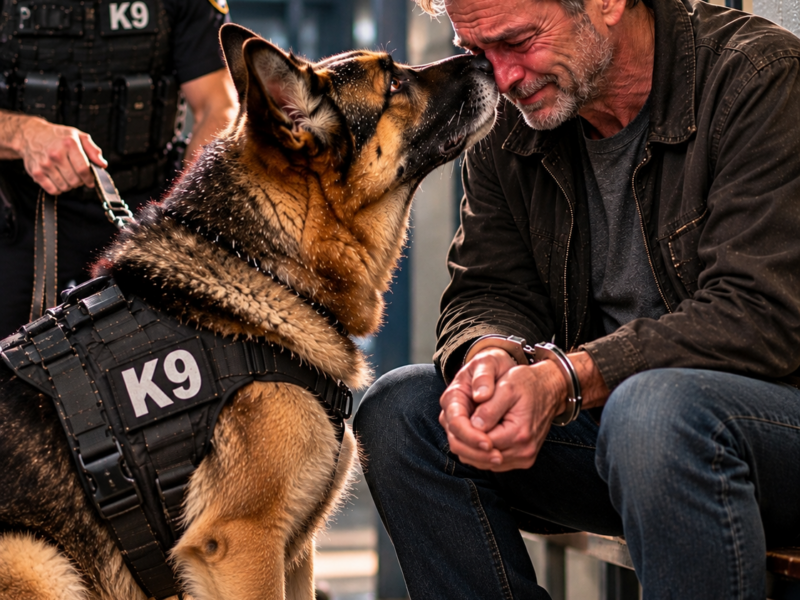
“The moment my police K9 lunged toward a handcuffed man outside the Miami-Dade courthouse, my fellow officers laughed and told me to pull him back
I looked at the booking officer and tried to keep my voice steady.
“Who else knows about the shoe?”
She frowned at her monitor.
“Nobody, as far as I know. Cross mentioned it when the arresting officer asked whether he had any weapons or contraband. The officer documented it, but we haven’t searched the shoe yet because he requested medical attention for his ankle.”
“Where is he now?”
“Interview Room Two. Why?”
“Because I need to know what he thinks I’ve got to do with this.”
She studied me for a moment, then picked up the phone to notify the desk sergeant.
I walked back to the K9 vehicle and opened the rear compartment.
Rex stood immediately, his ears forward and his tail motionless.
“All right, partner,” I murmured. “Let’s figure out what you remember.”
He pressed his nose against my hand, then looked toward the station entrance.
I’d seen that behavior when he was anticipating a familiar person. Usually, it happened when another handler approached or when I returned after being separated from him for a while.
This time, it felt different.
It was as though he was waiting for someone who had been gone a very long time.
I clipped his leash to his harness and headed inside.
Lieutenant Harris was standing near the front desk.
When he saw me, his expression hardened.
“Miller. My office. Now.”
“I need to speak with Daniel Cross.”
“Absolutely not.”
“He’s asking for me.”
“And I’m telling you to stay away from him.”
I stopped.
“Why?”
Harris glanced at the booking officers before lowering his voice.
“Because you don’t know what kind of man he is.”
“Then tell me.”
He stared at me for a moment, and I saw something I hadn’t expected.
Fear.
It vanished almost immediately, replaced by the familiar irritation he wore whenever someone challenged his authority.
“You’re too close to this situation already. Go home, take the dog, and let the detectives handle it.”
“He’s in custody for assault and possession of stolen property. What does any of that have to do with me?”
“That’s enough, Miller.”
He walked away before I could respond.
I watched him disappear into his office, then looked down at Rex.
The dog had stopped beside the interview room corridor.
He wasn’t pulling.
He wasn’t barking.
He was simply waiting.
I made a decision.
I wasn’t going to break department policy, sneak into a locked room, or interfere with an investigation. But I was going to request access through the proper channels, and I was going to document every answer I received.
I asked the desk sergeant to contact the detective assigned to Cross’s case.
Twenty minutes later, Detective Elena Ruiz arrived.
She was a compact woman in her early forties, with dark hair tied back and a habit of listening without showing whether she believed a word anyone said.
“You want to interview the suspect because your dog recognized him?” she asked.
“Yes.”
“That’s unusual.”
“I know.”
“Do you have any evidence that he’s connected to the dog?”
I handed her the photograph.
She examined both sides, then looked at me.
“Where did you get this?”
“From his property inventory. The booking officer showed it to me after I requested his name.”
Ruiz studied the image again.
“That dog looks remarkably like yours.”
“It’s Rex.”
“And the man?”
“Daniel Cross.”
She turned the photograph over and read the handwriting.
“Who is the other person named here?”
I swallowed.
“According to the military records I’ve seen, he’s dead.”
Ruiz didn’t react immediately.
Then she slipped the photograph into a folder.
“All right, Miller. I’ll allow you to be present for a short interview. I’ll ask the questions, and you won’t disclose any information that isn’t necessary. Understood?”
“Understood.”
She looked toward Rex.
“The dog stays outside the interview room.”
I nodded.
Rex didn’t like being separated from me, but I secured him with another officer who had worked with him before.
As I walked away, he watched me through the glass.
For the first time in four years, I felt as though I was the one leaving him behind.
Daniel Cross sat at the metal table with his hands cuffed in front of him.
Up close, he looked older than forty-six. His left cheek was bruised, and a bandage covered two knuckles on his right hand.
He lifted his head when I entered.
“Officer Miller.”
“You asked for me.”
“I did.”
“How do you know my name?”
Cross glanced at Detective Ruiz.
“Can I speak freely?”
“You can answer the questions you’re asked,” she said. “If you want an attorney, tell us.”
“I understand.”
He looked back at me.
“Your dog used to sleep beneath my bunk.”
I didn’t sit down.
“Rex came through a military transfer program. His records show no handler for seven months before he was transferred to the police department.”
Cross’s jaw tightened.
“That’s because they wanted to erase the person who handled him.”
“Who was that?”
He closed his eyes for a moment.
“Captain Michael Bennett.”
The name landed like a physical blow.
I knew Michael Bennett.
Not personally, but through the training materials and archived commendations I’d studied when I first took over Rex’s care. Bennett had been an Army special operations officer who worked with military working dogs and specialized tracking teams.
According to the official report, he’d died in a vehicle accident three years earlier.
I looked at the photograph again.
Bennett was the man standing beside the younger dog.
“How did you know him?” I asked.
Cross gave a tired smile.
“I served under him.”
“Where?”
“Afghanistan. Then at a training facility in North Carolina.”
Ruiz leaned forward.
“Mr. Cross, why were you arrested this morning?”
“Because I tried to stop a man from taking a bag that didn’t belong to him.”
“Did you strike him?”
“Yes.”
“Then you understand why you’re here.”
“I do.”
He didn’t try to excuse himself.
That bothered me more than a denial would have.
I sat down across from him.
“What happened to Captain Bennett?”
Cross looked at me for a long time.
Then he said, “He didn’t die in a vehicle accident.”
The room seemed to shrink around us.
Ruiz’s pen stopped moving.
“Do you have evidence to support that claim?” she asked.
Cross nodded toward the photograph.
“That was taken six weeks before the accident was reported. Captain Bennett was alive then. I was with him.”
“That doesn’t establish what happened afterward,” Ruiz said.
“No. But I can tell you what happened before.”
Cross leaned back against the chair.
“Captain Bennett discovered that a contractor was falsifying records connected to military equipment shipments. The contractor had access to specialized tracking systems, transport schedules, and the names of personnel assigned to sensitive operations.”
“Which contractor?” Ruiz asked.
“Northstar Tactical Logistics.”
I felt the same cold sensation I’d experienced when I saw the silver emblem on the briefcase in the photograph from my own case file.
I had no reason to believe the two stories were connected.
But the name was familiar.
Cross noticed my reaction.
“You’ve heard of them.”
“I’ve seen the name in old procurement documents.”
“Then you know why Bennett was worried.”
“Not enough to know what you’re talking about.”
Cross nodded.
“Fair.”
He looked down at his cuffed hands.
“Captain Bennett believed someone was using the shipping system to divert equipment and conceal unauthorized movements. At first, he thought it was financial fraud. Then he found records suggesting that certain personnel movements had been altered after operations were completed.”
Ruiz wrote something in her notebook.
“Are you alleging that someone deliberately caused military casualties?”
“I’m telling you what Bennett suspected. I don’t know who authorized what, and I won’t pretend I do.”
That answer sounded more credible than the kind of accusation I had expected.
“What happened to Rex?” I asked.
Cross’s face softened.
“He wasn’t called Rex back then.”
“I know.”
“Captain Bennett named him Little Bear because he used to curl up beneath the bunk and refuse to move when the other dogs were being loaded for training.”
For the first time, I could picture the young dog in the photograph as more than a set of familiar markings.
Cross continued.
“Bennett trained him for tracking and search work. They were inseparable. If the captain was in the room, the dog was watching him. If the captain left, the dog waited by the door.”
“Then why did Rex end up in the civilian transfer program?”
Cross’s expression hardened.
“Because Bennett disappeared.”
Ruiz looked up.
“Disappeared?”
“Three years ago, he was assigned to a temporary administrative detail. He called me the night before he left and told me he’d found something that could prove the contractor had been tampering with records.”
“Did he say what he’d found?”
“Not over the phone.”
Cross swallowed.
“He told me to keep an eye on the dog. He said if anything happened to him, the dog might be the only surviving witness to something nobody else wanted documented.”
I stared at him.
“Rex can’t testify.”
“No,” Cross said quietly. “But he was present when Bennett hid the evidence.”
The silence that followed felt heavier than anything else in the room.
Ruiz folded her hands.
“Where is that evidence now?”
Cross looked directly at me.
“That’s what I’ve been trying to find out for three years.”
I thought of the gap in Rex’s records.
Seven months with no handler listed.
No medical reports.
No explanation for the transfer.
“Why didn’t you go to the authorities?”
“I did.”
“Who did you speak to?”
“A military investigator. Then a civilian oversight office. I gave them what I had, and I waited.”
“What happened?”
Cross’s mouth tightened.
“Someone sent me a photograph of my daughter leaving school.”
My stomach dropped.
“Your daughter?”
“She was twelve at the time. They told me that if I continued making allegations, she’d lose her father the same way Bennett had lost his life.”
He looked down at his hands.
“I stopped. I told myself I was protecting her.”
Ruiz’s expression softened slightly.
“Is she safe now?”
“She’s an adult. She lives in Tampa. I haven’t seen her in two years.”
He paused.
“I thought leaving her alone was the safest thing I could do.”
For a moment, he looked less like a suspect and more like a man who had spent years trying to decide which kind of failure he could live with.
“Why come back now?” I asked.
Cross lifted his eyes.
“Because yesterday, someone tried to take the last piece of evidence I had.”
He explained that he’d been keeping an old maintenance ledger and a small digital storage device inside the lining of his shoe. He’d been moving between temporary jobs and short-term rentals, trying to stay out of sight.
That morning, a man approached him outside the storage facility where he’d rented a locker.
The man claimed the property manager had sent him to collect a bag.
Cross refused.
The man grabbed him, and Cross struck him in the face.
A passing patrol car saw the fight and arrested both men. The other man had left before officers could identify him, but the stolen-property complaint against Cross remained.
“Where is the evidence now?” Ruiz asked.
“In my shoe.”
“Why didn’t you tell the arresting officers?”
“Because I didn’t know who I could trust.”
He looked at me.
“I still don’t.”
I couldn’t blame him for that.
But I also couldn’t take his word as proof of a conspiracy.
“How do we know the evidence is real?” I asked.
Cross nodded.
“You don’t. Not yet.”
He leaned forward.
“But if you can find the original transfer records for Little Bear, you’ll see that Captain Bennett never signed the release form. The dog was removed from his assignment after Bennett disappeared, and the transfer paperwork was completed by someone who shouldn’t have had access to it.”
Ruiz stood.
“We’ll document the evidence in your possession and arrange for it to be examined. You will not be released simply because you’ve made an allegation.”
“I understand.”
She looked at me.
“Wait outside.”
I stood and left the room.
Rex was sitting beside the officer who had been watching him.
The instant I appeared, he rose and pressed his head against my thigh.
I rested my hand on his neck.
“What have you been trying to tell me, buddy?”
He looked toward the interview room.
I didn’t have an answer.
The next two days were a blur of interviews, records requests, and conversations I wasn’t permitted to join.
Cross’s shoe was examined under documented evidence procedures. Inside the lining, investigators found a small storage device and a folded page from a maintenance ledger.
The storage device was damaged but readable.
It contained copies of internal emails, shipping records, and a series of photographs showing Captain Bennett with several people connected to Northstar Tactical Logistics.
One photograph showed Bennett standing beside a transport vehicle at the North Carolina facility.
Rex was sitting at his feet.
Another showed the captain holding a folder with a handwritten reference number that appeared in the maintenance ledger.
Investigators confirmed that the files had not been created recently, but they still needed to establish their authenticity and whether the contents supported Cross’s allegations.
Then the original transfer records arrived.
I was called into a meeting with Lieutenant Harris, Detective Ruiz, and an investigator from the military.
The investigator placed a copy of the transfer form on the table.
“Officer Miller, this is the document that authorized the release of the dog now known as Rex to your department.”
I examined it.
The form carried a signature attributed to Captain Bennett.
But something about the signature looked wrong.
I’d seen enough signatures in official paperwork to recognize when one appeared to have been copied from another document.
“That isn’t his signature,” I said.
The investigator nodded.
“Preliminary analysis suggests the signature was reproduced from an earlier form. We’re conducting a forensic examination.”
Harris shifted in his chair.
“Could be a clerical error.”
The investigator turned toward him.
“Possibly. That’s why we’re investigating rather than drawing conclusions.”
Harris folded his arms.
“What does this have to do with our department?”
“Your department received the dog through a transfer that may have been improperly authorized. We need to understand who approved the transfer and what information accompanied it.”
Harris’s face had gone pale.
I looked at him.
“Lieutenant, why did you tell me to leave the file alone?”
He didn’t answer immediately.
Then he said, “Because I was told the transfer was sensitive.”
“By whom?”
He glanced toward the investigator.
“I received a call from a department administrator who said the dog had come through a protected military program. I was instructed not to circulate the original records.”
“Who was the administrator?”
Harris rubbed his forehead.
“Deputy Chief Nolan.”
The investigator wrote down the name.
“Did Deputy Chief Nolan tell you why the records were restricted?”
“No.”
“Did he provide written instructions?”
Harris hesitated.
“No.”
The room became very quiet.
I had worked under Harris for three years. He was stubborn, occasionally arrogant, and deeply protective of the department’s reputation.
But I had never known him to be careless with official orders.
Now he looked like a man realizing that the decision he’d defended as routine might have consequences he hadn’t anticipated.
The meeting ended with instructions that all relevant records be preserved.
I went home with Rex that evening and sat on the floor beside his bed.
He rested his chin on my knee.
“Little Bear,” I whispered.
His ears moved at the sound.
I said it again.
He leaned closer.
A memory surfaced from our first week together.
I’d been trying to teach him a new search pattern when he suddenly refused to move away from the door. I had assumed he was distracted by a sound in the hallway.
When I used the command I’d learned from his transfer notes, he responded immediately.
But when I called him Little Bear, he’d lifted his head and stared at me with an expression I’d never understood.
I had never used that name again.
Now I wondered how many times he’d been trying to tell me that the name belonged to someone else.
The following morning, Detective Ruiz called.
“Cross has agreed to provide a formal statement. He also gave us a name connected to the missing records.”
“Who?”
“Deputy Chief Nolan.”
I sat down.
“How?”
“According to Cross, Nolan was working in military procurement oversight before joining your department. He claims Nolan was involved in the administrative review of Captain Bennett’s disappearance.”
I thought of Harris’s warning.
Leave that file alone.
Ruiz continued.
“We haven’t established that Nolan committed a crime. Cross’s statement is an allegation, and we need corroboration.”
“What’s the next step?”
“We’re obtaining the records and arranging interviews. In the meantime, I need you to keep your distance from Nolan and anyone connected to the case.”
“I understand.”
“One more thing. Cross asked to see the dog.”
I looked at Rex, who was lying beside my desk.
“Is that allowed?”
“Not during the investigation without authorization. But the military investigator is considering a supervised meeting if it can be arranged safely.”
I ended the call and stared at the wall.
For four years, Rex had been my partner.
I’d learned his signals, his moods, and the tiny changes in his breathing that told me when he was uncomfortable. I trusted him with my safety and relied on him to keep me grounded when memories of my last deployment became difficult to manage.
I had never considered that his life before me might be a story somebody had deliberately erased.
The supervised meeting took place three days later at a secure training facility outside Miami.
Cross arrived with an investigator and his attorney.
He looked nervous.
So did I.
Rex stood beside me, wearing his working harness. He scanned the room, then noticed Cross.
The leash went taut.
I gave the command to sit.
Rex sat, but his eyes never left the older man.
Cross crouched slowly, keeping his hands visible.
“Hey, Little Bear.”
Rex made a soft sound in his throat.
Cross didn’t reach for him.
“I know,” he whispered. “I’m sorry I took so long.”
Rex rose and stepped toward him.
I allowed the leash to extend under the investigator’s supervision.
Cross held out his hand.
Rex pressed his muzzle into his palm.
The man closed his eyes.
For several seconds, he simply rested his forehead against the dog’s head.
Then he began to cry.
Not loudly.
Not dramatically.
His shoulders shook, and he tried to wipe his face with the back of his hand while Rex stood close enough to keep touching him.
I looked away to give him a moment.
When I looked back, Cross was speaking softly to the dog.
“You were supposed to stay with him.”
Rex nudged his hand.
“I know. I know.”
I felt something tighten in my chest.
For years, I’d thought Rex’s strange reactions to certain sounds and names were simply remnants of an unknown training history.
Now I understood that he had once belonged to a man who had vanished, and that some part of him had never stopped waiting.
Cross eventually stood and turned toward me.
“Thank you for taking care of him.”
I nodded.
“He takes care of me, too.”
Cross gave a small, sad smile.
“That’s what he does.”
Then he told me something that changed the way I understood the missing months in Rex’s records.
Before Bennett disappeared, the captain had arranged for Cross to take temporary custody of the dog if anything happened to him.
But when Bennett failed to report for duty, Cross was detained for questioning and later released without an explanation.
By the time he returned to the training facility, Rex had been transferred.
Cross had spent months trying to locate him through official channels.
Each request had been denied or redirected.
Eventually, he stopped asking questions publicly because the threats against his family had become too specific to ignore.
“I thought if I kept quiet, I could wait until things settled down,” he said. “Then I realized the people who wanted me silent were counting on me to get tired.”
He looked at Rex.
“I never thought they’d send him somewhere he could be loved.”
The words stayed with me.
I had loved Rex from the first day he’d leaned against my leg during a thunderstorm.
But love didn’t give me ownership of his history.
I could be his handler without pretending I was the first person who had mattered to him.
The investigation continued.
Forensic analysts confirmed that the transfer form had been altered, and the maintenance records supported Cross’s account that Captain Bennett had raised concerns about unauthorized equipment movements.
Investigators also found evidence that Deputy Chief Nolan had communicated with people connected to Northstar shortly before Bennett disappeared.
The messages didn’t prove Nolan had arranged the disappearance, but they contradicted his earlier claim that he had no knowledge of the contractor.
He was placed on administrative leave while the investigation proceeded.
Lieutenant Harris cooperated with investigators and provided the records he had received. He admitted that he should have demanded written authorization before restricting access to Rex’s file.
He apologized to me privately.
“I thought I was protecting the department,” he said.
“From what?”
He looked down.
“That’s what I should have asked.”
I accepted the apology, but I didn’t pretend it erased what had happened.
The case against Northstar grew stronger as additional witnesses came forward. Investigators uncovered falsified maintenance records and evidence that equipment transfers had been used to conceal unauthorized activity.
Captain Bennett’s disappearance remained the most difficult part.
For months, nobody could establish exactly what had happened to him after he left the training facility.
Then a retired records clerk contacted the military investigator.
She had kept a personal copy of a transport authorization because the original had been recalled under unusual circumstances.
The document showed that Bennett had been moved from the facility to a medical holding site under a name that did not appear in the ordinary personnel database.
The authorization was not proof that he was alive.
But it established that the official timeline was incomplete.
Investigators followed the record to a private medical center in Virginia that had treated an unidentified man with injuries consistent with a serious vehicle accident.
The patient had been admitted without military identification and transferred to a rehabilitation facility under a protected identity.
For months, the investigators waited for the facility to confirm the record through legal channels.
When the confirmation finally came, I was sitting at my kitchen table with Rex asleep at my feet.
My phone rang.
It was Detective Ruiz.
“Daniel, we have a development.”
I stood.
“What is it?”
“The medical records match Captain Bennett’s date of birth and several identifying marks. He’s alive.”
I gripped the edge of the table.
For a moment, the room seemed to tilt.
“You’re sure?”
“We have strong confirmation. He’s been living in a rehabilitation facility under a protected identity since the accident. His memory was severely affected, and he has only recently been able to provide a consistent account of his identity.”
I couldn’t speak.
Ruiz continued carefully.
“We haven’t established that the accident was deliberate. We also don’t know who arranged the protected identity. But Captain Bennett is willing to meet with investigators, and he has asked to see the dog.”
I looked down at Rex.
He had lifted his head, watching me.
“Can I be there?”
“Once the arrangements are approved, yes.”
I thanked her and ended the call.
Then I sat back down and placed both hands on Rex’s head.
“Little Bear,” I whispered.
He leaned against me.
This time, I understood why the name mattered.
The meeting was arranged two weeks later.
Captain Michael Bennett arrived in a wheelchair, accompanied by a rehabilitation nurse and two investigators. He was thinner than he appeared in the photograph, with gray hair and a pale scar running from his temple to his jaw.
His hands rested on the armrests.
He looked around the room as though he were trying to recognize a place he’d visited in a dream.
Then Rex entered.
For a moment, the dog didn’t move.
He stood beside me, ears raised, studying the man in the wheelchair.
Bennett’s lips parted.
“Little Bear?”
Rex took one step.
Then another.
I loosened the leash.
He approached the wheelchair and placed his head in Bennett’s lap.
The captain made a sound somewhere between a laugh and a sob.
He ran both hands over Rex’s ears, his neck, and the scar on his muzzle.
“I thought I’d lost you,” he whispered.
Rex’s tail swept slowly across the floor.
Bennett closed his eyes.
“I’m sorry.”
Nobody in the room interrupted them.
After a while, Bennett looked at me.
“You’re his handler?”
“Yes, sir. Officer Daniel Miller.”
He extended his hand.
“Thank you for taking care of my dog.”
I shook it.
“He takes good care of me.”
Bennett smiled faintly.
“That sounds like him.”
When the investigators asked whether he was ready to discuss the past, his smile disappeared.
He explained that he had discovered irregularities in the contractor’s records and attempted to preserve evidence before it could be altered.
He had planned to report his findings through official channels.
Before he could do so, his vehicle had been forced off a rural road during a late-night drive.
He remembered headlights approaching from behind.
He remembered the impact.
After that, his memories came in fragments.
He could not identify the driver or say with certainty whether the crash had been deliberate.
But he remembered being warned, shortly before the accident, that continuing his investigation could put other people at risk.
He also remembered that Cross had been trying to help him.
The evidence Bennett had hidden was incomplete, but it supported the records already recovered.
His testimony gave investigators a clearer timeline and helped establish which officials had known about the falsified transfers.
Several people eventually faced criminal charges for fraud, records tampering, and obstruction. Nolan was charged in connection with falsifying official records and concealing evidence. Northstar’s former logistics director was also charged with financial and procurement offenses.
Not every allegation could be proved.
The investigation did not establish that the vehicle crash had been ordered by a specific person, and nobody could honestly promise that every question surrounding Bennett’s disappearance would be answered.
But the records that had been buried were finally examined, and the people who had concealed them could no longer dismiss the concerns as administrative mistakes.
Cross’s assault charge was handled separately. He accepted responsibility for striking the man outside the storage facility, while investigators confirmed that his account of the confrontation had been substantially supported by the available evidence.
He eventually reconnected with his daughter.
Their relationship did not repair itself overnight. Two years of silence had left wounds that an explanation couldn’t erase.
But he began calling her every Sunday, and after several months, she agreed to visit him.
The first time he told me about it, he was sitting outside the courthouse with a paper cup of coffee.
“She hasn’t forgiven me yet,” he said.
“She doesn’t have to do it on your schedule.”
He nodded.
“That’s what she told me.”
I smiled.
“Sounds like she knows you.”
He looked toward Rex, who was resting beside my chair.
“At least one of us knows how to wait.”
Months later, Bennett was well enough to attend a small gathering at the training facility where Rex had once worked.
Cross came, too.
So did several former handlers who had never forgotten the captain.
There were no speeches about heroes or villains.
We shared coffee, looked through old photographs, and listened while Bennett told stories about a young dog who used to steal socks from the laundry room and hide them beneath his bunk.
For the first time, the past felt less like a locked door and more like a room we could enter without being afraid of what we’d find.
Before we left, Bennett asked whether he could walk Rex around the training yard.
I looked at the investigators, who had approved the visit, then unclipped the working leash and replaced it with a standard lead for the supervised outing.
Rex walked beside Bennett’s wheelchair, occasionally stopping to sniff the grass.
I followed a few steps behind.
At the far end of the yard, Bennett paused beneath a row of trees.
“Do you think he’ll remember all of this?” he asked.
I watched Rex look up at him.
“I think he remembers what matters to him.”
Bennett nodded, his eyes bright.
Then he rested one hand on Rex’s head.
“I wish I could remember every day we had together.”
“You don’t have to remember every day for it to have mattered.”
He looked at me.
“Who taught you that?”
I thought about the four years I’d spent trying to earn Rex’s trust, the questions I’d been afraid to ask, and the people who had carried grief in silence because they believed nobody would listen.
“No one in particular,” I said. “I think I’m still learning it.”
Bennett smiled.
“Then keep learning.”
When I returned to work, Rex went back to his duties. He still searched buildings, tracked suspects, and sat patiently beside me during long shifts.
Nothing about the case made him less of a police dog or less of my partner.
But I no longer looked at his old records as a collection of missing forms and incomplete dates.
They were pieces of a life that had existed before mine, a life that deserved to be acknowledged rather than erased.
Sometimes, when I called his name, he would turn his head with the same calm attention he’d shown me on our first day together.
And occasionally, when I was alone with him, I called him Little Bear.
He always looked up.
I never asked him to choose between the man who had trained him and the man who worked beside him now.
There was no need.
One afternoon, as we crossed the station parking lot, a young officer stopped to admire him.
“How long have you had him?”
“Four years.”
“Did you train him yourself?”
“Some of it. He came to me with a whole life I knew nothing about.”
The officer scratched his head.
“Must be strange, finding all that out.”
I looked down at Rex.
“It was.”
“Would you do anything differently?”
I thought about the first morning outside the courthouse, the handcuffed man, the growl that made everyone laugh, and the name that opened a door nobody knew was there.
“I’d ask more questions,” I said.
The officer nodded and walked away.
Rex pressed his shoulder against my leg, the same quiet gesture he’d used when I was new to his signals and unsure of what he needed.
I rested my hand on his back.
For years, I’d believed being a good handler meant learning to command every movement, understand every signal, and keep my partner under control.
Now I knew better.
Sometimes the most important thing a partner can do is recognize something you cannot see yet—and stay beside you until you’re ready to understand it.
The end.









