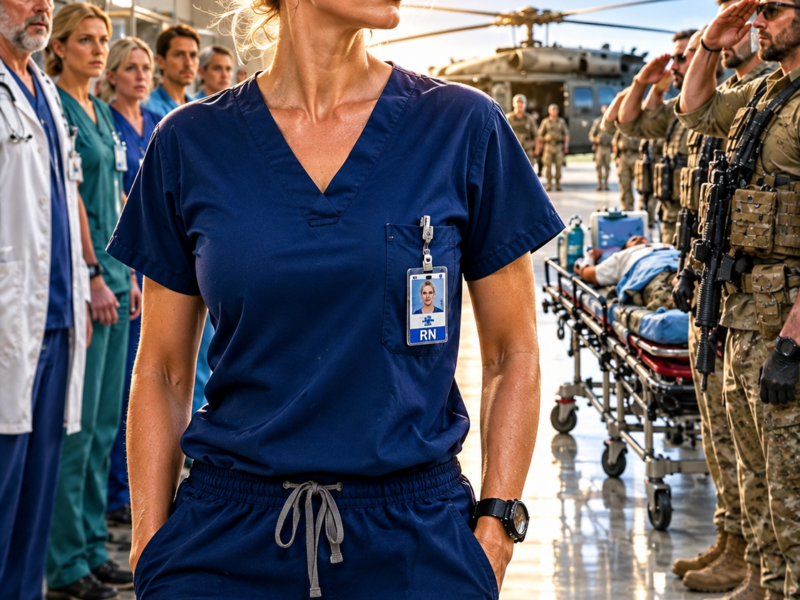
“The hospital administrator ordered security to escort me out of the emergency department because I was ‘just a quiet new nurse who didn’t understand military protocol,
I looked at the photograph again, focusing on the man standing behind the helicopter.
His face was partially hidden by the rotor assembly, but I recognized the posture, the broad shoulders, and the distinctive scar running beneath his left ear.
Colonel Nathaniel Price.
For five years, I had believed he was dead.
I looked at Colonel Walker.
“Where did you get this photograph?”
“From an archived mission file recovered three weeks ago.”
“That’s impossible.”
“Why?”
I pointed at the man behind the helicopter.
“Because Colonel Price died before that photograph was supposedly taken.”
Walker didn’t look surprised.
Instead, he pulled out a chair and sat down.
“That’s precisely why we need to talk.”
Behind him, Patricia Lawson was still standing beside Dr. Miller.
Neither seemed particularly comfortable with the conversation.
I glanced at Marcus’s treatment room.
“Before we discuss anything else, I need to know whether Staff Sergeant Reed is alive.”
Walker nodded.
“He’s stable. The doctors have controlled the immediate complications.”
“Can I see him?”
“Not yet. We need to establish what happened.”
I stared at him.
“With respect, sir, he is my patient, and I am a nurse. If you want answers about a rescue operation, you’re going to have to wait until he’s medically cleared.”
For the first time, Colonel Walker smiled.
“Some things haven’t changed.”
Patricia stepped forward.
“Colonel, perhaps we should move this discussion to the administration conference room.”
Walker stood.
“That would be appropriate.”
He looked at me.
“You’re coming with us, Sergeant.”
I shook my head.
“Emily. My name is Emily Carter now.”
He studied me for a moment.
“All right, Emily. But there are people waiting who have spent five years trying to find you.”
That sentence followed me down the hallway.
Five years.
I’d spent five years trying to make sure nobody found me.
And now three Air Force officers had walked into my hospital carrying a photograph that could reopen the worst chapter of my life.
Inside the conference room, Walker introduced the other two officers.
Major David Collins was a military investigator.
Captain Lauren Hayes worked in personnel recovery.
Neither said much.
Walker placed a thick folder on the table.
“Five years ago, an Air Force rescue team disappeared during a classified recovery operation in the mountains of eastern Afghanistan.”
I knew the mission.
I’d been there.
The official designation was Raven-17.
Six personnel had been assigned to the rescue team.
Staff Sergeant Marcus Reed.
Technical Sergeant Owen Miller.
Senior Airman Caleb Foster.
Staff Sergeant Aaron Mitchell.
Captain Daniel Ross.
And me.
At the time, I was serving under the name Sarah Bennett.
I had been a combat rescue medic attached to the team.
Our mission was to recover two American intelligence personnel who had gone missing after their convoy was attacked.
The operation was supposed to take less than six hours.
It lasted nearly two days.
“According to the original report,” Walker continued, “the helicopter was destroyed during extraction. The six-person rescue team was presumed dead.”
I nodded.
“That’s what we were told.”
Major Collins opened the folder.
“There’s a problem with that report.”
He slid a document toward me.
I recognized the formatting immediately.
It was the original mission summary.
Except the final page was missing.
“Who removed it?” I asked.
“That’s what we’re investigating.”
I leaned back.
“I can tell you what happened that night.”
Walker nodded.
“Please do.”
I closed my eyes.
The mountains came back before I could stop them.
The cold.
The wind.
The sound of rotor blades fighting against thin air.
The smell of fuel and burned electrical wiring.
And Marcus shouting through his radio that one of the recovery team members had stopped breathing.
I opened my eyes.
“We reached the extraction point just after midnight. Our helicopter was damaged during the landing. The pilot managed to get us down, but the aircraft couldn’t take off again.”
“What happened to the two intelligence personnel?” Collins asked.
“We found one alive. The second was missing.”
“And Colonel Price?”
I looked at him.
“He arrived approximately forty minutes later.”
Walker exchanged a glance with Major Collins.
“You’re certain?”
“Yes.”
“Was he wearing a flight suit?”
“No. He was in tactical gear.”
Collins made a note.
“That matters.”
I frowned.
“Why?”
Walker opened another envelope.
Inside was a copy of an operational photograph.
The date was clearly visible.
It had been taken three days after our team was officially declared missing.
Colonel Price was standing outside a secure facility in Germany.
Alive.
Healthy.
And speaking to a civilian whose face had been blurred in the copy.
I looked up.
“So he survived.”
“Yes,” Walker said. “And he was never reported as missing.”
I felt something tighten beneath my ribs.
“Then why did everyone else disappear from the records?”
Walker folded his hands.
“Because the mission wasn’t simply a rescue operation.”
He paused.
“It was also an investigation.”
I stared at him.
“What kind of investigation?”
“Someone had been selling American personnel locations to an enemy network. The missing intelligence officer had been carrying evidence.”
I looked at the folder.
“Who?”
“Colonel Price.”
The room went quiet.
I shook my head.
“That doesn’t make sense. He was our commanding officer.”
“That was exactly why he had access.”
Walker continued.
“Before the mission, an intelligence analyst identified irregularities in the movement of American personnel. Several operations had been compromised. The analyst believed someone inside the command structure was transmitting information.”
I remembered the argument before our deployment.
Colonel Price had insisted on a route change.
Captain Ross had questioned the timing.
Marcus had complained that the mission briefing had been revised twice.
At the time, I had assumed it was ordinary confusion.
Now those details seemed much less ordinary.
“Did Colonel Price know the analyst was carrying evidence?” I asked.
“Yes.”
“Then why did he come to the extraction point?”
Walker looked at me.
“To retrieve the evidence.”
I stared at him.
“And us?”
Major Collins answered.
“According to the recovered communications, your team was not supposed to return.”
I slowly placed my hands on the table.
I had spent five years telling myself that the mission had gone wrong because of bad weather, damaged equipment, and a series of terrible decisions.
Now someone was suggesting that our deaths had been part of the plan.
“Why would he leave us alive?” I whispered.
Walker didn’t answer immediately.
Then he opened another folder.
“Because someone else interfered.”
He removed a handwritten statement.
The handwriting was familiar.
Daniel Ross.
Our team captain.
I recognized the way he wrote his capital letters.
My eyes moved across the page.
“Price gave the extraction coordinates to the wrong people. I believe he intends to eliminate the team and recover the analyst’s evidence. If we survive, Sarah must keep the original medical record.”
I read it twice.
Then I looked at Walker.
“What original medical record?”
He leaned forward.
“That’s what we need you to help us find.”
I felt my mouth go dry.
“Marcus said something about a file.”
“Yes. He told our investigators that you were the only person who knew where the original document was hidden.”
I stared at the paper.
I hadn’t thought about that document in years.
Because I hadn’t realized I still had it.
Five years earlier, during the extraction, I had treated an injured intelligence analyst named Peter Lawson.
He had been carrying a small medical data card inside a sealed emergency dressing pouch.
Before he died, he had grabbed my wrist and told me something.
“Keep this away from Price.”
I had placed the card inside my medical kit.
Then the helicopter went down.
During the confusion that followed, Daniel had told me to take the kit and leave through a narrow ravine with Marcus and two other injured men.
I had escaped.
But when I returned to the United States, the military authorities had informed me that the operation was classified and all recovered equipment had been surrendered.
I had assumed the card was among the missing items.
“Where is the original medical kit?” I asked.
Walker looked at me carefully.
“That’s another problem.”
He slid a photograph across the table.
It showed a storage locker in a military warehouse.
The door was open.
The shelves were empty.
A small metal inventory tag lay on the floor.
The serial number matched my old medical equipment.
“Someone removed it six weeks ago,” he said.
I stared at the image.
“Who authorized the transfer?”
Major Collins turned a page.
“Colonel Nathaniel Price.”
I stood up.
“He’s still in the military?”
“Not officially. He retired four years ago.”
“Then why does he still have access to military property?”
“That’s what we’re trying to establish.”
I walked toward the window.
Outside, an ambulance pulled into the emergency entrance.
People moved around it with the same practiced urgency I had known for years.
I suddenly felt very far away from the life I had built.
“Colonel Walker, I need to tell you something.”
He stood.
“Go ahead.”
“Marcus didn’t ask me to find the file.”
Walker waited.
“He told me not to let them take it.”
I turned toward him.
“That means he knows someone is still looking for it.”
Walker’s expression changed.
“Did he say anything else?”
I remembered the way Marcus had gripped my wrist.
The fear in his eyes.
The effort it had taken him to speak.
Then I remembered one more thing.
Before he lost consciousness, he had tried to say another name.
“Peter.”
Walker looked at Collins.
“Peter Lawson?”
I nodded.
The major quickly opened his laptop.
“That’s the missing intelligence analyst.”
I looked at him.
“Was he ever found?”
Collins shook his head.
“No body was recovered.”
I sat down.
For five years, I had believed Peter had died in the mountains.
Now I wasn’t so certain.
A knock interrupted us.
Dr. Miller opened the door.
“Emily, your patient is awake.”
I stood immediately.
“Thank you.”
Patricia appeared behind him.
“She’s still under administrative suspension. She cannot enter the treatment area.”
Walker turned slowly.
“Mrs. Lawson, this nurse is not being disciplined for caring about an injured American serviceman.”
“That is an internal employment matter.”
“Then consider this an official request for her assistance.”
Patricia hesitated.
Dr. Miller looked uncomfortable.
I didn’t wait for either of them.
I walked toward Marcus’s room.
He was lying on the bed with an oxygen line beneath his nose.
His face was pale, and his right arm was wrapped in a fresh bandage.
When he saw me, he tried to smile.
“Still getting into trouble, Sarah?”
I pulled a chair beside his bed.
“You’re the one who nearly died in my emergency department.”
“Occupational hazard.”
I shook my head.
“Don’t make me laugh. My supervisor already thinks I’m a problem.”
He laughed, then winced.
I checked his pulse.
“Easy.”
For a few moments, we didn’t speak.
Then I looked at him.
“Why didn’t you tell me you were alive?”
His smile disappeared.
“Because I didn’t know who I could trust.”
“You could have trusted me.”
“I know that now.”
I lowered my eyes.
“Marcus, what happened to the others?”
He stared at the ceiling.
“Some survived. Some didn’t.”
I waited.
“Daniel?”
Marcus swallowed.
“Daniel died getting us out.”
I looked away.
I had known that.
But hearing it again still hurt.
“And Aaron?”
“Alive.”
“Owen?”
“Alive.”
“Caleb?”
Marcus hesitated.
“Alive. But he disappeared after we got back.”
I turned toward him.
“What do you mean, disappeared?”
“He went to meet someone about the mission report. Never came back.”
I felt the old tension return.
“Who did he meet?”
Marcus shook his head.
“I don’t know. But before he disappeared, he sent me a message.”
“What did it say?”
Marcus looked toward the door.
“That Price wasn’t the only person involved.”
I leaned closer.
“Who else?”
He reached beneath his pillow and removed a small folded piece of paper.
“That’s why I came here.”
I opened it.
There were four words written in blue ink.
THE NURSE HAS THE ORIGINAL.
I stared at the message.
“Who wrote this?”
“Caleb.”
“How did you get it?”
“Someone slipped it under my apartment door two nights ago.”
I looked at him.
“Then why did you come to this hospital?”
Marcus gave me a tired smile.
“Because I heard you were working here.”
I shook my head.
“How?”
“One of the old team members saw your name on the hospital website.”
I looked down at the paper.
The nurse has the original.
They weren’t talking about my medical kit.
They were talking about the data card.
The one I had believed was lost.
I suddenly remembered something.
After the mission, I had returned to my apartment with only a small duffel bag.
I had emptied my medical kit onto the kitchen table, looking for my personal identification and medication.
There had been a small plastic card tucked inside the lining.
I had placed it in a jewelry box because I didn’t know what it was.
And then I had forgotten about it.
“Marcus,” I whispered, “I think I know where the card is.”
He closed his eyes.
“Thank God.”
I stood.
“I need to get it before someone else does.”
Marcus grabbed my wrist.
“Wait.”
His voice was suddenly serious.
“Don’t go alone.”
I looked at him.
“Why?”
He turned his head toward the window.
“Because I think someone followed me here.”
Before I could respond, a nurse appeared in the doorway.
“Emily, there’s a man at the front desk asking for you.”
“Who?”
She hesitated.
“He says his name is Peter Lawson.”
My entire body went still.
Marcus slowly turned toward me.
Then he whispered the words I had spent five years hoping I would never have to hear.
“Sarah, don’t tell him where the card is.”
The nurse stepped aside.
A man entered the room.
He was older than I remembered, with gray hair and a slight limp.
But his eyes were unmistakable.
Peter Lawson.
The intelligence analyst we had left behind in Afghanistan.
The man everyone believed was dead.
He looked at me, then at Marcus.
“I see you finally found each other.”
I couldn’t speak.
Peter pulled a chair toward the bed.
“Emily, I need you to listen carefully. The card you kept isn’t the only copy of that evidence.”
He placed a photograph on the bedside table.
It showed Colonel Nathaniel Price standing beside a man in civilian clothes.
I recognized the civilian.
He was the hospital administrator’s husband.
Patricia Lawson’s husband, Edward.
I looked at the photograph again.
“Why is your husband standing with Colonel Price?” I asked.
Peter’s expression darkened.
“Because he was the person who paid for the original operation to disappear.”
For a few seconds, nobody moved.
Then the hospital lights flickered.
Marcus reached for my hand.
Peter looked toward the hallway.
“They know I’m here.”
A moment later, the fire alarm began screaming.
People rushed past the open doorway.
A security officer shouted for everyone to evacuate.
Peter stood.
“Take Marcus and get out through the service corridor.”
I looked at him.
“What about you?”
“I’m going to make sure the evidence doesn’t disappear again.”
I shook my head.
“We’re not leaving you.”
Peter’s face softened.
“Sarah, five years ago, I survived because you refused to leave me behind. Don’t make me ask you twice.”
I looked at Marcus.
His face was pale, but he nodded.
We moved into the corridor.
The smoke was thin at first, barely visible beneath the ceiling lights.
But the alarms continued, and staff were pushing patients toward the emergency exits.
I helped Marcus sit in a wheelchair.
A hospital security officer approached.
“Ma’am, you need to evacuate immediately.”
“I’m taking a patient out.”
“That’s not authorized.”
I looked him directly in the eyes.
“He’s medically unstable. If you want to stop me, call the attending physician.”
The officer stepped aside.
We reached the service corridor.
Behind us, a door slammed.
Then I heard a voice.
“Emily!”
I turned.
Patricia Lawson was standing at the far end of the hallway.
Her expression was no longer controlled.
“Give me the file.”
I stared at her.
“What file?”
“The one Peter gave you.”
I looked down at my empty hands.
“Why would I have anything from Peter?”
She stepped closer.
“Don’t make this harder than it needs to be.”
Marcus struggled to sit upright.
“Patricia, stop.”
She looked at him.
“You should have stayed quiet, Marcus.”
That was when I understood.
The fire alarm wasn’t the only thing happening.
Someone had deliberately created a distraction.
Patricia reached into her handbag.
I stepped in front of Marcus.
“Don’t.”
Her hand stopped.
For the first time, I saw uncertainty in her eyes.
Then a loud voice came from behind her.
“Ma’am, step away from the patient.”
Colonel Walker appeared with Major Collins and two security personnel.
Patricia slowly withdrew her hand.
The major moved toward her.
“Mrs. Lawson, we need to speak with you.”
She looked at me with open hatred.
“You have no idea what you’ve done.”
I held her gaze.
“Neither did I, five years ago.”
The officers escorted her away.
The fire alarm was eventually determined to be deliberately activated in an unused section of the hospital.
No one was injured.
But Peter was missing.
We searched the building for nearly an hour.
Then Colonel Walker received a call.
Peter had been found in the hospital’s underground parking garage.
He was alive, but unconscious.
A medical team transported him to another hospital under military protection.
Before he lost consciousness, he had managed to give Major Collins a small encrypted drive.
The next morning, I was sitting beside Marcus when Walker entered.
He looked exhausted.
“We found the second copy.”
I stood.
“What’s on it?”
“Communications between Colonel Price, Edward Lawson, and several individuals involved in the compromised operation.”
I looked at him.
“And Peter?”
“He’s stable. He has a head injury, but doctors expect him to recover.”
I sat down.
“Thank God.”
Walker placed a document on the table.
“There’s something else.”
I looked at it.
It was a list of names.
Several were familiar.
At the bottom was Edward Lawson’s signature.
“He wasn’t simply funding the operation,” Walker explained. “He was coordinating the transfer of personnel information to an outside network.”
I stared at the page.
“Why?”
“Money. Access. Influence. We haven’t established every detail yet, but the evidence suggests that he used the compromised intelligence to profit from operations involving American personnel.”
I thought about Patricia.
“Did she know?”
Walker paused.
“We found communications indicating she had helped him access restricted hospital and personnel records.”
I looked toward the window.
The hospital I had considered a safe place had been another piece of the same story.
“Is she being arrested?”
“She’s under investigation. Edward has been detained pending further proceedings.”
I nodded slowly.
For the first time, I didn’t feel the need to ask what would happen next.
I knew what mattered.
The evidence was safe.
Marcus was alive.
Peter had survived.
And the people who had spent years hiding the truth could no longer pretend it didn’t exist.
But there was still one thing I needed to do.
I asked Colonel Walker for permission to visit Peter.
He arranged it two days later.
Peter was sitting upright when I entered his room.
A bandage covered part of his forehead.
He looked older than the man I remembered in Afghanistan.
But when he smiled, I saw the same tired expression.
“Hello, Sarah.”
I pulled a chair beside him.
“Hello, Peter.”
We sat quietly for a while.
Then I asked the question I had carried for five years.
“Why didn’t you tell anyone I had the original card?”
He looked down.
“Because I didn’t know whether you had survived.”
I frowned.
“But you saw the reports.”
“I saw the reports written by the people who wanted us gone.”
He explained that after the helicopter went down, he had been captured by a local intermediary working for Price’s network.
He was held for several weeks before escaping with help from a local contact.
He had eventually reached a secure facility in Germany.
By then, the official report had already declared our team dead.
He had attempted to contact military investigators, but every request was redirected through offices connected to Price.
He disappeared from official records because he feared that revealing himself would put the remaining survivors in danger.
“Why come back now?” I asked.
“Because Marcus found me.”
I looked at him.
“He found you?”
Peter nodded.
“He tracked down an old contact. He had been looking for the truth since he recovered.”
I lowered my eyes.
“Why didn’t either of you tell me?”
Peter reached for the blanket.
“We thought protecting you meant keeping you out of it.”
I gave a small, tired laugh.
“That seems to be what everyone thought.”
He looked at me.
“You’re right.”
For a moment, neither of us spoke.
Then he said something that made my eyes burn.
“Daniel knew you would blame yourself.”
I looked up.
“What?”
Peter nodded.
“Before the helicopter went down, Daniel gave me a message for you. He said if we ever made it home, I had to tell you that the mission failed because of the people who betrayed it, not because of the people who tried to save everyone.”
I pressed my fingers against my lips.
“Why didn’t you tell me?”
“I couldn’t.”
He swallowed.
“I didn’t know whether you were alive, and later I couldn’t find a safe way to reach you.”
I looked out the window.
For five years, I had carried Daniel’s last moments like a weight I was supposed to earn every day.
I had remembered his hand slipping from mine.
His voice becoming quieter.
The way he had looked at me before telling me to take Marcus and leave.
Now I understood that his final act hadn’t been about abandoning anyone.
He had been trying to save us.
And I had done exactly what he wanted.
Three months later, the investigation reached its formal conclusion.
Colonel Price was arrested after returning to the United States.
Edward Lawson faced federal charges related to the transfer of classified information and the conspiracy surrounding the compromised operation.
The Air Force formally corrected the Raven-17 records.
The six missing personnel were no longer listed as having died in an unsuccessful extraction.
The surviving members were recognized for their actions.
Daniel Ross’s record was amended to reflect his leadership and sacrifice.
His family received the full account of what had happened.
I attended the memorial service at an Air Force base in Colorado.
It was a clear spring morning.
The sky was bright, and the wind moved gently through the flags.
Marcus stood beside me.
Peter sat in the front row, still walking with a slight limp.
Owen and Aaron had traveled across the country.
Caleb was there, too.
He had finally been found after years of living under a different identity because he feared the people connected to Price.
When Daniel’s photograph appeared on the large screen, I felt my eyes fill.
He was smiling.
Not the serious expression I remembered from the mission.
A real smile.
The kind he used whenever Marcus told one of his terrible jokes.
After the ceremony, his younger sister, Rebecca, approached me.
She was in her early thirties and carried a small framed photograph.
“Are you Sarah?”
I nodded.
“I’m Emily now, but yes.”
She held the photograph toward me.
It showed Daniel and me standing beside the helicopter before the mission.
We were both laughing.
“I found this among his belongings,” she said. “He wrote something on the back.”
I turned it over.
The handwriting was unmistakable.
“She always brings everyone home.”
I couldn’t keep the tears from falling.
Rebecca touched my arm.
“He talked about you a lot. He said you were the strongest person on his team.”
I shook my head.
“He was the reason we survived.”
She smiled sadly.
“He knew that.”
We stood together for a while.
Then she handed me the photograph.
“I think he’d want you to have this.”
I accepted it carefully.
That evening, I returned to St. Mary’s.
The hospital administration had changed.
Patricia Lawson had been removed from her position, and Dr. Miller had been required to complete a formal review of his actions during the incident.
He eventually requested a meeting with me.
I agreed.
He stood in the same conference room where he had once questioned my authority.
“I owe you an apology,” he said.
I waited.
“I saw your actions that morning as a challenge to my position. I should have listened to what you were telling me about Marcus.”
I looked at him.
“His condition could have become much worse.”
“I know.”
He lowered his eyes.
“I also should have asked why he recognized you before making assumptions about your background.”
I nodded.
“Thank you for saying that.”
He looked relieved, but I wasn’t ready to pretend nothing had happened.
“I’ll continue working here,” I said. “But I expect my clinical judgment to be evaluated on its merits, not on whether someone finds my personality impressive.”
He nodded.
“That’s fair.”
I returned to the emergency department the following week.
Nobody treated me like a hero.
That was fine.
I didn’t want a parade every time I walked into a room.
I wanted patients to receive good care.
I wanted nurses to be heard.
And I wanted the quiet people in the room to have the same chance to speak as everyone else.
One afternoon, a young nurse named Hannah approached me near the medication station.
She had been working at St. Mary’s for less than a month.
“I wanted to ask you something,” she said.
“Sure.”
“How do you handle it when a doctor dismisses you in front of everyone?”
I looked at her.
She was holding a chart tightly against her chest.
“Has that happened?”
She shrugged.
“Yesterday. I knew something was wrong with a patient, but I didn’t want to make a scene.”
I remembered the emergency room.
Marcus’s pale face.
The monitor.
Patricia’s office.
The feeling of being told I didn’t belong.
I set down my clipboard.
“You don’t have to make a scene. But you do have to speak up.”
She looked uncertain.
“What if they don’t listen?”
“Document what you see. Escalate through the proper channels. Keep the patient at the center of the decision.”
I paused.
“And don’t confuse being quiet with being powerless.”
She smiled slightly.
“Thank you.”
After she left, I returned to my station.
There was a new photograph beside my computer.
Daniel, Marcus, and me.
Six people had gone into the mountains that night.
Not everyone had come home.
But the truth had.
I touched the edge of the frame.
For years, I had believed that leaving the military meant leaving the most important part of myself behind.
I had thought I needed a different name, a different job, and a different life to escape what happened.
But I finally understood that I hadn’t been running from being Sarah Bennett.
I had been running from the guilt someone else had placed on my shoulders.
And I didn’t have to carry it anymore.
That evening, Marcus stopped by the hospital before heading home.
He was wearing civilian clothes and carrying two cups of coffee.
“One for you,” he said.
I accepted it.
“How thoughtful.”
“Don’t get used to it.”
We stood near the entrance, watching the sun disappear behind the mountains.
“Do you ever miss it?” he asked.
“The military?”
He nodded.
I thought about Daniel.
About the team.
About the people who had trusted me with their lives.
“Sometimes,” I said. “But I don’t miss who I was when I believed I had to prove I deserved to be there.”
Marcus smiled.
“Daniel would like that answer.”
I looked at the photograph in my hand.
For the first time in five years, remembering him didn’t feel like reopening a wound.
It felt like visiting someone I loved.
And when I returned to the emergency department the next morning, I wore my name badge proudly.
It read Emily Carter, Registered Nurse.
There was no military title beneath it.
No special designation.
No explanation of the past.
Just my name and the work I had chosen to do.
I had once been a combat pararescue medic.
I had helped bring six people into the mountains and fought to bring them home.
Now I helped strangers survive ordinary Tuesdays, difficult nights, and moments they never expected to face.
The uniform had changed.
The work had not.
And I no longer needed anyone to salute me to know that I belonged.
The End.









