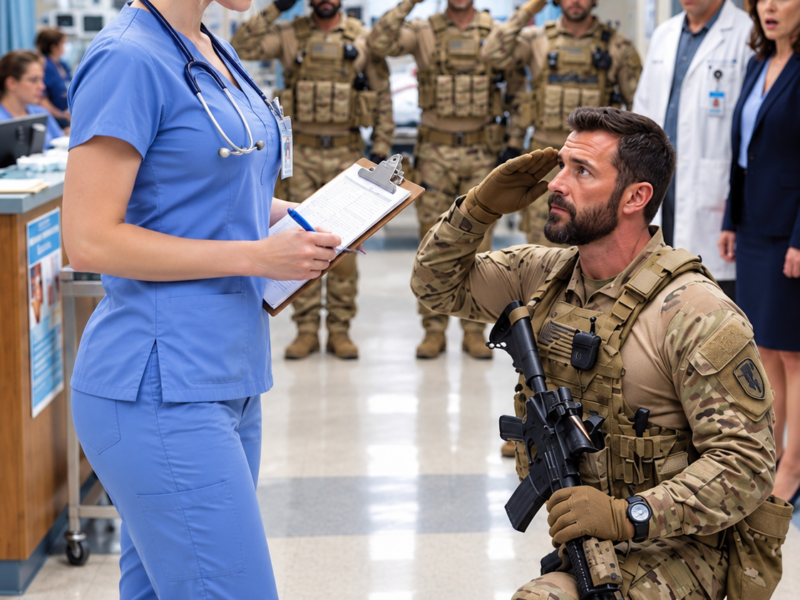
“The hospital administrator called me a DISRUPTIVE PATIENT in front of three nurses, ordered security to escort me out, and refused to hear another word
“Someone who believes the wrong person may have accessed your medical records.”
I looked at the photograph again.
The document showed my full name, military identification number, and a signature that was supposed to be mine.
But the date printed in the upper-right corner was what bothered me most.
October 14.
I had arrived at St. Catherine’s on November 5.
“Who created this?” I asked.
The uniformed officer glanced at Patricia Lawson.
“That’s what we’re here to determine.”
Patricia folded her arms.
“I don’t appreciate the implication that this hospital has done anything improper.”
The officer didn’t raise his voice.
“Then you’ll have no objection to preserving every record associated with Major Whitfield’s admission.”
He introduced himself as Colonel Daniel Brooks, an Army medical inspector assigned to a special investigative team.
The five other officers remained near the entrance.
Two spoke quietly with hospital security. Another was already on the phone.
I had worked with military investigators before, but I’d never seen six vehicles arrive over what appeared to be a routine emergency admission.
Something about this was bigger than a forged discharge form.
“Colonel, I need to understand why I’m involved in an investigation.”
He looked at me carefully.
“Major, did you receive any unusual medical instructions before coming here?”
I thought for a moment.
“No. I had a scheduled follow-up appointment this morning. Afterward, I developed chest pain and called emergency services.”
“Did anyone contact you about your medical records?”
“No.”
He nodded.
“Did you recently receive any notification that your records had been transferred to another medical facility?”
I shook my head.
Patricia interrupted.
“This is becoming unnecessarily dramatic. We have standard procedures for handling medical records. If there is a clerical error, we can correct it.”
Colonel Brooks turned toward her.
“An altered medical record isn’t necessarily a clerical error.”
The room went quiet.
He asked me to accompany him to a private consultation room.
Before I moved, I pointed to the bracelet on my wrist.
“Colonel, I still have chest pain. I need an actual physician, not another conversation about paperwork.”
He immediately turned to one of his officers.
“Get her evaluated. Independent medical staff. No medication changes until her existing records have been reviewed.”
That was the first time all morning someone had responded to what I was actually saying.
A few minutes later, a physician from another department arrived.
His name was Dr. Samuel Reed.
He introduced himself, listened to my symptoms, reviewed the medication list I’d brought, and ordered additional tests.
He didn’t treat my questions as a challenge.
He simply answered them.
While I was being examined, Colonel Brooks waited outside.
When the doctor finished, he told me the initial results required further monitoring but there was no immediate evidence of a cardiac emergency.
I was moved to a private observation room.
Only then did I begin to understand how strange the situation had become.
My phone had twelve missed calls.
Three were from my sister, Rachel.
One was from an unfamiliar number.
The remaining calls were from a contact saved under a name I hadn’t seen in almost two years.
General Marcus Hayes.
I called my sister first.
She answered immediately.
“Eleanor? Thank God. I’ve been trying to reach you.”
“I’m okay. I’m at the hospital.”
“Which hospital?”
“St. Catherine’s.”
There was a pause.
Then her voice dropped.
“Did they give you anything?”
“No. Why?”
“Because someone called the house this morning asking whether you’d been admitted somewhere.”
I sat up.
“Who?”
“They wouldn’t identify themselves. They said they were confirming your location for a medical transfer.”
“Rachel, did you give them anything?”
“No. I told them I wasn’t your emergency contact.”
I rubbed my forehead.
“Good. Don’t speak to anyone else about where I am.”
She hesitated.
“Eleanor, there’s something else.”
“What?”
“Mom called me last night. She said someone had been asking questions about your father.”
My hand stopped moving.
My father had died eleven years earlier.
He’d been a military physician who spent most of his career working in medical logistics and casualty evacuation.
After he retired, he rarely spoke about his service.
I hadn’t thought about his work in months.
“Who was asking?”
“She didn’t know. But she sounded frightened.”
I looked toward the closed door.
“Why didn’t you tell me earlier?”
“Because Mom asked me not to worry you. She said it was probably nothing.”
I closed my eyes.
My father had always been careful about what he put in writing.
Even after retirement, he kept a locked filing cabinet in his home office.
When I was younger, I’d asked him why.
He’d told me, “Some things are protected because they belong to the people who trusted us.”
At the time, I thought he meant patient confidentiality.
Now I wasn’t so sure.
After ending the call, I contacted Colonel Brooks.
He arrived within minutes.
I told him about my sister’s phone call and my father’s work.
He listened without interrupting.
Then he placed another document on the table.
It was a copy of a medical transfer authorization.
My name appeared at the top.
The destination was a private medical facility outside Richmond.
The authorization claimed I had requested the transfer.
I hadn’t.
More troubling was the signature of the approving physician.
Dr. Samuel Reed.
The same doctor who had just examined me.
I stared at the page.
“Colonel, he never signed this.”
Brooks leaned forward.
“Are you certain?”
“I watched him review my medication list. He never mentioned a transfer.”
He studied the document.
“Then we need to ask him about it.”
We found Dr. Reed in the nurses’ station.
When Colonel Brooks showed him the authorization, the physician went pale.
“I’ve never seen this document.”
“Your signature is on it,” Brooks replied.
“I know what my signature looks like.”
Dr. Reed took the paper and examined the lower corner.
“Where did you get this?”
“From the hospital’s electronic records.”
The doctor looked toward the computer.
“That’s impossible.”
“Why?”
He swallowed.
“Because I was on medical leave for three weeks in October. I didn’t even have access to the hospital system during that period.”
October.
The same month printed on the forged discharge paperwork.
Colonel Brooks asked for the hospital’s IT director.
Patricia appeared again before anyone could make the call.
“I think we should stop this conversation until our legal department is present.”
Brooks turned to her.
“Your legal department can join us. It cannot prevent us from securing records relevant to an active investigation.”
She looked at me.
“You have no idea what you’re putting this hospital through.”
I met her eyes.
“Neither do you.”
For a moment, neither of us spoke.
Then she walked away.
The next hour was spent reviewing the electronic admission history.
An IT specialist named Kevin Miller arrived with a laptop and several printed reports.
He was young, perhaps twenty-six, and visibly nervous.
He explained that my patient profile had been accessed multiple times before my arrival.
Not once.
Not twice.
Seventeen times.
All under a credential belonging to a senior hospital administrator.
Patricia Lawson.
“Could someone else have used her account?” Brooks asked.
Kevin nodded.
“It’s possible, but every access was made using her assigned workstation and a secondary authentication code.”
“Who had access to that code?”
“Only Ms. Lawson, according to our system.”
Patricia was brought back into the room.
She denied accessing my records before my admission.
She said someone must have stolen her credentials.
Kevin looked uncomfortable.
Then he opened another report.
“There’s something else.”
He pointed to a transaction dated October 14.
A file had been uploaded to my medical profile.
Its title was simple:
**WHITFIELD — RESTRICTED REVIEW.**
The file had been modified four times.
The last modification was made at 6:42 that morning.
My stomach tightened.
“Can you open it?” I asked.
Kevin hesitated.
Colonel Brooks nodded.
The document appeared on the screen.
It contained a list of medications, a description of a previous deployment-related injury, and several notes about my psychological evaluation after returning from overseas.
Most of the information was accurate.
But the final paragraph wasn’t.
It stated that I had experienced episodes of severe aggression, refused prescribed treatment, and demonstrated an inability to follow medical instructions.
I read the paragraph twice.
“Who wrote this?”
Kevin checked the metadata.
“The original author field is blank. But the latest edits came from an account assigned to Patricia Lawson.”
Patricia shook her head.
“I did not write that.”
I turned toward her.
“Then why is it in my file?”
She didn’t answer.
The colonel closed the laptop.
“Ms. Lawson, you’re going to need to explain that.”
She looked at the officers.
“I want an attorney.”
“That’s your right.”
The meeting ended shortly afterward.
Patricia was escorted to another office, not arrested, but no longer permitted to access the patient records system.
The hospital’s security director was instructed to preserve the relevant surveillance footage.
And I was told something that made the entire situation even more disturbing.
My records had been flagged for a special review several weeks before I ever entered St. Catherine’s.
Someone had anticipated my arrival.
But why?
I spent the afternoon under observation.
My chest pain gradually improved, and the doctor explained that the additional testing would help rule out more serious causes.
Colonel Brooks returned around four.
He carried a thin folder.
“Major, I think you should know why we came.”
I waited.
“Your father was involved in a medical logistics project during his final years of service.”
I nodded slowly.
“I know.”
“What you may not know is that he helped design a system intended to protect medical records belonging to military personnel involved in sensitive operations.”
I looked at him.
“What kind of protection?”
“Restricted access, independent authorization, and a separate audit trail. The system was intended to prevent records from being altered or used to identify personnel without proper approval.”
I thought of the document on the screen.
“Was my father investigating someone?”
Brooks opened the folder.
“Before he died, he submitted a report about unauthorized access to several military medical files.”
My throat tightened.
“He never told me.”
“He may have believed you were safer not knowing.”
I looked down at my hands.
My father had been a quiet man.
He never brought his work home, never discussed classified assignments, and rarely explained why certain phone calls made him leave the room.
I had always assumed he was protecting his professional boundaries.
Now I wondered whether he’d been protecting our family.
Brooks continued.
“After his death, the investigation was closed because the original evidence couldn’t be located.”
“Couldn’t be located?”
“Several files disappeared during an internal transfer.”
I looked at him.
“And you think someone has started looking for them again?”
He didn’t answer immediately.
Instead, he placed a photograph on the table.
It showed my father standing beside a younger version of General Marcus Hayes.
I recognized the location.
Fort Belvoir.
The photograph had been taken years before my father’s retirement.
On the back, in my father’s handwriting, were five words:
**If Eleanor asks, show her.**
I stared at the sentence.
“Why would he write that?”
Colonel Brooks leaned back.
“That’s what we’d like to find out.”
He told me General Hayes had requested that I be contacted directly.
The general had been my father’s commanding officer during the final phase of the medical records project.
He was also the person whose missed call had appeared on my phone that morning.
I called him.
He answered on the second ring.
“Major Whitfield.”
“General, it’s Eleanor.”
There was a long silence.
Then he said something I wasn’t prepared to hear.
“Your father told me this day might come.”
I gripped the phone.
“What day?”
“The day someone tried to make you look medically unfit.”
I looked at Colonel Brooks.
General Hayes continued.
“Your father discovered that a private contractor had been accessing restricted medical files and using them to influence personnel decisions. Some service members were removed from sensitive assignments after questionable psychological evaluations. Others were transferred without understanding why.”
“Who was responsible?”
“We never proved who gave the orders.”
“Then why was my father involved?”
“Because he discovered that someone had been using the system he helped build.”
I felt a cold pressure settle in my stomach.
“Was my father threatened?”
The general exhaled.
“He received several warnings. He told me he wasn’t afraid of losing his career. He was afraid that people would lose their lives because someone could manipulate their medical histories.”
I looked at the hospital bracelet.
For the first time, I understood why someone might want me labeled difficult.
If my records could be altered to suggest I was unstable or noncompliant, any complaint I made could be dismissed before anyone investigated it.
And if I had been transferred to the private facility listed on the forged authorization, I might never have reached the people who could verify my identity.
“General, do you know what happened to the original evidence?”
He was quiet for several seconds.
Then he said, “I believe your father left it somewhere you would eventually find it.”
I sat forward.
“Where?”
“Your mother’s house.”
I ended the call and immediately phoned Rachel.
She answered from our mother’s kitchen.
“Is Mom there?”
“Yes. Why?”
“Ask her about Dad’s locked filing cabinet.”
I heard Rachel cover the phone.
A moment later, my mother came on.
“Eleanor?”
“Mom, I need you to listen carefully. Did Dad leave anything in his office?”
She was quiet.
Then I heard a chair move.
“I thought you would never ask.”
My breath caught.
“What do you mean?”
“Your father gave me an envelope two weeks before he died. He told me not to open it unless someone started asking questions about your military medical records.”
I looked at Colonel Brooks.
“Do you still have it?”
“Yes.”
“What’s inside?”
“I don’t know. But there’s a key taped to the back.”
My mother’s voice trembled.
“And Eleanor, there’s something else.”
“What?”
“Someone came to the house yesterday.”
I sat completely still.
“Who?”
“He said he was from the hospital. He asked whether your father had left any medical documents behind.”
“Did you let him inside?”
“No. But he knew your father’s full name. He knew where he had worked. And he knew about the filing cabinet.”
Colonel Brooks reached for a notepad.
I gave him the details.
My mother described the visitor as a middle-aged man in a gray coat who drove a white sedan.
Before leaving, he’d told her that keeping old military documents could cause unnecessary trouble for the family.
Then he’d asked her to pass along a message.
I closed my eyes.
“What message?”
My mother took a shaky breath.
“He said, ‘Tell Eleanor the review has already been completed. She should stop looking.'”
The room seemed smaller.
Because I had never told anyone I was looking.
I hadn’t even known there was anything to find.
Colonel Brooks stood up.
“We’re going to your mother’s house.”
I insisted on going with them.
Dr. Reed objected because I was still under observation, but after reviewing my latest results, he agreed I could be transported with medical clearance and continued monitoring.
At 6:15 p.m., we left St. Catherine’s.
The six black SUVs were still there.
Only now, two additional vehicles had joined them.
As we passed the hospital entrance, I looked back through the window.
Patricia Lawson stood behind the glass.
She was watching us leave.
She didn’t look angry anymore.
She looked afraid.
My mother’s house was a modest two-story home in a quiet Richmond neighborhood.
The porch light was on.
Rachel opened the door before we reached the steps.
She hugged me tightly.
“You look terrible.”
“I’ve had a long day.”
She pulled back and studied my face.
“You’re not going to tell me everything is fine, are you?”
“No.”
She nodded.
“Good. I hate that answer anyway.”
My mother was waiting in the living room.
She looked smaller than I remembered.
On the coffee table sat a yellowed envelope, a brass key, and a photograph of my father.
I picked up the envelope.
My name was written across the front in his familiar handwriting.
Not Major Whitfield.
Not Eleanor Whitfield.
Just Ellie.
He hadn’t called me that since I was a child.
I opened it carefully.
Inside was a handwritten note.
*Ellie, if you’re reading this, someone has finally decided that the truth is more dangerous than the people hiding it.*
*I wish I could have told you everything.*
*I need you to understand one thing. I did not build that system to protect the military from its people. I built it to protect people from anyone who believes their authority makes them untouchable.*
*The evidence is not in the filing cabinet.*
*The key will open the place where I left the original record.*
*Trust the person who asks why you were never allowed to see it.*
I read the final sentence again.
“Who asks why I was never allowed to see it?”
My mother shook her head.
“I don’t know.”
Colonel Brooks examined the brass key.
There was a small number stamped into its handle.
417.
He looked at me.
“Does that mean anything?”
I shook my head.
But Rachel suddenly spoke.
“Wait.”
She walked toward the hallway.
“Didn’t Dad have a storage unit?”
My mother frowned.
“Not that I remember.”
Rachel returned holding an old address book.
“He mentioned something once when we were cleaning the garage. He said he kept a few things at a storage facility near the airport.”
I opened the book.
There was an address written on the last page.
Beside it were two words.
**Unit 417.**
We drove there with two officers accompanying us.
The facility was almost empty by the time we arrived.
A security guard checked Colonel Brooks’s credentials and escorted us to the storage building.
Unit 417 was at the far end.
The brass key turned smoothly.
Inside were several cardboard boxes, a metal desk, and an old computer monitor covered in dust.
There was no dramatic collection of weapons or secret equipment.
Just ordinary things.
Medical manuals.
Old photographs.
A few military uniforms.
And a locked metal case sitting beneath the desk.
Colonel Brooks examined it.
The lock matched the brass key.
Inside the case were three folders, a small encrypted storage device, and a sealed letter.
I opened the first folder.
It contained names.
Dozens of them.
Military personnel whose medical records had been accessed without authorization.
Some had been transferred.
Some had lost security clearances.
Several had been discharged after receiving psychological evaluations they disputed.
I turned the pages slowly.
Then I found a familiar name.
My father’s former colleague.
Colonel James Mercer.
I knew him.
He had retired years ago and now worked as a consultant for a private medical technology company.
His name appeared beside several of the unauthorized access reports.
Colonel Brooks studied the page.
“Do you know this man?”
“Yes.”
“How well?”
“Well enough to know he attended my father’s funeral.”
The colonel said nothing.
I opened the second folder.
Inside were copies of correspondence between my father and several senior officials.
One email caught my attention.
It was dated three months before his death.
The subject line read:
**WHITFIELD FAMILY — CONFLICT OF INTEREST.**
I felt my throat tighten.
The email explained that my father’s daughter had been assigned to a sensitive overseas medical evacuation operation.
It warned that someone might attempt to access her medical records to obtain information about the operation.
I looked at Colonel Brooks.
“My father knew.”
“Apparently.”
“He knew someone might come after my records?”
“That’s what the document suggests.”
I opened the third folder.
There was only one page.
A handwritten list of names and a date.
At the bottom, my father had written:
**The original audit is held by the only person who refused to sign the transfer order.**
I read it aloud.
“Who refused?”
Colonel Brooks examined the names.
One stood out.
Dr. Samuel Reed.
I stared at the page.
The same doctor who had treated me that afternoon.
“That’s impossible,” I whispered.
Colonel Brooks looked at me.
“Why?”
“Because he told us he’d never seen the forged transfer authorization.”
Brooks picked up the folder.
“Perhaps he was telling the truth.”
I thought about his expression when he’d seen the document.
The way he’d examined the signature.
The way he’d said his access had been suspended during October.
Then I remembered something.
When I had first met him, he hadn’t looked surprised to see my military identification.
He’d looked at it for a long time.
As if he recognized something.
I reached for the sealed letter in the case.
My father’s handwriting was on the front.
**For Dr. Reed, if Eleanor ever comes looking.**
Colonel Brooks stared at the envelope.
“Well, that answers one question.”
I carefully opened it.
Inside was a short letter.
*Sam,*
*If Ellie ever finds this, give her the original audit. Do not let anyone convince her that the records were lost.*
*You know what happened to the first three people who tried to report it.*
*I made a promise to her mother that I would keep her out of this. I may have failed.*
*But if they have reached her medical file, then the time for protecting her by keeping her ignorant is over.*
*Please tell her what we found.*
*Thomas Whitfield.*
My father’s name.
I read the letter again.
Then I looked at Colonel Brooks.
“Dr. Reed has the original audit?”
He nodded slowly.
“That’s what your father believed.”
We returned to the hospital the following morning.
My condition had stabilized, and Dr. Reed was waiting in a consultation room.
He looked at the folder in my hands.
For several seconds, he didn’t speak.
Then he closed the door.
“I wondered when Thomas’s letter would find its way to you.”
I sat down.
“How long have you known?”
“Since your father first contacted me.”
He explained that he’d worked with my father on the medical records protection system.
He had been one of the original physicians responsible for reviewing access requests.
When they discovered unauthorized changes, he refused to approve a transfer order that would have moved several restricted records into a private contractor’s system.
The order had later appeared with his forged signature.
He reported it.
Nothing happened.
Instead, he was placed on administrative leave and warned that further complaints could jeopardize his medical license.
He kept copies of the original audit.
But when my father died, the investigation stalled.
“Why didn’t you come forward?” I asked.
He looked down.
“Because I was afraid.”
The answer was so simple that I didn’t know what to say.
He continued.
“I had a wife. Two children. A mortgage. I told myself that if I kept the evidence safe, someone would eventually ask for it.”
“That someone was supposed to be me?”
“Your father believed you would recognize what was happening.”
I looked at the medical bracelet on my wrist.
“Then why was my file changed?”
Dr. Reed opened a drawer and removed a small flash drive.
“Because someone was trying to create a medical basis for removing you from a review assignment.”
I stared at him.
“What assignment?”
He placed another document on the table.
It was an official notice.
I had been selected several months earlier to serve on an Army medical oversight panel reviewing the very system my father had helped develop.
My appointment had been delayed twice.
The latest notice stated that my eligibility was under review because of concerns about my psychological stability and compliance with medical treatment.
I read the page carefully.
The allegations were almost identical to the false paragraph in my hospital file.
I finally understood.
Someone wasn’t simply trying to get me out of St. Catherine’s.
They were trying to make sure that when I reported what I’d discovered, nobody would believe me.
Colonel Brooks took the flash drive.
“Is this the original audit?”
Dr. Reed nodded.
“Along with correspondence showing who requested the unauthorized access.”
“Names?”
“Yes.”
Brooks looked at me.
“Major, this is going to take time.”
I nodded.
“I know.”
But I wasn’t prepared for what happened next.
Dr. Reed turned toward me.
“There’s one more thing your father wanted you to know.”
He reached into the drawer and removed a photograph.
It showed my father, Dr. Reed, and General Hayes standing beside a woman I’d never seen before.
She wore civilian clothes and held a folder.
On the back was a handwritten note.
**The first person who tried to stop them.**
“Who is she?” I asked.
Dr. Reed looked toward Colonel Brooks.
“Her name is Captain Laura Bennett. She was the original whistleblower.”
I studied the photograph.
“Where is she now?”
He hesitated.
“She died in a car accident six months after your father submitted his report.”
The room became very quiet.
“Was it investigated?”
“Yes. The official finding was an accident.”
“Do you believe that?”
Dr. Reed didn’t answer.
He didn’t have to.
Colonel Brooks took the photograph and examined it.
“We’ll verify everything before drawing conclusions.”
That was how the investigation truly began.
Over the following weeks, the military inspector general’s office worked with federal authorities to examine the records.
The evidence from my father’s storage unit was authenticated.
The original audit matched the hospital access logs.
The forged documents were traced to a series of unauthorized administrative requests involving a private medical records contractor.
Patricia Lawson was eventually found to have approved several access requests using her credentials.
But the investigation uncovered something more complicated than one administrator acting alone.
She had been receiving instructions from an outside consultant.
Colonel James Mercer.
The same man who had attended my father’s funeral.
He had been contracted to advise the hospital on medical records management.
He also had a financial interest in the company that had been seeking access to restricted military medical files.
Patricia initially claimed she had believed the requests were legitimate.
Later, she admitted that Mercer had told her certain military patients required special handling.
He had given her language to insert into reports when a patient questioned treatment or requested an independent review.
The phrase “discipline problem” was one of several descriptions he had recommended.
Patricia’s conduct was serious.
She had allowed false information to enter a patient’s medical record, failed to verify a transfer authorization, and used her position to restrict access to records that should have remained protected.
She lost her position.
The hospital also faced an external compliance investigation and was required to notify affected patients.
Mercer was removed from his consulting role.
The financial records, access logs, and correspondence were referred for further investigation.
The evidence didn’t prove that he had caused Captain Bennett’s death, and I refused to pretend it did.
That question remained open.
But the medical records investigation had finally found its way into the hands of people who could examine it independently.
My appointment to the oversight panel was restored after the false medical findings were formally withdrawn.
I returned to duty several months later.
Not because I wanted revenge.
Because there were people whose careers, reputations, and futures had been altered by information they never had a chance to challenge.
I wanted them to have what I had nearly been denied.
A fair hearing.
Before leaving Richmond, I visited my mother’s house.
She had placed my father’s photograph on the mantel.
The same photograph from the storage unit.
I stood in front of it for a long time.
“He knew this would happen,” I said.
My mother came to stand beside me.
“He knew someone might try.”
“Why didn’t he tell me?”
She took my hand.
“Because he wanted you to have a life that wasn’t defined by the things he had fought.”
I looked at the photograph.
For years, I’d thought my father had kept secrets because he didn’t trust me with them.
Now I understood that sometimes people keep quiet because they love someone too much to hand them a burden they cannot yet carry.
But love doesn’t always mean keeping someone in the dark.
Sometimes it means leaving them the truth, even when you won’t be there to explain it.
A week later, I received a handwritten letter from Dr. Reed.
He apologized for waiting so long.
He didn’t ask me to forgive him.
He simply wrote that he hoped the next person who came looking for the truth wouldn’t have to wait until six black SUVs arrived to be heard.
I kept that letter.
I also kept the forged discharge notice.
Not as a reminder of Patricia Lawson or Colonel Mercer.
As a reminder of the day I learned how easily a person’s credibility could be attacked by a document carrying the right letterhead and the wrong signature.
Months later, I returned to St. Catherine’s for a final medical follow-up.
The waiting room looked exactly as it had on that first morning.
Plastic chairs.
A television playing quietly.
A receptionist calling names.
A young woman sat near the entrance, holding a folder against her chest.
She looked frightened.
A nurse asked her to sign a form.
The woman hesitated.
“Could I read it first?”
The nurse sighed.
“We’re very busy.”
I watched the woman lower her eyes.
Then I stepped closer.
“Take your time,” I told her. “You’re allowed to understand what you’re signing.”
She looked up at me.
Something in her expression softened.
I didn’t know her name.
I didn’t know what had brought her there.
But I knew what it felt like to sit in a hospital and be treated as though asking questions made you the problem.
As I walked out, I glanced once toward the emergency entrance.
Six black SUVs had arrived that morning because someone finally believed my name deserved to be heard.
I hoped that someday, nobody would need six of them just to make a hospital listen.
The end.









