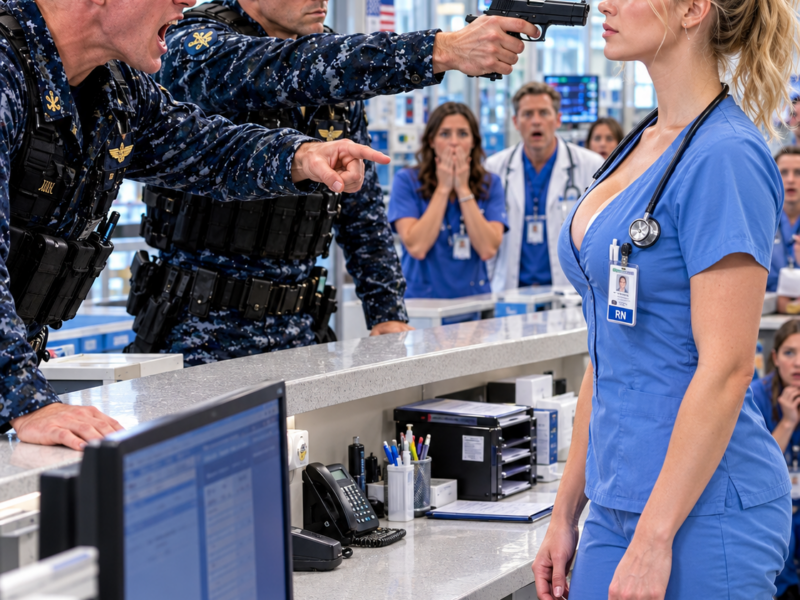
“The gunman’s pistol pressed against my temple while he ordered me to save the bleeding stranger on the warehouse floor
For a moment, nobody in the warehouse moved.
The gunman holding me had gone pale beneath the harsh fluorescent lights. His pistol remained against my forehead, but his eyes were fixed on Ethan as though the injured man had just pronounced a death sentence.
“That’s impossible,” he muttered.
Ethan tried to sit up. Pain twisted his face, and Ranger immediately pressed against his shoulder, whining softly.
“Don’t move,” I told him.
The gunman jerked me backward. “You said her father was dead.”
“I said her father was reported dead,” Ethan replied. “There’s a difference.”
The man in the charcoal coat recovered enough to smile, but the expression looked forced.
“Nice story. Maybe it’ll convince someone else.”
He turned toward one of his men. “Get the van ready. We leave in two minutes.”
I felt the pistol shift against my skin.
“You’re making a mistake,” I said.
He leaned close enough for me to smell whiskey on his breath.
“You’re a nurse. Your job is to keep people alive. Don’t pretend you understand anything happening here.”
He was right about one thing. I didn’t understand the operation, the mysterious drive, or why a wounded stranger knew my father’s name.
But I understood frightened people.
And the man holding the gun was frightened.
He had expected Ethan to be helpless, me to be obedient, and the little black drive to be the only obstacle between him and whatever he wanted. Now he was discovering that the past he’d tried to bury had followed him into this warehouse.
I swallowed hard.
“What’s your name?” I asked.
His eyes narrowed. “Why?”
“Because if you’re going to shoot me, I’d like to know who did it.”
One of the men near the loading door snorted. The gunman turned his head toward him for a fraction of a second.
That was enough for Ethan to speak.
“Emily, listen carefully. There’s a release on the inside of the pendant.”
I stared at him.
“What pendant?”
“The one your father left you.”
My hand flew to my throat.
Beneath my scrub top, a small silver disk rested against my skin. I’d worn it since I was seventeen. My mother had given it to me after the funeral, telling me it was the only personal item recovered from my father’s car.
It had never opened. It had never seemed to contain anything.
The gunman noticed my movement.
“What’s she touching?”
“Nothing,” I said quickly.
He grabbed my necklace and yanked it hard enough to cut my skin.
The chain snapped.
The pendant struck the concrete and rolled beneath a metal workbench.
For one terrible second, everyone watched it disappear into the darkness.
Then the gunman struck me across the face.
“Get it!”
I stumbled against a stack of wooden pallets. My cheek burned, and the taste of blood filled my mouth.
Ethan lunged toward the workbench, but his injured side gave way. He collapsed with a strangled cry.
Ranger sprang forward.
“Ranger, hold!” Ethan shouted.
The dog froze, trembling with effort.
The gunman pointed his weapon at the Shepherd.
“Call him off or I’ll put him down.”
“He won’t attack unless you give him a reason,” Ethan said through clenched teeth. “You should be more worried about what happens when the police arrive.”
The gunman laughed without humor.
“No police are coming.”
A distant siren rose outside, faint but unmistakable.
His smile vanished.
I dropped to my knees and reached beneath the workbench. My fingertips brushed dust, a broken bolt, and finally the cold edge of the pendant.
I closed my fist around it.
“Found it,” I whispered.
The gunman spun toward me.
“Bring it here.”
I stood slowly, keeping my hand closed around the silver disk.
“First, let him breathe.”
He stared at me.
“You think you’re in a position to negotiate?”
“I think you need something from me. If you kill me, you don’t get it.”
The room went quiet again.
Then Ethan gave a short, painful laugh.
“Your father would have liked that.”
The gunman slammed the pistol against my temple.
“Shut him up!”
Ethan didn’t look at him. He looked at me.
“Emily, the release is on the rim. Press the tiny notch and twist counterclockwise.”
I found the notch with my thumbnail.
The pendant clicked.
A seam appeared along its edge, so fine I’d never noticed it in all the years I’d worn it. I twisted carefully, and the disk opened like a miniature metal shell.
Inside was a small black memory chip.
The gunman reached for it.
I closed the pendant around the chip before he could take it.
“Not until you tell me what Ghostline Six is.”
His face hardened.
“You don’t get to ask questions.”
“Then you don’t get the chip.”
He stared at me, weighing his options. The gun remained against my head, but his hand had begun to shake.
Finally, he lowered it a fraction.
“Ghostline Six was a classified military intelligence program,” he said. “Your father ran a communications unit that intercepted transmissions no one wanted officially recorded. He stole sensitive information and tried to expose people who were operating outside the chain of command.”
Ethan shook his head.
“That isn’t what happened.”
The gunman ignored him.
“Your father was involved in an operation that went wrong. People died. He was supposed to answer for it, but he ran.”
“My father died in a car accident,” I said.
“That’s what the report says.”
The same phrase again.
Reported dead.
Reported accident.
Reported truth.
My life had been built on reports written by people who apparently knew more about my father than I ever had.
“Who are you?” I asked again.
This time, he answered.
“Victor Shaw.”
The name meant nothing to me.
But Ethan reacted as if someone had struck him.
“Shaw,” he whispered. “You were the operations liaison.”
Victor’s mouth tightened.
“You should have stayed dead, Mercer.”
The name landed in my mind.
Mercer.
I looked at Ethan.
“That’s your real name?”
He nodded faintly.
“Ethan Mercer. Former Navy special warfare operator.”
“Former?” I asked.
“Officially.”
Victor laughed. “He’s a deserter who stole classified material.”
“No,” Ethan said. “I’m the man who refused to let you erase six people from the record.”
Victor’s expression changed.
For the first time, I understood that this wasn’t just about a memory chip or my father’s past. It was about people who had been erased, families who had been lied to, and someone who had spent years making sure the lies remained intact.
Outside, tires crunched over gravel.
A man’s voice called from beyond the loading door.
“Victor! We have company!”
Victor grabbed my arm and pulled me toward the far side of the warehouse.
“Move.”
I stumbled after him, clutching the pendant. Ethan tried to follow, but two men forced him back down. Ranger barked once, a sharp warning that echoed through the building.
Victor dragged me through a narrow door into a storage corridor lined with shelves and rusted equipment. He shoved me against the wall and raised his pistol again.
“Give me the chip.”
I opened my hand enough for him to see the pendant.
“Tell me what happened to my father.”
His jaw tightened.
“Your father made a choice.”
“What choice?”
“He chose to protect people who didn’t deserve it.”
“That’s not an answer.”
“It’s the only one you’re getting.”
He reached for the pendant.
I pulled it away.
“You’re afraid of what’s on it.”
“I’m tired of this game.”
“Then tell me the truth.”
His eyes turned flat.
“Your father was offered a chance to cooperate. He refused. He was killed during a staged vehicle incident, and the report was altered to make it look accidental. The people responsible thought the evidence died with him.”
The corridor seemed to narrow around me.
I had spent half my life believing my father had been unlucky. A wet road. A dark curve. A collision no one could have prevented.
Now the man responsible was standing in front of me, admitting that my father’s death had been arranged like a problem on a spreadsheet.
I couldn’t breathe.
Victor watched my face with the detached interest of someone waiting for a wound to open.
“Now give me the chip.”
My fingers tightened around the pendant.
“No.”
His hand shot out, but I ducked sideways. The gun struck the wall, and I slammed my shoulder into his chest. We stumbled against a shelf, sending metal tools clattering across the floor.
He caught my jacket and threw me down.
Pain exploded through my elbow.
The pendant flew from my hand.
Victor reached for it.
Before his fingers could close around the silver disk, a low growl rolled through the corridor.
Ranger stood in the doorway.
His teeth were bared, his body rigid, his eyes locked on Victor.
“Call off your dog!” Victor shouted.
Ethan appeared behind him, one hand pressed against his wound. His face was gray with pain, but he remained upright.
“Ranger,” he said softly. “With me.”
The Shepherd moved to Ethan’s side without taking his eyes off Victor.
I scrambled backward and grabbed the pendant.
Then a voice came from the main warehouse.
“NAVAL CRIMINAL INVESTIGATIVE SERVICE! DROP YOUR WEAPONS!”
Victor looked toward the door.
For one second, I thought he might surrender.
Instead, he seized me by the collar and dragged me in front of him.
“Back away, or she dies!”
The agents stopped at the end of the corridor. Several weapons were raised, but nobody fired.
I felt Victor’s arm tighten around my neck.
Ethan took a step forward.
“Let her go, Shaw.”
“Put your hands where I can see them!”
Ethan raised both hands slowly. Blood had soaked through his shirt, and his breathing was ragged.
Victor pressed the gun against my ribs.
“You think this is over? You think a few agents can undo what we’ve built?”
“No,” Ethan said. “But they can stop you from building anything else.”
Victor shifted his weight.
I remembered the way he’d reacted when the sirens approached, the way his attention had fractured whenever someone challenged his control. He believed everyone in the room was an obstacle to remove. He hadn’t considered that a frightened nurse might be watching him closely enough to recognize his habits.
His right hand was occupied with the gun.
His left arm was wrapped around me.
The pendant was in my fist.
I drove my heel down onto his instep and threw my head backward into his face.
He cursed and loosened his grip.
I twisted free.
The gun fired.
The blast deafened me. A bullet struck the metal shelf above my head, showering us with fragments.
I fell to the floor as the agents surged forward. Victor tried to raise his weapon again, but an agent struck his arm and drove him against the wall. Another secured his hands.
“Don’t move!” someone shouted.
I pressed myself against the concrete, both hands over my ears.
Ethan was beside me a moment later.
“Emily. Look at me.”
I couldn’t answer.
He crouched despite the pain, his face level with mine.
“Emily, you’re safe. The gun is away from him.”
I looked at him.
“Is he dead?”
“No. He’s in custody.”
Only then did I realize I was still clutching the pendant so tightly that its edges had cut into my palm.
Ethan gently opened my fingers.
The memory chip was still inside.
For a moment, neither of us spoke.
Then he looked at the blood running down my hand.
“Let’s get you checked out.”
I almost laughed.
“You’re the one bleeding through his shirt.”
“I’m aware.”
“You’re a terrible patient.”
“So I’ve been told.”
The familiar exchange steadied me more than the agents’ reassurances could.
Outside, emergency vehicles had filled the access road. Paramedics carried Ethan to an ambulance while another team examined me for injuries. Ranger refused to leave his handler until Ethan gave the command, then followed the paramedics with a quiet determination that made one of them smile.
Before the ambulance doors closed, Ethan reached for my hand.
“Don’t let them separate you from that pendant,” he said.
“Why?”
“Because your father didn’t trust anyone else with the last copy.”
I stared at him.
“Last copy of what?”
“The truth.”
At the hospital, a doctor treated my bruised face and cleaned the cuts on my palm. Ethan underwent surgery to repair damage from the gunshot wound in his side. The bullet had missed major organs, but he’d lost enough blood to make the next several hours uncertain.
I sat in a family waiting room, wrapped in a blanket, with the pendant secured in a clear evidence bag on the table beside me.
A woman in a dark suit introduced herself as Special Agent Rebecca Sloan. She worked with a federal task force investigating corruption involving classified military contracts and covert operations.
“We’ve been looking for Victor Shaw for eighteen months,” she explained. “He’s suspected of directing an illegal intelligence network that targeted former service members and witnesses connected to several overseas operations.”
“Why did he want my father’s chip?”
“Because it may contain the original Ghostline Six records. If those records are authentic, they could establish that several operations were deliberately misrepresented, including the incident that led to your father’s death.”
“Can you prove it?”
“That’s what our forensic team is working on.”
She explained that the memory chip would be copied and analyzed, and the original preserved. The evidence would need to be authenticated before it could be used in court. Nothing was guaranteed, she cautioned, but the contents could be significant.
“What about Ethan?”
“Mr. Mercer has been helping us investigate Shaw. He was reported missing after an operation six years ago. The official record described him as having abandoned his post with classified material.”
“He didn’t abandon anyone.”
Agent Sloan studied me.
“You’re certain?”
“I watched him take a gunshot wound and still try to protect a stranger. I watched him keep a trained dog under control while armed men threatened us. And he told Victor he refused to let six people be erased from the record.”
She nodded slowly.
“Those details are consistent with what we’ve learned. But his actions tonight will be evaluated along with the evidence.”
I looked through the window toward the corridor.
“Will he be arrested?”
“Not at this time. He’s a witness and a potential victim of the same network we’re investigating. Once he’s medically stable, we’ll take a formal statement.”
I sat back, exhausted.
“Then tell me who Ghostline Six really was.”
Agent Sloan folded her hands.
“It wasn’t a unit in the ordinary sense. It was a small communications team established to verify reports from sensitive field operations. Your father, Commander James Carter, was responsible for maintaining an independent record of transmissions, movement orders, and casualty reports. The purpose was to prevent errors and unauthorized changes.”
“My mother said he worked in communications.”
“She wasn’t entirely wrong. She may not have known the full scope of his assignment.”
“And the six?”
“Six people were assigned to the original team. Your father was the commander. Five others supported the operation. Their work uncovered discrepancies in supply shipments and after-action reports. Some of those discrepancies pointed toward people who were using classified operations to conceal theft, unauthorized detentions, and deaths that had been incorrectly recorded.”
I thought of the tiny compartment in my pendant.
“My father copied the evidence?”
“Yes. According to preliminary information, he made a final backup before he died. We believe he hid it in the pendant because he suspected the official archive had been compromised.”
“Why leave it to me?”
“Perhaps because he trusted you. Perhaps because he believed no one would think to search a nurse’s necklace. We won’t know until we examine the files and locate any surviving correspondence.”
I stared at the evidence bag.
For years, that pendant had been a comfort. Now it was the key to a case that could reach people with enough influence to make a man’s death look like an accident.
“Did my mother know?”
“We don’t know yet.”
The uncertainty was becoming familiar, but this time it no longer felt like a locked door. It felt like a door with people finally trying to find the key.
Near dawn, a nurse came to tell me Ethan was out of surgery and stable. I was allowed to see him briefly.
He lay beneath a white blanket, an oxygen line beneath his nose. Ranger rested on a mat beside the bed, his harness removed, his head raised whenever anyone approached.
Ethan opened his eyes when I entered.
“You look terrible,” he murmured.
I pulled a chair beside him.
“You got shot. I think you lose the right to criticize anyone’s appearance.”
“Fair enough.”
I glanced at the bandage beneath his ribs.
“Will you be okay?”
“The doctor says I’ll recover.”
“That’s not what I asked.”
He studied me for a moment.
“Yes,” he said. “I think I will.”
I looked down at my hands.
“Agent Sloan told me about Ghostline Six. About my father.”
Ethan’s expression grew serious.
“Your father saved my life.”
I looked up sharply.
“What?”
“Six years ago, I was assigned to a team supporting an operation that had been compromised. We were given movement orders that sent us into an exposed position. Your father recognized that the communications didn’t match the official plan. He tried to warn us, but someone had overridden his channel.”
Ethan paused to catch his breath.
“When the attack began, we lost contact with command. My team was scattered. I was trapped under debris, and I thought I was going to die there. Your father found me and dragged me to cover. He stayed until another team reached us.”
“Was he injured?”
“Yes. But he kept working. He believed the attack had been arranged to eliminate witnesses and destroy the original records.”
“Did he know he was going to be killed?”
“I think he suspected it. Before we separated, he gave me a set of coordinates and told me to find the original archive if anything happened to him. He also told me that if I ever met you, I should tell you he was proud of you.”
My eyes filled.
“He never said that in his letters.”
“Maybe he didn’t want you to worry. Maybe he thought he’d have time to tell you himself.”
I pressed my fingers against my mouth.
“What happened after that operation?”
“My team was declared missing. I survived, but I was injured and moved through a series of temporary facilities. By the time I could contact anyone, the official story had changed. We were described as having disobeyed orders. Your father was listed as dead in an unrelated accident. The records I carried were dismissed as stolen material.”
“And Ghostline Six?”
“The other members were scattered. One died during the operation. Two were reassigned under false explanations. Another disappeared. The last one tried to bring the evidence forward and was threatened into silence.”
“Why didn’t you come to me?”
“I tried to find you. But your address had changed, and the people monitoring the case were watching everyone connected to your father. I didn’t know whether contacting you would put you in danger. When I finally traced your name to Norfolk, I learned you’d become a nurse. I kept looking for a safe way to approach you.”
I thought about the warehouse, the gun, the way he’d recognized me before I’d understood who he was.
“You could have told me the truth.”
“Yes,” he said quietly. “I should have.”
The admission surprised me. I had expected another explanation, another reason to wait.
“I can’t give you back the years you lost,” he continued. “I can’t make what happened to your father hurt less. But I can help you make sure the truth survives.”
I looked at Ranger, who had lifted his head and was watching us.
“Does he know when you’re lying?”
“Usually.”
“Then he must have been very confused when you told me you were fine.”
A faint smile appeared on Ethan’s face.
“He’s still deciding.”
I laughed softly, and for the first time since the warehouse, the sound didn’t feel forced.
The investigation moved quickly once the memory chip was authenticated. The files contained original communications logs, shipping records, and a sequence of recorded conversations. Several entries bore dates and signatures that contradicted official reports. Investigators matched financial transfers to shell companies linked to Victor Shaw and identified a senior contractor who had authorized the altered records.
The evidence also revealed that my father’s death had been concealed behind a false accident report. The people involved had believed the only surviving copy of his archive had been destroyed during the operation. They hadn’t known about the pendant.
Victor had learned of it through a former associate who had discovered that my mother still possessed some of my father’s personal belongings. He had arranged for me to be watched, then hired men to frighten me into surrendering the necklace. The plan was supposed to be quick and quiet.
Instead, they had brought the evidence—and a witness—into the open.
Tyler, one of the men involved in the warehouse assault, eventually agreed to cooperate. His information helped investigators identify the people who had arranged the confrontation. He still faced consequences for his role, but his testimony connected Victor to the attempted theft and established that the threats against me had been deliberate.
The larger case took months. Some of the people named in the records denied wrongdoing. Others claimed they had merely followed orders. Investigators had to distinguish between genuine mistakes, reckless decisions, and deliberate criminal acts. The files did not answer every question, but they provided a trail that could no longer be dismissed as one man’s accusation.
My mother came to Norfolk when I finally told her what had happened.
She listened in silence as I explained the pendant, the memory chip, and the evidence concerning my father’s death. When I finished, she sat at my kitchen table with both hands wrapped around a cup of tea.
“Your father told me there were people who might try to use his work against him,” she said. “He asked me to keep his belongings safe, but he never told me about the pendant. After the accident, someone from his office came to the house and warned me not to ask questions. I was afraid, Emily. I thought if I stayed quiet, I could protect you.”
I reached across the table and took her hand.
“You were trying to protect me.”
“I should have told you.”
“Maybe. But you didn’t know what we know now.”
She began to cry.
“I wanted you to remember your father as a good man. I was afraid the truth would take that away.”
I squeezed her hand.
“It didn’t. It gave me more of him.”
A week later, Agent Sloan arranged for us to view a restored recording from the archive. My father appeared on the screen in uniform, seated at a desk with papers stacked beside him. He looked younger than I remembered, though I knew the recording had been made only months before his death.
He spoke calmly, explaining the importance of preserving accurate records and protecting the people whose lives depended on them. Then he paused and looked directly into the camera.
“If this recording reaches my daughter, I want her to know that none of this was her responsibility. She has her own life to live. She should never feel obligated to carry my work simply because she carries my name.”
My mother covered her mouth.
I leaned closer to the screen.
My father smiled faintly.
“Emily, if you’re watching this, I hope you’re still helping people. You always had a way of making frightened people feel less alone. That’s a kind of courage, too. Don’t let anyone convince you that it matters less because you don’t wear a uniform.”
The recording ended.
I sat perfectly still, tears sliding down my face.
For years, I had wondered whether my father would have been disappointed that I hadn’t followed him into military service. I’d become a nurse because I wanted to help people in the most immediate way I knew how. I had spent my life treating the consequences of accidents, violence, and decisions made by people far from the bedsides where the suffering landed.
Now I understood that my father had never wanted me to become him.
He had wanted me to become myself.
Victor Shaw was eventually charged in connection with the conspiracy, the attempted theft, and the assault. The evidence from Ghostline Six helped prosecutors pursue additional charges against people who had falsified records and obstructed investigations. Not every allegation resulted in a conviction, and some questions remained unanswered, but the official account of my father’s death was corrected. His service record was restored, and his family was formally informed that he had been killed while attempting to protect his team and preserve evidence of wrongdoing.
The truth could not return the years we’d lost.
But it could return his name.
Ethan recovered slowly. The injury left him with a long scar beneath his ribs and a stiffness that bothered him on cold mornings. Ranger stayed close throughout the recovery, following him from room to room and refusing to settle until Ethan was comfortably seated.
When Ethan was discharged, he came to my mother’s house for dinner. He arrived with a small box tucked under his arm.
Inside was a folded American flag and a photograph of my father standing beside a younger Ethan. Both men were smiling, their faces tired and sunburned, with a military transport vehicle in the background.
“Your father gave me this picture,” Ethan said. “He told me to keep it until I found a way to get it back to you.”
I ran my fingers along the photograph’s edge.
“Thank you.”
“I should have brought it sooner.”
“You brought it when you could.”
He nodded, accepting the answer without trying to make it easier than it was.
We placed the photograph beside my father’s old letters. My mother stood quietly behind us, one hand resting on my shoulder.
For the first time, the past seemed less like a room we were afraid to enter and more like a place we could finally visit without getting trapped inside.
Several months later, I returned to work at the clinic. My bruises had faded, and the small cuts on my palm had healed. The silver pendant hung from a new chain around my neck, its hidden compartment empty now that the evidence had been secured.
Patients still arrived frightened and angry. Some shouted. Some cried. Some apologized for being difficult before I had even touched them. I treated each one as I always had, with steady hands and the quiet patience my father had once recognized in me.
One evening, after a long shift, I found Ethan waiting outside the clinic with Ranger. He had brought coffee and two sandwiches, claiming he’d learned that nurses were more likely to eat if someone put food directly into their hands.
“You’ve been talking to my coworkers,” I said.
“They seemed concerned about you.”
“They’re concerned about everyone. It’s their job.”
“Then I suppose I fit right in.”
Ranger nudged my hand, and I scratched the fur behind his ears.
“Does he ever take a night off?”
“Not when he thinks I’m being foolish.”
“Then he must be exhausted.”
Ethan laughed, and we walked toward the parking lot together.
At the curb, I touched the pendant beneath my collar.
“I used to think this was the last thing my father left me,” I said.
Ethan waited.
“Now I think it’s the first thing he gave me that I finally understand.”
The compass had never pointed north. Its needle was broken long before I’d received it. For years, I’d worn it as a memorial, believing it represented a life cut short and a truth I would never know.
But it had carried more than evidence. It had carried my father’s trust, his final effort to protect the people he loved, and a message that had survived every attempt to bury it.
I looked at Ethan, then at Ranger standing patiently beside him.
My father had spent his final days trying to make sure the truth would reach home.
It had taken years, a wounded Navy operator, a loyal dog, and one frightened nurse with a broken compass.
But the truth had made it back.
And this time, nobody could take it away.
The end.









