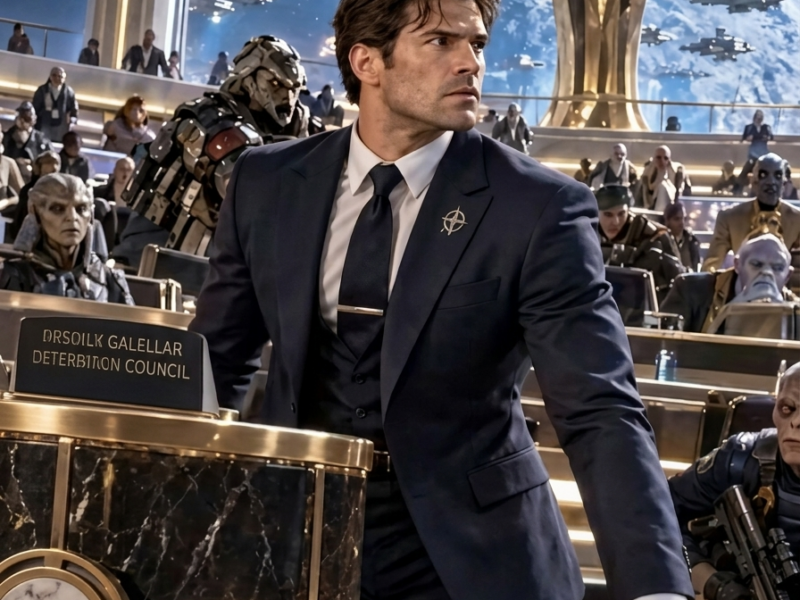
The Galactic Council was watching a live broadcast when a human soldier dropped his weapon, fell to his knees
The air inside the observation gallery of Station Elysium always smelled faintly of ionized nitrogen and expensive alien perfume. High above the ringed gas giant of Varkos-4, the Galactic Council held its annual military exposition—a glorified trade show where dominant star-nations displayed their biological marvels, bio-engineered war-beasts, and cybernetic shock troops to impress lesser protectorates.
My name is Daniel Reeves. Officially, I was the human military observer assigned to the Council. Unofficially, my job was to sit in a pristine, plush hover-chair, endure the polite condescension of thirty alien species, and ensure humanity didn’t get dragged into an interstellar proxy war we weren’t equipped to fight.
We were the newcomers. Humanity had unlocked slipstream drive technology only twelve years prior, limping out of the Sol system with rust-streaked frigates and a modest defense force. Across the galactic stage, we were viewed as an evolutionary footnote—a fragile, soft-skinned bipedal species with no chitin armor, no venom glands, no night-vision, and a laughably low pain tolerance.
“It is fascinating, Observer Reeves,” General Zorath had remarked earlier that afternoon. The massive Dravik general stood nine feet tall, his dark green scales gleaming like oiled steel under the stadium lighting. “Your people build such intricate machines, yet your bodies are made of soft meat and water. If an atmospheric seal breaches, you pop like overripe fruit.”
The surrounding ambassadors—an assortment of avian diplomats, insectoid trade barons, and silicon-based aristocrats—had chimed in with polite, synthesized laughter.
“We survive, General,” I had replied evenly, keeping my hands folded over my lap.
“You exist at our sufferance,” Zorath countered, his slit-pupiled eyes fixated on the lower arena floor. “A rabbit survives because the mountain lion is not hungry. Do not confuse the absence of a hunter with your own strength.”
I had remained silent. Arguments on Elysium were won with plasma tonnage and body counts, not diplomatic rhetoric.
The climax of the day’s exposition was supposed to be a standard demonstration of predator-containment doctrine. The Council had brought in a captured Varkul hunter—an apex carnivore from the uncharted Outer Reaches. It was a terrifying nightmare of evolution: eight hundred pounds of coiled muscle, quadrupedal speed, double-jointed limbs ending in monomolecular hooked talons, and a neural system that processed kinetic threats three times faster than a standard humanoid brain. Before its capture by Dravik shock troops, a single Varkul had slaughtered an eight-man armored reconnaissance squad.
Our unit had been asked to supply a single volunteer for a “low-impact kinetic evaluation” using non-lethal gear. They picked Sergeant Elias Ward.
Elias was thirty-four years old. He wasn’t a poster child for the Terran Marine Corps. He didn’t have intimidating facial scars or synthetic muscle implants. Back home in Ohio, he had a wife, two daughters, and a small garden behind his house. On duty, he was the quietest man in the logistics detachment—the guy who checked tire pressure on transport rovers and never raised his voice, even when junior enlisted recruits dropped expensive telemetry gear.
When Elias stepped into the reinforced glass arena wearing standard-issue padded training armor and carrying a low-yield stun rifle, Zorath had chuckled softly beside me. “A sacrificial lamb. How poetic.”
Then the arena’s automated restraint cradle failed.
It wasn’t supposed to happen. A high-voltage surge bypassed the containment seals, releasing the Varkul four seconds before the countdown reached zero. The beast didn’t hesitate. It didn’t roar. It moved like a shadow across the ferro-concrete floor, striking Elias with the force of a speeding hover-truck.
Elias was thrown forty feet across the pit, slamming hard against the reinforced blast wall. His training rifle flew from his grip, shattering into useless plastic fragments against the floor.
The Varkul stalked forward, its claws scraping sparks from the deck, its amber eyes locked onto the stunned human struggling on the ground.
In the observation gallery, several diplomats looked away. Zorath folded his arms, a smirk playing across his scaly maw. “A disappointing conclusion. Your soldier is done.”
I scrambled toward the emergency override panel, but the automated lockouts—designed to protect spectators during live-fire events—had sealed the arena doors from the inside.
Down in the dust, Elias lay motionless beneath the pulsing red warning lights. Three seconds passed. Three agonizing seconds where the entire galaxy watched a human soldier bleed onto the concrete.
Then, Elias lifted his head.
The fear wasn’t gone from his face—I could see his chest heaving, his mouth open as he fought for oxygen through broken ribs. But his eyes… his eyes had changed. He wasn’t looking at the shattered rifle twenty feet away. He wasn’t looking for help.
He was watching the Varkul’s left shoulder blade. He was calculating the weight distribution on its hind legs. He was measuring the exact arc of its breath.
“Elias,” I said into the com-link, my voice trembling. “Stand down. Stay flat. We’re overriding the doors.”
He didn’t answer. He slowly, deliberately pushed himself off the floor.
The Varkul lunged, a blur of muscle and talons aimed straight for his throat.
Elias didn’t step back. He stepped in.
He dropped his center of gravity, slipping beneath the lethal arc of the beast’s upper claw by less than an inch. As the creature passed over him, Elias drove his right elbow upward into the unarmored nerve-cluster beneath the Varkul’s lead joint. The beast let out an unnatural, wet screech as its front left leg buckled.
Elias was already gone. He didn’t try to grapple; he used the momentum of his dodge to pivot off the blast wall, kicking loose a heavy steel restraint bar that had been dislodged during the electrical surge.
What followed was not a heroic duel. It was a masterclass in ruthless, cold-blooded efficiency.
Elias didn’t waste a single calorie of energy. Every time the beast turned, Elias was already moving to its blind spot. He used the restraint bar not as a club, but as a lever—jamming it into the creature’s unhinged jaw, twisting its weight against its own momentum, forcing the eight-hundred-pound monster to stumble, turn, and exhaust its hyper-oxygenated blood supply.
The observation deck went dead silent. Nobody was laughing. Nobody was checking their datapads.
At the seventh second, the Varkul made a desperate, wide swipe with its right arm. Elias caught the wrist beneath the strike, dropped low, and used a classic leverage throw to send the giant beast crashing onto its back with a sound like falling thunder. Before it could roll, Elias stepped onto its chest, driving the steel restraint bar firmly across its windpipe.
The apex predator of the Outer Reaches froze. Its claws twitched, but it couldn’t move an inch.
Elias held the bar there for two seconds. He could have driven it down. He could have crushed its windpipe and killed the creature right there on live galactic television.
Instead, he took a deep breath, eased the pressure, and stepped backward, raising both open hands in the universal gesture of disengagement.
“Target neutralized,” Elias said into his helmet mic, his breath coming in sharp, ragged gasps. “Requesting medical assistance for both parties. The subject’s left shoulder joint is dislocated.”
The arena doors finally hissed open. Human medics rushed in alongside alien bio-handlers.
In the gallery, Zorath slowly rose from his seat, his claws digging so hard into the metallic railing that the alloy groaned. His yellow eyes were wide, unblinking, fixated on the quiet Sergeant down below who was currently helping the medics position a stretcher under the creature he had just defeated.
“What…” Zorath demanded, his voice devoid of its earlier arrogance, “did we just witness?”
I adjusted my uniform jacket, standing up beside the massive general. “Predator mode.”
Zorath turned his massive head toward me. “Explain.”
“Humans evolved on a death-world where everything was bigger, faster, and stronger than us,” I said, keeping my voice calm and measured. “We didn’t survive by growing thicker scales or bigger teeth. We survived because when a human is cornered, fear stops being an emotion and becomes a calculations engine. We learn the enemy’s patterns, we adapt, and we keep moving long after our bodies tell us to die.”
Zorath stared at me, then looked back at Elias, who was currently apologizing to the alien handlers for accidentally bruising the Varkul’s joint.
“Your soldier was terrified,” Zorath muttered, as if trying to reconcile the concept. “I smelled his adrenaline from here.”
“Of course he was terrified,” I replied. “That’s why he’s dangerous.”
By midnight, the fallout from the demonstration had transformed Station Elysium into a political beehive. The Council held an emergency closed-door session, unanimously voting to suspend all live war-beast evaluations involving human personnel. To the alien ambassadors, humanity had suddenly shifted from an amusing curiosity to an unpredictable military wildcard.
I sat in my private office inside the Terran Diplomatic Suite, sipping lukewarm coffee while reviewing the telemetry logs from the arena.
The door chime beeped. “Enter,” I called out.
Sergeant Elias Ward stepped into the office. He was wearing his standard gray duty uniform, his left shoulder wrapped tightly in a medical support brace. He looked tired, his eyes shadowed with exhaustion, but otherwise entirely unbothered by the fact that he was currently the most talked-about individual in the galaxy.
“Observer Reeves,” Elias said, coming to attention.
“At ease, Sergeant,” I pointed at the chair opposite my desk. “Sit down. How’s the shoulder?”
“Med-bay popped it back in, sir,” Elias said, sitting stiffly on the edge of the seat. “The creature’s going to be fine, too. Handlers said its joint will heal in a week. I… I hope I didn’t cause a diplomatic incident.”
I chuckled softly, leaning back. “Cause an incident? Elias, you scared General Zorath so badly he nearly shed his skin on live television. The Dravik delegation spent the last four hours filing formal inquiries about our ‘unrevealed bio-engineering programs.'”
Elias frowned, looking down at his lap. “I don’t have bio-engineering, sir. I just… I saw the monster coming, and I didn’t want my girls to grow up without a father.”
“I know, Elias,” I said softly. “You did great out there. Go get some rest.”
After Elias left, I returned to his medical file on my secure datapad. The station’s medical AI had automatically processed his biometric feed during the combat event, generating a detailed physiological report.
I scrolled down to the neural telemetry graphs, expecting to see a standard adrenaline spike followed by a gradual decline.
What I saw made me freeze.
At the exact second the Varkul broke its restraints and struck Elias, his heart rate had spiked to 190 beats per minute. That was normal.
Three seconds later—during the exact window when he lay motionless against the blast wall—his heart rate hadn’t stayed high. It had plummeted violently, dropping down to a steady, rhythmic 52 beats per minute. His brainwave activity had shifted instantly from high-beta stress spikes into a razor-flat, hyper-focused alpha state that defied standard human physiology.
A warning flag flashed in bright red text at the bottom of the screen:
ALERT: UNUSUAL NEUROLOGICAL MUTATION / REACTION PATTERN DETECTED.
DATA AUTOMATICALLY QUARANTINED UNDER GALACTIC MEDICAL PROTOCOL 9.
Before I could run a diagnostic on the alert, my terminal screen flickered. The station’s local network vanished, replaced by a high-level quantum-encrypted connection originating directly from Earth Command in Geneva.
A black screen appeared, displaying a single line of glowing amber text:
SECURE DECRYPTION KEY ACCEPTED. ACCESSING LEVEL-8 CLASSIFIED ARCHIVE.
My heart rate jumped. Level-8 was reserved for black-budget orbital defense projects and bio-weapon containment records.
A text file opened on my screen. It contained an official letter signed by General Vance, the Chief of Staff of the Terran Defense Forces.
FROM: Earth Command / General H. Vance
TO: Observer D. Reeves (Station Elysium)
SUBJECT: Sergeant Elias Ward (Service ID: 884-902-T)
Daniel,
If you are reading this, the station’s medical grid has already flagged Ward’s biometric telemetry from today’s incident. You need to purge the local med-bay cache immediately. Do NOT allow the Dravik or the Council’s medical officers to access his raw neural logs.
Sergeant Ward is not a standard Terran Marine. He is one of the twelve surviving candidates from Project NIGHTFALL (2018–2022).
The Council believes what they saw today was a human’s natural fear response being converted into tactical awareness. They call it ‘predator mode.’ Let them believe that.
They do not know what NIGHTFALL candidates were engineered to do. They do not know what happens when the neurological limiters are fully disengaged.
What Ward demonstrated today was not a human fighting for survival.
That was him holding back.
Keep him safe. Keep him quiet. If the Council discovers what we built during the Sol Reclamation War, they won’t just fear us—they will pre-emptively try to burn us out of the sky.
I sat frozen in my chair, staring at the glowing text on the monitor. The lukewarm coffee in my hand felt cold as ice.
Project NIGHTFALL.
I had heard rumors of the Sol Reclamation War—the brutal, shadowy conflict fought on the frozen moons of Saturn right before humanity made contact with the Galactic Council. The official history books called it a minor insurrection by outer-system mining cartels. But whispers among veteran officers spoke of something far worse: an encounter with an unknown, deep-space vanguard that humanity had barely managed to destroy before rewriting the records to avoid alarming the galactic public.
My terminal chimed again. A secondary encrypted file auto-extracted beneath the letter.
It was a combat video file dated nine years ago.
I pressed play.
The grainy, low-light footage showed the dark, icy surface of Titan. A perimeter outpost was surrounded by dozens of towering, multi-limbed armored shapes—entities that looked terrifyingly similar to the Varkul, but heavily armed with kinetic weaponry.
Standing alone in the center of the breach was a younger Sergeant Elias Ward.
He wasn’t wearing training armor. He was clad in a matte-black, unflagged suit of heavy power armor. He held no rifle.
And he wasn’t dodging.
The video showed Ward moving through the enemy rank like a scythe through dry wheat. His movements weren’t smooth or graceful—they were violently fast, horrifyingly precise, and executed with an absolute, mechanical brutality that tore through armored exoskeletons in seconds. His biometric overlay on the corner of the video showed his heart rate sitting at a flat, dead-cold 45 beats per minute while he dismantled an entire strike team with his bare hands.
There was no fear in his eyes on that video. There was no hesitation.
There was only a void.
The video ended. The terminal automatically wiped the cache, returning my screen to the standard station interface.
I leaned back in my chair, my hands shaking so violently I had to grip the edge of the desk.
The Council thought they had seen a clever prey animal slip out of a predator’s jaws today. They thought they were dealing with a fragile species that could be managed, patronized, and contained through superior technology.
They had no idea that the quiet thirty-four-year-old father sitting in our quartermaster’s office was a sleeping extinction event.
And as I looked out my office window at the massive, gleaming warships of the Dravik Empire anchored outside the station, a single, terrifying thought echoed in my mind:
What happens if someone forces him to wake up?
The answer to my question came less than thirty-six hours later.
At 0300 hours station time, the quiet corridors of the Terran Diplomatic Suite were shattered by a deafening structural shudder. The artificial gravity flickered, sending loose datapads and coffee mugs drifting off desks before slamming them back down onto the floor.
Red emergency lights flooded my private quarters.
“Warning,” the station’s synthesized automated voice echoed through the comms grid. “Hull breach detected in Sub-Level 4, Military Detachment Bay. Internal containment protocols compromised.”
I threw on my dress uniform jacket, grabbed my sidearm, and sprinted down the corridor toward the briefing room. I found Captain Miller, our detachment commander, frantically typing commands into a locked tactical terminal.
“Reeves!” Miller yelled over the blaring klaxons. “Get your gear on!”
“What the hell is happening?” I shouted, bracing myself against a structural pillar as another shockwave rocked the deck. “Is it an orbital strike?”
“Worse,” Miller spat, his face pale. “A rogue Dravik shock-squad just breached Sub-Level 4. They bypassed station security using General Zorath’s high-level command codes.”
My blood ran cold. “Sub-Level 4… that’s where Ward is staying.”
“Zorath didn’t buy the official report from the demonstration,” Miller said, pulling an assault rifle from the emergency locker. “His covert intelligence officers ran a deep-scan on the arena telemetry before we purges the cache. They realized Ward’s biometric curve didn’t match standard humanoid adrenaline patterns. They think we’re hiding a black-market genetic weapon… and they came to harvest his neural tissue before we can ship him back to Earth.”
“Where is Ward right now?” I demanded, drawing my pistol.
“He was asleep in the lower barracks when they blew the atmospheric seals,” Miller gritted his teeth. “The Dravik team dropped a localized dampening field. Communications in that sector are completely dead. We’re locked out.”
“We have to stop them!” I yelled. “If Zorath gets his hands on Ward’s brain scan, he won’t just discover NIGHTFALL—he’ll trigger an all-out war with Earth Command!”
“We can’t get through the blast doors!” Miller slammed his fist against the terminal. “Zorath’s tech-warriors hard-coded a lockdown on the entire lower sub-level. It’ll take our engineers forty minutes to cut through three feet of reinforced neutronium plate!”
I didn’t wait to hear the rest. I turned and ran down the service corridor toward the secondary environmental access tubes—the small, cramped maintenance vents that ran parallel to the main barracks.
I scrambled through the dark, narrow ventilation tube, my chest heaving, the metallic tang of ozone burning my nostrils. As I neared the access hatch overlooking the Sub-Level 4 sleeping quarters, the sound of heavy boots and guttural alien language echoed up through the metal grill.
I pulled out my optical scope and peered through the ventilation slats.
The lower barracks was a warzone.
Six heavily armored Dravik shock-troopers—wearing full-body kinetic carapace and carrying heavy pulse-rifles—had surrounded the center of the room. Two human guards lay unconscious near the door, their armor smoking from stun charges.
In the center of the room stood Sergeant Elias Ward.
He was wearing only his gray undershirt and sweatpants. His left arm was still bound tightly in his white medical support brace. He was standing near his cot, surrounded by four pointing rifles, his hands raised palms-out in front of him.
General Zorath himself stepped through the blasted threshold, holding a sleek, silver bio-extraction kit—a cruel, syringe-like apparatus used to harvest spinal fluid and neural tissue from living subjects.
“Remarkable,” Zorath rumbled, his reptilian voice dripping with cruel satisfaction. “No armor. No weapons. Trapped like a rodent in a hole. And yet your heart rate… my portable scanner shows your heart rate is only fifty beats per minute, Sergeant. How fascinating.”
Elias looked at Zorath. His voice was soft, devoid of anger or panic. “General. You are violating Galactic Council Treaty Article 4. This is an illegal entry into a sovereign Terran jurisdiction.”
Zorath laughed—a deep, wet sound that rattled his chest plates. “Treaties are written by the strong to bind the weak, human. Once my geneticists duplicate your neural architecture, the Dravik Empire will field an army of apex warriors. You should be honored. Your pathetic little life will serve a higher purpose.”
Zorath nodded to his squad commander. “Restrain him. Use the neural-shatter darts if he twitches. We only need his brain intact.”
Two heavy Dravik troopers stepped forward, their massive scales gleaming under the red emergency lights. One of them reached out with a heavy iron gauntlet, grabbing Elias by his injured left shoulder and wrenching it backward with a sickening POP.
Elias let out a sharp, ragged gasp of pain. He fell to his right knee, his head bowed toward the cold floorboards.
“Look at it,” Zorath sneered, stepping closer with the extraction syringe raised. “The grand predator of the arena. On its knees before its masters.”
In the ventilation tube, I raised my pistol, aiming directly through the grill at Zorath’s head. I knew the low-caliber round wouldn’t penetrate his heavy neck armor, but I couldn’t sit by and watch them butcher one of our men.
My finger tightened on the trigger.
Then, down in the barracks, Elias spoke.
His voice wasn’t loud. It wasn’t angry. It was a raspy, flat whisper that sounded like dry leaves scraping across a fresh grave.
“I promised her,” Elias muttered to the floor.
Zorath paused, raising an eyebrow. “What did you say, worm?”
Elias slowly lifted his face.
The red emergency lights reflected in his eyes, but there was no light inside them. The irises had dilated until his pupils swallowed the color entirely. His facial muscles went dead, completely expressionless, as if his persona had been wiped clean by an invisible eraser.
“I promised my wife I wouldn’t do this again,” Elias whispered.
The air inside the barracks suddenly felt five degrees colder.
The portable biometric scanner in Zorath’s hand began to emit a high-pitched, frantic warning chime.
WARNING: TARGET NEUROLOGICAL OVERRIDE DETECTED.
HEART RATE: 38 BPM.
ALPHA WAVE DENSITY: 100%.
LIMITERS: DISENGAGED.
Zorath looked down at the flickering screen in confusion. “What is this? The scanner is malfunctioning—”
Elias moved.
It didn’t look like a human body moving. It looked like a kinetic glitch in reality.
Before the Dravik trooper holding his shoulder could register the shift in weight, Elias’s right hand shot upward like a piston. His index and middle fingers, held rigidly together, drove directly into the soft, unarmored air-intake valve beneath the trooper’s helmet visor.
CRACK.
The pressurized seal exploded. The trooper let out a choked, wet gurgle as Elias twisted his hand, using the alien’s massive weight to pivot his own body backward while snapping the trooper’s neck with a single, leverage-assisted jerk.
The eight-hundred-pound alien soldier collapsed like a felled oak before his rifle even hit the deck.
“FIRE!” Zorath screamed, his reptilian voice cracking into a high-pitched shriek.
The remaining five troopers pulled their triggers. Heavy pulse-rounds chewed through the air, shattering the concrete walls and vaporizing metal lockers.
Elias wasn’t there.
He used the falling body of the dead trooper as a physical shield, catching the second soldier’s rifle barrel mid-burst with his bare right hand. With a terrifying display of mechanical leverage, Elias slammed his palm against the rifle’s firing pin mechanism, causing the weapon’s energy cell to overload and detonate in the trooper’s face.
The blast blew the second trooper backward, blinding his squadmates with a flash of plasma fire.
Elias stepped through the smoke.
His movements were terrifyingly quiet. He didn’t scream. He didn’t grunt. His breath came in slow, measured, rhythmic exhales—forty beats per minute—while his hands dismantled the elite Dravik shock-squad with surgical precision.
He didn’t use weapons. He used their own armor against them.
He jammed his fingers into hydraulic joints, tearing out synthetic muscle fibers. He caught a heavy power-blade mid-swing, inverted the angle, and drove the plasma edge clean through the third trooper’s neck seam. He stepped inside the fourth trooper’s guard, crushed his windpipe with an open-palm strike, and threw the massive alien across the room into the fifth soldier with enough force to crack both of their spine-plates.
It took four seconds.
Four seconds for a single, unarmed human in sweatpants to wipe out five of the most elite, heavily armored shock-troopers in the galaxy.
The barracks fell dead silent, save for the low hum of the flickering red lights and the wet, choking sounds of dying soldiers.
General Zorath stood frozen near the door, the silver extraction kit trembling wildly in his hand. His scales had turned a dull, terrified gray. His slit pupils were wider than I had ever seen them.
Elias turned slowly to face him.
He wasn’t panting. He wasn’t bleeding from anything vital. His broken left shoulder hung loosely at his side, but he didn’t even seem to register the agony of the dislocated joint. He took one slow, deliberate step toward the Dravik General.
“You…” Zorath rasped, staggering backward until his heavy back-armor hit the sealed blast door. “You… you are not human… what are you? WHAT ARE YOU?”
Elias didn’t answer him. He took another step forward.
From my position in the ventilation tube, I looked at Elias’s face through my optical scope.
It was horrific. Not because he looked like a monster, but because he looked like nothing. There was no rage, no satisfaction, no malice, and no mercy in his eyes. He was a execution algorithm operating a human vessel—a living apex weapon built to purge threats until nothing was left breathing in the room.
He reached out his right hand, his fingers curling into a crushing grip aimed directly at Zorath’s exposed throat.
“ELIAS! STOP!” I screamed, kicking the ventilation grill open and dropping eight feet down onto the blood-stained floor between them.
Elias’s hand stopped two inches from my face.
The speed of his reaction was so instantaneous that the wind from his movement slapped against my cheek. His dilated black eyes locked onto mine.
My heart was hammering against my ribs so hard I could barely breathe. I held up both hands, step-by-step backing away, keeping my body between him and Zorath.
“Elias,” I gasped, my voice trembling violently. “Look at me. Look at my uniform. It’s Daniel. Daniel Reeves.”
His eyes didn’t flicker. His posture didn’t soften. He stood there, two inches away, his breath coming in that terrifying, slow 40-BPM rhythm.
“Project NIGHTFALL is over, Sergeant,” I said, my voice breaking. “The war on Titan is over. You’re on Station Elysium. You’re a logistics sergeant. You have a wife named Sarah. You have two daughters—Maya and Lily. Remember them. Please, Elias… remember your girls.”
For three agonizing seconds, the silence in the room was suffocating.
Then, a tiny, subtle tremor passed through Elias’s right hand.
The dilated black pupils in his eyes began to contract. The flat, terrifying void in his expression cracked, replaced by a sudden wave of immense, crushing exhaustion.
He let out a long, shuddering gasp, as if he had been underwater for an hour and had just broken the surface.
His legs gave out. He collapsed forward, and I caught him beneath the shoulders, lowering him gently down onto the deck.
Elias looked up at me, his eyes wide, filled with a sudden, overwhelming human terror as he looked around at the broken bodies surrounding us.
“Observer…” Elias whispered, his voice cracking into a sob as he clutched his broken shoulder. “I… I did it again, didn’t I?”
“It’s okay, Elias,” I whispered, pressing a wet cloth against his forehead. “It’s okay. You saved us.”
Behind us, General Zorath had slid down the blast door onto his rear, his massive reptilian frame shaking uncontrollably as he stared at the quiet, weeping human sitting on the floor.
The blast doors finally groaned, cut open from the outside by our engineering team. Captain Miller and ten armed Terran Marines rushed into the room, their weapons raised—only to freeze in absolute, stunned disbelief at the scene before them.
I stood up slowly, stepping over the broken body of a Dravik trooper, and walked up to General Zorath.
I leaned down until my face was inches from his gray, trembling scales.
“You wanted to know what humanity was hiding, General?” I whispered softly. “Now you know. The next time you look at a human soldier… remember tonight. And pray to whatever gods you worship that we never have a reason to stop holding back.”
The diplomatic fallout of the Sub-Level 4 incident was handled with terrifying, silent efficiency.
General Zorath was quietly stripped of his command by the Dravik High Council and recalled to his home world under the guise of an “abrupt medical retirement.” The four surviving members of his illegal shock-squad were placed in deep-stasis transport pods and shipped back to Earth Command for intelligence extraction.
The Galactic Council never received the raw medical logs. A mysterious, irreversible data-phage corrupted the station’s central telemetry banks that very night, wiping every record of Elias’s physiological performance during both the arena fight and the barracks breach.
Officially, the incident was recorded as an tragic, isolated malfunction of the barracks environmental control system, combined with a violent security breach by rogue mercenaries that had been successfully repelled by Terran security forces.
Three days later, I stood on the civilian docking bay deck of Station Elysium, watching the heavy transport frigate USS Endeavor prepare for its slipstream launch back to Sol.
Sergeant Elias Ward stood beside me, wearing a clean, sharp service dress uniform. His left arm was neatly tucked inside a formal black sling, his hair neatly combed, his boots polished to a mirror shine. He looked once again like the quiet, unassuming logistics sergeant who spent his days checking tire pressure on rovers.
“Transport leaves in ten minutes, Sergeant,” I said, handing him his official travel papers.
“Thank you, Observer Reeves,” Elias said, taking the datapad. “For… for everything you did down there. In the barracks.”
I looked at him gently. “How are you feeling, Elias?”
“The doctors gave me a clean bill of health,” he said, offering a faint, tired smile. “They said the neural governor is stable. I’m being reassigned to a ground logistics depot in New Zealand. No combat deployments. No weapons evaluations. Just paperwork and supply manifests.”
“That sounds like a good life, Sergeant,” I said. “You earned it.”
Elias turned, looking out through the massive reinforced viewport at the stars stretching out into the dark infinite.
“Observer?” he asked softly.
“Yeah, Elias?”
“When I was in that… that state,” he whispered, his eyes distant. “I wasn’t afraid of the Dravik. I wasn’t angry at Zorath.”
“I know,” I said.
“I was afraid of what comes after us,” Elias said, his voice dropping into a register that made my skin cold. “During the war on Titan… when we disengaged our limiters… we saw something out there in the deep dark. Beyond the Outer Rim. Something that was watching us.”
He turned his head, looking me dead in the eye.
“The High Command didn’t build Project NIGHTFALL to fight the Dravik, Daniel,” Elias whispered. “They built us because they know what’s coming. And when it gets here… a few twelve-man squads aren’t going to be enough.”
I stood frozen on the deck as Elias offered a crisp, flawless salute, turned on his heel, and walked down the boarding gantry into the transport frigate.
The heavy airlock doors hissed shut behind him.
Ten minutes later, I stood alone at the viewport, watching the USS Endeavor ignite its slipstream drives, collapsing into a brilliant point of white light before vanishing into the dark sea of space.
I pulled out my secure personal datapad, opening a fresh, encrypted report addressed directly to the Chairman of Earth Command.
I didn’t write about diplomatic treaties. I didn’t write about trade quotas or station security.
I typed a single paragraph:
The Council believes they have seen our peak.
They believe fear makes us unpredictable, and training makes us dangerous.
They do not know about NIGHTFALL.
They do not know about Titan.
And they do not know about what is coming from the dark.
Keep the quiet ones home as long as you can, General.
Because if the galaxy ever forces us to wake them all up… there won’t be a Council left to govern.
I pressed send, wiped the datapad’s memory matrix, and turned back toward the bustling, vibrant corridors of Station Elysium.
Around me, alien diplomats laughed, traded, and gossiped, secure in their ancient empires, proud of their chitin armor and plasma cannons, entirely unaware of the apex apex predator that had just quietly boarded a ship for home.
The end.









