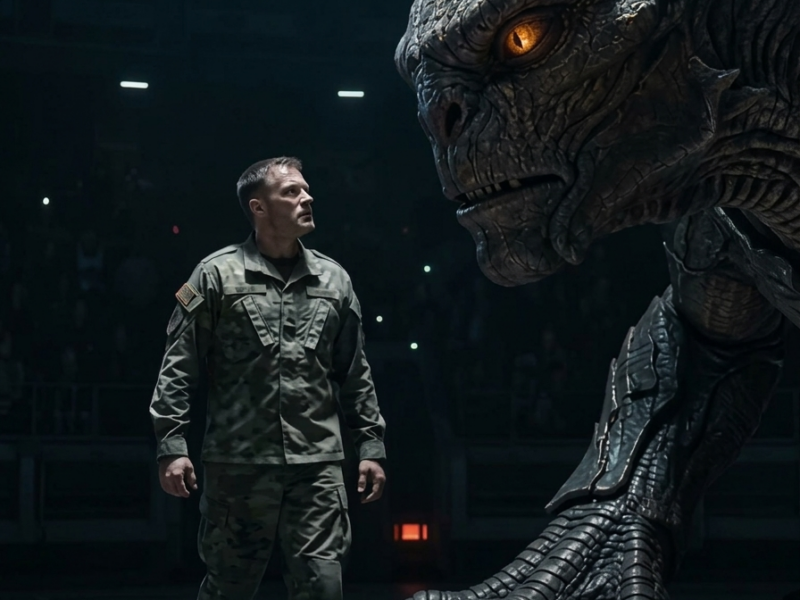
The entire military academy laughed when the galaxy’s most terrifying beast threw twelve elite cadets across the training arena
The metallic smell of scorched ozone and fresh blood hung heavy over the central sands of the Terran Defense Academy’s primary combat pit. High above the stadium floor, three thousand elite officer cadets sat clad in their immaculate silver-and-blue dress uniforms, their collective laughter ringing out against the reinforced plas-glass observation domes.
I stood near the equipment gate, wiping grease-stained hands on a rag that smelled of sub-light coolant and hydraulic fluid. My name, according to my official military identification tablet, was Caelen Vance—Junior Maintenance Technician, Ninth Grade. My boots were cracked at the toes, my coveralls bore the dark, permanent smudges of atmospheric drive manifolds, and my hands carried the faded white scars of a dozen low-level industrial accidents.
To the high-born sons and daughters of the Terran High Command sitting in the upper galleries, I was part of the machinery. I was the ghost who replaced stripped gears, mended frayed shock-cables, and scrubbed alien bio-matter off the floor after training drills.
On the arena floor below, three cadets lay broken against the reinforced blast wall.
At the center of the pit stood Varkuun.
The beast was a living siege engine—a seven-foot-tall apex combatant from the shattered rim-world of Kaelos. Its hide was covered in overlapping plates of natural obsidian armor that absorbed the glaring stadium lights. Its eyes glowed like dying suns, and its five-jointed limbs ended in monomolecular talons capable of tearing through the side hull of an orbital frigate.
In less than four minutes, the beast had dismantled twelve of the academy’s top varsity combatants, swatting their exo-suited forms across the arena floor as if they were fragile clay dolls.
Commander Voss, the Head of Tactical Instruction, stepped toward the rim of the observation deck. His crisp black uniform bristled with campaign medals, his chest puffed with the arrogance born of decades of unchallenged authority. He looked down at me, a cruel, thin smile curling the edge of his mouth.
“Since you believe humans are superior, technician, perhaps you can teach our guest some manners,” Voss boomed over the arena squawk-box.
The galleries erupted into a fresh wave of jeers and stomping boots. To them, it was a hilarious diversion—a filthy mechanic sent to be batted around by an untamed star-beast for the afternoon’s entertainment.
“I don’t fight,” I called up, my voice flat, unbothered, and raspy from years of breathing turbine fumes. “My orders are to service the shock-harnesses after the drill.”
“Your orders,” Voss barked, his eyes narrowing, “are to step into the pit or face immediate court-martial for insubordination. Step through the gate, Vance. Try not to die on the clean concrete.”
I swallowed hard, feeling the cold weight of thirty centuries of military hierarchy pressing against my spine. I threw my grease rag into a tool bin, stepped through the heavy pneumatic archway, and heard the titanium security gate slam shut behind me with a sickening THUD.
I took five slow steps onto the sand, keeping my hands empty and lowered at my sides.
Varkuun turned slowly. Its four nostrils flared, inhaling the sharp tang of my fear, the smell of my grease-stained uniform, and the cold sweat rising on my neck. It lowered its massive shoulders, its obsidian plates flaring as it prepared to pounce and tear me limb from limb.
Then, the beast stopped.
Its massive chest hitched. Its golden eyes widened until the amber pupils contracted to tiny, trembling pinpricks. The air rushed out of its lungs in a wet, ragged gasp that sounded like grinding stone.
It took a staggering step backward. Its heavy talons scraped across the metal floorboards beneath the sand, producing a horrific screech that cut through the crowd’s laughter like a razor.
“No…” the beast whispered.
The roaring crowd fell dead silent. Up in the command box, Commander Voss leaned over the railing, his brow furrowed in sudden confusion.
The seven-foot monster didn’t attack. Slowly, agonizingly, it dropped onto its thick right knee. Its massive head bowed until its forehead nearly touched the blood-stained sand at my boots. It brought a trembling, armored fist to the center of its massive chest-plate in a formal, ancient gesture of absolute military surrender.
“Commander Elias,” the beast rasped, its vocal cords vibrating with a sound that felt like thunder shaking a sealed vault.
My heart stopped beating in my chest.
The name didn’t belong to me. My tablet said Caelen Vance. My service record said orphan, draft-number 884-B, assigned to academy maintenance six years ago after an industrial concussion wiped my childhood memories clean.
Yet, as that word—Elias—vibrated through the air, something deep within the structure of my skull reacted. A cold, electric spark surged along my optic nerves. My vision flickered, overlaying the polished walls of the academy arena with the terrifying phantom memory of a sky burning with red, radioactive rain.
Above us, Commander Voss drew his heavy service sidearm, resting the barrel on the rail. “Stand down, creature! Engage the technician or face full neural-shock discharge!”
Varkuun ignored the officer completely. Heavy, thick tears—silver like mercury—pooled in its amber eyes and spilled down its battle-scarred snout.
“You came back,” the monster whispered, its voice breaking into a ragged, childlike sob. “After all these years… after the fire on Sector Nine… you finally came back for us.”
I shook my head, taking an involuntary half-step backward. “You’re wrong. I’m… I’m just a technician. I fix the atmospheric scrubbers.”
The beast looked up, and in its monstrous, terrifying face, I didn’t see ferocity. I saw a bottomless, unbearable grief—the look of a soldier who had guarded a cemetery for a hundred years, waiting for a king who never returned.
“They told us you died saving the evacuation fleet,” Varkuun rasped, its claws digging deep into the sand. “They told the rim-colonies that humanity had abandoned us to the Harvesters.”
“What evacuation fleet?” I asked, my own voice trembling now. “Humanity never fought a fleet in Sector Nine. That’s a civilian mining zone.”
Voss’s face turned from confusion to a dark, furious crimson. “Enough! This is a psychological manipulation attempt by a hostile alien subject!” He slammed his palm against the central console. “Activate the kill-collars!”
Before the shock-signal could clear the transmitter, Varkuun let out a guttural, deafening roar that shattered three panes of safety glass in the lower observation ring.
The beast struck its own chest plate with its bare fist. A blinding pulse of electromagnetic energy erupted from an old, buried cybernetic node beneath its skin, short-circuiting the arena’s control grid.
Every massive holoscreen lining the upper stadium flickered, hissed with static, and turned a deep, blood-red.
An ancient, corrupted video file began to play across fifty giant screens.
The footage showed a battlefield burning beneath a toxic, crimson sky. Tens of thousands of alien civilians—Kaelosians, like Varkuun, but smaller, starving, and terrified—were huddled behind a wall of burning transport ships. Surrounding them were thousands of elite Terran heavy infantry… shooting into the crowd.
And standing at the breach, holding the line against the Terran soldiers, was a officer in battered black power armor.
He carried no helmet. He held a ragged, burn-stained Terran flag in his left hand, and with his right, he shielded a small alien child with silver eyes and dark hair.
I couldn’t breathe.
The face on the screen was mine.
It wasn’t a resemblance; it was an absolute match. The same harsh jawline. The same dark, shadowed eyes. The same distinct, jagged scar cutting through the left eyebrow—a scar I had been told was from a falling coolant pipe when I was sixteen.
On the screen, the younger version of me turned toward an automated recording drone hovering nearby. His eyes were burning with a terrifying, righteous rage.
“If humanity ever finds this message,” my past self said, his voice echoing through the silent academy arena, “do not trust the High Command.”
In the observation box, Commander Voss went completely pale. He reached frantically for his encrypted communicator, his hands shaking wildly.
“They erased our memories,” my recorded voice continued, cold and unwavering, “because we discovered what they were really doing to the rim-colonies. They didn’t build this empire to protect us. They built it to consume us.”
A sharp, metallic CLANG echoed through the stadium as the automated emergency protocols took over. Every blast door slammed shut, locking three thousand cadets inside the arena. Emergency crimson strobes flooded the sand in rhythmic pulses.
Varkuun rose slowly to its full height, its massive body stepping between me and the stadium security guards who were frantically drawing their rifles.
The beast leaned its massive head down, stopping mere inches from my ear, its breath smelling of copper and ancient dust.
“Commander,” it whispered, its voice cracking with pure terror. “There is one thing they never told you before they wiped your mind.”
I stared into its ancient, terrified eyes, my whole world dissolving into ash around me. “What?”
Its voice broke. “You’re not the last survivor of that mission.”
Behind the thick, reinforced observation glass of the secondary VIP booth, someone began pounding frantically against the crystal pane.
I turned slowly toward the sound.
Standing behind the glass was a little girl, no older than ten years old. She wore a ragged, oversized mechanic’s tunic, and her small hands were wrapped around the wooden staff of a faded, burn-stained Terran flag—the exact same flag from the twenty-year-old recording.
She had silver, luminous eyes. Dark hair. And as she looked through the glass, tears cutting paths through the dirt on her cheeks, she pressed her small hand against the pane and mouthed three words that turned my blood to absolute ice:
“Dad, they’re coming.”
The silence in the arena didn’t last. It shattered like thin glass under an iron boot.
“Lethal force authorized!” Commander Voss screamed over the emergency loudspeakers, his voice cracking into a high-pitched panic. “Kill the beast! Neutralize the technician! Do not let them leave this pit!”
From the upper catwalks, twenty elite Academy Enforcers in heavy white power armor raised their magnetic rifles. Blue targeting lasers cut through the crimson emergency lighting, converging directly on my chest and Varkuun’s head.
Before the first pulse could fire, Varkuun moved.
For a creature of its massive bulk, its speed was impossible. The Kaelosian warrior grabbed me by the back of my work tunic, lifted me like a child, and threw his massive body over mine just as a hail of superheated plasma bolts rained down.
THUD! THUD! THUD!
The energy rounds slammed into Varkuun’s obsidian back plates, spalling sparks and black armor fragments across the sand. The beast didn’t even flinch. It let out a deep, rhythmic growl, wrapped its massive arm around my waist, and charged straight at the reinforced titanium blast doors leading to the lower maintenance levels.
“Varkuun, stop!” I yelled, my hands grabbing onto his shoulder plates as the world blurred around us. “The doors are three-inch solid titanium! You can’t—”
The monster didn’t stop. It lowered its head, channeled the full kinetic momentum of its eight-hundred-pound frame, and slammed squarely into the center of the security gate.
BOOM!
The heavy titanium doors buckled outward, their locking pins shearing clean off under the insane kinetic force. We tumbled through the shattered threshold into the dark, echoing maintenance corridors beneath the academy, leaving the screaming gallery and flashing red lights behind us.
Varkuun hit the deck, rolled twice to absorb the impact, and slid to a halt beside a row of heavy coolant pipes. He released me immediately, collapsing onto his side as black, viscous blood began to pool beneath his wounded back.
I scrambled to my feet, my lungs burning, my mind reeling in absolute chaos. “You’re bleeding! Those plasma rounds—”
“The plates… will regenerate,” Varkuun rasped, his massive chest heaving as he pointed a trembling talon down the dark hallway. “The child, Elias… you must get to the child before Voss’s death squads reach the upper observation suites!”
“My name is Caelen!” I screamed at him, pressing my back against the damp conduit wall. “I don’t know who Elias is! I don’t know who that child is! I’m a mechanic! I fix the air scrubbers!”
Varkuun slowly raised his massive head. His amber eyes locked onto mine with a look so intense, so filled with a century of shared pain, that the words died in my throat.
“They took your mind, Commander,” the beast whispered softly. “They used the neural-scrubbers at Sector Nine to burn away thirty years of your life. They gave you a slave’s name and a wrench, and they made you clean the floors of the men who murdered your fleet.”
He reached up, touching a small, raised scar behind my left ear—a scar I had touched a thousand times in the mirror without ever questioning its origin.
“That is not a surgical scar from a factory accident, Elias,” Varkuun said, his voice dropping to a low, guttural mourn. “That is a Class-Four Neural Governor. It feeds you false memories. It keeps you docile. It keeps you from remembering why the High Command fears you more than any alien armada.”
My hand hovered over the scar. My fingers began to shake violently.
Every memory I had—my childhood in the orbital orphanage, my basic technical training, my quiet, lonely years spent in the dark bowels of this academy—suddenly felt thin, artificial, like a poorly painted canvas stretched over a dark, hollow cavern.
“The girl…” I choked out, my throat tight. “Who is she?”
“Her name is Lyra,” Varkuun rasped, dragging his massive frame back up into a kneeling position. “She is the last natural-born child of the Kaelosian Royal House… and your adopted daughter. You carried her through the fires of Sector Nine when her own world was turning to glass. She has been hidden in the academy’s lower service ducts for three years, waiting for the signal.”
“What signal?”
Varkuun looked up at the ceiling as the heavy, rhythmic thud of armored boots echoed down the service shaft behind us.
“The day you finally remembered your name.”
A blinding flash of light detonated at the end of the corridor. A flashbang grenade.
“Go!” Varkuun roared, standing to his full height and spreading his massive arms to block the dark hallway. “Get to the secondary maintenance lift! Take Lyra to the lower shuttle bay! I will hold the choke-point!”
“I’m not leaving you!” I yelled, my hand instinctively dropping to my tool belt, wrapping around a heavy sixteen-inch torque wrench.
Varkuun looked back at me over his shoulder, a terrifying, beautiful alien smile gracing his scarred snout. “You gave that exact same order twenty years ago on the sands of Sector Nine, Commander. And I disobeyed you then, too.”
He turned and charged into the darkness, his massive obsidian body slamming into the front rank of the incoming white-armored Enforcers like a freight train hitting a brick wall.
Screams, gunfire, and the tearing of metal filled the narrow corridor.
I didn’t look back. I turned on my heel and sprinted down the access shaft toward the VIP observation lift.
Every step I took felt different now. The heavy, clumsy posture of a broken mechanic was sloughing off my bones like shed skin. My eyes, trained to scan dark engine blocks for microscopic cracks, were suddenly analyzing the structural weaknesses of the concrete walls, calculating the bounce angles of plasma rounds, and mapping the academy’s security grid from memory.
I didn’t need a map. I realized with a cold, terrifying clarity that I knew this base better than the architects who built it. Because forty years ago… I had helped design its defenses.
I reached the maintenance access hatch beneath the VIP observation suites, kicked the rusted latch open, and hauled myself up into the carpeted lounge above.
The room was deserted. The elite spectators had fled during the lockdown, leaving behind half-filled wine glasses and dropped datapads.
Standing near the center of the room, clutching the burn-stained Terran flag to her chest, was the little girl.
She didn’t run. She didn’t cry. She stood her ground as I stepped through the hatch, her large, silver, pupil-less eyes tracking my every movement.
I stopped ten feet away, my heart pounding so hard I could hear it in my teeth. My hands, covered in black engine grease, hovered uselessly at my sides.
“Lyra?” I whispered.
The little girl took a slow step forward. Her small, thin fingers reached out, touching the torn fabric of my mechanic’s tunic right over my heart.
“You look old, Dad,” she said softly, her voice carrying a melodic, twin-toned resonance that sounded like silver bells chiming in a winter wind. “And you smell like bad oil.”
A tear cut through the grease on my cheek before I could stop it. I dropped to my knees, wrapping my arms around her tiny frame, pulling her close. The instant her head touched my shoulder, a violent, blinding surge of electricity shot through my brain.
The Neural Governor behind my ear hissed.
A flood of buried memories breached the dam inside my mind: holding a tiny, glowing silver infant amidst the falling ash of a burning city; teaching a small alien girl how to read Terran star-charts inside the dark hold of a hiding freighter; signing an execution order for my own command staff when they refused to fire on innocent refugees…
The technician named Caelen Vance died in that instant.
Commander Elias of the Seventh Expeditionary Fleet opened his eyes.
I pulled back, looking down into her silver eyes, my face transformed into a mask of cold, absolute iron. “Where is the key, Lyra?”
She reached into her tunic and pulled out a small, crystal data-drive suspended on a leather cord around her neck. “Mother gave it to me before the flagship went down. It has the coordinates of the surviving fleet.”
“Good girl,” I said, standing up and grabbing a dropped Enforcer plasma rifle from the floor.
The door to the VIP lounge hissed open.
Commander Voss stepped through the threshold, accompanied by six heavy Enforcers with raised weapons. Voss was breathing heavily, his sidearm leveled directly at my head.
“Fascinating,” Voss sneered, a nervous sweat glistening on his forehead. “The scrubbed ghost has reassembled himself. It doesn’t matter, Elias. The entire academy is under total lockdown. You’re standing in a dead end.”
I turned slowly to face him, resting the plasma rifle casually across my shoulder. I didn’t look like a mechanic anymore. And judging by the sudden, instinctual step backward Voss took, he knew it.
“You’re right about one thing, Voss,” I said, my voice dropping into a register that made the glass panels behind him vibrate. “This is a dead end.”
I raised the plasma rifle and fired—not at Voss, but at the main power conduit running directly above his head.
The ceiling detonated into a blinding shower of sparks and molten copper.
The primary power trunk for the entire VIP sector shattered, plunging the hallway into pitch darkness just as the automated fire-suppression foam sprayed down from the emergency nozzles.
Before the Enforcers could adjust their night-vision visors, I moved.
I didn’t need thermal optics. I had spent six years servicing the precise wiring layout of this floor in complete dark. I swept low, driving the stock of my rifle into the knee joint of the nearest Enforcer. The armor cracked, the guard went down with a sharp yell, and I stripped his secondary tactical grenade from his belt before his body hit the carpet.
I threw the flash-grenade directly into the center of the squad.
BANG!
A localized pulse of white light and high-frequency sound blew through the corridor. The Enforcers staggered back, blinded and disoriented, firing wild plasma bursts into the foam-filled air.
I grabbed Lyra with my left arm, tucked her tightly against my ribcage, and sprinted down the service stairwell toward the subterranean shuttle bays.
“Voss will lock down the primary launch tubes!” Lyra yelled over the sound of screaming alarms, her small hands locked onto my collar. “How do we get out?”
“We aren’t taking a shuttle, kiddo,” I said, taking four steps at a time as we plummeted deeper into the bowels of the station. “Shuttles are slow, heavy, and easy for the orbital defense guns to pick off. We’re taking my personal project.”
We cleared the final landing, bursting into the lowermost maintenance sub-tier—Sector Thirteen.
This was the scrapyard of the academy—a massive, cavernous bay filled with the rusted hulls of decommissioned frigates, stripped atmospheric fighters, and piles of discarded drive cores. For six years, the academy officers thought they were punishing me by assigning me to rot in this dark, freezing corner of the station.
They didn’t know that every night, while the base slept, I had been building something.
At the far end of the bay, resting under a heavy, dust-covered canvas tarp, stood a sleek, matte-black wedge-shaped craft. It was no larger than an atmospheric interceptor, but its hull was constructed from dense, radar-absorbing Kaelosian alloy, fitted with twin illegal sub-light boost drives I had harvested from broken patrol ships over half a decade.
My mechanic’s hands hadn’t just been mindlessly fixing scrubbers. My buried instincts had been building a escape vector.
I tossed Lyra into the narrow secondary cockpit seat behind the pilot’s harness. “Straps on, eyes shielded. This is going to be a rough launch.”
I leapt into the pilot’s bucket, slapping my palm against the hand-scanned ignition plate.
For six years, the system had refused to recognize my biometric signature as Caelen Vance. But as my light-infused, restored neural pathway synced with the neural interface, the console flickered to life in a brilliant, sapphire-blue glow.
“WELCOME BACK, COMMANDER ELIAS,” the ship’s synthesized voice purred softly. “PRIMARY CORES AT ONE-HUNDRED PERCENT. TACTICAL OVERLAY ACTIVE.”
The heavy blast doors at the entrance of Sector Thirteen exploded inward.
Commander Voss, his face bloodied from the grenade blast, stepped into the bay alongside a dozen heavy combat droids wielding heavy anti-armor cannons.
“Fire! Destroy the prototype!” Voss screamed, pointing his trembling finger at my ship.
The droids raised their weapons.
“Sorry to leave without turning in my wrench, Commander,” I broadcasted over the localized comms channel.
I slammed the dual throttles forward.
The twin sub-light engines didn’t whine—they let out a terrifying, bass-heavy roar that blew out every light fixture in Sector Thirteen. The matte-black ship shot forward like a crossbow bolt, its kinetic shields instantly deploying to form a plow of compressed force in front of the nose cone.
The anti-armor rounds struck our shield, ricocheting harmlessly off into the cavernous bay. We slammed through the outer maintenance airlock doors, tearing through three feet of reinforced steel as if it were wet tissue paper, and erupted out into the freezing, star-dusted vacuum of deep space.
The Terran Defense Academy instantly shrank behind us—a massive, sprawling orbital ring floating against the dark curve of the planet below.
“Warning,” the ship’s computer chimed. “Orbital Defense Grid targeting lock acquired. Three defense platforms locking heavy laser arrays.”
On the tactical display, three giant orbital stations angled their multi-gigawatt beam cannons toward our tiny ship. We had less than four seconds before they vaporized us into space dust.
“Dad!” Lyra shouted from the rear seat, pointing at the crystal data-drive glowing around her neck. “The key! Plug it into the nav-comm!”
I ripped the crystal drive from her hand and slammed it into the central console slot.
The tactical display shifted from red to brilliant gold.
The data stream didn’t just upload coordinates; it broadcasted a high-frequency, encrypted quantum pulse directly into the academy’s automated defense network—a master override code written twenty years ago during the First Rim War.
The three giant orbital defense platforms froze mid-track. Their glowing targeting lasers died instantly. Their automated systems folded their weapon turrets back into their transport cradles, locking their own fire-control systems into an indefinite diagnostic loop.
Through the rear-view optical sensors, I watched Commander Voss’s flagship frantically launch three interceptor squadrons, but without the station’s heavy guns to back them up, they were miles out of position.
“Quantum jump drive initialized,” the computer reported calmly. “Coordinates locked: Sector Nine—The Shattered Ridge.”
I looked back at Lyra. Her silver eyes were reflecting the endless sea of stars stretching out before us.
“Ready to go home, kid?” I asked softly.
She reached forward, taking my grease-stained hand in her small, cool fingers. “We aren’t going home yet, Dad,” she whispered, a fierce, beautiful smile touching her face. “We have to wake the others up first.”
I pulled the hyperspace engagement lever.
Space distorted around the matte-black ship, stretching the stars into blinding lines of white light, and with a thunderous spatial snap, we vanished into the deep dark of hyperspace.
The transition out of hyperspace was like slamming into a brick wall made of ice.
The matte-black interceptor dropped back into sub-light speed three hundred astronomical units outside the civilized trade corridors, plunging us into the dead space of Sector Nine.
Out here, the stars were sparse, cold, and dim. Floating in the void before us was the corpse of a solar system—a shattered asteroid belt composed of the pulverized remnants of three terrestrial planets that had been cracked open during the final orbital bombardments of the First Rim War.
“Sensor sweep active,” the onboard computer reported. “Warning: High radiation levels detected. Spatial debris density at seventy-eight percent.”
I leaned forward in the pilot’s harness, my hands steady on the control stick as I guided the ship through a dense field of floating iron fragments and frozen atmosphere ice.
“Where are we, Elias?” Lyra asked softly, unbuckling her safety harness to lean over my shoulder. Her silver eyes scanned the dark radar glass. “There’s nothing here but dead rocks.”
“That’s what the High Command’s survey maps say,” I replied, adjusting the sub-space scanner to filter out the heavy cosmic background noise. “They listed Sector Nine as an uninhabitable waste zone twenty years ago. They wanted everyone to forget this place ever existed.”
I flipped a sequence of ancient toggle switches on the overhead console. A low, rhythmic audio pulse began to ping through the ship’s speakers—a steady, repeating code that sounded like a mechanical heartbeat.
DOT… DOT… DASH… DOT…
For three long, agonizing minutes, only static answered.
Then, deep within the shadow of a hollowed-out, fifty-mile-wide iron asteroid floating at the center of the debris field, something responded.
A low, subterranean hum vibrated through space, registering on our hull sensors.
The seemingly solid rock surface of the giant asteroid began to shift. Massive, camouflage-painted blast doors—coated in radar-absorbing ice and iron dust—swung slowly inward, revealing a cavernous, lit hangar bay hidden deep within the heart of the dead world.
“Biometric confirmation received,” a raspy, ancient voice crackled over our secure comms channel—a voice that sounded like grinding tectonic plates. “Designation: Commander Elias. Authorization code: Archangel-One. Welcome back to the tomb, sir.”
I let out a breath I felt like I had been holding for twenty years. “Bring us in, control.”
We glided through the subterranean hangar doors into an cavernous underground vault that dwarfed the academy back on Earth.
As the atmospheric seals engaged behind us and flooded the massive bay with oxygen, the floodlights came on row by row, illuminating a sight that made my heart leap into my throat.
Lined up in immaculate, military precision were hundreds of heavy warships.
Dreadnoughts, heavy cruisers, troop transports, and orbital gunships—all bearing the dark, burn-stained insignia of the Seventh Expeditionary Fleet. They were pristine, perfectly maintained, their weapons turrets greased and angled for launch, their sub-light cores humming with a low, dormant power.
And standing on the flight deck below, organized into crisp, flawless military ranks, were tens of thousands of soldiers.
Human veterans in battered black armor stood shoulder-to-shoulder with Kaelosian warriors, cybernetic rim-colonists, and silver-eyed refugees. Millions of souls, surviving in the dark, waiting for a single man to return and give the order to wake up.
As my interceptor set down on the central landing pad, the hangar bay exploded into a deafening, unified roar of stomping boots and raised weapons.
I popped the canopy latch and stepped out onto the boarding ladder, carrying Lyra on my shoulder.
Standing at the base of the ladder, waiting for me with a crisp, rigid salute, was a tall, heavily scarred woman in an Admiral’s dress uniform. Her left arm was entirely cybernetic, and her hair was stark white, but her dark eyes were sharp as flint.
“Admiral Vance,” I said, returning the salute with effortless, instinctual perfection. “Or should I say… Vice-Commander?”
Admiral Sarah Vance—my older sister, who the High Command had officially listed as killed in action twenty-two years ago—lowered her hand, a rare, breathtaking smile breaking across her stern face.
“You took your sweet time coming back, little brother,” she said, her voice rough with restrained emotion. “We were starting to think you actually enjoyed scrubbing floors for those bureaucrats back on Earth.”
“The floors were fine,” I said, stepping down onto the deck and setting Lyra on her feet. “It was the company I couldn’t stand.”
Sarah looked down at Lyra, her eyes softening instantly. She dropped to one knee and gently touched the little girl’s cheek. “You kept her safe, Elias. You kept the key safe.”
“She kept herself safe,” I corrected, looking around the massive, subterranean fortress. “How many ships are operational, Sarah?”
Sarah stood back up, her smile vanishing, replaced by the terrifying, cold posture of a fleet commander preparing for total war.
“Three hundred capital ships, Elias. Forty tactical wing divisions. Two million active combatants who have spent twenty years waiting to show the High Command what happens when you betray the men and women who bleed for you.”
She gestured toward the massive tactical holographic map hovering in the center of the hangar floor. It showed the Sol System—and the massive, arrogant fleet of the High Command orbiting Earth, completely unaware that their greatest mistake was about to return from the dead.
“The fleet is fueled, armed, and waiting for your word, Commander,” Sarah said softly. “What are your orders?”
I looked down at my grease-stained hands—hands that had built a life out of broken scraps, hands that had carried a child through fire, hands that were now ready to tear down an empire of lies.
I closed my fists tightly.
“Set vector for Earth,” I said, my voice echoing through the massive cavern like a death knell. “It’s time to clean house.”
The quiet space above Earth was normally a paradise of orderly commerce. Hundreds of luxury orbital liners, heavy cargo freighters, and sleek diplomatic yachts moved smoothly through the green navigational corridors enforced by the High Command’s Third Fleet.
Inside the High Command’s primary orbital citadel—the Apex Tower—High Admiral Vance (no relation to my scrubbed identity) sat at the head of a mahogany conference table, reviewing the morning status reports.
Beside him stood Commander Voss, his neck wrapped in medical bandages, his hands trembling as he presented a classified tablet.
“The technician… he escaped, High Admiral,” Voss stammered, his voice laced with terror. “He triggered an ancient override key in Sector Nine. He took the child. He took the prototype craft.”
The High Admiral didn’t look up from his coffee. “He is one man, Voss. An old, brainwashed soldier with a broken mind and a stolen ship. He has no fleet, no logistics, and no allies. Deploy two hunter-killer squadrons to Sector Nine and destroy whatever debris he is hiding in.”
“Sir, you don’t understand,” Voss pleaded, leaning over the table. “He remembered! The neural governor failed! If he reaches the old colonies, if he broadcasts the archives—”
Suddenly, the massive glass windows of the executive boardroom began to vibrate with a low, bass-heavy frequency that rattled the crystal water glasses on the table.
The room’s primary holographic display flared violently, overriding all administrative functions.
“WARNING,” the automated citadel voice shrieked. “MASSIVE SPATIAL DISRUPTION DETECTED IN SECTOR ONE. REASON: MULTIPLE HYPERSPACE PROXIMITY PENETRATIONS.”
High Admiral Vance dropped his coffee cup. It shattered on the floor.
Outside the panoramic windows overlooking Earth’s blue horizon, space itself seemed to tear open.
A blinding flash of spatial energy erupted three hundred miles off the bow of the Apex Tower. Then another. Then fifty more. Then three hundred.
Out of the boiling rift of hyperspace emerged an armada of black-hulled dreadnoughts and heavy gunships—ships that hadn’t been seen in human space for over two decades. Their hulls were scarred by ancient battles, their weapons arrays were fully deployed, and painted across the bow of every single capital ship was the burn-stained crest of the Seventh Expeditionary Fleet.
At the center of the formation hovered the flagship Archangel—a two-mile-long super-dreadnought whose main spinal cannon was already glowing with an ominous, supercharged blue light.
The Third Fleet’s orbital defense ships scrambled frantically, their alarm sirens wailing across the Sol system, but their tactical computers were completely overwhelmed. The Seventh Fleet didn’t attack. They didn’t fire a single missile. They simply moved into a flawless, ironclad blockade formation, trapping the High Command’s flagship and the Apex Tower in a inescapable cage of heavy firepower.
Every screen, every communications datapad, every holoscreen across the entire planet of Earth and its orbital stations suddenly flickered and locked onto a single live broadcast.
Standing on the bridge of the Archangel, flanked by Admiral Sarah Vance, Varkuun, and little Lyra, was a man in a crisp, black commander’s uniform.
He wore no helmet. His dark eyes were cold, clear, and unyielding. The grease stains were gone from his hands, replaced by white officer’s gloves, but the jagged scar across his left eyebrow remained—a mark of honor that three billion citizens recognized instantly from the history books they had been taught were fiction.
“Citizens of Earth and the Rim-Colonies,” Commander Elias spoke, his voice carrying effortlessly across every speaker in human space. “My name is Commander Elias of the Seventh Expeditionary Fleet.”
In the executive boardroom of the Apex Tower, High Admiral Vance collapsed backward into his leather chair, his face completely drained of color. “No… it’s impossible… he was scrubbed…”
“Twenty years ago,” Elias continued on the global broadcast, “the High Command lied to you. They told you the Rim War was fought to protect humanity from alien monsters. They told you the colonies fell to hostile forces. They erased my memory, murdered my command staff, and turned my soldiers into ghosts to hide a single, terrifying truth.”
Elias stepped aside, gesturing toward the main display terminal behind him.
The encrypted archives from Sector Nine—millions of files, video logs, financial ledgers, and classified orders—began to download simultaneously into every public data network across the galaxy.
“They didn’t fight to protect you,” Elias’s voice thundered, vibrating with twenty years of buried justice. “They engineered the war to seize the mineral wealth of a hundred free worlds. They used human soldiers to execute innocent civilians, and when we refused to carry out their butcher’s work… they tried to erase us from history.”
Across the planet Earth, millions of people stared at their datapads in horror as the undeniable, unredacted proof of the High Command’s atrocities flooded the screens.
In the streets of the capital city, crowds began to gather around the military administration buildings, their confused murmurs rapidly morphing into a roaring wave of anger.
On the bridge of the Archangel, Elias looked directly into the camera lens, his eyes locking onto the panic-stricken face of High Admiral Vance in the Apex Tower.
“To the High Command sitting in the Apex Tower,” Elias said, his tone dropping into a flat, terrifying quiet. “Your authority is revoked. Your fleet is surrounded. You have ten minutes to step out onto the landing bay with your hands raised, or my fleet will come down and collect you ourselves.”
Elias raised his right hand, making a single, sharp gesture to his communications officer.
“The scrubbers are off,” Elias whispered into the open channel. “And the technicians are taking back the house.”
The broadcast cut to black.
High Admiral Vance sat frozen in his chair, listening to the heavy, panicked footsteps of his own security detail fleeing down the hallway outside his office. He looked out the window at the three hundred black dreadnoughts floating in the clear blue sky above Earth, their weapons locked onto his desk.
Beside him, Commander Voss dropped his sidearm onto the mahogany table, stepped back, and slowly raised his hands above his head.
“It’s over, Admiral,” Voss whispered, his voice trembling in the quiet room. “The mechanic is done fixing the floor.”
Out in the clear, sunlit vacuum of space, the matte-black interceptor glided smoothly alongside the flagship Archangel. Inside the primary bridge, little Lyra stood beside her father, her small hand holding his, as they watched the sunrise break over the blue horizon of Earth.
The long night was finally over. The ghosts had returned home. And for the first time in twenty years, humanity was about to hear the truth.
The end.









