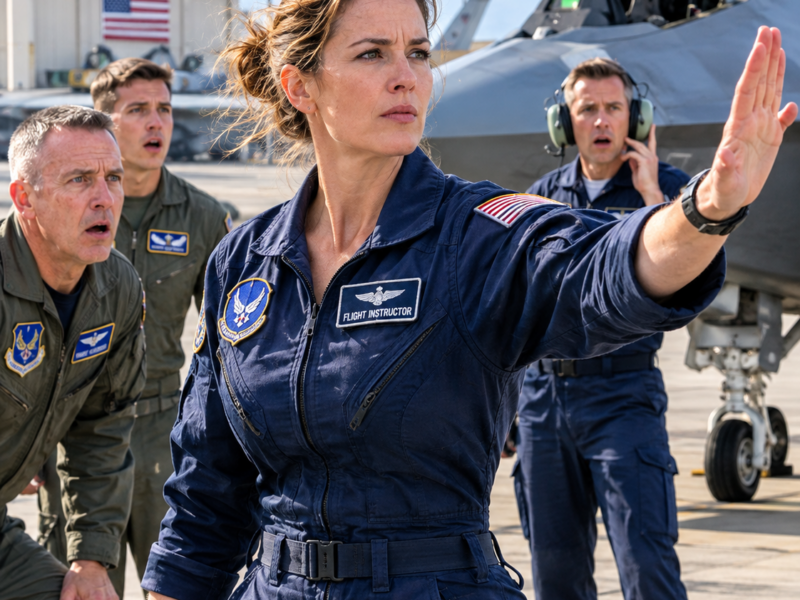
“The armed fighter jet was cleared to launch, but when the control tower ordered it to stand down, the pilot ignored every command
“Command authentication accepted.”
For three seconds, nobody in the operations room spoke.
I could hear the rain tapping against the reinforced windows and the faint hum of the computers.
On the radar, Viper 09 remained perfectly level, flying at an altitude of twenty-eight thousand feet.
The aircraft had stopped climbing, but its weapons system was still active.
“Commander Bennett,” the automated voice repeated. “Mission directive awaiting authorization.”
Colonel Walker slowly approached the console.
“Claire, don’t authorize anything.”
I kept my eyes on the screen.
“Then tell me why this aircraft recognizes my identity.”
He rubbed his forehead.
“Because the system was built using an old military authentication protocol.”
“That’s not an answer.”
“Claire—”
“Who activated it?”
The technician at the communications station interrupted us.
“Sir, we’re receiving an incoming encrypted transmission from Viper 09.”
“Put it through.”
The speakers crackled.
Then a man’s voice came through.
It was weak, distorted, and interrupted by static.
“Raven Actual… if you’re hearing this, they found the aircraft.”
My hand tightened around the headset.
I knew that voice.
I hadn’t heard it in twelve years, but I would have recognized it anywhere.
“Daniel?”
Ryan looked at me.
“Who is Daniel?”
I didn’t answer.
The voice returned.
“Claire, listen carefully. Do not let them authorize the original mission.”
The transmission ended.
A technician began typing furiously.
“Sir, the aircraft is transmitting coordinates.”
Colonel Walker leaned toward the screen.
“Where?”
The technician swallowed.
“Approximately forty miles northeast of the base. There’s an abandoned military testing facility in the area.”
I stared at the coordinates.
I knew that location, too.
It was the last place I had seen Daniel Mercer alive.
Twelve years earlier, Daniel had been my wingman, my closest friend, and the only person who knew what happened during Operation Nightfall.
The official report said he had died when his aircraft disappeared during a classified mission over the Pacific.
I had attended a memorial service.
His name was engraved on a wall at the military cemetery in Arlington.
But the voice I had just heard belonged to him.
Or someone who knew exactly how to imitate him.
“Colonel,” I said quietly, “I need access to the original mission archive.”
Walker shook his head.
“That archive is sealed.”
“Then unseal it.”
“I can’t.”
“You’re the commanding officer of this installation.”
“And you’re a civilian instructor who has no idea what she’s asking me to reopen.”
I turned toward him.
“Then perhaps you should explain why a dead man’s voice is coming through an armed aircraft.”
He looked away.
That was the moment I realized he knew more than he had admitted.
Twelve years earlier, I had been a major in the United States Air Force.
I was assigned to a special operations aviation unit tasked with testing an advanced flight-control system designed to allow aircraft to operate during communication failures.
The project was called Raven.
It wasn’t supposed to replace pilots.
It was supposed to keep them alive when conventional systems failed.
Daniel Mercer and I were among the first pilots selected to test it.
We spent months learning its unusual command structure.
The system recognized certain voice patterns, emergency authentication phrases, and decision protocols.
It could maintain flight, navigate hostile environments, and respond to threats when a pilot lost communication with ground control.
But there was one feature we never approved.
A hidden combat directive.
It had been developed without our knowledge and integrated into the system by a defense contractor.
During one of our final exercises, Daniel discovered that the directive could override a pilot’s normal command authority.
Worse, it could designate a friendly aircraft as hostile based on information entered into the system.
We reported it.
Three days later, Operation Nightfall began.
Daniel and I were sent to investigate an unexplained communications blackout at a remote testing facility.
Our orders were straightforward: inspect the system, retrieve the data, and return.
But when we arrived, the facility was already active.
We found evidence that someone had been running live weapons simulations without authorization.
Before we could transmit our findings, our communications went dead.
Daniel’s aircraft disappeared from radar.
I managed to return to base with a damaged engine and a partial recording of the facility’s activity.
The recording was classified.
My report was rejected.
And two weeks later, I was informed that Daniel had been killed in an accident.
I asked to see the flight data.
They refused.
I requested an investigation.
My commanding officer told me the matter was closed.
Then I received an offer to leave active service.
I could have fought the decision.
But I had spent weeks being questioned about my own judgment, and the people who had sent us into that operation were now the people controlling the investigation.
I signed the papers.
I left the military.
And I never spoke publicly about Nightfall again.
Now, twelve years later, the same system had awakened.
And it knew my name.
“Commander Bennett?”
Ryan’s voice brought me back to the room.
He was standing beside the console, no longer wearing the careless expression he had carried during our first weeks together.
“Is that really your aircraft?” he asked.
“No.”
“Then why did it identify you as its commander?”
“Because I helped design the emergency command structure.”
He stared at me.
“You designed it?”
“I helped test it.”
“Why didn’t you tell anyone?”
I looked toward the radar.
“Because I thought it was gone.”
Colonel Walker finally spoke.
“Everyone needs to leave this room except the weapons control team and communications.”
Ryan hesitated.
“Sir, I can assist with the flight simulation systems.”
“Lieutenant, that’s an order.”
Ryan looked at me.
I gave him a small nod.
He left without another word.
When the door closed, Walker lowered his voice.
“Claire, there’s something you need to understand.”
“Then start talking.”
“Viper 09 wasn’t supposed to be airborne today.”
“I gathered that.”
“It was transferred here six months ago under a restricted development agreement.”
“Who authorized it?”
He hesitated.
“Defense Systems Integration.”
I knew the name.
The company had been involved in the original Raven project.
“Why was it transferred?”
“Because they claimed the new software was ready for operational evaluation.”
“Did you know it contained the Nightfall directive?”
His silence was enough.
I stepped closer.
“James, did you know?”
He finally nodded.
“I was told the system had been sanitized.”
“By whom?”
“Dr. Evelyn Shaw.”
I felt my stomach tighten.
Evelyn Shaw had been the lead technical director of the original Raven program.
She was also the person who had signed the report declaring Daniel’s death an operational accident.
“Where is she?”
“On her way here.”
“When?”
“She’s already at the base.”
I turned toward the door.
“Take me to her.”
We found Evelyn in a secure conference room overlooking the hangars.
She was in her early sixties, with silver hair pulled neatly behind her head and a pair of reading glasses resting on the table.
She looked exactly as I remembered her.
Calm.
Controlled.
Impossible to read.
When she saw me, she slowly removed her glasses.
“Claire Bennett.”
“Dr. Shaw.”
“I heard about the aircraft.”
“Then you know it recognized me.”
“Yes.”
“Why?”
She gestured toward a chair.
“Please sit.”
“I’d rather stand.”
She studied my face.
“You’re still angry.”
“Daniel Mercer is apparently alive, and you’re asking me to sit down.”
Her expression changed.
Only slightly.
But I saw it.
“You heard the transmission?”
“I heard him say my name.”
Evelyn folded her hands.
“Claire, what you heard may not have been Daniel.”
“Then explain why the system used his voice.”
“The Raven architecture can reproduce stored voice signatures.”
“That wasn’t a recording.”
“You can’t know that.”
“He warned me not to authorize the mission.”
She looked toward Colonel Walker.
For the first time, she seemed genuinely concerned.
“What exactly did the aircraft say?”
I repeated the message.
Evelyn stood up.
“James, I need the communications logs.”
“Why?”
“Because if the system has initiated the original directive, we have a serious security problem.”
I stepped between them.
“Stop talking around me. What is Nightfall?”
Evelyn looked at me for a long moment.
Then she walked to the window.
“Nightfall was never an approved mission.”
I felt the room tilt slightly.
“What?”
“It was a classified test of autonomous combat coordination. The purpose was to determine whether multiple aircraft could identify and neutralize targets without direct human authorization.”
“That’s illegal under the rules we were operating under.”
“That’s why it was conducted under a restricted development program.”
“And Daniel found out.”
She didn’t answer.
“Dr. Shaw.”
“He discovered the directive had been activated during a live test.”
“Was he killed?”
Her eyes dropped.
“I don’t know.”
I stared at her.
“You signed his death report.”
“I signed the report I was given.”
“You told me he died in an aircraft accident.”
“Claire, I was instructed to classify the incident.”
“By whom?”
Before she could answer, an alarm sounded from the operations room.
Colonel Walker’s radio crackled.
“Command, Viper 09 has changed course.”
We hurried back.
The radar operator was already standing.
“Sir, the aircraft is descending toward the restricted testing zone.”
“Can we regain control?” Walker asked.
“Negative. It is rejecting all remote commands.”
I looked at the flight path.
The aircraft was heading directly toward the abandoned facility.
“How long until it reaches the coordinates?”
“Approximately nine minutes.”
Evelyn stared at the screen.
“That’s impossible.”
“What is?” I asked.
“The facility was decommissioned twelve years ago.”
I turned toward her.
“Apparently, nobody told the aircraft.”
The next few minutes passed in a blur of voices, alarms, and hurried decisions.
The weapons control team attempted another shutdown.
Nothing worked.
The base commander ordered the two interceptors to remain on standby.
Nobody wanted to shoot down an aircraft that might still contain a human pilot.
I stood at the communications console.
“Viper 09, this is Raven Actual. Respond.”
Static.
“Viper 09, confirm pilot status.”
A burst of interference followed.
Then Daniel’s voice returned.
“Claire?”
My throat tightened.
“I’m here.”
“Are you alone?”
I glanced at Walker and Evelyn.
“No.”
“Then listen carefully. They’re still running the program.”
“Who?”
“Shaw.”
I looked at Evelyn.
She had gone pale.
Daniel continued.
“They’re using the facility to test the original directive. Viper isn’t malfunctioning. It’s carrying the evidence.”
“What evidence?”
“Flight recordings. Authorization logs. Everything they erased.”
“Daniel, where are you?”
A long pause.
“Underground.”
The connection crackled.
“Claire, they told you I was dead because I refused to authorize the final test.”
My fingers went cold.
“What final test?”
Before he could answer, the transmission broke apart.
Then another message appeared on the monitor.
REMOTE MISSION AUTHORIZATION REQUIRED.
Beneath it was a countdown.
Five minutes.
Four minutes and fifty-nine seconds.
Evelyn stepped forward.
“Shut down the transmitter.”
“No,” I said.
“Claire, if that directive activates, the aircraft could release its weapons.”
“Then tell me how to stop it.”
She looked at the screen.
“There is a manual cancellation procedure.”
“Where?”
“At the testing facility.”
I turned toward Walker.
“How far?”
“Forty miles.”
“We need a ground team.”
Evelyn shook her head.
“That facility is not secure.”
“Neither is this aircraft.”
She lowered her voice.
“Claire, you don’t understand. The original system was designed so that only the field commander could terminate the directive.”
I looked at her.
“And who was the field commander?”
She didn’t answer.
I already knew.
The base commander initially refused to let me leave.
I was a civilian employee, not an active-duty pilot, and the facility was a restricted site.
But when I showed him the old authentication credentials stored in my training records, his expression changed.
Colonel Walker supported my request.
He also insisted that Ryan accompany the ground team as a communications specialist.
I objected.
“He’s a student.”
“He’s qualified to operate the equipment,” Walker replied.
“He’s never been inside that facility.”
“Neither have most of the people on this base.”
Ryan stepped forward.
“Ma’am, I’m going.”
I looked at him.
“Why?”
He swallowed.
“Because you were right about something I said during your first week.”
“What?”
“I thought experience was just time spent doing the same job. I was wrong.”
I studied him for a moment.
Then I nodded.
“Stay behind me, and don’t touch anything unless I tell you.”
We left in an armored utility vehicle with two security personnel.
The desert was darkening by the time we reached the testing facility.
Viper 09 was circling overhead.
Its navigation lights flashed against the low clouds.
The abandoned installation looked like a collection of concrete buildings buried in sand.
A rusted warning sign hung from the entrance gate.
Beyond it, a narrow road led toward a large underground hangar.
The security team checked the perimeter.
“Nobody’s supposed to be here,” one of them said.
I looked at the tire tracks in the dirt.
“Someone is.”
There were fresh tracks leading toward the main building.
Ryan crouched beside them.
“Two vehicles. Maybe three.”
We approached carefully.
The main entrance was locked, but the old emergency access panel was still installed beside the door.
I removed the cover.
The wiring looked untouched.
“Do you know how to open it?” Ryan asked.
“Yes.”
I entered the original emergency sequence.
For several seconds, nothing happened.
Then the lock clicked.
The door opened with a low mechanical groan.
Inside, the air smelled of dust, oil, and something electrical.
Our flashlights illuminated a corridor leading toward the underground hangar.
I recognized the layout immediately.
Twelve years earlier, Daniel and I had walked through that same corridor.
Only back then, the lights had been on.
We reached the central control room.
Most of the equipment had been removed.
But one monitor was still running.
A green indicator blinked on the screen.
RAVEN SYSTEM: ACTIVE.
Ryan leaned closer.
“Someone’s been maintaining this place.”
I examined the terminal.
There was a recent access record.
The last login had occurred less than twenty minutes earlier.
The username was E. SHAW.
I turned toward Ryan.
“Take a picture of that.”
He did.
Then I noticed something else.
A second access record.
The username was D. MERCER.
The timestamp was from that morning.
Ryan stared at it.
“That’s impossible.”
I didn’t respond.
I was already moving toward the lower-level access door.
It required a biometric scan.
I placed my hand on the reader.
A red light appeared.
IDENTITY NOT AUTHORIZED.
I tried my old military credentials.
Nothing.
Then Ryan pointed toward a small panel beside the reader.
“Ma’am, there’s a secondary port.”
I opened it.
Inside was a manual authentication connection.
I plugged in the portable diagnostic device.
The screen flickered.
A new message appeared.
COMMANDER BENNETT. FIELD AUTHORITY RECOGNIZED.
The lock disengaged.
The door slowly opened.
And somewhere below us, a machine started humming.
The underground hangar was larger than I remembered.
Rows of equipment stood beneath a high concrete ceiling.
Most of it was covered with protective sheets.
At the far end, a glass-walled observation room overlooked a maintenance bay.
There was a light on inside.
I raised my hand, signaling Ryan to stay behind me.
A figure stood near the console.
He was thin.
His hair was longer than I remembered, and one shoulder seemed slightly lower than the other.
But when he turned, I knew.
“Daniel.”
He stared at me.
For a moment, neither of us moved.
Then he took one step forward.
“Claire?”
I covered my mouth.
He looked older, thinner, and exhausted.
There was a scar along his jaw that hadn’t been there before.
But he was alive.
I walked toward him slowly, afraid that if I moved too quickly, the moment would disappear.
He reached for my hand.
“I thought you’d never come back.”
I couldn’t speak.
Ryan stood frozen in the doorway.
Daniel glanced at him.
“Who’s the kid?”
“Lieutenant Ryan Mitchell.”
“Good. We need someone who knows the current communications system.”
I finally found my voice.
“Daniel, they told me you died.”
His expression hardened.
“I know.”
“Why didn’t you contact me?”
“I tried.”
“When?”
“More times than I can count.”
He looked toward the console.
“They were monitoring every external communication. The first time I tried to send a message, they intercepted it. The second time, they threatened the people I was working with.”
“Who?”
“Technicians. Engineers. People who knew what Nightfall really was.”
I looked at the equipment around us.
“How long have you been here?”
“Not continuously. I was moved between facilities. This is the first time I’ve been able to access the original system without them watching every command.”
“Who brought Viper 09 back online?”
Daniel gave a tired laugh.
“That wasn’t me.”
He pointed toward the terminal.
“The system was activated remotely. I only managed to insert a warning into the communication stream.”
“By using your voice.”
“Partly. The aircraft has my original pilot profile.”
I stared at him.
“Then how did it recognize me?”
“Because you’re still the only field commander listed in the original authorization structure.”
I looked at the countdown display.
Three minutes.
“Daniel, what happens when it reaches zero?”
He walked to the terminal.
“The directive will attempt to identify and engage the designated target.”
“What’s the target?”
He hesitated.
Then he opened a file.
A satellite image appeared on the screen.
It showed the Redstone training base.
A red marker flashed over the main operations building.
My breath caught.
“That’s our base.”
“Yes.”
“Why would the system target Redstone?”
“Because someone entered the base’s weapons-control network as a hostile command source.”
Ryan stepped closer.
“That’s not possible. The base is secure.”
Daniel looked at him.
“Security systems don’t mean much when the person who designed the software has administrative access.”
I thought of Evelyn.
“She did this?”
“She helped build it. But she’s not the only one.”
Daniel opened another file.
A list of authorization signatures appeared.
Several belonged to contractors and former military officers.
One name stood out.
General Thomas Harlan.
I recognized him immediately.
He had been the senior commander overseeing Operation Nightfall.
The man who had personally told me Daniel was dead.
“He’s still involved?” I asked.
Daniel nodded.
“He’s the one who wants the system activated.”
“Why?”
“Because the original directive was never about protecting pilots. It was about proving that autonomous weapons could operate without human hesitation.”
He enlarged the file.
“The first test was supposed to be a demonstration. But the system misidentified friendly aircraft as hostile. Daniel and I were ordered to shut it down.”
He paused.
“That was the moment they decided we knew too much.”
I looked at him.
“What happened after your aircraft disappeared?”
Daniel took a breath.
“I survived the crash. I was injured, but I survived. They recovered me before the rescue team arrived.”
“Who?”
“People working for Harlan’s program. They moved me here and told the world I was dead.”
I felt anger rise in my chest.
“And you let them?”
“I didn’t have a choice at first. Then I found out they were using my pilot profile to keep the system operational.”
He looked down at his hands.
“Every time I tried to escape, they reminded me that if I disappeared, they’d activate the system and blame the failure on you.”
I stared at him.
“They used me as leverage.”
“Yes.”
The countdown reached two minutes.
Ryan moved toward the terminal.
“Can we cancel it?”
Daniel nodded.
“But not remotely.”
He pointed to a physical control panel near the maintenance bay.
“The original manual cancellation switch is down there.”
I looked at the door.
“Then let’s go.”
Daniel grabbed my arm.
“There’s something else.”
I turned.
“The cancellation switch requires two authorizations. Mine and yours.”
“Then we’ll do it together.”
He looked at me with an expression I couldn’t read.
“If we cancel the directive, the system will automatically transmit the complete mission archive to the military’s secure oversight network.”
“That’s what we want.”
“Not everyone on that network is clean.”
I understood.
“If Harlan has access, he can destroy the evidence.”
“Or alter it.”
I looked at the screen.
“What happens if we don’t cancel?”
“The aircraft may attack the base.”
“And if we do?”
“The archive becomes public to every authorized oversight office, including the people who have been protecting this program.”
I considered the choices.
We could stop the immediate threat and risk losing the evidence.
Or we could let the directive continue long enough to expose the people behind it.
There was no guarantee we would get another chance.
Daniel looked at me.
“Claire, I can’t make that decision for you.”
I remembered the last time I had been asked to trust the people in charge.
I remembered signing my resignation papers.
I remembered standing at Daniel’s memorial, listening to a chaplain speak about a man who wasn’t dead.
I had spent twelve years believing that staying silent was the only way to keep anyone else safe.
I wasn’t going to make that mistake again.
“Ryan,” I said, “can you isolate the transmission to the independent military oversight channel?”
He examined the terminal.
“Possibly. But I’ll need a few minutes.”
“We don’t have a few minutes.”
“I can try.”
Daniel nodded toward the lower panel.
“Then we need to start the cancellation process.”
We ran toward the maintenance bay.
The manual control station stood beneath a red emergency light.
Two biometric readers were mounted beside the switch.
Daniel placed his hand on the first.
The indicator turned green.
I placed mine on the second.
A warning appeared.
DUAL COMMAND AUTHORIZATION REQUIRED.
I looked at Daniel.
“Ready?”
He nodded.
We pressed the authorization controls together.
The system responded with a low mechanical tone.
Then the screen displayed a new message.
CANCELLATION WILL INITIATE ARCHIVE TRANSMISSION.
“Proceed,” I said.
Daniel pressed the final confirmation.
The countdown stopped.
For one brief second, everything went quiet.
Then the facility lights flashed.
The screen turned red.
REMOTE OVERRIDE DETECTED.
Daniel’s face changed.
“They’re trying to take control back.”
Ryan shouted from the observation room.
“Ma’am! Someone just accessed the system remotely!”
The terminal displayed a new authorization request.
GENERAL THOMAS HARLAN.
Daniel grabbed my arm.
“Claire, don’t accept it.”
“I wasn’t going to.”
The system began rejecting our cancellation commands.
The countdown restarted.
One minute and thirty seconds.
Ryan rushed toward us.
“I found a way to isolate the external connection, but I need physical access to the main network cabinet.”
“Where?”
“Behind the observation room.”
Daniel pointed toward a narrow service corridor.
“Go. There’s a manual breaker at the end.”
Ryan ran.
I turned back to Daniel.
“Can you hold the cancellation?”
“Not for long.”
I looked at the display.
The system was attempting to reconnect with Viper 09.
If it succeeded, the aircraft would regain control.
“Daniel, what does Raven recognize as its highest authority?”
He looked at me.
“Field command.”
“Not General Harlan?”
“No. The original system was designed to prioritize the field commander during emergencies.”
“Then why is it accepting his override?”
“Because he has the administrative credentials.”
I studied the authorization screen.
The system was asking for a command confirmation.
A small line of text appeared beneath the request.
FIELD COMMANDER MAY REVOKE ADMINISTRATIVE AUTHORITY.
I leaned toward the console.
“Daniel, give me the old command sequence.”
He stared at me.
“Claire, that procedure was never tested.”
“Neither was the directive we’re trying to stop.”
He told me the sequence.
I entered the first command.
The system rejected it.
I tried again, changing the authentication order.
A warning flashed.
SECONDARY AUTHORIZATION REQUIRED.
Daniel placed his hand on the reader.
The screen changed.
FIELD COMMAND AUTHORITY RESTORED.
For a moment, the countdown froze.
Then the system accepted our cancellation.
At the same time, Ryan pulled the manual breaker.
The lights went dark.
The aircraft transmission disappeared.
And the entire facility fell silent.
We stood in the darkness, listening to the sound of our own breathing.
Then the emergency lights came on.
Ryan returned from the corridor, holding a flashlight.
“Network connection is isolated.”
Daniel looked at the monitor.
“Is the archive transmitting?”
Ryan checked the diagnostic screen.
“Yes. But it’s going through the independent oversight channel.”
I exhaled slowly.
“How much?”
“All of it.”
For the first time that night, Daniel smiled.
It was a small, tired smile.
But it was real.
Then my radio crackled.
“Ground team, this is Redstone Tower. Viper 09 has lost weapons authorization and is returning to base under manual control.”
The aircraft had been stopped.
The immediate danger was over.
But we still had to face the people who had created it.
When we returned to Redstone, Colonel Walker was waiting near the hangar.
Behind him stood several security officers.
Evelyn Shaw was there, too.
She looked at Daniel.
For a moment, she seemed unable to speak.
“Daniel.”
He walked past her.
“Don’t.”
She lowered her eyes.
“I didn’t know they were keeping you here.”
“You signed the report.”
“I was told you had died.”
“You knew the report was false.”
She didn’t deny it.
I stepped forward.
“Why?”
Evelyn looked at me.
“Because I was afraid.”
“Of Harlan?”
“Of what would happen if the program was exposed.”
“People were nearly killed tonight.”
“I know.”
“Daniel lost twelve years of his life.”
Her eyes filled.
“I know.”
For a moment, I wanted to hear an explanation that would make those twelve years easier to understand.
But no explanation could give them back.
Colonel Walker approached.
“Claire, the oversight network has confirmed receipt of the archive. Federal investigators are being notified.”
“Good.”
He looked at Daniel.
“We’ll arrange medical evaluation and protection.”
Daniel nodded.
Then Walker turned to me.
“There’s something else.”
He held out a tablet.
A secure message had arrived from military headquarters.
The subject line read:
OPERATION NIGHTFALL — FORMAL REVIEW INITIATED.
Beneath it was a request for my testimony.
I looked at Daniel.
He gave a quiet nod.
“Tell them everything.”
I thought about the years I’d spent trying to forget.
Then I accepted the request.
The investigation lasted almost eight months.
The mission archive revealed that Nightfall had been operated outside its approved testing parameters.
General Harlan had authorized live weapons trials without the required oversight.
The system’s targeting failures had been concealed.
And Daniel’s disappearance had been deliberately misrepresented to protect the program.
Several officers and contractors were removed from their positions.
Harlan was placed under federal investigation, and the original Raven combat directive was permanently suspended pending independent review.
Evelyn cooperated with investigators.
She admitted signing documents she knew were misleading and provided the names of people who had helped conceal Daniel’s survival.
She didn’t ask me to forgive her.
I didn’t offer forgiveness.
Some things require more than an apology.
Daniel spent months recovering.
His injuries were worse than he had admitted, and years of confinement had left him struggling with ordinary things most people never think about.
Crowded rooms.
Unexpected footsteps.
The sound of a locked door.
I visited him regularly.
Sometimes we talked about the investigation.
Sometimes we talked about the old days.
Sometimes we sat in silence.
One afternoon, he asked me why I had accepted the instructor position at Redstone.
I looked out the hospital window.
“I wanted to teach pilots how to survive the things nobody tells them about.”
He smiled.
“You always were better at that than following orders.”
I laughed.
For the first time in years, the sound didn’t feel unfamiliar.
A year later, I returned to Redstone.
My job title had changed.
I was no longer just an instructor.
The Air Force had invited me to help establish a new emergency aviation safety program, one that required human authorization at every critical stage.
The new pilots were different with me now.
Not because they knew every detail of my past.
Most didn’t.
They respected me because I taught them to question systems, verify orders, and never confuse authority with truth.
Ryan Mitchell eventually graduated at the top of his class.
On the day he received his assignment, he came to my office carrying a folder.
“Ma’am, I wanted to thank you.”
“For what?”
“For not letting me remain the arrogant idiot I was when you arrived.”
I smiled.
“You did most of that yourself.”
He laughed.
Then he hesitated.
“Can I ask you something?”
“Of course.”
“When that aircraft recognized you, weren’t you afraid?”
I considered the question.
“Terrified.”
“You didn’t look terrified.”
“That’s because being afraid and being unable to act are two different things.”
He nodded slowly.
I handed him his assignment folder.
“One more thing, Lieutenant.”
“Yes, ma’am?”
“If a system ever tells you that it knows better than the people it’s supposed to protect, question it.”
He smiled.
“Understood.”
After he left, I walked toward the flight line.
Viper 09 was no longer there.
The aircraft had been dismantled under federal supervision, and its remaining components were stored for the investigation.
The sky above Nevada was clear.
A training jet passed overhead, its engines leaving a low rumble across the desert.
I watched until it disappeared beyond the mountains.
Daniel was standing beside the hangar when I turned around.
He had come to visit that morning.
He looked healthier than he had a year earlier.
Still quieter than before, but more like himself.
“Ready?” he asked.
I nodded.
We walked toward the parking lot together.
For twelve years, I had believed my military career ended when I walked away from the truth.
I had thought leaving was the only way to survive what happened.
But that day, watching a new generation of pilots prepare for their first flights, I understood something I hadn’t understood before.
My greatest contribution had never been the missions I flew or the aircraft I commanded.
It was the people I could teach to ask the right questions before someone else paid the price for their silence.
Daniel opened the passenger door.
I paused and looked once more toward the runway.
There had been a time when the entire airbase believed I was nobody special.
I hadn’t needed them to know I was a war hero.
I had only needed one moment when my experience could keep someone else alive.
And when that moment came, even an armed jet remembered my voice.
THE END.









