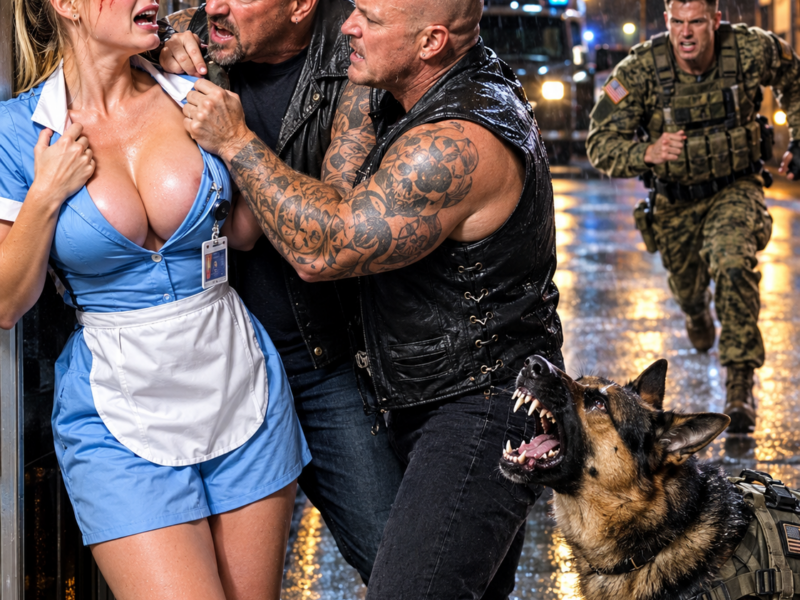
“‘Take it off, BITCH,’ the biggest man snarled as he and his two friends cornered me beside a deserted boardwalk in Virginia Beach
The first siren cut through the night just as Mason turned his phone toward me.
For a moment, I couldn’t understand what I was looking at. The photograph showed me leaving the emergency clinic less than an hour earlier, my hair pulled into a loose bun, my navy windbreaker draped over one arm. Whoever had taken it had been standing across the street, close enough to capture the small silver pendant at my throat.
The message beneath it was even worse.
SHE HAS THE PENDANT. DON’T LET HER LEAVE.
My fingers closed around the necklace.
“Who sent that?” I whispered.
“Unknown number.” Mason’s expression had changed completely. The quiet man who’d stepped out of the shadows with a German Shepherd at his side now looked like someone recognizing a threat he’d spent years hoping never to see again. “I need you to stay beside me.”
“Why? What does my brother’s necklace have to do with you?”
He looked down at the pendant, then toward the three men who had cornered me.
The man in the red cap was no longer laughing. The thin man with the neck tattoo had backed away from my arm, and Tyler, the youngest of the three, stared at Mason as if he’d just realized they’d walked into something far beyond their control.
“Tell the truth,” Mason said to them. “Who hired you?”
Red Cap tried to recover his swagger. “Nobody hired us. We were having a little fun.”
“You were threatening a woman and trying to take her necklace.”
“It’s not like that.”
The German Shepherd gave a low, controlled growl.
Red Cap shut his mouth.
Police lights swept across the empty boardwalk. Two officers approached with their hands near their belts, calling for everyone to keep their hands visible. Mason immediately stepped back, placed his phone where they could see it, and gave his name. His dog remained close to his left leg, alert but obedient.
I had spent years working in an emergency clinic, dealing with frightened patients, intoxicated men, and people who mistook desperation for permission to hurt someone. I knew how to keep my voice steady when everything around me went wrong.
But when an officer asked whether I was injured, my knees nearly gave out.
“I don’t think so,” I said.
Mason glanced at me. “Your wrist.”
Only then did I notice the red marks where the thin man had grabbed me.
One officer separated the men while the other took my statement. I told them exactly what had happened, including the demand to remove my jacket, the threats, and the attempt to pull my necklace away. Mason showed them the message and the photograph. The officers photographed my wrist and asked whether I wanted medical attention.
“I work at an emergency clinic,” I said. “I’ll know if it gets worse.”
“That’s not the same as being checked,” Mason replied quietly.
I almost snapped at him. I was tired, shaken, and suddenly surrounded by strangers who seemed to know more about my life than I did. But something in his voice stopped me. He wasn’t ordering me around. He sounded worried.
The officers questioned the three men separately. Red Cap insisted the confrontation had been a misunderstanding. The man with the neck tattoo claimed we’d all been drinking, which was ridiculous; I hadn’t touched alcohol that night. Tyler said nothing for several minutes, watching the others with growing unease.
Then one of the officers returned.
“Ms. Brooks, we’d like you to come to the station to make a more complete statement. You’re not under arrest, and you can arrange your own transportation. Given the message you received, we recommend you don’t walk home alone.”
“I’ll take her,” Mason said.
I looked at him sharply.
“Only if you want me to,” he added.
The officer studied him. “You know her?”
“Not personally.”
“Then let’s not make assumptions. Ms. Brooks, it’s your choice.”
I looked at the photograph again. The person who had taken it knew where I worked and what I wore. Someone had been watching me before those men appeared. Walking away alone suddenly seemed less like independence and more like giving that person exactly what they wanted.
“I’ll go with Mason,” I said. “But I want answers.”
“You deserve them,” he replied.
His German Shepherd moved closer as we headed toward the patrol car. Up close, I could see a small scar near the dog’s right ear and a worn working harness beneath his dark coat. He was older than I’d first thought, though his eyes were bright and focused.
“What is his name?” I asked.
“Ranger.”
“Does he always look at people like he’s reading their minds?”
Mason almost smiled. “Only the ones who act suspicious.”
Despite everything, a short laugh escaped me. It vanished quickly, but I was grateful for it.
At the station, I gave a longer statement and answered questions about the pendant. I explained that my brother, Daniel, had given it to me shortly before he deployed overseas. It was a small silver compass, worn smooth along the edges. The needle inside no longer moved, and the back bore two initials: D.B.
Daniel had been twenty-nine when he died. At least, that was what the military notification had said. Six years earlier, two uniformed officers had appeared at my parents’ front door and told us he’d been killed during a classified support operation. The details were limited. We were told there had been no remains available for immediate return, and that the circumstances were still being reviewed.
My mother had collapsed. My father had gone silent. I had stood there staring at the officers, waiting for one of them to tell us there had been a mistake.
No one did.
For months, I wrote letters to the address provided by the casualty assistance office, asking for clarification. Eventually, the replies stopped saying anything beyond what we’d already been told. Daniel had served honorably. His death had been confirmed. Further information was restricted.
The pendant was the only personal item of his that had come back to us.
I wore it because taking it off felt like losing him a second time.
When I finished, the officer asked Mason to provide his own statement. He did, but he left out the parts he clearly didn’t want to discuss in front of me. I noticed because he looked at me every time the questions turned toward Daniel.
Eventually, the officer stepped away to consult a supervisor.
I turned to Mason.
“Now tell me.”
He sat opposite me in a small interview room. Ranger lay beside his chair, his head resting on his paws, though his ears moved whenever someone passed in the hallway.
Mason rubbed his thumb across the edge of his phone.
“I served in the Navy for twelve years,” he said. “Most of that time was in maritime security and special operations support. I left active duty three years ago.”
“That doesn’t explain how you recognized the pendant.”
“No.”
“Or why you looked like you’d seen a ghost when I said Daniel’s name.”
He took a slow breath.
“Your brother was part of a joint team assigned to protect sensitive personnel and equipment during an overseas operation. I wasn’t in his unit, but our teams crossed paths. Daniel helped me when he had no reason to.”
“What kind of help?”
Mason stared at the floor.
“My team was moving through a temporary operations site when an explosion hit nearby. The official report later claimed we’d been nowhere near the affected area. That wasn’t true. Daniel pulled one of my men out of a damaged vehicle and stayed with him until evacuation arrived. He was injured himself.”
My mouth went dry.
“He was injured?”
“Yes.”
“But he died.”
Mason’s silence lasted a second too long.
“That’s what the report said,” he answered.
I pushed my chair back. “You’re telling me you knew my brother was hurt, and you let my family believe he died without even trying to tell us?”
“I didn’t know what happened to him after that night.”
“You expect me to believe that?”
“No. Not yet.”
His honesty was somehow worse than an excuse.
I stood and paced to the wall, pressing my palms against my eyes. The room smelled of disinfectant and stale coffee. Somewhere outside, a phone rang repeatedly before someone answered it.
“My mother still sets a place for him at Thanksgiving,” I said. “My father keeps his old boots in the garage because he can’t make himself throw them away. I spent six years telling them we had to accept what happened.”
My voice broke.
“And now you tell me the report might have been a lie?”
Mason didn’t move toward me. He let me have the space.
“I don’t know the whole truth,” he said. “But I know someone has been looking for that pendant. And I know Daniel made me promise that if anything happened to him, I would find his sister.”
I turned around.
“What?”
“He gave me your name. He told me you worked in medicine, that you were stubborn, and that you wouldn’t let anybody make decisions for you.”
I almost laughed again, but the sound came out painfully.
“That sounds like him.”
“He said the pendant wasn’t just sentimental. He told me never to discuss it over an unsecured phone, and never to approach you unless I was certain you were safe.”
I touched the compass through my shirt.
“What is it, then? A key? A tracking device? Some kind of military code?”
“I don’t know what’s inside it. Daniel said it contained something that could prove what happened during that operation. He didn’t explain more.”
“Why didn’t you come find me six years ago?”
“Because I was told Daniel had been killed, too. The people who handled the operation insisted there was nothing left to recover. I questioned it, but my own team was reassigned, and the inquiry was closed before I could get answers. Then, a year ago, I received a message from an encrypted account. It contained a phrase only Daniel would have known.”
“What phrase?”
Mason looked straight at me.
“Keep the compass pointed home.”
I stopped breathing for a moment.
Daniel had said those words to me when he gave me the pendant. I had teased him that a broken compass wasn’t much use to anyone. He’d closed my fingers around it and told me that direction wasn’t always about the needle.
“Keep the compass pointed home,” I repeated.
Mason nodded.
“The message said Daniel might still be alive. It gave me a place to look, but when I arrived, the location had been cleared. I spent months trying to trace the account. Last week, I received another message telling me to watch the emergency clinic in Norfolk. It said someone would come looking for the compass.”
“And you just happened to be on the boardwalk tonight?”
“I’d been watching the area near your clinic. I saw you leave and followed at a distance because I thought you might be in danger. I didn’t expect those men to corner you.”
“Why didn’t you tell me any of this before tonight?”
“Because I had no proof that the messages were real, and I didn’t want to put you in danger by approaching you. I was waiting for a safer way to make contact.”
I stared at him. “So you watched me for days without telling me?”
“Yes.”
“Do you understand how frightening that sounds?”
“I do.”
“Then why should I trust you?”
“You shouldn’t trust me just because I wear an old uniform or because I knew your brother.” His voice stayed calm. “Trust what we can prove. If you want me to leave, I will. But whoever sent that photograph already knows where you work. Until we find out why, I’d rather you didn’t face this alone.”
I hated how reasonable that sounded.
Before I could answer, the officer returned with a woman in plain clothes. She introduced herself as Detective Elena Ruiz, assigned to the department’s robbery and organized-crime unit. She had reviewed the message and the photograph.
“We’ve had reports of similar incidents near the waterfront,” she said. “Women approached by men who use threats or intimidation to obtain personal items. So far, the victims have reported jewelry, phones, and wallets. We initially treated them as separate crimes. Your photograph suggests someone may have been selecting victims in advance.”
“Why would anyone want my pendant?” I asked.
“That is what we need to establish. The men involved tonight may know more than they’re admitting.”
Detective Ruiz said Tyler had asked to speak with an officer without the other two present. He’d claimed the plan wasn’t supposed to involve violence. Someone had paid them to scare me, take the necklace, and leave it in a specific location.
“Who paid them?” I asked.
“He says he never met the person directly. He was contacted through an intermediary and promised five thousand dollars for the pendant. He also says the other two were told the necklace was worth far more than that.”
My stomach twisted.
“Did he give you a name?”
“Not yet. But he gave us a vehicle description and a partial license plate.”
Detective Ruiz turned to Mason.
“And you, Mr. Cole, need to tell me about these messages and why you were following Ms. Brooks.”
Mason agreed. He handed over his phone and explained the earlier contact from the encrypted account. The detective asked him not to delete anything and told us the department would coordinate with federal investigators if the evidence pointed to a larger operation.
Then she looked at me.
“Ms. Brooks, for your safety, I recommend staying somewhere other than your home tonight. If someone knows your work schedule and has been photographing you, we need to assume your usual routine is compromised.”
“I have a friend I can call.”
“Good. Don’t tell anyone outside your trusted circle where you’ll be staying.”
Mason offered to drive me to my friend’s apartment, but before I could decide, his phone buzzed again. The detective, standing beside him, saw the message arrive.
It was a single line.
THE GIRL HAS NO IDEA WHAT HER BROTHER STOLE.
Beneath it was a photograph of a man sitting in a dim room. His hair was longer than I remembered, his face thinner, and a pale scar crossed his left cheek.
But I knew his eyes.
My knees weakened. I grabbed the edge of the table.
“Daniel.”
The room seemed to tilt around me.
I had dreamed of that face so often that I had learned to fear hope. In the dreams, Daniel would walk through the front door carrying his battered duffel bag, grin at my shocked expression, and complain that our mother had probably cooked enough food for a platoon.
Every time I woke up, the house was silent.
This photograph was different. It was too specific, too recent. The man wore a dark shirt and looked directly into the camera. A date and time appeared in the corner, just three days earlier.
I reached for the phone, but Mason stopped me gently.
“Let Detective Ruiz document it first.”
“That’s my brother!”
“I know.”
“You don’t get to tell me to wait!”
“I know,” he repeated, and this time I heard the pain in his voice. “I would be doing the same thing.”
Detective Ruiz photographed the screen and asked her team to preserve the message metadata. She sent the image to a secure contact and requested an urgent verification.
I could barely stand still.
“Where is he?” I asked Mason.
“I don’t know.”
“Then find out.”
“We will.”
“No.” I wiped my face with the heel of my hand. “You don’t understand. I have spent six years trying to stop imagining that he might still be alive. I cannot go back to waiting for someone else to decide what I deserve to know.”
I looked at Detective Ruiz.
“I want to help.”
She studied me carefully before nodding.
“You can help by giving us everything you remember about Daniel, the pendant, and anyone who might have known what he was doing before his deployment. But you must let us handle the dangerous part.”
“I work with injured people every day. I’m not going to run toward gunfire, but I’m not sitting in a room while strangers decide my brother’s future.”
“That isn’t what I’m asking you to do,” she said. “I’m asking you to stay alive long enough to learn the truth.”
The words struck harder than I expected.
After the police finished processing the scene, Mason drove me to a secure guest apartment used by a veterans’ support organization. Detective Ruiz arranged for an officer to check the building and promised to contact us as soon as she received confirmation about the photograph.
I didn’t sleep.
I sat on the edge of the bed with Daniel’s pendant in my palm, turning it over beneath the bedside lamp. The silver compass was scratched, the hinge stiff from years of wear. I’d examined it dozens of times since his death, searching for some hidden message or clue. I’d always found nothing.
At two in the morning, Mason knocked on the open door.
“Can I come in?”
I nodded.
He remained near the doorway, giving me room.
“I know you’re angry,” he said.
“I’m beyond angry.”
“Fair.”
“Did you know Daniel well?”
“Not as well as I wish I had. We worked together during a difficult stretch. He was the sort of man who noticed when someone was struggling and helped without making a show of it.”
“That sounds like him.”
“He once stayed awake for thirty hours because a young sailor was having panic attacks and refused to be alone. Daniel sat beside him, talking about baseball and bad coffee until the kid finally slept.”
I smiled through my tears. “He did that with me when our parents were fighting. He’d sit on the floor outside my room and tell me stories until I stopped crying.”
Mason nodded as though that explained something important.
“Daniel wasn’t careless,” he said. “He was brave, but he understood the cost. If he hid evidence in that pendant, he had a reason.”
“Then we need to open it.”
“Not until Ruiz has it examined. If there’s something inside, we don’t want to destroy it or trigger anything we don’t understand.”
I gave him a skeptical look.
“It’s a six-year-old necklace, not a bomb.”
“Probably. But we don’t know who made it, or whether it’s been altered.”
I wanted to argue, but he was right.
In the morning, Detective Ruiz arrived with a federal investigator named Sarah Kim, who specialized in fraud and classified contracting cases. They brought a small evidence kit and asked permission to examine the pendant under controlled conditions.
I handed it over reluctantly.
Agent Kim inspected the casing beneath a magnifying lamp, then used a fine tool to press a nearly invisible indentation beside the compass hinge. A thin panel shifted.
Inside was a tiny sealed memory card wrapped in a strip of protective film.
I stared at it.
“How could I have missed that?”
“It’s designed to be missed,” Agent Kim said. “The casing has been modified carefully. Whoever did this knew what they were doing.”
She photographed the compartment and placed the card in an evidence sleeve.
“Can you read it?” I asked.
“Not until we create a forensic copy. We’ll preserve the original and examine the contents in a secure environment.”
“How long?”
“I can’t promise a time frame.”
I closed my eyes. The same phrase I’d heard for six years—wait, be patient, we need more time—had become almost unbearable.
Agent Kim softened her tone.
“I understand what this means to you. But if this contains what we suspect, handling it properly may be the difference between evidence that stands up in court and information someone can dismiss.”
I nodded because there was nothing else to do.
Later that afternoon, Detective Ruiz received a call. Tyler had agreed to cooperate fully. He’d identified the intermediary who recruited him as a man named Grant Voss, a former private security contractor with connections to several defense logistics companies. Voss had offered the men money and provided a description of my necklace. He’d told them I was carrying property that belonged to him.
“He said the pendant had been stolen from a government operation,” Ruiz explained. “He also told them you were dangerous, which makes no sense given what happened.”
“Unless he wanted them to panic and use force,” I said.
“Exactly.”
Agent Kim recognized Voss’s name. He had been investigated years earlier for falsifying invoices and diverting equipment through subcontractors. The case had fallen apart when a key witness withdrew his statement and records disappeared.
“Daniel was assigned to a logistics support operation,” she said. “We now believe he discovered a discrepancy between the equipment recorded as delivered and what actually reached the field. The missing inventory included communications equipment, protective gear, and medical supplies.”
My work as a nurse made the last category feel personal. I had seen the consequences of shortages: empty cabinets, delayed treatment, exhausted staff trying to make one box of supplies serve three patients.
“People could have died because someone stole medical equipment,” I said.
“Yes,” Agent Kim replied. “And Daniel appears to have collected evidence linking the missing supplies to a group of contractors, including Voss.”
“What happened to him?”
“That is the question we’re trying to answer.”
By early evening, the forensic team had produced a verified copy of the memory card. It contained encrypted files, scanned invoices, shipment logs, and a series of short video recordings. Agent Kim said the files appeared to document a deliberate scheme to divert supplies and falsify delivery records. Several signatures matched officers and contractors who had denied involvement in the original inquiry.
But the most important file was a video.
Daniel appeared on the screen, seated in what looked like a bare room. His face was bruised, his left arm supported in a sling. He looked exhausted, but when he began to speak, his voice was unmistakably his.
“If you’re watching this, I couldn’t get the evidence where it needed to go,” he said. “The reports have been altered. The operation log doesn’t match the actual movement of personnel or supplies. Voss knows I’ve copied the records. Someone inside the command structure is helping him cover it up.”
I covered my mouth.
Daniel paused, glancing toward a door outside the frame.
“I don’t know who I can trust. If I can’t get home, make sure Hannah knows none of this was her fault. She’ll think she should have seen something, asked something, done something. She couldn’t have. I made sure she stayed out of it.”
My tears fell before I could stop them.
He looked back at the camera.
“Hannah, if this reaches you, I’m sorry. I wanted to come home. I still want to come home. Keep the compass pointed home. That’s all you need to remember.”
The video ended.
For several seconds, no one spoke.
Then I leaned forward and pressed my hands to my face. I had heard his voice so many times in my memory that I could almost predict every pause. But this was not memory. This was Daniel, alive after the date we had been told he died, looking at a camera and trying to reach me.
Mason stood beside my chair, close enough that I could hold on to his sleeve. He didn’t tell me to be strong. He didn’t say everything would be fine.
He simply stayed.
Agent Kim explained that the video and records gave investigators grounds to reopen the original case. They were working to identify the location where it had been recorded and trace the most recent photograph. The image’s metadata was limited, but an independent analysis of its background revealed a distinctive industrial window and part of a sign.
A former storage facility outside Portsmouth matched the features.
Federal agents prepared a coordinated operation, with local police assisting. I was told to remain in the secure apartment.
I refused to accept that without a fight.
“I won’t interfere with the operation,” I said. “But if you find him, I want to know immediately.”
Detective Ruiz looked at me for a long moment.
“If we locate him, you will be the first person we contact. I promise.”
Mason remained with me while the hours crawled past. Ranger lay near my feet, occasionally lifting his head when my phone vibrated. I called my parents and told them I had received information that might change everything, but I did not share the photograph yet. I couldn’t bear to give them hope before we had confirmation.
My mother cried anyway when I said Daniel’s name.
“Are you sure you’re safe?” she asked.
“I am right now.”
“Your father is listening. He wants to know if he should come get you.”
“Not yet, Mom. Please. I’ll explain as soon as I can.”
After I hung up, Mason poured two cups of coffee from the apartment’s small kitchen. I took mine without drinking it.
“What if it’s not him?” I asked.
“Then we’ll know more than we knew yesterday.”
“And if it is?”
Mason looked down at his hands.
“Then we’ll find out what happened and bring him home if we can.”
I wanted to believe him. I wanted to believe the photograph, the video, the evidence, all of it. But six years of grief had taught me that hope could be as painful as loss.
At 11:42 p.m., Detective Ruiz called.
“We have a location,” she said. “The team found evidence that someone was recently staying there. There’s a second building on the property, and we’re checking it now.”
“Did you find Daniel?”
“We found a man matching his description. He’s alive. He’s receiving medical attention, and we’re confirming his identity.”
My cup slipped from my hand and struck the table, spilling coffee across the wood.
“Can I see him?”
“Not yet. He’s being assessed, and we need to secure the scene. I’ll call again as soon as it’s safe.”
The call ended.
I stood in the middle of the room, unable to move.
Mason rose slowly.
“They found him,” I whispered.
He nodded, his eyes bright with emotion.
“They found him.”
I began to cry so hard that my legs gave way. Mason caught me before I hit the floor, and Ranger pressed his warm body against my side. For the first time in six years, the tears were not only for a man I had lost. They were for someone who might still be waiting to come home.
The next call came forty minutes later.
Daniel had been taken to a hospital under federal protection. He was dehydrated, malnourished, and suffering from injuries that required treatment, but he was conscious. Investigators believed he had been held under a false identity after the operation and moved between locations to prevent him from contacting anyone who could expose the scheme.
Voss had not acted alone. Evidence from the storage facility connected him to a former logistics officer who had helped alter the original operation records. Both men were taken into custody. The three men from the boardwalk were also facing charges related to the attempted robbery and assault, while Tyler’s cooperation would be considered as the case proceeded.
None of that mattered as much to me as the words the detective said next.
“Daniel has asked for you.”
The drive to the hospital felt endless. Mason sat beside me in the back seat of a police vehicle, Ranger traveling with another officer who was certified to handle him in public settings. I stared out the window at the dark roads and storefronts, watching the city pass in streaks of light.
At the hospital entrance, Agent Kim met us and led me through a secured corridor. She explained that Daniel was weak and might be confused from medication, and that I should let the medical team guide the visit.
I nodded, though I barely heard her.
Then she opened a door.
Daniel lay in a hospital bed beneath a white blanket. His hair was longer than I’d ever seen it, and the scar on his cheek looked deeper in person. An IV ran into his arm. His face was thinner, his shoulders narrow beneath the gown.
But his eyes were the same.
He turned his head when I entered.
For a moment, neither of us spoke.
Then he whispered, “Hannah?”
I crossed the room so quickly that a nurse had to step aside.
“Daniel.”
I reached for his hand, afraid to touch him too hard, afraid he might disappear if I moved too quickly. His fingers closed around mine.
“You’re real,” I sobbed. “You’re really here.”
He tried to smile. “You look exactly the same.”
“That’s a terrible thing to say to someone who hasn’t slept in two days.”
A faint laugh escaped him, followed by a wince.
“Sorry.”
I pressed his hand against my cheek.
“They told us you were dead.”
His eyes filled with tears.
“I know.”
“Mom still sets a place for you at Thanksgiving.”
He shut his eyes.
“Dad kept my boots?”
I nodded, unable to speak.
Daniel swallowed hard. “I wanted to call. I tried. They told me if I contacted any of you, they’d make sure you were hurt. At first, I thought I could get away and come home before they knew. Then they moved me, and I couldn’t risk it.”
“You should have found a way.”
“I know.”
“I was angry with you for leaving us.”
“I know.”
“I was angry with myself for believing the report.”
His grip tightened around my hand.
“None of this was your fault, Hannah. Not one part of it.”
I lowered my forehead to his knuckles and cried. He cried, too, though he was too weak to lift his other hand. We stayed that way until a nurse gently reminded us that he needed rest.
Before I stepped away, Daniel looked past me toward the door.
“Did Mason come?”
“He’s outside.”
“Tell him I still owe him a drink.”
I stared at my brother.
“You’ve been missing for six years, and you’re already making plans to buy people drinks?”
Daniel managed a small grin.
“It’s a very long story.”
I laughed through my tears. It was the first laugh that had felt whole in years.
Mason entered a few minutes later. Daniel’s expression changed when he saw him, gratitude and pain passing across his face.
“You kept your promise,” Daniel whispered.
Mason pulled a chair beside the bed.
“I took longer than I wanted.”
“You came.”
They clasped hands. Neither said much after that. They didn’t need to.
Over the following weeks, Daniel’s recovery was slow. The doctors treated his injuries and worked with specialists to address the effects of prolonged confinement and malnutrition. Some days he was strong enough to sit up and tell stories; other days, even a short conversation exhausted him.
My parents arrived as soon as investigators cleared them to travel. My mother held Daniel for so long that a nurse finally had to remind her to let him breathe. My father stood at the foot of the bed, his face rigid, until Daniel reached for him.
Then my father broke.
He bent over his son and wept with his forehead pressed against the blanket, apologizing for every year he had believed he had failed to bring him home. Daniel kept telling him there was nothing to forgive.
The investigation unfolded over months. The evidence recovered from the pendant helped establish a chain of falsified shipments, altered reports, and payments routed through shell companies. The inquiry also revealed that the original death notification had been based on deliberately misleading information. Officials involved in the cover-up faced criminal and administrative proceedings, while investigators continued to examine who had authorized Daniel’s detention and why the records had been manipulated.
There were questions that took longer to answer. Some evidence had been destroyed. Some witnesses were afraid. Daniel couldn’t remember every location or every person who had moved him, and no one pretended that recovery would be simple.
But the truth was no longer buried.
The boardwalk incident became part of the case against Voss. Investigators traced the message about my pendant to a device linked to one of his associates. The men who had cornered me had been told to take the necklace at any cost, because Voss believed the memory card would expose the entire operation. They had never been told that the person wearing it was the sister of the man whose evidence could bring them down.
They thought I was an easy target.
They were wrong.
Tyler eventually admitted that he had recognized how far things were going and had failed to intervene soon enough. His cooperation helped investigators establish how the robbery had been arranged. He still faced consequences for his role, as he should have. Fear and bad judgment did not erase what had happened to me.
The other two men were prosecuted for their part in the assault and attempted theft. None of them ever came near me again.
Mason continued to check in during Daniel’s recovery, though he never treated me as someone who needed to be watched. He asked before visiting, accepted no as an answer, and never confused protection with control. Ranger became a familiar presence during our hospital visits, usually settling beside Daniel’s chair while the two men exchanged stories from their service.
One afternoon, several months after Daniel came home, I found Mason and my brother sitting in the hospital garden. Daniel had a blanket over his knees and a cup of coffee in his hands. Mason was telling him about the night we’d met on the boardwalk.
“He tried to act like he wasn’t scared,” Mason said.
“I wasn’t scared,” I protested.
Daniel raised one eyebrow. “You used to scream when a spider got into your room.”
“That was different. Spiders don’t follow rules.”
Ranger lifted his head at the sound of our voices, then returned to sleep.
For a moment, we looked like an ordinary family spending an ordinary afternoon together. The realization hurt, because it reminded me how much time had been taken from us. But it also gave me something I hadn’t felt in years: a future that belonged to us again.
Later, Daniel asked me to walk with him along the quiet hospital path.
“I owe you an apology,” he said.
“You’ve apologized.”
“Not for everything.”
I waited.
“I thought keeping you safe meant keeping you ignorant. I thought if you didn’t know anything, no one could use you to reach me. I never understood what that silence would cost you.”
I slipped my arm through his.
“You were trying to protect me.”
“I was. But I made the decision for you.”
I looked at him, at the scar on his cheek and the familiar stubborn set of his jaw.
“Then don’t make it for me again.”
He nodded.
“I won’t.”
We walked in silence for a while. The pendant hung from my neck again, its repaired casing smooth against my skin. The memory card had been secured as evidence, but the compass itself had been returned to me once investigators finished documenting it.
For six years, I’d believed it was a reminder of a death I could never understand. Now it reminded me that love and truth could survive things that seemed impossible, even when they returned changed.
When Daniel was finally discharged, our family gathered at my parents’ house. My mother cooked enough food for twice the number of people present. My father had polished Daniel’s old boots and placed them beside the front door, where Daniel stopped and stared at them for a long time.
Then he picked them up and carried them inside.
No one asked him to explain.
That evening, Mason joined us for dinner. Ranger rested quietly near the table, occasionally receiving a small piece of chicken from my father when my mother wasn’t looking. Daniel raised his glass of water toward Mason.
“You saved my sister.”
Mason shook his head.
“She saved herself. I just made sure those men had a reason to stop.”
Daniel smiled.
“Then I owe you two drinks.”
“Make it coffee,” I said. “You both look like you need sleep.”
Everyone laughed, and the sound filled the room.
After dinner, I stepped onto the porch with Daniel. The night was cool, and the air smelled of damp earth and the ocean carried faintly inland. I touched the compass at my throat.
“Do you remember giving me this?” I asked.
“Of course.”
“You told me it would always point home.”
Daniel looked at the pendant.
“I may have exaggerated its abilities.”
“It didn’t point anywhere for six years.”
He was quiet for a moment.
“Maybe home isn’t a place you can find with a needle.”
I rested my head against his shoulder.
“No,” I said. “Maybe it’s the people who keep looking for you.”
For the first time in years, I could picture the future without feeling guilty for leaving the past behind. There would be difficult mornings, long appointments, unanswered questions, and memories that arrived without warning. Daniel would need time. My parents would need time. I would, too.
But we had time now.
The men who tried to steal my pendant had believed it was valuable because of what it contained. They were right, but not in the way they understood. It held evidence that could expose a criminal operation, but it had also carried the last message my brother had found a way to leave me: a promise that he had not forgotten home.
And home, at last, had found its way back to us.
The end.









