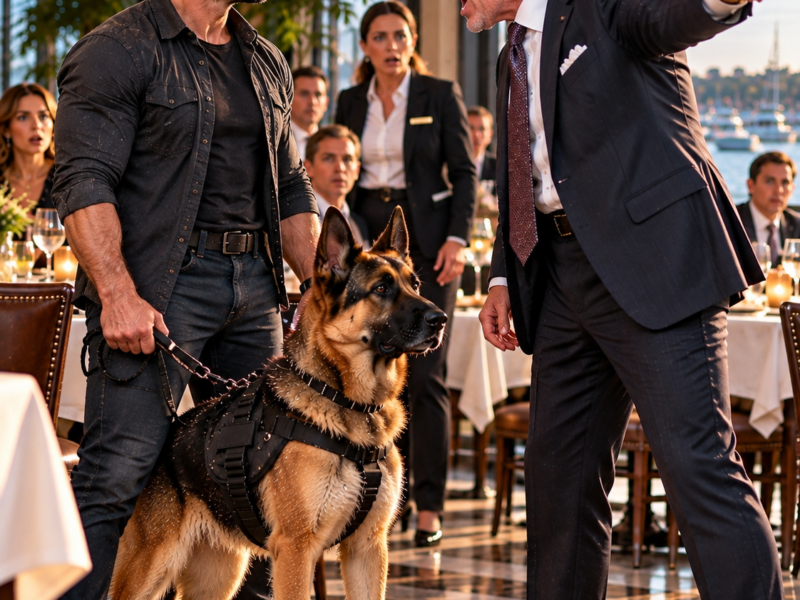
“I watched a billionaire point at my service dog in the middle of a packed Manhattan steakhouse and tell the manager to get the animal out before it ruined his dinner,
Whitmore’s hand tightened around the briefcase handle until his knuckles turned white.
“Call your dog off,” he repeated.
I stayed crouched beside Ranger, keeping one hand near his harness without forcing him to move.
“Tell me what you think he’s trained to do.”
Whitmore glanced toward the restaurant entrance, then at the two men who had been sitting with him.
Neither moved.
The younger man on his right looked pale. The other had quietly slipped his phone into his jacket pocket.
That bothered me more than Whitmore’s anger.
People who believed they were in control usually talked too much. People who knew they were losing control started looking for exits.
“Mr. Mercer,” Whitmore said, trying to recover his composure, “this is a private business matter. Your dog is creating a disturbance, and I suggest you leave before this becomes unpleasant.”
Ranger gave another low growl.
I had spent years learning when to push and when to wait. Right then, I knew neither instinct nor curiosity justified turning a crowded restaurant into a battlefield.
But I also knew my dog wasn’t reacting to the man himself.
He was focused on the case.
I eased my hand toward the handle of Ranger’s harness and gave him the quiet cue to settle. He lowered his body but kept his eyes on the briefcase.
“Thomas,” I said to the manager, “please ask everyone to give us a little space.”
Thomas nodded quickly and motioned the nearest servers away from the table.
Whitmore looked furious.
“You have no authority to give orders here.”
“Neither do you when it comes to my service dog.”
Emily stood beside me, her face pale.
“Daniel, what’s going on?”
“I don’t know yet.”
That was the truth, and I hated how little comfort it offered her.
Then Ranger did something that made me forget the argument entirely.
He shifted away from the briefcase, moved to my left side, and pressed his shoulder firmly against my leg.
It was one of the behaviors he’d been trained to use when he detected a significant change in my condition.
Except I wasn’t having a panic episode.
My breathing was steady. My hands weren’t shaking.
I looked down at him.
“Ranger?”
His ears flicked toward the briefcase again.
I remembered something my trainer, a retired military working-dog handler named Paul, had told me during our first week together.
“Never assume the behavior tells you what the threat is,” he’d said. “It tells you your dog has noticed something. Your job is to figure out what, without making the situation worse.”
Ranger had not been trained to identify secret military emblems or recognize the history of a stranger’s luggage. His medical-alert and interruption work had nothing to do with the specialized detection tasks performed by military working dogs.
Whatever he was noticing, I couldn’t honestly say I knew what it meant.
But Whitmore seemed convinced that I did.
“Get him away from the table,” he said again.
This time, his voice cracked.
I stood slowly.
“Mr. Whitmore, I’m going to ask you one question. Why are you afraid of a dog that’s sitting perfectly still?”
For a moment, nobody spoke.
Then one of the younger men beside Whitmore stood.
“Richard, we should leave.”
Whitmore shot him a look so vicious that the man immediately sat back down.
That reaction told me more than any answer could have.
The restaurant manager moved toward the front desk and quietly asked someone to contact security.
I took Emily’s hand and guided her a few steps away from the table.
“Stay behind me,” I whispered.
She looked offended for half a second.
“I’m not a child.”
“I know. Just trust me for a minute.”
She nodded, but I could feel her fingers trembling against mine.
Whitmore suddenly grabbed the briefcase and started toward the entrance.
Ranger rose.
“Down,” I commanded.
He stopped immediately, though every muscle in his body remained tense.
Whitmore reached the aisle, then turned back when he noticed I wasn’t following him.
“You have no idea what you’re interfering with.”
“Then explain it.”
He looked at the people watching us.
His jaw worked, but no words came.
Finally, he said, “You served overseas, didn’t you?”
“Yes.”
“Where?”
I stared at him.
“Why?”
His eyes dropped to the scar behind my ear.
“Because I think you know exactly what that emblem means.”
He turned and walked out before I could answer.
The two men followed him.
One of them glanced back at Ranger with an expression that looked disturbingly like guilt.
When the door closed behind them, the noise of the restaurant slowly returned. People began talking in whispers, and someone near the bar finally lowered their phone.
Thomas approached me.
“Sir, I’m sorry about all this. I can bring your food to another table.”
“That’s all right. We won’t be staying.”
Emily didn’t argue when I said we should leave.
Outside, the November wind swept between the buildings, carrying the smell of rain and exhaust. Whitmore’s black SUV was pulling away from the curb.
I watched its taillights disappear into traffic.
Then I looked at Emily.
“Have you ever heard of a company called Northstar Strategic?”
She blinked.
“Northstar? Why?”
“Because that emblem looked familiar.”
Her expression changed.
Not dramatically. She didn’t gasp or cover her mouth.
She simply stopped walking.
“Daniel, where did you see it?”
I studied her face.
“Overseas. Years ago.”
She swallowed.
“Northstar is one of the firms my company works with.”
The street seemed to grow quieter around us.
“What kind of work?”
“Financial consulting. Contract reviews. Asset transfers.” She rubbed her thumb along the edge of her phone. “I don’t handle their military contracts. I barely know anything about them.”
“Do you know Richard Whitmore?”
“Not personally. He’s connected to one of our clients.”
I waited.
Emily looked away.
“What?”
She shook her head.
“Nothing.”
“Emily.”
She exhaled.
“I’ve seen his name in some internal files. That’s all.”
I wanted to believe her.
She was my little sister, the kid who used to hide under my bed during thunderstorms because she thought the mattress could protect her from lightning. I’d spent years trying to protect her from the worst parts of my life.
But she was no longer a child, and I had learned the hard way that love could make people keep secrets they believed were necessary.
I took a step closer.
“Are you involved in something you don’t understand?”
Her eyes filled with tears so quickly that I regretted asking.
“I don’t know anymore.”
Those six words frightened me more than Whitmore’s threats.
We drove to my hotel in silence.
Ranger settled on the floor beside my seat, occasionally lifting his head to check on me. Emily sat by the window, watching the city pass.
When we reached the hotel, she finally spoke.
“Three weeks ago, I found a discrepancy in a file I was reviewing. A payment had been made to a company that didn’t appear in the supporting documentation.”
“What kind of payment?”
“Almost four million dollars.”
I turned toward her.
“Four million?”
“That’s why I reported it. My supervisor told me it was an administrative issue and that I should stop looking into it.”
“Did you?”
She stared at her hands.
“No.”
I didn’t interrupt.
“I checked the transaction history. There were several more payments, all routed through different companies. Some of them had names that sounded like ordinary consulting businesses, but their mailing addresses led back to the same office building.”
“Northstar?”
“One of the companies, yes.”
She took a shaky breath.
“I made copies of the records because I thought someone might delete them. I didn’t know what I was looking at, Daniel. I just knew the numbers didn’t add up.”
“Where are the copies?”
“At my apartment.”
I looked at the clock on the dashboard.
“We’re going there.”
“Wait.” She caught my sleeve. “I didn’t tell you the worst part.”
She opened her phone and showed me a message from an unknown number.
The message had arrived forty minutes earlier.
Stop investigating Northstar. You have no idea whose money you’re touching.
Beneath it was a photograph.
It showed Emily entering her apartment building that afternoon.
I stared at the image until the muscles in my neck began to ache.
“Have you called the police?”
“No. I thought it might be someone trying to scare me.”
“Someone took a picture of you outside your home.”
“I know.”
“Emily, this isn’t a disagreement with your supervisor.”
Her face crumpled.
“I know that now.”
I called the hotel desk and asked them to contact the police about a threatening message and possible surveillance. Then I called my attorney, a former military lawyer who had helped me navigate the medical discharge process.
He listened without interrupting.
When I finished, he said, “Don’t touch the briefcase, don’t confront Whitmore, and don’t assume the emblem proves anything. If you have evidence of financial misconduct, preserve it and let investigators establish what it means.”
“I understand.”
“Daniel, I mean it. You spent years solving problems by moving toward them. This one may require you to step back.”
I looked through the windshield at Emily.
“Stepping back isn’t the same as leaving my sister alone.”
“No,” he replied. “But protecting her doesn’t mean you have to do this yourself.”
I promised to call him again in the morning.
Then Emily and I went upstairs to collect her records.
Her apartment was on the seventh floor of a building in Chelsea, a small place with exposed brick, a narrow kitchen, and a plant she kept forgetting to water.
Nothing appeared disturbed.
Her laptop sat on the desk. A half-finished mug of tea rested beside it.
But Ranger stopped in the hallway.
His attention shifted toward the front door, and he pressed close to my leg.
I examined the lock.
There were no obvious scratches.
Emily whispered, “What is it?”
“I don’t know.”
I asked her to stay near the kitchen while I checked the apartment. I didn’t find anyone hiding inside, and nothing appeared to be missing.
Still, I couldn’t shake the feeling that someone had been there.
Emily retrieved a small encrypted drive from a drawer and held it out to me.
“This is everything I copied.”
I didn’t plug it into her laptop.
Instead, I placed it in my jacket pocket and called my attorney again. He arranged for us to meet an investigator the following morning and told us to leave the apartment if we felt unsafe.
Before we left, Emily went to retrieve her coat.
That’s when she noticed the envelope.
It had been slipped beneath her apartment door.
Her name was printed across the front in black ink.
No return address.
No stamp.
She looked at me.
“Daniel, I didn’t put that there.”
I opened the envelope carefully.
Inside was a single photograph of a military transport yard at night.
Rows of metal containers stood beneath floodlights.
At the far end, a man in uniform was speaking to someone whose face had been obscured by the angle of the shot.
I knew the yard.
I knew the containers.
And I recognized the patch on the uniform of the man standing nearest the camera.
It belonged to my unit.
On the back of the photograph, someone had written a date.
The date of my final deployment.
Beneath it were six words.
Ask what happened to Owen Price.
For several seconds, I couldn’t hear the traffic outside.
Owen had been my closest friend in the teams. He’d taught me how to make coffee strong enough to strip paint, and he’d once driven fourteen hours through a snowstorm because I’d called him after my father died.
He was also the last man I’d seen alive before the explosion that ended my career.
According to the official report, Owen had died during the same operation.
I’d attended his memorial.
I’d stood beside his widow, Sarah, while she held their six-year-old daughter and tried to understand how a man could leave home healthy and never come back.
I had spent years carrying the guilt of surviving him.
Now someone was telling me to ask what had happened to him.
Emily touched my arm.
“Daniel?”
I turned the photograph over again.
The image showed the silver emblem on one of the containers.
Northstar’s emblem.
For the first time, the connection between Whitmore, the briefcase, and my final deployment felt less like a coincidence and more like a deliberate attempt to reach me.
I called my attorney.
He answered immediately.
“Tell me you haven’t confronted anyone.”
“I haven’t.”
“Good. What happened?”
I described the photograph and read the message aloud.
He was silent for a long time.
“Do you still have the original records from your deployment?”
“Some of my personal documents. Nothing classified.”
“Don’t search for classified material or contact anyone who might be involved. We need to preserve what you’ve received and bring it to the appropriate authorities.”
I agreed.
Then he said something I hadn’t expected.
“Daniel, I know an investigator who handled financial fraud involving defense contractors. I’ll contact him tonight. If the documents are authentic, we may be looking at something much bigger than a billing discrepancy.”
I looked at Emily.
She was sitting on the edge of the couch, holding her phone in both hands.
“I need to tell you something,” she said.
I sat beside her.
“What is it?”
“The man who hired me to review those accounts wasn’t my regular supervisor. He was brought in temporarily after the previous director resigned.”
“What’s his name?”
“Martin Shaw.”
The name meant nothing to me.
Emily opened her email and searched for the project folder. Most of the documents had been archived, but she found an attachment she hadn’t copied to the drive.
It was a scanned contract.
The first page listed Northstar Strategic as a subcontractor responsible for transporting and maintaining specialized equipment.
The second page contained a series of payments authorized under an emergency procurement program.
The third page included a signature.
Richard Whitmore.
At the bottom of the page was a reference number.
I recognized the final four digits.
They matched the number on the container that had been beside Owen the night we were hit.
I read the page again, forcing myself not to jump to conclusions.
A contract number wasn’t proof that Whitmore had caused the explosion. A signature wasn’t proof that the equipment had been misused.
But the documents established a connection that deserved investigation.
And someone had gone to considerable trouble to make sure I saw it.
The next morning, my attorney met us at his office with a retired federal investigator named Laura Bennett.
She was in her late fifties, with short gray hair and the calm, patient manner of someone who had spent decades listening to people explain why they hadn’t done anything wrong.
She examined the photograph, the threatening message, and the contract.
Then she asked me to tell her everything I remembered about the deployment.
I described the mission as accurately as I could without disclosing restricted information. I explained the timing of the explosion, the transport yard, and the official account of Owen’s death.
Laura took notes.
When I finished, she leaned back in her chair.
“Your documents don’t establish that Whitmore was involved in the incident,” she said. “But they give us a reason to ask questions about the contract and the people who handled it.”
“What about the photograph?”
“It could have been taken before or after the operation. We’ll need to establish its origin.”
“And Owen?”
Her expression softened.
“If someone is using his name to contact you, we need to determine why.”
She asked whether Owen had ever mentioned concerns about the mission.
I thought back to the weeks before our deployment.
He’d been quieter than usual, spending long evenings on the phone with Sarah. Once, while we were packing equipment, he’d asked me whether I trusted the people who handled our logistics.
I’d laughed and told him I trusted the people beside me.
He hadn’t laughed back.
“Did he explain what he meant?” Laura asked.
“No.”
“Did you ask again?”
I looked down at my hands.
“No.”
It was the first time I’d admitted that out loud.
Laura didn’t criticize me.
“People under pressure sometimes decide that a question is safer left unanswered. That doesn’t make you responsible for whatever someone else may have done.”
I wished I could believe her.
Over the next several days, Laura helped us preserve the evidence and report the threats. The financial records were referred to investigators who could examine the transactions legally, while my attorney contacted the appropriate military authorities about the old contract.
Emily’s employer placed her on administrative leave.
She hated it.
“They’re acting like I did something wrong,” she told me over dinner one night.
“They may be trying to protect the company.”
“That’s a generous way of putting it.”
“I didn’t say I trusted them.”
She pushed her food around her plate.
“I thought I was finally doing something with my life that mattered. Now I’m wondering whether I was just a convenient person to blame if those numbers ever came to light.”
I reached across the table and covered her hand with mine.
“You found the discrepancy. You reported it. You kept records. Those are the things you know you did.”
“What if I should have stopped sooner?”
“Then we’ll learn from it. But you don’t get to turn someone else’s decisions into your guilt.”
She nodded, though I could tell she wasn’t ready to believe me.
Three days later, Laura called.
The financial investigators had found several payments routed through shell companies associated with Northstar. Some appeared to have legitimate explanations. Others lacked the supporting records required by the contracts.
More importantly, the original procurement files contained a discrepancy in the shipping documentation for the container number I’d recognized.
The container had been listed as carrying communications equipment.
A separate inventory showed that its contents had been changed shortly before transport.
No authorization for the change could be found.
“Does that mean the equipment caused the explosion?” I asked.
“No,” Laura replied. “It means we have a documented inconsistency. We still need the technical reports, chain-of-custody records, and testimony from people who were there.”
I closed my eyes.
For years, I’d believed the explosion was the result of an enemy attack during a dangerous operation. I’d never liked the gaps in the report, but war was full of gaps, and grief made people search for explanations that might not exist.
Now I had evidence that the paperwork surrounding the mission had been altered.
It wasn’t proof of murder.
But it was enough to make me question the certainty I’d lived with.
That afternoon, a message arrived from an unfamiliar number.
I can tell you what happened to Owen. Come alone to the old ferry terminal at six. Bring nothing.
I showed Laura immediately.
She advised me not to go.
“We can arrange a controlled meeting through investigators if the sender is willing to cooperate,” she said. “Going alone would put you and the case at risk.”
I agreed.
Then, an hour later, another message arrived.
This one contained a photograph of Sarah and Owen’s daughter, now a teenager, leaving a school building.
The message beneath it read:
If you bring the police, the truth dies with me.
I called Laura.
She was quiet for a moment.
“We’ll handle the threat to the family through the proper channels. Don’t respond to the sender.”
I wanted to obey her.
I also knew what it felt like to stand beside a grieving spouse and have no answers to offer.
I called Sarah instead.
When she answered, her voice was warm but cautious.
“Daniel? Is everything okay?”
“I need to ask you something about Owen.”
The warmth disappeared.
“What about him?”
“Did he ever tell you he was worried about our deployment?”
Silence stretched across the line.
Then she said, “He told me he thought someone was moving equipment without recording it properly. He said it might be nothing, but he didn’t like the way his questions were being handled.”
My throat tightened.
“Why didn’t you tell anyone?”
“I did. I told the officer who came to the house after he died. He wrote it down, then told me Owen had probably misunderstood something.”
She took a breath.
“Daniel, I kept asking questions for months. Eventually, people stopped returning my calls. I had a little girl who needed her mother to get out of bed in the morning. I couldn’t spend the rest of my life chasing people who wouldn’t speak to me.”
I leaned against the kitchen counter.
“I’m sorry.”
“So am I,” she said. “But why are you asking now?”
I told her about the photograph and the contract.
When I finished, she didn’t cry.
Instead, she asked, “Do you think Owen was trying to warn you?”
“I don’t know.”
“Then find out. But don’t let someone use his memory to send you into a trap.”
Her words stayed with me long after we hung up.
Laura arranged a secure meeting with the investigators and contacted the appropriate authorities about the message and the photograph of Sarah’s daughter.
The sender eventually agreed to speak through legal counsel.
His name was Martin Shaw.
He had worked as a logistics compliance officer for a contractor connected to Northstar. He claimed he had discovered unauthorized changes to shipping records before our deployment and had raised concerns internally.
According to his statement, the discrepancies had been dismissed as administrative errors.
He said Owen had independently noticed the same irregularities.
I read Shaw’s statement twice.
Then I asked the question that had haunted me since the first photograph arrived.
“Does he know whether Owen survived the explosion?”
Laura looked at the file.
“He claims he doesn’t know.”
“Then why did he tell me to ask what happened to Owen?”
“Because he believes the official investigation failed to examine the contract changes adequately.”
It was a disappointing answer.
I’d wanted something definite, something that would turn years of uncertainty into a single truth I could hold.
Instead, I had more documents, more questions, and a growing suspicion that someone had benefited from our confusion.
The investigators arranged a formal interview with Whitmore.
He arrived with two attorneys and denied knowing anything about the alteration of the shipping records. He acknowledged that he had signed contracts connected to the project but claimed the operational details had been handled by his staff.
He also denied ever threatening Emily.
When shown the restaurant incident report, he insisted he’d been frightened because Ranger had growled at him.
“Any reasonable person would have been concerned,” he said.
One of the investigators asked why he had reacted so strongly to the briefcase.
Whitmore’s attorney objected to the question.
The interview ended without an admission.
But the investigators had obtained enough financial records to continue examining the transactions, and they were no longer relying solely on Emily’s copies.
A week later, Whitmore’s company announced that he was stepping away from day-to-day operations while an independent review took place.
The announcement didn’t establish guilt.
It did, however, make the story difficult to bury.
I thought the case would become a long, quiet process of records, interviews, and waiting.
Then Laura called me with news about the silver emblem.
A forensic review of the contract files had established that the emblem belonged to a subsidiary used to manage equipment transfers. Investigators had also identified the briefcase from the restaurant as a company-issued document case.
That alone wasn’t remarkable.
What mattered was what had been inside it.
Whitmore had voluntarily surrendered the case after his attorneys learned that investigators intended to seek a warrant. It contained business records, old correspondence, and a sealed envelope holding a copy of an internal audit.
The audit documented concerns about the same container number that appeared in Emily’s files.
It also showed that the concerns had been raised before our deployment.
One signature appeared repeatedly in the approval chain.
Martin Shaw’s former supervisor.
The man who had dismissed the discrepancies.
The man who had told Owen there was nothing to investigate.
Investigators now had a clear line of inquiry, but they still couldn’t prove that the irregularities had caused the explosion or that anyone had intended to harm our unit.
Then the technical records arrived.
A review of the equipment inventory showed that the container had been assigned a different configuration shortly before departure. The change was not reflected in the final manifest.
A separate maintenance record documented a fault that should have triggered an inspection.
No signed inspection record could be found.
The investigators requested additional testimony from the people who had handled the equipment.
Several former employees cooperated.
One did not.
Whitmore’s former logistics director left the country before investigators could interview him.
Authorities issued requests for records related to his departure and financial accounts.
I watched the case develop from a distance, forcing myself to accept that evidence did not always arrive in the order a wounded man wanted it to.
Some days, I was convinced we were finally getting close.
Other days, the paperwork felt like a maze designed to wear everyone down.
Through it all, Ranger stayed beside me.
He never showed interest in the silver emblem again, and I eventually stopped trying to interpret his behavior at the restaurant as proof of anything about Whitmore’s guilt.
His reaction had been a warning that something had caught his attention, not a verdict.
That distinction mattered.
I had spent too many years living with the certainty of a report that might have been incomplete. I wasn’t going to replace it with a certainty built from suspicion.
Two months after the night at the Whitmore, Laura called with the first answer that truly mattered.
The investigation had uncovered evidence that the equipment change had been approved outside the required process. The missing inspection record had been deliberately removed from the project archive, and financial transfers had been used to conceal payments to companies that had no legitimate role in the shipment.
Several people faced criminal charges related to fraud, falsified records, and obstruction.
Whitmore was charged with financial offenses connected to the contracts. He denied wrongdoing and was entitled to defend himself in court.
Investigators had not established that he ordered the explosion or knew it would happen.
But the records showed that the warning about the equipment had been raised before our deployment, and that the people responsible for addressing it had failed to follow the required procedures.
For the first time in years, I could look at the official account of Owen’s death and recognize that it had left out important facts.
That evening, I drove to Sarah’s house.
She opened the door before I could knock a second time.
I held out a folder containing the documents Laura had cleared for us to share.
“I can’t give you every answer yet,” I said. “But I can tell you Owen wasn’t imagining the problems he found.”
Sarah looked down at the folder.
For a moment, she seemed unable to move.
Then she stepped aside and let me in.
Owen’s daughter, Lily, was sitting at the kitchen table doing homework. She looked up when I entered, and I saw her father’s eyes in her face.
“Uncle Daniel?”
I hadn’t heard her call me that in years.
I set the folder on the table.
“Hey, kiddo.”
She came over and hugged me.
I held her carefully, aware that she was no longer the little girl who had hidden behind her mother’s legs at Owen’s memorial.
Sarah opened the folder and began reading.
When she reached the first page documenting Owen’s concerns, she sat down.
Her hand covered her mouth.
“He told them,” she whispered. “He actually told them.”
I sat opposite her.
“Yes.”
“And they ignored him.”
I couldn’t offer a comforting explanation.
“That’s what the records indicate.”
She looked at the photograph of the transport yard, then at the page bearing the altered inventory number.
For a long time, she said nothing.
Finally, she closed the folder.
“I used to wonder whether I should have pushed harder,” she said. “Whether I should have called someone else, written another letter, demanded another investigation.”
I watched her trace the edge of the paper.
“I thought if I stopped asking, it meant I’d failed him.”
“You didn’t fail him, Sarah.”
She shook her head.
“I know that now. Or at least I’m trying to.”
We sat together until Lily finished her homework and came to ask whether anyone wanted tea.
It was the first ordinary question I’d heard in that house in years.
I accepted a cup.
Before I left, Sarah walked me to the door.
“Thank you for coming back to this,” she said.
“I should have asked more questions back then.”
“Maybe. But you were trying to survive what happened, too.”
She put her hand on my arm.
“Owen would never have wanted you to spend the rest of your life punishing yourself for being the one who came home.”
I drove back to my hotel with the windows cracked, letting the cold air clear my head.
The investigation continued for months. Some of the defendants pleaded guilty to financial crimes. Others contested the charges, and the legal process moved slowly.
The evidence never established that Whitmore had deliberately caused Owen’s death, and I refused to claim otherwise.
What it established was serious enough: warnings had been ignored, records had been falsified, and people entrusted with the safety of others had protected their own interests instead.
Emily eventually found a new job with a firm that took compliance seriously. She still had days when she questioned whether she should have seen the warning signs earlier.
When those days came, I reminded her that finding wrongdoing was not the same as causing it.
As for Ranger, he remained exactly what he’d always been: my partner, my anchor, and a dog who didn’t need to understand every part of my past to help me live in the present.
On the anniversary of Owen’s death, I took him to a quiet stretch of beach outside the city.
I brought a photograph of Owen in uniform, laughing at something just outside the frame.
The wind lifted the corners of the paper while the tide moved steadily over the sand.
I told Owen what had happened, though I knew the words were mostly for me.
I told him Sarah had the records. I told him Lily was growing up. I told him people were finally being held accountable for the things they had hidden.
Then I admitted the truth I’d avoided for years.
“I thought surviving you meant I owed you a lifetime of guilt.”
Ranger leaned against my leg.
I rested my hand on his head and watched the water pull away from the shore.
“But I think you’d rather I did something useful with the time I got.”
The next morning, Emily called to say she had received an envelope from the investigators.
Inside was a copy of a final report confirming that Owen’s concerns about the shipment had been documented before the deployment, along with an acknowledgment that the earlier review had failed to address them adequately.
It didn’t bring Owen back.
It didn’t answer every question.
But it restored something I’d thought we’d lost forever: the knowledge that he had spoken up, that his concerns were real, and that his death had not erased the truth of what he’d tried to do.
That evening, I clipped Ranger’s leash to his harness and took him to the neighborhood park.
A little boy approached us with his mother, then stopped when he noticed the service-dog patch.
“Can I pet him?” he asked.
“Not while he’s working,” I told him gently. “But you can say hello from here.”
The boy waved.
Ranger wagged his tail once before turning back toward me.
I smiled and continued down the path, no longer searching every shadow for the answer to a question I might never fully resolve.
For years, I’d believed that bringing Owen home meant finding a perfect explanation for what had happened to him.
Now I understood that honoring him meant refusing to let the truth disappear, even when it arrived in pieces.
Ranger had never solved the case for me.
He had simply helped me stop long enough to notice that something deserved a closer look.
And sometimes, that was where the road back to living began.
THE END









