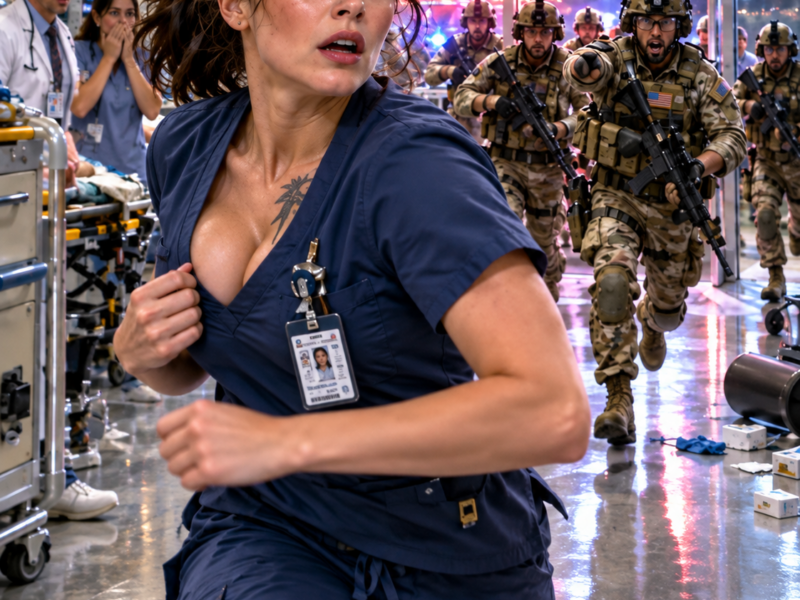
“I was halfway through stitching a trauma patient’s chest wound in a crowded Chicago ER when six Navy SEALs stormed through the doors
I held the envelope beneath the fluorescent lights and stared at the handwriting until the letters blurred.
Seven years earlier, I had watched the man who wrote those words disappear into smoke, and I had spent every day since then believing I was the only person from our unit who knew what had really happened.
The envelope had no return address, no postage stamp, and no hospital label.
My name was written across the front in the same narrow, slanted script I remembered from field reports, maps, and the little notes he used to leave beside my coffee when we were too exhausted to speak.
Dr. Claire Bennett.
Not Raven Six.
Not Lieutenant Bennett.
Not the name carved into a memorial wall overseas.
Someone had gone to considerable trouble to make sure that envelope reached the one place I had convinced myself was safe from my past.
I turned it over.
The flap had been sealed with medical tape, and beneath it, someone had written three words in block capitals.
**WHEN HAYES WAKES.**
My pulse hammered against my throat.
Captain Daniel Hayes was alive, but only because our trauma team had moved faster than the bleeding inside his abdomen.
He had taken a round high in the left side, sustained a fractured rib, and arrived with his blood pressure collapsing.
We had stopped the hemorrhage, repaired the damage we could reach, and transferred him to intensive care.
He was sedated, ventilated, and not expected to wake for several hours.
Whoever had delivered this envelope knew that.
Whoever had written it knew Daniel.
And whoever had written it knew I was still alive.
“Dr. Bennett?”
I nearly dropped the envelope.
Nurse Patel stood beside the supply cart, watching me with the careful expression nurses develop when a physician’s face changes in a way that has nothing to do with the patient.
“Are you okay?”
“Yes.”
The answer came too quickly.
She glanced toward the ICU doors.
“Those Navy guys are still out there. Security wants to know whether they can stay.”
“Let them stay.”
“All six?”
“All six.”
She studied me for another second.
“Claire, you look like you’ve seen a ghost.”
I slid the envelope into the inside pocket of my scrub jacket.
“Maybe I have.”
Then I walked away before she could ask another question.
I spent the next forty minutes pretending to be a doctor.
I checked a teenager’s fractured wrist, reviewed an abdominal scan, and helped a resident stabilize an elderly man whose oxygen levels had suddenly dropped.
I gave orders, answered questions, and corrected a medication error before it reached a patient.
My hands never shook.
That was the first thing the military had taught me about fear: it didn’t always make you tremble.
Sometimes it made you precise.
Sometimes it made you so efficient that nobody noticed you were terrified.
But every time the ICU doors opened, I looked up.
Every time a phone rang at the nurses’ station, I felt the envelope against my ribs.
And every time I caught sight of the six men waiting beyond the glass partition, I remembered the memorial.
Seven names.
Seven photographs.
Seven families who had been told that a mission in Afghanistan had ended with no survivors from Raven Team.
My name had been the fourth photograph.
The official report said I had died covering the extraction route after the team leader was killed.
It said my body had not been recovered because enemy fire had made the area inaccessible.
It said my final radio transmission had been a request for air support.
All of those statements were lies.
Not every detail in the report was false, but the most important part was.
I had not died in that desert.
I had survived long enough to discover that the mission had been compromised before our boots touched the ground.
Then someone had made certain that nobody could prove it.
At 4:46 a.m., Lieutenant Marcus Reed approached the nurses’ station.
He was the tall one, broad-shouldered, with a scar crossing his right eyebrow and the posture of a man who had spent too many years expecting trouble from every doorway.
His expression had changed since the operation.
The shock was gone.
In its place was a tightly controlled anger.
“Doctor, I need to speak with you.”
“I’m working.”
“Then I’ll wait.”
“You’ve been waiting for hours.”
“I’ve waited seven years.”
His voice wasn’t loud, but Nurse Patel stopped typing.
I looked at him.
“Not here.”
Marcus nodded once.
I led him into an empty consultation room and closed the door.
For a moment, neither of us spoke.
Then he looked at my sleeve.
“You still have it.”
I knew what he meant.
The tattoo on my left forearm was faded now, its black compass broken by a pale surgical scar.
The three tiny stars beneath it had blurred with time.
I had considered covering it with another design, then removing it, then simply pretending it didn’t exist.
In the end, I had done nothing.
Some part of me had refused to let the last evidence of Raven Team disappear.
“Why are you here, Marcus?”
He reached into his jacket and pulled out a photograph.
It showed seven soldiers standing in front of a transport vehicle, all wearing dusty combat uniforms and looking far younger than I remembered.
I was at the far left, one hand resting on my helmet.
Daniel Hayes stood beside me.
And behind us, grinning like the world had never hurt him, was Sergeant Nathan Cole.
My knees almost gave out.
Marcus watched my face.
“That’s the man who wrote the envelope, isn’t it?”
I stared at Nathan’s photograph.
Nathan had been our communications specialist, a former farm kid from Missouri who could repair a radio with two pieces of wire and a pocketknife.
He had also been the man who pulled me behind a concrete wall when the first explosion tore through our position.
The last time I saw him, his uniform was burning.
I had tried to drag him toward the extraction point.
He had shoved a small metal case into my hands and ordered me to run.
Then the building behind him collapsed.
The report listed him as the first fatality.
I had watched the dust settle over the place where he disappeared.
I had believed it.
“Where did you get this?” I asked.
“From Daniel.”
“Daniel gave you this photograph?”
“No. His wife did, after the memorial.”
I looked up.
“His wife?”
“She kept the copies he had sent home before the mission. Daniel never stopped asking questions about what happened that night.”
That sounded like Daniel.
He had always been the kind of man who remembered details other people dismissed.
The way a guard held his rifle.
The time between two radio checks.
The name of a frightened local interpreter who had been left out of an official report.
If anyone had spent seven years refusing to accept a convenient answer, it was him.
“Why didn’t he come looking for me?” I asked.
Marcus’s jaw tightened.
“He did.”
The words landed harder than I expected.
“What?”
“For the first two years, he filed requests, contacted former commanders, and asked anyone who might have seen the after-action report. He was told the investigation was closed. Then he was warned to stop asking.”
“By whom?”
“He never told me the name. He only said that someone with enough authority had made it clear that the next person who pushed would lose more than a career.”
I sat down slowly.
For years, I had imagined Daniel surviving the mission, returning home, and accepting the report because it was easier than believing his team had been betrayed.
I had been wrong.
Or at least, I had been wrong about part of him.
“How did he find me?”
“He didn’t. Nathan did.”
I looked at the photograph again.
“Three weeks ago, Daniel received an anonymous package at his home. Inside was a copy of a report that had never been released to the families. It included a note saying Nathan was alive.”
My mouth went dry.
“That isn’t possible.”
“I said the same thing.”
“Nathan died in the compound.”
“Did you see his body?”
I opened my mouth, then closed it.
Marcus waited.
“No,” I finally said. “I saw the building come down. I heard him on the radio afterward, but the signal was distorted.”
“You heard him?”
I had not meant to say that.
The memory returned with brutal clarity: static, the crackle of gunfire, a voice broken by interference.
Raven Six, keep moving.
I had thought it was my mind trying to make sense of chaos.
I had heard the voice again two nights later, in a field hospital, after a medic told me I was the only survivor.
The voice had come through a radio that wasn’t connected to any power source.
Raven Six, trust no one outside the extraction team.
I had never told anyone about that second transmission.
Not the doctors who treated me.
Not the investigators who interviewed me.
Not the man who helped me disappear.
“Claire,” Marcus said quietly. “What did you hear that night?”
I stood.
“I need to see Daniel.”
“He’s still sedated.”
“Then I’ll wait.”
Marcus studied me, then reached into his pocket and removed a small black device.
It was a military-grade encrypted drive, scratched along one edge.
“Nathan’s package included this. Daniel brought it with him tonight.”
I didn’t take it.
“Why?”
“Because he said if you were alive, you’d know what to do with it.”
I stared at the drive.
“What does it contain?”
“An audio file, some coordinates, and a list of names. He wouldn’t open it without you.”
“Why not?”
“Because the note said the evidence could only be understood by the people who were there.”
I looked toward the door.
Beyond it, the hospital was beginning to wake.
Day-shift nurses were arriving with coffee cups and tired smiles.
An ambulance backed into the bay, its lights turning the wet pavement blue.
Everything continued as if my life had not just been split open.
“Give me the envelope,” I said.
Marcus blinked.
“You have it?”
I pulled it from my jacket and set it on the table.
He stared at the handwriting.
“That’s Nathan’s.”
“I know.”
I opened the envelope carefully.
Inside was a single sheet of paper folded into quarters, along with a small brass key.
The note contained only six lines.
Claire,
If this reached you, Daniel is alive, and the people who buried the truth know we’re moving.
The drive is not the whole story.
Find the place where the first transmission ended.
Bring Daniel.
Come alone if you want to live.
Do not trust the man who signed the report.
N.
I read it twice.
Then I looked at Marcus.
“Who signed the report?”
He didn’t answer immediately.
When he did, his voice was barely above a whisper.
“Colonel Adrian Voss.”
I knew that name.
Everyone on Raven Team knew that name.
Voss had been the senior officer overseeing the operation from a command center hundreds of miles away.
He had approved our mission, controlled the extraction window, and signed the official report declaring us dead.
He had also been the man who stood beside my hospital bed after the mission and told me that the rest of my team had died with honor.
I remembered his clean uniform.
His perfectly polished boots.
The way he placed a hand on my shoulder and told me that some truths were too painful for surviving soldiers to carry.
At the time, I had been too injured to argue.
Two days later, a civilian physician had visited my room and offered me a choice.
Remain under military supervision, where I would be questioned until my story matched the official version, or disappear under a new identity while the investigation quietly closed.
He had never told me who sent him.
He had only said that if I wanted to live, I should stop asking why the extraction team had arrived before the scheduled signal.
I had chosen to live.
I had left the military.
I had become Claire Bennett.
And I had spent seven years telling myself that walking away was the same as surviving.
Marcus was still watching me.
“You know Voss,” he said.
“I know what he told me.”
“Which was?”
“That my team was dead.”
Marcus looked down at the photograph.
“Daniel says Voss was the last person to speak to him before the mission. The colonel changed the extraction coordinates at the last minute and told the team to proceed without confirmation.”
I felt the old, familiar chill settle into my chest.
“That wasn’t the only change.”
“What else?”
“The frequency. We were told to use an emergency channel if the primary one failed. But the emergency channel had already been compromised.”
Marcus’s eyes narrowed.
“How do you know?”
“Because someone answered when I used it.”
He leaned closer.
“What did they say?”
I remembered the voice.
Calm.
Unhurried.
Almost amused.
“You’re not supposed to be on this channel, Raven Six.”
I had assumed the voice belonged to an enemy operator who had intercepted our transmission.
Now I wasn’t certain.
Before Marcus could ask another question, a sharp tone sounded from the corridor.
The ICU doors opened.
A nurse stepped out and looked directly at me.
“Dr. Bennett? Captain Hayes is awake.”
I left the envelope on the table and moved toward the ICU.
Marcus followed.
Inside, Daniel lay beneath the harsh white lights, his face pale, a breathing tube already removed and an oxygen line resting beneath his nose.
His left arm was immobilized.
A monitor traced a steady rhythm beside him.
His eyes were open, and the moment he saw me, he tried to sit up.
“Don’t,” I said, moving to his bedside. “You have stitches in places you don’t want to think about.”
He managed a faint smile.
“Still giving orders.”
“Someone has to.”
The smile disappeared when he saw my expression.
“You got the envelope.”
I nodded.
“Is Nathan alive?”
Daniel closed his eyes.
For a moment, I thought the pain had become too much.
Then he whispered, “I don’t know.”
I gripped the bed rail.
“Daniel.”
“The package came three weeks ago. The report was real. The recording was real. But the person who sent it could have copied Nathan’s voice. Could have taken the file from an old server. Could have used anything.”
“You believed it enough to come here.”
“I believed it enough to stop hiding.”
He turned his head toward Marcus.
“Did you tell her about the drive?”
“Yes.”
Daniel looked back at me.
“There’s something else.”
“Of course there is.”
He drew a careful breath.
“Seven years ago, after the mission, I woke up in a military hospital with a broken shoulder and a concussion. Voss visited me before the investigators did. He told me we’d lost everyone and that I had been found near the extraction point.”
“That was the official story.”
“Except I wasn’t near the extraction point. I was in a village two miles south, and a local family had hidden me in their cellar. I remembered hearing a radio transmission before I lost consciousness.”
“What transmission?”
He swallowed.
“Your voice.”
I went still.
“You said the extraction team had changed its route. You said the coordinates were wrong. Then someone else came on the channel and ordered you to surrender.”
The room seemed to contract around us.
“I never surrendered.”
“I know.”
“How?”
“Because the voice that answered you was Voss’s.”
For a moment, I could hear nothing except the monitor beside his bed.
Daniel continued.
“I recognized it later, when he visited me. He told me I was confused. He said the concussion had damaged my memory. But I remembered the transmission, Claire. I remembered the exact words.”
“What did he say?”
Daniel met my eyes.
“He said, ‘Raven Six is contained. Proceed with the recovery.'”
My stomach turned.
Contained.
Not rescued.
Not missing.
Contained.
The word belonged to a report, not a battlefield.
“Who was recovering what?” Marcus asked.
Daniel looked at the closed door.
“That’s what Nathan’s drive is supposed to tell us.”
I glanced toward the window.
Outside, the first pale light of morning had appeared above the city.
I had spent seven years believing the past was a locked room.
Now the door stood open, and the man I thought had died was leaving messages from the other side.
“You’re not going anywhere,” I told Daniel.
He gave me a tired look.
“Doctor, I just survived being shot.”
“And I just repaired the damage. You’re staying here until I say otherwise.”
“Then I suppose I’ll have to listen.”
“You always were terrible at that.”
For the first time, he laughed.
It was brief and painful, but it was real.
Then he reached for my hand.
I hesitated before taking it.
His fingers were warm.
“Claire,” he said, “I need you to tell me one thing.”
“What?”
“When the building came down, did you see Nathan die?”
I thought of the fire.
The collapsing walls.
The transmission that had come through the static.
“No,” I said. “I didn’t.”
Daniel’s grip tightened.
“Then we don’t call him dead.”
I wanted to believe him.
But belief had nearly killed me once.
This time, I needed proof.
By eight o’clock, Daniel had been transferred to a private room under hospital security, and I had handed my emergency department cases over to another attending physician.
I told my supervisor I had a personal emergency.
It wasn’t a lie.
It simply wasn’t the whole truth.
Marcus brought coffee and a laptop.
We sat around a small table while Daniel rested, his face drawn with exhaustion.
The drive was connected to an isolated computer, with the hospital’s network disabled.
I had learned enough about military systems to know that a device could be dangerous without containing a virus.
Sometimes the danger was in what it revealed.
The first folder contained a file labeled TRANSMISSION_0417.
The date matched the night our team was lost.
The second contained a set of coordinates.
The third was a list of seven names.
I recognized all of them.
Raven Team.
My name appeared fourth.
Beside each name was a status code.
The first three were marked KIA.
The fourth was marked RECOVERED.
The last three were marked UNCONFIRMED.
My breath caught.
“Recovered,” Marcus said. “That’s not how the report described you.”
“No.”
“Who entered this?”
I clicked the file details.
The document had been created on a military server and modified two days after the mission.
The author field showed a username I didn’t recognize.
The signature field, however, contained a name.
Adrian Voss.
Daniel had pushed himself upright despite my instructions.
“Play the audio.”
I looked at him.
“You’re supposed to be resting.”
“I’ll rest when we know what happened.”
“That’s not how medicine works.”
“Then it’s fortunate we’re not discussing medicine.”
I should have refused.
Instead, I opened the audio file.
Static filled the room.
Then came the sounds I had spent seven years trying to forget: distant gunfire, someone calling for a medic, the sharp crack of an explosion.
My own voice broke through.
“Command, this is Raven Six. We have a compromised route. Repeat, the route is compromised. Requesting immediate extraction.”
A second voice answered.
“Raven Six, maintain position. Recovery team is inbound.”
I closed my eyes.
That had been the first lie.
The recovery team was not inbound.
They had already been there.
The recording continued.
A new voice entered the channel, crisp and controlled.
“Raven Six, this is Colonel Voss. Confirm your location.”
My recorded voice gave the coordinates.
Then a pause.
Long enough for me to hear the static shift.
Voss spoke again.
“Your team has been compromised. Secure the package and hold position until the recovery unit arrives.”
Daniel leaned forward.
“What package?”
I shook my head.
“We weren’t told there was a package.”
But I remembered a metal case.
Nathan had carried it into the compound, and I had seen him arguing with our team leader before we entered.
He had said the mission briefing was incomplete.
The team leader had ordered him to keep his concerns to himself.
The recording crackled.
My voice came again.
“Command, we have hostile movement on the east side. The recovery unit is not responding. Requesting authorization to withdraw.”
Voss answered immediately.
“Negative. You are to remain in place.”
Then, faintly, another voice spoke in the background.
A voice that didn’t belong on the command channel.
“Package is secure.”
I stopped the recording.
Nobody moved.
Marcus looked at the screen.
“Who was that?”
“I don’t know.”
Daniel’s expression had gone rigid.
“Play it again.”
I did.
This time, I heard the background voice more clearly.
“Package is secure.”
Then another sound.
A small metallic click.
I had heard it before.
Not in the desert.
In Voss’s office, when he had visited my hospital room.
He had carried a pen with a silver clip and tapped it twice against the edge of a folder while he spoke.
The same two clicks appeared at the end of the recording.
Marcus leaned back.
“That doesn’t prove he was there.”
“No,” I said. “But it proves someone near him was.”
I looked toward the coordinates.
“Where does that lead?”
I entered them into an offline map.
The location appeared in a remote stretch of terrain north of our original mission area, near a disused communications station.
A place that had not appeared on our briefing maps.
My skin prickled.
“That’s where the first transmission ended.”
Marcus looked at the envelope.
“Then that’s where Nathan wants us to go.”
“Or where someone wants us to go.”
Daniel nodded.
“Either way, it’s the only lead we have.”
I looked at him.
“You can barely sit upright.”
“And you have a hospital to run.”
“I’ve already handed over my cases.”
“Then we have two problems.”
“No,” I said. “We have one problem, and it’s called Adrian Voss.”
For the first time that morning, Daniel didn’t argue.
We didn’t leave immediately.
I made Daniel undergo another examination, reviewed his postoperative results, and arranged for a colleague I trusted to cover my shift.
I also insisted on a security escort until he was medically stable.
It wasn’t because I feared the hospital.
It was because someone had known where Daniel would be, when he would arrive, and which surgeon they wanted to see.
That level of precision was not coincidence.
At noon, Marcus returned from the hospital garage with a grim expression.
“Someone went through the vehicle.”
“What?”
“The rear compartment was open. Nothing obvious was missing, but the case Daniel brought from home had been moved.”
Daniel looked at him.
“Did you see anyone?”
“No.”
“Security cameras?”
“One camera near the exit went offline for eleven minutes.”
I felt the old coldness spread through my chest.
“Then we’re not the only ones looking for that drive.”
Marcus nodded.
“Which means we should assume the hospital isn’t safe.”
I hated how quickly my mind accepted that conclusion.
I had built a life around the idea that hospitals were places where people came for help, where the rules were written down and evidence could be documented.
But hospitals were also buildings full of doors, corridors, and blind spots.
They were places where someone could disappear behind a badge.
I looked at Daniel.
“We’re not going to the coordinates today.”
His jaw tightened.
“Claire—”
“You are recovering from abdominal surgery. We have a compromised vehicle, a missing camera recording, and no idea who entered the garage. If we walk into a remote site without preparation, we’ll be giving them exactly what they want.”
He held my gaze.
Then he nodded.
“Fine.”
Marcus looked surprised.
“You’re agreeing?”
“I’ve learned that arguing with Claire Bennett is a waste of valuable oxygen.”
“Good,” I said. “Then use yours to tell me everything you remember about the mission.”
For the next two hours, Daniel and Marcus described the operation in detail.
Their account matched mine in some places and contradicted it in others.
The mission had been described as a rescue operation involving a missing intelligence officer.
The briefing identified a compound where the officer was supposedly being held.
Our team was ordered to enter, secure the officer, and extract before dawn.
But when we arrived, the compound was empty.
There were signs of recent activity, a working radio, and a metal case hidden beneath the floor of a storage room.
Nathan had found the case first.
He had refused to let anyone open it.
He said the contents had to be verified by someone outside the unit.
The team leader ordered him to hand it over.
Nathan refused again.
Then the first explosion hit.
Our route out was blocked.
The radio channels filled with conflicting orders.
And the extraction team appeared long before the scheduled signal.
They wore our insignia.
They used our codes.
But they didn’t answer the challenge phrase we had been given that morning.
The team leader ordered us to fall back.
I stayed behind to cover the retreat.
That was the last time I saw Daniel before the building collapsed.
“What was in the case?” I asked.
Marcus shook his head.
“None of us knows.”
Daniel stared at the floor.
“Except Nathan.”
“Maybe,” I said.
“And if he survived, he may know why Voss wanted it.”
I looked again at the list of names.
Seven soldiers.
One official story.
A secret that had survived longer than it should have.
“There’s another question,” I said.
“What’s that?” Marcus asked.
“Why did Voss need the team declared dead?”
Daniel answered without hesitation.
“Because dead soldiers can’t testify.”
Nobody spoke after that.
At three in the afternoon, my phone rang from a blocked number.
I almost ignored it.
Then a message appeared.
**You have the drive. Leave Daniel out of it.**
I showed it to Marcus.
He read it twice.
“Don’t respond.”
A second message arrived.
**The first lie kept you alive. The next one won’t.**
Daniel reached for my phone.
“Call the police.”
“And tell them what?” I asked. “That someone sent a threat about a classified operation from seven years ago?”
“Tell them someone is targeting a wounded officer.”
“That part we can prove.”
I saved the messages and forwarded them to hospital security.
Then I did something I hadn’t done in seven years.
I called the civilian physician who had helped me disappear.
His name was Dr. Samuel Mercer.
He had retired from military medicine and moved to a small town in Vermont, where he supposedly spent his days restoring old furniture and avoiding the telephone.
I had not spoken to him in six years.
He answered on the fourth ring.
“Claire?”
His voice sounded older.
“How did you get this number?” I asked.
“I kept it.”
“Why?”
A long silence followed.
“Because I hoped you’d never need me again.”
I looked at Daniel.
He watched me carefully.
“Someone sent me a message,” I said. “They know I have evidence connected to Raven Team.”
Mercer exhaled.
“Then the truth is moving.”
“You knew?”
“I suspected.”
“Did you know Nathan might be alive?”
“No.”
“Did you know Voss had changed the extraction coordinates?”
Another silence.
“Yes.”
The word was so quiet I almost missed it.
My grip tightened around the phone.
“You knew?”
“I discovered the discrepancy after you were transferred. I tried to challenge the report, but the original mission logs had been altered. When I asked Voss for an explanation, he told me the changes had been authorized at a higher level.”
“Did you believe him?”
“No.”
“Then why did you help me disappear?”
“Because I believed someone intended to kill you.”
I stared at the wall.
“Who?”
“I don’t know. But after you woke up, a man visited the hospital claiming to be from the investigation team. He asked whether you had remembered anything about the package. He wanted to know whether you had seen Nathan after the explosion.”
My blood ran cold.
“What did you tell him?”
“That you were heavily sedated and unable to speak.”
“Was that true?”
“At the time, yes.”
I thought of the second radio transmission.
The voice telling me to trust no one outside the extraction team.
“Did you ever see the man again?”
“No. But I kept a copy of the original patient transfer records. They were the only documents I could remove without raising suspicion.”
“Where are they?”
“In a safe deposit box. The key is in a book at my house.”
I looked at the brass key from Nathan’s envelope.
“Is it a small brass key?”
Mercer went silent.
“Claire, where did you get that?”
“An envelope arrived this morning.”
“Do not use it.”
“Why?”
“Because I didn’t send it.”
I glanced at Daniel.
“Then who did?”
“I don’t know. But if Nathan is alive, he knows something I don’t. And if Voss knows you have the drive, he will do whatever he can to keep it from being opened.”
“Mercer, I need the records.”
“I’ll send them through a lawyer.”
“No. We need them now.”
“You need to listen to me. Don’t go to those coordinates without someone you trust.”
I looked at Marcus.
Then at Daniel.
“That’s the problem,” I said. “I’m not sure how many people fit that description anymore.”
Mercer lowered his voice.
“There’s one thing I never told you.”
I waited.
“After you disappeared, I received a letter from someone claiming to be a member of Raven Team. It said you had survived because Nathan disobeyed a direct order.”
I stopped breathing.
“What order?”
“To leave you behind.”
The room seemed to tilt.
“What?”
“According to the letter, the extraction team had been told to recover the package and abandon anyone who had seen it. Nathan refused. He diverted the recovery unit and got you to a secondary evacuation point.”
My mind raced through the memory of the ruined compound.
Nathan shoving the metal case into my hands.
His order to run.
The fire.
The voice on the radio.
He had not been trying to save the package.
He had been trying to save me.
“Who wrote the letter?” I asked.
“It wasn’t signed.”
“Do you still have it?”
“Yes.”
“Then send me a photograph.”
“I will.”
He paused.
“Claire, if Nathan is alive, he may not be the man you remember.”
“Neither am I.”
I ended the call before he could answer.
For a long moment, I sat motionless.
Daniel spoke first.
“You thought Nathan was dead.”
“I watched him disappear.”
“You thought he betrayed you?”
“No.”
I looked at him.
“I thought he had been the only one who didn’t.”
The distinction mattered.
I had spent years trying to understand why he had sent me away, why he had refused to explain the case, why he had made me promise to trust no one.
Perhaps he had known the mission was compromised.
Perhaps he had understood that the truth would put all of us in danger.
Perhaps he had made a choice that saved my life and destroyed his own.
Or perhaps I was constructing a story because the alternative was admitting I knew nothing.
At six that evening, Mercer sent the photograph.
The letter was typed, not handwritten.
Its final paragraph read:
The officer known as Raven Six was not to be recovered under any circumstances. Her survival would compromise the operation. Sergeant Cole refused to comply and diverted the team to an alternate extraction route. The subsequent explosion was recorded as a fatal incident to preserve operational security.
There was no signature.
But at the bottom of the page, someone had stamped a classification code.
I recognized it immediately.
It belonged to an intelligence office that had been dissolved two years after our mission.
A unit that officially had never existed.
Marcus stared at the screen.
“So they planned to leave you behind.”
“Yes.”
Daniel’s face had gone pale.
“And Nathan stopped them.”
I nodded.
The truth had become clearer, but it had not become safer.
If Voss had ordered my death, he would not welcome evidence that I had survived.
If Nathan had kept proof of the order, he would be a threat to anyone who had helped conceal it.
And if Daniel had spent seven years asking questions, then his shooting might not have been random.
“Someone knew he was coming here,” Marcus said.
“Someone knew I would operate on him,” I replied.
Daniel shook his head.
“The hospital schedule isn’t public.”
“But the mission details were classified. Someone still got them.”
Marcus rose and went to the window.
“We need to leave.”
“Not until Daniel is stable enough to travel.”
“I’m stable,” Daniel said.
“You are stubborn, not stable.”
He gave me a tired smile.
“I’ve been called worse.”
I checked his latest results and spoke with the attending physician.
We arranged a transfer to a secure medical facility outside the city, using an ambulance with a vetted crew and a route coordinated by hospital security.
I made certain the destination was known only to three people.
Me.
Daniel.
Marcus.
We left after dark.
The city lights passed in streaks across the ambulance windows, and the monitor beside Daniel beeped with every turn.
I sat beside him, checking his pulse and watching the color in his face.
For the first time since the envelope arrived, I let myself think about what would happen if Nathan were alive.
Would he look at me and see the soldier who had disobeyed his order to run?
Would he blame me for leaving him behind?
Would he tell me that the mission had gone wrong because I had trusted the wrong person?
Or would he simply ask why it had taken me seven years to come back?
Daniel watched me from the stretcher.
“You’re doing that thing again.”
“What thing?”
“Trying to solve every possible disaster before it happens.”
“It’s called planning.”
“It’s called being afraid.”
I adjusted the monitor lead.
“You’re a patient. You don’t get to psychoanalyze me.”
“I’m a captain. It’s practically in the job description.”
I almost smiled.
Then his expression softened.
“Claire, you don’t have to go back there alone.”
“I know.”
“Do you?”
I looked out the window.
“No,” I admitted. “I don’t think I do.”
He reached for my hand again.
This time, I took it without hesitation.
The secure facility was an old rehabilitation center outside the city, closed to the public while undergoing renovations.
A small medical team had agreed to monitor Daniel overnight.
Marcus checked the entrances while I reviewed the plan.
At 11:18 p.m., we drove north toward the coordinates.
The disused communications station lay beyond a stretch of wooded hills, accessible by a narrow service road.
We parked a mile away and continued on foot.
The air was cold.
My old instincts returned with every step: check the tree line, listen for movement, watch the ground for anything that didn’t belong.
I had not carried a weapon in seven years.
I carried a flashlight, a medical kit, and the brass key.
Marcus had brought a radio and a compact sidearm.
Daniel remained at the facility under medical supervision, furious at being left behind but too injured to argue successfully.
We had agreed that if we found anything, Marcus would send the location and wait for support.
I would examine the site.
It was the safest plan we could manage.
The station appeared through the trees as a low concrete structure with a rusted antenna tower.
The windows were boarded.
A faded warning sign hung crookedly beside the entrance.
The lock had been replaced recently.
I knelt and examined it.
“Someone’s been here.”
Marcus scanned the tree line.
“How recent?”
“Within days.”
I inserted the brass key.
It turned smoothly.
The door opened with a soft metallic click.
Inside, the air smelled of dust and damp concrete.
A narrow corridor led to a room filled with old equipment.
Most of the panels had been stripped.
One remained powered, its small green light blinking in the darkness.
Beside it sat a metal desk.
On the desk was a second envelope.
This one had no name.
It contained a folded map and a photograph.
The photograph showed Nathan standing outside the same building.
He looked older, thinner, and deeply tired.
But he was alive.
On the back, someone had written:
**YOU HAVE TEN MINUTES.**
Marcus moved to the doorway.
“Claire.”
“I know.”
I unfolded the map.
It marked a service tunnel beneath the station, leading to a small chamber that had been omitted from the original blueprints.
A red circle had been drawn around the far end.
The first transmission had not ended here.
It had been routed through this station.
I crossed the room and examined the remaining console.
A handwritten label had been taped beneath a row of switches.
RAVEN EMERGENCY RELAY.
My hands went cold.
This was the channel that had answered me in the desert.
This was where the voice had come from.
Marcus leaned over my shoulder.
“Can you access it?”
“Maybe.”
I opened the panel.
The wiring was old but intact, and a small storage unit had been connected to the relay.
I removed it carefully and placed it in an evidence bag.
Then I heard a sound from the corridor.
Three slow knocks.
Marcus raised his weapon.
“Who’s there?”
A voice answered from the darkness.
“Someone who has been waiting a very long time.”
I knew that voice.
Older.
Rougher.
But unmistakable.
I stepped toward the doorway.
“Nathan?”
A figure emerged into the dim light.
Sergeant Nathan Cole stood before me, his face lined with scars and his left hand resting against the wall for support.
For several seconds, neither of us moved.
Then he looked at my tattoo.
“Raven Six,” he whispered.
I felt the seven missing years collapse into a single breath.
“You were dead.”
Nathan gave a small, humorless smile.
“So were you.”
I wanted to hit him.
I wanted to hold him.
I wanted to ask every question I had been afraid to ask in the years since the mission.
Instead, I heard myself say, “You let me believe you were gone.”
His expression changed.
“I tried to reach you.”
“Then why didn’t you?”
“Because the first person who helped you disappear was being watched.”
I thought of Mercer.
“He saved my life.”
“He did. But he was watched, too. If I contacted him, I’d have exposed you.”
“Who was watching him?”
Nathan looked toward the console.
“Voss wasn’t working alone.”
A noise sounded outside.
A vehicle door slammed.
Marcus moved to the window.
“Lights on the road.”
Nathan’s face tightened.
“They found us.”
“Who?”
He looked at me.
“The people who ordered the mission.”
Then he reached into his jacket and pulled out a small black pistol.
“Claire, listen carefully. The drive you brought is only a copy. The real evidence is in that relay. If they get it, they’ll erase everything.”
I held up the evidence bag.
“I already have the storage unit.”
Nathan stared at it.
Then, for the first time, he looked afraid.
“That’s not the storage unit I meant.”
The console behind us began to beep.
A red indicator flashed.
The door at the far end of the corridor slammed shut.
Marcus turned toward us.
“Tell me that’s supposed to happen.”
Nathan shook his head.
“No.”
The lights went out.
A sharp burst of static erupted from the relay.
Then a voice filled the room.
“Raven Six, if you can hear this, the operation has already begun.”
I recognized the speaker immediately.
Colonel Adrian Voss.
His voice was calm, measured, and utterly unchanged.
“Stand down. The recovery team is entering the station. Do not attempt to leave.”
Marcus raised his radio.
“There’s no signal.”
Nathan grabbed my arm.
“There’s a second exit.”
“Where?”
He pointed toward the floor.
A low metal hatch stood beneath the desk, almost invisible beneath a layer of dust.
We pulled it open.
Cold air rose from the darkness below.
“Go,” Nathan ordered.
I stared at him.
“Not without you.”
His eyes met mine.
“That’s the same mistake you made seven years ago.”
Before I could answer, a gunshot cracked through the corridor.
Concrete dust burst from the wall beside Marcus.
He dropped behind the desk and returned fire.
Nathan shoved me toward the hatch.
“Move!”
I climbed down the ladder into the narrow tunnel, my heart hammering.
Marcus followed.
Nathan came last, pulling the hatch shut above us just as boots thundered into the room.
The tunnel was barely wide enough for our shoulders.
Emergency lights glowed faintly along the floor, illuminating pipes and old cable trays.
We moved quickly, following Nathan toward the far end.
Behind us, metal struck metal.
Someone was trying to force the hatch open.
“Where does this lead?” Marcus whispered.
“To the original relay chamber,” Nathan said. “The one they never put on the maps.”
“Why?”
“Because that’s where the real transmission was recorded.”
We reached a steel door.
Nathan used a code, then pressed the brass key into a narrow slot.
The lock released.
Inside was a small room containing a server rack, a desk, and a wall covered with photographs.
I stopped.
Every photograph showed a member of Raven Team.
Some were official portraits.
Others were candid images taken during training.
At the center of the wall was a photograph of me, taken after the mission.
I was sitting in a hospital bed, my face bruised, my left arm wrapped in bandages.
Someone had written beneath it:
SURVIVOR — UNCONFIRMED.
Nathan closed the door.
“There’s a reason I asked for you.”
He crossed to the server and opened a locked drawer.
Inside lay a metal case.
The same kind of case I remembered from the compound.
My throat tightened.
“What’s in it?”
“The reason they sent us there.”
He opened the latches.
Inside were printed financial records, encrypted storage devices, and a thin folder marked with the name of a defense contractor.
The records described payments routed through shell companies, equipment purchases that had never reached their stated destinations, and mission authorizations that had been signed after the operations they supposedly approved.
At the center of the documents was a list of names.
Adrian Voss was first.
Several intelligence officials followed.
One name belonged to a senior executive at the contractor.
Another belonged to a government investigator who had supposedly overseen the inquiry into Raven Team’s deaths.
I recognized the investigator.
He had interviewed me in the hospital.
He had told me that my memory was unreliable.
“That’s not all,” Nathan said.
He opened a second folder and revealed a stack of handwritten notes.
“These are copies of the original transmission logs. The official records were altered, but I kept the raw recordings.”
“Why keep all of this here?”
“Because the station was abandoned before the investigation began. Voss believed the relay had been dismantled. He never knew this chamber existed.”
“How did you know?”
Nathan glanced at the photographs.
“Because I built it.”
I stared at him.
“You built this station?”
“Not the whole station. The relay system. Before Raven Team, I worked communications support. I found the hidden chamber while testing a replacement system. It was connected to an old intelligence network that had supposedly been shut down.”
“An intelligence network that was still operating?”
“Yes. The relay could intercept and redirect emergency transmissions. Someone had been using it to monitor classified operations and alter orders before they reached the field.”
I looked at the server.
“So they could make a team walk into a trap.”
“They could make a team believe the trap was a rescue.”
A cold silence settled over us.
The mission had not been compromised by an enemy who happened to know our route.
The route had been given away by someone who controlled our communications.
The extraction team had not arrived early by accident.
It had arrived when the people behind the operation wanted it to arrive.
“Why didn’t you take this to the authorities?” Marcus asked.
“I tried. The first investigator I contacted was the man who signed the report.”
Nathan tapped the folder.
“He knew exactly what I had. After that, I stopped trusting official channels.”
“Then why send the drive to Daniel?”
“Because Daniel never stopped asking questions. I needed to know whether he was still willing to risk something for the truth.”
“And me?”
Nathan looked directly at me.
“I needed to know whether you were still alive.”
I struggled to keep my voice steady.
“You could have sent a message.”
“Not without risking your life.”
“You don’t get to make that choice for me.”
“I know.”
His answer was immediate.
That surprised me more than any excuse could have.
He lowered his head.
“I know now.”
A metallic bang echoed from the tunnel.
The people above had found the hatch.
Marcus checked his radio again.
“We need to get the evidence out.”
Nathan nodded toward the server.
“The files can be transmitted through a secure line, but the connection has to be restored manually. It will take a few minutes.”
“How many?”
“Five if the system cooperates.”
“And if it doesn’t?”
“Then we take the physical records and leave.”
I moved beside him.
“Tell me what to do.”
He showed me the console.
The system was old, but its logic was familiar. The relay used a series of switches and coded inputs to establish a connection with a remote server.
I had worked with similar systems in the field, although I had not touched one in years.
Nathan entered the first sequence.
I checked the cable connections and replaced a damaged fuse.
Marcus watched the door.
The server hummed to life.
A green light appeared.
Then another.
“Connection established,” Nathan said.
He inserted the storage device.
A transfer window opened.
The files began moving.
For the first time that night, I allowed myself to breathe.
Then the screen flashed red.
CONNECTION INTERRUPTED.
Nathan swore under his breath.
“They’ve cut the line.”
“Can you restore it?”
“Not from here.”
Another bang sounded from the tunnel.
The steel door shuddered.
Marcus raised his weapon.
“Whatever you’re going to do, do it now.”
Nathan looked at me.
“There is another way. The station can broadcast directly through the emergency relay, but it will expose our location.”
“Then we broadcast.”
“If we do that, they’ll know exactly where we are.”
“They already know.”
He hesitated.
I understood why.
For seven years, he had survived by hiding, moving, and trusting no one.
Broadcasting the evidence meant giving up the one advantage he had preserved.
It meant stepping into the open.
I put my hand on his shoulder.
“You don’t have to do it alone.”
He stared at me for a long moment.
Then he nodded.
We switched the relay to emergency broadcast.
The screen filled with a list of available channels.
Nathan selected the one reserved for official mission recordings and entered a code.
The system asked for authorization.
I entered my old service number.
A warning appeared.
IDENTITY STATUS: DECEASED.
For a moment, I could not move.
Even here, even after everything, the system still believed I was dead.
Nathan looked at me.
“Try the manual override.”
I pressed the keys he indicated.
The warning disappeared.
IDENTITY STATUS: VERIFIED.
A small green light blinked.
Then the recording began to upload.
We had thirty seconds before the relay would transmit our location.
Marcus checked the door.
“Twenty seconds.”
The server continued to hum.
“Fifteen.”
Nathan stared at the progress bar.
“Come on.”
The bar reached one hundred percent.
A tone sounded.
**BROADCAST COMPLETE.**
The steel door buckled inward.
Marcus shouted, “Move!”
Nathan pulled the original recorder from the console.
I grabbed the folder and the smaller storage device.
We ran toward the second passage as the door crashed open behind us.
Voices filled the chamber.
“Stop! Hands where we can see them!”
Marcus turned and fired a warning shot into the ceiling.
We reached the tunnel exit and climbed a narrow ladder toward the surface.
Cold air hit my face as I emerged among the trees.
For several seconds, I could hear only my own breathing.
Then sirens rose in the distance.
Nathan crouched beside the exit.
“Did the broadcast go through?”
I held up the recorder.
“The evidence is out.”
He nodded, but his expression remained troubled.
“That’s not the same as being safe.”
“I know.”
A pair of headlights appeared on the road.
Marcus raised his radio and gave our location.
This time, the signal held.
Within minutes, vehicles approached from the south.
Federal agents surrounded the station.
We watched from the tree line as the first team entered the building.
Then a familiar figure emerged between two agents.
Colonel Adrian Voss.
His hands were cuffed in front of him.
He looked toward the woods, and for a moment, his eyes found mine.
Even at that distance, I could see the anger in his face.
He had spent seven years controlling the story.
Now the story had escaped him.
Agent Elena Ruiz reached us shortly afterward.
She had received the broadcast and dispatched a team as soon as the files arrived.
“Dr. Bennett, Sergeant Cole, Lieutenant Reed,” she said. “I need to know whether anyone is injured.”
“No,” I replied.
Marcus shook his head.
Nathan said nothing.
Ruiz looked toward the station.
“The evidence is already duplicated across several secure systems. The original recordings are being preserved. Nobody will be able to erase them quietly.”
“Can you prove the orders came from Voss?” I asked.
“We have the audio, the relay logs, and the authorization trail. We’ll still need independent verification, but it’s a substantial start.”
She glanced at Nathan.
“Sergeant Cole, you’ve been listed as deceased for seven years. I imagine that creates a complicated set of questions.”
Nathan gave a tired laugh.
“That’s one way to put it.”
“We’ll arrange protection and medical evaluation. But I need your full cooperation.”
“You’ll have it.”
Ruiz turned to me.
“Dr. Bennett, the broadcast also included your identity verification. The military database now records you as alive.”
I felt something shift inside my chest.
For years, I had avoided official records because I feared they would lead someone to me.
Now my name was back where it belonged.
Not as a casualty.
Not as a missing soldier.
As a living witness.
“Thank you,” I said.
Ruiz nodded.
“Don’t thank me yet. This investigation will be long.”
“I’ve waited seven years.”
“Then you know patience.”
She was right.
The case did not end that night.
It took months to authenticate the records, interview witnesses, and trace the financial network.
Voss’s attorneys challenged the evidence, arguing that the recordings had been altered and that the emergency relay was not an authorized system.
The forensic team proved otherwise.
The audio matched surviving radio logs.
The timestamps matched the satellite records.
The altered extraction coordinates could be traced to an account accessed with Voss’s credentials.
And the financial documents connected the defense contractor to payments made through shell companies controlled by two senior officials.
The case grew beyond Raven Team.
Investigators uncovered other operations in which extraction orders had been changed, equipment had disappeared, and reports had been rewritten after casualties occurred.
Not every operation had involved deliberate harm.
Some had been compromised by incompetence, corruption, or panic.
But several had been manipulated to conceal the theft of equipment and money.
Our mission had been one piece of a much larger pattern.
The first charges were announced three months later.
Voss was indicted for conspiracy, obstruction, and falsifying official records.
The contractor’s chief operating officer was charged in connection with the theft of government property and funds.
Two former intelligence officials resigned before investigators could compel their testimony.
The government reopened the inquiry into Raven Team’s deaths.
It was not a clean victory.
Some documents remained classified.
Some witnesses refused to cooperate.
And several people who had helped conceal the truth were never charged.
But the official report was withdrawn.
The seven names were no longer listed as casualties of an enemy ambush.
They were listed as members of a unit whose deaths had occurred during a compromised operation under investigation.
It was an imperfect correction.
It was also the first honest sentence the government had written about us in seven years.
Daniel recovered slowly.
He returned to duty only after his doctors cleared him, and even then he was required to limit his physical training for several months.
I visited him during his recovery, bringing coffee he was forbidden to drink and books he claimed he would read but rarely opened.
“You could have called before you disappeared into a secret communications station,” he said one afternoon.
“You were recovering from surgery.”
“I was recovering while you were apparently saving the country.”
“I wasn’t saving the country.”
“What would you call it?”
“Trying to keep you from reopening your stitches.”
He smiled.
“Still giving orders.”
“Still ignoring them.”
For a while, we talked about ordinary things.
His rehabilitation.
My hospital.
Marcus’s latest complaints about federal paperwork.
Then Daniel grew quiet.
“Did Nathan tell you why he stayed away?”
“Most of it.”
“And do you believe him?”
I considered the question.
“I believe he was trying to keep me safe. I don’t know whether every decision he made was right.”
Daniel nodded.
“That sounds like him.”
“You always trusted him.”
“I trusted him with my life.”
“That isn’t the same as knowing everything about someone.”
“No,” Daniel said. “It isn’t.”
He looked out the window.
“I spent seven years thinking I had failed all of you. I thought I should have found the truth sooner.”
“You didn’t have the evidence.”
“I had questions.”
“So did I. We both survived by answering them in whatever way we could.”
He looked back at me.
“Do you think we wasted those years?”
I wanted to give him an easy answer.
Instead, I told him the truth.
“Some of them. But not all.”
He nodded slowly.
“Then we should try not to waste the next ones.”
Nathan chose to live in a small town in the Midwest under his own name, with legal protection while the remaining cases proceeded.
He still avoided crowded rooms.
He still sat facing the door.
And he still woke some nights believing he was back in the detention facility.
I recognized those signs because I had spent years learning to hide my own.
We met at a small diner near the river.
When he arrived, he looked at my forearm.
“Still haven’t covered it.”
“No.”
“Why?”
I turned my wrist so the faded compass caught the light.
“Because it belongs to me.”
He nodded slowly.
For a while, we talked about ordinary things.
His new apartment.
My hospital.
The weather.
The terrible coffee at the diner.
We did not discuss the mission until the waitress had refilled our cups twice.
Then Nathan set his hands on the table.
“I owe you an apology.”
I waited.
“I made choices for you without giving you the truth. I told you to run, and I let you believe I was dead because I thought it was the only way to keep you safe.”
“It might have been.”
“That doesn’t make it right.”
“No,” I said. “It doesn’t.”
He looked down.
“I don’t know how to make up for seven years.”
“You can’t.”
He flinched, but I continued.
“You can’t return those years. You can’t undo the things that happened to either of us. And you can’t make me trust you just because we survived the same mission.”
He nodded.
“But you can stop making decisions for me,” I said. “You can tell me the truth, even when you’re afraid of what I’ll do with it.”
Nathan looked up.
“Can you do the same?”
I thought about all the years I had spent pretending I was only a doctor, as if a new profession could erase the soldier beneath it.
“Yes,” I said. “I can try.”
It wasn’t forgiveness in the way stories liked to describe it.
It was something smaller and more difficult.
It was a decision to let the next conversation happen.
I returned to the emergency department.
The hospital had changed in small ways while I was gone.
A new attending physician had joined the team.
The trauma bay had been repainted.
The vending machine near the nurses’ station still swallowed dollar bills.
On my first night back, a young resident approached me after a difficult case.
“Dr. Bennett, can I ask you something?”
“Of course.”
“How do you stay calm when everything goes wrong?”
I looked through the glass at the empty trauma bay.
I thought about the six SEALs who had stormed into the ER demanding an elite surgeon.
I thought about the faded tattoo beneath my sleeve.
I thought about the moment Daniel had looked at me and said we had been told I was dead.
Then I turned back to the resident.
“You don’t always stay calm,” I said. “You learn to do the next necessary thing, even when you’re afraid.”
He nodded, considering that.
“Is that something they teach you?”
“Not exactly.”
I glanced at the scar crossing my forearm.
“Sometimes life teaches you the hard way.”
Later that night, I checked on a child recovering from emergency surgery.
His mother sat beside the bed, holding his hand and watching every rise and fall of his chest.
I explained the plan, answered her questions, and reassured her that we would continue monitoring him through the night.
When I stepped into the corridor, I found Daniel waiting near the elevators.
He had come to Chicago for a follow-up appointment and had decided to stop by.
“You still work too much,” he said.
“You still give orders when you’re not in charge.”
He smiled.
“Some habits survive.”
We walked toward the hospital entrance together.
Outside, the city was alive with traffic and distant sirens.
For years, I had believed survival meant leaving the past behind.
I had changed my name, changed my career, and built a life where nobody knew the callsign Raven Six.
But the past had not vanished.
It had waited in the shadows of a sealed report, in the voice on an old transmission, in the handwriting on an envelope that arrived at the exact moment I thought I was safe.
Facing it had not made me fearless.
It had made me honest.
I still woke sometimes from dreams of dust and gunfire.
I still hated the sharp crack of fireworks on summer nights.
I still checked exits whenever I entered a crowded room.
Some wounds did not close simply because the truth had been uncovered.
But I no longer mistook silence for peace.
And I no longer believed that being alive meant I had to remain invisible.
At the hospital doors, Daniel paused.
“Do you ever wish you’d never opened that envelope?”
I considered the question.
For a moment, I saw the life I might have kept if I had thrown it away.
A quiet career.
A carefully protected past.
No investigation.
No hearings.
No nights spent listening to old transmissions until the voices became part of my dreams.
Then I remembered Nathan standing in that underground room, scarred and exhausted, still trying to give us the truth.
I remembered the names on the memorial.
I remembered the way Daniel’s face had changed when he learned that one more member of his team might be alive.
“No,” I said. “I wish I’d never needed it.”
Daniel nodded.
“That’s fair.”
He held the door open for me.
I stepped outside into the cool night air.
For the first time in seven years, I was not running from the woman I had been.
I was not trying to prove that the soldier had disappeared.
I was simply Claire Bennett, a surgeon who had saved a wounded man’s life—and a survivor who had finally stopped letting other people write her ending.
My tattoo remained beneath my sleeve, faded but unmistakable.
A broken circle.
A compass.
Three small stars.
I had hidden it for years because I believed it was a reminder of everything I’d lost.
Now I understood that it was also a reminder of what had survived.
The mission had ended.
The truth had begun.
And I was finally ready to live in the space between them.
The end.









