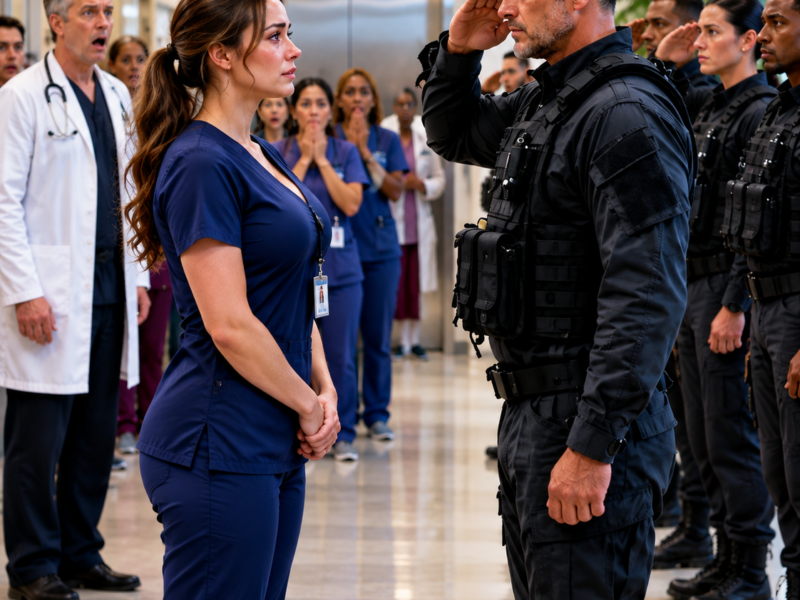
“Dr. Richard Hayes called me incompetent in front of a crowded hospital lobby, ordered me to stay away from his trauma patients
The young soldier’s words hung in the hospital lobby, and Dr. Hayes tightened his grip on the clipboard as if the papers inside could protect him from whatever was coming.
“Security,” he called again. “I want these men escorted out.”
Nobody moved.
Marcus glanced at me, then at the eight soldiers standing between the reception desk and the elevators.
“Doctor,” he said carefully, “I think you should let her read the document.”
Hayes’s face reddened. “I don’t take instructions from security guards.”
“Then take them from me,” I said.
My voice sounded calmer than I felt.
“Give me the file.”
For several seconds, he stared at me. Then he pulled the folded document from behind his clipboard and held it against his chest.
“You’re making a serious mistake,” he said.
“Maybe. But you’ve been making decisions about my character all morning without knowing a single thing about my past. I’d like to see what you’re so afraid of.”
His jaw tightened at the word afraid.
Sergeant Miller stepped closer, but I raised one hand to stop him.
I didn’t need eight soldiers to defend me from a doctor in a white coat. If Daniel Brooks had somehow survived, I needed answers more than I needed a confrontation.
Hayes finally shoved the document toward me.
“Take it. But don’t expect the hospital to become part of your personal investigation.”
I unfolded the first page.
The document was a photocopy of an official military incident report dated three years earlier. My name appeared near the bottom, typed beneath a section labeled PERSONNEL ACCOUNTABILITY.
Captain Emily Carter.
The report stated that I had been responsible for the medical evacuation of a forward operating position after an attack. It listed four wounded personnel who had been transferred to a field hospital.
Then I saw Daniel’s name.
Sergeant Daniel Brooks.
Status at time of evacuation: deceased.
Below it was a sentence I remembered reading in that government office.
“Captain Carter acknowledged that the casualty could not be recovered before departure and authorized the withdrawal of the medical team.”
My fingers tightened around the page.
“I never authorized that,” I whispered.
Miller’s expression hardened.
“We know.”
“No. You don’t understand.” I looked up at him. “I signed the evacuation log because the commanding officer ordered the withdrawal. I never signed a statement saying Daniel was dead, and I never said he couldn’t be recovered.”
“That’s what the report says,” Miller replied. “But that’s not what happened.”
The youngest soldier stepped forward.
“His name is Private Noah Bennett,” Miller said. “He was with Daniel that night.”
Noah looked barely old enough to shave, but the grief in his eyes seemed much older than he was.
“I was a medic trainee,” he said. “Sergeant Brooks was still talking when we loaded the last casualties. He asked me to tell you something.”
I couldn’t breathe properly.
“What?”
Noah glanced toward Hayes.
“He said, ‘Don’t let them use the second list.'”
The words meant nothing to anyone else in that lobby.
To me, they meant everything.
Three years earlier, before the attack, I had found a discrepancy between the names on our evacuation roster and the names on a separate medical transfer list. Three people appeared on the second list who weren’t supposed to be at our position.
I reported the discrepancy to my commanding officer.
He told me it was an administrative error.
By the following evening, the attack had happened, Daniel was missing, and I was being questioned about a decision I hadn’t made.
The second list had disappeared from the investigation file.
I had spent months trying to get someone to look at the discrepancy again. Eventually, my request was denied, the case was closed, and I was advised to stop pursuing information that had already been reviewed.
Then I left military service.
I came home to Ohio, rented a small apartment near Lake Erie, and accepted a nursing position at Westbridge Medical Center. I told myself that saving lives in a civilian hospital was enough.
I’d never expected the past to walk through the front doors wearing combat boots.
I looked at Noah.
“Where did you get that message?”
“An encrypted account. It used Daniel’s old identification number. The account went quiet after the first message, but the last one included a photograph.”
He reached into his pocket and pulled out his phone.
I leaned toward the screen.
The photograph showed a man sitting beside a window in a plain room. He was thinner than I remembered, with a pale scar running from his left temple toward his ear.
But I recognized the crooked smile.
Daniel had that same smile the first time I treated him for a cut above his eyebrow. He’d told me the scar would make him look more interesting to women.
I had told him it would make him look like someone who didn’t know how to duck.
The man in the photograph was older, gaunter, but unmistakably Daniel Brooks.
My knees weakened.
“When was this taken?”
“Six months ago,” Noah said. “The account sent it with a message saying he couldn’t safely contact anyone directly.”
I touched the screen with one finger.
Daniel was alive.
Or he had been alive six months ago.
Three years of grief, unanswered questions, and waking in the middle of the night with his name on my lips collapsed into a single impossible image.
“Why didn’t you bring this to the authorities?” I asked.
“We tried,” Miller said. “The first investigator told us the photograph couldn’t be authenticated. The second said the account had been compromised. Then we were warned that continuing to contact it could jeopardize a classified investigation.”
“And you came here?”
“We followed a lead that put you at this hospital. We didn’t know what we’d find. We certainly didn’t expect that doctor to have your file.”
I turned toward Hayes.
He was no longer pretending to be angry.
He looked as though he were calculating the distance between himself and the nearest exit.
“How did you get this document?” I asked.
“I reviewed your personnel information when you were hired.”
“That doesn’t explain why you recognized the report.”
Hayes straightened his coat.
“I’m a physician. I’ve consulted on military medical cases.”
“Which cases?”
“That information is confidential.”
“Then why did you have a copy of my report?”
He opened his mouth, but no answer came.
At that moment, a nurse hurried from the emergency department.
“Dr. Hayes, we need you in trauma. Ambulance inbound. Male patient, approximately forty-five, found unconscious in a parking garage. He’s showing signs of severe internal bleeding.”
Hayes grabbed the clipboard.
“Have the trauma team prepare operating room two.”
The nurse hesitated.
“There’s something else. The patient regained consciousness briefly during transport. He kept repeating a name.”
Hayes stopped.
“What name?”
The nurse looked at her notes.
“Emily Carter.”
Every face in the lobby turned toward me.
The paper in my hands began to tremble.
“Where is he?” I asked.
“Emergency bay three.”
I was already moving before the nurse finished speaking.
The emergency department smelled of antiseptic, warmed blankets, and the metallic tang of blood. A paramedic stood beside the gurney, giving a rapid report while another cut away the patient’s shirt.
The man’s face was bruised, his breathing shallow. A dark stain spread beneath the dressing wrapped around his abdomen.
I reached the bedside.
“Sir, can you hear me?”
His eyelids fluttered.
For a moment, I saw only a stranger struggling to breathe.
Then his eyes opened.
Gray-green. Tired. Familiar.
“Emily,” he rasped.
I gripped the bed rail.
“Daniel?”
His fingers twitched toward my wrist.
“Don’t let them take the list.”
His eyes rolled shut.
The monitor alarmed, and the trauma team surged forward.
Hayes pushed past me.
“Move. We need to stabilize him.”
I stepped aside, but I kept my gaze on Daniel as the team worked. An emergency physician called for blood products. A nurse established another IV line. The attending surgeon assessed the abdominal injury and began issuing orders.
Hayes moved to the head of the bed.
“He’s unstable. We need to get him upstairs.”
Then he saw the small object clenched in Daniel’s right hand.
A flash drive.
Hayes reached for it.
I caught his wrist.
“Don’t.”
He stared at my hand as though he couldn’t believe I’d touched him.
“Let go of me.”
“That’s evidence.”
“This man is critically injured, and you are interfering with his care.”
“Then treat him. I’ll secure the evidence.”
For a fraction of a second, his eyes flicked toward the flash drive.
That was all I needed to see.
I released him and called to the charge nurse.
“Please document that the patient arrived with an object in his right hand. Have it secured according to hospital policy once it’s safe to do so.”
The nurse nodded, her expression suddenly alert.
Hayes turned away and focused on Daniel.
Whatever he knew, he wasn’t going to risk Daniel dying in front of a dozen witnesses.
I stayed near the door while the team prepared him for surgery.
Miller and the other soldiers had followed us down the corridor, but I kept them outside the treatment area. They didn’t argue. They stood shoulder to shoulder against the wall, each man carrying a different piece of a history none of us had been allowed to understand.
When the operating room doors closed, I leaned against the wall.
My hands were shaking.
Miller approached quietly.
“Ma’am, we should tell you something before this gets any worse.”
I looked at him.
“There’s more?”
He nodded.
“Two weeks ago, somebody contacted our former unit commander. They said Daniel had been located and that anyone who tried to bring him home would be charged with interfering in a classified operation.”
“Who contacted him?”
“We don’t know. But they knew where all eight of us lived.”
The corridor suddenly felt too narrow.
“Why all eight?”
“Because all eight of us were there that night.”
He paused.
“And because all eight of us signed statements saying Daniel was alive when we left.”
I stared at him.
The official report had not merely changed my statement.
It had erased theirs, too.
“Did you tell the investigators that?”
“Every one of us.”
“What did they say?”
Miller looked down at his hands.
“They said we’d been under stress, that our memories were unreliable, and that we were confusing Daniel with another casualty.”
I closed my eyes briefly.
I’d spent three years believing I had failed one man. These soldiers had spent the same three years being told that their memories of him were wrong.
“What happens now?” I asked.
“Now we find out who was so determined to keep Daniel missing.”
A surgeon appeared at the end of the corridor before I could answer.
“Family for Daniel Brooks?”
Miller and I both stepped forward.
“I’m a longtime colleague,” I said. “And these men served with him.”
The surgeon nodded.
“We’ve controlled the bleeding for now. He’s in critical condition, but he’s responding to treatment. We need to get him into intensive care, and he’ll require close monitoring overnight.”
I let out a breath I hadn’t realized I was holding.
“Can I see him?”
“Briefly, once he’s settled.”
As the surgeon walked away, Miller placed a hand on my shoulder.
“You brought him home once, Captain. Maybe you can do it again.”
I wanted to believe him.
But when I looked through the glass toward the recovery corridor, I saw Dr. Hayes standing near the nurses’ station, speaking quietly into his phone.
He turned away when he noticed me watching.
I couldn’t hear what he said.
I could see his expression.
He wasn’t relieved that Daniel had survived.
He looked like a man whose plans had just become much more complicated.
I waited until he left, then asked the charge nurse whether the flash drive had been secured.
“It has,” she said. “It’s in the hospital’s evidence envelope, and the incident has been documented.”
“Who has access to it?”
“Only the staff listed in the report and the hospital’s designated security personnel.”
I thanked her and went to the intensive care unit.
Daniel lay beneath a white blanket, surrounded by monitors and IV lines. His face had been cleaned, revealing the scar I remembered from the photograph. Without the dust and bruises, he looked more like the young sergeant who used to bring me terrible coffee than the man who had just appeared in my emergency department.
I sat beside his bed.
For several minutes, I said nothing.
Then I leaned forward.
“I don’t know where you’ve been, Daniel. I don’t know who hurt you, or why you disappeared. But I’m here now.”
His fingers moved against the blanket.
I thought it was a reflex until his eyes opened.
“Emily?”
“I’m here.”
He swallowed painfully.
“Did they get it?”
“The flash drive? It’s secure.”
His gaze sharpened.
“Not secure enough.”
I leaned closer.
“Tell me what happened.”
He struggled to speak, and I reached for the call button. He shook his head.
“Listen. The list wasn’t just names. It was transfer orders. People who weren’t supposed to leave the base were moved out before the attack.”
“Who moved them?”
“I don’t know everyone involved. I only saw the authorization codes. But the second list was real. You were right.”
His breath caught, and I waited until he could continue.
“Someone used the evacuation to cover the transfers. When the attack happened, they needed a dead man to explain why the records didn’t match.”
“And they chose you.”
He closed his eyes.
“They chose you first. I found the discrepancy after you reported it. I copied the list because I thought it would protect you if anything happened.”
I stared at him.
“You had a copy?”
He gave the faintest nod.
“I hid it before the evacuation. They searched everything afterward, but they never found the original.”
“Where is it?”
His eyes moved toward the door.
“Not here.”
I heard footsteps in the corridor.
Daniel’s fingers clamped around mine with surprising strength.
“Emily, don’t trust the doctor.”
The door opened.
Hayes stepped inside.
He looked at Daniel, then at me, and finally at our joined hands.
“I need to speak with the patient alone.”
“No,” Daniel whispered.
It was the first time his voice had carried anything resembling anger.
Hayes’s face hardened.
“Sergeant Brooks, you’re in a hospital. You need to cooperate with your medical team.”
“You’re not my medical team.”
Hayes looked at me.
“I don’t know what this man has told you, but he’s seriously injured and may be confused. We need to limit stress and unnecessary visitors.”
“Then you can explain your concern to the attending physician,” I said. “You won’t be speaking to him alone.”
For a moment, the three of us stood in silence.
Then Hayes smiled, but there was no warmth in it.
“Of course.”
He left the room.
Daniel’s grip loosened.
“He’s not the one who ordered it,” he whispered. “But he knows who did.”
“Why would a civilian doctor be involved in a military cover-up?”
“Because some of the transfers went through a private medical contractor. The same contractor that handled the field hospital records.”
His eyes closed again, and the monitor beside his bed continued its steady rhythm.
I sat there long after he fell asleep, replaying every word.
The next morning, hospital security called me into a small conference room.
The flash drive had been moved to a locked evidence cabinet overnight. The designated security officer had discovered that the envelope’s seal had been disturbed.
Nothing appeared to be missing, but someone had attempted to access it.
The hospital had reviewed the access log.
Dr. Richard Hayes had entered the secure records area at 11:43 p.m.
I read the report twice.
“Has he been suspended?”
“Administration is reviewing the incident,” the security director replied. “Until they make a decision, we can’t discuss personnel matters.”
“He’s treating patients while under investigation for tampering with evidence.”
“We’re following procedure.”
I knew what that meant. Everyone was waiting for someone else to make the first difficult decision.
I walked out of the conference room and called Miller.
Within an hour, he and the other soldiers were back at Westbridge.
We met in a quiet family consultation room, away from the main lobby. Noah sat with his phone on the table, while Miller spread copies of the old incident report beside it.
“We need to find the original list,” I said. “Daniel says he hid it before the evacuation.”
“Did he tell you where?”
“No. He said it wasn’t here.”
Noah tapped his phone.
“There’s something else about the photograph.”
He enlarged the image Daniel had sent six months earlier.
At first, I saw only the window, the bare walls, and the man sitting beside the bed. Then Noah zoomed in on the reflection in the glass.
A road sign stood outside.
The letters were blurry, but a few were visible.
I leaned closer.
“That looks like the old medical complex outside Dayton.”
Miller frowned.
“The facility that closed after the contractor lost its government agreement?”
“Yes. It was used for temporary rehabilitation patients for years. If Daniel was being held somewhere connected to that contractor, it would make sense.”
“Do you think he’s still there?”
“I don’t know. But we have to check.”
Miller shook his head.
“We can’t just walk into a closed medical facility.”
“I wasn’t suggesting that. We give the evidence to the proper investigators and ask them to verify the location.”
Noah looked toward the door.
“How do we know the people who receive it won’t bury it again?”
Nobody answered immediately.
That was the hardest part. We had evidence of misconduct, but we had also seen how easily a report could be altered, a witness dismissed, and a person declared dead while he was still alive.
Finally, Miller spoke.
“We don’t hand it to one person and hope they do the right thing. We make copies, document every transfer, and take it through independent channels.”
I nodded.
It was the first plan we’d made that didn’t depend on trusting someone simply because of their title.
By noon, we had contacted an attorney who represented military whistleblowers and an independent federal investigator recommended by a retired officer Miller trusted. We provided copies of the report, the photograph, and the hospital’s access log.
We did not distribute the flash drive’s contents because we had not yet verified what was on it.
The investigator agreed to meet us that afternoon.
Before we could leave the hospital, a nurse called.
Daniel was awake and asking for me.
I returned to his room alone.
He looked exhausted, but his eyes were clearer than they had been the previous night.
“I remembered something,” he said.
“What?”
“The original list wasn’t the only copy.”
I pulled a chair closer.
“Where’s the other one?”
He took a shallow breath.
“Your medical kit.”
I stared at him.
“My field kit was returned to me after the investigation. I brought it home when I left the service.”
“Did you keep everything inside?”
“I think so.”
“Check the lining. The bottom panel was loose. I put the list there before the evacuation.”
For three years, that kit had sat in a storage box beneath my bed. I’d kept it because throwing it away felt like admitting that the part of my life it represented had never mattered.
I had never opened it.
I called my neighbor, who had a spare key to my apartment, and asked her to bring the box to the hospital.
When she arrived that evening, I carried it into the consultation room and shut the door.
The canvas was faded, and one strap had been replaced with a length of black webbing. I opened the main compartment and removed the remaining gauze, old instruments, and a folded field dressing.
Then I felt along the bottom seam.
A section of lining lifted under my fingers.
Inside was a thin, sealed plastic pouch.
My hands began to shake as I pulled it free.
The paper inside was yellowed around the edges, but the writing remained legible. Rows of names, transfer codes, and authorization numbers filled the page.
At the bottom were three signatures.
One belonged to the commanding officer who had ordered our evacuation.
The second belonged to a representative of the private medical contractor.
The third was a name I recognized from the hospital’s executive directory.
Dr. Richard Hayes.
For several seconds, I couldn’t move.
The doctor who had called me incompetent in front of a crowded lobby had signed a transfer authorization connected to the very operation that had cost Daniel three years of his life.
I photographed every page and sent the images to the investigator through the secure channel we’d been given.
Then I called Miller.
“Don’t confront Hayes,” I told him. “We have the original list, and his name is on it.”
Miller was silent for a moment.
“Captain, if that’s authentic, this goes much higher than one doctor.”
“I know.”
The investigator arrived less than an hour later with another agent. They photographed the document, verified the identifying marks, and took possession of it under a signed chain-of-custody form.
They also arranged for Daniel’s statement to be recorded when his doctors cleared him to participate.
For the first time in three years, the evidence was no longer sitting in a file controlled by the people accused of burying it.
But the case wasn’t finished.
The next morning, Hayes was escorted from Westbridge while hospital administrators reviewed the evidence. He did not resist, and he didn’t look at me as he passed through the lobby.
I watched him go without feeling triumphant.
I had wanted an explanation. I had wanted someone to acknowledge that the report had been wrong, that Daniel had not been abandoned, and that the soldiers who’d spoken up had not imagined what they saw.
What I wanted most was for the truth to stop being treated like a problem that could be managed away.
The investigation continued for months.
The original list, the altered evacuation report, the photograph, and the testimony of the eight soldiers helped investigators reconstruct the unauthorized transfers. Hayes had served as a medical liaison for the contractor before joining Westbridge, and investigators found evidence that he had knowingly approved records that concealed the movement of several personnel.
They also established that Daniel had been held at a private facility under a false identity after the evacuation. He had been moved between locations and threatened whenever he attempted to contact former members of his unit.
The reason was painfully simple: he had discovered the unauthorized transfers and kept evidence that someone believed had been destroyed.
The people responsible had relied on the distance between a battlefield and a hospital thousands of miles away. They had counted on exhaustion, secrecy, and the assumption that a dead soldier’s name would eventually become just another line in a closed report.
They had not counted on eight men remembering what they saw.
Or on a piece of paper hidden in the lining of a medical kit.
Hayes was eventually charged in connection with the falsified records and obstruction of the investigation. Other officials were investigated, and the unauthorized transfer scheme became the subject of a wider inquiry. Not every question was answered publicly, but the official finding that Daniel had died during the evacuation was formally withdrawn.
Daniel spent weeks recovering.
Some days, he was the same stubborn sergeant who used to complain about my coffee. Other days, he barely spoke, staring at the window as though he were still waiting for someone to come through a door.
I learned not to demand that he explain everything at once.
Healing was not a single conversation or a dramatic moment when the past finally released its hold. It was a series of small choices: sitting with him through a difficult night, letting him decide when he wanted visitors, and understanding that survival did not mean he owed anyone a performance of gratitude.
The eight soldiers visited whenever they could.
Noah came most often. He brought Daniel a terrible cup of hospital coffee one afternoon, and Daniel took one sip before making a face.
“That is criminal,” he muttered.
Noah laughed so hard that he had to set the cup down.
I laughed, too, and the sound surprised me.
It had been a long time since laughter in a hospital room had felt like something other than a brief interruption in the work of keeping someone alive.
When Daniel was finally strong enough to leave, the soldiers gathered near the hospital entrance.
It was the same lobby where Hayes had called me incompetent, where security had been asked to escort me away, and where eight men had saluted a woman they believed the world had forgotten.
This time, nobody ordered them to stand at attention.
They did it anyway.
I stopped in front of them.
“Please,” I said softly. “You don’t have to do that.”
Miller gave me a small, tired smile.
“We know, ma’am.”
Daniel stood beside me, one hand resting lightly against his side.
“They’re not saluting your rank,” he said.
I looked at him.
“What are they saluting?”
He glanced at the men, then back at me.
“The fact that you kept asking questions when everyone else wanted the report to be the end of the story.”
I looked down at the silver pin on my uniform.
For three years, I’d worn it as a reminder of the person I used to be, someone I wasn’t sure I could become again. Now it meant something different. Not because the investigation had proved me right, or because the men in front of me had honored me, but because I finally understood that leaving the service hadn’t erased the work I’d done or the person I’d been.
I was still Emily Carter.
I was still a nurse.
And I no longer needed to pretend that the past had never happened in order to build a life beyond it.
As Daniel and I walked toward the doors, sunlight spilled across the lobby floor. The automatic doors opened with a quiet hiss, letting in the sound of traffic and the ordinary rush of a city going about its day.
I had spent years believing that the worst thing someone could take from you was the truth.
I was wrong.
The worst thing was being made to doubt your own memory until you stopped looking for it.
That morning, eight soldiers had reminded me that the truth could survive in the people who carried it, even when the official record said otherwise.
And for the first time since the evacuation, I stepped outside the hospital without looking back.
The end.









