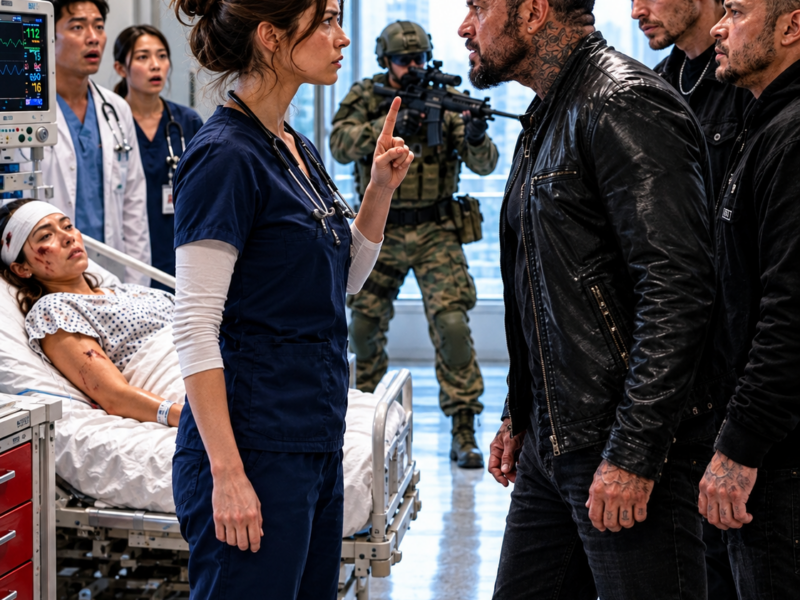
“BACK OFF!” I shouted, raising both hands as three men cornered me outside the emergency department
For several seconds, I couldn’t answer Jack Mercer.
My father’s name had not been spoken in my home for years. Not because we had forgotten him, but because every time someone mentioned him, my mother found a reason to leave the room.
When I was sixteen, she told me he had died during a classified Navy operation overseas. There had been no body, no funeral with an open casket, and no details beyond a folded flag and a letter from the government.
I had spent the next sixteen years building a life that didn’t depend on unanswered questions.
Now, standing in the emergency department with blood on my cheek, I was being told that a stranger knew something about my father that my own family had never explained.
“What do you know about him?” I demanded.
Jack’s expression softened, but he didn’t answer immediately.
The Navy commander stepped closer.
“Emily, my name is Commander Michael Hayes. I served with your father.”
“You knew him?”
“Yes.”
“Then tell me how he died.”
Hayes glanced at Jack.
Jack shook his head slightly.
“Not here,” he said.
I almost laughed.
“Not here? I’ve just been attacked at work, suspended from my job, and told that someone might be targeting me because of my father. You don’t get to decide when I deserve the truth.”
Jack accepted the rebuke without protest.
“You’re right.”
That surprised me.
He continued, “But there are people who may be monitoring this situation. We need to make sure we’re not handing them another opportunity.”
I looked toward the three men being escorted through the entrance.
“Those men?”
“Possibly.”
“Who are they?”
“We’re working on it.”
“That isn’t good enough.”
“No,” Jack said quietly. “It isn’t.”
Commander Hayes gave instructions to the officers, then arranged for Rachel, the young woman I had tried to protect, to be examined in a private treatment room. Security footage was preserved, witness statements were collected, and the three attackers were taken into custody.
Only after the immediate danger had been contained did Hayes ask me to accompany him and Jack to a private conference room.
I agreed on one condition.
“No more half-truths.”
Hayes nodded.
“That’s fair.”
I followed them inside.
The door closed behind us.
Jack took the chair nearest the exit, a habit so automatic that he seemed unaware of it. Even injured, even after years away from active duty, he positioned himself where he could see everyone entering the room.
I noticed the details now: the old scar along his jaw, the careful way he moved his left shoulder, the faded military tattoo visible beneath his sleeve.
He wasn’t simply a veteran who happened to know how to fight.
He had spent years learning how to recognize danger before it reached him.
And somehow, that skill had led him into my life.
Commander Hayes placed a thin folder on the table.
“Your father was Lieutenant Daniel Carter. He served as a communications specialist supporting a Navy special operations unit. His final assignment involved an operation that became compromised before the team reached its objective.”
I sat very still.
“What does that have to do with me?”
“Your father discovered that information about the team’s movements was being leaked to people outside the authorized command structure. He reported the discrepancy.”
“And then he died?”
“That’s what the official report says.”
I looked at Jack.
“You don’t believe it.”
He shook his head.
“No.”
“Why?”
“Because I was there when the report was written, and the details didn’t match what I saw.”
My throat tightened.
“Were you with him when he died?”
Jack looked down at his hands.
“I was with him before the operation. I was one of the last people to speak to him.”
“That’s not what I asked.”
“No,” he admitted. “I wasn’t there when the final incident occurred.”
“Then how can you say he didn’t die?”
“Because we never recovered him, and because the evidence used to declare him dead was incomplete.”
I felt anger rise in my chest.
“So my mother was told he died without a body, and everyone just accepted it?”
“Not everyone,” Hayes said. “Some of us questioned it. The inquiry was closed before those questions were resolved.”
“Why?”
Hayes hesitated.
Jack answered for him.
“Because someone wanted it closed.”
Silence settled over the room.
I stared at the folder.
“What did my father discover?”
Hayes opened it.
Inside were copies of old communications logs, photographs of equipment, and a report with several sections blacked out.
“Your father found irregularities in the routing of mission intelligence,” Hayes explained. “Someone had accessed restricted information and transmitted details about operational movements to an unauthorized recipient.”
“An informant?”
“Possibly. Or someone who was being paid to provide information.”
“And my father found proof?”
“He believed he had.”
“Where is it?”
Hayes looked at Jack.
Jack’s face tightened.
“We don’t know.”
I stood abruptly.
“You brought me in here to tell me my father may have been murdered, but you don’t know who did it, where the evidence is, or whether he’s even dead?”
“We brought you in because someone appears to have connected you to the investigation,” Hayes replied. “The men who attacked you may have been trying to intimidate you or find out what you know.”
“I know nothing.”
“That may be why they underestimated you.”
I thought of the man in the leather jacket, his smile as he struck me, and the way his friend had grabbed my arm.
They hadn’t asked me questions.
They hadn’t demanded money.
They had simply tried to overpower me.
“Why would they come after me now?” I asked.
Jack leaned forward.
“Because something changed recently. Someone started asking questions about the old operation again.”
“Who?”
“I did.”
I stared at him.
“You?”
“Eighteen months ago, I received information suggesting that the original investigation had been deliberately compromised. I started tracing the records. A few weeks later, someone broke into my apartment and stole a box of documents.”
“Why didn’t you report it?”
“I did. The report disappeared.”
Hayes’s expression darkened.
“Jack brought the matter to me after that. I reopened the inquiry through a separate command channel, but we haven’t identified everyone involved.”
“And now three men attack me at my hospital.”
“Which suggests that someone believes your connection to Daniel Carter is important,” Hayes said.
I sat down slowly.
“My father never told me anything about his work. He used to bring home little gifts from his deployments, but he never talked about the missions.”
“Did he ever give you anything that seemed unusual?” Jack asked.
I tried to remember.
“He gave me a compass when I was twelve. A small brass one. He said it was for finding my way home.”
Jack and Hayes exchanged a glance.
“What happened to it?” Hayes asked.
“It’s at my mother’s house. In a wooden box with his letters.”
Jack’s face changed.
“Emily, do you know whether your mother has ever opened that box?”
“Of course. She’s kept it for years.”
“Then we need to speak with her.”
I shook my head.
“No. You need to explain why a compass matters before you turn my mother’s life upside down.”
Jack paused.
“Your father used a particular marking system to identify secure communications. It was simple enough to remember, but difficult to interpret without the original key. He sometimes used a compass symbol as part of that system.”
I looked at the folder again.
“You think the compass he gave me contains information about the investigation?”
“We think it’s possible.”
“And you waited until tonight to tell me?”
“We didn’t know you had it,” Hayes said.
I closed my eyes.
For sixteen years, the compass had sat in a wooden box, gathering dust beside photographs and letters from a man I believed I would never see again.
Now it might be the only thing connecting him to the truth.
I opened my eyes.
“Take me to my mother.”
***
My mother lived in a quiet neighborhood twenty minutes from the hospital.
When we arrived, the porch light was on, and the curtains in the living room were drawn. I had called her from the car, telling her I was coming over and that I needed to talk about Dad.
She hadn’t asked questions.
That frightened me more than anything else.
She opened the door before I knocked.
The moment she saw Commander Hayes, the color drained from her face.
“Michael?”
Hayes removed his cap.
“Margaret.”
She looked at Jack, then at me.
“Oh, Emily.”
Her voice broke.
I stepped inside.
“Mom, what do you know?”
She closed the door slowly.
For a long moment, she didn’t speak.
Then she walked toward the living room and sat on the sofa, her hands clasped tightly in her lap.
“I was hoping you would never have to ask me that question.”
I felt my stomach drop.
“You knew Dad might not be dead?”
She looked up at me with tears in her eyes.
“I knew the circumstances were strange. I knew they never gave us a complete explanation. But I didn’t know whether he was alive.”
“Why didn’t you tell me?”
“Because you were sixteen, and I had already lost him—or believed I had. I couldn’t bear the thought of making you wait for someone who might never come home.”
I wanted to be angry.
I was angry.
But beneath the anger, I could see the exhaustion in her face, the years she had spent trying to protect me from an uncertainty she couldn’t resolve herself.
“Where is his compass?” I asked.
She stood and went to a small cabinet beside the stairs.
From the bottom drawer, she removed a wooden box.
Inside were several photographs, a folded flag, a collection of letters, and the brass compass.
I picked it up.
It was heavier than I remembered.
The lid opened with a small click, revealing the glass face and the needle that always pointed north. On the underside, beneath the hinge, was a series of tiny scratches.
Four short lines.
One longer line.
And a small symbol that looked like a wave.
Jack leaned closer but didn’t touch it.
“That’s a cipher mark.”
I looked at him.
“How do you know?”
“Your father showed me a similar mark during our training.”
My mother sat down again.
“Daniel told me that if anyone ever came asking about the compass, I should give it to Emily only after she was old enough to understand what it meant.”
I turned toward her.
“You knew it was important?”
“I knew he wanted you to have it. I didn’t know why.”
My fingers trembled as I examined the markings.
The wave symbol was familiar.
My father had drawn it in the margins of several letters, always beside a date or a place name. When I was younger, I had assumed it was a private joke.
I found one of the letters in the box and unfolded it.
The date was six weeks before his final deployment.
At the bottom, beside the same wave symbol, he had written a sentence.
*The truth is not always where the light falls.*
I read it aloud.
Jack went very still.
“That’s a reference to a lighthouse.”
My mother looked confused.
“Why a lighthouse?”
“Because the team used coastal landmarks as part of an emergency communications protocol,” Hayes explained. “A lighthouse could serve as a reference point when standard channels were compromised.”
I turned the compass over again.
“Which lighthouse?”
Neither man answered.
Then I remembered another detail.
When I was little, my father used to take me to a lighthouse on the Virginia coast. He would let me climb the steps and look through the viewing windows while he told me stories about sailors who had found their way home by following the light.
At the time, I thought he was simply teaching me how to read a map.
Now I wondered whether he had been showing me something he couldn’t explain directly.
“I know where to start,” I said.
Jack looked at me.
“Emily, if your father left evidence there, someone may have been looking for it for years.”
“Then we shouldn’t waste any more time.”
Hayes checked his phone.
“I’ll arrange a security team.”
“No,” I said. “Not until we know whether the people looking for this evidence can access military channels. The fewer people who know where we’re going, the better.”
Hayes studied me.
“You understand that this could be dangerous.”
“Three men attacked me in front of a waiting room full of witnesses. I’m already involved.”
Jack rose from his chair.
“Then you’re not going alone.”
I looked at him.
“I didn’t ask you to.”
“No,” he said. “But I’m coming anyway.”
***
The lighthouse stood at the edge of a rocky stretch of coastline, about an hour’s drive from my mother’s house.
We arrived shortly before dawn.
The wind was bitter, and waves crashed against the rocks below the narrow path. A maintenance fence surrounded the base of the structure, but the gate was unlocked.
Jack moved ahead, scanning the area.
I followed with the compass in my pocket and my father’s letter folded inside my jacket.
“Do you always look at everything like it might attack you?” I asked quietly.
“Only when I’m somewhere people have been warned not to go.”
“That’s reassuring.”
He gave a brief smile.
“It’s not meant to be.”
We reached the lighthouse door.
It was old, with peeling white paint and rust along the hinges. I searched the frame and found a small metal plate beneath the handle. A compass symbol had been etched into its surface.
The wave mark appeared beneath it.
I took out my father’s compass and held it beside the plate.
The markings matched.
There was a narrow slot beneath the symbol.
I pressed the compass into it.
A soft click sounded from inside the door.
The lock released.
Jack looked at me.
“Your father planned for someone to find this.”
“Someone who had the compass.”
“Someone he trusted.”
I pushed the door open.
Inside, a narrow staircase wound upward around the central column. The air smelled of dust and salt. We climbed until we reached a small maintenance room beneath the lantern chamber.
At the far wall stood a metal cabinet.
The door was locked, but the same compass symbol appeared beside the handle.
I examined the markings.
Four short lines.
One long line.
A wave.
I entered the numbers from my father’s letter into the small keypad beside the cabinet.
Nothing happened.
I tried the date of his deployment.
The lock clicked open.
Inside was a waterproof case containing a flash drive, several photographs, and a notebook filled with handwritten entries.
I opened the notebook.
The first page contained a list of dates, coordinates, and names.
One name appeared repeatedly.
Captain Adrian Cross.
Jack leaned over my shoulder.
“Cross was the operations officer who approved the mission routing.”
I turned another page.
There were records of communications sent from a restricted terminal, payment references, and notes about a private contractor moving weapons through an overseas port.
Then I found the entry that made my hands go cold.
*If anything happens to me, the official record will say the team was compromised by a local source. That will be a lie. The leak came from inside our own command structure.*
Below it was a final line.
*Cross knows who gave the order. He is not the only one.*
I stared at the words.
“There’s someone else.”
Jack nodded.
“And your father knew it.”
A noise came from the staircase below us.
Footsteps.
Jack immediately closed the notebook and moved toward the door.
“Stay behind me.”
I slipped the flash drive into my pocket.
A man appeared at the top of the stairs.
He wore a dark jacket and gloves, and he held a compact pistol pointed toward the floor.
“Step away from the cabinet,” he ordered.
Jack moved between us.
“Put the weapon down.”
The man laughed.
“You should have stayed retired, Mercer.”
Jack’s expression hardened.
“You should have stayed away from her.”
The man raised the pistol.
Everything happened at once.
Jack shoved me behind the metal cabinet as the first shot struck the wall. The sound was deafening inside the small room. I dropped to the floor, covering my head while Jack closed the distance between himself and the attacker.
There was a struggle.
A sharp impact.
Then silence.
I looked up.
Jack stood beside the doorway, breathing hard. The gun lay several feet away, and the attacker was on the floor, conscious but unable to get up.
Jack kicked the weapon out of reach and secured the man’s hands with a restraint from his pocket.
I stared at him.
“You’re hurt.”
He glanced at his arm. Blood was spreading through the bandage he had been wearing since his arrival at the hospital.
“It’s nothing.”
“That is not an acceptable medical assessment.”
Despite everything, he almost smiled.
“Noted, Nurse.”
I crouched beside the attacker.
“Who sent you?”
He refused to answer.
I examined his jacket and found a small identification card tucked into an inner pocket.
The name was unfamiliar, but the contractor’s logo matched a reference in my father’s notebook.
I looked at Jack.
“This wasn’t random.”
“No,” he replied. “Someone knew we were coming.”
I glanced toward the open cabinet.
Then I understood.
The attack at the hospital, the threat against Mason, and the man at the lighthouse were connected. Whoever had spent years burying the truth was still trying to keep it hidden.
And now they knew we had found something.
***
We contacted Commander Hayes through a secure line.
He arrived with an investigative team less than an hour later. The attacker was taken into custody, the lighthouse was secured, and the contents of the cabinet were documented and transported for forensic examination.
Hayes examined the notebook in silence.
When he reached the final entry, he closed it carefully.
“Cross is going to have a difficult time explaining this.”
“Is he the one who sent the men to the hospital?” I asked.
“We don’t know yet. But the contractor’s name appears in several records tied to his old assignment.”
Jack leaned against the wall, his injured arm pressed against his side.
“We need to identify the person above Cross.”
Hayes nodded.
“We’ll trace the payment records and compare them with the original mission logs.”
I turned toward him.
“You said you served with my father. Did you know he suspected Cross?”
“Yes.”
“Then why didn’t you stop the mission?”
Hayes looked down.
“Because the information reached me too late. By the time I received Daniel’s warning, the operation was already underway. I tried to redirect the team, but the replacement order had been authenticated through a channel I believed was secure.”
“Believed?”
“I trusted the system.”
“And my father paid for it.”
Hayes didn’t look away.
“Yes.”
For a moment, I hated him.
I hated the fact that he had survived while my father vanished. I hated the years of silence and the official letters that had reduced a human life to a few lines on paper.
But I also saw that he wasn’t trying to excuse himself.
He was admitting what he had done wrong.
“What happens now?” I asked.
“Now we follow the evidence,” he replied. “And we don’t let anyone bury it again.”
***
The forensic team decrypted the flash drive within forty-eight hours.
It contained the original mission logs, financial records, and a series of messages between Captain Cross and a civilian defense contractor named Victor Hale.
Hale had arranged payments to several intermediaries in exchange for restricted operational information. Cross had altered the mission route and used compromised communications credentials to send the team into an ambush.
But the records revealed something more disturbing.
A senior official had approved the payments and authorized the cover-up.
His name was Admiral Richard Voss.
Voss had since retired from active service, but he still worked as a consultant for the same defense contractor named in my father’s notebook.
The connection explained why earlier investigations had stalled. The people reviewing the evidence had been reporting through a chain that included individuals with financial and professional ties to the contractor.
Cross had not been acting alone.
When investigators approached Voss, he denied involvement and claimed the records were fabricated. His legal team demanded an independent review, and he publicly accused the Navy of persecuting retired officers based on unverified allegations.
For a brief moment, it looked as though the case might disappear into another battle over paperwork.
Then Mason came forward.
He provided a sworn statement describing the ambush, Daniel’s efforts to preserve the original communications logs, and the orders he had received during the mission. His testimony matched the records recovered from the lighthouse.
Jack also provided his own account.
He described the warnings Daniel had given him before the operation and the discrepancies he noticed afterward. He explained why he had spent eighteen months trying to locate the missing evidence and how the attack on me had convinced him that the threat was still active.
Together, their accounts gave investigators something they had lacked for years: a coherent explanation supported by independent witnesses and physical evidence.
Cross was arrested.
Hale was charged with conspiracy and illegal disclosure of restricted information.
Voss was placed under investigation, and his consulting contracts were suspended pending the outcome.
The inquiry was far from over, but the truth could no longer be dismissed as a grieving family’s suspicion.
For the first time in sixteen years, the official record of my father’s final mission was being rewritten.
***
The hospital reinstated me after completing its own review of the assault.
The security footage showed that I had attempted to protect Rachel and de-escalate the confrontation before the men attacked me. My actions were found to be appropriate under the circumstances.
Nurse Manager Wells met me in her office on my first day back.
“I owe you an apology,” she said.
I waited.
“We treated your response as a policy violation before we had all the facts. We should have investigated before suspending you.”
“Yes,” I replied. “You should have.”
She looked uncomfortable, but she didn’t argue.
“Will you accept the apology?”
“I accept that you’re offering one. But I hope the hospital changes how it handles situations like this.”
“We’re reviewing our procedures.”
“Good.”
I returned to the emergency department that afternoon.
Rachel was waiting near the nurses’ station.
Her cheek was healing, and the bruising on her arm had begun to fade. When she saw me, she stood and walked toward me.
“I heard what happened at the lighthouse,” she said.
I stared at her.
“How?”
“Commander Hayes told the hospital security chief that the investigation was connected to the men who attacked us. He didn’t give me the classified details.”
I nodded.
Rachel looked down at her hands.
“I wanted to thank you. You stood between me and those men when you could have walked away.”
“You needed help.”
“I know. But people don’t always help.”
She hesitated.
“I left him before I came to the hospital. I thought if I got medical attention, he would leave me alone. I didn’t expect him to follow me.”
“Do you have somewhere safe to stay?”
“Yes. My sister is letting me stay with her.”
“Good. If you need help arranging support, let me know.”
She smiled faintly.
“You’re a good nurse, Emily.”
After she left, I stood at the nurses’ station for a moment, listening to the familiar sounds of the department.
For weeks, I had been pulled into a world of classified files, military investigations, and secrets buried for years.
But none of it changed why I had become a nurse.
People came to the emergency department when they were frightened, injured, or out of options.
Sometimes they needed medicine.
Sometimes they needed someone to believe them.
And sometimes, they needed another person to stand between them and the people who wanted them silent.
I had done that for Rachel.
Jack had done it for me.
***
Three months later, Commander Hayes called me with an update.
The investigation had established that my father had survived the initial ambush.
A local medical team had treated him under an emergency arrangement after he was separated from his unit. Before military investigators could reach the location, he had disappeared.
The evidence suggested he had gone into hiding after discovering that the mission’s command records had been compromised.
Investigators found no reliable proof that he was still alive, but they also found no evidence that he had died in the immediate aftermath of the operation.
The official death finding was amended to reflect the uncertainty.
It wasn’t the answer I had wanted.
But it was the truth.
Hayes also told me that the Navy had opened a formal review of the command decisions that led to the ambush and the subsequent cover-up. The review included the failures that allowed the original evidence to be lost and the reporting channels that had been used to suppress questions.
“What happens to Jack?” I asked.
“He’s been asked to advise the investigation, but he hasn’t accepted a permanent role.”
“Why not?”
“He says he’s spent enough time fighting people who think the truth belongs to them.”
I smiled faintly.
“That sounds like him.”
Hayes paused.
“There’s something else. Jack asked me to give you this.”
A small envelope arrived at my home the next day.
Inside was a photograph of Jack standing beside my father near a military transport aircraft. Both men were younger, grinning at something outside the frame.
On the back, my father had written:
*If you ever meet Emily, remind her that courage isn’t the absence of fear. It’s what you choose to do while you’re afraid.*
I sat at the kitchen table and read the sentence until the words blurred.
For years, I had imagined my father as a memory trapped inside a folded flag and an official letter.
Now I had a photograph of him laughing, a notebook in his handwriting, and evidence that his final mission had been nothing like the story I had been told.
I still didn’t know where he was.
I still didn’t know whether I would ever see him again.
But I finally knew that his life had not been erased by the report written about his death.
And neither had mine.
***
Jack came back to St. Mary’s a week later.
This time, he arrived through the main entrance without an injury, wearing a clean shirt and carrying two coffees.
I was finishing my shift when he found me at the nurses’ station.
“I brought a peace offering,” he said, holding one out.
I eyed the cup.
“Is it an apology for getting shot at in my general direction?”
“I wasn’t shot.”
“You were bleeding in a lighthouse.”
“Technically different.”
I laughed before I could stop myself.
He looked pleased.
We walked outside to the small courtyard behind the hospital, where the rain had finally given way to clear skies.
For a while, neither of us spoke.
Then Jack said, “I’m sorry you got pulled into all this.”
I looked at him.
“You didn’t choose the people who attacked me.”
“I could have told you more sooner.”
“You didn’t know I was connected to Daniel until you saw the tattoo.”
“I knew you were connected before that. I just didn’t know how.”
“That’s not the same thing.”
“No,” he admitted. “It isn’t.”
I studied him.
“Why did you leave the Navy?”
He looked toward the trees.
“After the operation, I spent a long time believing that if I’d made one different decision, the team might have survived. I left because I couldn’t tell the difference between doing my job and trying to punish myself.”
“Did it work?”
“No.”
He gave a small, rueful smile.
“Turns out you can change your uniform and still carry the same problems.”
I understood that more than he probably realized.
I had spent years trying to build a life that didn’t require me to ask questions about my father. I had buried my grief beneath work, convinced that if I helped enough people, the empty space in my family would eventually become easier to live with.
It hadn’t.
But now I was beginning to understand that I didn’t have to let the past make every decision for me.
“You know,” I said, “when those men attacked me, I was terrified.”
“I know.”
“I wasn’t brave. I was scared, and I was angry, and I didn’t want Rachel to be dragged out of that hospital.”
“That’s what courage usually looks like.”
I glanced at him.
“You always talk like that?”
“Only when I’m trying to impress a nurse.”
I laughed again.
It felt strange, but good.
Jack looked at me more seriously.
“I can’t promise you that we’ll find your father. I can’t promise that every person involved will be held accountable. But I can promise that I won’t lie to you about what we learn.”
I considered the promise.
It was smaller than the guarantees people had given my family over the years.
It was also more valuable.
“That’s a start,” I said.
***
A year after the attack, the investigation reached its first major conclusion.
Captain Cross pleaded guilty to charges connected to the unauthorized disclosure of operational information and the falsification of mission records. Victor Hale faced separate criminal proceedings, and the evidence against Admiral Voss led to further inquiries into his financial dealings and role in the cover-up.
The Navy issued a formal acknowledgment that its original investigation had failed to adequately examine discrepancies in the mission record.
My father’s death declaration remained under review, but his name was cleared of the allegations that had been used to explain the mission’s failure.
I attended the ceremony with my mother.
She held my hand throughout the proceedings, her fingers cold and trembling.
When the officer reading the statement reached my father’s name, she began to cry silently.
I didn’t try to stop her.
Some grief had been waiting sixteen years for someone to admit that it had been built on a lie.
Afterward, we went home and opened the wooden box together.
We read Daniel’s old letters, examined the photographs, and laughed at stories we had forgotten. For the first time in years, my mother talked about him without looking as though the memory might break her.
We didn’t find a final answer.
But we found a different way to remember him.
Not as a man who had vanished into a classified report, but as a son, a brother, a husband, and a father who had tried to do the right thing when the people around him had failed.
***
I still wear the compass tattoo on my wrist.
The small marks haven’t changed, and the line still points north.
People sometimes ask me what it means.
I tell them it’s a reminder to find my way home.
I don’t explain the rest unless I trust them enough to hear it.
Jack still visits the hospital from time to time. He helps with a veterans’ support program and occasionally sits in the courtyard with a cup of coffee, watching the world go by without looking over his shoulder every few seconds.
He’s learning how to live without expecting every quiet moment to turn into a threat.
I’m learning that protecting people doesn’t mean carrying every burden alone.
We never made grand promises about the future.
We didn’t need to.
Some things grow better when they’re allowed to happen honestly, without pressure or performance.
One evening, after a long shift, I found Jack waiting near the emergency department doors.
“Bad night?” he asked.
“Three admissions, two angry relatives, and a vending machine that stole my money.”
“Sounds dangerous.”
“The vending machine was the worst of them.”
He smiled and offered me his hand.
I took it.
For a moment, I thought about that first night: the men who had cornered me, the fear that had frozen my legs, and the stranger who stood up when everyone else was still deciding whether to intervene.
Jack had not saved me because he was a Navy SEAL.
He had helped because he had seen someone being hurt and refused to look away.
That was the part I wanted to remember.
The uniform, the training, and the scars explained how he could act so quickly.
They didn’t explain why he chose to.
That came from somewhere deeper.
I looked down at the compass on my wrist, then back at him.
“My father used to say that courage was what you did while you were afraid.”
Jack nodded.
“He was right.”
I squeezed his hand.
“Then I guess I’m still learning.”
“So am I.”
We walked into the evening together.
My father’s story was no longer finished, and the search for him continued. There were still unanswered questions, still people who needed to face the consequences of what they had done, and still a family waiting for a homecoming that might never come.
But I no longer felt trapped by the silence.
I had learned that the truth could be buried, delayed, and deliberately distorted.
It could cost people their careers, their freedom, and sometimes their lives.
But it could also survive in a letter, a compass, a witness who refused to forget, or a nurse who chose to stand between a frightened woman and the men hurting her.
That night, I went back to work.
A new ambulance was arriving, its lights flashing against the glass doors.
Someone needed help.
I tightened my gloves, checked the trauma bay, and moved toward the entrance.
Whatever waited on the other side, I would face it one decision at a time.
Because courage wasn’t the absence of fear.
It was what I chose to do while I was afraid.
The end.









