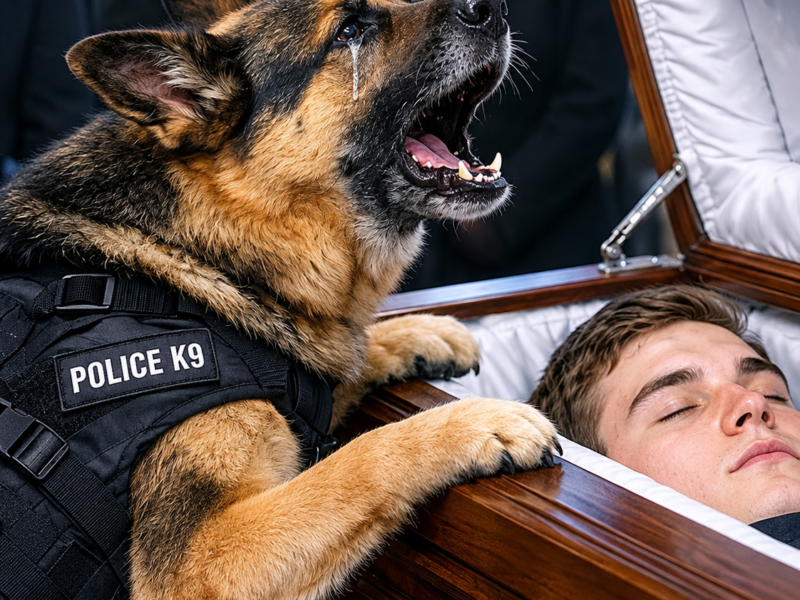
“At my husband’s police funeral in Arlington National Cemetery, his K-9 partner suddenly lunged at the flag-draped coffin
Captain Hayes reached for the piece of fabric, but I pulled Emma behind me and closed my fist around it.
“Don’t touch that,” I said.
His hand stopped in midair.
For several seconds, nobody moved.
The honor guard stood frozen beside the coffin. Officer Miller kept one hand on Max’s collar, while the funeral director stared at the ground as if he wished the pavement would open beneath him.
Hayes lowered his hand.
“Sarah, I understand you’re upset. You’re grieving, and this situation is getting out of control.”
I looked at the four words in my palm.
“Then explain why my husband left me a warning about you.”
His jaw tightened.
“Daniel was under enormous pressure before he died. You know that.”
“I know he trusted you.”
“Exactly. Which is why you need to listen to me.”
He glanced toward the other officers.
“Let’s get Mrs. Carter somewhere private.”
I recognized the tone.
It was the same voice he used when he wanted a room to follow his instructions without asking questions.
But Daniel had once told me something about men who gave orders.
“Never confuse a calm voice with an honest one.”
I stepped away from Hayes.
“I’m not going anywhere until someone explains why my husband’s coffin has a hidden seam.”
The funeral director finally spoke.
“Mrs. Carter, please. I was only following instructions.”
“Whose instructions?”
He looked at Hayes.
That was enough.
Hayes took a step toward him.
“Frank, don’t.”
The funeral director flinched.
I felt Max press against my leg.
Then Officer Miller spoke.
“Captain, I think we need to call the department’s internal affairs division.”
Hayes turned sharply.
“Nobody is calling anybody.”
Miller didn’t move.
“Sir, this is no longer a routine funeral.”
For the first time, I noticed something else.
Two officers standing near the cemetery entrance had quietly moved closer to Hayes.
They weren’t helping him.
They were watching him.
And one of them had his hand resting near his radio.
I looked down at Max.
His ears were pointed toward the coffin again.
He gave a short whine.
“Please,” I whispered. “Show me.”
Miller looked at me.
“Ma’am, what are you asking?”
“Open it.”
The funeral director shook his head.
“We can’t do that here.”
“Why not?”
He swallowed.
“Because the coffin was sealed before it arrived.”
I stared at him.
“Sealed by whom?”
He didn’t answer.
Hayes stepped between us.
“That’s enough. The funeral is over.”
I almost laughed.
My husband had been dead for six days.
His daughter was standing beside his coffin.
And the man who had supposedly spent nine years protecting him was more concerned about ending a ceremony than finding out why a police dog was desperately trying to get inside.
“No,” I said. “It isn’t.”
I turned to Miller.
“Call whoever you need to call. But nobody touches that coffin until someone independent examines it.”
Miller nodded.
He took out his radio.
Hayes moved toward him, but one of the officers near the entrance stepped forward.
“Captain, I’d advise you to stay where you are.”
The change in the atmosphere was immediate.
Hayes looked from one officer to the other.
Then he slowly lowered his hands.
Within fifteen minutes, an internal affairs investigator arrived with two additional officers.
Her name was Lieutenant Dana Brooks.
She was in her early forties, with short brown hair and the tired expression of someone who had already seen too many people lie for a living.
She introduced herself to me and listened without interrupting.
When I showed her the fabric, she examined the handwriting.
“Is this definitely your husband’s?”
“Yes.”
“Have you seen this handwriting before?”
“Every day for twelve years.”
She looked at the note again.
Then she turned toward Hayes.
“Captain, I’d like you to explain why your name appears in a warning found at the scene of Officer Carter’s funeral.”
Hayes gave a short, humorless laugh.
“You’re seriously going to question me based on a scrap of fabric?”
“I’m going to question everyone.”
She nodded toward the coffin.
“And I’m going to find out why a trained police dog is reacting to it.”
The funeral director began trembling.
“I didn’t know,” he whispered.
Dana turned toward him.
“Didn’t know what?”
He looked at the coffin.
Then at Hayes.
“I was told the family had approved a replacement.”
My mouth went dry.
“Replacement?”
He nodded.
“The original coffin was changed last night.”
I felt Emma’s fingers tighten around mine.
“Why would anyone replace my daddy’s coffin?”
The man looked as though he might cry.
“I was told there had been a problem with the first one.”
Dana’s expression hardened.
“Who told you?”
He looked at Hayes again.
Nobody spoke.
Finally, he said, “Captain Hayes.”
Hayes shook his head.
“That’s a lie.”
But the funeral director had already begun talking.
He explained that the original coffin had arrived at the funeral home two days earlier.
It had been prepared according to the family’s instructions.
Then, shortly after midnight, Hayes had called and requested a last-minute substitution.
He claimed the original coffin had been damaged during transportation.
The funeral director had agreed because Hayes had presented official paperwork.
“Do you still have the original?” Dana asked.
The man hesitated.
“I think so.”
“Where?”
“At the funeral home. In storage.”
Dana looked at her officers.
“Secure it. Nobody moves anything until the evidence team arrives.”
Hayes took a step forward.
“You don’t understand what you’re doing.”
Dana turned to him.
“Then help me understand.”
He said nothing.
For the first time, I noticed that his right hand was shaking.
Not much.
Just enough.
And Max noticed it too.
The dog moved away from me and began growling at Hayes.
Miller gently pulled him back.
“Easy, buddy.”
Hayes stared at the dog.
Then he looked at me.
“Sarah, Daniel made mistakes. He got involved in something he couldn’t control.”
My throat tightened.
“What mistakes?”
He looked toward Emma.
“Not here.”
I felt anger rise behind my ribs.
“You don’t get to decide where I hear the truth about my husband.”
Dana stepped closer.
“Captain, I think you’d better stop talking until we can arrange a formal interview.”
Hayes looked at her.
Then he looked at the coffin.
And finally, he said something that made the funeral director cover his mouth.
“You’re too late. Whatever Daniel wanted you to find is already gone.”
Nobody moved.
Dana’s eyes narrowed.
“What exactly is gone?”
Hayes didn’t answer.
Instead, he asked for his lawyer.
That was when I realized the note hadn’t been written to frighten me.
Daniel had expected this.
He had known that someone might try to interfere with his funeral.
And he had somehow arranged for Max to recognize the danger.
But I still didn’t know why.
Not until the evidence team arrived.
They examined the coffin carefully before removing the lower panel.
The narrow seam Max had been scratching was not part of the original construction.
It had been fitted recently.
Inside the small compartment was a folded piece of paper, a damaged microSD card, and a tiny brass key.
There was also something else.
A strip of blue fabric.
I recognized it from Daniel’s old winter police jacket.
I had repaired that jacket twice.
The last time was three weeks before he died.
I remembered him standing in our kitchen, asking me to sew a small tear near the inside pocket.
“Don’t throw this jacket away,” he had said.
“I wasn’t planning to.”
He had smiled.
“Good. I might need it again.”
At the time, I thought he was joking.
Now I watched Dana carefully place the objects into separate evidence bags.
“Do you know what these are?” she asked.
I shook my head.
But Max was staring at the brass key.
His tail moved once.
Then he looked toward the cemetery parking lot.
It was as if he was waiting for someone.
Dana noticed.
“Does he recognize that?”
“I don’t know.”
She studied the dog.
“Maybe he knows where it belongs.”
The microSD card was too damaged to read immediately.
The folded paper, however, was intact.
Dana opened it.
There were only two lines.
Locker 214. Union Station.
The truth is on the other side of the photograph.
I read the words twice.
“Union Station?”
Dana nodded.
“Washington, D.C.”
I looked at the brass key.
A number had been engraved into its handle.
214.
The next morning, Dana arranged for a small team to accompany me to Union Station.
Emma stayed with my sister, who had driven up from Virginia after hearing what happened at the funeral.
I didn’t want my daughter anywhere near another investigation.
Max came with us.
Dana had learned that he was no longer technically assigned to active duty because Daniel’s death had left the department’s K-9 unit without a handler.
But she allowed him to accompany me under Miller’s supervision.
We arrived shortly after nine.
The station was already busy.
People hurried past with coffee cups and rolling suitcases.
A child cried near the ticket counter.
Somewhere, a train announcement echoed through the building.
It was strange to be surrounded by ordinary life when mine had become a collection of evidence bags and unanswered questions.
Locker 214 was in a row near the lower concourse.
I inserted the key.
It turned smoothly.
Inside was a brown envelope, an old digital camera, and a photograph.
The photograph showed Daniel standing beside three other officers outside a warehouse.
I recognized one of them immediately.
Captain Hayes.
The second was Detective Michael Reeves, a man Daniel had worked with for years.
The third was someone I had never seen before.
He was wearing a dark civilian jacket.
On the back of the photograph, Daniel had written:
October 12. The night they told everyone the evidence was destroyed.
Dana leaned over my shoulder.
“What evidence?”
I opened the envelope.
Inside were printed pages of financial transfers, copies of police reports, and several photographs of sealed evidence containers.
Some of the reports had been marked as closed.
Others had been altered.
I didn’t understand every detail, but one thing was clear.
The same case number appeared repeatedly.
A case involving a warehouse robbery and the disappearance of nearly two million dollars in seized cash.
Dana examined the papers.
“These transfers came from a private security company.”
“Was that company connected to the department?”
“Not officially.”
She flipped through another page.
“That’s interesting.”
“What?”
“Several officers listed here signed off on evidence transfers that were never recorded in the department’s official system.”
She looked at the photograph again.
“Daniel was investigating an internal leak.”
My stomach tightened.
“Was Hayes involved?”
Dana didn’t answer immediately.
Instead, she studied the civilian man in the photograph.
“Do you recognize him?”
“No.”
She turned the photograph over.
There was another note in Daniel’s handwriting.
Find the person who never left the building.
I frowned.
“What does that mean?”
Dana looked around the station.
“Maybe nothing. Maybe someone was watching the warehouse from inside.”
She placed the photograph into an evidence sleeve.
Then Max began sniffing the brown envelope.
He nudged it with his nose and scratched at the bottom.
I opened it again.
There was a second sheet of paper tucked into the lining.
It contained a name.
Michael Reeves.
Dana went very still.
“Do you know him?” I asked.
She nodded.
“He’s the detective who was listed as the lead investigator on Daniel’s final operation.”
“Was?”
“He retired three days after Daniel died.”
I stared at her.
“Three days?”
“Yes.”
“That seems convenient.”
Dana folded the paper.
“It does.”
We spent the next several hours reviewing the documents with a forensic analyst.
The evidence suggested that someone had been diverting seized money through a private security company.
Reports had been altered to make the transfers appear legitimate.
But Daniel had found a discrepancy.
A warehouse inventory showed that one container had been removed before the official evidence seizure.
The signature authorizing the removal belonged to Michael Reeves.
And the witness signature belonged to Captain Hayes.
I remembered something Daniel had told me during dinner a month before he died.
He had been staring at his plate when I asked why he was so quiet.
“Some people spend twenty years building a good reputation,” he had said.
“And then they spend one night deciding whether it’s worth protecting.”
I had asked him what he meant.
He had simply shaken his head.
“Nothing you need to worry about.”
Now I understood that he had been talking about someone inside his own department.
But the documents still didn’t explain the coffin.
Why had Daniel hidden the key there?
Why had Max been trained to find it?
And why had Hayes gone to such lengths to replace the coffin?
The answer came from the damaged microSD card.
A forensic specialist managed to recover part of its contents that afternoon.
There were several audio recordings.
The first was mostly static.
The second contained a conversation between two men.
Dana played it in the conference room.
At first, I couldn’t identify the voices.
Then I heard one of them say, “The inventory is already clean. Nobody is going to reopen it.”
The second voice replied, “Daniel has the original records.”
The first man laughed.
“Then you should have taken them.”
There was a pause.
Then the second man said something that made me grip the edge of the table.
“He’s not going to hand them over.”
Dana stopped the recording.
She looked at me.
“That voice sounds like Hayes.”
I stared at the laptop.
“Play it again.”
She did.
I recognized it this time.
The slight rasp.
The clipped words.
The way he pronounced Daniel’s name.
It was Captain Hayes.
The second recording was clearer.
It appeared to have been made inside a vehicle.
A man said, “Reeves, I told you to leave Carter alone.”
Another voice replied, “He won’t stop.”
“Then make sure he can’t talk.”
The recording ended.
Nobody spoke for several seconds.
Dana closed the laptop.
“We have enough to request warrants and bring both men in for questioning.”
“Is that what happened to Daniel?” I asked.
She didn’t answer immediately.
“I don’t know yet.”
I hated that answer.
But I respected her for giving it.
That evening, we returned to the police department.
Hayes had already been placed on administrative leave.
His access card had been suspended, and investigators were searching his office.
Michael Reeves was nowhere to be found.
His house was empty.
His phone had been turned off.
His car had been discovered at a commuter parking lot outside Alexandria.
There was no sign of him.
I sat in Dana’s office while she spoke with the investigators.
Max lay beside my chair, his head resting on my shoe.
Every so often, he lifted his ears when someone walked past the door.
I was exhausted.
My husband had been dead for a week, and I had learned more about his final days in one afternoon than he had told me in our last month together.
I was angry with him for keeping me in the dark.
But beneath that anger was something worse.
I wondered whether he had been afraid to tell me because he knew the danger could reach our daughter.
At around seven, Dana returned with a new report.
“We found something in Hayes’s office.”
She placed a photograph on the desk.
It showed a small metal box hidden behind a filing cabinet.
Inside were several personal items belonging to Daniel.
His old watch.
A broken phone.
And a photograph of me and Emma at a school picnic.
I picked it up.
It had been taken from a distance.
I could see the playground in the background.
Emma was laughing, holding a red balloon.
I remembered that day.
Daniel had been on duty and couldn’t attend.
I had thought another parent had taken the picture.
“Why would Hayes have this?”
Dana looked uncomfortable.
“We’re still examining the box.”
I turned the photograph over.
There was a handwritten date.
Three days before Daniel died.
My fingers went cold.
“Someone was watching us.”
Dana nodded.
“That’s one possibility.”
I looked at her.
“Did Daniel know?”
“We don’t know.”
I studied the picture again.
Then I noticed something in the lower right corner.
A reflection in the glass of a parked car.
A man standing behind the fence.
I couldn’t make out his face.
But I recognized the coat.
It was the same dark jacket worn by the unidentified civilian in Daniel’s photograph outside the warehouse.
I handed it to Dana.
“That’s him.”
She examined the image.
“You’re sure?”
“Look at the coat.”
She compared it with the earlier photograph.
Her expression changed.
“You’re right.”
The unknown man was no longer unknown.
His name appeared in the financial records as the director of the private security company.
His name was Thomas Vance.
And he had once been employed as a civilian evidence contractor for the department.
He had left the position two years earlier.
Dana immediately requested a search of his last known address.
But before the team could leave, my phone rang.
It was an unfamiliar number.
I answered.
“Hello?”
A man’s voice came through.
“Mrs. Carter?”
“Who is this?”
“My name is Michael Reeves.”
I stood up.
Dana looked at me.
“Where are you?”
He ignored the question.
“I know what happened to Daniel.”
My mouth went dry.
“Then tell me.”
“Not over the phone.”
Dana motioned for me to put it on speaker.
Reeves continued.
“Your husband didn’t die because of the warehouse investigation.”
I gripped the phone.
“Then why did he die?”
There was a long silence.
“Because he found out what Vance was planning to do next.”
“What was he planning?”
Reeves exhaled.
“To make sure nobody could ever connect the missing evidence to the department.”
Dana leaned closer to the phone.
“Michael Reeves, this is Lieutenant Dana Brooks. Where are you?”
He gave a nervous laugh.
“I knew you’d be there.”
“Where are you?”
“An old storage facility near the river. I have something Daniel left behind.”
Dana asked him to stay where he was.
He agreed.
Then he said something directly to me.
“Mrs. Carter, there’s one thing you need to understand. Daniel didn’t trust Hayes, but he didn’t trust me either.”
The line went quiet.
Then he added, “And I deserved that.”
Dana dispatched officers to the location.
We arrived forty minutes later.
The storage facility was nearly empty, with rows of metal doors and a flickering security light near the entrance.
Reeves stood beside Unit 38.
He looked older than his photograph.
His hair had turned almost completely gray, and his hands trembled as he held a small black case.
Two officers approached him.
He raised both hands.
“I won’t run.”
Dana introduced herself.
“What’s in the case?”
Reeves looked at me.
“Everything I should have given Daniel before he died.”
He opened it.
Inside was a small digital recorder, a second memory card, and a handwritten statement.
Reeves began explaining.
He had been involved in the evidence diversion scheme for almost a year.
At first, he had told himself the transfers were temporary.
He believed the money was being moved to protect an undercover operation.
Then he discovered that Vance was selling information about police investigations to criminal groups.
Hayes had been receiving payments in exchange for keeping certain reports closed.
Reeves had signed false documents.
He had lied to investigators.
And when Daniel began asking questions, Reeves had warned Hayes.
He insisted he hadn’t known what Hayes would do.
“Daniel confronted me the night before the operation,” Reeves said.
“He told me he had the original inventory records and a recording of Vance discussing the missing containers.”
“Why didn’t he arrest them?” Dana asked.
“Because the records showed that officers inside the department were involved. He didn’t know who he could trust.”
Reeves looked at me.
“He wanted me to help him expose everything. I was supposed to meet him at the warehouse.”
“Did you?”
He lowered his eyes.
“No.”
“Why?”
“Hayes called me. He said the operation had been compromised and told me to stay away.”
Dana’s voice hardened.
“Did you believe him?”
Reeves nodded.
“I did. And I was afraid.”
He rubbed his forehead.
“By the time I realized what was happening, Daniel was already dead.”
I could barely breathe.
“What happened that night?”
Reeves opened the case and removed a recording.
“This is from the warehouse security system. I copied it before Hayes could erase everything.”
Dana took the recorder.
“We’ll review it at the station.”
Reeves nodded.
Then he looked at me again.
“There’s something else.”
I waited.
“Daniel knew he might not come home. He left a message for you.”
My throat tightened.
“Where?”
Reeves pointed to the black case.
“On the second memory card.”
Dana took it carefully.
“Why didn’t you give this to the department?”
“Because I didn’t know who was safe.”
He looked toward the officers.
“And because I was ashamed.”
I didn’t forgive him.
Not then.
Maybe not ever.
But I understood that fear could turn an ordinary man into someone who made terrible choices.
Dana ordered the evidence secured and had Reeves taken into custody for questioning.
He didn’t resist.
Before they led him away, he turned toward me.
“I am sorry about Daniel.”
I looked at him.
“Being sorry doesn’t bring him home.”
He nodded.
“I know.”
The next morning, the recovered warehouse footage was examined.
It showed Daniel entering the building at 10:42 p.m.
He was carrying a folder.
At 10:51, Thomas Vance arrived.
At 11:03, Hayes entered through a side door.
The footage showed Daniel confronting both men.
The audio was poor, but several sentences were clear.
Daniel told them he had copied the original evidence records.
Hayes demanded the folder.
Daniel refused.
Then Vance moved toward him.
The camera briefly lost its image.
When it returned, Daniel was on the ground.
Hayes stood over him.
Vance picked up the folder.
A few minutes later, the two men left through the side entrance.
Daniel was still lying on the warehouse floor.
The recording continued for another twenty minutes.
At 11:38, a delivery driver entered the building and found him.
The emergency call was made shortly afterward.
I watched the footage twice.
The second time, I noticed something.
Daniel had been wearing his old police jacket.
The one I had repaired.
The camera showed him reaching inside the jacket before the confrontation.
He seemed to remove something and push it beneath a metal cabinet.
I leaned toward the screen.
“Stop.”
The technician paused the footage.
“Go back three seconds.”
He did.
Daniel’s hand disappeared beneath the cabinet.
Dana studied the image.
“Could he have hidden another copy?”
“I think so.”
The team returned to the warehouse that afternoon.
The building had already been searched once, but the cabinet had been moved during the original investigation.
Behind it, officers found a small plastic container.
Inside was a flash drive wrapped in the same blue fabric we had found in the coffin.
The drive contained the original evidence inventory, photographs of the missing containers, and a complete audio recording of Hayes and Vance discussing the scheme.
There was also a short video recorded by Daniel himself.
He was sitting in his car, wearing his uniform.
His face looked tired.
He stared into the camera for several seconds before speaking.
“If you’re watching this, I probably wasn’t able to finish what I started.”
I covered my mouth.
Daniel continued.
“I don’t know who will find this. But if it’s Sarah, I need you to know something.”
His eyes shifted briefly toward the passenger seat.
“I wanted to tell you everything. I kept waiting for the right moment. Every time I came home and saw you and Emma, I thought about how much I had to lose.”
He swallowed.
“I convinced myself that keeping you out of it was protecting you. Maybe I was wrong.”
His voice became softer.
“Take care of our little girl. And don’t let anyone make you believe you weren’t enough to bring me home.”
I started crying.
Not quietly.
Not politely.
I cried the way I hadn’t allowed myself to cry at the hospital or the funeral.
Max lifted his head and pressed his muzzle against my knee.
On the screen, Daniel gave a small, tired smile.
“Tell Max he was a good partner. Better than I deserved.”
Then the recording ended.
I sat there for a long time.
Dana didn’t rush me.
She simply placed a box of tissues on the desk and waited.
The investigation moved quickly after that.
The recovered evidence connected Hayes and Vance to the missing cash and the altered reports.
The recordings established that Hayes had known Daniel was investigating the scheme.
The warehouse footage showed that he had been present during the confrontation.
Additional forensic evidence contradicted the original account of Daniel’s death.
Hayes was arrested two days later.
Thomas Vance was found at a motel outside Baltimore.
He had attempted to leave the country using false identification.
He was arrested before he reached the airport.
Michael Reeves was charged for his role in the evidence diversion and for providing false information during the investigation.
He cooperated with prosecutors, but his cooperation did not erase what he had done.
The department issued a public statement acknowledging that Daniel’s final operation had been compromised by corruption within its own ranks.
They also corrected the original report.
Daniel had not died in an accidental confrontation with an armed suspect, as the first official summary had suggested.
He had been deliberately targeted after discovering the theft and attempted cover-up.
The truth did not bring him back.
It did, however, give his daughter something important.
She no longer had to wonder whether her father had made some careless mistake that cost him his life.
He had done his job.
He had tried to expose people who believed their badges made them untouchable.
And he had left behind enough evidence for the truth to survive him.
Three months later, the department held another ceremony.
This time, it wasn’t a funeral.
It was a memorial service in Daniel’s honor.
The police chief spoke about the investigation and apologized to our family for the failures that had allowed corruption to reach Daniel.
I listened without expecting an apology to repair anything.
Some things couldn’t be repaired.
But when the chief announced that the K-9 training center would be renamed after Daniel, Emma smiled for the first time in weeks.
After the ceremony, Miller approached us.
He was holding a small wooden box.
“Sarah, this belongs to Max.”
Inside was Max’s old service badge and a certificate officially recognizing him as Daniel’s K-9 partner.
“We’d like him to remain with your family,” Miller said.
“He’s earned his retirement.”
I looked down at Max.
He was sitting calmly beside Emma.
“Are you sure?”
Miller smiled.
“Daniel would have wanted that.”
I knelt and scratched behind Max’s ears.
“Looks like you’re coming home with us, buddy.”
Emma wrapped both arms around his neck.
“He’s already home.”
Miller laughed softly.
“You’re right.”
Life didn’t suddenly become easy after that.
There were mornings when I still reached across the bed expecting to feel Daniel beside me.
There were evenings when Emma asked a question about her father that I couldn’t answer without crying.
And there were days when Max refused to leave the front window because he expected Daniel’s truck to turn into the driveway.
But slowly, our house began to feel like a home again.
I returned to work.
Emma went back to school.
Max learned to sleep without his service vest.
Sometimes, he still carried Daniel’s old training sleeve into the living room and placed it beside the couch.
I never took it away.
One Saturday morning, nearly six months after the funeral, Emma and I were cleaning the garage.
We found Daniel’s old jacket hanging behind a shelf.
The repaired pocket was still there.
Emma ran her fingers over the stitching.
“Mom, is this the jacket Daddy wore when he found the bad guys?”
I nodded.
“Yes, sweetheart.”
She looked at Max.
“Did he know Daddy was in danger?”
I sat beside her on the garage floor.
“I think he knew something wasn’t right.”
“That’s why he barked at the coffin?”
“Yes.”
Emma considered that for a moment.
Then she leaned against me.
“I think Max was trying to tell everybody that Daddy wasn’t finished.”
I looked at the dog.
He was lying in a patch of sunlight near the garage door, his eyes half closed.
For months, I had wondered how he knew.
How he recognized the hidden compartment.
How he found the fabric.
How he seemed to understand that the coffin held something important.
Dana eventually explained that Daniel had trained Max to recognize a specific scent associated with his old training sleeve.
During their final months together, Daniel had used that scent in several search exercises.
He had also practiced having Max locate hidden objects inside containers and sealed training boxes.
Daniel had left the fabric in the compartment because he knew Max would recognize it.
He had trusted his partner to find what he could no longer deliver himself.
And somehow, that trust had reached us.
I placed the jacket back on its hanger.
Emma stood and brushed dust from her jeans.
“Can we take Max to the park?”
I smiled.
“Of course.”
She clipped on his leash.
Max stood, stretched, and followed her toward the driveway.
Before we left, I glanced once more at the jacket.
For a long time, I had thought Daniel’s final gift to us was the truth about his death.
But I was beginning to understand that it was something more personal.
He had left us a way to keep going.
Not by pretending he hadn’t died.
Not by forgetting the people who had hurt us.
But by making sure the people he loved would never have to carry his silence as their only memory of him.
At the park, Emma ran ahead while Max walked beside her.
She stopped near the playground and turned around.
“Mom! Look!”
Max was carrying a tennis ball in his mouth.
It was the first time I had seen him play since Daniel died.
I laughed.
Emma threw the ball.
Max chased it across the grass, his ears bouncing as he ran.
For a moment, I could almost picture Daniel beside him, laughing and calling him back.
The picture hurt.
But it didn’t break me.
I had finally learned that loving someone who was gone didn’t mean I had to remain standing at the place where I lost them.
Sometimes, it meant taking their handprint from the past and using it to guide the people still beside me.
Max returned with the ball and dropped it at Emma’s feet.
She threw it again.
And for the first time since that terrible morning in Arlington, I didn’t look at the empty space where Daniel should have been.
I watched the two living pieces of him running together in the afternoon sunlight, and I let myself smile.
The end.









