Helen Brooks had been working at Iron Creek Ranch for less than a week when she burned her hand saving a cowboy from a pot of boiling gravy.
“An old friend of yours,” Helen answered softly. “He told me your mother used to bake you a peach pie on your birthday.”
Grant looked past her toward the crowd of cowboys. Near the back stood Samuel, the oldest ranch hand, suddenly finding something very interesting about the ground beneath his boots.
“Samuel,” Grant called.
The old man removed his hat. “Figured it was about time somebody remembered, boss.”
Grant said nothing. His attention returned to the pie, and Helen noticed his fingers trembling slightly as he reached for the plate.
“My grandmother taught me the recipe,” she explained. “I don’t know if it’s anything like your mother’s, but I thought you might enjoy it.”
Grant swallowed hard.
“My mother always made little leaves out of the leftover dough.”
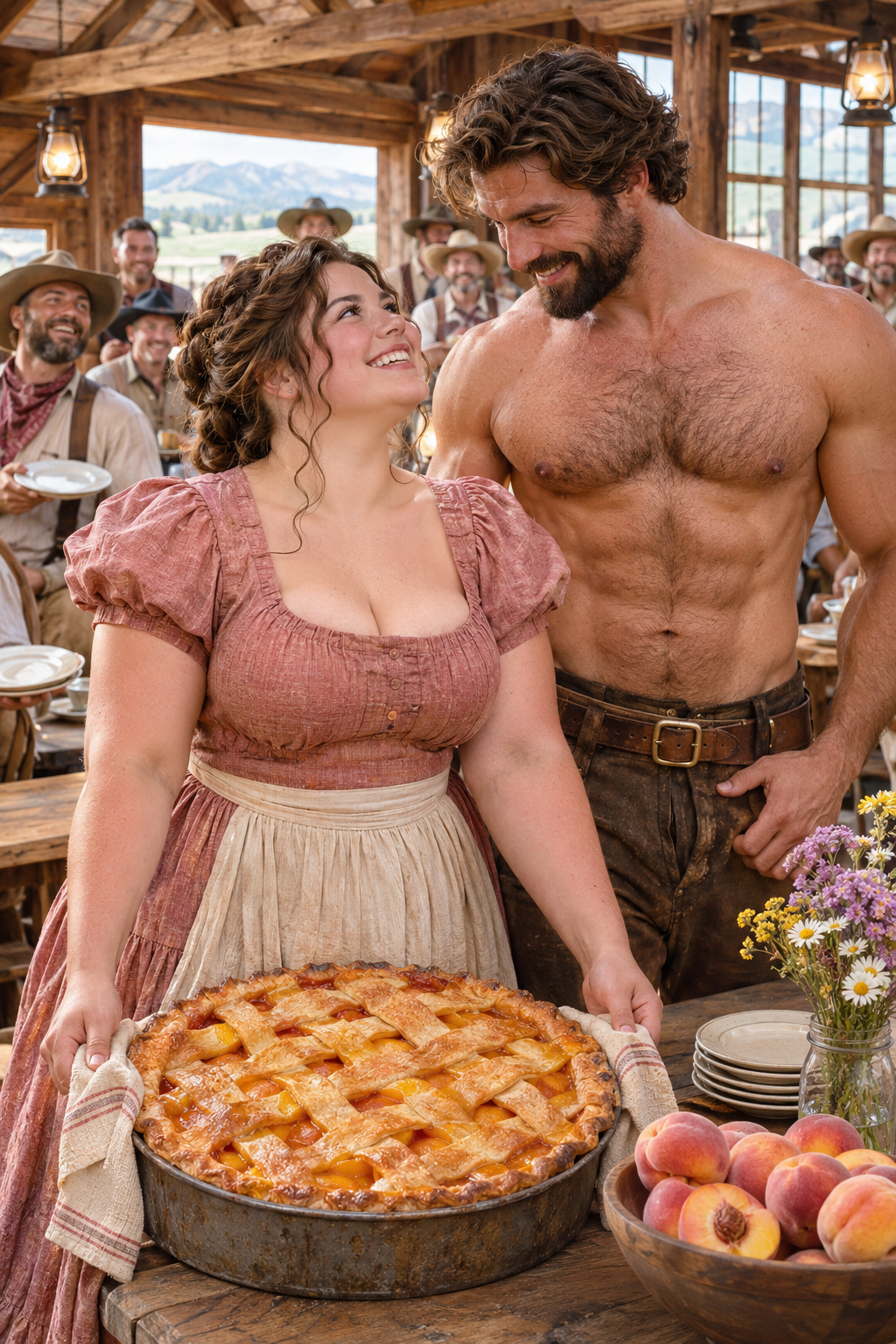
Helen looked down at the three pastry leaves decorating the center of her pie.
“So did my grandmother.”
For a moment, Grant seemed unable to speak. Then he stepped backward and opened his door wider.
“Well,” he said quietly, “there’s no sense letting a perfectly good pie get cold.”
The cowboys erupted into cheers.
Someone brought chairs from the dining hall. Another man fetched plates, while Samuel disappeared into the kitchen and returned with a fresh pot of coffee. Within minutes, the porch that had stood silent for years was filled with laughter.
Helen had actually baked two additional pies, knowing twenty-eight hungry cowboys would never be satisfied watching someone else eat dessert.
Grant took his first bite slowly.
He lowered his fork and stared across the dark pasture.
“It’s been eleven years,” he said.
Helen sat beside him. “Since your mother passed?”
He nodded.
“She died three days before my birthday. I was away buying cattle. By the time I got home, she was already gone.”
His voice grew rough.
“The last thing she asked Samuel to do was bring peaches from town. She wanted everything ready for when I returned.”
Helen finally understood why nobody celebrated his birthday.
Grant wasn’t avoiding getting older. He was avoiding a memory that hurt too much to face.
“I didn’t mean to upset you,” she whispered.
“You didn’t.”
He looked at her, his expression softer than she had ever seen.
“For the first time in eleven years, remembering her doesn’t feel quite so terrible.”
Helen smiled.
Across the porch, Samuel pretended to wipe coffee from his cheek, although everyone knew perfectly well that he hadn’t spilled a drop.
The following morning, Helen woke before sunrise and found something waiting outside her bedroom door.
It was a small wooden box.
Inside were several clean bandages, a jar of ointment for her healing palm, and a beautifully carved wooden spoon.
A folded note rested underneath.
“For the woman who keeps this place running. Try not to burn yourself again. — Grant.”
Helen laughed so loudly that one of the cowboys passing outside stopped to investigate.
For the next several weeks, something changed at Iron Creek Ranch.
Grant began appearing in the kitchen before breakfast. At first, he claimed he was checking supplies. Then he started bringing in firewood, carrying heavy sacks of flour, and repairing things Helen hadn’t even complained about.
One morning, she caught him tightening every handle on every cooking pan.
“Planning to become a kitchen assistant?” she asked.
“Planning to keep my cook from putting herself out of work.”
“Your cook appreciates the concern.”
Grant glanced at her.
“Good.”
Neither noticed Samuel standing outside the window, grinning like a man who had just won a bet.
The cowboys noticed everything.
They noticed Grant smiling more often. They noticed him taking his evening coffee in the kitchen instead of alone in his house. They noticed that whenever Helen laughed, their boss suddenly forgot whatever he had been saying.
But happiness at Iron Creek Ranch was about to face a serious test.
One afternoon, a well-dressed man arrived from Dry Creek.
His name was Walter Briggs, and Helen recognized him immediately.
He owned the boardinghouse where she had originally been promised a kitchen job.
The same man who had left her standing outside with a suitcase and nowhere to go.
“Helen Brooks,” Walter said, stepping into the ranch kitchen. “I heard you’d landed on your feet.”
Helen continued kneading bread.
“What brings you here, Mr. Briggs?”
“A business matter with Foster. But seeing you reminds me of something.”
He reached into his coat and produced a folded paper.
“Your outstanding boarding expenses.”
Helen stopped working.
“What expenses?”
“The room we reserved for you. The arrangements we made before your arrival. You owe me twenty dollars.”
Helen stared at him.
“You gave my job to someone else. I never spent a single night in your boardinghouse.”
Walter shrugged.
“That’s not what my records say.”
“Then your records are wrong.”
His smile disappeared.
“You ought to be careful, Miss Brooks. A woman traveling alone doesn’t want people questioning her honesty.”
Before Helen could answer, Grant’s voice came from the doorway.
“Is that a threat?”
Walter turned around.
“Just collecting a debt.”
Grant took the paper, read it, and handed it back.
“Bring proof.”
“Surely you don’t intend to involve yourself in a private disagreement.”
“You walked into my kitchen and threatened my employee. You involved me.”
Walter folded the paper and shoved it into his pocket.
“Very well. But don’t say I didn’t warn you.”
After he left, Helen sat heavily in a chair.
Grant poured her a glass of water.
“You don’t owe him anything, do you?”
“No.”
“Then that’s settled.”
But Helen knew men like Walter Briggs. They rarely accepted embarrassment without making someone pay for it.
Two days later, Grant returned from town carrying a letter.
His face was unusually serious.
Helen immediately sensed something was wrong.
“What’s happened?”
Grant placed the letter on the kitchen table.
Walter had accused Helen of stealing money from his boardinghouse before leaving Dry Creek. He claimed a cash envelope had disappeared on the very day she arrived.
The accusation had reached the local sheriff.
Helen read the letter twice.
Her hands began shaking.
“I never took anything.”
“I know.”
“He could ruin me, Grant. Nobody will hire a woman accused of stealing.”
Grant pulled out a chair.
“Tell me everything that happened that day.”
Helen explained how she had traveled nearly two hundred miles after receiving Walter’s written promise of employment. When she arrived, he informed her that his niece had taken the position instead.
She had never entered his office, never handled his money, and never been alone inside his building.
“Do you still have the letter promising you the job?” Grant asked.
Helen nodded.
She retrieved it from her suitcase.
Grant studied the date and Walter’s signature.
“We’re going to town tomorrow.”
Helen looked up sharply.
“We?”
“You’re not facing this alone.”
The next morning, Grant accompanied Helen to the sheriff’s office.
Walter was already there, looking confident.
He presented an account book showing a missing payment and insisted Helen had been seen near his office.
“By whom?” Grant asked.
Walter hesitated.
“One of my employees.”
“Then bring that employee here.”
The sheriff agreed.
An hour later, a nervous young woman named Clara entered the office. She worked at Walter’s boardinghouse and had apparently been named as his witness.
Walter gave her a warning look.
“Tell them what you saw.”
Clara twisted her hands together.
“I saw Miss Brooks standing near the front entrance.”
“And near my office?”
Clara looked at the sheriff.
“No, sir.”
Walter’s face turned red.
“You told me otherwise!”
“You told me to say otherwise.”
The room fell silent.
Clara’s eyes filled with tears.
“He said I’d lose my job if I didn’t.”
The sheriff closed the account book.
Walter immediately began protesting, but Clara wasn’t finished.
“The money wasn’t stolen. Mr. Briggs used it to pay a supplier. I saw him take it himself.”
Helen covered her mouth.
Grant remained perfectly still beside her.
By the time they left the sheriff’s office, the accusation against Helen had fallen apart. Walter was facing questions about his false report, and Clara had walked away from the boardinghouse for good.
Outside, Helen turned toward Grant.
“How can I ever thank you?”
“You don’t need to.”
“You could’ve believed him.”
Grant looked genuinely offended.
“I’ve watched you feed twenty-eight men before feeding yourself. I’ve seen you give away your own dinner when somebody was still hungry. You burned your hand protecting a boy you’d barely met.”
He paused.
“I know what kind of woman you are.”
Helen blinked back tears.
Nobody had ever defended her with such certainty.
Before returning to the ranch, she found Clara sitting outside the general store with a small suitcase.
The young woman had nowhere to go.
Helen looked at Grant.
He sighed.
“How many people are you planning to bring home?”
“Just one today.”
Grant shook his head, but a smile appeared beneath his mustache.
“Suppose we could use another pair of hands in the kitchen.”
Clara joined Iron Creek Ranch that afternoon.
For a while, life became peaceful again.
Then winter arrived earlier than anyone expected.
A terrible storm swept across the valley, burying fences beneath snow and trapping cattle in distant pastures. The temperature dropped so quickly that water froze inside buckets before the men could carry them to the barns.
Grant and his cowboys worked from sunrise until long after dark.
Helen kept the kitchen running almost constantly, preparing hot soup, bread, coffee, and whatever else might help the exhausted men recover.
On the third evening of the storm, twenty-seven cowboys returned.
Grant was missing.
So was Tommy, the young man Helen had saved from the boiling gravy.
Samuel entered the kitchen with snow covering his shoulders.
“Where’s Grant?” Helen demanded.
Samuel removed his gloves.
“Tommy’s horse went down near the north pasture. Grant stayed behind to help him. They should’ve been back an hour ago.”
Helen looked toward the window.
Outside, the storm had swallowed everything beyond the nearest fence.
“Then somebody needs to find them.”
Samuel was already gathering men.
Helen packed blankets, food, and supplies while the cowboys prepared their horses. She waited inside with Clara, keeping water warm and clearing space near the stove.
Every minute felt like an hour.
Nearly two hours later, someone shouted outside.
The kitchen door burst open.
Two men carried Tommy inside, followed by Samuel and another cowboy supporting Grant.
Tommy was conscious but freezing.
Grant was barely able to stand.
His coat was covered in snow, and his left leg was injured.
Helen rushed forward.
“What happened?”
“Horse slipped,” Samuel explained. “Grant got Tommy into an old shelter and wrapped him in his own coat. We found them just before the boy stopped responding.”
Helen helped settle Grant near the stove while the others cared for Tommy and sent for the doctor.
Grant tried to speak.
“Boy all right?”
“He will be,” Helen answered, hoping she was right.
Only then did Grant close his eyes.
The doctor arrived after midnight. Tommy was expected to recover, but Grant had suffered a broken leg and dangerous exposure to the cold.
For the next several days, Helen hardly slept.
She prepared his meals, helped the doctor, and sat beside his bed whenever the pain kept him awake.
One night, Grant opened his eyes and found her asleep in a chair, her head resting against the edge of his mattress.
“Helen,” he whispered.
She woke immediately.
“Do you need something?”
He studied her tired face.
“You ought to go to bed.”
“So should you.”
“I’m already in one.”
“Then quit complaining.”
Grant laughed, then winced.
Helen adjusted his blanket.
“You frightened me,” she admitted.
His smile faded.
“I didn’t have much choice. Tommy wouldn’t have survived out there alone.”
“I know.”
She lowered her eyes.
“That’s what frightened me most. You’d do it again.”
Grant reached for her hand.
“Yes.”
Helen squeezed his fingers.
“Then somebody needs to make sure there’s a home waiting for you when you come back.”
For a long moment, neither spoke.
Grant looked at her as though he had finally understood something that had been growing between them for months.
“Helen, when I’m back on my feet, there’s something I’d like to ask you.”
She smiled.
“Then you’d better concentrate on getting well.”
But another problem was waiting.
The storm had killed cattle, destroyed fencing, and damaged several buildings. With fewer animals to sell and expensive repairs ahead, Iron Creek Ranch was facing its worst financial season in years.
Grant spent hours studying his ledger.
One evening, Helen entered his office and found him staring at a list of employees.
“What are you doing?”
He closed the book.
“Trying to figure out how many men I can afford to keep.”
Helen felt her stomach tighten.
“You’re letting people go?”
“I may have to.”
She thought of Samuel, whose knees were too worn for heavy work elsewhere. She thought of Tommy, who was sending money home to his widowed mother. She thought of Clara, who had finally found somewhere safe to live.
“There must be another way.”
Grant shook his head.
“Good intentions don’t pay wages.”
“No,” Helen replied. “But twenty-eight men working together might accomplish something one man can’t.”
The next morning, she called everyone into the dining hall.
She explained the ranch’s situation without hiding the seriousness of it.
Nobody laughed. Nobody interrupted.
When she finished, Samuel stood.
“I’ve got savings. I can wait a little for part of my wages, if that’s what it takes.”
Several others volunteered to do the same.
Helen insisted that nobody should sacrifice money they needed for their families. Instead, they began looking for ways to earn extra income and reduce unnecessary expenses.
The cowboys repaired damaged equipment rather than replacing it. Some took temporary work helping neighboring ranches rebuild fences. Clara suggested selling Helen’s baked goods in Dry Creek.
Helen started with six peach pies.
They sold before noon.
The following week, she made twelve pies, along with bread, biscuits, and cinnamon rolls.
Soon, people were placing orders days in advance.
Even travelers passing through Dry Creek began asking where they could find the famous Iron Creek peach pies.
Grant watched the transformation with growing amazement.
Helen carefully recorded every sale and expense. After setting aside money for ingredients and paying Clara for her extra work, she offered part of the profits toward the ranch’s recovery.
Grant refused at first.
“That money belongs to you.”
“And this place matters to me.”
“Helen, I won’t take advantage of you.”
“Then don’t. Treat it as a business arrangement.”
They agreed that the bakery would remain Helen’s own business, with a fair payment to the ranch for supplies and use of the kitchen. Any additional money she contributed would be her choice.
By spring, cattle prices had improved, the repairs were nearly finished, and the ranch had managed to keep every cowboy employed.
Grant called a meeting and announced that the worst was behind them.
He thanked the men for their hard work, promised to settle every delayed payment, and turned toward Helen.
“And none of us would be standing here quite the same way without this woman.”
The men rose from their chairs and applauded.
Helen laughed through her tears.
That evening, Grant asked her to walk with him.
His leg had healed enough for him to move without assistance, although Helen still scolded him whenever he tried to do too much.
They stopped beneath an old peach tree behind the ranch house.
“My mother planted this,” he told her. “It hasn’t produced much fruit in years.”
Helen touched one of its branches.
“Maybe it needs a little care.”
Grant smiled.
“Seems that happens to more than trees.”
He reached into his pocket and removed a small velvet box.
Helen’s breath caught.
“I’ve been trying to find the right words for months,” he admitted. “But every time I practice, they sound foolish.”
“Then stop practicing.”
Grant laughed nervously.
“Helen Brooks, you came here looking for a job. Somehow, you gave twenty-eight lonely men a family, brought this ranch through the hardest winter we’ve ever faced, and reminded me that loving somebody doesn’t mean you have to stop missing the people you’ve lost.”
He opened the box.
Inside was a simple gold ring.
“It belonged to my mother.”
Helen’s eyes filled with tears.
“I don’t want you to marry me because you feel grateful,” Grant continued. “And I don’t want you to give up your bakery or anything else you’ve built. I want you to have the life you choose.”
He took a deep breath.
“I just hope there’s room for me in it.”
Helen looked at the man who had once greeted her with nothing more than a warning about twenty-eight hungry cowboys.
“Yes, Grant.”
He blinked.
“Yes?”
“Yes, I’ll marry you.”
From somewhere behind the barn came a sudden cheer.
Grant turned sharply.
Twenty-eight cowboys and Clara emerged from their hiding places.
Samuel was holding his hat above his head.
“About time!” he shouted.
Helen burst out laughing.
Grant shook his head and pulled her into his arms.
They married beneath the peach tree that summer.
Samuel walked Helen down the aisle, Tommy carried the rings, and Clara helped prepare the wedding feast.
Instead of a traditional wedding cake, Helen baked peach pies.
Years later, Iron Creek Ranch became known throughout the valley for more than its cattle. Helen opened a proper bakery in Dry Creek, employing women who needed honest work and a fresh beginning.
She never forgot what it felt like to arrive in an unfamiliar town with a suitcase, a broken promise, and nowhere to sleep.
Grant continued managing the ranch, but he was no longer the man who spent his birthdays alone behind a closed door.
Every year, Helen baked him a peach pie decorated with three little pastry leaves.
One birthday, their young daughter asked why they always made the same dessert.
Grant lifted her onto his knee.
“Because your grandmother used to make it for me.”
“Was she a good cook?”
“The very best.”
Helen raised an eyebrow from across the table.
Grant quickly corrected himself.
“One of the very best.”
Their daughter giggled.
Outside, the cowboys were gathering for another birthday celebration. Samuel, older and slower now, occupied his favorite chair on the porch.
The old peach tree was covered in fruit again.
Helen stood beside Grant as he watched their daughter carry a plate of pie to Samuel.
“Do you ever wonder what would’ve happened if I’d gotten that kitchen job in Dry Creek?” she asked.
Grant wrapped an arm around her waist.
“Sometimes.”
“And?”
“I’m grateful you found your way here.”
Helen rested her head against his shoulder.
Losing that promised job had once seemed like the worst thing that could happen to her. She had believed that a door closing meant her future was slipping away.
But life had taken her somewhere unexpected.
She had found meaningful work, people who valued her, and a man who loved her without asking her to become someone else.
And Grant had learned that honoring the people he had lost did not require him to spend the rest of his life grieving alone.
Sometimes, the smallest act of kindness reaches a place that years of silence have kept hidden.
For Grant Foster, it had been a warm peach pie delivered just before midnight.
For Helen Brooks, it had been a rough-handed rancher who saw her worth when others had turned her away.
Neither could have known how much those simple moments would change their lives.
But that was the beautiful thing about kindness.
You didn’t have to know where it would lead.
You only had to choose to give it.
Ten years later, on a warm summer morning, Helen stood behind the counter of her bakery when the bell above the door rang.
An elderly man entered, leaning heavily on a walking stick. His coat was worn, his shoes were covered in dust, and his face looked strangely familiar.
It took Helen a moment to recognize him.
Walter Briggs.
The man who had once broken his promise, falsely accused her of theft, and nearly destroyed her chance at a new life now stood before her with his hat in his hands.
“Good morning, Mrs. Foster,” he said awkwardly.
“Good morning, Mr. Briggs.”
He glanced around the bakery. Every table was occupied, and the shelves were filled with fresh bread and pastries.
“I heard you’ve done well for yourself.”
“I’ve been fortunate.”
Walter lowered his eyes.
“My boardinghouse closed last year. Lost most of what I owned. I’ve been looking for work, but nobody seems interested in hiring an old man.”
Helen waited.
“I suppose you remember what I did to you.”
“I do.”
He nodded slowly.
“I wouldn’t blame you if you threw me out.”
Helen studied him. For years, she had imagined what she might say if she ever saw him again. Yet standing before him now, she felt no desire for revenge.
“Have you eaten today?” she asked.
Walter looked surprised.
“No, ma’am.”
Helen brought him a bowl of soup, two slices of fresh bread, and a piece of peach pie.
He stared at the food.
“I can’t pay for this.”
“I didn’t ask you to.”
Walter’s eyes filled with tears.
“After everything I did?”
“What you did was wrong, Mr. Briggs. Feeding you doesn’t change that. But I won’t let your past behavior decide what kind of person I become.”
The old man bowed his head.
For the first time, he offered her a sincere apology without excuses.
Helen accepted it.
She didn’t offer him access to her business accounts or pretend that trust could be restored overnight. However, she arranged for him to earn a modest wage helping maintain the bakery’s garden.
Over the following months, Walter arrived early every morning. He pulled weeds, repaired fences, and carried vegetables into the kitchen.
Little by little, he began earning back the respect he had once thrown away.
When Grant heard what Helen had done, he smiled.
“Still bringing home strays, are you?”
“Only the ones willing to work.”
He kissed her forehead.
“That’s my Helen.”
That autumn, Samuel’s health began to decline.
The old cowboy who had once revealed Grant’s birthday secret could no longer walk comfortably across the ranch. Helen and Grant moved him into a comfortable room in their home, where their children visited him every afternoon.
One evening, Samuel asked Helen to sit beside him.
“You remember that first peach pie?” he asked.
“How could I forget?”
Samuel smiled.
“Best thing that ever happened to this ranch.”
“It was only a pie, Samuel.”
“No, ma’am. Before you came, we had jobs. After you came, we had a home.”
Helen took his weathered hand.
“You helped make it that way.”
Samuel closed his eyes, still smiling.
He passed peacefully several weeks later, surrounded by people who loved him.
The entire ranch gathered beneath the old peach tree to say goodbye.
Grant struggled to finish his speech. Samuel had worked beside his father, watched him grow up, and remained loyal through every difficult season.
When Grant’s voice failed, Helen stepped beside him and held his hand.
They planted another peach tree in Samuel’s memory.
As the years passed, their children grew older, the ranch expanded, and Helen’s bakery became a beloved part of Dry Creek.
Tommy eventually became the ranch foreman. Clara married a kind carpenter and opened a small café of her own, using recipes Helen had taught her.
The people whose lives had once seemed uncertain had built futures they could be proud of.
Many years later, on Grant’s seventieth birthday, Helen entered their kitchen and discovered flour scattered across the counter.
Their grandchildren were attempting to bake a peach pie.
Grant stood among them, wearing an apron and holding a rolling pin.
“What happened in here?” Helen asked.
“Birthday preparations,” Grant answered.
“Looks more like a cattle stampede.”
The children burst into laughter.
That evening, three generations gathered around the long dining table. The pie was slightly burned around the edges, and its crust was uneven, but three little pastry leaves decorated the center.
Grant took a bite.
“Well?” his youngest granddaughter asked nervously.
He looked at Helen.
“Perfect.”
Later, when everyone had gone home, Grant and Helen sat together on the porch.
Their hair had turned gray, their hands had grown wrinkled, and their steps were slower than they once had been.
Yet Grant still reached for Helen’s hand the same way he had all those years ago.
“You know,” he said, “I never did properly thank you for that first birthday pie.”
Helen smiled.
“You’ve had plenty of time.”
“Not nearly enough.”
He looked across the pasture, where the last light of day rested upon the two peach trees.
“I thought I had everything I needed before you arrived. Land, cattle, money, good men working for me. But I didn’t understand the difference between owning a place and belonging somewhere.”
Helen leaned against his shoulder.
“And I thought losing that job in Dry Creek meant I’d lost my future.”
Grant kissed her hand.
“I’m glad we were both wrong.”
They remained together on the porch until the stars appeared.
Inside their home were photographs, children’s drawings, handwritten recipes, and decades of memories. Outside stood a ranch that had survived storms, hardship, grief, and uncertainty because its people had learned to care for one another.
Helen had arrived at Iron Creek with little more than a suitcase and a willingness to work.
She had never expected to change anyone’s life.
She simply chose to do what she could, with what she had, whenever someone needed her.
And in doing so, she built a life richer than anything she could have imagined.
Her story became a reminder passed down through generations of the Foster family: never measure a person’s worth by their circumstances, never allow another person’s cruelty to destroy your kindness, and never underestimate the power of making someone feel remembered.
Because sometimes the greatest blessings begin with a disappointment.
Sometimes a stranger becomes family.
And sometimes, an entire lifetime of love begins with something as simple as a homemade peach pie.
On their fiftieth wedding anniversary, Helen and Grant returned to the spot beneath the old peach tree where they had exchanged their vows.
Their children had arranged a celebration, inviting friends, former ranch hands, and families from Dry Creek. Tommy, whose hair had turned silver, stood beside Clara near the porch.
Helen could hardly believe how many familiar faces surrounded her.
During dinner, her eldest daughter rose and unfolded a faded piece of paper.
“Mother, we found something while cleaning your old bedroom.”
Helen adjusted her glasses.
It was the original letter promising her employment at Walter Briggs’s boardinghouse.
She had kept it all these years.
“Why did you save it?” her daughter asked.
Helen smiled.
“Because it reminds me that life doesn’t always turn out the way we plan. Sometimes it turns out better.”
Grant reached across the table and took her hand.
“Best broken promise I ever heard of.”
Everyone laughed.
That evening, their grandchildren presented them with a wooden sign they had made together.
It read: “Iron Creek Ranch — There Is Always Room at Our Table.”
Grant insisted they hang it above the dining hall entrance.
Three winters later, Grant’s health began to fail. The man who had once ridden across miles of frozen pasture could barely make it from his bedroom to the porch.
Helen remained beside him, reading letters from their grandchildren and telling him stories about the bakery.
One afternoon, Grant asked for a piece of peach pie.
Helen prepared one using the same recipe she had followed so many years earlier.
She carried a warm slice to his bedside.
Grant managed a few bites before setting down his fork.
“Still the best pie I’ve ever tasted.”
Helen brushed his silver hair away from his forehead.
“You’ve been saying that for fifty-three years.”
“And I’ve meant it every time.”
He reached for her hand.
“Promise me something, Helen.”
“Anything.”
“When I’m gone, don’t stop celebrating birthdays. Don’t close the curtains. Don’t let the house become quiet because of me.”
Helen’s eyes filled with tears.
Grant smiled gently.
“You taught me that remembering someone doesn’t have to hurt forever. I want you to remember that, too.”
She leaned forward and kissed him.
“I promise.”
Grant passed peacefully in his sleep two days later, with Helen holding his hand.
The entire community gathered to honor him. Cowboys who had worked at Iron Creek decades earlier traveled long distances to attend.
Tommy stood before the gathering and spoke about the night Grant had saved his life during the winter storm.
“He gave me the chance to grow old,” Tommy said, his voice breaking. “Everything I’ve had since that night, my wife, my children, my grandchildren, began with a man who refused to leave me behind.”
Helen listened with quiet pride.
Her husband had never considered himself a remarkable man. Yet the people standing before her were living proof of the difference he had made.
When Grant’s birthday arrived the following year, Helen kept her promise.
She opened the curtains, invited the family over, and baked peach pies with her great-grandchildren.
They shared their favorite memories of Grant until laughter filled the dining hall.
Helen missed him terribly, but she understood that grief and gratitude could exist together.
Two years later, at the age of eighty-six, Helen passed away peacefully in the home she had shared with Grant.
Among her belongings, her family discovered a handwritten recipe book.
On the final page, beneath the instructions for her famous peach pie, Helen had written a message.
“Whatever happens in your life, remember to leave room at your table for someone who needs a place to belong. You may think you’re only offering a meal, but to someone else, you might be offering hope.”
Her children established a community kitchen in Dry Creek in their parents’ memory.
Anyone facing difficult circumstances could receive a warm meal there without being judged or turned away.
Above the entrance hung the wooden sign from Iron Creek Ranch.
And every year, on Grant’s birthday, volunteers served homemade peach pie to everyone who walked through the door.
Helen and Grant were buried beside each other beneath the peach tree where their marriage had begun.
Their names were carved into a simple stone, along with a sentence chosen by their children:
“They made a home wherever kindness was needed.”
The ranch remained in the Foster family for generations, but its greatest inheritance was never its land, cattle, or money.
It was the belief that every person deserved dignity, that love was expressed through everyday actions, and that even the smallest kindness could change the direction of someone’s life.
Helen had once arrived in Dry Creek believing nobody wanted her.
In the end, generations of people were grateful that she had come.
And the kindness she had given so freely continued long after she was gone.
That was her true legacy.
Not the bakery.
Not the ranch.
But the countless lives made warmer because she had chosen to care.
THE END.