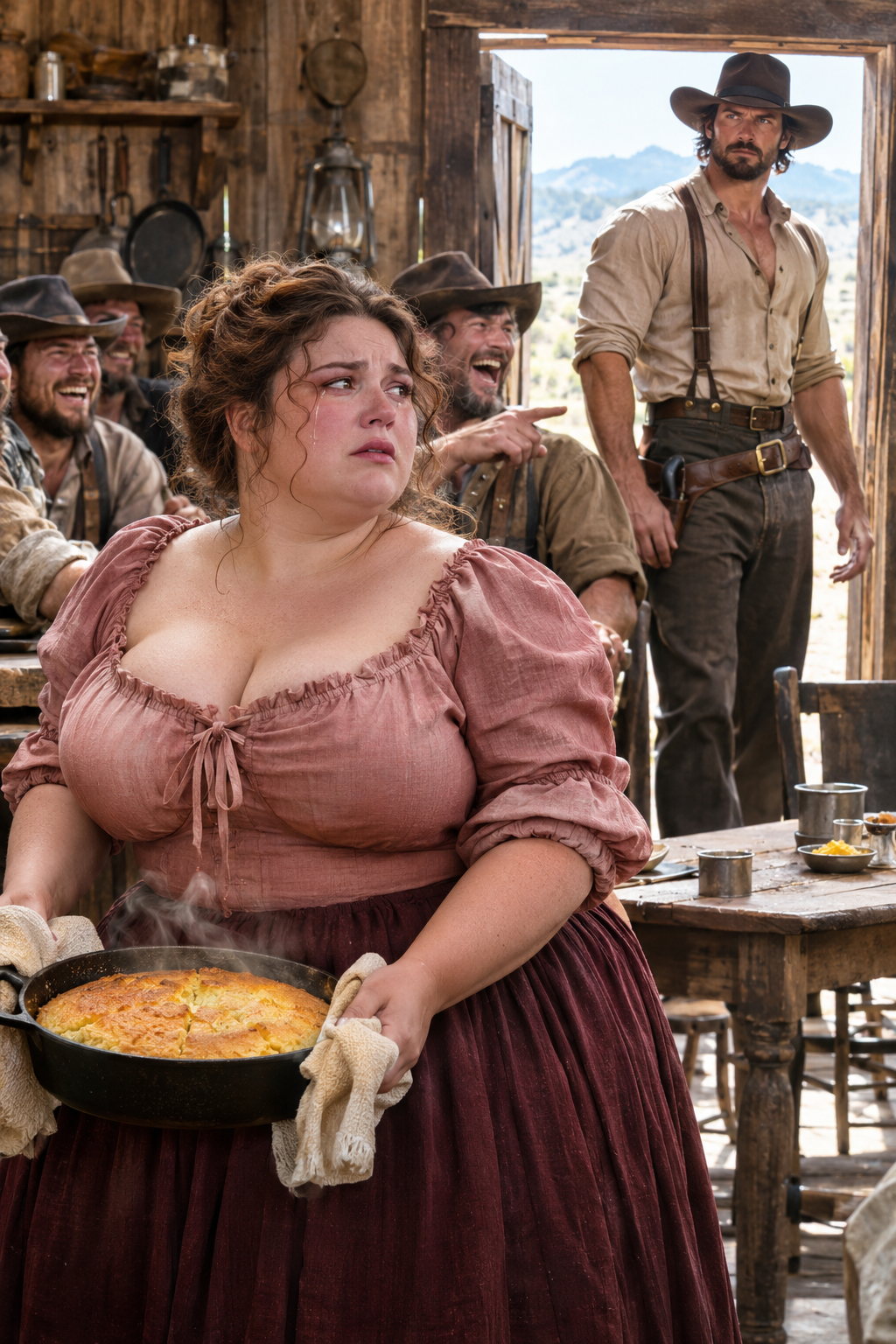
The cowboys laughed when Edith Parker arrived at Red Willow Ranch, carrying everything she owned in a battered suitcase. But when the ranch owner spotted the silver watch hanging from her neck, his face went pale.
Mercer glanced at Edith before turning his attention back to Walter.
“Those supplies were authorized,” he said. “I sent them to the men repairing fences along the northern boundary.”
Walter rested both hands on the table.
“North Fork Camp has been empty since last October.”
For a moment, the only sound in the kitchen was the crackling fire beneath the stove.
Mercer cleared his throat. “Perhaps I entered the wrong location.”
“Seven times?” Edith asked.
Mercer turned toward her. “Nobody asked for your opinion.”
“She has every right to speak,” Walter interrupted. “Especially when she’s the only person who seems to know where my money is going.”
Mercer’s face reddened. He insisted that the missing supplies were nothing more than bookkeeping mistakes and that the stolen cattle had nothing to do with him.
Walter ordered him to surrender the keys to the supply building until the matter could be investigated.
Mercer dropped the keys onto the table.
“You’re making a mistake, Walter. I’ve worked here for eleven years. That woman hasn’t been here a month.”
“Then you should have no trouble proving your innocence.”
Mercer stormed out, slamming the door behind him.
Edith watched through the window as he crossed the yard. Before disappearing into the bunkhouse, he turned and looked directly at her.
There was something in his expression that made her uneasy.
Walter gathered the records.
“You did good work, Edith.”
“I hope I haven’t caused you trouble.”
“You didn’t cause it. You uncovered it. There’s a difference.”
He promised to investigate the camp the following morning and instructed two trusted ranch hands to keep watch over the cattle overnight.
Edith returned to her cooking, but she couldn’t shake the feeling that Mercer wasn’t going to accept his humiliation quietly.
She was right.
Early the next morning, Edith entered the pantry and discovered that the lock on her small wooden storage chest had been broken.
Her spare apron lay on the floor. Her letters had been scattered, and the envelope containing her savings was gone.
She searched desperately through the chest.
Eleven dollars and forty cents. Every penny she had managed to save for Louise.
Then she noticed something even worse.
The silver watch she had placed inside the chest before washing dishes the previous evening was missing.
Edith sank onto a stool.
The money could eventually be replaced. The watch couldn’t.
It was the only possession she had left that truly connected her to her father.
When Walter learned what had happened, he immediately questioned the ranch hands. Nobody admitted seeing anyone near the pantry during the night.
Mercer appeared while Walter was examining the broken lock.
“Perhaps she misplaced her belongings,” he suggested.
Edith stood up.
“You know perfectly well I didn’t.”
“Are you accusing me of stealing?”
“I’m saying someone wanted to frighten me.”
Mercer smiled without warmth.
“Maybe ranch life is too much for you, Miss Parker.”
Walter stepped between them.
“That’s enough, Charles.”
Mercer walked away, but not before Edith noticed something sticking out of his coat pocket.
It was a folded envelope with blue writing along one edge.
Her savings had been kept in an envelope just like it.
She wanted to confront him, but Walter stopped her when she explained what she had seen.
“We need proof,” he said. “Otherwise, he’ll claim we’re trying to ruin him.”
Walter left for North Fork with three men shortly afterward. Edith remained at the ranch, preparing breakfast and trying to concentrate on her work.
Around noon, a wagon arrived carrying supplies from town.
The driver handed Edith a letter.
It was from Louise.
Edith opened it eagerly, expecting news about her sister’s sewing work. Instead, the first few lines made her stomach tighten.
Their father’s creditor, a man named Silas Whitcomb, had visited Louise twice that week. He was demanding immediate payment of the remaining debt.
If they failed to pay, he threatened to take their little house.
Louise had tried to reassure her sister, but Edith could sense the fear behind every sentence.
The amount demanded was one hundred and eighty dollars.
Edith couldn’t imagine earning that much before the deadline.
She folded the letter and pressed it against her chest.
For months, she had been fighting to keep their lives together. Now someone had stolen her savings, her father’s watch was gone, and Louise might lose the only home she had ever known.
For the first time since arriving at Red Willow, Edith considered leaving.
Perhaps she could find work closer to town. At least she would be near her sister.
She was still considering her options when Walter and his men returned.
Their expressions told her something had gone terribly wrong.
They had discovered fresh cattle tracks, abandoned cooking fires, and several empty supply sacks bearing the Red Willow brand.
The stolen cattle, however, were gone.
Someone had moved them before Walter arrived.
“Who knew you were going there?” Edith asked.
“Everyone who heard the rider’s report last night.”
“Including Mercer.”
Walter nodded.
“But there’s something else.”
He placed a torn piece of paper on the kitchen table.
One of the ranch hands had found it beneath a wooden crate at the abandoned camp.
Written across it were several numbers and a name.
S. Whitcomb.
Edith stared at the paper.
“Where did you find this?”
“At North Fork.”
She pulled Louise’s letter from her apron pocket.
Walter read it twice.
“Silas Whitcomb is your father’s creditor?”
“Yes. He’s been collecting payments from us since Father died.”
Walter looked troubled.
“How long has your family owed him money?”
“According to Mr. Whitcomb, nearly four years.”
Walter slowly lowered the letter.
“Edith, I think there’s something about your father’s affairs that neither of us understands.”
He asked her to accompany him to his office.
From a locked cabinet, Walter removed an old leather folder containing business papers, receipts, and personal letters.
He searched through them until he found a document dated August 1883.
“Your father worked for me briefly that summer,” he explained. “My wife had passed away the previous winter, and my mother was helping raise my little boy.”
Edith listened carefully.
“One afternoon, their wagon overturned while crossing a flooded creek. Albert was passing through. He pulled my mother and my son out of the water.”
Walter paused, remembering the terrible day.
“My boy was only six. Without your father, I would have buried him beside his mother.”
Edith’s eyes filled with tears.
Her father had never told her that story.
Walter continued.
“I offered Albert a substantial reward. He refused it. Eventually, he agreed to accept some money as payment for helping me with a difficult cattle delivery.”
He handed Edith the document.
It was a receipt for three hundred dollars, signed by Albert Parker.
Edith recognized her father’s handwriting immediately.
“He received this money shortly before returning home,” Walter said. “He told me he intended to settle a debt and start a small business.”
Edith remembered that summer. Her father had returned with new boots for Louise and a beautiful blue dress for Edith.
He had seemed happier than he had in years.
But shortly afterward, he became unusually worried. Whenever she asked what was wrong, he told her not to concern herself with grown men’s troubles.
“He never started that business,” Edith whispered.
Walter studied the receipt.
“If he used this money to pay Whitcomb, why was Whitcomb still collecting from your family?”
Before Edith could answer, someone knocked urgently on the office door.
It was a young ranch hand named Ben Miller.
“Mr. Hayes, I need to tell you something.”
Ben looked nervously toward the yard.
“It’s about Mercer.”
Walter invited him inside.
The young man admitted that Mercer had been paying him extra money to load supplies onto wagons after dark. He had been told the deliveries were part of a private arrangement with another ranch.
At first, Ben hadn’t questioned the orders.
Then he noticed that some wagons returned carrying unfamiliar cattle equipment and that Mercer often met a well-dressed man from town.
“Was his name Whitcomb?” Edith asked.
Ben nodded.
“He came here last night, too. I saw him talking to Mercer behind the stable.”
Walter stood abruptly.
“Why didn’t you tell me sooner?”
“Mercer said he’d have me fired. My mother’s sick, sir. I couldn’t lose my wages.”
Ben lowered his head.
“I’m sorry.”
Walter’s expression softened.
“You’ve done the right thing by coming here.”
Ben hesitated before reaching into his pocket.
“I found this near the stable this morning.”
He opened his hand.
Edith gasped.
It was her father’s silver watch.
She took it with trembling fingers, examining the familiar scratch on the case.
But something was different.
The back cover had been forced open, leaving a fresh mark along its edge.
Walter noticed it immediately.
“Did your father ever keep anything inside this?”
“Not that I know of.”
Edith opened the back.
A tiny space behind the inner cover was empty.
She remembered her father sitting beside the fireplace, carefully opening the watch with a small knife. Whenever she approached, he would close it and smile.
“Some things are worth keeping close, sweetheart,” he used to say.
At the time, she thought he was talking about the watch itself.
Now she wondered whether he had been hiding something.
Walter decided they needed to speak with Whitcomb directly.
The following morning, he accompanied Edith into town, where they found Louise waiting anxiously outside their little house.
Louise rushed into her sister’s arms.
She was nineteen, with tired eyes and fingers roughened by endless hours of sewing.
Edith introduced Walter and explained what they had discovered.
Louise listened in disbelief.
“Father always said he would never leave us owing anyone,” she whispered. “I couldn’t understand why Mr. Whitcomb kept coming.”
Inside the house, Edith searched through her father’s old belongings.
She examined letters, clothing, account books, and a wooden toolbox that hadn’t been opened since his death.
At the bottom of the toolbox, beneath several rusty nails, she discovered a small notebook.
Most of its pages contained ordinary expenses.
Then she found an entry dated September 1883.
Paid S. Whitcomb in full. Receipt secured.
Edith called Walter over.
The original debt had been two hundred and twenty dollars.
Her father had recorded the payment clearly.
There were no further entries concerning Whitcomb.
“He paid it,” Louise said, covering her mouth.
Walter looked grim.
“And Whitcomb has been collecting money from you ever since.”
They took the notebook to the sheriff, who listened carefully but explained that a personal record alone might not be enough to prove the fraud.
They needed the original receipt or another witness.
Walter mentioned the stolen cattle and the connection between Mercer and Whitcomb.
That was enough to convince the sheriff to begin investigating both men.
When Edith and Walter returned to Red Willow that evening, they discovered Mercer had disappeared.
His room was empty, his horse was gone, and several pages had been torn from the supply ledger.
But Mercer had left something behind.
Inside his desk, Walter found a railway timetable and a handwritten list of cattle shipments scheduled for the following morning.
The shipment was unusually large.
Walter recognized several identifying marks recorded beside the numbers.
They belonged to Red Willow cattle.
The sheriff was notified immediately.
Before sunrise, Walter, the sheriff, and several ranch hands headed toward the railway loading grounds.
Edith insisted on accompanying them.
Walter initially refused, concerned about her safety.
“Those men have already stolen from my family,” she told him. “I won’t spend another morning wondering what they’re doing behind my back.”
He finally agreed, provided she remained with the sheriff.
When they arrived, dozens of cattle were being gathered for shipment.
Mercer stood beside a fence, speaking with Whitcomb.
Neither man noticed Walter until he approached with the sheriff.
“Those cattle aren’t leaving,” Walter announced.
Whitcomb turned sharply.
“This is private business, Hayes.”
“Not when you’re selling my property.”
The sheriff ordered the shipment stopped while the cattle brands and ownership papers were examined.
Mercer tried to explain that he had purchased the animals from independent ranchers.
But the records didn’t support his story.
Several cattle carried Red Willow’s unmistakable brand.
Realizing that his explanation was falling apart, Mercer suddenly blamed Whitcomb.
“He arranged everything! I only handled the supplies.”
Whitcomb grabbed his arm.
“Keep your mouth shut.”
Mercer pulled away.
“You promised nobody would find out!”
The sheriff ordered both men detained.
As Whitcomb was being escorted away, Edith stepped forward.
“Where is my father’s receipt?”
Whitcomb stopped.
“I don’t know what you’re talking about.”
“You stole it from his watch.”
He laughed.
“Your father was a foolish man, Miss Parker. Perhaps you should stop digging into his mistakes.”
Edith felt Walter stiffen beside her.
But she refused to let Whitcomb intimidate her.
“My father paid you. You knew he paid you, and you still took money from his daughters.”
Whitcomb said nothing.
The sheriff searched the men’s belongings and obtained legal authority to examine Whitcomb’s business records.
What investigators discovered over the following days shocked the entire town.
Whitcomb had been financing stolen cattle shipments for years. Mercer supplied food, equipment, and information about Red Willow’s operations in exchange for a share of the profits.
They had also been falsifying accounts to conceal their activities.
But the cattle theft was only part of Whitcomb’s dishonesty.
Several families had been pressured into paying debts they had already settled. Some had lost land. Others had surrendered livestock or valuable possessions because they couldn’t afford to challenge him.
Among Whitcomb’s papers, the sheriff discovered a small, folded receipt bearing Albert Parker’s name.
It had been taken from Edith’s watch.
Mercer had recognized the Parker name when Edith first arrived. He had mentioned her to Whitcomb, who immediately became concerned that Albert’s daughters might still possess evidence of the original payment.
When Mercer learned about the watch, Whitcomb instructed him to search it.
They had stolen Edith’s savings to make the incident look like an ordinary robbery.
The receipt confirmed everything.
Albert Parker had paid his debt in full.
Edith and Louise had never owed Whitcomb another penny.
When the sheriff handed Edith the document, she sat quietly for several minutes.
Then she began to cry.
Not because of the money.
Because she finally understood that her father hadn’t failed them.
He had worked hard, kept his promises, and done everything he could to protect his daughters.
A dishonest man had taken advantage of his death.
Louise held Edith’s hand as they read the receipt together.
“He kept his promise,” Louise whispered.
Edith nodded through her tears.
“Yes. He did.”
Mercer and Whitcomb were eventually convicted for their crimes. Some of their property was sold to compensate the people they had cheated, and Edith recovered part of the money her family had wrongfully paid.
Walter also recovered most of his stolen cattle.
But the experience changed Red Willow Ranch in ways nobody expected.
Walter introduced a new system requiring independent records of every delivery and payment. He offered Edith the position of managing the ranch’s household expenses and supply accounts, with wages considerably higher than those she had earned as a cook.
“You’ve saved this ranch a great deal of money,” he told her.
Edith smiled.
“Does this mean the cowboys will have to make their own biscuits?”
Walter laughed.
“I suspect they’d rather face another winter without blankets.”
Edith accepted the position on one condition.
She wanted Louise to come live at Red Willow.
Walter arranged for the sisters to occupy a comfortable cottage near the main house. Louise began sewing clothes for the ranch families and soon earned enough to support herself.
For the first time in years, neither sister went to bed worrying about losing her home.
As winter approached, Edith grew closer to Walter and his twelve-year-old son, Thomas.
Thomas was a quiet boy who missed his mother and often spent his afternoons reading beside the kitchen stove.
Edith never tried to replace the woman he had lost. She simply listened when he wanted to talk and made room for him in her daily life.
One snowy evening, Thomas asked whether he could help prepare supper.
Edith handed him a bowl of flour.
By the time Walter arrived, his son’s face was covered in flour, and both Thomas and Edith were laughing.
Walter stood in the doorway, watching them.
His house hadn’t sounded that happy in years.
Several months later, when spring returned to Wyoming, Walter invited Edith to walk with him beside the creek.
The grass was turning green, and newborn calves followed their mothers across the pasture.
Walter seemed unusually nervous.
“Edith, there’s something I’ve wanted to ask you for some time.”
She smiled.
“Is there another problem with the accounts?”
“Not exactly.”
He stopped walking.
“When you came here, I thought I was hiring a cook. Instead, I found someone who reminded me what courage and kindness look like.”
Edith lowered her eyes.
“I don’t want you to think you owe me anything because of what happened with your father,” Walter continued. “And I don’t want you to believe that what I feel is simply gratitude.”
He reached for her hand.
“I love you, Edith. I’d like to marry you, if you’ll have me.”
For a moment, Edith couldn’t speak.
She had spent so much of her adult life surviving that she had almost forgotten she was allowed to dream about happiness.
“I’m not a woman who knows how to sit quietly and let someone else make every decision,” she warned him.
Walter smiled.
“That’s one of the reasons I’m asking.”
She laughed, and tears gathered in her eyes.
Then she said yes.
They married that summer beneath a large cottonwood tree at Red Willow Ranch.
Louise made Edith’s wedding dress. Ben helped decorate the yard, and the same cowboys who had once mocked their new cook spent the morning arranging tables and carrying flowers.
Thomas proudly stood beside his father.
Around Edith’s neck hung Albert Parker’s silver watch, repaired and polished.
Years later, Edith would sometimes take that watch from its chain and tell her children about their grandfather.
She told them how he had rescued two strangers, how he had worked to provide for his family, and how his honesty had survived even after someone tried to destroy his good name.
She also taught them something she had learned during those difficult months at Red Willow.
A person’s worth isn’t measured by money, expensive clothes, or the power they hold over others. It is measured by what they do when nobody is watching, how they treat people who cannot reward them, and whether they have the courage to stand up for what is right.
Edith had arrived at Red Willow with a battered suitcase, an empty purse, and a burden she believed would follow her forever.
She had been mocked, threatened, and robbed.
Yet she had refused to surrender her dignity or remain silent when she discovered wrongdoing.
In the end, she gained something far more valuable than the fortune she had once wished for.
She found justice for her father, security for her sister, a family that loved her, and a life she could finally call her own.
And whenever the little silver watch ticked softly against her chest, Edith remembered that an honest act of kindness is never truly wasted.
Sometimes, it takes years for that kindness to find its way home.
Ten years after Edith married Walter, a stranger arrived at Red Willow Ranch on a cold November afternoon.
His coat was torn, his boots were worn through, and his face looked much older than his years.
Edith was reviewing the monthly accounts when Thomas, now a grown young man, knocked on her office door.
“There’s someone outside asking to speak with you.”
“Did he give you his name?”
“Charles Mercer.”
Edith slowly put down her pen.
She hadn’t heard that name in years.
When she stepped onto the porch, she barely recognized the man who had once made her life miserable.
Mercer removed his hat.
“Mrs. Hayes, I know I’m probably the last person you want to see.”
“What brings you here, Charles?”
He explained that he had served his sentence but struggled to find steady employment after his release. His wife had died, and he was raising his eight-year-old daughter alone.
“I haven’t come asking for money,” he said. “I’m looking for work. Anything you’ve got.”
Edith remained silent.
She remembered the stolen savings, the broken chest, and the terrible fear of losing her father’s watch.
Then she noticed a little girl sitting inside Mercer’s wagon, wrapped in a thin blanket.
“Has your daughter eaten today?”
Mercer lowered his head.
“Not since yesterday morning.”
Edith called Louise, who was visiting with her own family, and asked her to prepare a hot meal for the child.
Then she turned back to Mercer.
“I haven’t forgotten what you did.”
“I wouldn’t expect you to.”
“And forgiveness doesn’t mean pretending it never happened.”
Mercer nodded.
“But your daughter shouldn’t have to suffer for your mistakes,” Edith continued. “We need someone to repair fences. You’ll receive fair wages, but you won’t be handling money or supplies.”
Mercer’s eyes filled with tears.
“After everything I did to you, you’d still give me a chance?”
“One chance, Charles. What you make of it is up to you.”
Over the following months, Mercer arrived early, worked hard, and kept every promise he made.
One afternoon, he approached Edith with a small envelope.
Inside were eleven dollars and forty cents.
“I’ve owed you this for ten years,” he said.
Edith accepted the envelope.
It wasn’t the amount that mattered. It was the fact that he had finally taken responsibility without being asked.
That evening, Walter found Edith sitting beside the fireplace, holding her father’s silver watch.
“Do you think Albert would have done the same thing?” he asked.
Edith smiled.
“I think he would have fed the little girl before asking her father’s name.”
Walter sat beside her and took her hand.
Outside, snow began falling across Red Willow Ranch. Inside, their children laughed around the dinner table, and the smell of fresh biscuits filled the house.
Edith looked around at the life she had built.
She understood now that justice and mercy didn’t have to stand against each other. A person could demand accountability without becoming cruel. They could remember the past without allowing bitterness to control their future.
Her father had left her no great fortune, but he had given her something that had carried her through poverty, betrayal, and uncertainty.
He had taught her to remain a good person even when the world gave her every reason not to.
And that was the inheritance Edith passed on to her children.
The silver watch eventually stopped ticking, but the lessons it represented never faded.
Long after Edith and Walter were gone, their family continued welcoming hungry travelers, paying workers fairly, and offering second chances to those willing to earn them.
Red Willow became known not simply as a prosperous ranch, but as a place where people were treated with dignity.
And it all began with a struggling young cook who arrived carrying a battered suitcase and her father’s old silver watch.
She had come looking for a way to survive.
Instead, she built a legacy that would outlive her.
THE END.