The gray drake dragged a wounded enemy soldier through the gates of Ashfen Post, then collapsed before anyone could shoot him.
Marin followed him.
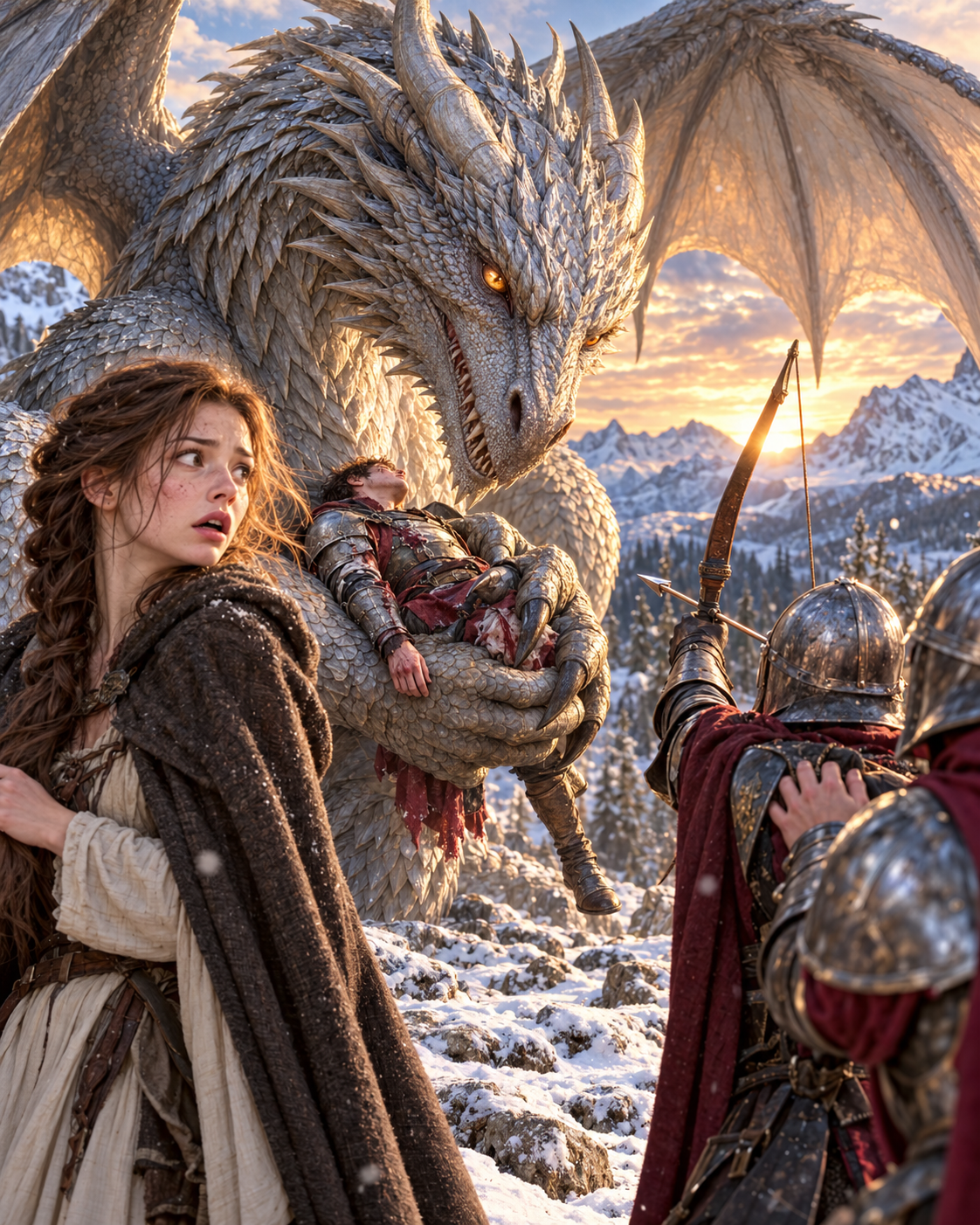
She did not know whether that decision would save Varrow or destroy everything she had spent the last twelve years building. She knew only that the gray drake had heard something beyond the eastern ridge, something the soldiers inside Ashfen Post had not yet understood.
Varrow moved through the open gate with his injured wing hanging low against his side. Every step cost him. Rain slid over his shale-colored scales, washing thin streams of blood from the wound beneath his shoulder.
“Varrow, wait.”
He stopped.
Marin approached slowly, expecting him to pull away. Instead, he lowered his head until his amber eyes were level with hers.
“You can’t fly,” she whispered. “And I can’t carry you back if you collapse.”
Varrow pressed his forehead against her chest.
Then he turned toward the distant explosions.
Captain Cade appeared behind them, holding a lantern.
“If you cross that ridge, Voss will call it another act of disobedience.”
Marin took the lantern from him.
“Then he can add my name to the report.”
Cade studied her for a long moment before removing his officer’s coat.
“What are you doing?” she asked.
“Making sure you don’t get yourselves killed.”
He handed the coat to a passing sentry and ordered two medical packs brought from the infirmary.
Within minutes, the three of them were moving along the eastern supply road, guided by artillery flashes that briefly illuminated the black hills.
They had traveled less than a mile when Varrow suddenly stopped.
His head lifted.
A deep vibration rolled through his chest.
Marin recognized the sound. He made it whenever he discovered someone buried beneath wreckage.
“There’s someone nearby,” she said.
Cade raised his lantern.
The road appeared empty.
Then Varrow turned toward a narrow drainage ditch and began scraping at the earth.
Beneath a collapsed wooden culvert, they found a teenage messenger trapped under a broken beam.
His blue uniform was soaked with blood.
“Please,” the boy whispered. “Don’t leave me.”
Marin dropped beside him.
“We’re not going anywhere.”
Cade lifted the beam while Varrow braced the collapsing timbers with his massive shoulder. Marin pulled the messenger free and immediately pressed bandages against a deep wound in his thigh.
The boy grabbed her wrist.
“The eastern batteries,” he gasped. “They’ve been overrun.”
Cade froze.
“Which batteries?”
“All three. The enemy crossed through Blackthorn Pass. They have our signal codes.”
Marin looked toward the distant flashes.
Blackthorn Pass was supposed to be impassable after the autumn landslides.
If enemy forces had crossed it, Ashfen’s eastern defenses were exposed.
“How many soldiers?” Cade demanded.
The messenger struggled to breathe.
“Thousands.”
Then he said something that made Cade’s expression change completely.
“They’re not attacking the post.”
“Then what are they attacking?”
“The evacuation road.”
For three days, hundreds of wounded soldiers and displaced civilians had been traveling west toward the protected medical settlements.
If the enemy reached the road before dawn, those wagons would be trapped between the mountains and the artillery.
Cade immediately reached for his signal whistle.
Varrow caught his sleeve gently between two teeth.
The captain turned.
“What?”
The drake stared toward the northern slope.
Another low rumble vibrated through his chest.
Marin understood.
“There’s more.”
They followed him into a stand of shattered pine trees.
There, hidden beneath camouflage netting, stood six abandoned medical wagons.
Two had overturned.
One was burning.
The others were surrounded by wounded men who had been left behind when their escort retreated.
Marin counted at least forty.
Some wore blue.
Others wore green.
And among them were several civilians.
A woman clutching a small child looked up as Varrow approached.
She screamed.
The drake stopped immediately.
He lowered himself onto his stomach, folding his uninjured wing against his body.
The child stared at him.
Then, slowly, she reached out and touched his nose.
Varrow closed his eyes.
Marin felt something tighten in her throat.
Even injured, exhausted, and surrounded by frightened strangers, he understood how to make himself less terrifying.
Cade hurried toward the nearest wagon.
“We need reinforcements.”
“There’s no time,” Marin replied.
“Then we move everyone ourselves.”
A wounded enemy sergeant laughed bitterly.
“With what horses? Half the teams ran off when the shelling started.”
Varrow lifted his head.
Marin followed his gaze toward the heavy wagon harnesses.
“No,” she whispered.
But the drake was already rising.
His damaged wing trembled.
He walked toward the largest wagon and placed his chest against its broken tongue.
The enemy sergeant stared.
“He’s offering to pull it.”
Marin shook her head.
“He’ll tear his wing open.”
Varrow looked back at her.
There was no confusion in his eyes.
Only determination.
For the first time, Marin wondered whether she had misunderstood him.
Perhaps Varrow did not simply respond to cries for help.
Perhaps he understood exactly what helping would cost.
And chose it anyway.
They worked quickly.
Cade cut the damaged harnesses and fashioned a broad pulling rig from wagon straps and spare canvas. Marin padded the leather beneath Varrow’s injured shoulder.
The wounded soldiers helped one another climb aboard.
Those who could walk carried supplies.
The enemy sergeant, whose name was Anton Rell, took charge of the rear wagon.
“Why are you helping us?” Cade asked him.
Rell glanced at Varrow.
“Because your drake carried my brother out of a shell crater last month.”
Cade looked surprised.
“Your brother survived?”
“He did.”
Rell tightened a harness buckle.
“And I would like to meet him again.”
By midnight, the strange procession was moving west.
Varrow pulled the first wagon.
The others followed behind, pushed and guided by men who had been enemies only hours earlier.
Marin walked beside his wounded wing, checking the bandages whenever he stumbled.
They had almost reached the old stone bridge when a flare rose above the valley.
The entire road turned white.
Cade shouted for everyone to take cover.
An artillery shell struck the hillside behind them.
Earth and stones rained over the wagons.
The child screamed.
Varrow threw his body sideways, shielding the nearest wagon with his uninjured wing.
A second explosion shattered the bridge’s eastern support.
The structure groaned.
Then half its roadway collapsed into the river.
The procession stopped.
Behind them, enemy artillery continued advancing.
Ahead lay a broken bridge and a freezing river swollen by rain.
Cade examined the remaining stonework.
“Too unstable for the wagons.”
Marin looked at the wounded passengers.
They could not climb the gorge.
They could not turn back.
And Varrow could not fly.
For a moment, she felt the terrible weight of her decision.
She had followed him because she believed compassion deserved a chance.
Now forty wounded people might die because she had brought them to an impossible crossing.
Varrow approached the bridge.
He lowered his head toward the rushing water.
Then he made a sound Marin had never heard before.
Three deep pulses, separated by long silences.
The sound traveled through the gorge.
From somewhere beneath the bridge came an answering vibration.
Cade stepped backward.
“What was that?”
Varrow repeated the call.
The water below began to move.
A huge dark shape emerged beneath the broken arch.
Then another.
Marin stared as two drakes climbed from the riverbank, their scales glistening black and copper in the lantern light.
Neither wore military harnesses.
One had a scar across its muzzle.
The other was missing several scales along its spine.
They approached Varrow cautiously.
He lowered his head.
The copper drake touched his forehead with hers.
Then both creatures turned toward the damaged bridge.
“They know him,” Marin whispered.
Cade watched the three drakes exchange low, resonant calls.
“How?”
Marin remembered Thomas Wren’s testimony.
The frozen river.
The missing rescuers.
The creature who refused to leave until everyone had been recovered.
And suddenly she wondered how much of that story the official report had omitted.
The two wild drakes descended into the gorge.
Using their powerful bodies, they braced themselves against the surviving bridge supports.
Varrow moved onto the remaining roadway and pushed his shoulder beneath a sagging stone beam.
The bridge steadied.
Cade stared in disbelief.
“They’re holding it.”
“Not for long,” Marin said. “Move!”
The first wounded soldiers crossed on foot.
Then came the civilians.
The wagons were too heavy, so the men carried patients across on doors torn from their frames.
The enemy sergeant organized the crossing while Cade stood near the broken edge, guiding each stretcher through the narrow passage.
For twenty minutes, the drakes held the bridge against the river’s force.
Varrow’s injured wing began bleeding again.
Marin saw his legs shaking.
“That’s enough,” she called. “Come away!”
But three patients remained.
One was unconscious.
Another had lost too much blood to stand.
The last was the young messenger.
Varrow shifted his weight beneath the beam.
A crack echoed through the stone.
The copper drake cried out.
The bridge dropped several inches.
“Marin!” Cade shouted. “Get across!”
She refused.
She ran back toward the final stretcher.
Together, she and Rell carried the messenger across the narrowest section.
Behind them, the stone beam split.
Varrow roared.
The bridge collapsed.
Marin turned just in time to see the gray drake disappear into the darkness.
For one terrible second, everything became silent.
Then the river swallowed the broken masonry.
“VARROW!”
She ran toward the edge.
Cade caught her around the waist.
“You’ll fall!”
“Let me go!”
Below them, the water churned around shattered stone.
The copper drake surfaced first.
The black one followed.
Neither carried Varrow.
Marin sank to her knees.
She had saved the wounded.
She had saved the civilians.
But she had lost the creature who had taught her what courage truly meant.
Then, far downstream, a faint amber glow appeared beneath the water.
The black drake turned sharply.
A deep call echoed through the gorge.
The copper drake answered.
Both disappeared beneath the surface.
Marin waited, unable to breathe.
A minute passed.
Then another.
Finally, the river erupted.
The two wild drakes emerged with Varrow between them.
His body hung limp.
His injured wing dragged through the water.
They carried him onto a gravel bank below the western road.
Marin scrambled down the slope.
By the time she reached him, he was not breathing.
She pressed her ear against his chest.
Nothing.
“No,” she whispered.
She opened his jaws and cleared mud from his throat.
Cade arrived carrying the medical packs.
Marin pressed both hands against the softer scales beneath Varrow’s breastbone.
“Come on.”
She pushed with all her strength.
Again.
Again.
The drake remained motionless.
Rell knelt beside her.
“Doctor—”
“Don’t.”
She continued.
Her arms burned.
Her hands slipped on wet scales.
The copper drake lowered her head beside Varrow and released a low, trembling sound.
The black drake answered.
Their calls grew louder.
Marin felt the vibrations beneath her palms.
Then Varrow’s chest moved.
Once.
A weak, uneven breath.
Water spilled from his mouth.
Marin almost collapsed.
“That’s it,” she whispered. “Stay with me.”
Varrow opened one amber eye.
His gaze found hers.
And his enormous tail moved just enough to touch her boot.
By dawn, the survivors reached the western medical station.
Word of the rescue spread faster than the wounded could be unloaded.
Forty-three people had crossed the gorge alive.
Twenty-nine were Ashfen soldiers.
Nine wore enemy uniforms.
Five were civilians.
Every one of them had survived because a condemned drake had refused to abandon them.
But the danger was not over.
Two hours later, Harlan Voss arrived with twelve armed handlers.
He found Marin beside Varrow in a sheltered courtyard, stitching the torn muscles beneath his wing.
“Step away from the animal.”
Marin did not look up.
“He’s receiving treatment.”
“He’s under military seizure.”
Captain Cade moved between them.
“On whose authority?”
Voss produced a signed document.
“Emergency command authority. The drake violated a direct restriction, entered an active combat zone, and compromised military operations.”
“He evacuated forty-three people,” Cade said.
“He also summoned two unidentified drakes into a military corridor.”
Marin finally raised her head.
“Those drakes saved the bridge crossing.”
“And how did he know they were there?” Voss demanded.
Nobody answered.
Voss smiled coldly.
“Exactly. We have no idea what this creature communicates, what loyalties it possesses, or what information it may have passed to wild drakes.”
He turned toward his handlers.
“Secure him.”
Varrow lifted his head.
The handlers hesitated.
Voss drew a restraint collar from his coat.
Marin recognized it immediately.
The iron was lined with suppression crystals, designed to interrupt the natural resonance drakes used to communicate.
For Varrow, whose calls had saved dozens of lives, the collar would be devastating.
“You cannot put that on him,” she said.
Voss ignored her.
Two handlers approached.
Varrow did not attack.
He merely lowered his head and watched them.
Marin stepped forward.
“If you want him, you’ll have to remove me first.”
Voss’s expression hardened.
“Doctor, I can have you arrested.”
“Then arrest me.”
“Marin,” Cade warned quietly.
But she would not move.
Voss raised his hand.
Before he could give the order, a voice called from the courtyard entrance.
“Master Voss.”
Commandant Rusk stood beneath the archway.
Beside him was an elderly man wearing a weathered medical uniform.
Marin recognized the man’s name before she recognized his face.
Thomas Wren.
The medic from the frozen river.
Wren walked slowly toward Varrow, leaning on a cane.
When the gray drake saw him, something extraordinary happened.
Varrow lifted his head despite the pain.
His eyes widened.
Then he released a soft, broken sound.
Wren stopped.
“Hello, old friend.”
He reached out.
Varrow pressed his forehead against the man’s shoulder.
The courtyard fell silent.
Voss recovered first.
“This man has no authority here.”
Rusk looked at him.
“He has testimony.”
“That testimony has already been reviewed.”
“Not all of it.”
Wren opened a worn leather satchel.
Inside were several pages of handwritten notes and a small brass identification plate.
“During the winter rescue,” he began, “Varrow was ordered to withdraw after the first section of ice collapsed. Master Voss believed the remaining men were dead.”
“They were presumed lost,” Voss corrected.
Wren continued.
“Varrow heard them beneath the ice. He refused to leave. When the handlers tried to drag him away, he broke his restraint and returned to the river.”
Marin watched Voss’s face grow pale.
“But there was something the official report never mentioned,” Wren said.
He held up the brass plate.
“One of the men trapped beneath the ice wasn’t a soldier.”
Rusk frowned.
“Who was he?”
“A drake handler. A young apprentice named Samuel Voss.”
The courtyard became utterly still.
Marin turned toward Harlan.
“Your son?”
Voss stared at the plate.
Wren nodded.
“Samuel had entered the river to help an enemy prisoner who’d fallen through. The ice collapsed beneath both of them.”
Marin felt her breath catch.
“Varrow saved them?”
“He saved the prisoner first because the current was carrying him away. Then he went back for Samuel.”
Wren’s voice trembled.
“But the second collapse was worse. Varrow was injured, and Samuel was trapped beneath a slab of ice. The drake stayed with him until we could pull him out.”
Voss looked away.
Marin remembered the original report.
The missing rescue team.
The damaged wing.
The refusal to abandon the river.
“Samuel survived?” she asked.
Wren lowered his eyes.
“For eleven days.”
Voss closed his hands into fists.
“Enough.”
But Wren continued.
“Samuel died from an infection that spread through his injuries. Varrow stayed outside the medical tent every night. When Samuel stopped breathing, the drake cried until sunrise.”
Marin looked at Varrow.
He had not simply learned compassion from the frozen river.
He had learned grief.
And perhaps, ever since that winter, he had been searching every battlefield for someone he could still save.
Voss’s voice cracked.
“My son would still be alive if that animal had followed orders.”
Wren faced him.
“Your son would have died beneath the ice if Varrow had followed orders.”
Voss stepped backward.
For the first time, Marin saw something beneath his cruelty.
Not merely anger.
A grief he had spent months turning into blame.
“He chose an enemy over my boy,” Voss whispered.
“No,” Wren replied. “He chose the person who would drown first. Then he went back for Samuel.”
Voss shook his head.
“You weren’t there when Samuel died.”
“No,” Wren said gently. “But Varrow was.”
The words seemed to strike harder than any accusation.
For several moments, Voss could not speak.
Then he turned toward Rusk.
“Whatever happened at the river, the creature remains a military liability.”
Rusk looked at the wounded drake.
“Perhaps.”
Marin felt her heart sink.
But the commandant continued.
“Or perhaps we have been measuring the wrong kind of usefulness.”
He placed a new document on the courtyard table.
“The western station has confirmed the evacuation. The enemy advance was delayed after both sides discovered their wounded were being transported together. A temporary ceasefire has been requested along the medical corridor.”
Cade stared.
“A ceasefire?”
“Forty-eight hours, initially. Both armies need time to recover their wounded.”
Rusk turned toward Marin.
“The enemy commander has also requested something unusual.”
“What?”
“Permission for the gray drake to assist in further evacuations.”
Voss looked horrified.
“You cannot seriously consider allowing an unreliable military animal to operate between opposing armies.”
Rusk’s expression hardened.
“Master Voss, the man who crossed the river last night saved more lives than an entire battalion of stretcher teams could have managed under those conditions.”
He paused.
“And unlike us, he never asked which side deserved saving.”
For the first time since Marin had discovered the condemnation order, nobody challenged Varrow’s right to live.
But Marin knew the commandant’s proposal carried another danger.
A temporary ceasefire could end at any moment.
If Varrow returned to the battlefield under military orders, another commander might condemn him.
If he remained with Marin, he would be safe but unable to answer the cries he heard beyond the hills.
She looked at the release agreement still folded inside her coat.
Then she understood.
The problem was not that Varrow had no place in the army.
The problem was that the army had no place for what Varrow had become.
“Commandant,” she said, “I have a different proposal.”
Rusk turned toward her.
“Go on.”
“Release Varrow from military ownership permanently. Establish an independent rescue service under medical authority, recognized by both armies.”
Voss gave a bitter laugh.
“You want to create a hospital with wings?”
“If necessary.”
“Who would fund it?”
Marin looked toward the rescued soldiers gathering around the courtyard.
“Those who understand what it means to be carried home.”
Rell stepped forward.
“My commander would support it.”
Cade nodded.
“So would the western medical corps.”
Wren rested a hand on Varrow’s scales.
“And I know three retired handlers who would volunteer tomorrow.”
Rusk considered the proposal.
“An independent service would require formal agreements, supplies, neutral territory, and protection from military interference.”
“Then we begin with those things,” Marin replied.
“And what if the war continues?”
She looked at Varrow.
“Then the need will continue too.”
Rusk studied her for a long moment.
Finally, he reached for his pen.
“I can authorize a provisional medical rescue unit for thirty days. Anything permanent will require approval from both commands.”
Marin nodded.
“Thirty days is a beginning.”
Rusk signed.
Then he turned toward Voss.
“Your authority over this drake ends now.”
Voss stood motionless.
His eyes moved from the document to Varrow.
The gray drake watched him without hostility.
For a moment, Marin thought Voss might speak.
Instead, he placed the suppression collar on the table.
Then he walked away.
Three days later, Varrow was transferred to a sheltered valley between the opposing armies.
The place had once been a farming settlement.
Its barns were empty.
Its houses had lost their roofs.
But a clean spring flowed through the center, and the surrounding cliffs offered protection from artillery.
Marin named it Havenfield.
Cade arranged supply wagons.
Wren recruited handlers.
Rell negotiated safe passage for medical teams traveling from the eastern lines.
And the two wild drakes returned.
They came at dawn, circling above the valley before landing beside Varrow.
Marin watched them exchange their deep, musical calls.
The copper drake touched Varrow’s damaged wing.
The black one lowered his head beside the fresh bandages.
For the first time, Marin realized that these creatures were not simply responding to commands or instincts.
They remembered one another.
They formed bonds.
And perhaps they understood loyalty better than the people who claimed to own them.
Within two weeks, Havenfield had treated more than a hundred wounded people.
By the end of the month, there were four additional drakes.
Some had escaped military service.
Others had been abandoned after injuries made them unsuitable for combat.
One arrived with a broken horn.
Another had lost the ability to produce fire.
A small brown drake had never learned to fly.
None would have been considered valuable by military standards.
But each discovered a purpose.
The brown drake could squeeze through collapsed tunnels.
The hornless drake carried stretchers across flooded ground.
The fireless drake possessed an extraordinary ability to locate buried survivors by sensing vibrations beneath the earth.
Varrow became their guide.
He could not fly yet.
His wing would require months of healing, and Marin doubted he would ever carry heavy military armor again.
But every morning, he walked among the wounded.
He lowered his head beside frightened patients.
He rested near those who could not sleep.
And whenever someone cried out, he was the first to respond.
Yet Havenfield’s greatest test came on the thirty-first day.
The temporary medical agreement was due to expire.
Both armies had resumed fighting along the northern front.
And that morning, a messenger arrived carrying orders from the eastern command.
All neutral rescue operations were to cease immediately.
Any drake entering an active combat zone would be treated as a hostile military asset.
Marin read the order twice.
Cade stood beside her.
“They’re afraid the rescue corridors are being used to move intelligence.”
“Are they?”
“Some officers believe so. There’s no verified evidence.”
Marin folded the paper.
“Then we need to prove our neutrality.”
Before Cade could answer, the ground shook.
A distant explosion rolled across the valley.
Then another.
Wren hurried from the medical barn.
“Doctor! The northern hospital has been hit.”
Marin froze.
The northern hospital stood inside a narrow mountain basin.
Nearly two hundred wounded soldiers were being treated there.
The facility had been clearly marked as medical ground.
A second messenger arrived moments later.
His horse collapsed beneath him.
“The hospital is burning,” he gasped. “The eastern army thinks it was struck by western artillery. The western army says the eastern batteries caused it.”
Cade caught him before he fell.
“How many are trapped?”
“Most of them.”
Marin looked toward Varrow.
He was already standing.
The other drakes gathered behind him.
For one terrible moment, she remembered the broken bridge.
The river.
The silence when his heart had stopped.
She could not bear to lose him again.
But then she saw something that changed her understanding of love.
Varrow was not pulling against a harness.
He was waiting.
Waiting for her.
Not because he needed permission to care.
Because he trusted her to help him care wisely.
Marin stepped forward.
“We don’t rush into artillery fire,” she told him. “We plan.”
Varrow lowered his head.
Together, they began.
Cade sent riders to both commands requesting an emergency medical corridor.
Rell carried the same message east.
Wren organized evacuation wagons.
Marin prepared surgical supplies and assigned the drakes according to their abilities.
They would enter through the western ravine, approach the hospital from below, and evacuate patients through a disused mining tunnel.
The tunnel was narrow.
Only the smallest drake could pass through it.
But Varrow knew another route.
He led them toward a ridge overlooking the basin.
There, beneath a curtain of falling water, lay an ancient passage worn through the rock.
Marin stared.
“How did you know this was here?”
Varrow touched the stone with his nose.
The copper drake answered with a low call.
Marin suddenly understood.
The wild drakes had used these mountains long before armies had divided them into territories.
The passage belonged to no kingdom.
No commander.
No war.
For the next four hours, Havenfield’s rescuers worked beneath falling ash.
The brown drake crawled through the mining tunnel carrying ropes and bandages.
The larger drakes cleared fallen beams.
Varrow guided the wounded through the hidden passage, stopping whenever someone fell behind.
Marin performed emergency surgery beneath a shattered archway.
Cade coordinated stretcher teams from both armies.
And when the first artillery shells struck near the evacuation route, something unexpected happened.
The guns stopped.
Not everywhere.
Only along the narrow basin.
But it was enough.
From the eastern ridge, soldiers emerged carrying white medical flags.
From the western trenches, another group approached.
Neither side fired.
They had seen the drakes carrying wounded men through the smoke.
They had recognized their own uniforms among the rescued.
And for one brief afternoon, the battlefield became something neither army had expected.
A place where enemies helped one another survive.
By sunset, one hundred eighty-six patients had been evacuated.
Fourteen others had died before the rescuers could reach them.
Marin recorded every name.
She refused to call the operation a complete victory.
There were families who would receive terrible news.
There were injuries no drake could heal.
And there were still commanders who believed mercy was weakness.
But something irreversible had happened.
Soldiers from both armies had witnessed the same truth.
Saving an enemy did not erase loyalty to one’s own people.
It simply refused to make suffering a requirement of that loyalty.
Two weeks later, the opposing commands signed a permanent agreement protecting Havenfield’s rescue corridors.
The war continued for another eleven months.
There were battles, losses, broken promises, and days when Marin wondered whether anything they had built could survive.
But Havenfield endured.
Its rescuers wore no national colors.
Its wagons carried a simple symbol: an open hand beneath a pair of drake wings.
By the war’s end, more than three thousand wounded soldiers and civilians had passed through its gates.
Varrow had personally helped rescue hundreds.
And not once had he asked which uniform they wore.
On the first anniversary of the frozen river disaster, Harlan Voss arrived at Havenfield.
He came alone.
His uniform was gone.
He carried a small wooden box.
Marin found him standing outside Varrow’s shelter.
For a moment, neither spoke.
Then Voss opened the box.
Inside lay Samuel’s old handler’s whistle.
“He used to say Varrow was the gentlest creature he’d ever trained,” Voss said quietly.
Marin watched him struggle with the words.
“I thought that gentleness killed him.”
He looked toward the gray drake.
“But Samuel went into the river because he saw someone drowning. Varrow followed because he couldn’t leave either of them behind.”
His voice broke.
“I spent a year hating the one creature who stayed with my son when I couldn’t.”
Varrow approached slowly.
Voss stiffened.
The drake stopped a few feet away.
Then he lowered his enormous head.
Voss reached out with a trembling hand.
“I’m sorry.”
Varrow closed his eyes beneath the touch.
There was no grand declaration.
No sudden forgiveness that erased everything.
Only a grieving father finally allowing himself to remember his son without blaming the creature who had tried to save him.
Voss placed the whistle beside Varrow’s resting place.
Then he asked Marin whether Havenfield needed someone to repair harnesses.
She considered him carefully.
“We need people willing to learn.”
Voss nodded.
“Then I’d like to begin.”
Years passed.
The ruined farming settlement became a thriving sanctuary.
Children who had once hidden beneath hospital beds grew old enough to volunteer.
Former enemies worked together in its kitchens.
The drakes who had been dismissed as useless became legends among the mountain villages.
And Varrow grew old.
His scales faded from dark shale to pale silver.
His damaged wing never fully recovered, but he learned to glide short distances when the valley winds were strong.
On quiet afternoons, he rested beside the spring while young drakes gathered around him.
Marin often sat nearby, reading old medical ledgers.
One autumn evening, a young apprentice asked her a question.
“Doctor, was Varrow the greatest war drake who ever lived?”
Marin looked toward the enormous gray creature sleeping beneath the willow trees.
She thought about the military records.
The condemnation order.
The frozen river.
The broken bridge.
And the thousands of lives changed because one creature refused to obey an order that contradicted his heart.
“No,” she said softly.
The apprentice looked surprised.
“But he saved more people than any other drake.”
“Yes.”
“Then why wasn’t he the greatest?”
Marin smiled.
“Because he was never truly a war drake.”
She watched Varrow open one amber eye as a frightened young patient approached him.
The child hesitated.
Varrow lowered his head until they were face-to-face.
A small hand touched his nose.
And just as he had done so many years before, the old drake closed his eyes.
“He was something far more important,” Marin said.
“He was a reminder that strength is not measured only by what we can destroy.”
The apprentice watched the child embrace Varrow’s enormous muzzle.
“Then how is it measured?”
Marin closed her ledger.
“Sometimes, by what we refuse to abandon.”
That evening, the bells of Havenfield rang as another rescue team returned safely through the mountain pass.
Varrow lifted his head toward the sound.
For a moment, his old body seemed to remember every battlefield, every distant cry, every desperate journey through smoke and rain.
Then he settled peacefully beneath the willow tree.
He no longer needed to run toward every voice calling for help.
Others were answering now.
And that was the greatest victory of his life.
He had not merely saved the wounded.
He had taught an entire generation to do the same.
Because compassion, when protected and shared, becomes something stronger than any army.
It becomes a legacy.
And long after the last battle had faded into history, people still told the story of the gray drake who had been condemned for refusing to kill.
They remembered that he had carried enemies and friends through the same burning fields.
They remembered that a doctor had risked everything to defend him.
And they remembered the lesson that changed Havenfield forever:
The world may teach us to divide people into those who deserve our kindness and those who do not. But the greatest courage is often found in the heart that refuses to stop caring, even when everyone else insists it should.
THE END.