The foreman humiliated me before thirty-two hungry cowboys at Morgan Creek Ranch, calling me worthless for refusing dinner, but someone had deliberately hidden the spoiled meat.
Caleb Morgan stood motionless in the kitchen doorway, staring at the photograph in my hands as though someone had reached into his chest and pulled out a memory he had spent years trying to bury.
Outside, the Wyoming wind rattled the windows, carrying the distant sounds of thirty-two cowboys returning from the pastures.
But Caleb seemed to hear none of it.
“Where did you get that photograph, Martha?”
His voice was barely recognizable.
I explained how Eli had discovered the leather satchel beneath Wade Turner’s saddle and how the photograph had been hidden among forged bank receipts and a railway ticket.
Caleb took it carefully, turning it over to read the six words Eleanor had written on the back.
“Ask Samuel why the records disappeared.”
His face drained of color.
“Who is Samuel?” I asked.
Caleb looked toward the kitchen door before answering.
“Samuel Whitcomb was Eleanor’s younger brother.”
I waited, sensing there was more.
“He disappeared three months before she died.”
The stove crackled behind us, but I suddenly felt cold.
Caleb explained that Samuel had worked as a bookkeeper in Cheyenne before Eleanor invited him to help straighten out the ranch accounts.
He had stayed for six weeks, spending most evenings bent over ledgers while Wade handled the cattle operations.
Then one morning, Samuel had vanished.
Wade claimed the young man had stolen money and fled east on the railroad.
Eleanor refused to believe it, but her illness was worsening, and Caleb had been too occupied with the failing ranch to investigate properly.
“She begged me to find him,” Caleb whispered.
He lowered himself into a chair.
“And I told her Samuel was a grown man who could make his own decisions.”
I watched the regret settle across his face.
There are mistakes we make because we are cruel, and there are mistakes we make because we are exhausted.
Sometimes the second kind hurts just as deeply.
Caleb crossed the room and unlocked the bottom drawer of his desk.
Inside lay a small leather-bound notebook, several old letters, and a silver pocket watch.
He lifted the watch with trembling fingers.
“Samuel left this behind.”
I noticed the engraved initials on its cover.
S.W.
“He carried it everywhere,” Caleb continued.
“When Eleanor became ill, he told her he would never leave until he knew she was safe.”
Caleb looked at the photograph again.
“I should have known he wouldn’t abandon her.”
Before I could answer, footsteps sounded in the hallway.
Eli appeared, breathing hard.
“Mr. Morgan, Wade’s getting ready to leave.”
Caleb rose immediately.
“Where?”
“He’s saddling his horse and loading two bags.”
The three of us exchanged a look.
Wade had a railway ticket for the following morning, but the discovery of his satchel might have frightened him into leaving early.
Caleb moved toward the door.
I caught his sleeve.
“Remember what Eleanor wrote.”
He stopped.
“She was afraid of Wade for a reason, Caleb.”
His jaw tightened.
“I know.”
“Then don’t give him another chance to hide the truth.”
For a moment, I thought he would ignore me.
Instead, he turned to Eli.
“Find Ben Carter and Thomas Reed. Tell them to meet us at the stable.”
Ben and Thomas were two of the oldest cowboys on the ranch, men who had worked for Caleb’s father and whose loyalty had never been questioned.
When we reached the stable, Wade was tightening the saddle strap on his dark gelding.
He looked up and immediately understood something had changed.
“Going somewhere?” Caleb asked.
Wade straightened.
“Cheyenne. We need supplies.”
“We received supplies last week.”
“Then we need replacement harnesses.”
Caleb stepped closer.
“Funny how you remembered that just as your financial records disappeared.”
Wade’s expression hardened.
“I don’t know what you’re talking about.”
Caleb held up the photograph.
For the first time since I had met him, Wade Turner looked genuinely frightened.
“Where did you find that?”
“In your belongings.”
“You had no right searching my things.”
“Then perhaps you should explain why my dead wife’s signature appears on documents dated six months after her funeral.”
Wade looked toward the stable entrance.
Ben and Thomas stood there quietly.
Behind them, Eli waited with his arms crossed.
Wade’s hand tightened around the reins.
“You’re making a mistake, Caleb.”
“Maybe,” Caleb answered.
“But I’ve made enough mistakes protecting you.”
Wade suddenly shoved past him.
The horse startled, pulling against its tether.
Ben caught the reins while Thomas blocked the doorway.
Nobody struck Wade.
Nobody needed to.
For several seconds, the only sounds were the horse’s nervous breathing and the wind moving through the rafters.
Then Caleb spoke.
“Where is Samuel Whitcomb?”
Wade’s face changed.
Not anger this time.
Fear.
“I don’t know.”
“Look at me and say that again.”
Wade stared at the floor.
Caleb took another step.
“Did you kill him?”
The question seemed to drain the air from the stable.
Wade looked up sharply.
“No.”
“Then where is he?”
“I said I don’t know.”
But his voice had lost its certainty.
Caleb studied him for a long moment.
Then he turned to Ben.
“Keep him here until the sheriff arrives.”
Wade laughed bitterly.
“You’re going to ruin this ranch over a dead woman’s suspicions?”
Caleb stopped at the doorway.
“No, Wade.”
His voice was quiet.
“I’m going to find out what happened because I should have listened to her when she was alive.”
That evening, Morgan Creek Ranch felt different.
The men still gathered for supper, but their conversations were subdued.
Rumors traveled quickly across a ranch, especially when the foreman was being held under watch in the bunkhouse.
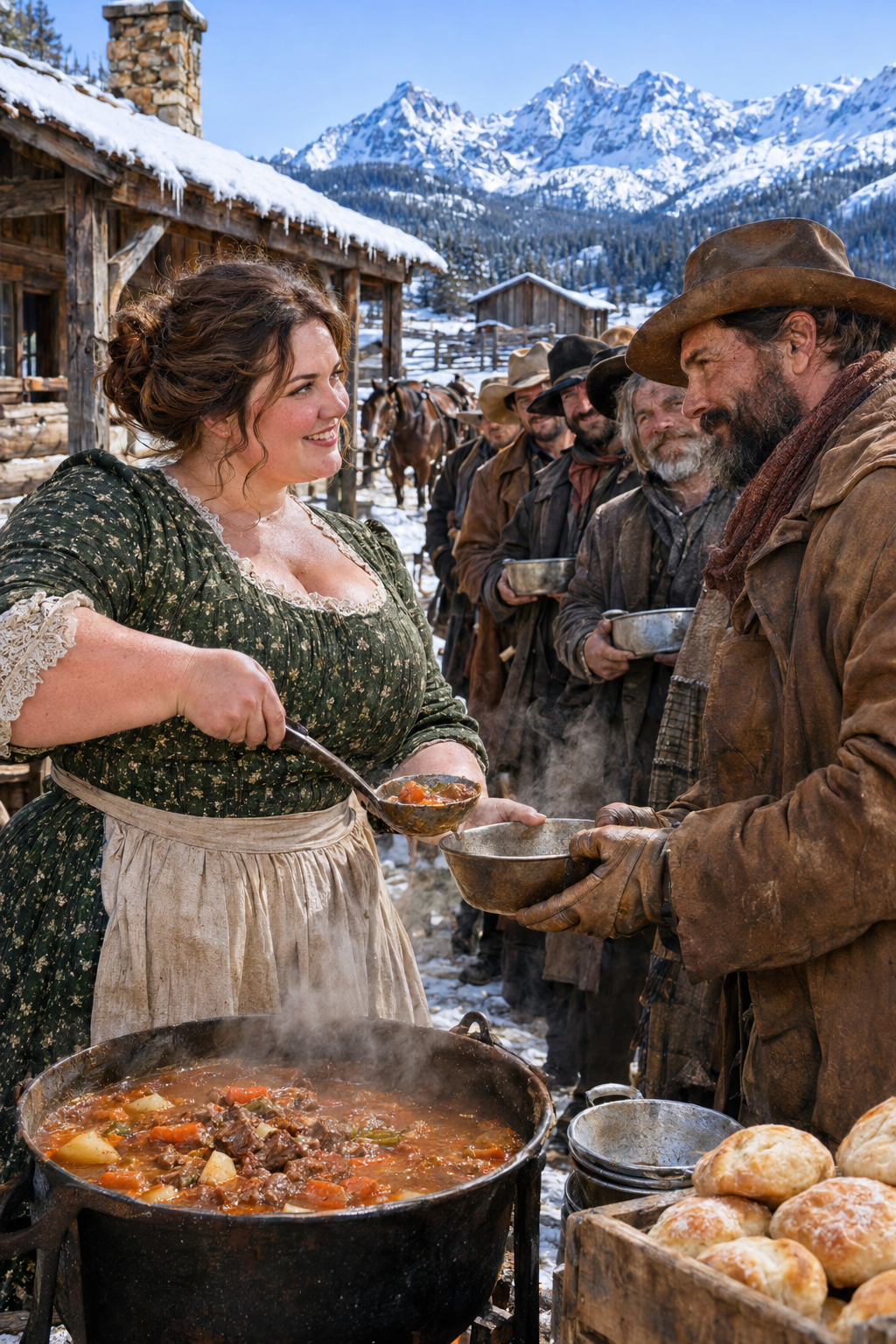
I served beef stew made from the fresh supplies Caleb had purchased after selling his prized cattle.
For once, nobody complained about the portions.
Eli helped carry bowls to the tables.
When the last cowboy had been served, he approached me.
“Miss Martha, do you think Mr. Morgan will lose the ranch?”
I looked toward Caleb’s empty chair.
“I don’t know, sweetheart.”
Eli lowered his eyes.
“My father worked here before he died. He always said Mr. Morgan was a good man.”
“He is.”
“Then why do bad things keep happening to him?”
I wanted to give him an answer that would make sense.
But life had taught me that goodness was not a shield against suffering.
Sometimes it simply determined what a person chose to do after suffering arrived.
“Because being good doesn’t mean life will be fair,” I told him.
“It means you keep trying to be fair when life isn’t.”
Eli considered that quietly.
Then he picked up another stack of empty bowls.
“I guess that’s why you’re still here.”
His words stayed with me long after supper ended.
The next morning, Sheriff Daniel Mercer arrived from the county seat with Deputy Frank Ellis.
The storm had left the roads nearly impassable, and their horses were exhausted.
I gave them hot coffee while Caleb explained everything.
The sheriff examined the forged signatures, missing supply receipts, and railway ticket.
Then he read Eleanor’s letter.
His expression grew increasingly serious.
“Mr. Morgan, these records suggest someone has been selling ranch property and using false documents to conceal the transactions.”
Caleb nodded.
“How much?”
The sheriff spread the receipts across the table.
“That depends on how far back it goes.”
He pointed to several entries.
“These cattle shipments don’t match the ranch inventory.”
Caleb leaned forward.
“Those animals were reported lost during the spring floods.”
“Apparently, somebody found buyers for them.”
The room fell silent.
Then the sheriff reached for Samuel’s photograph.
“Where did you get this?”
I explained.
He studied the stranger’s face.
“I’ve seen this man.”
Caleb gripped the edge of the table.
“Where?”
“Last autumn, in Cheyenne.”
Caleb stared at him.
“That’s impossible.”
“Why?”
“Samuel disappeared more than two years ago.”
The sheriff looked at the photograph again.
“Then somebody should have told him he was missing.”
For a moment, nobody moved.
Caleb’s chair scraped against the floor.
“You’re certain?”
“I remember him because he came to my office asking about a ranch accountant who had vanished.”
My heart began pounding.
“What did you tell him?”
“That the man he described was presumed to have left the territory.”
The sheriff paused.
“He didn’t seem satisfied.”
Caleb closed his eyes.
“Did he give you a name?”
“Samuel Whitcomb.”
I watched Caleb struggle to breathe.
Samuel had been alive.
He had been searching for answers.
And somehow, Wade had convinced everyone at Morgan Creek that he had disappeared forever.
The sheriff continued examining the documents.
Eventually, he found a small notation beside one of the livestock payments.
It referred to a freight warehouse near the Cheyenne rail yards.
“I know this place,” he said.
“It’s operated by a company called Western Prairie Transport.”
Caleb frowned.
“That’s the company that purchased our missing cattle.”
“Then I suggest we start there.”
By noon, Wade was placed in the sheriff’s custody on suspicion of fraud and theft.
He refused to answer questions about Samuel.
But as the deputy prepared to escort him outside, Wade suddenly turned toward Caleb.
“You think Eleanor was some kind of saint?”
Caleb went rigid.
“Don’t speak about my wife.”
Wade smiled without warmth.
“She knew more than you ever did.”
I saw Caleb’s hands curl into fists.
Before he could respond, I stepped between them.
“Then she was smarter than you thought, because she left enough evidence to expose you.”
Wade’s smile disappeared.
The sheriff led him away.
But his final words followed us into the hallway.
“You’re going to wish you’d left those papers buried.”
That night, Caleb sat alone in the kitchen long after everyone had gone to bed.
I found him staring into a cold cup of coffee.
He looked up when I entered.
“I keep thinking about Eleanor.”
I sat across from him.
“She must have been a remarkable woman.”
“She was.”
His voice softened.
“She could make this whole place feel warm even in the worst winter.”
He looked toward the stove.
“You remind me of her sometimes.”
I didn’t know how to answer.
For years, I had believed my usefulness was the only thing anyone valued.
I could cook, clean, mend clothing, and stretch a sack of flour farther than most people thought possible.
But Caleb wasn’t looking at my hands.
He was looking at me.
“I don’t want you to think I’m trying to replace her,” I said.
He shook his head.
“You’re not.”
Then he added something I would remember for the rest of my life.
“Grief doesn’t leave a house because someone new walks through the door. Sometimes the house simply becomes big enough to hold both memory and hope.”
I looked away before he could see my tears.
Three days later, Caleb traveled to Cheyenne with Sheriff Mercer.
I remained at Morgan Creek, responsible for feeding the men and keeping the household running.
Before leaving, Caleb handed me a sealed envelope.
“If anything happens, give this to Ben.”
I frowned.
“What do you mean, anything?”
“Just promise me.”
I took the envelope reluctantly.
“Come home, Caleb.”
He looked at me for a long moment.
“I intend to.”
But two days passed without word.
Then three.
On the fourth morning, a rider arrived carrying a telegram.
I opened it with shaking hands.
The message was brief.
SAMUEL FOUND.
RECORDS RECOVERED.
RETURNING FRIDAY.
I pressed the paper against my chest.
For the first time in days, I could breathe.
But Friday brought another snowstorm.
By afternoon, the road disappeared beneath drifting snow.
The men gathered near the windows, watching the white horizon.
Eli stood beside me.
“Do you think they’ll make it?”
I remembered the four missing riders and the meals I had kept waiting for them.
“Yes,” I answered.
“Then we’d better keep supper warm.”
Just before sunset, three horses appeared through the snow.
Caleb rode first.
Sheriff Mercer followed.
Between them sat a thin, pale man wrapped in a heavy coat.
When Caleb helped him dismount, I recognized the face from Eleanor’s photograph.
Samuel Whitcomb had come home.
He was thinner than I expected, with silver beginning to show in his dark hair.
A scar crossed his left temple.
But when he entered the kitchen, his eyes filled with tears.
“Eleanor used to stand right there,” he whispered.
He pointed toward the stove.
Caleb placed a hand on his shoulder.
“I know.”
Samuel looked around the room.
“She loved this place.”
“So do I,” Caleb answered.
Samuel lowered his head.
“I’m sorry I couldn’t save it for her.”
I brought him a bowl of hot stew.
“Then perhaps you can help save it now.”
He looked at me with surprise.
I set the bowl before him.
“Eat first. Explanations can wait until your hands stop shaking.”
For the first time, he smiled.
Later that evening, Samuel told us everything.
He had discovered that Wade was secretly selling cattle through Western Prairie Transport and depositing the proceeds into accounts controlled by a business partner named Harold Vance.
When Samuel confronted him, Wade accused him of stealing from the ranch.
The following night, two men attacked Samuel outside a Cheyenne boardinghouse.
He survived but suffered a severe head injury.
For months, he recovered under the care of a railroad physician, unable to remember everything that had happened.
When his memory returned, he began gathering evidence.
He had tried to contact Eleanor, only to discover she had died.
Then he learned that Wade was still managing Morgan Creek.
“I knew he’d destroy the records if I returned without proof,” Samuel explained.
“So I stayed away.”
Caleb stared at him.
“Why didn’t you write to me?”
Samuel’s eyes filled.
“I did.”
He reached into his coat and produced three folded letters.
“Every one came back marked undeliverable.”
Caleb examined the envelopes.
The handwriting was familiar.
Wade had handled the ranch mail.
For two years, he had controlled not only the accounts but also the truth.
Samuel opened a leather portfolio.
Inside were copies of livestock contracts, bank transfers, and shipping records.
But the final document was the most important.
It showed that Wade and Harold Vance had arranged to place Morgan Creek Ranch into foreclosure through a series of fraudulent debts.
The deadline was only eleven days away.
Caleb stared at the amount.
It was more money than he could raise by selling every remaining animal.
“Then we’ve already lost,” he whispered.
Samuel shook his head.
“Not necessarily.”
He explained that the debt depended on forged agreements bearing Eleanor’s signature.
If they could prove the fraud before the foreclosure hearing, the claims might be invalidated.
But the bank required certified evidence, and Harold Vance had powerful connections.
Sheriff Mercer had already arranged for the records to be reviewed.
Still, there was no guarantee.
For the next week, Morgan Creek became a place of anxious waiting.
The cowboys worked through freezing mornings, repairing fences and preparing the remaining cattle for winter.
Nobody spoke openly about losing the ranch.
But I saw fear in their faces.
Some had families in town.
Others had nowhere else to go.
Eli approached me one evening carrying a small cloth pouch.
Inside were fourteen dollars and several coins.
“It’s not much,” he said.
I stared at him.
“What is this?”
“My savings.”
He looked embarrassed.
“I thought maybe Mr. Morgan could use it.”
My throat tightened.
I closed his fingers around the pouch.
“Your mother needs that money.”
“So does the ranch.”
I shook my head gently.
“Then give us something more valuable.”
He frowned.
“What?”
“Keep showing up. Keep doing your work. Keep believing this place is worth saving.”
The next morning, I discovered that the cowboys had begun repairing the old storage barn without being asked.
Ben organized the work.
Thomas brought spare lumber.
Eli climbed onto the roof despite my protests.
They worked until darkness made the tools difficult to see.
When Caleb came outside, he stopped in the yard.
“What are you men doing?”
Ben wiped his hands on his coat.
“Fixing your barn.”
“I can’t pay overtime.”
“We didn’t ask.”
Caleb looked from one face to another.
Thirty-two men stood in the snow, tired and determined.
For the first time since I had arrived, I saw him smile without sadness.
The foreclosure hearing took place the following Tuesday.
Caleb, Samuel, and Sheriff Mercer traveled to Cheyenne before dawn.
I wanted to accompany them, but someone had to keep the ranch running.
Before Caleb left, he found me beside the kitchen stove.
“If this goes badly, Martha, I’ll make sure you receive every dollar I owe you.”
I turned toward him.
“Caleb Morgan, if you think I’m worried about my wages, you haven’t been paying attention.”
He smiled faintly.
“What are you worried about?”
I looked into his tired eyes.
“That you’ll forget how much you’ve already saved.”
He reached for my hand.
His fingers were rough and cold.
“I don’t think I could forget with you here.”
Then he left.
The hours passed slowly.
I baked bread, stirred soup, and cleaned shelves that were already clean.
By evening, the men had gathered in the dining hall.
Nobody wanted to admit they were waiting.
But every time the door opened, thirty-two heads turned.
At nearly nine o’clock, hoofbeats sounded outside.
I hurried toward the entrance.
Caleb stepped through the doorway, his coat covered in snow.
Samuel followed.
Neither man spoke.
My stomach dropped.
“Caleb?”
He removed his hat.
Then he looked around the room.
“The bank has withdrawn its foreclosure claim.”
For one stunned second, nobody moved.
Then the dining hall erupted.
Men shouted, laughed, and embraced one another.
Eli nearly knocked over a chair.
Ben covered his face with both hands.
I stood motionless, afraid to believe what I had heard.
Caleb crossed the room toward me.
“We did it, Martha.”
My eyes filled.
“Tell me everything.”
The evidence had been enough to establish that the disputed debts were fraudulent.
Harold Vance had been arrested after attempting to destroy shipping records.
Wade, confronted with Samuel’s testimony and the bank documents, had finally admitted his role in the scheme.
He had forged Eleanor’s signature, diverted cattle profits, and concealed Samuel’s letters.
But the most painful revelation concerned Eleanor herself.
She had discovered the fraud shortly before her death.
Knowing she was too weak to confront Wade, she had hidden copies of the records and written her warning to Caleb.
She had believed that someone would eventually find them.
Someone willing to question what everyone else accepted.
I thought about that first evening, when Wade ordered me to serve spoiled meat.
If I had obeyed, I might never have examined the pantry.
If Caleb had dismissed me, Eleanor’s evidence might have remained hidden until the ranch was lost.
Sometimes the smallest refusal changes the direction of an entire life.
The celebration lasted until midnight.
I made fresh biscuits, opened our remaining jars of preserves, and served every man an extra helping of stew.
Caleb insisted I sit down.
“Just for once,” he said.
I laughed.
“Who’s going to wash the dishes?”
Thirty-two cowboys raised their hands.
The sight was so ridiculous that I began laughing until tears rolled down my cheeks.
For years, I had worked in kitchens where nobody noticed when I was exhausted.
Now an entire room of men was arguing over who would wash my plates.
That night, after everyone had gone to bed, I found Caleb standing on the porch.
Snow covered the yard in a silver blanket.
The ranch buildings stood quiet beneath the stars.
He handed me a cup of coffee.
“There’s something I haven’t told you.”
I looked at him.
“After everything we’ve been through, I hope it isn’t another missing ledger.”
He laughed softly.
“No.”
Then his expression grew serious.
“When Eleanor was dying, she asked me to promise something.”
I waited.
“She told me not to turn this ranch into a monument to her memory.”
His eyes moved toward the darkened kitchen window.
“She said a home should belong to the living.”
I felt my chest tighten.
“For two years, I thought loving her meant refusing to change anything.”
He looked at me.
“Then you arrived and told thirty-two hungry cowboys they couldn’t eat rotten beef.”
I smiled through sudden tears.
“Not exactly a graceful introduction.”
“It was the first honest thing anyone had said in this house for a long time.”
He took a breath.
“I don’t know what the future holds, Martha, but I know this place feels like home again because you’re here.”
For a moment, I couldn’t speak.
I thought about my husband, the restaurant I had lost, the lonely winters, and the countless nights when I had wondered whether anyone would ever need me for something beyond a hot meal.
“I spent so many years believing home was something I’d lost forever,” I whispered.
Caleb reached for my hand.
“Maybe home is something we can build again.”
I looked toward the warm kitchen windows.
Inside, thirty-two men slept beneath a roof they had helped repair.
Eli would send his wages home to his mother.
Samuel would remain through winter to restore the ranch accounts.
And Caleb would wake tomorrow knowing that the land his family had worked for generations was still his.
But there was something else I wanted.
Something I had almost forgotten how to ask for.
“Caleb?”
“Yes?”
“If I’m going to stay here, I want one thing changed.”
He looked concerned.
“Anything.”
“I don’t want the men calling this your kitchen anymore.”
His eyebrows lifted.
“What should they call it?”
I smiled.
“Our kitchen.”
He laughed, then drew me into a gentle embrace.
And standing there beneath the Wyoming stars, I realized that belonging wasn’t about being needed only when things went wrong.
It was about being welcomed when everything was finally right.
Spring came slowly to Morgan Creek.
The snow retreated from the pastures, revealing green grass and muddy trails.
The cattle grew strong.
The ranch accounts were restored.
Money recovered from the fraudulent sales helped repay legitimate debts and rebuild the winter stores.
Samuel took charge of the books, though Caleb insisted that every major transaction be reviewed by two people.
Trust, we had learned, was precious.
But trust without accountability could become an invitation to betrayal.
Wade and Harold Vance eventually faced trial.
Their convictions could not restore Eleanor’s life or erase the years Samuel had lost.
But the truth was finally recorded where nobody could hide it again.
On a warm May morning, Caleb asked me to accompany him to the little cemetery beyond the eastern pasture.
Eleanor’s grave stood beneath a cottonwood tree.
He carried a small bouquet of wildflowers.
I hesitated at the gate.
“Are you sure you want me here?”
He nodded.
“More than anything.”
We stood together before the simple stone.
Caleb placed the flowers gently at its base.
For a long time, he said nothing.
Then he knelt.
“I’m sorry I didn’t listen,” he whispered.
The breeze moved through the branches overhead.
“I should have protected what you were trying to save.”
I watched his shoulders tremble.
He had spent two years carrying guilt like a punishment he believed he deserved.
But grief does not become love simply because we refuse to put it down.
Finally, Caleb stood.
He looked at the grave one last time.
“Thank you for bringing me back to myself, Eleanor.”
Then he turned toward me.
His eyes were wet, but peaceful.
We walked home together.
That evening, I prepared supper while sunlight poured through the kitchen windows.
Eli came in carrying fresh eggs.
Ben brought a basket of potatoes.
Thomas arrived with a broken chair he had promised to repair.
The room filled with familiar voices, laughter, and the smell of baking bread.
Caleb stood in the doorway, watching us.
I caught his eye.
He smiled.
And suddenly I understood something that had taken me fifty-one years to learn.
A person’s worth cannot be measured by the wages they earn, the property they own, or the approval of someone powerful enough to dismiss them.
Sometimes courage looks like refusing to serve a dangerous meal.
Sometimes love looks like saving four portions for men who might never return.
And sometimes the greatest act of faith is staying when every painful memory tells you to run.
That summer, Caleb built a long wooden table for the dining hall.
It was large enough for every cowboy, every visitor, and anyone who arrived hungry.
He carved a small sentence into its edge.
I discovered it one morning while setting out the breakfast dishes.
“THERE IS ALWAYS ROOM FOR ONE MORE.”
I traced the letters with my fingertips.
Then I heard Caleb behind me.
“Do you like it?”
I turned toward him.
“It’s beautiful.”
He stepped closer.
“I was thinking we might make it a rule.”
“What kind of rule?”
“Nobody who comes through our door leaves believing they don’t matter.”
I looked at the table, the warm kitchen, and the man who had once nearly lost everything because he trusted the wrong person.
Then I thought of Eleanor, whose courage had survived her death in a hidden wooden box.
Of Samuel, who had refused to abandon the truth.
Of Eli, who had offered his last fourteen dollars.
And of thirty-two exhausted cowboys who had learned that kindness could be stronger than pride.
I took Caleb’s hand.
“I think that’s the finest rule a home could have.”
He leaned forward and kissed my forehead.
Outside, the morning sun rose over Morgan Creek Ranch, touching the fields with gold.
And for the first time since my husband’s funeral, I no longer felt like a woman searching for somewhere to belong.
I was already home.
The ranch had been saved by evidence, courage, and people willing to stand together, but the greatest thing we recovered was something no bank could ever place a price upon.
We recovered the belief that even after betrayal, grief, and terrible loss, a heart can learn to trust again.
And whenever a stranger arrived at Morgan Creek hungry, frightened, or convinced that the world had forgotten them, I would pull out another chair, fill another bowl, and tell them the words I once needed someone to say to me.
“Sit down, sweetheart. There’s a place for you here.”
Because the truest measure of a home isn’t how tightly its doors are locked against the world.
It’s how willingly those doors open when someone needs a reason to keep going.
I thought Morgan Creek Ranch had already given me everything I could ever ask for, but one autumn morning, Caleb Morgan placed a small velvet box beside my breakfast plate, and I realized our story still had one beautiful chapter left.
The kitchen was quiet, with sunlight falling across the wooden table and the smell of fresh bread drifting from the oven.
I looked at the box, then at Caleb, whose hands seemed unusually restless.
“What’s this?” I asked.
He smiled nervously.
“Something I should have given you a long time ago.”
Inside lay a simple gold ring, its surface worn smooth with age.
I recognized it immediately.
It had belonged to Caleb’s mother, whose photograph stood on the mantel beside his father’s.
“My father gave this to my mother when they had nothing but forty acres, six cows, and a roof that leaked every spring,” Caleb said.
He took my hand gently.
“They built this ranch together, and she always said the greatest thing they owned wasn’t the land.”
I felt tears gathering in my eyes.
“What was it?”
“Someone who would stay when the harvest failed.”
His voice trembled slightly.
“Martha, you’ve stood beside me when I had almost nothing left, and somehow you made this place richer than it ever was before.”
I tried to answer, but the words caught in my throat.
Caleb lowered himself onto one knee.
“I don’t need someone to replace Eleanor, and I would never ask you to forget the husband you loved.”
He looked up at me.
“I only want to know whether you’d be willing to spend whatever years we have left building something new together.”
For a moment, I saw my entire life passing before me.
I remembered the lonely boardinghouses, the employers who treated me like hired hands instead of a human being, and the nights when I had eaten supper alone beside a cold window.
I remembered arriving at Morgan Creek with one suitcase, forty dollars, and a heart so tired that I barely dared to hope.
And now this good, imperfect man was asking me to stay forever.
“Caleb Morgan,” I whispered, laughing through my tears, “I thought you’d never ask.”
He slipped the ring onto my finger.
Then he stood and wrapped his arms around me, holding me as though he had finally found something he no longer intended to lose.
Neither of us noticed the kitchen door opening.
“Well, I’ll be,” Ben Carter announced.
Behind him stood Eli, Thomas, Samuel, and nearly every cowboy on the ranch.
Eli grinned.
“Does this mean we’re getting wedding cake?”
The room erupted with laughter.
I buried my face against Caleb’s shoulder, embarrassed and happier than I had been in years.
“Only if you boys promise to wash the dishes,” I answered.
Thirty-two hands immediately rose into the air.
We married six weeks later in the little white church outside town.
There were no expensive decorations, no grand carriages, and no elaborate celebration.
The cowboys gathered wildflowers from the pastures, Samuel arranged the church benches, and Eli insisted on polishing Caleb’s boots himself.
I wore a cream-colored dress that I had sewn by hand.
Caleb waited at the altar in his best dark suit, looking more nervous than he had during the foreclosure hearing.
When I reached him, he took both my hands.
“You look beautiful,” he whispered.
“So do you,” I answered, making him laugh.
Our vows were simple.
We promised honesty, patience, kindness, and the courage to face difficult days together.
When the minister pronounced us husband and wife, Caleb kissed me gently.
Outside, the church bells rang beneath a clear Wyoming sky.
And for the first time in my life, I understood that happiness did not have to arrive when we were young to be real.
Sometimes it came after heartbreak, after disappointment, after years of believing our best days were already behind us.
That evening, the entire ranch gathered around the long wooden table Caleb had built.
There was roasted beef, fresh bread, potatoes, apple pie, and enough food for everyone to eat until they were satisfied.
I looked down the table at the men who had once doubted me.
Now they were my family.
Eli raised his glass.
“To Miss Martha, who saved us from rotten beef and somehow ended up saving the whole ranch.”
Everyone cheered.
I shook my head, smiling.
“No, sweetheart. We saved it together.”
Caleb stood beside me and placed his hand over mine.
“That’s exactly right.”
Years passed, and Morgan Creek continued to prosper.
Eli eventually became ranch foreman, a responsibility he accepted with the same humility he had shown when offering his fourteen dollars to help save the property.
Samuel remained our bookkeeper and became the careful guardian of every financial record.
Ben and Thomas grew older, though neither could be persuaded to retire completely.
And every winter, when storms swept across the Wyoming plains, I made certain there was extra food waiting in the kitchen.
One December evening, a young widow arrived at our door with two small children.
Her wagon had broken down several miles from the ranch, and she had walked through the snow carrying her youngest child.
Her face was pale with exhaustion.
“I’m sorry to trouble you,” she whispered.
“I heard there might be work here.”
I looked at her worn coat, her trembling hands, and the frightened little faces beside her.
For one terrible moment, I saw myself standing at Morgan Creek years earlier, afraid that one wrong word would cost me my last chance.
Then I opened the door wider.
“Come inside, sweetheart.”
She hesitated.
“I don’t have money to pay for supper.”
I smiled.
“Nobody asked you for money.”
Caleb appeared behind me, carrying a stack of firewood.
When he saw the children, he immediately set it down.
“Looks like we need three more places at the table.”
The young woman began crying.
I wrapped my arms around her.
And as I held her, I finally understood why life had brought me through so many lonely years.
Not because suffering was necessary to deserve happiness, but because I now knew how much a little kindness could mean to someone who had almost lost hope.
That Christmas, Morgan Creek Ranch welcomed three new members into its growing family.
The young widow found work helping me in the kitchen, and her children filled the house with laughter.
Caleb built them a small cottage beside the orchard when spring arrived.
Sometimes, on quiet evenings, he and I would sit together on the porch, watching the sunset settle over the pastures.
His hair had turned silver, and my hands had grown slower, but he still reached for me whenever the evening wind became cold.
“Any regrets, Martha?” he asked me one evening.
I thought about the life I had lost before coming to Morgan Creek.
I thought about the spoiled meat, Wade Turner’s cruelty, Eleanor’s hidden letter, and the terrible secrets that had nearly destroyed everything.
Then I looked at the warm lights glowing through our kitchen windows.
“Only one,” I answered.
Caleb turned toward me.
“What’s that?”
I smiled and rested my head against his shoulder.
“That I spent so many years believing nobody would ever want me to stay.”
He kissed my forehead.
“Well, you’re stuck with me now.”
I laughed softly.
“That sounds like a pretty good bargain.”
The sun disappeared beyond the mountains, and somewhere inside the house, I heard children laughing around the supper table.
I closed my eyes, feeling Caleb’s hand wrapped securely around mine.
I had arrived at Morgan Creek Ranch as a lonely cook who refused to serve spoiled meat to thirty-two exhausted cowboys.
I had expected to lose my job before my first supper was finished.
Instead, I had found friendship, purpose, love, and a family larger than anything I could have imagined.
And I learned something I wished every lonely person in the world could understand.
Your life is not over simply because one chapter ended in heartbreak.
You are not too old to begin again, too wounded to be loved, or too ordinary to change someone’s world.
Sometimes the door you are most afraid to walk through leads to the place where you were always meant to belong.
And sometimes all it takes to change your destiny is the courage to stand up, tell the truth, and refuse to accept something you know is wrong.
That night, before going to bed, I walked into the quiet dining hall and rested my hand on the words Caleb had carved into our long wooden table.
“THERE IS ALWAYS ROOM FOR ONE MORE.”
I smiled, turned down the lamps, and went upstairs to the man who had given me a home.
Because after a lifetime of searching, I had finally discovered that home wasn’t a place where nobody ever suffered.
Home was the place where, no matter what happened, nobody had to suffer alone.
And that was the greatest treasure Morgan Creek Ranch ever held.
THE END.