The dragon had three deep scars across his left wing, and Ianthe knew immediately they hadn’t come from another animal. Someone had put them there.
Bram helped establish safe mountain routes and trained younger trackers to recognize animal behavior before assuming aggression. Their work brought them closer, not through dramatic declarations, but through shared meals, long walks, and the quiet comfort of having someone who understood the things they regretted.
Eventually, they began planning a small home near the sanctuary boundary. For the first time in years, both could imagine a future that wasn’t defined by guilt.
But peace didn’t mean every difficult decision was behind them.
One evening, Inspector Rook arrived carrying a letter bearing the Crown’s official seal. A regional council had petitioned to reopen part of the protected territory for commercial passage. The proposed road would cross the valley where Marrow sheltered during winter.
The sanctuary’s designation remained valid, but the Crown had requested an ecological assessment before deciding whether to approve an exception.
Ianthe read the letter twice. If she accepted the assignment, her findings could help stop the road. But the same research might reveal Marrow’s most vulnerable resting places to officials who could later authorize construction.
Bram stood beside the window, watching the mountain darken beneath the evening sky. “We fought to keep him safe.”
“I know.”
“And now they’re asking you to show them exactly where he lives.”
Ianthe looked at the empty pages of her new field notebook.
Refusing the assessment might leave the council’s claims unchallenged. Completing it could put the dragon’s winter refuge at risk.
Outside, Marrow’s distant call echoed through the valley.
For the first time since the sanctuary was established, Ianthe couldn’t tell whether the greatest danger lay in what she might discover or what she might be required to reveal.
There was no governor to expose, no forged attack to disprove, and no easy villain to blame. There was only a difficult choice about how far she should trust the very authorities who had helped protect Marrow.
And when Inspector Rook quietly asked whether he could count on her cooperation, Ianthe realized that protecting the dragon might now require her to refuse the people who had finally given him peace.
Inspector Rook stood beside the fireplace, waiting for Ianthe’s answer. Outside the cottage, the last light of evening slipped behind the northern mountains, turning the distant cliffs a deep shade of blue. Somewhere beyond those cliffs, Marrow was settling into the valley that had become his refuge.
“I need to know whether I can count on your cooperation,” Rook repeated.
Ianthe placed the official letter on the table. “You can count on me to protect the sanctuary. Whether that means cooperating with this assessment depends on what you’re asking me to reveal.”
Rook studied her carefully. “The Crown requires reliable information before it can reject a commercial petition.”
“And if that information tells the merchants exactly where Marrow sleeps during winter?”
“Then we establish restrictions on who can access it.”
“You know as well as I do that restrictions can change.”
Bram stood near the window, his arms folded. He had remained silent throughout the conversation, but Ianthe recognized the expression on his face. It was the same one he had worn when they discovered the governor’s secret operation: anger held tightly beneath a determination not to act recklessly.
Rook sighed. “I helped establish this sanctuary because the evidence justified protecting it. I’m not here to undo that work.”
“Then help us find another way,” Ianthe replied.
For several moments, the inspector said nothing. Finally, he removed his gloves and sat down.
“There may be one,” he admitted. “But it will require more than your word.”
He explained that the regional council had submitted a proposal for a commercial road connecting two mining districts. The route would shorten transportation distances considerably, and several influential merchants had already promised financial support. The petition described the proposed passage as an abandoned valley containing little wildlife of significance.
Ianthe almost laughed.
“Abandoned?”
“That’s their description.”
“Marrow spends four months there every year. The silver-crested hawks nest along its western cliffs, and the upper streams feed half the mountain’s breeding grounds.”
“Then you’ll need to demonstrate that without exposing every vulnerable location.”
Bram stepped forward. “Who submitted the petition?”
Rook hesitated.
“Councilman Alden Mercer.”
Bram’s expression hardened. “Mercer supplied equipment to Vantry’s administration.”
“That doesn’t establish wrongdoing,” Rook replied.
“No,” Bram agreed. “But it gives us a reason to pay attention.”
After the inspector departed, Ianthe remained seated at the table, staring at the letter. She remembered the research she had published years earlier, when she had believed that knowledge belonged to everyone who wanted it. She had mapped the nesting grounds of a rare mountain bird with extraordinary precision. Within months, collectors had begun appearing in those valleys.
She still remembered finding an abandoned nest beneath a broken branch, the eggs gone and the surrounding earth marked by unfamiliar boots.
She had spent years wondering whether keeping her discoveries private would have prevented the damage.
Now the same question had returned, only this time the creature depending on her was enormous enough to terrify entire villages.
Bram pulled out the chair opposite her.
“You’re thinking about the birds again.”
“I thought if I told people how extraordinary they were, they’d want to protect them.”
“Some probably did.”
“Others used my work to find them.”
He reached across the table and rested his hand beside hers.
“You didn’t choose what those people did.”
“But I can choose what I do now.”
The next morning, they climbed toward Marrow’s winter valley. Autumn had begun painting the lower slopes gold, and cold wind moved through the narrow passes. The dragon was resting beside a shallow pool when they arrived, his immense body stretched across the warm stones.
He raised his head at their approach.
Ianthe stopped several yards away, allowing him to recognize her voice before moving closer.
“Good morning, old friend.”
Marrow blinked slowly.
Bram smiled. “He listens to you more carefully than most people do.”
“That’s because I don’t interrupt him.”
The dragon released a low rumble that vibrated through the stones.
Ianthe laughed, but the sound faded when she looked toward the valley entrance.
A road through that narrow passage would bring wagons, blasting crews, construction camps, and constant noise directly into Marrow’s refuge. Even if nobody deliberately harmed him, the disruption could force him into unfamiliar territory, closer to settlements where fear might turn dangerous again.
They spent the day surveying the outer ridges, recording watercourses, vegetation, and animal tracks without marking the dragon’s resting places. Bram identified an older route farther south, a difficult but passable corridor once used by shepherds.
It would require additional construction, but it avoided the sanctuary entirely.
“Why didn’t Mercer propose this route?” Ianthe asked.
Bram examined the distant hills. “Because it’s longer.”
“How much longer?”
“Perhaps two days for a loaded wagon.”
“Two days isn’t worth destroying a protected valley.”
“That depends on how much money someone expects to make.”
They returned home with a plan. Ianthe would prepare a limited ecological assessment establishing the valley’s importance without identifying sensitive habitats. Bram would survey the southern alternative and estimate the work required to make it suitable for commercial traffic.
If they could demonstrate that the merchants had another reasonable option, the Crown might reject the original proposal without demanding the precise location of Marrow’s winter refuge.
For two weeks, they worked from dawn until long after sunset. Ianthe filled notebooks with observations, while Bram traveled through difficult terrain with two experienced local trackers.
Their efforts attracted attention.
One afternoon, a neatly dressed man arrived at their cottage carrying a leather portfolio. He introduced himself as Edwin Vale, an agent representing Councilman Mercer.
“I understand you’re preparing an assessment for the Crown,” Vale said pleasantly.
“That’s correct,” Ianthe answered.
“My employer appreciates the importance of conservation. He simply hopes your findings will reflect the broader needs of the region.”
“They’ll reflect what we observe.”
“Naturally.”
Vale placed the portfolio on the table. Inside was a generous financial offer for Ianthe to serve as a permanent scientific adviser to the proposed road project.
The amount was more than she could earn in several years.
She closed the portfolio.
“I’m not interested.”
“Perhaps you should consider it before deciding.”
“I already have.”
Vale’s smile thinned. “The council will proceed whether you participate or not. It would be unfortunate if your objections were interpreted as personal rather than scientific.”
After he left, Bram examined the offer.
“That’s a remarkable amount of money for someone who claims to want an impartial assessment.”
Ianthe looked at the road disappearing between the trees.
“He wasn’t offering to pay for my knowledge. He was offering to control how I used it.”
Three days later, the first official hearing took place in the district courthouse.
Merchants filled the benches alongside farmers, miners, and residents from the mountain villages. Councilman Mercer sat near the front, his silver hair carefully combed and his expression composed.
He presented the road as an opportunity to bring prosperity to isolated communities. He spoke of cheaper supplies, improved transportation, and employment for families struggling through difficult winters.
Several villagers nodded in agreement.
Ianthe listened carefully. She knew their concerns were real. The sanctuary had protected Marrow, but it had not made the mountain communities wealthy.
When her turn came, she described the ecological importance of the proposed route and presented evidence that the valley supported several interconnected habitats.
Mercer interrupted.
“Can you identify the precise locations of these habitats?”
“Not in a public hearing.”
“Then how can the council verify your claims?”
“Through a confidential review conducted by qualified independent specialists.”
Mercer leaned back. “So we’re expected to accept your conclusions without examining the underlying evidence?”
“You’re being asked to examine it responsibly.”
A murmur passed through the room.
Mercer smiled. “Miss Ianthe, nobody questions your affection for this dragon. But public policy cannot be governed by affection.”
“Nor should it be governed by convenience,” she replied.
Bram then presented his survey of the southern route. He explained that it avoided the protected territory and could support commercial traffic with improvements to two bridges and several steep sections.
Mercer dismissed the alternative as financially impractical.
“Your proposal would impose unnecessary costs on hardworking merchants.”
Bram remained calm. “How much have you calculated those costs to be?”
Mercer glanced at his papers.
“The figures are still being finalized.”
“Then how can you call them unnecessary?”
For the first time that morning, the councilman had no immediate answer.
The hearing ended without a decision. The Crown ordered an independent engineering review of the southern route and postponed consideration of the original petition.
It was a small victory.
But when Ianthe and Bram returned home, they found fresh wagon tracks near the sanctuary boundary.
Someone had entered the protected territory.
Bram followed the tracks until they disappeared beneath a stand of pines. Nearby, he discovered a survey marker hammered into the earth.
The marker bore the seal of Mercer’s commercial association.
“They’ve already started planning,” Bram said.
Ianthe crouched beside the stake. “Without permission?”
“Looks that way.”
They documented the evidence and reported it to Inspector Rook. He ordered the unauthorized survey work suspended while the matter was investigated.
For several days, the mountain remained quiet.
Then the hawks began abandoning their nests.
Ianthe noticed the change during her morning observations. Birds that normally circled the western cliffs were flying toward the lower forest, calling sharply. Small animals had disappeared from the upper meadows, and even Marrow seemed restless.
He paced along the ridge, repeatedly lifting his head toward the southern entrance.
Bram investigated the following morning.
By afternoon, he returned carrying fragments of broken stone and a length of burned fuse.
“Someone’s been blasting near the old pass.”
Ianthe stared at the evidence. “The council ordered all work suspended.”
“Someone decided not to wait.”
They followed the sound of distant hammering to a narrow gorge outside the sanctuary’s official boundary. There, workers were preparing a section of rock for demolition.
A temporary construction camp stood beside the stream.
The foreman insisted they were operating on privately leased land and had permission to improve an existing trail.
Bram examined the slope above the worksite.
“That ridge isn’t stable.”
The foreman shrugged. “Our engineers inspected it.”
“When?”
“Last week.”
“Then they missed the fracture running through the upper face.”
Ianthe followed Bram’s gaze. A dark line crossed the rock high above the gorge, partially concealed by vegetation.
If explosives loosened the lower supports, the upper slope could collapse into the stream.
The foreman refused to halt operations without instructions from his employer.
Bram warned him again, then left with Ianthe to contact Rook.
They had barely reached the lower trail when the first explosion shook the mountain.
A deep cracking sound followed.
Bram turned immediately.
“Get down!”
The hillside moved.
At first, it looked like a thin curtain of dust sliding from the cliff. Then enormous sections of rock broke loose, crashing into the gorge below.
The ground trembled beneath their feet.
Ianthe grabbed a tree trunk as stones scattered across the trail. Far below, workers shouted and scrambled away from the falling debris.
The collapse lasted less than a minute.
When the dust began clearing, the stream had disappeared beneath a wall of broken rock.
Bram stared down into the gorge.
“They’ve blocked the water.”
Ianthe understood the danger immediately. The stream drained a large mountain basin. If water accumulated behind the landslide, it could eventually break through and flood the villages downstream.
Worse, the blocked gorge lay directly below Marrow’s winter valley.
They hurried toward the construction camp. Several workers had suffered minor injuries, but everyone was accounted for. The foreman stood beside the ruined equipment, his face pale.
“I told you to stop,” Bram said.
The man looked at the collapsed slope.
“I didn’t know.”
“You were warned.”
Ianthe stepped between them. “Arguing won’t move the rocks. We need to warn the villages.”
Bram took one of the surviving horses and rode toward the lower settlements. Ianthe remained with the workers, helping establish a temporary observation point above the growing pool.
By evening, water had begun collecting behind the landslide.
Inspector Rook arrived with engineers and emergency crews shortly after midnight.
Their assessment confirmed Bram’s fears. The blockage was unstable, and the rising water could break through without much warning.
The inspector ordered downstream evacuations and requested additional workers to establish a controlled drainage channel.
Mercer arrived the following morning.
He looked furious.
“This is an unfortunate accident,” he declared.
Rook turned toward him. “An accident involving unauthorized work conducted after a suspension order.”
“The contractors misunderstood their instructions.”
“Then they’ll have an opportunity to explain that under oath.”
Mercer said nothing.
Ianthe watched the councilman carefully. He seemed more concerned about the investigation than the danger facing the villages.
But she had little time to think about him.
A messenger arrived from the northern observation station with troubling news.
Marrow had disappeared from his usual territory.
Bram returned from the villages exhausted and covered in dust. When Ianthe told him, he looked toward the mountains.
“He’s probably moved away from the noise.”
“Perhaps. But the rising water is changing the lower valley.”
“Then we need to find him before the emergency crews mistake him for another threat.”
They climbed toward the sanctuary while engineers worked below.
The mountain was strangely quiet. Dust coated the leaves, and the stream that normally crossed the eastern trail had slowed to a trickle.
Near the upper meadow, they found Marrow standing beside a narrow ravine.
He was staring down toward the blocked gorge.
His wings were partially spread, and his tail moved restlessly across the stones.
Ianthe approached slowly.
“Marrow.”
The dragon turned his head but did not retreat.
She stopped beside him and followed his gaze.
Below them, water was beginning to spill into a network of smaller channels. The blocked stream had forced runoff toward the base of an old natural stone arch.
Bram examined the terrain.
“If that arch gives way, the water could reach the lower trail before anyone sees it coming.”
Ianthe looked at Marrow.
He had been watching the same place.
“He’s been hearing the movement beneath the rock.”
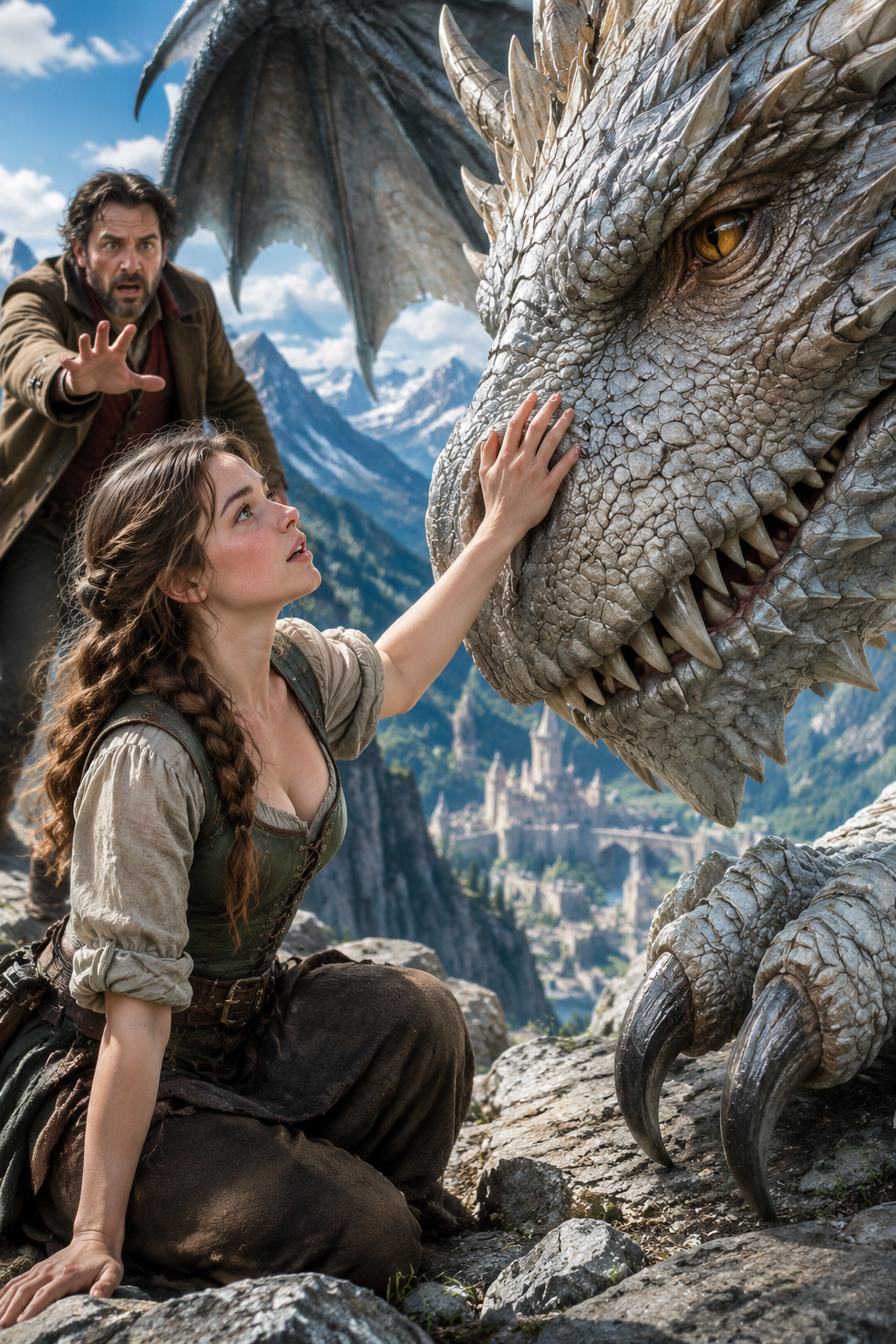
Bram nodded. “Probably long before we noticed anything.”
They hurried back to warn the engineers.
The chief engineer initially dismissed their concern. His team was focused on the main landslide, and the secondary channels appeared insignificant on their maps.
But Bram insisted on showing him the terrain.
When they reached the natural arch, they heard the unmistakable sound of water moving through hidden cracks.
The engineer’s expression changed.
“Clear the lower worksite,” he ordered.
Within minutes, workers began retreating to higher ground.
Then the stone arch collapsed.
A surge of muddy water rushed through the narrow passage, sweeping away abandoned tools and temporary wooden supports. The flood struck the lower trail and spread across the empty worksite before draining into the wider basin.
Had the workers remained there, several could have been trapped.
Bram watched the water settle.
“Marrow warned us.”
The engineer looked toward the mountain.
“Then we owe that creature more than we realized.”
The emergency continued for another two days. Crews eventually opened a controlled drainage channel through the landslide, lowering the water behind the blockage.
The villages remained safe.
But the disaster transformed the road debate.
The independent engineering review revealed that the proposed northern route crossed unstable terrain and would require extensive blasting near sensitive watersheds. The southern alternative, though longer, offered safer construction conditions and fewer environmental risks.
Investigators also discovered that Mercer’s association had authorized preliminary work despite the suspension order.
The foreman produced written instructions confirming that his employer had demanded progress before the Crown’s final decision.
Mercer was removed from the council’s road committee pending investigation, and the unauthorized construction contracts were suspended.
Unlike Vantry, he had not staged attacks or deliberately targeted Marrow. His wrongdoing was more ordinary: impatience, financial pressure, and a willingness to ignore warnings when they threatened his plans.
That made the consequences no less serious.
At the final hearing, Inspector Rook presented the engineering findings and the evidence gathered after the landslide.
The Crown rejected the proposed road through the protected valley.
Instead, it authorized further planning for the southern route, subject to environmental safeguards and consultation with the affected communities.
The sanctuary’s boundaries remained intact.
Ianthe felt relief, but she also understood that the decision had not solved every problem. The villages still needed reliable transportation, and the merchants still needed a practical way to move their goods.
Protecting the mountain could not mean ignoring the people who depended on it.
Over the following months, she and Bram joined a regional advisory group to help design the southern passage. Farmers, traders, engineers, and conservation workers met regularly to discuss the route.
The meetings were sometimes exhausting.
There were arguments over costs, access rights, and construction schedules. Some people remained suspicious of the sanctuary, while others feared that any new road would eventually expand toward protected land.
But slowly, the discussions produced compromises.
The southern route would avoid nesting cliffs, include drainage protections, and remain closed to heavy construction during sensitive breeding periods. Local residents would receive priority for maintenance jobs, and a portion of commercial access fees would support conservation work.
It wasn’t a perfect arrangement.
It was something more useful: an agreement people could live with.
One evening, after another long meeting, Bram and Ianthe returned to their cottage beneath a sky filled with stars.
Bram placed the brass compass on the table.
“You never gave this back.”
Ianthe smiled. “I thought you might want it.”
He pushed it toward her.
“I do. But I want you to keep it.”
“It belonged to your brother.”
“That’s why.”
She looked at him, confused.
Bram sat beside her.
“For years, I thought remembering him meant holding on to everything that hurt. I thought if I stopped being angry, I’d somehow be leaving him behind.”
Ianthe waited.
“But he loved these mountains. Before that expedition, before everything went wrong, he used to bring me up here to watch the hawks. He taught me how to read tracks and find my way home when the weather changed.”
Bram turned the compass gently in her hand.
“I think he’d be glad that someone finally learned how to protect this place instead of trying to conquer it.”
Ianthe felt tears gathering in her eyes.
“I wish I could have met him.”
“I think he would have liked you.”
They sat together in comfortable silence.
Then Bram took a folded piece of paper from his coat.
“I’ve been meaning to show you something.”
It was a drawing of a small house near the sanctuary boundary. The cottage had a wide porch, a room for Ianthe’s research, and a covered workspace where Bram could repair equipment during winter.
Behind it stood a modest garden.
“You’ve been planning this?”
“Only for a few months.”
“Without asking me?”
“I was hoping you’d help decide whether the windows should face east or west.”
Ianthe studied the drawing.
“East,” she said.
Bram smiled. “Why east?”
“Because that’s where the hawks fly at sunrise.”
He reached for her hand.
“Then east it is.”
They began building the following spring.
Neighbors helped raise the timber frame, and several former construction workers volunteered their skills. The same village families who had once feared Marrow brought meals and supplies.
The work took longer than expected. Rain delayed the roof, a shipment of windows arrived cracked, and Bram discovered that building a home required a different kind of patience than tracking animals.
Ianthe teased him whenever he complained.
“You can follow a dragon across fifty miles of mountain, but you can’t find the hammer you used ten minutes ago?”
“Dragons don’t hide themselves under piles of lumber.”
Despite the difficulties, the house slowly took shape.
On the day they finished the porch, Marrow appeared on the distant ridge.
He stood against the afternoon sunlight, his great wings folded neatly along his sides.
Several workers stopped to watch.
Nobody reached for a weapon.
Nobody shouted.
A little girl carrying a basket of bread pointed toward the mountain.
“Is that the dragon?”
Bram nodded.
“That’s Marrow.”
“Is he dangerous?”
Bram considered the question.
“He’s powerful,” he said. “And he’s wild. That means we respect his space.”
The girl watched the dragon for another moment.
“Does he live here?”
“He lives in the mountains.”
She smiled. “Then we’re neighbors.”
Ianthe heard the exchange from the porch and felt something inside her settle.
That simple answer represented years of work, grief, fear, and difficult choices.
Marrow had not become tame.
He had not been transformed into a harmless creature for the convenience of the people around him.
He remained a dragon, immense and unpredictable, belonging to the mountains rather than to anyone who wished to claim him.
But the people had changed.
They were learning that understanding an animal did not require controlling it.
As summer passed, the sanctuary flourished. The silver-crested hawks successfully raised their young, mountain deer returned to the upper meadows, and Marrow resumed his familiar seasonal movements.
Ianthe continued documenting his behavior, carefully separating information that could be shared publicly from details that needed protection.
Her research eventually became the foundation for a new conservation program throughout the region.
Young naturalists visited to learn observation techniques, ethical fieldwork, and the importance of considering how scientific knowledge might be used.
Whenever Ianthe spoke to them, she told the truth about her earlier mistakes.
“I once believed that discovering something gave me the right to reveal everything about it,” she explained during one lesson. “I was wrong. Knowledge creates responsibility. Sometimes protecting what you love means knowing when to remain silent.”
Bram taught the students how to recognize warning signs in the wilderness.
He showed them broken branches, weather patterns, animal tracks, and the subtle changes that could signal danger.
But his most important lesson had nothing to do with survival skills.
“Don’t mistake fear for evidence,” he told them. “And don’t mistake confidence for wisdom. The mountain doesn’t care how certain you are. It only responds to what you actually do.”
Years later, visitors would remember those lessons more clearly than any particular animal they had seen.
The sanctuary became known not simply as the home of a rare dragon, but as a place where people had learned to live alongside something they could never fully understand.
One autumn morning, Ianthe woke before sunrise and found Bram standing on the porch.
He was holding two cups of tea.
“He’s back,” Bram said.
She stepped outside.
Across the valley, Marrow stood on the high ridge where she had first seen him years earlier.
The early sunlight illuminated the old scars on his wing. They were still visible, pale lines against darker scales, reminders of a time when people had tried to make him something he was never meant to be.
But he stood tall now.
Unchained.
Unhunted.
Free.
Ianthe leaned against Bram’s shoulder.
“Do you ever wonder what would have happened if I’d never followed that hawk?”
Bram smiled.
“Probably. But I try not to spend too much time wondering.”
“Why?”
“Because you did.”
Marrow lifted his wings.
For a moment, he remained motionless against the brightening sky. Then he launched himself from the ridge, rising above the valley with slow, powerful strokes.
Ianthe watched until he became a dark shape against the clouds.
She thought of Governor Vantry, whose hunger for authority had nearly destroyed the mountain. She thought of Mercer, whose impatience had endangered the very communities he claimed to serve.
She remembered the birds she had failed to protect, and the years Bram had spent blaming a creature for a tragedy neither of them could fully explain.
None of those memories had disappeared.
But they no longer controlled the future.
Bram placed his arm around her.
“Breakfast?”
“In a minute.”
He followed her gaze toward the sky.
“He’s going north.”
“Yes.”
“Will he come back?”
Ianthe watched the dragon disappear beyond the mountains.
“When he’s ready.”
Bram nodded, understanding that no promise was necessary.
Behind them, their little house glowed in the morning light. The garden needed tending, the research notebooks were waiting, and somewhere down the valley a new group of students would soon arrive to learn about the sanctuary.
There would be other challenges. Other decisions. Other people who believed the mountains existed only to serve their ambitions.
But Ianthe and Bram no longer needed a world without uncertainty to feel at peace.
They had built something worth protecting, and they had learned that protecting it would always require patience, courage, and the willingness to listen.
Ianthe took Bram’s hand and turned toward home.
For years, she had searched for redemption as though it were a destination she might someday reach. Now she understood that it was something quieter: a series of choices, made carefully, whenever the past offered an opportunity to do better.
And Bram, who had once believed that closure required a perfect explanation for his brother’s death, had discovered that love could survive unanswered questions.
High above the valley, Marrow flew toward the distant peaks.
He belonged to no governor, no hunter, no naturalist, and no kingdom.
He belonged to the open sky.
And perhaps that was the greatest lesson the mountain had given them.
Not everything beautiful needed to be possessed.
Not everything frightening needed to be destroyed.
And not every wound needed to disappear before a life could become whole again.
Sometimes the greatest act of love was simply making room for another living creature to exist in peace.
THE END.