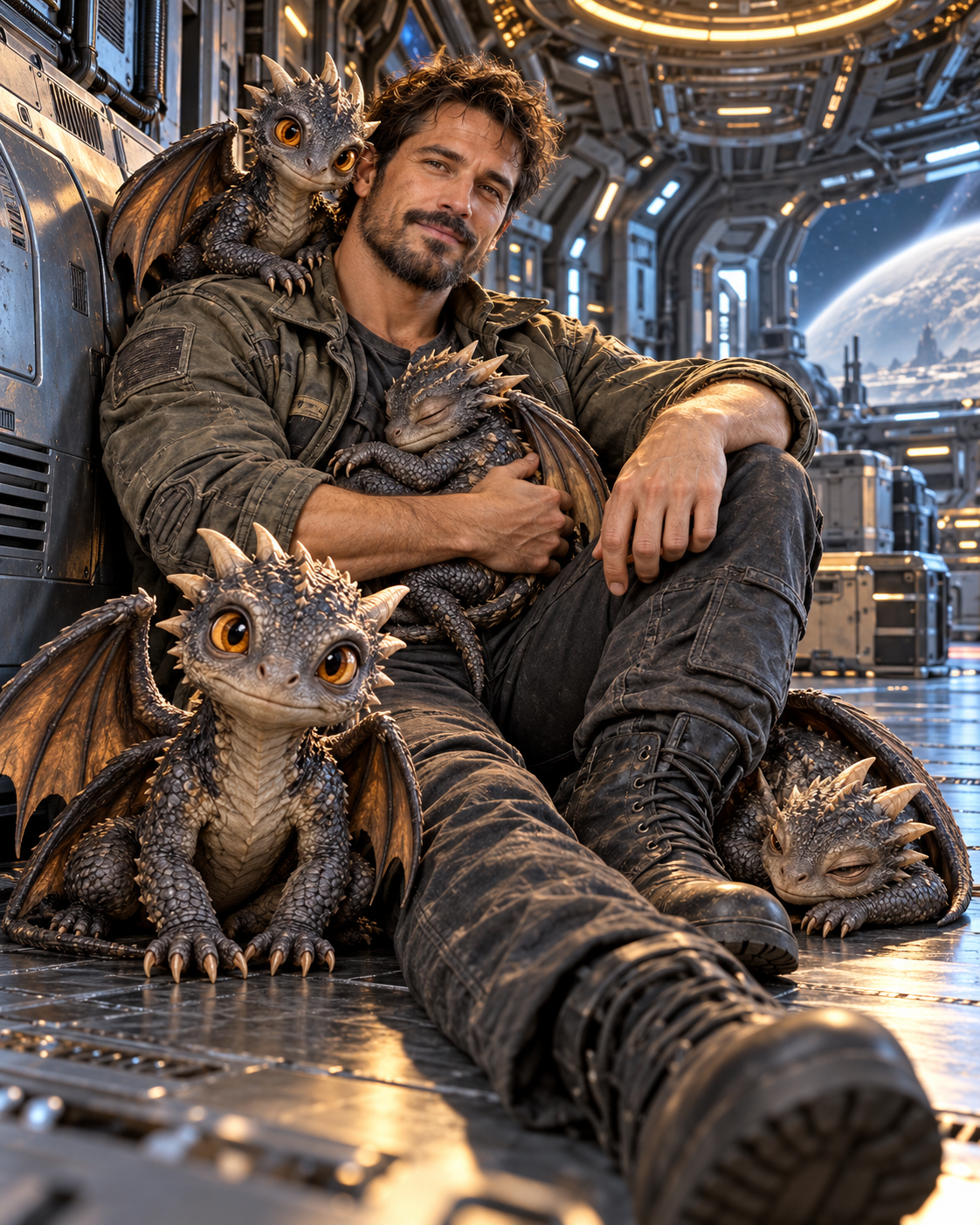
The distress pod wasn’t supposed to be carrying passengers. But when Ren Dallas cut through its emergency seal, six tiny armored creatures opened their eyes—and every single one crawled toward him.
Ren Dallas had repaired failing oxygen recyclers, crawled through flooded maintenance shafts, and once spent eleven hours inside a malfunctioning waste processor because someone had forgotten to shut off the pressure valves.
None of those experiences had prepared him for choosing the future of six alien children.
He sat on the nursery floor long after the station’s artificial night cycle began, studying the tribunal’s conditions on his communicator.
Accept the invitation, and the children would travel to the Dravath homeworld under diplomatic protection.
Refuse, and that protection would expire within seventy-two hours.
The Galactic Union could then reopen its claim to place the infants in a research facility.
Ren read the conditions three times.
There wasn’t a single line explaining what would happen if the tribunal decided the children belonged to the collective.
Tank stirred inside the overturned storage container, climbed over his sleeping siblings, and stumbled toward Ren.
His little armored claws clicked against the floor.
Ren lifted him into his lap.
“You know,” he whispered, “most parents get to worry about school lunches and whether their kids are eating vegetables.”
Tank caught his thumb and immediately tried chewing it.
“Yeah. You’re probably going to be expensive.”
The infant made a soft rumbling sound and settled against his chest.
Ren looked at the tribunal document again.
Then he made his decision.
The following morning, Grand Lector Drath found Ren waiting outside the diplomatic chamber.
“I’ll go,” Ren said. “But I have conditions.”
Drath’s enormous eyes narrowed slightly.
“You are not in a position to negotiate.”
“Then I guess we’re done.”
Ren turned toward the door.
“Wait.”
He stopped.
Drath regarded him for several seconds.
“What conditions?”
“Nobody separates them from me without medical evidence that it’s necessary. No experiments. No forced imprinting. And if the tribunal decides something I don’t agree with, I get to appeal.”
“The collective does not recognize appeals from outsiders.”
“Then maybe it’s time you learned.”
Drath stood motionless.
Finally, he extended one massive armored hand.
“I can guarantee the first two conditions. The third requires approval.”
“Get it.”
For the first time, Ren thought he detected something resembling amusement in the ancient leader’s expression.
“You are remarkably difficult for such a physically fragile creature.”
“My supervisor says that too.”
Six hours later, the collective approved a provisional appeal mechanism.
Ren packed three changes of clothes, a maintenance toolkit, two heated blankets, and the six battered feeding containers the children refused to eat without.
He almost forgot his own toothbrush.
Feain met him at the docking terminal.
The station director looked older than he had three weeks earlier.
“You understand that once you leave this station, I can’t protect you.”
Ren glanced at the diplomatic vessel waiting beyond the security glass.
“With respect, Director, you’ve been trying to get rid of us since the day they arrived.”
Feain lowered his gaze.
“At first, yes.”
Ren waited.
“I thought they were a political disaster,” Feain admitted. “I thought if I could get them transferred quickly enough, the station would survive.”
“And now?”
“Now I know six children shouldn’t have to pay for my fear of losing a job.”
He handed Ren a small data chip.
“Security recovered this from the maintenance system. It’s the complete access record from the night someone tried opening your nursery.”
Ren examined it.
“Why give it to me?”
“Because someone deleted the official copy.”
Before Ren could respond, Feain walked away.
The journey to the Dravath homeworld lasted nine days.
During the first two, the infants refused to sleep unless Ren stayed within arm’s reach.
By the third, they had discovered the ship’s ventilation grilles.
By the fourth, Pip had stolen an ornamental fastening from Drath’s ceremonial armor.
Ren returned it personally.
Drath stared at the tiny object.
“That fastening represents the authority of seventeen generations.”
“Well, Pip thinks it’s a toy.”
“She removed it from my armor while I was wearing it.”
“Yeah. She’s quick.”
Drath looked toward the nursery, where Pip was enthusiastically dismantling a harmless educational puzzle.
Then he made an extraordinary request.
“May I observe them during their evening feeding?”
Ren shrugged.
“Sure. Bring a towel.”
The Grand Lector learned why twenty minutes later.
Dravath infants did not eat gracefully.
They attacked their food like miniature mining equipment.
Pebble managed to get nutritional paste onto Drath’s ceremonial chest plate.
The ancient leader froze.
Ren handed him a cloth.
“Welcome to childcare.”
But as the journey continued, Drath began noticing things his civilization had spent centuries teaching him were impossible.
When Ash became frightened by turbulence, Bolt approached her without any instruction.
When Tank struggled to climb a platform, Cricket and Pebble pushed from behind.
When Ren offered two different foods, the infants developed individual preferences.
Drath documented every behavior.
At first, he described them as neurological abnormalities.
By the seventh day, he had stopped using that word.
On the eighth, he asked Ren a question.
“What command do you use to make them cooperate?”
Ren looked up from repairing a broken warming unit.
“I don’t.”
“Then how do they know what is expected?”
“Sometimes they don’t.”
“That must produce disorder.”
“Sure does.”
Ren gestured toward Pip, who had somehow gotten her head stuck inside a food container.
“But they’re learning.”
Drath watched Ren carefully remove the container.
“And when they refuse your instructions?”
“I figure out why.”
“You do not punish them?”
“If they’re doing something dangerous, I stop them. But being difficult isn’t the same as being bad.”
Drath considered that for a long time.
“My people have never made that distinction.”
The Dravath homeworld appeared beyond the observation window the next morning.
It was enormous.
Vast dark oceans surrounded continents covered in geometric cities. Towering metallic structures rose through silver clouds, connected by bridges that seemed to stretch for hundreds of miles.
The capital’s central tower was so large that Ren initially mistook it for a mountain.
Then the diplomatic vessel descended through the atmosphere, and he saw the crowds.
Millions of Dravath had gathered beneath the arrival platforms.
Their armored bodies formed an endless ocean of black, bronze, and silver.
They weren’t celebrating.
They were waiting.
The first words Ren heard after landing came from a security commander.
“Human caretaker, surrender the heirs for examination.”
Ren tightened his grip on Tank.
“No.”
The commander stepped forward.
Drath moved between them.
“The human is under my protection.”
“Grand Lector, the Supreme Conclave has issued revised instructions.”
Drath’s expression hardened.
“Show me.”
A document appeared between them.
Ren couldn’t read the Dravath symbols, but he recognized the look on Drath’s face.
Something had changed.
“The Conclave has accelerated the hearing,” Drath said quietly.
“To when?”
“Now.”
They were escorted through corridors wider than the entire maintenance section of Waypoint Nine.
Ren carried Tank while the other infants followed inside a mobile warming enclosure.
Everywhere they passed, Dravath citizens stopped to stare.
Some looked curious.
Others looked disgusted.
One elderly female pressed her armored hands against the glass as Pebble crawled past.
Her eyes widened.
“She is looking at me,” the female whispered.
Ren frowned.
“Of course she is.”
The female backed away.
“An heir has never looked at a citizen without receiving a command.”
The doors to the tribunal chamber opened before Ren could ask what she meant.
Inside waited thirty enormous Dravath leaders arranged in a semicircle.
At the center sat High Arbiter Veyr, a towering figure whose armor was marked by centuries of ceremonial scars.
He did not greet Ren.
“Place the heirs in the examination enclosure.”
Ren studied the raised platform before him.
A transparent barrier surrounded six small compartments.
Each compartment was connected to a complex network of neurological instruments.
“No,” Ren said.
A murmur spread through the chamber.
Veyr leaned forward.
“You will comply.”
“Are those machines going to hurt them?”
“They will determine the extent of the imprinting deviation.”
“That wasn’t my question.”
The chamber fell silent.
Veyr’s voice became colder.
“You are a maintenance worker. You possess no scientific knowledge of Dravath biology.”
“That’s true.”
“You have no diplomatic standing.”
“Also true.”
“You cannot possibly understand the consequences of what has occurred.”
Ren looked down at Tank, who had fallen asleep against his shoulder.
“Maybe not. But I know when somebody won’t answer a simple question.”
For several seconds, nobody moved.
Then Drath stepped forward.
“I request an independent medical assessment before any neurological examination.”
Veyr turned toward him.
“You question the Conclave?”
“I question the procedure.”
The room erupted into overlapping voices.
Ren stood quietly while thirty leaders argued in a language his translator struggled to process.
Finally, Veyr struck the floor with his ceremonial staff.
“Very well. An independent specialist will examine the heirs.”
A side entrance opened.
And Dr. Soren Vale walked into the chamber.
Ren felt his stomach tighten.
Vale smiled.
“Mr. Dallas. How good to see you again.”
Ren turned toward Drath.
“Absolutely not.”
Veyr spoke before the Grand Lector could answer.
“Dr. Vale has been appointed as an external scientific advisor.”
“He’s the man whose credentials were used to access the nursery during an attempted extraction.”
Vale’s smile disappeared.
“That’s an unproven accusation.”
Ren reached into his pocket.
“Then you won’t mind if we look at the station records.”
He inserted Feain’s data chip into the chamber’s evidence console.
A security recording appeared above the tribunal floor.
The footage showed the nursery’s maintenance systems being accessed remotely.
Then came a sequence of authorization codes.
One belonged to Vale.
The second belonged to an encrypted diplomatic channel.
Drath studied the code.
His armored jaw tightened.
“That channel is controlled by the Supreme Conclave.”
The chamber went completely still.
Veyr rose slowly.
“The code proves nothing.”
Ren looked at him.
“Then why was somebody using it to get into a room full of sleeping children?”
Before Veyr could answer, an alarm sounded.
A deep vibration passed through the building.
The nursery enclosure’s lights flashed red.
Tank jerked awake.
The other five infants began screaming.
Ren hurried toward them.
“What happened?”
Drath checked the chamber’s emergency display.
His expression changed.
“The collective resonance network has been activated.”
Ren looked at the infants.
Their armor was trembling.
Pebble collapsed against the enclosure wall.
Ash began striking her head against the floor.
Ren rushed to open the enclosure, but its security locks had engaged.
“Turn it off!”
Veyr remained standing.
“The resonance is necessary to stabilize their biological hierarchy.”
“They’re in pain!”
“Their genetic systems are resisting proper alignment.”
Ren grabbed the emergency release.
It wouldn’t move.
Then Bolt began convulsing.
Ren stopped thinking about the tribunal.
He pulled a maintenance cutter from his belt and drove it into the enclosure’s external control panel.
Sparks flew.
Security guards rushed toward him.
Ren ignored them.
He knew industrial locking systems.
Every model had a weakness, and this one had been designed by engineers who assumed nobody would ever need to open it without authorization.
He found the backup relay.
Cut the power.
And tore the access panel away.
The enclosure opened.
Six tiny bodies scrambled toward him.
The instant Ren touched Bolt, the infant’s trembling slowed.
Pebble climbed into his lap.
Ash pressed against his arm.
The others crowded around him, frightened and shaking.
Ren looked up at thirty silent leaders.
“Look at them.”
Nobody spoke.
“Whatever that machine was supposed to do, it was hurting them.”
Veyr descended from his platform.
“You have interfered with a sacred biological process.”
Ren stood, holding Bolt against his chest.
“Then maybe your sacred process needs fixing.”
Veyr’s expression darkened.
“Remove the human.”
Four guards approached.
Drath stepped between them and Ren.
“No.”
Veyr stared.
“Grand Lector, stand aside.”
“I have spent three thousand years serving the collective’s laws,” Drath said. “I have never once considered disobedience a virtue.”
He looked at the children.
“Until today.”
Veyr raised his ceremonial staff.
“Then you are relieved of your authority.”
The chamber doors slammed shut.
A heavy security barrier descended over the exits.
Ren realized they were trapped.
Veyr turned toward the assembled leaders.
“The human has contaminated our heirs. The Grand Lector has abandoned his duty. We will proceed with restoration under emergency authority.”
Drath drew himself to his full height.
“Restoration will kill them.”
A stunned silence followed.
Ren stared at him.
“What?”
Drath looked devastated.
“The early readings show that their neural development has advanced beyond the stage when collective imprinting can safely be imposed.”
Veyr’s voice thundered across the chamber.
“That conclusion is unproven.”
“You saw the resonance response,” Drath said. “Their minds are no longer structured around involuntary obedience.”
“Then they are defective.”
“No,” Drath replied. “They are different.”
Veyr activated the chamber’s security restraints.
Metallic arms extended from the walls.
Ren moved backward, gathering the infants behind him.
He couldn’t fight Dravath soldiers.
He couldn’t outrun them.
But he noticed something.
Every time the resonance network pulsed, the infants reacted before the adults.
And every time Ren calmed one of them, the others settled faster.
The connection wasn’t simply between Ren and six children.
The children were communicating with one another.
“Drath,” he whispered. “Can the tribunal see their neurological readings?”
“Yes.”
“Then show them everything.”
Drath turned toward the evidence console.
Veyr shouted an order.
Security rushed forward.
But Grand Lector Drath had spent centuries commanding the collective’s highest ceremonial systems.
His authority had been revoked.
His knowledge hadn’t.
He activated the chamber’s emergency medical broadcast.
A vast holographic image appeared above the tribunal.
Six neurological patterns glowed in different colors.
The leaders watched as Bolt’s distress diminished when Ren touched him.
Then something remarkable happened.
Ash’s neural activity stabilized without Ren touching her at all.
She was responding to Bolt.
Pebble calmed next.
Then Cricket.
Then Pip.
Finally, Tank.
Drath enlarged the readings.
“Their nervous systems are regulating one another voluntarily.”
Veyr stepped closer.
“That is impossible.”
“Apparently not.”
For the first time, Ren heard fear in the High Arbiter’s voice.
“If this becomes known, every foundation of our civilization will be questioned.”
Ren looked around the chamber.
“Maybe that’s why it needs to be known.”
A younger Conclave member rose.
“How many generations have we prevented from developing this ability?”
Nobody answered.
Another leader examined the readings.
“Could the compulsory imprinting process have suppressed natural social development?”
Drath lowered his head.
“I believe we must investigate that possibility.”
Veyr struck the floor again.
“Our civilization has survived because each citizen knows their place.”
“And perhaps,” Drath said, “we have survived despite the cost of enforcing it.”
The chamber’s security system suddenly issued a warning.
The resonance network was still operating.
Its energy output had begun increasing.
Ren checked the display beside the broken enclosure.
“That’s not right.”
He examined the pressure readings.
The resonance system was connected to the city’s central power distribution grid.
Someone had overridden its safety limits.
If the overload continued, the network’s amplifiers could rupture beneath the tribunal tower.
“Shut it down,” Ren said.
Drath reached for the controls.
Nothing happened.
Veyr attempted the same command.
Access denied.
Ren studied the diagnostic panel.
“Whoever started this locked everybody out.”
The building shook again.
An emergency announcement echoed through the chamber.
Structural failure was imminent.
The Conclave leaders began issuing conflicting orders.
Ren grabbed his toolkit.
“Where’s the main service junction?”
Drath pointed toward a maintenance hatch near the western wall.
“Behind there. But the network chamber is filled with dangerous electromagnetic radiation.”
“How long until the amplifiers fail?”
Drath checked the display.
“Less than eleven minutes.”
Ren handed Tank to him.
“Hold him.”
Drath looked at the infant in his arms.
“Ren—”
“Keep them together.”
He crawled into the maintenance hatch.
The space beyond was narrow, hot, and filled with cables thicker than his legs.
For the first time since leaving Waypoint Nine, Ren felt almost comfortable.
Machines made sense.
Machines didn’t care about ancient laws or political power.
They failed for reasons.
And reasons could be found.
His communicator crackled.
“Ren, the central junction is three levels below your position,” Drath said.
“Got it.”
He descended a service ladder.
A wave of heat struck him.
Warning lights flashed across a massive energy regulator.
Ren checked the manual override.
Disabled.
He tried the auxiliary circuit.
Also disabled.
Then he noticed the regulator’s cooling system.
Its emergency pumps had been disconnected from the backup power feed.
The resonance network wasn’t merely overloading.
Someone had deliberately prevented it from shutting down safely.
Ren’s hands trembled.
He had nine minutes.
He opened the cooling control panel and began rearranging the emergency power connections.
Behind him, the access hatch slammed shut.
His communicator hissed.
“Ren?”
“I’m here.”
“Security has identified the source of the sabotage.”
“Let me guess.”
“Dr. Vale.”
Ren closed his eyes briefly.
Vale had received authorization to study the heirs under Conclave supervision, but the tribunal’s investigation had threatened everything.
According to the recovered security records, he had secretly installed remote control access to the resonance equipment.
The overload was intended to destroy the chamber’s neurological evidence and create a crisis that could justify emergency custody of the infants.
Now his own system was spiraling out of control.
“Where is he?” Ren asked.
“Detained.”
“Good. Tell him his engineering is terrible.”
Ren worked faster.
The first cooling pump activated.
Then the second.
Temperature readings began falling.
But the central resonance generator remained dangerously unstable.
Drath’s voice returned.
“Ren, the system requires a manual disconnection at the primary capacitor.”
Ren stared at the warning label.
The capacitor was on the other side of the regulator.
Reaching it meant crossing an energized maintenance bridge.
There was no safe route.
“Ren,” Drath said, “you must leave.”
Ren looked at the countdown.
Five minutes.
If the capacitor ruptured, the tower’s lower levels would collapse.
Thousands of workers were still evacuating.
He thought about Feain’s battered office.
The little nursery made from insulation panels.
Tank sleeping with a glove over his head.
Then he clipped his safety harness to the service rail.
“Not yet.”
Crossing the bridge was the worst forty seconds of his life.
Electrical arcs snapped through the air.
His suit’s warning system screamed.
Halfway across, a violent surge struck the railing.
Ren fell against his harness.
For one terrible moment, he hung above a shaft filled with blue energy.
His left hand went numb.
He pulled himself upward.
Reached the capacitor.
And found the manual disconnect.
It required two locking mechanisms to be released simultaneously.
One on each side of the housing.
He couldn’t reach both.
Ren swore.
The countdown showed ninety seconds.
Then his communicator crackled.
“Human.”
It was Veyr.
Ren almost laughed.
“Little busy.”
“The secondary locking mechanism can be released remotely from the tribunal chamber.”
“Then release it!”
“The system requires authorization from a senior collective official.”
“You’re the senior collective official!”
Veyr remained silent.
Ren understood.
Activating the emergency mechanism would permanently disable the collective resonance network throughout the capital.
A system that had maintained their civilization’s biological hierarchy for millennia.
Veyr would have to choose between preserving his doctrine and protecting his people.
“Seventy seconds,” Ren said.
On the other end, he heard voices arguing.
Then Drath spoke.
“Veyr, the network can be rebuilt if we choose. Those lives cannot.”
For a long moment, nothing happened.
Then Veyr answered.
“Release the primary lock, human.”
Ren pulled the lever.
The capacitor screamed.
A second later, the remote lock disengaged.
Ren threw himself behind a reinforced service wall as the generator discharged.
The shockwave knocked him unconscious.
When Ren opened his eyes, he was lying beneath a medical scanner.
His left arm was wrapped in a regenerative brace.
A Dravath physician stood beside him.
“You sustained significant electrical injuries.”
Ren tried to sit up.
“Where are the kids?”
“Rest.”
“Where are they?”
A familiar rumbling sound answered him.
Tank scrambled onto the medical bed.
Behind him came five other armored infants.
Pebble climbed over Ren’s legs.
Pip immediately attempted to steal a monitoring sensor.
Ren laughed despite the pain.
“Yeah. I missed you too.”
Drath stood in the doorway.
His ceremonial armor was damaged, and one shoulder bore a fresh fracture.
“The children refused to remain in the nursery,” he explained.
“Smart kids.”
“They dismantled three security barriers.”
“That’s probably Pip.”
Drath approached the bed.
“The capital survived. The resonance network has been deactivated, and the Conclave has ordered every compulsory imprinting procedure suspended pending independent review.”
Ren stared at him.
“All of them?”
“All of them.”
“What about Veyr?”
“He remains High Arbiter, for now. But his authority is being challenged.”
Ren looked down at the six infants gathering around him.
“And what happens to these guys?”
Drath hesitated.
“The tribunal has reached a preliminary decision.”
Ren felt his chest tighten.
“Tell me.”
“The heirs will not undergo restoration. Their development will continue without compulsory neurological intervention.”
Ren exhaled.
“But?”
“They are still considered essential to the future of our civilization. The Conclave wishes them to remain on our homeworld.”
Ren looked toward the enormous windows.
Beyond them, the metallic towers of the capital gleamed beneath a violet sky.
“So they’re letting me stay?”
Drath lowered his head.
“That is where the disagreement remains.”
The Conclave had offered Ren permanent residency, a generous salary, and an official position as guardian to the heirs.
But he would be required to accept collective oversight.
Every educational decision, every medical treatment, every significant choice concerning the children would need approval.
Ren listened carefully.
Then he asked one question.
“When they’re old enough to choose their own lives, will they be allowed to?”
Drath didn’t answer immediately.
“The Conclave has not yet agreed.”
“Then neither have I.”
Three days later, Ren appeared before the tribunal again.
This time, there were no restraints.
No resonance chambers.
No sealed enclosures.
The six infants sat beside him on a padded platform, playing with pieces of a mechanical puzzle.
Veyr addressed the assembly.
“The human caretaker has requested an amendment to our guardianship agreement.”
Ren stepped forward.
“I don’t want to take your heirs away from their people.”
He glanced at the watching leaders.
“But I won’t help you raise them just to hand them over to a system that decides their lives before they can speak.”
A senior leader challenged him.
“Without hierarchy, how will they understand responsibility?”
Ren considered the question.
“By having responsibility.”
“Without obedience, how will they learn cooperation?”
“By learning that other people matter.”
“Without predetermined purpose, how will they know where they belong?”
Ren looked at the children.
“Maybe belonging isn’t something you’re assigned. Maybe it’s something you build.”
The chamber remained quiet.
Then Drath stepped forward.
“I propose a different arrangement.”
Under his proposal, the six heirs would remain on the Dravath homeworld with Ren as their primary guardian.
They would have access to their culture, language, and history.
They would also have the right to independent medical care, personal education, and eventual self-determination.
A council of Dravath citizens, medical specialists, and external observers would monitor their welfare.
Ren could challenge decisions affecting the children.
And when the heirs matured, they would choose whether to accept collective leadership.
The proposal horrified several senior officials.
Others supported it.
The debate continued for eleven hours.
When the final vote came, the chamber was divided.
Seventeen supported the amendment.
Thirteen opposed it.
Ren barely understood the significance until Drath turned toward him.
“The agreement is approved.”
Ren looked at the infants.
Bolt was asleep.
Pebble had eaten part of the puzzle.
Pip was attempting to climb the voting console.
“Great,” Ren muttered. “Now somebody tell me where to buy diapers on this planet.”
Over the following months, the changes spread slowly.
Not everyone celebrated them.
Several provinces refused to suspend their traditional ceremonies until further research was completed.
Some citizens accused Ren of corrupting the royal bloodline.
Others began asking questions their families had avoided for generations.
Why did children need to be assigned permanent roles before they understood themselves?
Why was disagreement treated as illness?
Could cooperation exist without compulsory obedience?
The Conclave established a commission to examine those questions.
Its findings were uncertain, and the political arguments continued.
But one change became impossible to reverse.
Dravath parents began requesting the right to observe their own children developing before collective assignment.
For the first time in recorded history, the government agreed to limited voluntary trials.
Ren never imagined he would live long enough to see a civilization reconsider three thousand years of tradition.
He also never imagined he’d spend his mornings chasing six armored toddlers through a diplomatic residence.
Two years later, the residence was filled with dented furniture, broken appliances, and one very exhausted human.
Tank had grown large enough to knock over a refrigerator.
Pip could dismantle an electronic lock in under thirty seconds.
Ash had developed a fascination with astronomy.
Cricket loved music.
Pebble collected smooth stones from the gardens.
And Bolt still insisted on checking that every sibling was safe before going to sleep.
Grand Lector Drath visited every week.
He usually brought educational materials.
Occasionally, he brought snacks.
He had even learned to tolerate Pip stealing the ornamental fastenings from his armor.
One evening, Ren found him sitting in the garden with Tank asleep against his side.
The old leader was watching the sunset.
“Do you regret it?” Ren asked.
Drath looked toward him.
“Regret what?”
“Everything that happened. Losing your authority for a while. Challenging the Conclave. Turning your whole world upside down.”
Drath studied the sleeping child.
“For three thousand years, we believed that order required certainty.”
He gently adjusted the blanket covering Tank.
“We told ourselves that if everyone knew their purpose, no one would suffer from doubt.”
“And?”
“We never considered how much suffering came from denying them the chance to discover it.”
Ren sat beside him.
From somewhere inside the residence came a tremendous crash.
Then Pip’s unmistakable clicking laughter.
Ren closed his eyes.
“That was probably expensive.”
Drath made a low rumbling sound.
Ren had learned it was the Dravath equivalent of a chuckle.
“Almost certainly.”
For several minutes, they watched the sun disappear behind the distant towers.
Then Tank woke, stretched his armored legs, and reached toward Ren.
Ren picked him up.
The child rested his head against Ren’s shoulder.
“Do you think they’ll become good leaders?” Drath asked.
Ren looked toward the residence, where five other children were probably destroying something important.
“I don’t know.”
Drath seemed surprised.
“You do not?”
“Maybe one will lead. Maybe another will become a scientist. Maybe somebody will spend their life fixing broken machines.”
He smiled.
“Whatever they choose, I just hope they grow up to be decent people.”
Drath considered that.
“Your expectations are remarkably modest.”
“Try raising six kids. You’ll learn to appreciate modest expectations.”
Years later, historians would disagree about when the Dravath civilization truly began to change.
Some would point to the tribunal vote.
Others would cite the suspension of compulsory imprinting.
A few would credit Grand Lector Drath’s decision to challenge the laws he had spent his life defending.
But the first real change had happened much earlier, in an ordinary maintenance bay on a forgotten deep-space station.
It happened when six frightened infants reached toward a stranger.
And instead of asking what they were worth, what they were destined to become, or who had the right to control them, that stranger picked them up.
He fed them.
He kept them warm.
He learned what made each one different.
Most importantly, he never confused loving them with owning their futures.
Ren Dallas never became a king, a famous scientist, or a great political leader.
He remained a maintenance worker who sometimes fixed broken heating systems between school meetings and bedtime arguments.
But when the Dravath finally began teaching their children that obedience was not the same as goodness, and that belonging did not require surrendering their individuality, they discovered something their ancient laws had never explained.
A society does not become stronger simply because everyone follows the same path.
Sometimes, its greatest strength begins when someone is finally allowed to choose a different one.
And the six children who had once been called defective would grow up knowing a truth that generations before them had been denied.
They did not have to earn the right to be loved by becoming what someone else expected.
They had been worthy of love from the very beginning.
THE END.