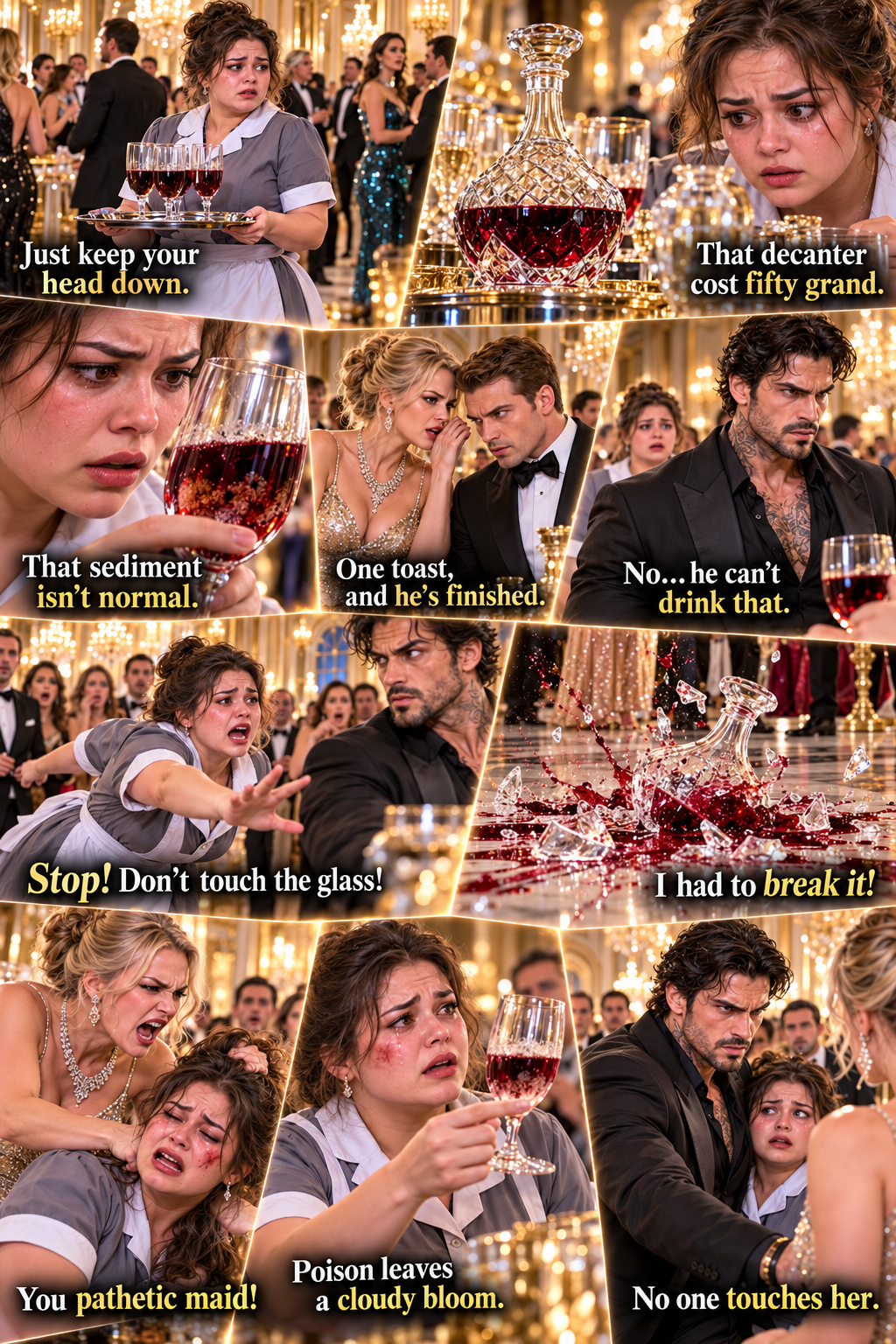
Clara Vance knew the crystal decanter was worth $50,000 when she picked it up. She also knew that if she didn’t smash it, the man standing ten feet away might be dead before dessert.
The attorney on the other end of the phone was silent for several seconds.
“Clara, do you understand what you’re asking me to do?”
Clara Vance stood in her tiny Queens apartment, staring at the employment contract Dante Moretti had offered her.
“I understand perfectly, Margaret.”
“No, I don’t think you do. Three years ago, we barely survived that investigation. You lost your career. I nearly lost my license trying to defend you. And now you want to reopen everything?”
Clara touched the faded newspaper clipping lying on her kitchen table.
The headline still made her stomach turn.
DISGRACED CHEMIST ACCUSED OF MANIPULATING EVIDENCE.
“I didn’t manipulate anything,” Clara said.
“I know.”
“Then why am I still living like I did?”
Margaret Ellis sighed.
“Because sometimes the truth isn’t enough to defeat people with money.”
Clara looked down at Dante’s contract.
“Then maybe it’s time I stopped being afraid of people with money.”
Margaret didn’t answer immediately.
“Who’s offering you this position?”
Clara hesitated.
“Dante Moretti.”
A sharp breath came through the phone.
“Clara. Tell me you haven’t signed anything.”
“I haven’t.”
“Good. Don’t.”
“Margaret—”
“That man is connected to people who make problems disappear. You don’t rebuild your reputation by climbing into another dangerous man’s pocket.”
Clara glanced toward the window.
Outside, a delivery truck struggled to park between two cars. Somewhere downstairs, her landlord was arguing about a broken washing machine.
For three years, she’d lived quietly, kept her expectations small, and avoided anyone powerful enough to ruin her again.
It hadn’t made her happy.
It had only made her invisible.
“Will you review the contract?” she asked.
Margaret exhaled.
“Send it over. And Clara?”
“Yes?”
“Whatever happens, don’t mistake gratitude for trust.”
The following morning, Clara returned to the Moretti estate.
This time, she wasn’t wearing a maid’s uniform.
She wore a navy blazer she’d purchased six years earlier, when attending scientific conferences had still been part of her life.
It fit more tightly than she remembered.
She almost changed before leaving home.
Then she looked in the mirror and decided she’d spent enough years apologizing for taking up space.
Dante met her in his office.
He stood when she entered.
“Clara.”
“Mr. Moretti.”
“Dante, please.”
She remained standing.
“My attorney is reviewing your offer.”
“Good.”
“And before I consider accepting, I need to understand what kind of work you actually expect me to do.”
Dante gestured toward a chair.
“Sit.”
“I’d rather stand.”
A faint smile crossed his face.
“Then I’ll stand too.”
That surprised her.
She opened her notebook.
“I won’t conceal evidence, falsify findings, or interfere with an investigation.”
“Understood.”
“I want access to independent laboratories.”
“You’ll have it.”
“And I want written authority to report criminal conduct without asking permission.”
Dante studied her.
“Even if it damages my businesses?”
“Especially then.”
For a moment, the office felt smaller.
Then Dante walked to his desk and picked up a pen.
“Have your attorney write the language.”
Clara blinked.
“Just like that?”
“You saved my life by doing something nobody in that ballroom wanted you to do. Why would I hire you and then demand obedience?”
She didn’t have an answer.
But she still wasn’t ready to trust him.
“There’s one more condition,” she said.
“I suspected there might be.”
“I want to investigate what happened to my career.”
Dante’s expression grew serious.
“Tell me about it.”
Clara sat down.
Three years earlier, she’d worked at a respected private forensic laboratory in Manhattan.
Her team had been hired to analyze chemical evidence from a suspicious industrial warehouse fire in New Jersey.
The fire had killed two maintenance workers and destroyed millions of dollars in equipment.
Investigators initially believed faulty wiring had caused it.
Clara’s testing suggested something else.
She’d identified chemical residues consistent with an accelerant in several samples collected from the scene.
More importantly, the pattern suggested the substance had been introduced deliberately.
Her findings threatened the company’s insurance claim and raised the possibility of criminal responsibility.
Before her final report was submitted, a senior laboratory director named Richard Hale requested a private meeting.
He told her the results needed reconsideration.
Clara refused.
A week later, a revised report appeared under her name.
It reached the opposite conclusion.
When she objected, Hale accused her of mishandling samples and altering laboratory records.
Documents appeared showing supposed changes to her analysis.
An internal disciplinary panel dismissed her.
The company that owned the warehouse sued the laboratory, and Clara became the convenient explanation for everything that had gone wrong.
Her name appeared in newspapers.
Her colleagues stopped returning calls.
Even after Margaret uncovered inconsistencies in the disciplinary process, the laboratory refused to release the original instrument data.
“They said it had been deleted during a system migration,” Clara explained.
Dante listened without interrupting.
“And the warehouse company?”
“Sterling Industrial Holdings.”
His face changed.
Clara noticed immediately.
“What’s wrong?”
Dante slowly lowered his coffee cup.
“Sterling?”
“Yes.”
“As in Camila Sterling?”
Clara nodded.
“Her father’s company.”
For several seconds, neither spoke.
Then Dante walked to the window.
“Camila told me her family had recovered from a warehouse disaster a few years ago. She said it nearly bankrupted them.”
Clara felt a familiar coldness settle in her chest.
“Did she tell you about the insurance payout?”
“No.”
“Twenty-eight million dollars.”
Dante turned around.
“And the two workers?”
“Their families received small settlements. Both signed confidentiality agreements.”
Dante’s jaw tightened.
Clara closed her notebook.
“I didn’t come here expecting you to fix my past. But I won’t work for someone who expects me to bury it.”
Dante returned to his desk.
“Then don’t bury it.”
He picked up his phone.
“There’s someone I want you to meet.”
Three days later, Clara sat across from a woman named Evelyn Brooks.
Evelyn was a former federal investigator who now worked as an independent compliance consultant.
She was in her late fifties, with short gray hair and an expression that suggested she’d heard every possible lie at least twice.
Dante had arranged the introduction, but Clara’s attorney insisted that any investigation into the old laboratory case remain legally separate from Dante’s business interests.
Evelyn agreed.
“I answer to the evidence,” she told Clara. “Not to Mr. Moretti.”
Clara liked her immediately.
They began with the documents Margaret had preserved.
Old emails.
Sample intake records.
Incomplete laboratory reports.
Copies of internal disciplinary proceedings.
At first, nothing seemed new.
Then Evelyn noticed something strange.
“Look at the timing.”
Clara leaned forward.
On the day her original report had been replaced, Richard Hale had logged into the laboratory database at 11:43 p.m.
His official statement claimed he’d been attending a conference in Chicago.
Clara frowned.
“That could have been remote access.”
“Possibly,” Evelyn said. “But look at the login terminal.”
The access record identified a workstation inside the Manhattan laboratory.
Someone had used Hale’s credentials from within the building.
“Maybe his assistant,” Clara said.
“Maybe. But somebody knew precisely which files to change.”
They examined the records again.
Then Clara noticed a sample identification number.
She went still.
“That’s wrong.”
Evelyn looked up.
“What is?”
“The sample number on the revised report. It belongs to a control specimen, not the warehouse debris.”
“Could be a clerical error.”
“Not with that instrument sequence.”
Clara pulled out an old notebook.
She’d kept handwritten observations from the original testing, including dates, sample numbers, and equipment maintenance notes.
Her employer had confiscated the official files.
They hadn’t known about her private notebook.
She turned to a page covered in small, careful handwriting.
“The revised report references a test that couldn’t have happened that night.”
“Why?”
“Because the instrument was out of service. I recorded the maintenance shutdown myself.”
Evelyn leaned closer.
“Can you prove it?”
“The manufacturer might still have the service records.”
For the first time in three years, Clara felt something stronger than fear.
Hope.
But hope didn’t last long.
That Friday evening, Clara returned home to find her apartment door slightly open.
She stopped in the hallway.
Her landlord never entered without notice.
Carefully, she stepped backward and called the police.
When officers arrived, they found drawers overturned, papers scattered, and her laptop missing.
The television remained untouched.
So did the small amount of cash she’d left beside the microwave.
Someone had been searching for information.
And they had known where to look.
Clara stood in her doorway while an officer took notes.
“Any idea who might want your computer?”
She thought of Richard Hale.
Of the Sterling family.
Of the investigation she’d just reopened.
“No,” she said quietly. “But I think I know why.”
That night, Dante called after Margaret informed his office of the burglary.
“Are you safe?”
“I’m staying with Margaret.”
“Good. I’m arranging protection.”
“No.”
“Clara—”
“I said no.”
His voice hardened.
“Someone broke into your home.”
“And if you send armed men to follow me everywhere, how is that supposed to help me feel free?”
Silence.
Then Dante spoke more carefully.
“What would make you feel safe?”
Clara sat on Margaret’s couch, exhausted.
“I want the police handling the break-in. I want my attorney involved in every decision. And I want to know who’s trying to frighten me.”
“All right.”
She almost didn’t believe she’d heard him correctly.
“That’s it?”
“That’s it. I can offer help without making the decision for you.”
Clara stared at the phone.
“Thank you.”
“Get some sleep.”
She ended the call.
But sleep was impossible.
At two in the morning, Margaret entered the living room carrying two mugs of tea.
“You’ve been staring at that wall for an hour.”
Clara accepted a mug.
“I’m wondering whether reopening the case was a mistake.”
Margaret sat beside her.
“Would you stop now if I told you to?”
Clara considered the question.
“No.”
“Then it wasn’t a mistake. But don’t confuse courage with pretending you’re not scared.”
Clara gave a tired laugh.
“I am scared.”
“I know.”
“More than I was three years ago.”
Margaret squeezed her hand.
“Then we’ll be more careful.”
A week later, the investigation took an unexpected turn.
Evelyn located the technician who had serviced the laboratory instrument.
His name was Daniel Price.
He now worked for a medical equipment company in Pennsylvania.
When Clara called, he recognized her name immediately.
“I wondered when someone would come looking.”
Her heart began pounding.
“What do you mean?”
Daniel hesitated.
“That instrument wasn’t simply out of service, Ms. Vance. Someone asked me to backdate the maintenance record.”
Clara gripped the phone.
“Who?”
“Richard Hale.”
“Did you?”
“No. I refused.”
“What happened afterward?”
“Two days later, the laboratory canceled our maintenance contract.”
Clara closed her eyes.
“Do you still have the original service report?”
“Yes.”
“Would you be willing to provide it?”
Daniel was quiet for a long moment.
“Those workers who died in that fire,” he said eventually. “One of them had a daughter. I remember seeing her on television.”
Clara waited.
“I should have spoken up back then.”
“It’s not too late.”
Daniel agreed to send the records directly to Margaret.
Three days later, Evelyn received another important piece of information.
A former employee of Sterling Industrial Holdings contacted her.
His name was Peter Lawson.
He’d worked as a financial controller during the warehouse fire.
He claimed the company had been in serious financial trouble before the incident.
Several loan payments were overdue.
The warehouse contained aging equipment that would have required expensive repairs.
And shortly before the fire, someone had dramatically increased the property’s insurance coverage.
“Who authorized it?” Evelyn asked.
Peter swallowed.
“Camila’s father. Edward Sterling.”
Clara leaned forward.
“And did you report your concerns?”
“I tried.”
“To whom?”
Peter looked down.
“Richard Hale.”
The room fell silent.
The laboratory director had been involved before Clara even analyzed the evidence.
Evelyn immediately cautioned them.
“That doesn’t establish conspiracy. We need records, corroboration, and a clear chain of custody.”
Clara nodded.
She understood.
Science had taught her that suspicion wasn’t proof.
But for the first time, the pieces were beginning to connect.
The evidence was turned over to investigators and prosecutors reviewing the Sterling case.
Clara provided her original notebook.
Daniel supplied authenticated maintenance records.
Peter agreed to make a formal statement.
Margaret began preparing a legal petition to challenge the professional findings against Clara.
Everything moved slowly.
Then, one Tuesday morning, Richard Hale called Clara directly.
She stared at the unfamiliar number before answering.
“Clara.”
She recognized his voice instantly.
Three years disappeared in a heartbeat.
“Richard.”
“I hear you’ve been asking questions.”
“Yes.”
“You should stop.”
“Why?”
“Because you’re walking into something you don’t understand.”
Clara’s hands began to shake.
She remembered sitting across from him in his office, pleading with him to release the original test results.
Back then, he’d smiled and told her reputations were fragile things.
Now she heard something different in his voice.
Fear.
“Did you change my report?” she asked.
Richard didn’t answer.
“Did you help Edward Sterling cover up that fire?”
A long silence followed.
Then he said, “You were always too stubborn for your own good.”
Clara slowly sat down.
“Two men died, Richard.”
“I know.”
Those two words chilled her.
“You knew?”
He exhaled.
“Meet me tomorrow. Somewhere public. I’ll explain what happened.”
“Why should I trust you?”
“You shouldn’t.”
The call ended.
Clara immediately contacted Margaret and Evelyn.
They informed investigators and arranged for the meeting to take place with appropriate precautions.
Richard chose a crowded café near Grand Central Terminal.
He arrived fifteen minutes late.
Clara almost didn’t recognize him.
His hair was thinner.
His expensive suit hung loosely on his shoulders.
He kept glancing toward the windows.
“You look well,” he said.
Clara didn’t smile.
“Why did you call?”
Richard placed a sealed envelope on the table.
“Because Edward Sterling is trying to make me responsible for everything.”
Clara refused to touch it.
“What’s inside?”
“Copies of communications. Payments. Instructions.”
“Instructions from whom?”
“Edward.”
Clara felt her pulse quicken.
Richard rubbed his forehead.
“The fire was supposed to destroy the warehouse records and obsolete inventory. That’s what I was told.”
“By Edward?”
“He said the building would be empty.”
Clara leaned forward.
“But it wasn’t.”
Richard’s expression crumpled.
“Two maintenance workers were still inside.”
“Did you know the fire was deliberate when you reviewed my report?”
“Yes.”
The word landed between them.
For three years, Clara had imagined hearing him admit the truth.
She’d thought it would make her feel victorious.
Instead, she felt sick.
“You framed me.”
Richard looked away.
“I was told you’d receive compensation if you cooperated.”
“I never agreed to anything.”
“I know.”
“You destroyed my career.”
His eyes filled with tears.
“I’m sorry.”
Clara stared at him.
“Those men don’t get to hear an apology.”
Richard nodded.
“I know that too.”
She stood.
“Give your statement to the investigators.”
“I will.”
“And Richard?”
He looked up.
“I hope they hold you accountable.”
Clara walked out before he could answer.
Outside, she stood among rushing commuters, unable to move.
A train announcement echoed from the station.
A woman hurried past with a stroller.
Someone laughed into a phone.
The world continued as though Clara’s life hadn’t just changed.
She called Margaret.
“He admitted it.”
“I know,” Margaret said gently. “The investigators are ready to take his formal statement.”
Clara swallowed.
“I thought I’d feel better.”
“Maybe that comes later.”
The legal process that followed was neither quick nor painless.
Richard’s documents helped investigators reconstruct the financial arrangements surrounding the warehouse fire.
Further examination uncovered payments routed through a consulting company connected to Sterling Industrial Holdings.
Edward Sterling was charged in connection with the alleged arson and financial fraud.
Richard Hale faced charges related to evidence tampering and obstruction.
The cases would take months to resolve.
Meanwhile, Camila and Adrian remained under prosecution for the attempted poisoning of Dante Moretti.
Their lawyers denied that Edward had known about the assassination plot.
Investigators found no reliable evidence connecting him to that specific attempt.
Clara insisted those facts remain separate.
“Just because someone committed one crime,” she told Evelyn, “doesn’t mean we get to blame them for every crime.”
Evelyn smiled.
“That’s why you’re a good scientist.”
For a moment, Clara couldn’t speak.
Nobody had called her that in years.
Then came another complication.
Dante asked Clara to dinner.
Not a business meeting.
Dinner.
At a quiet restaurant overlooking the East River.
Clara almost refused.
She knew the rumors surrounding him.
She knew his wealth came from a family history deeply connected to organized crime.
She also knew that he’d treated her with more respect than many respectable men ever had.
Curiosity won.
When she arrived, Dante was already seated.
He stood and pulled out her chair.
“You didn’t have to do that,” she said.
“I know.”
They ordered dinner.
For nearly an hour, they talked about ordinary things.
Books.
Bad coffee.
His mother’s obsession with growing tomatoes.
Clara’s childhood fascination with chemistry sets.
Dante laughed when she described accidentally staining her parents’ kitchen counter purple at thirteen.
“My mother made me scrub that counter every Saturday for six months,” she said.
“Did it teach you a lesson?”
“Yes. Use a tray.”
He laughed again.
She liked the sound.
That unsettled her more than she expected.
Eventually, the conversation turned serious.
“People say dangerous things about you,” Clara said.
Dante set down his glass.
“Some are true.”
“Have you hurt people?”
He didn’t answer immediately.
“I’ve made decisions I’m not proud of.”
“That’s not what I asked.”
“No,” he admitted. “It isn’t.”
Clara looked at him.
For once, he seemed less like a powerful businessman and more like a tired man who’d spent years avoiding his own reflection.
“I won’t ask you to pretend I’m innocent,” he said.
“Good.”
“But I’m trying to change what my name stands for.”
“Trying isn’t the same as doing.”
“I know.”
Clara folded her napkin.
“Then start doing.”
Dante studied her for a long moment.
“You really aren’t afraid to tell me what you think.”
“I am afraid.”
That surprised him.
She continued.
“I just don’t want fear making all my decisions anymore.”
They finished dinner without making promises.
When Dante offered to have his driver take her home, Clara declined.
She took a cab.
And as the city lights moved past her window, she realized something important.
She could appreciate his kindness without owing him her future.
Six months later, Clara’s professional disciplinary finding was formally vacated after a renewed review of the evidence.
The board acknowledged that critical laboratory records had been withheld and that the accusations against her were unsupported.
The laboratory issued a public correction.
Richard Hale eventually entered a guilty plea in connection with the evidence-tampering scheme.
Edward Sterling’s criminal proceedings continued.
For Clara, the most important moment wasn’t the official letter.
It was the afternoon she visited the family of one of the deceased warehouse workers.
His widow, Maria Alvarez, opened the door of a modest home in Newark.
Clara had brought copies of the corrected forensic findings.
Maria invited her inside.
Photographs covered the living room walls.
In one picture, a smiling man stood beside a little girl holding a bicycle.
Clara recognized him.
Luis Alvarez.
One of the workers who’d died.
Maria studied Clara’s face.
“You’re the scientist.”
Clara nodded.
“I tried to tell them what the evidence showed.”
“I know.”
Clara blinked.
Maria reached into a drawer and removed a yellowed newspaper clipping.
It was an article about Clara’s original findings, published before the allegations destroyed her reputation.
“I kept it,” Maria said.
“Why?”
“Because you were the only person who said my husband’s death might not have been an accident.”
Clara’s eyes filled with tears.
“I’m sorry I couldn’t do more.”
Maria took her hand.
“You did what you could. Then they punished you for it.”
Clara looked down.
“For a long time, I thought I’d failed him.”
Maria shook her head.
“No. The people who covered up the truth failed him.”
The little girl from the photograph was now a teenager.
She entered the room carrying a school backpack.
Maria introduced her.
“This is Sofia.”
Sofia looked at Clara shyly.
“Mom says you’re a scientist.”
Clara smiled.
“Yes.”
“I’m thinking about studying chemistry.”
Something inside Clara shifted.
“Then I hope you do.”
Sofia hesitated.
“Is it hard?”
“Sometimes.”
“Do people take you seriously?”
Clara thought about the years she’d spent being ignored, mocked, and doubted.
“Not always,” she answered. “But that doesn’t mean your work isn’t valuable.”
Sofia nodded thoughtfully.
Clara left the house carrying something she hadn’t expected.
Not forgiveness.
Not closure.
A reason to keep going.
That evening, she returned to Dante’s office.
He was reviewing financial documents when she knocked.
“Come in.”
Clara placed her employment contract on his desk.
It was still unsigned.
Dante looked at it.
“I assumed you’d decided against the position.”
“I have.”
He leaned back slowly.
“I see.”
“But I have another proposal.”
She opened a folder.
Inside was a plan for an independent forensic consulting laboratory.
A place where scientific findings would be protected from corporate interference.
Where whistleblowers could seek confidential guidance.
Where families without wealth could obtain reliable expert review.
And where young scientists who’d been unfairly pushed out of their professions might find another opportunity.
Dante read the first page.
Then the second.
“You’re asking me to finance this?”
“I’m asking whether your charitable foundation would consider a grant.”
He raised an eyebrow.
“What’s the difference?”
“Control.”
Clara met his gaze.
“You wouldn’t own the laboratory. You wouldn’t select its cases. You wouldn’t control the findings.”
“And if you investigate one of my companies?”
“We publish the truth when legally appropriate.”
Dante studied the proposal.
“Even if it ruins me?”
“Even then.”
A slow smile appeared.
“That sounds familiar.”
“Because I meant it the first time.”
He closed the folder.
“How much do you need?”
Clara named the amount.
Dante whistled softly.
“That’s ambitious.”
“So was throwing a fifty-thousand-dollar decanter across a ballroom.”
He laughed.
“Fair point.”
But Clara wasn’t smiling.
“This isn’t charity to make you feel better, Dante. The laboratory needs independent directors, transparent funding, and outside audits. If those conditions aren’t acceptable, I’ll find another donor.”
Dante looked at her for a long moment.
Then he nodded.
“Have Margaret send the proposal to the foundation’s independent board. I won’t interfere.”
Clara felt herself breathe more easily.
“Thank you.”
He stood.
“Clara, there’s something I need to say.”
She waited.
“I’ve spent most of my life believing power meant making people do what I wanted.”
“And now?”
“Now I’m beginning to think real power might be knowing when to let someone walk away.”
Clara smiled faintly.
“That’s a good beginning.”
Over the following year, Clara worked with Margaret, Evelyn, and several respected scientists to establish the Vance Center for Forensic Integrity.
Funding came from multiple independent sources, including a grant approved by Dante’s charitable foundation.
The center opened in a renovated building in Brooklyn.
It wasn’t glamorous.
The walls needed repainting.
The coffee machine broke twice during the first week.
And Clara spent nearly an entire afternoon arguing with a supplier about mislabeled storage cabinets.
She loved every minute.
On opening day, Sofia Alvarez arrived with her mother.
Sofia had been accepted into a summer science program.
Clara showed her around the laboratory.
“This is where we examine samples,” she explained.
“And that’s where we review the results.”
Sofia looked at the equipment with wide eyes.
“Is this really yours?”
Clara thought about the question.
“No,” she said. “It belongs to everyone who needs the truth.”
Later that afternoon, Dante arrived without photographers or an entourage.
He stood quietly near the back of the room while Clara delivered a short speech.
She thanked her colleagues.
She thanked the families who’d trusted her.
She thanked the investigators and attorneys who had refused to let missing evidence remain missing.
Then she paused.
“Three years ago, I lost my career because I wouldn’t change a scientific finding to make powerful people comfortable.”
The room grew quiet.
“I thought losing my job meant losing my value. I thought that because people stopped respecting me, I must have become someone unworthy of respect.”
Her voice trembled slightly.
“But I learned something.”
She looked at Sofia.
Then at Maria.
Then at Margaret.
“Your worth doesn’t disappear because someone refuses to recognize it. And the truth doesn’t become less important because telling it costs you something.”
A few people began applauding.
Clara lifted her hand gently.
“There’s one more thing.”
She took a breath.
“I spent years wishing someone powerful would rescue me. But what finally changed my life wasn’t being rescued. It was learning that I could accept help without surrendering my judgment, my independence, or my dignity.”
This time, the applause filled the room.
After the ceremony, Dante found her standing alone beside a window.
“You were remarkable,” he said.
Clara smiled.
“I was nervous.”
“I noticed.”
“Was it obvious?”
“Only to someone paying attention.”
They watched the guests gathering around the refreshments.
For a moment, neither spoke.
Then Dante reached into his jacket.
“I brought you something.”
Clara raised an eyebrow.
“If that’s another expensive crystal decanter, I’m leaving.”
He laughed.
“No. Nothing breakable.”
He handed her a small framed photograph.
It showed Clara at the Moretti estate on the night of the engagement party.
She was standing near the shattered decanter, her face pale but her chin lifted.
Clara stared at it.
“Where did you get this?”
“One of the event photographers captured it.”
She studied the woman in the image.
Her black uniform.
Her frightened eyes.
The stubborn set of her shoulders.
She remembered feeling humiliated.
Trapped.
Certain she was about to lose the only job she had.
But looking at the photograph now, she saw something different.
A woman who’d refused to look away.
“Why would you give me this?” she asked.
Dante’s expression softened.
“Because I thought you should see yourself the way I saw you that night.”
Clara looked at him.
“And how was that?”
“Like the bravest person in the room.”
Her eyes filled with tears.
For once, she didn’t try to hide them.
“Thank you, Dante.”
He hesitated.
“Would you have dinner with me again?”
Clara smiled.
“That depends.”
“On what?”
“Whether you’re asking because you think I owe you something.”
His face grew serious.
“I don’t.”
“Good.”
She looked toward the laboratory, where Sofia was laughing with Margaret.
“Then yes. Dinner would be nice.”
Dante smiled.
But Clara raised one finger.
“And I choose the restaurant.”
“Of course.”
“And no private dining room.”
“All right.”
“And absolutely no fifty-thousand-dollar glassware.”
Dante laughed so loudly that several guests turned around.
Clara laughed too.
Not because her life had become perfect.
It hadn’t.
Some days, she still woke up afraid that everything she’d rebuilt could disappear.
She still struggled with the memories of humiliation.
She still had difficult decisions ahead.
And Dante still had to prove, through actions rather than promises, that he was willing to leave behind the darker parts of his life.
But she no longer believed that love required blind trust, or that gratitude meant surrendering control.
If there was ever a future between them, it would have to be built slowly, with honesty and boundaries neither could ignore.
As the afternoon sunlight filled the laboratory, Clara placed the photograph on a shelf beside her desk.
Not as a reminder of the night she met Dante Moretti.
Not as a reminder of the expensive crystal she’d destroyed.
But as proof of something she’d nearly forgotten.
Three years earlier, powerful people had taken her job, her reputation, and almost every opportunity she’d worked for.
They had mocked her appearance.
Questioned her intelligence.
Made her feel that she belonged nowhere.
Yet when a man’s life depended on her decision, she’d still trusted her knowledge.
She’d still done what she believed was right.
And that choice had led her back to herself.
Clara looked around the laboratory one last time before turning off the lights.
Tomorrow, there would be new cases.
New problems.
New people who needed someone willing to examine the evidence without fear.
She couldn’t promise she’d win every fight.
She couldn’t promise every wrong would be corrected.
But she could promise one thing.
She would never again let someone else’s judgment determine her value.
Because dignity isn’t something the powerful give to the powerless.
It’s something every person deserves, whether anyone in the room is willing to acknowledge it or not.
And sometimes, the moment that looks like the destruction of everything you have left is the moment you finally begin building something that nobody can take away.
The End.