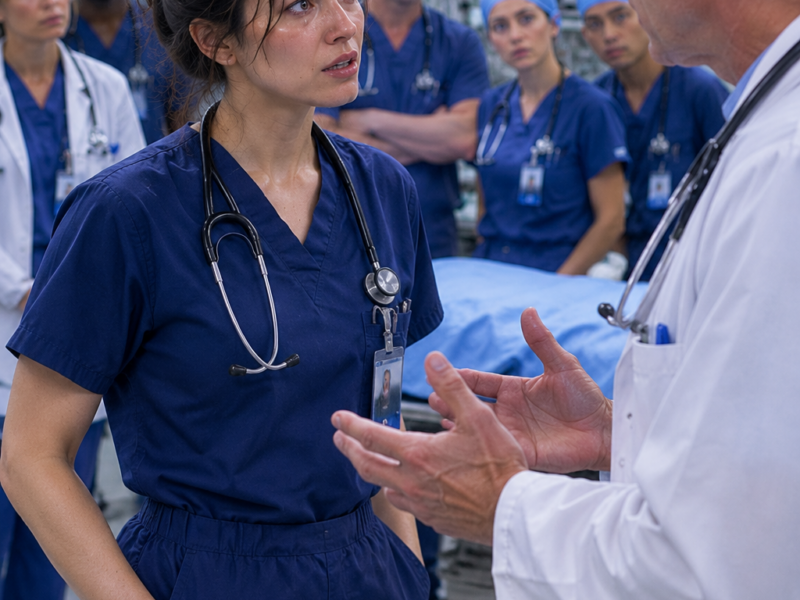
“Who Trained You?” the Chief Surgeon Asked—Her Answer Left Everyone Speechless
“Who Trained You?” the Chief Surgeon Asked—Her Answer Left Everyone Speechless
The first thing Dr. Adrien Keller noticed was the blood.
Not the amount of it, although there was enough to turn the floor of Trauma Bay Six into a slippery red surface. Not the frantic voices, the alarms, or the young resident standing beside the operating table with trembling hands and an expression that suggested he had reached the very edge of everything medical school had taught him. Keller had seen all of those things before. He had spent more than twenty years working in trauma medicine, and there were very few emergencies left that could genuinely surprise him.
What caught his attention was the woman standing beside the patient.
She was removing her bloody gloves with an almost unsettling calmness. Her shoulders were relaxed, her breathing controlled, and her eyes remained fixed on the young man lying beneath the surgical lights. A temporary vascular repair had been secured inside his chest, holding together an injury that should have killed him several minutes earlier. The stitches were rough, unusually positioned, and unlike anything Keller expected to find in a civilian emergency department.
Yet they were holding.
He stepped closer, examining the work without immediately speaking. The technique was unfamiliar to most civilian surgeons, but Keller recognized enough of it to understand that whoever had performed it possessed extraordinary experience working under conditions where conventional surgical equipment, time, and even basic medical facilities could not be taken for granted.
His eyes moved from the wound to the woman’s hands.
Then to the badge attached to her uniform.
Mara Ellison. Registered Nurse.
He looked at her again.
“Who trained you?”
The room seemed to lose its remaining noise.
Mara raised her eyes and met his gaze.
“JSOC,” she answered.
Keller went completely still.
Those four letters meant something very specific to him. Joint Special Operations Command. He had spent three years advising military medical units and had attended enough classified briefings to understand the kind of people who emerged from that world. They were not ordinary medical professionals who happened to have military experience. They were individuals trained to keep people alive in places where evacuation might be hours away, supplies were limited, and failure was measured in lives rather than paperwork.
And one of them had been working quietly in his hospital for three weeks, wearing a nurse’s badge and deliberately making herself appear unremarkable.
Keller looked at the patient again.
Then he looked back at Mara.
For the first time since she had arrived at Harbor County Medical Center, he realized he had never actually understood who he was working with.
Three weeks earlier, nobody at Harbor County had paid much attention when Mara Ellison walked through the staff entrance for her first shift.
She was thirty-four years old, with dark hair usually tied neatly behind her head and an expression that revealed very little about what she was thinking. She wasn’t particularly tall, didn’t have an intimidating appearance, and rarely spoke unless someone addressed her first. Her voice was quiet, her movements economical, and her manner professional without being especially warm.
If anything, she seemed determined not to attract attention.
Her employment file was unusual, although not unusual enough to prevent her from being hired.
She had worked at several small medical facilities in Montana and Wyoming, mostly rural clinics serving communities where the nearest hospital could be more than an hour away. Her clinical evaluations were consistently excellent. Her references were professional and brief. There was also an unexplained two-year gap in her employment history, during which the only traceable connections led to administrative offices associated with the Department of Defense.
The hiring coordinator had noticed the discrepancy.
A request for clarification had been sent to the appropriate liaison, but no meaningful response ever arrived. Eventually, the coordinator decided that Harbor County had more urgent problems than investigating the mysterious employment history of an otherwise qualified nurse.
The hospital was short-staffed, the emergency department was struggling to maintain coverage, and Mara’s credentials were valid.
She was hired.
On her first morning, she arrived fifteen minutes early, collected her identification badge, and listened carefully while the charge nurse explained the hospital’s procedures.
She asked where the emergency equipment was stored, how the trauma rooms were organized, and which supply cabinets were accessible after hours.
The questions seemed ordinary enough.
But what nobody noticed was how quickly she memorized the answers.
Within her first shift, Mara knew which trauma bays had the most reliable equipment, which monitors occasionally malfunctioned, where replacement blood products were kept, and which emergency carts were missing items that should have been standard.
She also began learning the people.
She noticed which residents became nervous when several patients arrived simultaneously. She recognized the nurses who worked best under pressure and those who needed clear instructions when a situation became chaotic. She observed how doctors communicated with one another, where decisions were delayed, and which small inefficiencies could become dangerous if a patient deteriorated unexpectedly.
She never announced any of these observations.
She simply remembered them.
Her hands moved efficiently, her assessments were accurate, and she never needed instructions repeated. When a patient required reassurance, she offered it naturally. When a family member became frightened, she spoke gently. When the department was quiet, she kept herself occupied without searching for conversation.
She ate lunch alone, usually standing near a window or sitting at the far end of the cafeteria.
At the end of her shifts, she collected her belongings and left.
Some colleagues considered her distant.
Others thought she was shy.
A few suspected she was simply one of those people who preferred to keep their professional lives separate from everything else.
Nobody knew that her quietness was intentional.
For years, Mara had worked very hard to become someone people would forget.
She had discovered that ordinary work was easier to tolerate than extraordinary responsibility. In small rural clinics, she could treat infections, stabilize fractures, manage emergencies, and help families who had nowhere else to turn. The patients needed her, and she could help them without being forced to confront the memories she had spent years trying to bury.
She had become comfortable with limited responsibility.
She had become comfortable being overlooked.
And most importantly, she had become comfortable never being asked what she had done before.
Dr. Adrien Keller, however, was not particularly comfortable with people he could not understand.
He had joined Harbor County as chief of trauma surgery after building an impressive career at some of the most respected medical institutions in the country. He had trained at Johns Hopkins, completed his residency at Massachusetts General Hospital, and spent several years working alongside military medical teams before returning to civilian practice.
He was tall, broad-shouldered, and possessed the kind of confidence that came from repeatedly being the person everyone depended on when situations became difficult.
He believed in preparation.
He believed in discipline.
Most of all, he believed in systems.
In his experience, trauma departments survived because everyone understood their responsibilities. Surgeons made surgical decisions. Nurses provided essential clinical support. Residents learned through supervision, and every member of the team respected the chain of command.
It wasn’t about arrogance, he often explained. It was about accountability.
A trauma department was not a place where people could improvise simply because they believed they knew better.
Keller had seen what happened when inexperienced medical professionals stepped outside their training.
That was why he paid attention to Mara almost immediately.
On her first afternoon, he found her checking the equipment in one of the trauma bays after a patient had been transferred upstairs.
“You don’t need to inspect everything,” he told her.
Mara looked up.
“I was checking the suction equipment.”
“The maintenance team handles that.”
“Understood.”
Keller glanced at the cart beside her.
“And you should make sure you stay within your scope of practice. We have a clear division of responsibility here. Doctors make clinical decisions. Nurses carry out the appropriate orders. Don’t try to do my job.”
There was no hostility in his voice, but there was little room for discussion either.
Mara studied him for a brief moment.
“Yes, Doctor.”
Then she returned to the equipment.
Keller walked away with an uncomfortable impression that she had not actually been corrected.
It felt more as though she had simply decided to let him believe he had made a point.
He disliked that feeling.
Nevertheless, he had more important matters to manage.
The following three weeks passed without incident.
Mara became part of the department’s routine. She handled patients efficiently, assisted with procedures, and responded to emergencies without hesitation. Her charting was meticulous, her medication checks were accurate, and her communication was clear.
Keller could find nothing to criticize.
Yet he continued noticing her.
There was something unusual about the way she watched the emergency department.
Most people concentrated on the patient in front of them. Mara seemed to maintain an awareness of the entire room. Even while preparing medication or changing a dressing, she remained conscious of what was happening around her.
She noticed changes in a patient’s breathing before the monitor registered a significant deterioration. She recognized when a family member was about to faint. She could tell when a resident was becoming overwhelmed simply by watching the way he moved his hands.
Keller had seen that kind of awareness before.
He remembered military field medics who could identify problems before anyone else recognized that something was wrong.
They learned to observe everything because overlooking one small detail could mean losing someone.
He occasionally wondered whether Mara had military experience.
Then he dismissed the thought.
People came into trauma medicine from many different backgrounds. Some had unusual experiences. Some had developed exceptional instincts through years of difficult work.
It didn’t matter.
As long as she followed hospital procedures, Keller had no reason to investigate further.
Then came the night of the fourteenth.
At 11:47 p.m., the emergency dispatch system announced a mass-casualty incident on the expressway.
A chain-reaction collision involving a city bus, a freight truck, and four passenger vehicles had left dozens of people injured. The initial report described multiple trapped occupants, severe chest injuries, and several patients in critical condition.
The number of incoming casualties increased with every update.
Within eight minutes, Harbor County Medical Center’s emergency department was overwhelmed.
Six trauma rooms filled almost simultaneously.
Ambulances arrived one after another, carrying patients with fractured limbs, penetrating wounds, head injuries, and internal bleeding. Paramedics shouted reports while nurses rushed between rooms. Hospital security redirected visitors away from the emergency entrance, and administrators began calling additional staff members to report for duty.
The charge nurse was attempting to coordinate intake while simultaneously managing triage.
Neither responsibility was getting the attention it deserved.
Keller arrived from the attending lounge, took one look at the incoming patient board, and immediately began assigning teams.
He selected the most serious case for himself.
The patient was a man in his fifties with a penetrating chest wound, a compromised right lung, and signs of developing cardiac tamponade. He needed immediate intervention.
Keller moved into the operating area and began preparing for surgery.
The next patient was assigned to Ethan Rourke, a second-year resident.
Ethan was intelligent, hardworking, and confident enough to believe he was becoming a very good doctor. He had performed well during simulations and had received favorable evaluations from his supervising physicians.
But he had not yet learned how different a real emergency could be from a controlled training exercise.
His patient was a woman with significant abdominal trauma and a rapidly falling blood pressure.
Keller instructed him to stabilize her while waiting for another attending physician to scrub in.
Ethan acknowledged the orders and hurried to his assigned bay.
Meanwhile, Mara was placed on floating support duty.
She moved between the rooms, checking equipment, preparing supplies, assisting nurses, and monitoring patients who were not yet stable enough to be left unattended.
She worked without hesitation.
When a patient in Bay Three began showing early signs of respiratory distress, she had already repositioned him before the attending requested airway assistance.
When the blood supply in Bay Five approached depletion, she had a replacement unit ready before the infusion pump began sounding its warning.
She anticipated needs rather than waiting for them to become emergencies.
Nobody stopped to compliment her.
There was simply too much happening.
But Ethan noticed.
During the brief moments when he could look away from his own patient, he saw Mara moving through the department with a strange sense of timing.
It was as though she was always several seconds ahead of everyone else.
He had no idea why.
He was too busy trying to keep his own patient alive.
For nearly twenty minutes, Ethan struggled to maintain the woman’s blood pressure. Her condition was unstable, but he eventually managed to achieve enough improvement to allow the team to continue preparing for surgery.
He stepped back, exhaled, and wiped sweat from his forehead.
Then the radio crackled.
The final ambulance of the night was approaching.
Its patient was a twenty-seven-year-old man named Noah Bennett.
The paramedics had spent the previous several minutes fighting to keep him alive.
A piece of structural steel from the damaged bus frame had penetrated his upper chest and damaged the tissue surrounding his left subclavian artery. The metal had been removed at the scene, a decision that had created a much more complicated injury.
Without the object in place, the damaged vessel was bleeding heavily.
The paramedics had attempted manual compression during transport, but they could not adequately control the hemorrhage.
Noah’s systolic blood pressure was already down to sixty-one when the ambulance reached the hospital.
By the time the gurney entered the emergency department, the cardiac monitor was producing increasingly alarming signals.
His face was pale, his skin cold, and his breathing shallow.
The trauma team moved immediately.
Keller was still operating on his own patient.
He heard the announcement through the intercom and understood the severity of the situation.
He could not abandon the man whose chest was already open.
“Bay Six,” he ordered through the communication system. “Get pressure on that hemorrhage. Ethan, take the case until I arrive.”
Ethan rushed toward the room.
Mara followed him, accompanied by Patricia Hale, an experienced nurse who had worked at Harbor County for eleven years.
Patricia had seen nearly every kind of emergency the hospital could produce.
She had learned not to panic easily.
But when Noah was transferred onto the trauma table, even she understood that they were facing something extraordinary.
The bleeding was coming from deep inside the upper chest.
The damaged artery had retracted behind the clavicle, making it almost impossible to visualize. Blood continued filling the surgical field faster than the team could clear it.
Ethan tried to locate the source.
He adjusted the lighting, requested additional suction, and attempted to identify the damaged vessel.
Nothing worked.
The more he searched, the more difficult the field became to understand.
The patient’s blood pressure continued dropping.
Ethan felt his hands begin to shake.
He knew what the textbooks said. He understood the anatomy. He had studied vascular trauma, hemorrhage control, and emergency thoracic procedures.
But none of those lessons had prepared him for the sight of a living patient disappearing beneath a rapidly expanding pool of blood.
“More suction!” he called.
Patricia responded immediately.
Ethan tried again.
The artery remained hidden.
Then the monitor changed.
The irregular rhythm became slower.
The next sound was a continuous, unmistakable tone.
Noah Bennett’s heart had stopped.
For two seconds, Ethan stood motionless.
He was not a coward.
He was not incompetent.
He was simply experiencing something he had never encountered before: the moment when knowledge remained present in his mind, but his ability to use it seemed to disappear.
He stared at the patient.
His hands were still holding the instruments, but he could no longer organize his thoughts quickly enough to make a decision.
“I can’t find the artery,” he whispered.
Nobody answered.
“I can’t see it. There’s too much blood.”
Mara was standing near the supply tray.
She had been watching Noah’s monitor and Ethan’s movements for the previous ninety seconds.
She had recognized the pattern of the bleeding. She understood where the damaged vessel had probably retracted and what was happening to the patient’s circulation.
She had also recognized the look on Ethan’s face.
It was the look of someone whose training had reached its limit.
She placed the instrument she was holding on the tray.
“Move.”
Ethan turned toward her.
At first, he didn’t understand.
“What?”
“Move. Right now.”
Her voice contained no anger, no panic, and no hesitation.
It was not the voice of someone requesting permission.
It was the voice of someone who had given the same order in circumstances where every second mattered.
Ethan looked at her.
“You’re a nurse. You can’t—”
“Move.”
Patricia instinctively stepped backward.
Ethan hesitated for another moment, struggling to reconcile what he was seeing with what he believed was supposed to happen in a hospital.
Then Mara stepped around him.
She moved directly to the patient and placed both hands into the wound.
She did not waste time searching visually for the damaged artery.
Her fingers moved through the blood with extraordinary certainty, following the anatomy she understood beneath the injured tissue.
It was a kind of precision that could not be developed through ordinary hospital rotations.
She found the retracted vessel behind the clavicle and applied direct pressure, reducing the hemorrhage almost immediately.
“Bridging clamp.”
Patricia handed her the requested instrument.
Mara positioned it carefully, creating temporary control of the damaged vessel.
With her other hand, she accepted a suture driver and placed several rapid anchor stitches around the compromised area.
The stitches were not intended to provide a permanent repair.
They were designed to hold the temporary assembly in position long enough to transport Noah into the operating room.
Everything she did was functional.
Nothing was decorative.
She was working with the kind of practical precision that came from environments where survival mattered more than appearance.
For several seconds, nobody spoke.
Then the monitor changed.
One heartbeat appeared.
Then another.
A weak rhythm began returning.
Noah’s heart started beating again.
His blood pressure, which had fallen almost to nothing, slowly began to recover.
The continuous tone disappeared.
In its place came the irregular beeping of a patient who was still critically ill but no longer dying in front of them.
Mara stepped back.
She removed her outer gloves and looked at the monitor.
Her breathing remained steady.
Her hands did not shake.
That was when Keller entered.
He had just finished closing his first patient’s chest and had hurried toward Bay Six.
He expected to find Ethan fighting an ongoing hemorrhage.
Instead, he found a patient whose circulation had been partially restored.
He approached the table, studying the temporary vascular assembly.
At first, he couldn’t understand what he was seeing.
Then he recognized the technique.
The sutures were rapid placement anchors, the kind of improvised stabilization used in environments where definitive surgical equipment might not be available.
He had encountered something similar during his military advisory years.
Twice.
Both times, the procedure had been performed by highly trained field medical personnel.
He examined the wound again.
Then he looked at Mara.
“Who trained you?”
She met his eyes.
“JSOC.”
Keller felt the answer land with unexpected weight.
Joint Special Operations Command.
He knew what it represented.
He also knew that people with that background rarely spoke about it casually.
He looked at Ethan, who was still standing near the table, then at Patricia, whose expression suggested she had just witnessed something she would never forget.
Noah was alive, but the temporary repair would not last indefinitely.
Keller immediately began organizing the transfer.
“Prepare the operating room. We need definitive vascular repair now.”
The team moved.
Then he turned toward Mara.
“You’re scrubbing in.”
Mara looked at him.
“I don’t have surgical privileges.”
“I know.”
“Then you understand why I can’t.”
Keller paused.
He understood the professional and legal implications of what he was proposing. Harbor County had strict rules governing surgical privileges, and bringing an uncredentialed nurse into an operating room to assist with a procedure would invite serious scrutiny.
But he also understood what was happening in front of him.
The patient was alive because Mara had created a temporary solution that nobody else in the room had been able to provide.
And the person who had built that solution understood the injury better than anyone else currently available.
Keller looked at Noah.
Then at Mara.
“You built the bridge keeping him alive,” he said. “You’re going to stand beside me when we remove it.”
She remained silent.
“If something goes wrong, the responsibility is mine. I’ll answer for it.”
He adjusted his surgical gown.
“Let’s go.”
Mara followed him.
The operating room was ready when they arrived.
Noah was placed under anesthesia, and the team began preparing the surgical field.
Compared with the emergency department, the room was almost unnaturally calm.
The lighting was controlled. Instruments were arranged in precise order. The anesthesia team monitored every change in Noah’s condition, and the scrub technician moved efficiently between the surgical tables.
For a moment, everything seemed manageable.
Then Keller opened the surgical field.
The injury was worse than the initial imaging had suggested.
The clavicle had shattered into several fragments. Pieces of bone had penetrated the surrounding tissue, and three fragments were particularly dangerous.
Two were pressing against the pleural margin.
The third was lodged dangerously close to the wall of the subclavian artery.
A conventional approach would require manipulating the damaged area, but even a small movement could dislodge one of the fragments.
If that happened, the artery could rupture again.
The lung could also be punctured.
Keller studied the anatomy.
His hands became still.
He understood the problem, but he was not immediately satisfied with the available options.
Mara stood across from him, examining the same area.
“You’ve seen this before,” he said.
She nodded.
“Where?”
“Baghdad.”
Keller looked up.
The answer explained more than she probably intended.
He understood that she was not referring simply to a city where she had once worked.
She was describing an environment where medical decisions had to be made under extraordinary pressure, where the available equipment could be limited, and where the conventional approach was not always possible.
He returned his attention to the wound.
“What would you do?”
Mara examined the three bone fragments.
Then she explained her approach.
Rather than entering directly through the damaged portion of the clavicle, she suggested extending the access window around its medial third and approaching the artery through healthier tissue.
The approach would require a larger incision and more extensive dissection.
It would also take longer.
That was dangerous in a patient who had already experienced massive blood loss.
But it would provide access to the vessel without disturbing the fragments.
Keller considered her proposal.
He knew the technique.
He had encountered it in military field surgery literature years earlier. It was not the standard approach he would normally choose in a civilian operating room.
However, the standard approach carried a significant risk of moving the fragment lodged against the artery.
He considered the alternatives.
He looked at the anatomy again.
Then he looked at Mara.
For three weeks, he had interpreted her quietness as professional detachment.
Now he understood that he had been looking at someone who had learned to remain calm in situations where losing control could cost another person their life.
“Do it,” he said.
The dissection began.
Keller performed the surgical work while Mara guided the approach.
She identified anatomical landmarks that had been obscured by the trauma and explained how to reach the vessel without disturbing the critical fragments.
The scrub technician kept the field clear.
Dr. Warren, the anesthesiologist, monitored Noah’s blood pressure and adjusted treatment to maintain enough circulation for the team to continue.
For nearly forty-five minutes, the procedure progressed without major complications.
Keller worked with extraordinary concentration.
He was a highly experienced surgeon, and once the correct approach had been established, his technical skill became evident.
Mara spoke only when necessary.
“Stay lateral.”
“That tissue is compromised.”
“Don’t pull against the superior fragment.”
Keller listened.
There was no argument about hierarchy, no attempt to establish who was in charge.
They were simply two medical professionals working toward the same outcome.
By the time Keller reached the damaged artery, the three bone fragments remained stable.
The pleural margin was intact.
The temporary vascular bridge had performed exactly as intended.
The definitive repair began.
For the first time that night, Keller allowed himself to believe that the worst was behind them.
Then the smallest bone fragment moved.
It was barely larger than a thumbnail, a thin piece of cortical bone that had remained stable throughout the dissection.
But as Keller placed the third suture, the fragment shifted approximately one millimeter.
One millimeter was enough.
The damaged arterial wall reacted immediately.
Blood surged into the surgical field.
The suction could not keep up.
Keller’s view disappeared beneath the hemorrhage.
“Secondary bleed,” he said sharply. “Proximal source.”
Dr. Warren looked at the monitors.
Noah’s blood pressure was dropping.
The alarms began sounding.
“More suction!”
The scrub technician responded, but the blood continued filling the field.
Keller tried to identify the source.
He could not see it.
The patient was deteriorating again.
Mara moved closer.
She understood what had happened.
The fragment had shifted against the vessel wall, creating a new injury.
She knew what needed to be done.
But the alarms were no longer the only sounds she could hear.
For a moment, the operating room seemed to disappear.
The bright surgical lights became the dim interior of a military helicopter.
The smell of antiseptic faded beneath the memory of cold metal, fuel, snow, and blood.
She heard the sound of rotor blades struggling against the wind.
She remembered a mountain pass in the darkness.
She remembered a man lying on the floor of a damaged helicopter, trying to breathe while the aircraft’s metal structure creaked around him.
His name was Captain Lucas Vale.
And she remembered the moment she had realized that she could not save him.
Years earlier, during a military exfiltration operation, Mara had been the only medical specialist aboard a helicopter carrying six people.
The aircraft had been forced into an emergency descent after a rifle round damaged its tail rotor.
The descent had become uncontrolled during the final three hundred feet.
The helicopter struck the ground in a remote mountain pass.
Snow covered everything.
The temperature was falling rapidly.
Several people were injured, and the nearest evacuation team could not reach them immediately.
Mara had spent the first hours moving between the survivors, assessing injuries, controlling bleeding, stabilizing fractures, and using whatever equipment remained available.
There had been no proper operating room.
No reliable supply of medical instruments.
No comfortable place to work.
There was only the wreckage, the cold, and six people who needed her.
Lucas had suffered a penetrating neck injury.
A fragment from the impact had damaged the internal jugular vein.
The bleeding was initially slow enough to appear manageable, but Mara understood that it could become fatal if she released pressure.
She reached the injury within the first twenty minutes.
She applied direct compression and held it.
For hours.
The evacuation window kept changing.
The conditions remained dangerous.
The other injured men needed attention, but Lucas’s injury required constant pressure. Even a brief release caused the hemorrhage to worsen.
He remained conscious for much of that time.
He occasionally spoke to her, not because he was frightened, but because he was trying to monitor his own condition.
“My fingers are getting colder,” he told her once.
Mara nodded.
She adjusted her position and continued applying pressure.
“Still with you,” she said.
He tried to smile.
Lucas had always been the kind of man who made plans even when circumstances suggested that making plans was pointless.
During the third hour, he told her that if he survived, he wanted to work somewhere people couldn’t afford medical treatment.
He wanted to help communities where the nearest trauma center was too far away and where a minor emergency could become a tragedy because nobody had the resources to respond.
He spoke about it without dramatic emotion.
It sounded less like a dream and more like a decision he had already made.
Mara told him to save his career planning for after the evacuation.
He smiled.
She remembered that smile more clearly than almost anything else.
During the fourth hour, his pulse began changing.
Mara felt it beneath her fingers.
She knew the rhythm so well by then that she could recognize even the smallest alteration.
She adjusted her pressure.
She repositioned her hands.
She tried everything available to her.
But the damaged vessel was too compromised, and the resources needed for a definitive repair were nowhere near them.
The bleeding worsened.
Lucas became weaker.
Mara kept working.
Her hands remained steady.
Her breathing remained controlled.
She did not panic.
She did everything she knew how to do.
And Lucas Vale died with her fingers still pressing against his neck.
For years afterward, that moment followed her.
Not simply because Lucas had died.
People died in medicine, even when everyone did everything correctly.
She understood that intellectually.
But something inside her had changed.
Before that night, she had believed that precision was a kind of promise.
If she knew enough, prepared enough, and worked hard enough, she could control the outcome.
She had never consciously believed herself invincible.
But she had believed that there was always something more she could do.
Lucas’s death had destroyed that belief.
Her hands had not shaken.
Her decisions had been correct.
Her training had been sufficient for the circumstances.
And he had still died.
After the operation, Mara remained in military medical service for a period of time, but something in her relationship with the work had changed.
She continued performing her duties.
She continued treating patients.
She continued helping people.
But she no longer trusted herself to take responsibility for situations where the difference between success and failure was so narrow.
Eventually, she left.
She moved into civilian medicine and accepted positions in small rural clinics.
Montana.
Wyoming.
Small towns where she could help people without being placed in situations that reminded her of the mountain pass.
She told herself she was choosing a quieter life.
She told herself she wanted to make a difference in communities that needed medical care.
Both things were true.
But there was another reason.
She was afraid of discovering that she could do everything right again and still lose someone.
And she was terrified that if it happened a second time, she might never be able to return to the work at all.
Now, standing in Harbor County’s operating room, she was hearing the past collide with the present.
The blood in the surgical field became the blood on the helicopter floor.
The alarms became the sounds of the damaged aircraft.
The patient on the table became Lucas.
Her hands stopped moving.
Keller noticed immediately.
At first, he thought she was reassessing the injury.
Then he recognized the difference.
Her posture had changed.
Her attention was no longer on the surgical field.
She was looking at something that nobody else in the room could see.
“Mara.”
She didn’t respond.
He called her name again.
The alarms continued.
Noah’s blood pressure was falling.
Keller could have shouted.
He could have demanded that she move.
But something in her expression told him that the problem was not a lack of skill.
It was something much older.
“Mara.”
This time, his voice changed.
He stripped away the authority and urgency.
He spoke as a person trying to reach another person.
“The man on this table is not the man you lost.”
The words seemed to travel through a great distance.
Mara blinked.
For a second, she was still in the helicopter.
Then she looked down.
She saw Noah Bennett.
Twenty-seven years old.
Alive when the operation had begun.
Still alive now, but losing ground with every passing second.
She looked at the blood.
She looked at the damaged artery.
She looked at the monitors.
And slowly, the operating room returned.
The present became separate from the past.
Lucas was gone.
Noah was here.
There was still time.
Mara moved.
She reached into the surgical field and located the source of the bleeding with two fingers.
Direct pressure.
The most basic intervention in medicine.
The one that remained effective when everything else became too complicated.
The hemorrhage slowed.
Then it became manageable.
“I have it,” she said.
Keller was already preparing the suture.
He understood what she needed without requiring further explanation.
He moved toward her hands.
“Suture to my fingers,” Mara instructed.
Keller positioned the needle carefully.
For a few seconds, they both remained perfectly still.
Mara maintained pressure and protected the damaged vessel while Keller placed the repair.
The closure held.
The bleeding stopped.
Dr. Warren looked at the monitors.
“Pressure is recovering.”
Nobody answered immediately.
They were all watching the numbers.
Then another reading appeared.
And another.
Noah’s circulation began stabilizing.
The alarms gradually fell silent.
The patient was still critically ill, but the immediate danger had passed.
Keller completed the vascular repair with methodical precision.
The rest of the procedure continued without another major complication.
When the final sutures were placed, the damaged artery was secure.
The surrounding tissue remained intact.
The bone fragments had not caused further injury.
And Noah Bennett’s heart continued beating.
Mara stood across from Keller, her hands lowered at her sides.
She did not smile.
She did not celebrate.
She simply watched the patient.
But something inside her had shifted.
The past had not disappeared.
Lucas was still dead.
The mountain pass was still part of her history.
Nothing that had happened in that operating room could change those facts.
But Noah was alive.
And for the first time in years, Mara allowed herself to recognize that her hands could still be used to save someone.
The post-operative debrief lasted twelve minutes.
It was clinical, efficient, and focused on the patient’s condition.
Keller reviewed the surgical notes with Dr. Warren, confirmed the transfer arrangements, and answered questions from the scrub technician.
Noah was moved to intensive care.
His condition remained serious, but the definitive repair had been successful.
Keller watched the transport team wheel him out.
Then he removed his surgical cap and walked toward the scrub sinks.
Mara was already there.
Water ran over her hands as she watched the remaining traces of blood disappear.
Keller turned off the faucet beside her.
He handed her a towel.
“Cafeteria,” he said. “Ten minutes.”
It was not an order.
At least, it didn’t sound like one.
Mara looked at him.
Then she nodded.
The hospital cafeteria at four in the morning was almost empty.
The overhead lights were dimmed, and a custodian was moving chairs near the far wall. A tired employee was restocking the coffee station, occasionally checking the clock above the entrance.
Keller collected two cups of coffee and sat across from Mara.
He placed one in front of her.
She looked at it.
“Thanks.”
The coffee was terrible.
Neither of them mentioned it.
For several minutes, they sat quietly.
It was not an uncomfortable silence.
It was the silence of two people who understood that the next conversation mattered enough not to rush.
Keller wrapped both hands around his cup.
“I’m not going to file tonight as anything other than a successful surgical intervention,” he said.
Mara looked up.
“The documentation will reflect what was done and the outcome. It will not turn the situation into some kind of spectacle.”
He paused.
“That’s not a promise to protect you from consequences. It’s simply an accurate record of what happened.”
Mara nodded.
Keller studied her for a moment.
Then he asked the question that had been building in his mind since he entered Bay Six.
“Why did you leave?”
Mara looked down at her coffee.
She understood what he was asking.
He wasn’t interested in her employment history.
He wanted to know why someone with her training had chosen to work in small rural clinics and then accepted a position as an ordinary emergency nurse.
For a while, she said nothing.
Then she spoke.
“There was a captain named Lucas Vale.”
She did not introduce the name as though she were beginning a dramatic story.
She said it quietly, with the exhaustion of someone who had repeated those words inside her mind thousands of times.
“The mission doesn’t have a public record,” she continued. “There were six of us on the helicopter. We were coming out of an operation when the aircraft took a hit. The tail rotor was damaged, and the pilot tried to bring us down in a mountain pass.”
She paused.
“The landing didn’t go well.”
Keller listened.
Mara described the cold first.
The temperature had fallen rapidly after the crash, and the wreckage offered very little protection from the wind.
She remembered the sound of metal bending.
She remembered one of the injured men shouting when she reset his shoulder without anesthesia because he needed the arm to remain functional.
She remembered constructing an improvised tourniquet from equipment that had never been designed for that purpose.
She remembered the strange feeling of working in darkness while knowing that the nearest evacuation team was still too far away.
Then she spoke about Lucas.
His injury had been to the neck.
A fragment from the impact had damaged the internal jugular vein, and she had reached him within twenty minutes.
She had applied pressure and held it.
For four hours.
“Every time I released pressure, even slightly, the bleeding started again,” she explained. “So I kept holding it.”
Keller’s expression remained serious.
“He stayed conscious?”
“For most of it.”
Mara looked at her hands.
“He kept telling me about his fingers. They were getting colder. He knew what that meant, so he would report it to me. Not dramatically. Just the facts.”
She gave a faint, humorless smile.
“He was a good patient.”
Keller didn’t interrupt.
“He told me that if he survived, he wanted to work somewhere that needed trauma care but couldn’t afford it. Somewhere people were used to being told that the nearest help was too far away.”
She looked toward the dark cafeteria windows.
“I told him to save the career planning for after the evacuation.”
Keller lowered his eyes.
Mara continued.
“During the fourth hour, his pulse changed. I could feel it. I had been holding that vessel long enough to know his heartbeat better than I knew my own. I adjusted my hands. I changed position. I tried everything I could.”
She stopped speaking.
For several seconds, the only sound was the cafeteria refrigerator humming near the wall.
“His vein finally gave way,” she said. “The bleeding became something I couldn’t control with the equipment we had. He died with my hands still against his neck.”
Keller remained silent.
“My hands didn’t shake,” Mara said.
She looked directly at him.
“That’s the thing I kept thinking afterward. They didn’t shake. I did everything right. I knew what I was doing. I stayed calm. I followed every principle I had been trained to follow.”
Her voice became quieter.
“And he died anyway.”
Keller let the words settle.
“So you stopped trusting your hands,” he said.
Mara shook her head slightly.
“I stopped trusting what my hands were for.”
She turned the coffee cup slowly between her fingers.
“I could still do the work. I knew that. I continued working afterward. I treated people. I helped with emergencies. I did what I was supposed to do.”
She paused.
“But I started choosing situations where the difference between what was needed and what I could provide was smaller. Cases where I could see the limits clearly. Cases where I didn’t have to discover how far I could go.”
Keller listened carefully.
“That’s why the clinics?” he asked.
“Partly.”
She looked toward the window again.
“Lucas wanted to work somewhere people couldn’t afford care. I couldn’t do exactly what he wanted, so I did something close to it. Montana. Wyoming. Small clinics. Communities where people needed help.”
She gave a small shrug.
“I told myself I was honoring what he wanted.”
“Maybe you were.”
“Maybe.”
She took a sip of coffee.
“But I was also making sure I never had to become the person I used to be again.”
Keller thought about the operating room.
He remembered the moment her hands had stopped moving.
Before that night, he would have described her as someone who remained calm because she was emotionally detached.
Now he understood that her composure had been built through years of experiences most people would never encounter.
And he understood something else.
Mara had not frozen because she lacked courage.
She had frozen because the present had briefly become indistinguishable from the worst moment of her past.
The difference between the two was enormous.
“You know what I saw tonight?” Keller asked.
Mara looked at him.
“I saw someone who understood that the patient was dying and knew exactly what needed to happen. Then I saw someone who remembered losing a person she couldn’t save.”
He leaned back.
“And then I saw that person come back and save someone else.”
Mara did not respond.
“I don’t need another trauma surgeon,” Keller continued. “I have surgeons. What I don’t have is someone who can teach residents how to function when the plan stops working.”
She raised her eyes.
“Ethan froze tonight,” Keller said. “He knew what to do in theory. He had the instruments. He understood the anatomy. But when the situation became something he had never experienced, he couldn’t move.”
“He wasn’t ready for that case,” Mara said.
“No. He wasn’t.”
Keller looked at her.
“And he won’t be ready for the next one unless someone teaches him what happens when preparation isn’t enough.”
Mara remained quiet.
“I can teach him the textbook,” Keller continued. “I can teach him surgical technique. I can teach him how to follow protocols and make decisions under pressure.”
He paused.
“But I’ve never been where you’ve been. I don’t know how to teach someone what to do when every option disappears and the patient is still depending on them.”
He placed his cup on the table.
“I’m proposing an advanced trauma response unit. A small team dedicated to training for situations where standard procedures fail or aren’t available. High-acuity emergencies, complex hemorrhage control, unexpected complications, mass-casualty response, and decision-making under extreme pressure.”
Mara looked at him carefully.
“I want you to lead it.”
She almost laughed.
“Adrien, I’m a nurse.”
“I know what your badge says.”
“I don’t have the credentials to lead a surgical department.”
“I’m not asking you to lead surgery.”
He leaned forward.
“I’m asking you to design the way this hospital responds when everything goes wrong at once. You’ll work with the physicians, nurses, and residents. You’ll help build the training program, identify weaknesses in our emergency response, and teach people how to remain effective when the circumstances are no longer predictable.”
Mara looked down at the table.
She thought about the years she had spent making herself smaller.
The rural clinics.
The temporary contracts.
The careful decisions to avoid situations that might force her to confront her limits.
She had called it humility.
She had called it responsibility.
She had even called it a way of honoring Lucas.
But sitting there, listening to Keller describe a future in which her experience might help other people survive, she recognized another truth.
She had been protecting herself.
She had been afraid that if she stepped fully into the work again, she might discover that the past had taken more from her than she could recover.
She had feared being responsible for another life and failing.
But Noah Bennett was alive.
Not because the circumstances had been perfect.
Not because the equipment had been sufficient.
And not because the people in the room had followed a flawless plan.
He was alive because people had adapted, listened, and continued working when the situation became difficult.
Mara looked at Keller.
“I spent years trying to become someone ordinary.”
“I know.”
“It wasn’t easy.”
“I can imagine.”
She studied his face.
“And you think I should just walk back into all of it?”
“No,” Keller said. “I think you should decide whether you’re ready to stop running from it.”
The words were direct, but they were not unkind.
Mara looked toward the windows.
Outside, the sky was beginning to change.
The darkness was slowly becoming gray.
“I don’t know if I’m ready,” she said.
Keller nodded.
“That’s an honest answer.”
He stood and collected both coffee cups.
At the cafeteria door, he stopped.
“There’s something I wanted to ask you earlier.”
Mara looked up.
“When I asked who trained you, I thought I was asking about your background.”
He glanced back at her.
“I think I was asking the wrong question.”
She waited.
“The right question is what you’re going to do with everything you’ve learned.”
He left without waiting for an answer.
He understood that some decisions could not be made because another person had presented a reasonable argument.
They had to come from somewhere deeper.
Mara remained seated for several minutes.
Then she stood and walked toward the intensive care unit.
Noah Bennett was in the third room.
He was still under sedation, with tubes and monitoring equipment surrounding him. His chest was covered with surgical dressings, and the monitor beside his bed displayed the steady rhythm of his heartbeat.
Mara stood outside the glass partition.
She watched the numbers.
They remained stable.
For the first time that night, she allowed herself to breathe without consciously controlling it.
Noah was alive.
She was still looking through the glass when she heard footsteps approaching.
Ethan Rourke appeared from the direction of the resident lounge.
He was wearing the same scrubs from the previous evening. His hair was disheveled, and the coffee cup in his hand suggested that sleep had not been particularly successful.
He stopped when he saw Mara.
For a moment, neither spoke.
Then he stepped beside her and looked through the glass.
“He’s doing better,” he said.
“Yes.”
Ethan nodded.
They stood quietly.
“In the operating room,” he began, then stopped.
He looked down at his coffee.
“When you stopped moving, I saw it happen.”
Mara turned toward him.
He continued carefully.
“I recognized the expression. I had the same thing happen in the emergency bay. I knew what needed to happen, but I couldn’t make myself do it.”
He swallowed.
“I’ve been thinking about whether those two moments were the same.”
Mara considered him.
“They weren’t.”
Ethan looked at her.
“You froze because you hadn’t seen something like that before. I froze because I had.”
He frowned slightly.
She continued.
“The difference is what you do the next time.”
Ethan looked through the glass again.
“I thought I was prepared.”
“You were prepared for the situation you expected.”
“And when it wasn’t that situation?”
“Then you have to recognize that your plan isn’t working.”
He remained silent.
Mara looked at him.
“Freezing doesn’t automatically mean you’re a bad doctor. It means you reached a point where your experience wasn’t enough to tell you what to do next.”
“That doesn’t sound particularly reassuring.”
“It isn’t supposed to be.”
For the first time, Ethan gave a faint smile.
Mara continued.
“You can’t guarantee you’ll never freeze again. Nobody can. But you can learn to recognize what’s happening. You can train yourself to make the next decision instead of waiting for the perfect decision.”
Ethan nodded slowly.
“Who were you seeing in the operating room?”
She looked at the patient.
“Someone I couldn’t save.”
He did not immediately ask another question.
“Someone from a long time ago,” she added. “In a place where there was nothing left to try.”
Ethan lowered his coffee cup.
“I’m sorry.”
Mara nodded.
He did not offer empty reassurances.
He did not tell her that everything happened for a reason.
He simply stood beside her.
After a while, he said, “There’s a briefing at seven.”
“I know.”
“Are you going?”
Mara looked at him.
“Yes.”
Ethan nodded.
“Good.”
He turned and walked toward the resident area.
Mara watched him leave.
He was moving differently than he had been the previous night.
He wasn’t suddenly confident.
He wasn’t pretending that the experience had made him a better doctor overnight.
But there was something more deliberate in the way he carried himself.
He had seen the limits of his experience.
And instead of pretending those limits didn’t exist, he had begun thinking about how to overcome them.
Mara returned her attention to Noah.
The monitor continued recording his heartbeat.
One beat.
Then another.
Steady and indifferent.
She realized she was looking at two things simultaneously.
A young man who had survived a night that should have killed him.
And proof that the worst thing she had ever experienced had not destroyed everything she had once been.
For years, she had believed that Lucas’s death meant she could no longer trust herself with another person’s life.
She had confused the limits of what could be done in that mountain pass with the limits of what she could ever do again.
She had allowed one terrible outcome to define every future possibility.
But Lucas’s death had not erased her training.
It had not taken away her ability to think, to act, or to help.
It had simply made her afraid to use those abilities fully.
The realization was painful.
But it was also strangely freeing.
At 6:57 a.m., Mara entered the trauma briefing room.
The room had a long conference table, a whiteboard that had not been completely erased from the previous session, and a window overlooking the hospital parking structure.
The first light of morning was coming through the glass.
Ethan was already seated.
Three other residents had arrived as well.
They were speaking quietly, occasionally glancing toward the door.
Word about the previous night’s emergency had spread through the department.
Everyone knew that a patient had arrived with a devastating chest injury, that a young resident had been unable to control the bleeding, and that a nurse had intervened in a way nobody expected.
Some had heard that the patient had died and been revived.
Others had heard that Keller had personally requested the nurse’s assistance in surgery.
Nobody seemed to know exactly what had happened.
When Mara entered, the conversation stopped.
She placed a folder on the table.
For a moment, she looked around the room.
A few days earlier, these same residents might have regarded her as another nurse assigned to assist with routine procedures.
Now they were watching her with genuine curiosity.
Ethan met her eyes and gave a small nod.
She returned it.
Keller was standing near the whiteboard.
He had arrived early and written a single sentence across the top.
WHAT HAPPENS WHEN THE PLAN STOPS WORKING?
Mara looked at it.
Then she opened her folder.
“All right,” she said.
The room became quiet.
“Today, we’re going to start with something no textbook can completely teach you.”
She looked around the table.
“What to do when everything you planned for stops being relevant.”
Nobody moved.
She picked up a marker and walked toward the whiteboard.
“Most of you have been trained to recognize certain emergencies. You know the symptoms, the protocols, the appropriate interventions, and the order in which those interventions should happen.”
She wrote the words EXPECTED CONDITIONS.
“That training matters. You need it. Protocols exist for a reason, and you should understand them before you ever consider doing anything outside them.”
She paused.
“But a real emergency doesn’t always respect the sequence you’ve memorized.”
She wrote a second phrase beneath the first.
UNEXPECTED CONDITIONS.
“Sometimes the equipment fails. Sometimes the patient doesn’t respond. Sometimes the injury is more complicated than the imaging suggested. Sometimes the person who is supposed to make the decision is unavailable, and sometimes the person standing closest to the patient has to recognize that the current approach is not working.”
She turned toward the residents.
“What do you do then?”
Nobody answered immediately.
Mara looked at Ethan.
He understood that she was giving him an opportunity.
He sat forward.
“You reassess the patient,” he said.
“Good. What else?”
“You identify what has changed and what the immediate threat is.”
“Good.”
Another resident spoke.
“You communicate the problem and request help.”
“Exactly.”
Mara nodded.
“You don’t become so attached to your original plan that you fail to recognize when the situation has changed.”
She walked back toward the table.
“And you don’t confuse hesitation with careful decision-making. There is a difference between taking a moment to assess a situation and losing the ability to act because you’re waiting for certainty.”
Ethan listened closely.
Mara looked around the room.
“One of the most dangerous assumptions in emergency medicine is that the right answer will always be obvious if you’re experienced enough.”
She paused.
“It won’t.”
The residents remained silent.
“You will encounter situations where every available option carries risk. You will make decisions with incomplete information. You will have patients who deteriorate despite your best efforts. And sometimes, despite everything you do, you will lose someone.”
Her voice remained steady.
“That doesn’t mean your training was worthless. It doesn’t mean you weren’t good enough. It means medicine has limits.”
She looked directly at Ethan.
“But those limits should never become an excuse to stop thinking.”
He nodded.
For the next hour, Mara walked them through a series of emergency scenarios.
She asked them to identify the first signs of deterioration, explain how they would communicate under pressure, and describe what they would do when their initial treatment failed.
She did not encourage reckless improvisation.
In fact, she repeatedly emphasized that understanding the boundaries of one’s authority and training was essential.
But she also challenged them to recognize when a situation had moved beyond the assumptions built into a standard protocol.
She taught them to observe the entire environment rather than concentrating exclusively on one problem.
She explained how small failures could combine into a larger emergency, and why the most effective medical teams were often the ones that noticed problems before they became visible to everyone else.
Most importantly, she taught them that panic was not the only response to uncertainty.
A person could be frightened and still think.
A person could feel overwhelmed and still make the next necessary decision.
A person could remember a previous failure without allowing that memory to determine the outcome of the present.
Keller stood near the back of the room, listening.
For the first time since Mara had joined Harbor County, he was not evaluating whether she belonged in his department.
He was watching someone do something he had never been able to teach through ordinary clinical instruction.
He understood now why her presence had seemed unusual from the beginning.
She was not simply an experienced nurse.
She had spent years in environments where the distance between a good decision and a fatal mistake could be measured in seconds.
She understood that emergency medicine was not only about knowing what to do.
It was also about remaining capable of doing it when everything around you was telling you that the situation had become impossible.
The briefing ended shortly after eight.
The residents left with notes, questions, and a new appreciation for the importance of preparation beyond the textbook.
Ethan remained behind.
He approached Mara as she was collecting her folder.
“Can I ask you something?”
“Of course.”
“Do you think I’ll get over what happened last night?”
Mara looked at him.
“Over it?”
He nodded.
She considered the question.
“Probably not in the way you mean.”
His expression changed slightly.
“You’ll remember it,” she continued. “You’ll remember the patient, the blood, the monitor, and the moment you couldn’t move. That’s not necessarily a bad thing.”
“But I don’t want it happening again.”
“Then learn from it.”
She closed her folder.
“Don’t spend the next six months trying to convince yourself you weren’t scared. Figure out why you became overwhelmed. Learn what you missed. Practice making decisions when you’re uncomfortable. Ask questions. Train.”
She looked at him.
“And the next time you encounter something you don’t understand, don’t waste time pretending you do.”
Ethan nodded.
“Thank you.”
Mara gave him a small smile.
“You’re welcome.”
He left.
Keller approached a few seconds later.
He stood beside the whiteboard, looking at the words Mara had written.
“You have a way of making people listen,” he said.
“They’re good residents.”
“They are. But they don’t usually sit that quietly for an hour.”
Mara gathered the last of her papers.
“Maybe they were tired.”
Keller laughed softly.
It was the first time she had heard him laugh without the weight of a difficult medical decision behind it.
“Probably.”
He looked at her.
“I spoke with the hospital director this morning. We’re going to arrange a formal meeting about the advanced trauma response program.”
Mara nodded.
“I haven’t agreed to anything.”
“I know.”
“There’s going to be paperwork.”
“An unreasonable amount.”
“Credentialing questions.”
“Several.”
“And people who won’t understand why a nurse is being asked to design a training program.”
Keller smiled.
“That part I can handle.”
Mara looked toward the window.
The morning had fully arrived.
For years, she had believed that moving forward meant leaving her old life behind.
But perhaps moving forward did not require forgetting.
Perhaps it meant carrying the past without allowing it to decide everything that came next.
She thought about Lucas.
She remembered the mountain pass, the snow, the cold metal, and the way he had smiled when she told him to save his career plans for later.
He had wanted to work somewhere people couldn’t afford care.
She had never forgotten that.
And perhaps, in her own way, she had already been trying to honor him.
But now she understood that honoring someone did not mean spending the rest of her life hiding from the work they had once hoped to do.
It meant continuing.
Not because every patient could be saved.
Not because training could eliminate uncertainty.
Not because the next emergency would necessarily end differently.
But because the possibility of helping someone still mattered.
“All right,” she said.
Keller looked at her.
“All right?”
“I’ll meet with the director.”
He nodded.
“Good.”
“But I’m not interested in creating a program that teaches people to act like soldiers.”
Keller raised an eyebrow.
“What would you teach them?”
“How to think. How to communicate. How to recognize when something is going wrong. How to work together without wasting time protecting their egos.”
She paused.
“And how to understand that improvisation is not the same thing as recklessness.”
Keller smiled.
“I think we can work with that.”
They left the briefing room together.
The emergency department was already becoming busy again.
A child had arrived with a fractured arm. An elderly man was waiting for an assessment. An ambulance had called ahead with a patient experiencing severe respiratory distress.
The hospital was returning to its familiar rhythm.
Nurses were moving between rooms.
Residents were reviewing charts.
Doctors were making decisions.
And Mara Ellison was walking through the center of it all.
She still wore the same badge.
Her name was still printed beneath the words REGISTERED NURSE.
Nothing about her appearance had changed overnight.
But the way she carried herself was different.
She was no longer trying quite so hard to disappear.
Later that morning, Keller found her in Bay Three, helping a nurse prepare equipment for an incoming patient.
He watched her for a moment.
Then he approached.
“Ellison.”
She turned.
“Doctor?”
He looked at the equipment she was organizing.
“Everything ready?”
“Almost.”
“Good.”
He hesitated.
Then he said, “I never apologized for what I said on your first day.”
Mara looked at him.
“You told me to stay within my scope.”
“I did.”
“You were right to explain the hospital’s expectations.”
Keller shook his head.
“That wasn’t the part I was thinking about.”
She waited.
“I assumed I understood your experience because I recognized certain things about the way you worked. I saw you as someone who was unusually disciplined, but I didn’t bother asking why.”
He looked at her.
“I also assumed that because your badge said nurse, I knew the limits of what you could contribute.”
Mara considered him.
“You didn’t know me.”
“No. I didn’t.”
He offered a small nod.
“That’s my mistake.”
Mara accepted the apology without making a ceremony of it.
“We were both busy.”
Keller smiled.
“That’s a very generous interpretation.”
She returned to the equipment.
He remained for another moment before moving toward the next trauma bay.
For the first time, he understood that leadership did not always mean being the person with the most authority.
Sometimes it meant recognizing experience wherever it existed, even when it appeared in a form you had not expected.
And sometimes it meant allowing someone else to teach you something you had spent twenty years believing you already understood.
Noah Bennett remained in intensive care for several days.
His recovery was difficult, as expected after such a severe injury and significant blood loss.
There were complications to monitor, rehabilitation decisions to make, and concerns about the long-term effects of the trauma.
But the vascular repair held.
His circulation remained stable.
Eventually, he regained consciousness.
The first time he opened his eyes, he was confused by the tubes and unfamiliar surroundings.
A nurse explained that he was in Harbor County Medical Center and that he had been involved in a serious accident.
He listened weakly.
Then he asked whether anyone else had survived.
The nurse assured him that the hospital was still coordinating information about the other victims, but that his immediate medical condition was improving.
A day later, Mara visited his room.
She stood near the foot of the bed while Noah tried to adjust to sitting upright.
He looked at her.
“Do I know you?”
“You came into the emergency department after the expressway accident.”
He frowned, trying to remember.
“I don’t remember much.”
“That’s understandable.”
He glanced at the bandages covering his chest.
“Was it bad?”
Mara looked at him.
“It was serious.”
He swallowed.
“Am I going to be okay?”
“You’re recovering. The doctors are monitoring you closely, and there will be some work ahead of you.”
Noah nodded.
He looked at the monitor.
Then back at her.
“Did I almost die?”
Mara did not lie.
“Yes.”
He was quiet for a moment.
“Who saved me?”
Mara glanced toward the door, where another nurse was reviewing his chart.
“A lot of people helped.”
Noah looked at her hands.
“Did you?”
She paused.
Then she nodded.
“We all did what we could.”
He seemed to consider that answer.
“Thank you.”
Mara gave him a small smile.
“You’re welcome, Noah.”
She left the room a few minutes later.
In the corridor, she stopped beside the window.
For a moment, she thought about Lucas again.
She imagined telling him about the young man who had survived.
She imagined describing the hospital, the operating room, and the residents who were learning how to respond when their training reached its limits.
She imagined telling him that she had finally stopped hiding.
The thought brought a familiar ache.
But the ache was no longer quite the same.
Lucas’s death remained a loss she would carry for the rest of her life.
Noah’s survival did not cancel it.
One did not replace the other.
There was no mathematical balance in which saving one person made losing another acceptable.
The past could not be corrected.
But the future could still be influenced.
And perhaps that was enough.
Over the following weeks, the advanced trauma response program began taking shape.
Keller secured administrative support.
Mara met with the nursing leadership team, the residency director, and the hospital’s clinical education department.
There were disagreements, as she had expected.
Some administrators questioned whether a nurse without formal surgical privileges should lead a specialized emergency training initiative.
Others worried about the legal implications of teaching techniques associated with military medicine.
Mara listened to every concern.
She understood that a hospital could not simply adopt battlefield procedures without considering the differences between environments.
A civilian medical center had resources, regulations, professional boundaries, and established standards of care.
The purpose of the program was not to replace those systems.
It was to strengthen the people working within them.
She proposed training focused on recognition, communication, team coordination, equipment familiarity, decision-making under pressure, and the early identification of deteriorating patients.
She insisted that every exercise include clear professional boundaries and appropriate clinical supervision.
She wanted residents to understand that asking for help was not weakness.
She wanted nurses to feel confident communicating critical changes without worrying that speaking up would be interpreted as challenging authority.
And she wanted everyone to understand that the most important part of an emergency response was not looking fearless.
It was remaining useful.
Keller supported her throughout the process.
He challenged her ideas when necessary, defended the program during administrative discussions, and gradually began changing the way he managed his department.
He became more interested in what nurses noticed.
He asked residents to explain their reasoning rather than simply announcing their decisions.
He encouraged staff to report equipment problems and procedural weaknesses before those issues became serious.
The culture did not change overnight.
But it began changing.
Ethan became one of the first residents to volunteer for the training program.
He worked hard.
Sometimes too hard.
He repeatedly reviewed the events of the night Noah arrived, trying to identify exactly where he had lost control of the situation.
Mara encouraged him to examine the experience without turning it into a punishment.
One afternoon, during a simulation exercise, Ethan encountered a patient scenario that deliberately changed halfway through the procedure.
His first approach failed.
He hesitated.
Then he stopped, reassessed, and asked for additional support.
The scenario continued.
He made another decision.
This time, he did not freeze.
When the exercise ended, he looked at Mara.
“Better?”
She nodded.
“Much better.”
He smiled.
“Still not perfect.”
“Good.”
He frowned.
“Good?”
“Perfect isn’t what we’re training for.”
She gathered the simulation notes.
“We’re training you to recognize when something isn’t working and respond before the situation becomes unrecoverable.”
Ethan nodded.
He understood.
Months later, when another mass-casualty incident tested Harbor County’s emergency department, the hospital was far from calm.
There were too many patients, too few available hands, and several situations that required immediate attention.
But the response was different.
Staff communicated more clearly.
Residents recognized early signs of deterioration.
Nurses anticipated problems and reported them without hesitation.
The trauma teams adjusted when their original plans failed.
Nobody behaved as though they were invincible.
They simply kept working.
Mara moved between the rooms, observing, assisting, and guiding where necessary.
At one point, she noticed a resident struggling to coordinate two competing emergencies.
She stepped beside him.
“What do you need first?”
He looked at the patients, then at the monitors.
He took a breath.
“Help with Bay Two. I can manage Bay Four if someone gets the blood ready.”
“Good. I’ll arrange it.”
She moved immediately.
The resident returned his attention to the patient.
There was no dramatic speech.
No extraordinary intervention that would make headlines.
Just a team recognizing a problem and responding before it became a disaster.
Later that evening, Keller found Mara reviewing the department’s incident reports.
He leaned against the doorway.
“How did we do?”
She looked up.
“Better.”
“Anything we missed?”
“Several things.”
Keller smiled.
“Of course.”
“We need to improve the way we communicate equipment shortages during simultaneous arrivals. And the handoff process between triage and the trauma teams still creates delays.”
“Anything else?”
She considered it.
“Yes. We need another simulation.”
Keller laughed.
“I was hoping you’d say that.”
Mara closed the folder.
Outside, the hospital parking lot was illuminated by rows of lights.
Somewhere in the building, a patient was sleeping.
Somewhere else, another family was waiting for news.
The work never really ended.
Mara understood that now in a way she had not allowed herself to understand for years.
She could not promise that every patient would survive.
She could not guarantee that her hands would always find the answer.
She could not change what had happened to Lucas Vale.
But she could make sure that the people around her were better prepared for the moments when ordinary plans failed.
And perhaps, in doing so, she could help create the kind of medical environment Lucas had once described.
A place where people did not have to accept that help was too far away.
A place where knowledge, preparation, and determination could give someone another chance.
One evening, several months after the night of the expressway collision, Mara returned to the hospital after a long day of training.
She stopped outside the intensive care unit.
The corridor was quiet.
The third room, where Noah Bennett had once been fighting for his life, was occupied by another patient.
Mara stood near the glass for a moment.
Then she continued walking.
She no longer needed to look at the empty room to remind herself that Noah had survived.
She carried that knowledge with her.
She also carried Lucas.
She always would.
But she had finally learned that remembering someone did not require remaining trapped in the moment they died.
Sometimes the greatest way to honor the people we lose is to continue doing the work they believed mattered.
And sometimes the people who appear most ordinary are carrying experiences that nobody around them could begin to imagine.
Mara Ellison had spent years trying to become invisible.
She had believed that if she kept her responsibilities small enough, she could protect herself from the possibility of failing again.
But that night in Harbor County had shown her something she had forgotten.
Her greatest strength had never been the ability to remain untouched by tragedy.
It had been her ability to keep going after tragedy had touched her.
She had once believed that Lucas’s death had taken away the meaning of everything she had been trained to do.
Now she understood that his death had become part of the reason she continued doing it.
And that was the part of her story Keller would remember long after the details of the operation faded.
Not simply the extraordinary way she had controlled a damaged artery.
Not the temporary stitches.
Not the moment she had walked into a room where a young doctor could no longer see a way forward and somehow found one.
He would remember the woman who had been carrying a loss so heavy that she had spent years shrinking her own life to accommodate it.
And he would remember how, when another patient needed her, she had stepped forward anyway.
There was something important about that distinction.
Mara had not defeated her past.
She had not erased the memory of the mountain pass or suddenly become free of every fear that had followed her since Lucas died.
She had simply stopped allowing that memory to decide what she was allowed to do next.
Lucas Vale was still gone.
Noah Bennett was still alive.
Both truths existed together.
Neither one canceled the other.
And perhaps that was what healing actually looked like.
Not forgetting.
Not pretending that loss had been necessary.
Not convincing yourself that everything happened for a reason.
But learning that a terrible ending does not have to become the ending of your own story.
Sometimes the person you become after losing something important is still capable of doing extraordinary things.
Sometimes the experience you spend years trying to hide is exactly the experience someone else desperately needs.
And sometimes, when the world becomes chaotic and every carefully prepared plan begins to collapse, the most important person in the room is not necessarily the one with the highest title.
It is the person who can still think clearly, recognize what matters, and take the next necessary step.
For three weeks, Harbor County had seen Mara Ellison as a quiet nurse who kept to herself.
They had no idea where she had been.
They had no idea what she had survived.
They had no idea how many nights she had spent remembering a young captain’s cold fingers beneath her hands.
Then one night, when a patient was dying and the entire room had run out of answers, the woman with the ordinary badge stepped forward.
And when the chief surgeon finally asked who had trained her, she gave him an answer that changed the way he saw her forever.
“JSOC.”
But the most important part of Mara Ellison’s story was never the organization that had trained her.
It was what she chose to do after that training had been tested by the worst loss of her life.
She chose to keep helping people.
She chose to stop hiding.
And she chose to teach others that even when fear, uncertainty, and failure become part of the job, there is still a next decision to make.
Because sometimes survival begins with the person who refuses to give up.
And sometimes healing begins when that person finally realizes that they deserve another chance, too.









