I Spent 11 Years Building a $460 Million Hotel, Only to Be Fired by the 29-Year-Old Owner’s Son on My First Morning Back—All Because He Hated My Scuffed Shoes and Refused to Listen to My Safety Warning. My Husband Looked Away, and the Protégé I Had Trained Took My Badge Without Hesitation. Then a $6.4 Billion Investor Walked In, Canceled a $1.2 Billion Deal, and Whispered Something That Changed Everything. But When I Discovered Why My Husband Had Changed the Locks, I Realized This Was Much Bigger Than Losing My Job…
I Spent 11 Years Building a $460 Million Hotel, Only to Be Fired by the 29-Year-Old Owner’s Son on My First Morning Back—All Because He Hated My Scuffed Shoes and Refused to Listen to My Safety Warning. My Husband Looked Away, and the Protégé I Had Trained Took My Badge Without Hesitation. Then a $6.4 Billion Investor Walked In, Canceled a $1.2 Billion Deal, and Whispered Something That Changed Everything. But When I Discovered Why My Husband Had Changed the Locks, I Realized This Was Much Bigger Than Losing My Job…
He looked at the scuff on my left shoe, then at my name badge, and smiled as though nobody in the world had ever dared challenge him.
“You do not look like the future of this company. You look like the past. You are done here, effective immediately.”
I stood frozen in the middle of the lobby of a $460 million hotel I had spent four years building. Fifty employees watched in silence. My husband, Derek, stood thirty feet away, staring at his phone. And the young woman I had personally trained for six years stepped forward and removed my badge without hesitation.
Twenty minutes later, a 71-year-old billionaire walked through those same doors, kissed me on the cheek, and asked where she should sign the $1.2 billion investment agreement.
“Nowhere, Margaret,” I whispered. “He just fired me.”
My name is Nora Bennett. I was 37 years old, and for eleven years I had served as senior vice president of development at Vance Hospitality Group in Chicago. I was responsible for building hotels, negotiating construction contracts, securing financing, and making sure the structures we built would still be standing decades later.
The hotel that had just cost me my job was the Vance Lakefront, a spectacular 41-story tower overlooking Lake Michigan. It had 412 rooms, two restaurants, a spa, and a rooftop terrace designed to host hundreds of guests beneath the Chicago skyline.
That Monday was supposed to be the proudest day of my career. It was also the first official day of Preston Vance, the 29-year-old son of the company’s chairman, as its new president.
I arrived at six in the morning, as usual, and inspected the property before the staff arrived. On the rooftop, I noticed something that immediately worried me. Panel 14, near the northeast corner, had a small gap around its base clamp. It was barely a quarter of an inch, but I knew enough about structural engineering to understand the danger.
The rooftop was scheduled to host a grand opening gala on Friday, with 600 guests and fireworks over the lake.
I photographed the defect, contacted the general contractor, and flagged it as an urgent safety issue. Then I recorded everything in my leather notebook using my usual blue ink.
My father had been a union carpenter for 34 years. He taught me one rule that I had followed throughout my career.
“Sign your work in blue, Nora. Black is what copies look like. Blue is what the real thing looks like.”
Every contract, approval, and change order I had ever signed carried my blue signature.
At nine, Preston entered the lobby surrounded by assistants filming him on their phones. My deputy, Tessa Holloway, stood beside me. I had hired her six years earlier and taught her almost everything she knew about development.
My husband, Derek, followed Preston into the building. He was the company’s director of financial planning and had been my partner for six years.
I smiled when I saw him, but he barely acknowledged me.
Preston looked around the lobby, criticized the decorations, and then turned his attention to my shoes.
“Is that what you’re wearing today?”
I explained that I had just inspected the rooftop and needed comfortable shoes. He laughed and began talking about luxury branding.
I tried to redirect the conversation toward the safety problem.
“There’s a structural issue with panel 14. The contractor needs to inspect all the clamps before Friday. It will cost approximately $90,000 and may require postponing the rooftop event.”
Preston laughed again.
“Are you insane? We have influencers flying in from Miami. We’re not postponing anything because you found a scratch on a window.”
“It isn’t a scratch,” I replied. “It’s a safety barrier 41 floors above the street. Someone could go home in an ambulance.”
His expression changed.
He turned toward the employees and announced that he wanted a younger, more exciting company. Then he looked directly at me.
“You’re done here.”
I waited for Derek to defend me. He didn’t.
Instead, Preston called Tessa forward and appointed her acting head of development. She unclipped my badge and handed it to him.
Her hands were perfectly steady.
That hurt more than the firing itself.
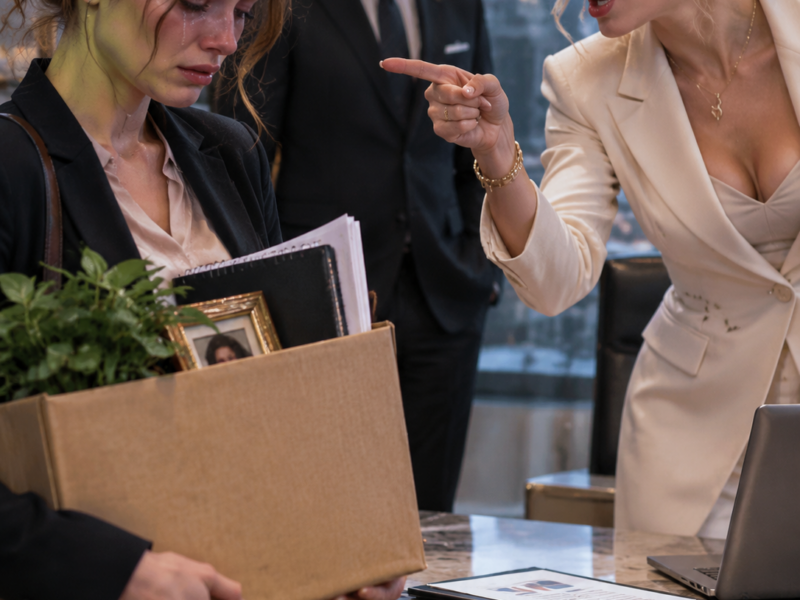
Security escorted me upstairs to collect my belongings. My computer was already gone, and my filing cabinets had been emptied. Someone had cleared my office before Preston even entered the lobby.
The only personal items left in a cardboard box were a photograph of my father, a coffee mug, a small plant, and my leather notebook.
I took the box and walked toward the exit.
Luis Ortega, our longtime bell captain, stepped forward and carried it for me.
When Preston told him to stop behaving like a bellboy, Luis calmly replied, “With respect, sir, she hired me for this building. I’ll carry her box to the door. You can fire me too, if you want.”
Then the revolving doors opened.
A silver-haired woman entered, carrying a black cane with a silver handle. Behind her walked two men in suits and an assistant holding an iPad.
It was Margaret Halloran, one of the most powerful investors in the hotel industry, with a fortune exceeding $6 billion.
For fourteen months, I had been negotiating with her to purchase 49% of Vance Hospitality for $1.2 billion. The agreement was supposed to be signed that afternoon.
Margaret walked straight past Preston and took both my hands.
“Nora, my dear. You look exhausted. Good. That means you’ve been working. Shall we go upstairs and sign?”
I looked at Preston.
“I’m afraid there’s nothing left to sign. He just fired me.”
Margaret slowly turned toward him.
“You fired her?”
Preston tried to explain that there were financial irregularities and that Tessa would now oversee the partnership.
Margaret asked Tessa a simple technical question about the post-tension slab thickness on floors 12 through 30.
Tessa couldn’t answer.
Margaret calmly supplied the answer herself and then announced that Halloran Trust was withdrawing from the entire transaction.
“You had fourteen months of work on this deal,” Preston protested.
“No,” Margaret replied. “She had fourteen months of work. You had fifteen minutes, and you used them to fire her.”
She escorted me outside.
Before we reached the car, Luis quietly told me he had seen Derek and Tessa entering the building together late at night, carrying boxes into my office.
Then Margaret showed me an old fountain pen.
“This is the pen I used to sign the original partnership agreement for the first Vance Hotel in 1984,” she said. “Before it was called Vance.”
I stared at her.
“What do you mean, before it was called Vance?”
She put the pen away.
“Not today, Nora. First, you need to understand what is happening to your own life.”
When we arrived at my house, I discovered Derek’s car, his mother’s SUV, and Tessa’s Volkswagen parked outside.
I tried my key.
It wouldn’t turn.
My husband had changed the locks.
Through the doorbell camera, Derek accused me of stealing nearly $2 million from the company. He claimed there were fraudulent change orders carrying my signature.
When I demanded my 23 leather notebooks from my home office, he refused.
Then he warned me that the company might contact the police.
I understood immediately that this was not simply about my shoes or Preston’s arrogance.
Someone had prepared a story to destroy me.
I returned to Margaret’s car and told her I had never taken a dollar from the company. The only evidence I still possessed was the notebook they had left behind.
And I knew exactly why the signatures in the accusations were fake.
I had never signed anything in black ink.
For the first time, Margaret smiled.
“Marcus,” she said to her attorney, “did you hear that?”
“Every word.”
And as the car pulled away, I noticed Tessa standing behind the curtains of my house, holding one of my missing leather notebooks.
THE END








