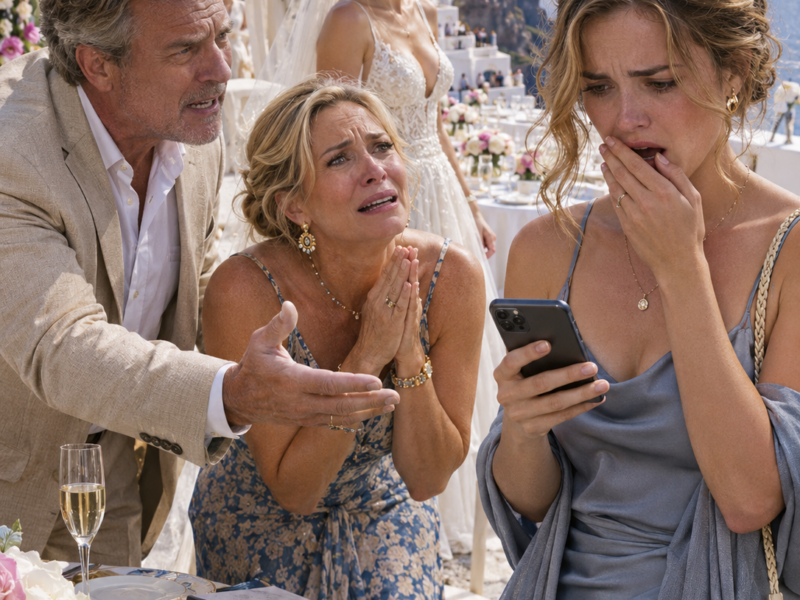
My Father Was Arrested in Greece on My Sister’s Wedding Night After I Refused to Wire €61,400 for a Wedding I Hadn’t Even Been Properly Invited To. My Family Called Me Heartless, My Sister Publicly Shamed Me, and My Mother Told Everyone I Was Mentally Unstable. But When My Brother-in-Law Took the Microphone at Her Wedding Celebration and Projected a Single Credit Card Application Onto the Screen, My Mother’s Face Suddenly Changed…
My Father Was Arrested in Greece on My Sister’s Wedding Night After I Refused to Wire €61,400 for a Wedding I Hadn’t Even Been Properly Invited To. My Family Called Me Heartless, My Sister Publicly Shamed Me, and My Mother Told Everyone I Was Mentally Unstable. But When My Brother-in-Law Took the Microphone at Her Wedding Celebration and Projected a Single Credit Card Application Onto the Screen, My Mother’s Face Suddenly Changed…
Part 1
“Wire €61,400 to the villa account. Right now. Don’t ask questions.”
That was my father’s message at 8:14 on a Saturday night in September. I was in my Somerville apartment while my family celebrated my younger sister Juliet’s wedding in Santorini. I hadn’t truly been invited. The invitation said I would have to pay for my own flight and hotel, and there wasn’t enough room to seat me with the immediate family.
For fifteen years, I had been the person they called whenever something went wrong. I paid my parents’ property taxes, covered Juliet’s credit cards, and rescued my father from financial trouble. I was thirty-four, a clinical embryologist and laboratory director, but to my family I was simply the daughter who always picked up.
When I finally answered, my father was frantic. The villa’s cards had been declined, the owner had called the police, and officers were threatening to take him to the station. He needed me to wire the money immediately.
I asked which cards had failed. Then I named them: three cards opened in my name without permission, carrying nearly $95,000 in wedding expenses.
Two weeks earlier, a credit alert had revealed the accounts. The charges included a villa deposit, flowers, first-class flights, and designer purchases. Every statement went to a private mailbox near my parents’ house. I had never seen the cards or authorized a single charge. I reported identity theft, filed a police report, and froze my credit. When I gave my father a chance to explain, he called me crazy and swore he had never touched my credit.
Now a Greek police sergeant was asking whether I had authorized the cards. I closed my eyes and said no. My father was taken in for questioning. My mother accused me of letting them arrest him on Juliet’s wedding night.
I didn’t send a cent.
My friend Despina arrived the next morning with coffee. She explained that my father might face charges unless the villa owner was repaid. My mother called and demanded that I reverse the fraud reports, insisting it was a family arrangement. “You’ve always been the one who fixes things,” she said.
For the first time, I told her no.
Juliet retaliated with a tearful video implying I had abandoned our father over money. Millions watched. Strangers found my workplace and flooded the fertility clinic with abuse. Then an anonymous complaint accused me of being unstable and unsafe in the lab. I was placed on administrative leave.
The complaint described a panic attack I’d suffered in the locker room six years earlier. I thought only Despina knew, until my lawyer reminded me that I had once written my mother a letter about that night. My mother had kept it.
As my lawyer investigated, the truth grew darker. There were nine fraudulent accounts in my name, opened over eleven years and totaling $143,000. My grandmother’s retired lawyer then contacted me. Before she died, Gran had placed $68,000 in a trust for my education, naming my father as custodian. The money had disappeared before I turned twenty-one, spent on Juliet’s pageants, braces, dance lessons, and first car.
Every check carried my father’s name, but the signature looked wrong. My grandmother’s letter warned me that my father had a soft heart and a terrible temper—and that I should be careful about whom he was protecting.
My younger brother Dermit revealed that he had seen our mother collecting mail from the private mailbox. He had found a brass key marked 214 hidden in her sewing room. The mailbox was registered under my father’s name, but our mother had been renewing it in person.
A few days later, my brother-in-law Kobby asked to meet me privately. He had discovered a credit card opened in his name, too, using documents my mother had collected for the Greek marriage paperwork. He had quietly contacted the postal inspector and was helping build the case.
He asked me to attend Juliet’s second wedding celebration—and to stay silent until the truth was ready.
I agreed.
Part 2
At the celebration, 212 guests watched my mother take the microphone and read aloud the private letter I had written about my panic attack. She called me sick, portrayed me as unstable, and toasted Kobby for saving our family by paying the villa debt. I sat frozen, remembering the inspector’s instruction to let them reveal themselves.
Then Kobby stepped forward.
He projected my nine fraudulent accounts—and the card opened in his own name—onto the ballroom screen. The applications carried a round, looping capital G: my mother’s unmistakable handwriting. My father stared at it and realized he had taken the blame in Greece.
A postal inspector joined him onstage and laid out the evidence: the mailbox, the forged signatures, and the anonymous complaints sent to my workplace. She revealed that my mother had used my identity for eleven years, stolen my grandmother’s trust, and secretly funded Juliet’s influencer career.
My mother removed my grandmother’s ring, set it beside my letter, and walked out with the inspector. Juliet finally understood that the success she thought she had earned had been built on stolen money.
Then the inspector announced the federal warrant for my mother’s arrest.
Part 3
My mother was sentenced to forty-six months in federal prison. The fraudulent debts were erased, my credit was restored, and the state withdrew the complaints against me. I returned to the laboratory, where my colleagues welcomed me back with a banner and homemade spinach pie.
My father admitted he had ignored the warning signs because believing my mother was easier than facing the truth. He apologized, and though forgiveness took time, we began speaking again. Juliet eventually confessed that she had known nothing about the stolen money. She came to my apartment with the cash from the seven car payments I had once made for her, saying she was sorry she had spent a lifetime leaving me out of the picture.
Months later, she invited me to Santorini. On the terrace where everything had fallen apart, she leaned her head against my shoulder and whispered that she wished she had invited me the first time.
Kobby raised a glass. “To the one who picks up the phone,” he said.
Juliet shook her head. “No,” she replied. “To the one who finally didn’t.”
For the first time, I understood that saying no hadn’t destroyed my family. It had exposed what had been destroying us all along.








